 | Acta Crystallographica Section B Acta Crystallographica Section B STRUCTURAL SCIENCE, CRYSTAL ENGINEERING AND MATERIALS |


 journal menu


research papers
| STRUCTURAL SCIENCE CRYSTAL ENGINEERING MATERIALS |
 access
OD (order–disorder) interpretation and diffuse scattering analysis of an organic polytype with character: a detailed how-to

aInstitute of Applied Synthetic Chemistry, TU Wien, Getreidemarkt 9, 1060 Vienna, Austria, bX-Ray Centre, TU Wien, Getreidemarkt 9, 1060 Vienna, Austria, cInstitute of Inorganic and Analytical Chemistry, Goethe Universitaet Frankfurt, Max-von-Laue-Str. 7, 60438 Frankfurt, Germany, and dInstitute of Chemical Technologies and Analytics, TU Wien, Getreidemarkt 9, 1060 Vienna, Austria
*Correspondence e-mail: [email protected]
2,3-Dihydroxy-1,3,4-trimethyl-6-oxo-1,4-cyclohexadiene-1-carboxylic acid crystallizes in an order–disorder (OD) structure with a high probability. The diffraction pattern features diffuse scattering and broad peaks, which can be attributed to fragments of two of a maximum degree of order (MDO). Additional weak peaks indicate existence of a non-MDO polytype. A detailed step-by-step instruction is given on how to develop an OD description and interpret the diffuse scattering using a stochastic growth model.
Keywords: order–disorder theory; diffuse scattering; polytypes; twinning; allotwinning.
CCDC reference: 2496234
1. Introduction
are structures that crystallize with identical (up to minor desymmetrization) layers arranged in different ways (Aksenov et al., 2023 ). Polytypism is a multifarious phenomenon leading to interesting crystallographic challenges such as twinning (Nespolo & Ferraris, 2004), antiphase domains (Wondratschek & Jeitschko, 1976), allotwins (Nespolo et al., 1999) and diffuse scattering (Welberry, 2010). Often, these appear in the same crystal and may not be separable.
We encountered an example of a such a complex crystallization behavior during a synthetic campaign towards 3,5-dimethylorselinic acid (DMOA)-derived meroterpenoid natural products. During the attempted alkaline hydrolysis of DMOA methyl ester (Powers et al., 2019), a concomitant spontaneous oxidation towards the dearomatized dienone 2,3-dihydroxy-1,3,4-trimethyl-6-oxo-1,4-cyclohexadiene-1-carboxylic acid 1 was observed (Scheme 1).
![[Scheme 1]](dk5140scheme1.gif)
Presumably, the oxidative event takes place by nucleophilic attack of a phenolate with molecular oxygen. On routine structural characterization of 1 by single-crystal diffraction, we observed distinct diffuse scattering and broad peaks at positions that indicated fragments of distinct i.e. an intermediate between a disordered structure and an The phenomenon was systematic and observed for different crystals isolated from the same crystallization experiment.
The order–disorder (OD) theory (Dornberger-Schiff & Grell-Niemann, 1961) was created in the 1950s and further developed in the second half of the 20th century to explain the common occurrence of polytypism in all known classes of crystalline matter. It is based on the limited range of interatomic interactions. OD polytypes are an often observed class of polytypes, where layers can connect in different ways, nevertheless forming geometrically equivalent layer pairs. This means that, in theory, an infinite number of ordered polytypes or disordered stacking arrangements may form, which are all locally equivalent and form an OD family.
Herein, we will give a step-by-step introduction on how to develop an OD model based on the structure of 1. For high-quality diffuse scattering reconstructions, we collected data of a selected crystal at the P24 beamline of the PETRA III synchrotron at DESY. A semi-quantitative interpretation of the diffraction pattern is given using growth models (Welberry, 2010). §3.6 and §3.11 contain detailed derivations, which may be skipped by the reader interested mainly in practical application of OD theory and growth models.
2. Experimental
2.1. Synthesis
The precursor DMOA methyl ester was obtained as per the published procedure by Porco et al. (2019).
Procedure: 50 mg of DMOA methyl ester (0.237 mmol, 1 equivalent) were dissolved in ethanol (1 ml) and stirred at room temperature. At the same time, 134 mg of KOH (2.38 mmol, 10 equivalents) were dissolved in deionized water (0.2 ml) and then added to the solution of the starting material. As soon as the base was added, the color of the solution changed from yellow to light red, during the next hour of stirring the solution turned dark red. The solution was stirred at room temperature for 20 h. Work up: the reddish-black solution was made acidic through addition of 3 M HCl (2 ml). The reaction mixture was extracted with ethyl acetate (4×), dried over magnesium sulfate and concentrated in vacuo. Purification: the product was purified through column chromatography (DCM/MeOH = 20/1 and 0.5% acetic acid). Yield: 33 mg (0.155 mmol, 65% of theory).
Single crystals were grown by dissolving 10 mg in a 1:1:1 mixture of acetone, ethanol and water and evaporating slowly through a septum with needle over 14 days.
2.2. Single-crystal diffraction
Intensity data of a single crystal of 1 was collected at the high-flux P24 beamline of the PETRA III synchrotron using λ = 0.56 Å (E = 22.14 keV) radiation. Two 360° φ-scans with 0.2° frame width were collected. Data were converted into ESPERANTO format and processed with the CrysAlis software (Rigaku Oxford Diffraction, 2022). As discussed below, diffraction data consisted of reflections that could be attributed to multiple polytypes. The major polytype was orthorhombic and reflection intensities of other domains were omitted during structure refinement. The structure was solved with the dual-space approach implemented in SHELXT (Sheldrick, 2015b) and refined against |F|2 using SHELXL (Sheldrick, 2015a). The errors owing to ignoring reflections of alternative polytypes produce alternative orientations of the molecules in the difference Fourier maps, sometimes designated as `phantom molecules'. For each atom one major alternative position could be located in the difference Fourier map and the structure was refined as an overlay of two orientations of each molecule (Fig. 1). The displacement parameters of both orientations were constrained to be equal. Additional electron density peaks are attributed to even more alternative orientations, which were however too weak for inclusion in the refinements. Since the occupancy of the second orientation was only ca 11%, some atomic positions were ill-determined and distance restraints were implemented to achieve a reasonable geometry. The hydroxyl and carboxyl H atoms of the major orientation were refined with distance restraints, those of the minor orientation were omitted. More details on data collection and structure are compiled in Table 1. Molecular graphics were prepared using the Mercury (Macrae et al., 2020) software.
| ||||||||||||||||||||||||||||||||||||||||||||||||||||||||||||||||||
![[Figure 1]](dk5140fig1thm.gif) | Figure 1 Asymmetric unit of the refined orthorhombic polytype viewed along [100]. Atoms are represented by red (O) and gray (C) ellipsoids drawn at the 50% probability levels; H atoms by white spheres of arbitrary radius. The phantom molecules are shown as wireframe. |
3. Results and discussion
3.1. Crystal chemistry
The crystal chemistry of 1 will only be sketched briefly based on the major Pna21 polytype. Molecule 1 [Fig. 2(a)] possesses three hydrogen bond donors. The carboxylic acid group forms an intramolecular hydrogen bond to the oxo group. Pairs of molecules related by pseudo-inversion symmetry are connected by intermolecular hydroxyl-to-hydroxyl bonds [see Fig. 2(a)]. Note that the two molecules are not equivalent according to the Pna21 symmetry (hence Z′ = 2), which will play a crucial role in the description of the disorder. The remaining hydroxyl group forms an intermolecular bond to a carboxyl group, resulting in infinite sheets extending parallel to the (001) plane [Fig. 2(b)].
![[Figure 2]](dk5140fig2thm.gif) | Figure 2 (a) Pair of 1 molecules connected by hydrogen bonds and (b) diperiodic hydrogen-bonding network extending parallel to the (001) plane. Atoms as in Fig. 1 . Inter- and intramolecular hydrogen bonds are represented by red and black dashed lines, respectively. |
3.2. Deriving the OD layers
Even though application of OD theory is extremely useful from a descriptive but also a predictive point of view, its is not widely used. We attribute this to a lack of awareness and a perceived impenetrability. Therefore, here we give step-by-step instructions of how to derive the OD model of 1.
An OD model should always be based on experimental evidence (for example twinning or diffuse scattering). For 1 there were four characteristic signs of stacking disorder.
(i) Pronounced one-dimensional diffuse scattering in c* direction.
(ii) `Phantom molecules' of alternative stacking arrangements.
(iii) Crystallographically independent molecules (Z′ = 2) with systematic orientation relations.
(iv) Additional diffraction peaks of alternative polytypes.
None of these prove the OD character of the structure [see Schöbinger & Stöger (2024) for a counter-example], but they are a good indication.
The first step in an OD interpretation is identification of the OD layers, their (idealized) symmetry, and the operations relating layers. These operations need not be symmetry operations of the space group. They are partial (symmetry) operations (POs), because they apply only to distinct layers. The layers in 1 should be parallel to (001) in accordance with the observed diffuse scattering. Apart from the translations in the (001) plane, only the a[010] glide reflection of the Pna21 (and the compositions with the translations) maps potential layers parallel to (001) onto themselves. This however means that the symmetry groups of the OD layers must be supergroups of p1a1, where we use the notation of the International Tables for Crystallography, Vol. E (Kopsky & Litvin, 2006), which assumes layers extending parallel to the (001) plane.
In the refined Pna21 polytype, there are two non-equivalent molecules [marked by distinct colors in Fig. 3(a)]. Note that the stacking direction [001] in Fig. 3 and in the two-dimensional reconstructions below is pointing up, as is common in the OD literature and which is implied by the expression `layer stacking'. Since the molecules are `asymmetric', or more precisely only symmetric by the trivial 1 (C1 after Schönfließ), any additional layer must be located between molecules. In Fig. 3(b) a simplified view is given by replacing the molecules with arrows pointing from the 6-oxy group to the opposite 3-hydroxy group, whereby red and yellow colors give the orientation with respect to the viewing direction [010]. The symmetry elements of the Pna21 are indicated by black symbols.
![[Figure 3]](dk5140fig3thm.gif) | Figure 3 The Pna21 polytype of 1 viewed down [010] with (a) molecules colored according to symmetry equivalence, (b) molecules represented by red (pointing toward the reader) and yellow (pointing away) arrows and (c) layer interfaces indicated by a black polygonal chain. In (b) symmetry elements of the space group (black) and non-space group symmetry elements (blue) are given by the common symbols. Additional translation along [010] is given to the right. Inter- and intramolecular hydrogen bonds are represented in (a) by black and red dashed lines, respectively. The geometric elements discussed in the text are marked by their printed symbol in (b). Atom colors and ellipsoids in (c) as in Fig. 2 . |
The two molecules at the bottom left of Fig. 3(b) feature opposite orientation in [100] and [001] and the same orientation in [010] direction. Their orientations are therefore related by a 2[010] rotation. Observe that when discussing orientation relations of molecules, we only consider the linear part of the operations relating the molecules (the `point operation'). An additional translational component of ½b means that the molecules are related by a 21 screw rotation as indicated by the blue symbol in Fig. 3(b), whereby the blue color indicates that the operation is not a space group operation of the Pna21 polytype.
Double application of this screw rotation gives a b translation, which means that the 21 screw rotation is a of a layer formed by two half-layers. Combination of the 21 screw rotation and the a[010] glide reflection results in inversions, as indicated by blue circles in Fig. 3(b). Pairs of molecules related by inversion correspond to the hydrogen-bond connected pair in Fig. 2. Combining these symmetries, the overall layer group symmetry is p121/a1.
Additional POs are identified by considering pairs of red (or yellow) arrows at the center of Fig. 3(b). Here, the orientations are related by an m[001] reflection. The intrinsic translational component of the operation relating the molecules is ca ¼a, resulting in a glide reflection. In the OD literature, a generalization of Hermann Mauguin symbols is used and if the translational component were precisely ¼a, the glide reflection would be written as a½. Owing to a small deviation, it is instead written as ar, indicating an intrinsic translation of  . Observe that reflections are the composition of a twofold rotation and an inversion and therefore the subscript r is interpreted as in the case of a twofold screw rotation. r is a metric parameter of the structure (see below). Double application of the ar operation results in a translation by ra ≈ ½a, which is not a (pseudo) translation of the (the lattice formed by all translations of the crystal). Thus, this glide reflection is not a of a layer, since it does not map a potential layer onto itself. However it plays a crucial role in the OD description, as it relates two distinct layers. By composition with the a[010] operation of the Pna21 one obtains a screw rotation with intrinsic translation ca
  in the [100] direction, with the symbol 2r+1. Both operations are indicated in Fig. 3(b) by the graphical symbols for regular a and 21 operations.
In summary, the structure of 1 can be considered as a structure of layers parallel to (001) with p121/a1 symmetry. The layer boundaries are indicated in Fig. 3(c). These layers corresponds to hydrogen bonded sheets described in the previous section, though this is purely coincidental. OD layer boundaries may even `slice' through molecules as for example described by Stöger et al. (2013).
Note that the layer boundary is not a plane. The crucial point from an OD perspective is that the layers possess a substantial thickness at every point so that there are only weak interactions across a full layer width. The layers will be designated as Aj, j being a sequential integer.
3.3. OD groupoid family
In a proper the layers may contact in different, yet geometrical equivalent ways, resulting in an infinity of stacking possibilities built according to the same symmetry principle. The set of these stacking arrangements form an OD family. The full symmetry of each family member is given by the POs mapping individual layers. These do not form a group, but a because an operation that maps layer Aj onto layer Ak can only be composed with an operation that maps layer Ak onto a layer Al (Ito & Sadanaga, 1976).
To classify the symmetry of OD families, the groupoids are grouped into OD groupoid families which, in analogy to space group types, abstract from metric parameters (Fichtner, 1977b). For the special case of OD structures of one kind of layer with all the same translation lattice there are 400 kinds of OD groupoid families (Fichtner, 1977a). The OD groupoid family is derived from the layer symmetry, called λ-POs in the OD literature (λ for layer), and one operation that relates two adjacent layers, called σ-PO (σ for space). The full set of σ-POs is generated by composing the λ-POs with the σ-PO (in mathematical terms, this can be regarded as forming a coset of the layer group). To do so, we use a computer program that we plan to publish in the foreseeable future.
The layer symmetry and a σ-PO were derived in the prior section, leading to the OD groupoid family

according to a notation inspired by Dornberger-Schiff & Grell-Niemann (1961). The first line indicates the layer symmetry, the second line the σ-POs using the usual positional Hermann–Mauguin symbols. The meaning of the individual symbols is given in Table 2, where c0 is the vector perpendicular to the layer planes with the length of one layer width. r and s are metric parameters. As noted above, the subscripts of the glide reflections symbols are based on those of twofold rotations. In particular, nr,s in [001] direction standing for a glide with intrinsic translation +  is an unfortunate quirk of the notation, because n is defined as a glide reflection with intrinsic translation half the diagonal of a base of the The intrinsic translations of symmetry group operations are restricted because n-fold application of an operation with linear part of order n must result in a lattice translation. In particular, the intrinsic translations of glide reflections and twofold screw rotations (higher order screw rotations cannot exist in layers) must be a full or half of a lattice vector. In contrast, the intrinsic translation of σ-POs is not restricted and, therefore, r and s may adopt any value, integral, rational or irrational. As will be shown below, these parameters and their deviations from rational values with low denominators have profound implications on the observed diffraction patterns.
| ||||||||||||||||||||||||||


3.4. Possible layer arrangements and metric parameters
As noted before, the OD family abstracts from the metric parameters, namely the layer's cell parameters (a = |a|, b = |b|), the layer spacing (c0 = |c0|) and the relative positions of adjacent layers with respect to a and b (r, s). The latter determine the number of distinct ways in which adjacent layers can be placed and they therefore need to be determined.
There are two ways of generating an ambiguity in the stacking arrangement. Firstly, application of a symmetry operation of layer Aj that does not invert the orientation of c0 and is not a of Aj+1 to the layer pair (Aj, Aj+1) generates a a new pair (Aj, A′j+1), which has the same interatomic distances as the original pair. In 1, p1a1 is the subgroup of operations of Aj that does not invert c0 (called λ-τ-POs in the OD literature). The 21 operation is ignored, as it inverts the orientation of c0 and therefore maps Aj+1 onto the space occupied by Aj−1. It consequently does not generate a new (Aj, A′j+1) pair. For general s, the a-glide planes of Aj and Aj+1 do not overlap and only the operations of the p1 < p1a1 also apply to Aj+1. Given Aj, there are thus [p1a1:p1] = 2 possible ways of placing Aj+1 ( is the index of the
  in
in  ).
).
Secondly, if there is a σ-PO that inverts c0 (called σ-ρ-PO in the OD literature) and the pair (Aj, Aj+1) is polar, i.e. none of the σ-ρ-POs map Aj onto Aj+1 and Aj+1 onto Aj, then application of the inverse of a σ-ρ-PO creates a new pair (Aj, A′j+1): Aj+1 is mapped onto Aj, but Aj is not mapped onto any Aj+1 derived by decomposition above. Thus the number of stacking possibilities is doubled. In 1, for general r, the 2r+1 and nr,s operations are of this kind and therefore given Aj, there are Z = 2[p1a1:p1] = 4 ways of placing the adjacent layers. This is known as the NFZ relationship in the OD literature (Ďurovič, 1997).
For special values of r and s, the number of stacking possibilities decreases. Again, we use custom software routines, which we plan to publish in due course, to enumerate these special cases. For the OD groupoid family of 1, there are the following sets of special parameters:
(i) s = n,  : Z = 2[p1a1:p1a1] = 2
(ii) r = n, : Z = [p1a1:p1] = 2
(iii) r = n, s = m,  : Z = [p1a1:p1a1] = 1
In the first case, the a glide planes of adjacent layers overlap. In the second case, the 2r+1 operation becomes a of the (Aj, Aj+1) layer pair, which therefore ceases being polar. In the third case, both conditions are true and the structure is fully ordered, i.e. there is no stacking ambiguity. Its depends on the parity of r and s.
Since the major polytype of 1 possesses Pna21 symmetry, the a glide planes of adjacent layers overlap and we can conclude that s is an integer. For even s, adjacent A layers are related by an a[001], for odd s, by a n[001] glide reflection. In 1, the former is the case and we conclude that s = 0. This can be expressed by the (nonstandard) symbol

The remaining metric parameter r can be derived from the refined coordinates of the 1 molecules. Averaging the atomic coordinates (excluding H atoms) of two independent molecules gives the inversion center of an Aj layer, from which r can be inferred. We obtain a clearly non-integral value of r = 0.510 which means that the intrinsic translational component of the ar glide is = 0.255a.
Thus, given a layer Aj, the adjacent layer Aj+1 can be placed in two ways, namely application of an ar or an a−r operation.
3.5. Maximum degree of order (MDO) polytypes
The stacking ambiguity leads to an infinite number of potential which are all locally equivalent. Pairs of adjacent layers are always equivalent. However, there are two kinds of triples (Aj, Aj+1, Aj+2): application of twice ar (or a−r) and application of ar followed by a−r (or vice versa).
The two polytypes consisting of only either of the triples are said to be of an MDO (Dornberger-Schiff, 1982). They are particularly simple in the sense that all other polytypes can be decomposed into fragments of MDO polytypes. Moreover, ordered MDO polytypes need the least amount of contextual information during growth. The two MDO polytypes are:
(i) MDO1: P21/a, c = 2c0 + ra, generated by repeated application of ar (or a−r for different orientation).
(ii) MDO2: Pna21, c = 2c0, generated by alternating application of ar and a−r.
The MDO2 polytype corresponds to the refined Pna21 structure, fragments of MDO1 were observed by `phantom' molecules and additional diffraction peaks.
The of the OD family (the group generated by the linear part of all POs) is mmm. The point groups of the MDO polytypes are proper subgroups of mmm and they may therefore crystallize as twins if a (a fragment of the other MDO polytype) appears.
The expected twin operations are the operations of the mmm of the OD family that do not appear in the of the polytype. The orientation states are determined formally by a decomposition: for the MDO1 (P21/a) polytype there are [mmm:2] = 2 orientation states, related by 2[100], m[100], 2[001] or m[001]. If r is idealized to ½, the translation lattice of MDO1 would be orthorhombic B-centered (oB). Since the twin operations are point operations of this lattice (the point group of an oB lattice is mmm), the twinning would be by metric merohedry, which means that the direct and reciprocal lattices of both twin domains coincide perfectly (Grimmer & Nespolo, 2006). Since r deviates from the ideal value, the can be considered as being by pseudo-merohedry, with the twin obliquity depending on the deviation from r = ½.
For MDO2 (Pna21), there are [mmm:mm2] = 2 expected twin domains. This is a twin by inversion and, since the inversion is always a symmetry operation of any lattice, a twin by merohedry. It can't be directly showed in our experiment, since the short wavelength of 0.56 Å was far from the absorption edges of the C and O elements, which means that the deviation from Friedel's `law' (stating that diffraction patterns are centrosymmetric) is too small to determine the volume fraction of the two twin domains (the Flack parameter). In fact, the estimated standard uncertainty of the Flack parameter was higher than 0.5, if refined.
Given the observed diffuse scattering, which implies an intimate stochastic mix of MDO1 and MDO2 fragments, one can assume that the MDO2 fragments appear in both orientations to equal fractions, as per the law of big numbers. The structure was therefore performed with a fixed 1:1 volume ratio.
3.6. Other polytypes
Potentially, there are an infinity of which can be built of fragments of MDO1 and MDO2. In this section an in-depth discussion of these polytypes and their symmetries is given. Readers not interested in these details may proceed to §3.7.
We will designate as a translational period of a polytype the smallest n-tuple of adjacent layers from which the polytype can be constructed by translation. It must contain an even number of layers because Aj with even and odd j possess different orientations with respect to [100].
Since two adjacent layers are related either by a+r or a−r σ-POs, a classical approach of enumerating polytypes would be generating bi-infinite periodic strings over the binary alphabet {+, −}. Symmetry equivalents (e.g. those obtained by switching + and −) are then removed. We will call these strings σ-sequences, as they list the σ-POs. The primitive period of a periodic bi-infinite word is the smallest fragment from which the word can be generated by repeated juxtaposition. Even- length primitive periods correspond to a translation period. For odd lengths, the primitive period must be doubled to obtain a translation period.
Here we propose a different approach, which respects the OD description: consider (periodic) polytypes as a periodic sequence of MDO1 and MDO2 triples (sharing a layer), represented by a periodic bi-infinite string over the alphabet {1, 2} (the number stands for the kind of MDO triple). These strings will be called stacking sequences. The primitive period of these strings correspond to an of the polytype and better represents the complexity of a polytype than the σ-sequence. Moreover, weeding out symmetry equivalents is simpler, as only reverse strings have to be removed.
Periodic strings can be enumerated very efficiently according to Duval (1983), however, for primitive periods of lengths n ≥ 6, pairs of non-palindromic reflected strings appear (e.g. strings with the primitive period 112122 and 221211), where one instance has to be removed. An efficient algorithm to directly avoid these pairs was described by Sawada (2001).
The polytypes with stacking sequences up to a primitive period length n = 6 are compiled in Table 3. For odd n, the translation period is doubled, owing to the different orientations of the Aj and Aj+n layers. For even n with an odd number of MDO2 triples in the primitive period, the translation period is likewise doubled. The σ-sequence (third column) and c vector (fourth column) are trivially derived by observing that every MDO2 triple changes direction (a+r ↔ a−r).
| ||||||||||||||||||||||||||||||||||||||||||||||||||||||||||||||||||||||||||||||||||||||||||||||||||||||||||||||||||||||||||
Since the a[010] glide reflection applies to all layers, it is a total operation of every polytype, i.e it is element of the symmetry group of the polytype. Periodic possess symmetry and their symmetry must therefore be a of a of type Pa. Other total symmetry operations can either derive from layer operations (λ-POs) or operations relating layers (σ-POs). A polytype is P21/a symmetric, if the 21 operation of a layer is a global operation. This is only possible inside MDO1 fragments and the remaining part of the primitive period must be palindromic. Thus, to check for P21/a symmetry, locate all odd-length 1…1 subsequences in the primitive period of the stacking sequence and check if the rest is palindromic. An example is the primitive period 111121112, where 111 is a block of an odd number of MDO1 fragments and the remainder 211112 is palindromic.1
A polytype is Pna21 symmetric, if all layers Aj, Aj+k, where k is half the translation period, are related by an n[100] glide reflection. This is only possible if k is odd (because only then Aj and Aj+k have opposite orientation with respect to [100]), which means that the stacking sequence has an odd primitive period. In this case it is sufficient that there is an odd number of MDO2 triples in the stacking sequence, because then the second half of the primitive period of the σ-sequence is precisely the reflected version of the first half. Consider for example the stacking sequence with the primitive period 12122 resulting in the σ-sequence with primitive period + + − − + − − + + −. Note that this condition precludes the conditions for P21/a symmetry, because for odd n the latter requires and even number of MDO2 triples in the palindromic part of even length.
All other possess only Pa symmetry. It is interesting to investigate the asymptotic behavior for stacking sequences with large periods. The number of whose stacking sequence has a primitive period of length n corresponds to the integer sequence A001371 of the On-line Encyclopedia of Integer Sequences (OEIS Foundation Inc., 2025). Those with P21/a symmetry are given by the sequence A056513. In the n → ∞ limit, the density of P21/a sequences approaches zero. In contrast, Pna21 appear for precisely half of the stacking sequences with odd periods. Thus, in the limit, 25% of stacking sequences are Pna21 and the remaining 75% are Pa, whereas for small n, P21/a dominates. Table 4 lists the numbers for n ≤ 30.
| ||||||||||||||||||||||||||||||||||||||||||||||||||||||||||||||||||||||||||||||||||||||||||||||||||||||||||||||||||||||||||||||||||||||||||||||||||||||||||||||||||||||||||||||||||||||||||||||||||||||||||||||||||||||||||||||||||||||||||||||||||||||||||||||||||||||||||
3.7. Diffraction pattern
The diffraction pattern of 1 is complex, featuring more or less diffuse peaks that can be attributed to different domains on top of pronounced diffuse scattering (Fig. 4).
![[Figure 4]](dk5140fig4thm.gif) | Figure 4 Reconstruction of the k = 2 plane from diffraction data. k = 2 was chosen arbitrarily. Other k constant sections are qualitatively similar, except k = 0, which is affected by the of the a glide reflection common to all polytypes. |
Describing the diffraction pattern requires a reciprocal basis (a*, b*, c*)T (the superscript T stays for the transpose operation, as reciprocal bases are written by convention as columns). Since any periodic polytype must possess a multiple of two layers in the primitive translation period (see above), we will use the of (a, b, 2c0). Since a, b and c0 are mutually orthogonal, a* is the vector parallel to a with the length 1/a, etc.
The coordinate triples in reciprocal space will be designated as hkν (s = ha* + kb* + νc*) to highlight that diffraction can occur anywhere on rods parallel to c* with integral h and k.
A crucial point in understanding diffraction patterns of polytypes is identifying reflections that are common to all domains. Thereto, the family structure is determined, which is informally an equal overlay of all possible The symmetry group of the is generated by extending the POs to global operations. For the OD family of 1, let us first concentrate on the group of translations. Layers Aj and Aj+2n () are related by a translation. The vector connecting the origins of both layers can be written as 2mra + 2nc0, −n ≤ m ≤ n, whereby it is useful to reduce the a component to its fractional part frac(2mr). The metric parameter r is not close to a rational with small denominator and can be assumed as being irrational. This means that with growing n, frac(2mr) can be arbitrarily close to any number in the 0–1 range. Overall, the translation group of the family structure is dense in the a direction, and has periodicities b and 2c0 in the other directions. Accordingly, the symmetry of the is not a but the smallest of the space groups of all possible Owing to the dense translation vectors in the a direction, the a-component of glides and screw rotations can likewise be arbitrary small. In the context of Euclidean normalizers (Koch et al., 2016), similar groups exist, with a technical difference: for normalizers, the set of translations is uncountably infinite, so in a sense the set of translations is even `more dense'.2 If, nevertheless, the same notation is used, the symmetry group of the can be stated as being of type P1bmm with the `basis' (ɛa, b, 2c0).
While this discussion may appear academical, a crucial consequence is that diffraction intensities may appear anywhere on rods h and k integral (since any Aj layer can only produce intensities on such rods), except for h = 0 rods. There, sharp reflections are observed at positions k + l even owing to the b-glides in the P1bmm group. A statistical stacking without any correlation between layers would produce unstructured diffuse scattering along c* on all rods h ≠ 0.
These considerations are only perfectly true if there is no i.e. all layers and all layer contacts are perfectly equivalent. This assumption is confirmed by the diffraction pattern, as indeed for h = 0 it features sharp peaks and no diffuse scattering.
3.8. Qualitative interpretation of the diffraction pattern
For h ≠ 0, diffraction peaks are broader and placed on top of diffuse scattering (Fig. 4), which means that the crystal is not periodic (or quasi-periodic) and has to be described using disorder models. Nevertheless, it is useful to describe the peak positions qualitatively at first. Peaks corresponding to both MDO polytypes are observed. The reciprocal bases are:
(i) MDO1 (first orientation): (a* − rc*, b*, c*)T
(ii) MDO1 (second orientation): (a* + rc*, − b*, − c*)T
(iii) MDO2 (both orientations): (a*, b*, c*)T
The reflections of MDO2 are all located at integral ν. Since r ≈ ½, for small even |h| MDO1 reflection are likewise expected close to integral ν. With increasing |h|, their positions deviate, resulting in distinct `triplets' of MDO1 and MDO2 peaks [Fig. 5(a)]. For small odd |h|, MDO1 reflections are close to half-integer ν. Deviations for increasing |h| lead to a distinct splitting into `doublets' [Fig. 5(b)].
![[Figure 5]](dk5140fig5thm.gif) | Figure 5 Comparison of experimental reflection profiles on (a) even h and (b) odd h rods with low (2, 1) and high (12, 11) h values, showing splitting of the MDO1 `reflections' for high h values resulting in characteristic triple and double peaks, respectively. In all cases, k = 2. The high-h intensities were scaled by a factor of 3 to bring them to a similar scale as the low-h intensities. |
Close inspection of the rods with low odd h values reveal additional peaks at quarter points of ν, marked by black arrows in Fig. 6. These peaks are significantly weaker than the MDO1/MDO2 peaks. For |h| = 5 they are barely observed, for |h| = 7 they are practically absent. It is unknown whether they belong to distinct domains or are part of the disordered MDO1/MDO2 domains.
![[Figure 6]](dk5140fig6thm.gif) | Figure 6 Comparison of reflection profiles on (11ν)* (red) and (51ν)* (black) rods showing additional peaks at quarter points of ν. |
Since there is no broadening, splitting or deviation from  () observed up to |h| = 5, we assume a polytype with a c vector without ra component. The potential with c = 8c0 are (see §3.6 and Table 3):
1112, + + + + − − − −, P21/a
1222, + + − + − − + −, P21/a
11211222, + + + − − − + −, Pa
11212212, + + + − − + − −, Pa
12122222, + + − − + − + −, Pa
Applying Occam's razor principle we can suppose that the first two, the simplest, polytypes are the most probable. The absence of these peaks on h even rods is a case of systematic non-space group absences and is due to r ≈ ¼, which are characteristic of OD structures where layers are translationally equivalent. For derivation, see e.g., Ferraris et al. (2008).
If the diffraction peaks are interpreted as Bragg peaks (i.e. their shape is only determined by experimental artifacts), then the crystal would be considered as an composed mostly of MDO1 and MDO2 with minor domains of an unknown non-MDO polytype, showed by very minor peaks at quarter points of ν, see above. Yet, owing to broad peaks and diffuse scattering, we will categorize the crystal under investigation as an allotwin-like disordered OD polytype. The aforementioned contributions of the non-MDO polytype are so weak that we will ignore them in the upcoming modeling of the diffraction pattern.
3.9. Growth models
Here we assume that the crystal is one homogeneous disordered domain, in contrast to distinct independently scattering domains. There are different ways to model such domains. For layer-stacking disorder we find that the most intuitive approach is growth models, which means that the position/orientation of the layer Aj is given in a probabilistic way depending on the s prior layers Aj−s…Aj−1, where s is called the range of interaction or reichweite (Treacy et al., 1991). It should be stressed that such a description does not describe the actual physico-chemical process of crystal growth, i.e. it does not imply that the crystal is grown layer-by-layer. It is merely a mathematical model of expressing probabilities of finding specific layer n-tuples. Alternative equivalent descriptions are Ising models (Welberry, 2010), which have the advantage of being applicable to two-dimensional disorder (i.e. arrangements of rods).
The range of interaction s is a measure of complexity as is the number of parameters used to describe the model. We will require that the model follows the symmetry of the OD description, because we assume no external influences that could favor one orientation of a layer n-tuple over another.
The simplest model is described by a single parameter p, the probability of encountering an MDO1 fragment (the probability of an MDO2 fragment then is 1 − p). Expressed as a growth model, it is a range of interaction s = 1 model represented by the graph
since every step depends only on the prior step. The nodes in the graph represent the σ-PO relating adjacent layers and the edges are marked with the transition probabilities. Strictly speaking, p = ½ would represent an s = 0 model, as every step is independent. Such a model would result in unstructured diffuse scattering. For p > ½ broad peaks at the MDO1 positions appear, converging to the Bragg peaks of a 1:1 MDO1 twin for p → 1. The shape of the peaks is well understood and given for example in Hendricks & Teller (1942![[Scheme 2]](dk5140scheme2.gif) ). In return, for p → 0 the diffraction pattern converges to the 1:1 MDO2 However, there exists no probability p for which peaks at the MDO1 and MDO2 positions are observed, i.e. such a simple model cannot describe the observed diffraction pattern.
). In return, for p → 0 the diffraction pattern converges to the 1:1 MDO2 However, there exists no probability p for which peaks at the MDO1 and MDO2 positions are observed, i.e. such a simple model cannot describe the observed diffraction pattern.The simplest model able to describe an allotwin-like disordered structure possesses two parameters p1 and p2 giving the probability of MDO1 after MDO1 and MDO2 after MDO2, respectively. It corresponds to the range of interaction s = 2 model represented by the graph
where each node represents the two prior steps. For p = p1 = 1 − p2 the model degenerates to the simple model of equation (3![[Scheme 3]](dk5140scheme3.gif) ). The s = 2 model has two additional extreme cases:
). The s = 2 model has two additional extreme cases: p1, p2 → 0: the non-MDO polytype with stacking sequence of primitive period 12, respectively σ-sequence of primitive period + + − − + + − − (see §3.6)
p1, p2 → 1: an of MDO1 and MDO2
Thus, in a sense an allotwin and the simplest non-MDO polytype possess the same complexity: both require an s = 2 range of interaction, in contrast to MDO (s = 1).
Note that only probabilistic statements can be given on such random processes. In particular, in probability theory, statements with a probability 1 should be prefixed with the expression almost surely. Here, we will omit this expression for brevity. Solving the steady state of the random process in equation (4) shows that the fraction of MDO1 and MDO2 triples are

and

respectively. Another interesting property is the average length of MDO1 and MDO2 fragments. It is a standard result that these are

and

respectively.
3.10. Diffuse scattering
Even though modeling diffuse scattering is often considered as being tricky, from a mathematical point of view it is easier to handle than diffraction of periodic structures. The latter is plagued by the issue of sums of regular density functions converging to discrete distributions. The convergence behavior of diffuse scattering is distinctly `nicer' (uniform versus distributional convergence) and very reasonable approximations can be obtained with early series terminations. Though general software such as DIFFaX (Treacy et al., 1991) and its derivatives can simulate diffuse scattering of layer structures in the general case, it is instructive to analyze the concrete case of 1 in detail. Readers not interested in calculations may proceed to §3.11.
Let us assume that the diffraction intensity |F|2 of a polytype is the sum of the pair correlations between any two pairs of layers (Welberry, 2010):

where Fj is the Fourier transform of the layer Aj and an overline indicates the complex conjugate. The overall sum is real, because for every  term, it contains the complex conjugate
  . This can be made more explicit by summing over all unordered pairs of layers:
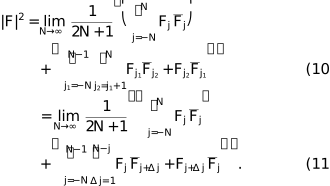
Here, all terms are real (though potentially negative). The second line conveniently groups pair-correlations of layers spaced by Δj.
Note that all even j and all odd j layers are translationally equivalent and call F+ and F− the Fourier transforms of the respective layers when placed at the origin [ ]. Then we have:

where oj is the origin of the layer Aj and the terms in equation (16) calculate as

and
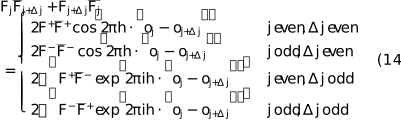
where  designates the real value.
It is easy to construct layer sequences where the limit of equation (9) does not converge. However stochastic processes such as the one given in equation (4) typically possess very `nice' (exponential) convergence behavior. The expected densities of oj − oj+Δj are well defined and easily calculated.
For a given Δj ≥ 1, oj − oj+Δj may adopt the form mra/2 + Δjc0 with m being of the same parity as Δj and in the range − Δj → Δj. In the model of equation (9), the expected density of oj − oj+Δj is independent of the parity of j and will be designated as PΔj(m), which accordingly must fulfill

To clarify, let us consider a few examples:
(i) In the MDO1 polytype (repeated application of ar), the origins of layers Lj and Lj+Δj are connected by Δjra/2 + Δjc0. Thus, PΔj(m) = 1 if m = Δj and 0 otherwise.
(ii) In the other orientation of the MDO1 polytype (repeated application of a−r), PΔj(m) = 1 if m = −Δj and 0 otherwise.
(iii) In a twin of both MDO1 orientations with twin  , P0(0) = 1 and for Δj ≠ 0:
  if |m| = |Δj| and 0 otherwise.
(iv) In the MDO2 polytype (alternating application of ar and a−r), PΔj(0) = 1 for even Δj and  for odd Δj. PΔj(m) = 0 for all other combinations. The same is true for twins of both MDO2 orientations, because, by definition, the twin interfaces are infinitely sparse compared to the bulk of the twin domains.
(v) In a purely random stacking, where ar and a−r are chosen for each layer independently with a probability of , for Δj and m of same parity,
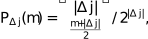
where  is the binomial coefficient, leading to a Pascal's triangle-like construction.
For a p1 ≠ 0, 1 and p2 ≠ 0, 1 model, the expected densities of the vectors connecting the origins of the layers Lj and Lj+Δj are independent of the parity of j. Thus, for a given mra/2 + Δjc0, the terms in the top two and bottom two cases of equation (14) possess the same expected density of PΔj(m)/2 and we can further simplify the Δj odd case to
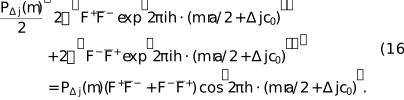
We can now resolve the limits of equation (11). The auto-correlation of layers is

and the cross-correlation of layers spaced by Δj:
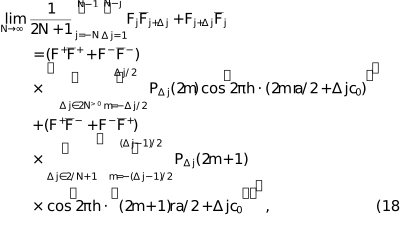
where  and
and  are the sets of positive even and odd numbers, respectively. The scalar product h · (mra/2 + Δjc0) can be written in hkν coordinates as (mrh + Δjν)/2 and thus the diffraction intensity at hkν is given as
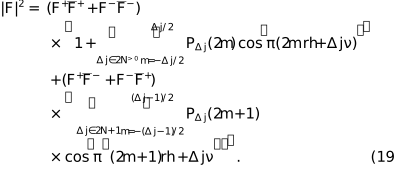
Note that the factors  and
and  are real and can be pre-calculated for every h, k rod with the experimental resolution of ν. The PΔj(m) are easily calculated by step-wise development of the stochastic process with the starting probabilities derived from equations (5, 6), For p1, p2 not close to 0 or 1, the PΔj converge quickly and the series in equation (19) can be truncated at low Δj values. In our simulations, we used Δjmax = 40 for adequate results with very short calculation times in the microsecond range.
3.11. Properties of the diffuse scattering
Before analyzing the actual diffraction pattern, let us examine a few of its properties. When analyzing diffuse scattering, homometry has to be taken into account (Welberry, 2010), that is distinct models resulting in the same diffraction pattern. As we will show in an upcoming publication, for r = ½, there are homometric pairs, in particular models with p1 = p2 = p and p1 = p2 = 1 − p describe distinct structures resulting in the same diffraction pattern. Here, this affects only rods with low |h| values, because the hr factors in equation (19) are close to ½. Consider for example the allotwin-like p1 = p2 = 0.9 and the non-MDO-like p1 = p2 = 0.1 structures. Both are composed of an equal amount of MDO1 and MDO2 triples. However in the former, the average length of MDO1 and MDO2 fragments is 10, in the latter 10/9 ≈ 1.11, i.e. the structures are fundamentally different. Yet, the h = 1 rods of both structures are practically indistinguishable [Fig. 7(a)]. There are only very subtle changes in the peak heights and positions. In contrast, the h = 11 rods differ substantially [Fig. 7(b)]. In particular, the peaks at half-integer ν are split in the allotwin-like phase, but remain unsplit in the non-MDO-like phase, as expected. Note that homometric mates also exist for pairs p1 ≠ p2 in the case of r = ½, though the deviation of their growth-model probabilities is non-trivial and will be discussed in a future publication. In these cases too, differences in the diffraction pattern increase with |h|.
![[Figure 7]](dk5140fig7thm.gif) | Figure 7 Simulations of the (a) (11ν)* and (b)  rods with the parameters p1 = p2 = 0.9 (red) and p1 = p2 = 0.1 (black) and r = 0.51. rods with the parameters p1 = p2 = 0.9 (red) and p1 = p2 = 0.1 (black) and r = 0.51. |
Thus, in the present case, it is most productive to analyze rods with high h values. Moreover, the splitting of the peaks in the experimental data [Fig 5(b)] clearly shows that only models with p1, p2 > ½ have to be considered.
Let us further evaluate the effect of the parameters p1, p2 on characteristic triplet peaks at high even h values [see experimental data in Fig. 5(b)]. Fig. 8 shows the  rod for p1 = p2 = 0.9, 0.8, 0.7 models. These correspond to allotwin-like disordered structures with equal amounts of MDO1 and MDO2 triples and average MDO1 and MDO2 fragment sizes of 10, 5 and
  , respectively. A clear separation of MDO1 and MDO2 peaks is only observed for the p1 = p2 = 0.9 case. For p1 = p2 = 0.8 there is only a single peak with slight shoulders. A qualitative interpretation in this case would suggest an MDO2 disordered phase, even though the structure is built of equal amounts of MDO1 and MDO2 fragments, which proves that such interpretations are treacherous. The diffraction intensities of the p1 = p2 = 0.8 and p1 = p2 = 0.7 models are barely distinguishable though the average size of the fragments decreased by 33%. This shows that determining the actual domain size is very difficult in highly disordered Given the clear splitting into triplets in the experimental pattern [compare Fig. 5(b)] one can expect values of p1 and p2 close to 1.
![[Figure 8]](dk5140fig8thm.gif) | Figure 8 Simulations of the rod with the parameters p1 = p2 = 0.9 (red), p1 = p2 = 0.8 (black) and p1 = p2 = 0.7 (yellow) and r = 0.51. With decreasing h, the broadening / splitting is even less pronounced. |
3.12. Semi-quantitative interpretation of the diffuse scattering
Despite the expected difficulties mentioned in the last section, here we will try to give a semi-quantitative evaluation of the diffuse scattering.
One issue to consider is that the shape of the diffuse scattering is convolved with an experimental profile. Even though we minimized artifacts by using synchrotron radiation featuring high monochromaticity and low beam divergence, some broadening due to still not fully perfect beam, detector resolution, and most notably crystal size and mosaicity cannot be prevented. Moreover, the probabilities p1, p2 may change throughout the macroscopic crystal. As noted in §3.7, the h = 0 peaks can be considered being mostly unaffected by diffuse scattering. Therefore we used these sharp peaks to estimate the experimental broadening. By fitting a sum of normal distributions on the peaks 01l, l = −5…5 extracted from two-dimensional reconstructed sections, we obtained a variance of σ2 = 1.32352 (12) in pixels (Fig. 9). The peak profile is well described by a Gauss function. A small anisotropy at the base of some peaks is due to parasitic diffraction of additional domains, respectively mosaicity. By using high quality synchrotron radiation, the broadening is tiny, but as we will show below not negligible.
![[Figure 9]](dk5140fig9thm.gif) | Figure 9 Experimental profile on the (01ν)* rod (black crosses) and fitted sum of normal distributions (red line) with common variance. |
We optimized the model based on two sections of two high-h rods ( and
and  ) using the MCS algorithm (Huyer & Neumaier, 1999), which performs a global search. In contrast to classical local searches, a global search finds all local minima, which might be necessary in the case of (pseudo-)homometry. Here, owing to high-h values this was not the case.
Owing to inconsistencies in the reconstructions, which are due to different crystal positions with different and absorption effects, we only optimized short sections of the rods. The refined parameters were: center in pixels, length of c* in pixels, r, p1 and p2. We performed optimizations with and without convolution of the experimental normal distribution. The loss function was the unweighted Rp (the average difference between calculated and measured intensity, p for profile), as determined by a linear regression. Fig. 10 shows the measured and simulated intensities of the optimized model. Table 5 summarizes the refined parameters.
| |||||||||||||||||||||||||||||||||||||||||||||||
![[Figure 10]](dk5140fig10thm.gif) | Figure 10 Optimization results on the (a)  and (b) and (b)  rods. Simulated and measured intensity profiles are given by red lines and black crosses, respectively. rods. Simulated and measured intensity profiles are given by red lines and black crosses, respectively. |
Generally we found simulations of h even rods much more robust than of h odd rods, which is reflected by significantly improved Rp values. As an example of a mediocre fit, see for example the valley at ν = 2.5 in Fig. 10(a). In a different structure (publication in preparation) we found these errors to be due to unaccounted desymmetrization: In MDO1 fragments and MDO2 fragments one can expect the molecules to adopt slightly different orientations. There, better fits of the valleys were obtained by using different structure factors for distinct fragments. Thereto, structures of alternative have to be determined either experimentally by growing crystals of distinct or by theoretical calculations, based on quantum-chemistry or molecular mechanics.
Despite these issues, as well as parasitic diffraction resulting in shoulders, the evaluation of the parameters p1 and p2 seems to be rather reproducible. They are determined by the width of the peaks, but also the relative heights of MDO1 versus MDO2 peaks. When convolving with the experimental profile one finds p1 ≈ 0.93 and p2 ≈ 0.94, which would correspond to an allotwin-like structure with ca 47% MDO1 and 53% MDO2 fragments. Though, given the inherent imprecision, one probably should consider the structure as being composed of approximately equal amounts of MDO1 and MDO2. The average length of the fragments is ca 14 (MDO1) and 17 (MDO2).
By not taking into account the experimental peak broadening, the values of p1 and p2 decrease to p1 ≈ 0.91 and p2 ≈ 0.92, which proves that even with low-divergence synchrotron radiation the experimental peak profile cannot by neglected completely.
The refined metric parameter r ≈ 0.515 is within 1% of r derived from the structural refinements (r = 0.51034, see §3.4). The latter is certainly the more precise value, though it has to be noted that again r may be affected by and change for different local environments in the structure.
4. Conclusion and outlook
The title compound is further proof of the fascinating complexity that often arises from with a single crystal showing peaks that can be attributed to three distinct It also confirms the pervasiveness of OD structures and the generality of OD theory. However, software support such as automatic determination of partial pseudo-symmetry is still lacking and needs to be improved.
Our analysis shows that a quantitative interpretation of the diffraction pattern of disordered crystals can be very treacherous. The occurrence of fragments of minor are easily underestimated. Pronounced changes in the stacking probabilities result in only mild changes of the peak profiles, which are however affected by experimental artifacts. The robustness of classical single-crystal diffraction is due to the ability of ignoring real structure effects leading to peak broadening by reducing intensities to discrete values and a luxurious data to parameter ratio. Both are lost when analyzing diffuse scattering. On the flip side, crucial structural information is lost by averaging over all unit cells in the crystal, as is done in a classical structure refinement.
Notably, the analysis of the diffuse scattering provides a complexity measure of the structure, namely the range of interaction. To properly describe the observed diffraction pattern, it was necessary to use a range of interaction s = 2 model, which allows the modeling of an allotwin-like disordered structure. The same parametrization can describe the simplest of the non-MDO polytype. The crystal under investigation also featured minor amounts of a more complex non-MDO polytype, which requires a longer range of interaction.
Supporting information
CCDC reference: 2496234
contains datablock I. DOI: https://doi.org/10.1107/S205252062500914X/dk5140sup1.cif
Structure factors: contains datablock I. DOI: https://doi.org/10.1107/S205252062500914X/dk5140Isup2.hkl
| C10H12O5 | Dx = 1.393 Mg m−3 |
| Mr = 212.20 | Synchrotron radiation, λ = 0.56000 Å |
| Orthorhombic, Pna21 | Cell parameters from 28523 reflections |
| a = 18.2995 (2) Å | θ = 2.0–29.6° |
| b = 6.5887 (1) Å | µ = 0.07 mm−1 |
| c = 16.7828 (2) Å | T = 170 K |
| V = 2023.50 (4) Å3 | Block, colorless |
| Z = 8 | 0.21 × 0.14 × 0.06 mm |
| F(000) = 896 |
| Eulerian Cradle diffractometer | 7252 reflections with I > 2σ(I) |
| Radiation source: synchrotron | Rint = 0.075 |
| Synchrotron monochromator | θmax = 30.3°, θmin = 1.9° |
| Absorption correction: multi-scan CrysAlisPro 1.171.42.69a (Rigaku Oxford Diffraction, 2022) Empirical absorption correction using spherical harmonics, implemented in SCALE3 ABSPACK scaling algorithm. | h = −28→32 |
| Tmin = 0.779, Tmax = 1.000 | k = −11→11 |
| 66327 measured reflections | l = −26→30 |
| 9320 independent reflections |
| Refinement on F2 | Hydrogen site location: mixed |
| Least-squares matrix: full | H atoms treated by a mixture of independent and constrained refinement |
| R[F2 > 2σ(F2)] = 0.082 | w = 1/[σ2(Fo2) + (0.1903P)2] where P = (Fo2 + 2Fc2)/3 |
| wR(F2) = 0.255 | (Δ/σ)max = 0.005 |
| S = 1.08 | Δρmax = 0.90 e Å−3 |
| 9320 reflections | Δρmin = −0.31 e Å−3 |
| 386 parameters | Absolute structure: Modelled as perfect inversion twin. |
| 11 restraints | Absolute structure parameter: 0.5 (fixed) |
Geometry. All esds (except the esd in the dihedral angle between two l.s. planes) are estimated using the full covariance matrix. The cell esds are taken into account individually in the estimation of esds in distances, angles and torsion angles; correlations between esds in cell parameters are only used when they are defined by crystal symmetry. An approximate (isotropic) treatment of cell esds is used for estimating esds involving l.s. planes. |
Refinement. Modelled as a 2-component perfect inversion twin. |
| x | y | z | Uiso*/Ueq | Occ. (<1) | |
| O1 | 0.80667 (10) | 0.3827 (3) | 0.26218 (12) | 0.0331 (4) | 0.8859 (16) |
| H1 | 0.7673 (19) | 0.443 (6) | 0.280 (3) | 0.050* | 0.8859 (16) |
| O2 | 0.83212 (11) | 0.6657 (3) | 0.14415 (14) | 0.0350 (4) | 0.8859 (16) |
| H2 | 0.866 (2) | 0.631 (7) | 0.178 (3) | 0.053* | 0.8859 (16) |
| O3 | 0.61078 (13) | 0.4649 (3) | 0.03477 (14) | 0.0424 (5) | 0.8859 (16) |
| O4 | 0.53760 (13) | 0.1853 (4) | 0.08815 (18) | 0.0481 (6) | 0.8859 (16) |
| H4 | 0.556 (3) | 0.283 (7) | 0.060 (3) | 0.072* | 0.8859 (16) |
| O5 | 0.58056 (13) | −0.0111 (4) | 0.18229 (18) | 0.0468 (5) | 0.8859 (16) |
| O6 | 0.44988 (10) | −0.1148 (3) | 0.23652 (12) | 0.0325 (3) | 0.8859 (16) |
| H6 | 0.4909 (18) | −0.075 (6) | 0.215 (3) | 0.049* | 0.8859 (16) |
| O7 | 0.42233 (11) | 0.1618 (3) | 0.35654 (15) | 0.0382 (4) | 0.8859 (16) |
| H7 | 0.391 (2) | 0.125 (8) | 0.322 (3) | 0.057* | 0.8859 (16) |
| O8 | 0.64220 (13) | −0.0421 (4) | 0.46865 (14) | 0.0441 (5) | 0.8859 (16) |
| O9 | 0.71602 (13) | −0.3191 (4) | 0.41490 (17) | 0.0472 (5) | 0.8859 (16) |
| H9 | 0.694 (3) | −0.258 (10) | 0.455 (3) | 0.071* | 0.8859 (16) |
| O10 | 0.67617 (13) | −0.5069 (4) | 0.31626 (17) | 0.0471 (5) | 0.8859 (16) |
| C1 | 0.78555 (12) | 0.3348 (4) | 0.18228 (16) | 0.0279 (4) | 0.8859 (16) |
| C2 | 0.77905 (13) | 0.5295 (3) | 0.13504 (16) | 0.0289 (4) | 0.8859 (16) |
| C3 | 0.72361 (13) | 0.5684 (4) | 0.08358 (16) | 0.0301 (4) | 0.8859 (16) |
| C4 | 0.66329 (13) | 0.4299 (4) | 0.08072 (16) | 0.0311 (4) | 0.8859 (16) |
| C5 | 0.66101 (14) | 0.2513 (6) | 0.1341 (3) | 0.0295 (6) | 0.8859 (16) |
| C6 | 0.71649 (12) | 0.2050 (4) | 0.18341 (16) | 0.0294 (4) | 0.8859 (16) |
| C7 | 0.84768 (13) | 0.2098 (4) | 0.14533 (18) | 0.0339 (5) | 0.8859 (16) |
| H7A | 0.8340 | 0.1689 | 0.0912 | 0.051* | 0.8859 (16) |
| H7B | 0.8564 | 0.0886 | 0.1778 | 0.051* | 0.8859 (16) |
| H7C | 0.8923 | 0.2920 | 0.1434 | 0.051* | 0.8859 (16) |
| C8 | 0.7224 (3) | 0.7557 (5) | 0.0304 (4) | 0.0399 (9) | 0.8859 (16) |
| H8A | 0.7479 | 0.7259 | −0.0196 | 0.060* | 0.8859 (16) |
| H8B | 0.7469 | 0.8682 | 0.0576 | 0.060* | 0.8859 (16) |
| H8C | 0.6717 | 0.7933 | 0.0190 | 0.060* | 0.8859 (16) |
| C9 | 0.59051 (14) | 0.1305 (4) | 0.13665 (19) | 0.0363 (5) | 0.8859 (16) |
| C10 | 0.71882 (15) | 0.0340 (4) | 0.2424 (2) | 0.0371 (5) | 0.8859 (16) |
| H10A | 0.7047 | −0.0927 | 0.2160 | 0.056* | 0.8859 (16) |
| H10B | 0.6848 | 0.0623 | 0.2861 | 0.056* | 0.8859 (16) |
| H10C | 0.7685 | 0.0207 | 0.2636 | 0.056* | 0.8859 (16) |
| C11 | 0.47024 (13) | −0.1657 (4) | 0.31618 (16) | 0.0293 (4) | 0.8859 (16) |
| C12 | 0.47615 (13) | 0.0278 (4) | 0.36446 (17) | 0.0300 (4) | 0.8859 (16) |
| C13 | 0.53051 (14) | 0.0640 (4) | 0.41745 (17) | 0.0325 (4) | 0.8859 (16) |
| C14 | 0.59081 (14) | −0.0747 (4) | 0.42050 (16) | 0.0318 (4) | 0.8859 (16) |
| C15 | 0.59584 (12) | −0.2508 (5) | 0.3650 (2) | 0.0274 (5) | 0.8859 (16) |
| C16 | 0.53914 (13) | −0.2934 (4) | 0.31552 (17) | 0.0303 (4) | 0.8859 (16) |
| C17 | 0.40676 (14) | −0.2933 (5) | 0.35130 (19) | 0.0355 (5) | 0.8859 (16) |
| H17A | 0.3615 | −0.2140 | 0.3496 | 0.053* | 0.8859 (16) |
| H17B | 0.4180 | −0.3292 | 0.4066 | 0.053* | 0.8859 (16) |
| H17C | 0.4006 | −0.4175 | 0.3198 | 0.053* | 0.8859 (16) |
| C18 | 0.5317 (2) | 0.2441 (4) | 0.4708 (3) | 0.0387 (8) | 0.8859 (16) |
| H18A | 0.5727 | 0.3320 | 0.4562 | 0.058* | 0.8859 (16) |
| H18B | 0.5372 | 0.1995 | 0.5261 | 0.058* | 0.8859 (16) |
| H18C | 0.4858 | 0.3194 | 0.4650 | 0.058* | 0.8859 (16) |
| C19 | 0.66529 (14) | −0.3705 (4) | 0.36425 (18) | 0.0347 (5) | 0.8859 (16) |
| C20 | 0.53846 (16) | −0.4654 (5) | 0.2563 (2) | 0.0393 (6) | 0.8859 (16) |
| H20A | 0.4944 | −0.4563 | 0.2233 | 0.059* | 0.8859 (16) |
| H20B | 0.5388 | −0.5951 | 0.2848 | 0.059* | 0.8859 (16) |
| H20C | 0.5818 | −0.4564 | 0.2222 | 0.059* | 0.8859 (16) |
| O1' | 0.7919 (8) | 0.115 (2) | 0.2624 (10) | 0.0331 (4) | 0.1141 (16) |
| O2' | 0.8194 (8) | −0.167 (2) | 0.1427 (11) | 0.0350 (4) | 0.1141 (16) |
| O3' | 0.5977 (10) | 0.040 (3) | 0.0354 (12) | 0.0424 (5) | 0.1141 (16) |
| O4' | 0.5278 (10) | 0.307 (4) | 0.0880 (14) | 0.0481 (6) | 0.1141 (16) |
| O5' | 0.5690 (9) | 0.512 (3) | 0.1786 (13) | 0.0468 (5) | 0.1141 (16) |
| O6' | 0.4381 (7) | −0.383 (2) | 0.2363 (9) | 0.0325 (3) | 0.1141 (16) |
| O7' | 0.4092 (9) | −0.659 (2) | 0.3562 (11) | 0.0382 (4) | 0.1141 (16) |
| O8' | 0.6324 (10) | −0.470 (3) | 0.4675 (11) | 0.0441 (5) | 0.1141 (16) |
| O9' | 0.7042 (11) | −0.183 (3) | 0.4148 (13) | 0.0472 (5) | 0.1141 (16) |
| O10' | 0.6615 (10) | 0.004 (3) | 0.3182 (13) | 0.0471 (5) | 0.1141 (16) |
| C1' | 0.7735 (9) | 0.166 (3) | 0.1816 (12) | 0.0279 (4) | 0.1141 (16) |
| C2' | 0.7683 (10) | −0.028 (3) | 0.1342 (12) | 0.0289 (4) | 0.1141 (16) |
| C3' | 0.7135 (10) | −0.069 (3) | 0.0819 (12) | 0.0301 (4) | 0.1141 (16) |
| C4' | 0.6528 (10) | 0.077 (3) | 0.0790 (12) | 0.0311 (4) | 0.1141 (16) |
| C5' | 0.6451 (16) | 0.242 (6) | 0.135 (3) | 0.0295 (6) | 0.1141 (16) |
| C6' | 0.7027 (10) | 0.295 (3) | 0.1837 (12) | 0.0294 (4) | 0.1141 (16) |
| C7' | 0.8322 (11) | 0.292 (3) | 0.1494 (14) | 0.0339 (5) | 0.1141 (16) |
| H7BD | 0.8207 | 0.3293 | 0.0943 | 0.051* | 0.1141 (16) |
| H7BE | 0.8370 | 0.4156 | 0.1817 | 0.051* | 0.1141 (16) |
| H7BF | 0.8782 | 0.2163 | 0.1508 | 0.051* | 0.1141 (16) |
| C8' | 0.714 (3) | −0.280 (7) | 0.031 (4) | 0.0399 (9) | 0.1141 (16) |
| H8BD | 0.6707 | −0.2848 | −0.0037 | 0.060* | 0.1141 (16) |
| H8BE | 0.7581 | −0.2855 | −0.0023 | 0.060* | 0.1141 (16) |
| H8BF | 0.7133 | −0.3959 | 0.0672 | 0.060* | 0.1141 (16) |
| C9' | 0.5799 (11) | 0.370 (3) | 0.1350 (15) | 0.0363 (5) | 0.1141 (16) |
| C10' | 0.7078 (12) | 0.465 (3) | 0.2482 (15) | 0.0371 (5) | 0.1141 (16) |
| H10D | 0.7565 | 0.4628 | 0.2724 | 0.056* | 0.1141 (16) |
| H10E | 0.6992 | 0.5970 | 0.2233 | 0.056* | 0.1141 (16) |
| H10F | 0.6709 | 0.4407 | 0.2894 | 0.056* | 0.1141 (16) |
| C11' | 0.4597 (9) | −0.335 (3) | 0.3156 (12) | 0.0293 (4) | 0.1141 (16) |
| C12' | 0.4659 (10) | −0.531 (3) | 0.3644 (13) | 0.0300 (4) | 0.1141 (16) |
| C13' | 0.5165 (11) | −0.569 (3) | 0.4190 (12) | 0.0325 (4) | 0.1141 (16) |
| C14' | 0.5790 (10) | −0.429 (3) | 0.4191 (12) | 0.0318 (4) | 0.1141 (16) |
| C15' | 0.5799 (13) | −0.257 (5) | 0.366 (2) | 0.0274 (5) | 0.1141 (16) |
| C16' | 0.5220 (10) | −0.212 (3) | 0.3158 (12) | 0.0303 (4) | 0.1141 (16) |
| C17' | 0.3968 (10) | −0.207 (4) | 0.3548 (14) | 0.0355 (5) | 0.1141 (16) |
| H17D | 0.3518 | −0.2880 | 0.3560 | 0.053* | 0.1141 (16) |
| H17E | 0.4107 | −0.1705 | 0.4093 | 0.053* | 0.1141 (16) |
| H17F | 0.3886 | −0.0837 | 0.3235 | 0.053* | 0.1141 (16) |
| C18' | 0.520 (2) | −0.717 (5) | 0.473 (2) | 0.0387 (8) | 0.1141 (16) |
| H18D | 0.5645 | −0.7026 | 0.5045 | 0.058* | 0.1141 (16) |
| H18E | 0.4771 | −0.7084 | 0.5082 | 0.058* | 0.1141 (16) |
| H18F | 0.5199 | −0.8488 | 0.4459 | 0.058* | 0.1141 (16) |
| C19' | 0.6501 (10) | −0.128 (3) | 0.3627 (14) | 0.0347 (5) | 0.1141 (16) |
| C20' | 0.5279 (13) | −0.028 (3) | 0.2591 (15) | 0.0393 (6) | 0.1141 (16) |
| H20D | 0.4829 | −0.0164 | 0.2278 | 0.059* | 0.1141 (16) |
| H20E | 0.5351 | 0.0960 | 0.2903 | 0.059* | 0.1141 (16) |
| H20F | 0.5695 | −0.0475 | 0.2231 | 0.059* | 0.1141 (16) |
| U11 | U22 | U33 | U12 | U13 | U23 | |
| O1 | 0.0299 (8) | 0.0373 (9) | 0.0322 (8) | −0.0011 (6) | −0.0007 (6) | −0.0013 (6) |
| O2 | 0.0365 (8) | 0.0258 (7) | 0.0428 (10) | −0.0048 (6) | −0.0043 (7) | 0.0030 (6) |
| O3 | 0.0420 (9) | 0.0437 (10) | 0.0414 (11) | −0.0030 (7) | −0.0120 (8) | 0.0050 (8) |
| O4 | 0.0366 (10) | 0.0523 (14) | 0.0554 (14) | −0.0090 (9) | −0.0105 (9) | 0.0040 (11) |
| O5 | 0.0369 (9) | 0.0466 (12) | 0.0570 (14) | −0.0118 (8) | 0.0022 (9) | 0.0107 (10) |
| O6 | 0.0306 (7) | 0.0372 (9) | 0.0296 (7) | −0.0007 (6) | −0.0009 (6) | 0.0021 (6) |
| O7 | 0.0382 (9) | 0.0290 (8) | 0.0474 (11) | 0.0076 (6) | −0.0087 (8) | −0.0072 (7) |
| O8 | 0.0438 (10) | 0.0442 (11) | 0.0442 (11) | 0.0075 (8) | −0.0146 (9) | −0.0087 (8) |
| O9 | 0.0415 (10) | 0.0480 (13) | 0.0522 (13) | 0.0117 (8) | −0.0121 (9) | −0.0062 (9) |
| O10 | 0.0410 (10) | 0.0488 (12) | 0.0516 (13) | 0.0124 (8) | −0.0022 (9) | −0.0109 (10) |
| C1 | 0.0295 (9) | 0.0244 (8) | 0.0300 (9) | −0.0003 (6) | 0.0001 (7) | 0.0010 (6) |
| C2 | 0.0330 (10) | 0.0209 (8) | 0.0328 (10) | 0.0007 (6) | 0.0003 (8) | −0.0006 (6) |
| C3 | 0.0335 (9) | 0.0242 (9) | 0.0328 (10) | 0.0014 (7) | −0.0012 (8) | 0.0006 (7) |
| C4 | 0.0343 (9) | 0.0285 (9) | 0.0305 (10) | 0.0018 (7) | −0.0008 (8) | −0.0020 (7) |
| C5 | 0.0274 (13) | 0.0292 (11) | 0.0317 (13) | −0.0032 (12) | 0.0022 (13) | −0.0014 (7) |
| C6 | 0.0322 (10) | 0.0248 (10) | 0.0311 (10) | −0.0002 (7) | 0.0011 (8) | 0.0002 (8) |
| C7 | 0.0319 (10) | 0.0289 (10) | 0.0409 (13) | 0.0062 (8) | 0.0042 (9) | −0.0008 (10) |
| C8 | 0.046 (2) | 0.027 (2) | 0.0473 (18) | −0.0016 (12) | −0.0037 (14) | 0.0076 (16) |
| C9 | 0.0336 (10) | 0.0363 (12) | 0.0390 (12) | −0.0041 (8) | 0.0023 (9) | −0.0048 (9) |
| C10 | 0.0368 (11) | 0.0302 (11) | 0.0442 (13) | −0.0037 (8) | −0.0013 (10) | 0.0099 (9) |
| C11 | 0.0321 (10) | 0.0261 (9) | 0.0297 (9) | 0.0001 (6) | −0.0014 (8) | 0.0001 (7) |
| C12 | 0.0315 (9) | 0.0251 (9) | 0.0332 (10) | 0.0007 (6) | −0.0016 (8) | −0.0011 (7) |
| C13 | 0.0369 (10) | 0.0273 (9) | 0.0333 (10) | 0.0010 (7) | −0.0028 (8) | −0.0036 (7) |
| C14 | 0.0354 (10) | 0.0286 (9) | 0.0314 (10) | 0.0012 (7) | −0.0027 (8) | −0.0002 (7) |
| C15 | 0.0296 (12) | 0.0232 (9) | 0.0294 (12) | 0.0017 (10) | 0.0004 (13) | 0.0009 (6) |
| C16 | 0.0305 (9) | 0.0280 (10) | 0.0325 (11) | 0.0028 (7) | 0.0005 (8) | −0.0009 (9) |
| C17 | 0.0346 (10) | 0.0304 (11) | 0.0415 (13) | −0.0009 (9) | 0.0036 (9) | 0.0015 (10) |
| C18 | 0.0525 (19) | 0.0243 (15) | 0.0393 (16) | 0.0068 (10) | −0.0078 (13) | −0.0090 (11) |
| C19 | 0.0349 (10) | 0.0334 (10) | 0.0358 (11) | 0.0061 (7) | −0.0003 (9) | 0.0032 (9) |
| C20 | 0.0400 (12) | 0.0334 (11) | 0.0445 (14) | 0.0034 (8) | −0.0025 (10) | −0.0110 (10) |
| O1' | 0.0299 (8) | 0.0373 (9) | 0.0322 (8) | −0.0011 (6) | −0.0007 (6) | −0.0013 (6) |
| O2' | 0.0365 (8) | 0.0258 (7) | 0.0428 (10) | −0.0048 (6) | −0.0043 (7) | 0.0030 (6) |
| O3' | 0.0420 (9) | 0.0437 (10) | 0.0414 (11) | −0.0030 (7) | −0.0120 (8) | 0.0050 (8) |
| O4' | 0.0366 (10) | 0.0523 (14) | 0.0554 (14) | −0.0090 (9) | −0.0105 (9) | 0.0040 (11) |
| O5' | 0.0369 (9) | 0.0466 (12) | 0.0570 (14) | −0.0118 (8) | 0.0022 (9) | 0.0107 (10) |
| O6' | 0.0306 (7) | 0.0372 (9) | 0.0296 (7) | −0.0007 (6) | −0.0009 (6) | 0.0021 (6) |
| O7' | 0.0382 (9) | 0.0290 (8) | 0.0474 (11) | 0.0076 (6) | −0.0087 (8) | −0.0072 (7) |
| O8' | 0.0438 (10) | 0.0442 (11) | 0.0442 (11) | 0.0075 (8) | −0.0146 (9) | −0.0087 (8) |
| O9' | 0.0415 (10) | 0.0480 (13) | 0.0522 (13) | 0.0117 (8) | −0.0121 (9) | −0.0062 (9) |
| O10' | 0.0410 (10) | 0.0488 (12) | 0.0516 (13) | 0.0124 (8) | −0.0022 (9) | −0.0109 (10) |
| C1' | 0.0295 (9) | 0.0244 (8) | 0.0300 (9) | −0.0003 (6) | 0.0001 (7) | 0.0010 (6) |
| C2' | 0.0330 (10) | 0.0209 (8) | 0.0328 (10) | 0.0007 (6) | 0.0003 (8) | −0.0006 (6) |
| C3' | 0.0335 (9) | 0.0242 (9) | 0.0328 (10) | 0.0014 (7) | −0.0012 (8) | 0.0006 (7) |
| C4' | 0.0343 (9) | 0.0285 (9) | 0.0305 (10) | 0.0018 (7) | −0.0008 (8) | −0.0020 (7) |
| C5' | 0.0274 (13) | 0.0292 (11) | 0.0317 (13) | −0.0032 (12) | 0.0022 (13) | −0.0014 (7) |
| C6' | 0.0322 (10) | 0.0248 (10) | 0.0311 (10) | −0.0002 (7) | 0.0011 (8) | 0.0002 (8) |
| C7' | 0.0319 (10) | 0.0289 (10) | 0.0409 (13) | 0.0062 (8) | 0.0042 (9) | −0.0008 (10) |
| C8' | 0.046 (2) | 0.027 (2) | 0.0473 (18) | −0.0016 (12) | −0.0037 (14) | 0.0076 (16) |
| C9' | 0.0336 (10) | 0.0363 (12) | 0.0390 (12) | −0.0041 (8) | 0.0023 (9) | −0.0048 (9) |
| C10' | 0.0368 (11) | 0.0302 (11) | 0.0442 (13) | −0.0037 (8) | −0.0013 (10) | 0.0099 (9) |
| C11' | 0.0321 (10) | 0.0261 (9) | 0.0297 (9) | 0.0001 (6) | −0.0014 (8) | 0.0001 (7) |
| C12' | 0.0315 (9) | 0.0251 (9) | 0.0332 (10) | 0.0007 (6) | −0.0016 (8) | −0.0011 (7) |
| C13' | 0.0369 (10) | 0.0273 (9) | 0.0333 (10) | 0.0010 (7) | −0.0028 (8) | −0.0036 (7) |
| C14' | 0.0354 (10) | 0.0286 (9) | 0.0314 (10) | 0.0012 (7) | −0.0027 (8) | −0.0002 (7) |
| C15' | 0.0296 (12) | 0.0232 (9) | 0.0294 (12) | 0.0017 (10) | 0.0004 (13) | 0.0009 (6) |
| C16' | 0.0305 (9) | 0.0280 (10) | 0.0325 (11) | 0.0028 (7) | 0.0005 (8) | −0.0009 (9) |
| C17' | 0.0346 (10) | 0.0304 (11) | 0.0415 (13) | −0.0009 (9) | 0.0036 (9) | 0.0015 (10) |
| C18' | 0.0525 (19) | 0.0243 (15) | 0.0393 (16) | 0.0068 (10) | −0.0078 (13) | −0.0090 (11) |
| C19' | 0.0349 (10) | 0.0334 (10) | 0.0358 (11) | 0.0061 (7) | −0.0003 (9) | 0.0032 (9) |
| C20' | 0.0400 (12) | 0.0334 (11) | 0.0445 (14) | 0.0034 (8) | −0.0025 (10) | −0.0110 (10) |
| O1—C1 | 1.431 (3) | C20—H20A | 0.9800 |
| O1—H1 | 0.88 (2) | C20—H20B | 0.9800 |
| O2—C2 | 1.331 (3) | C20—H20C | 0.9800 |
| O2—H2 | 0.87 (2) | O1'—C1' | 1.44 (2) |
| O3—C4 | 1.253 (3) | O2'—C2' | 1.32 (2) |
| O4—C9 | 1.316 (4) | O3'—C4' | 1.27 (2) |
| O4—H4 | 0.87 (3) | O4'—C9' | 1.31 (3) |
| O5—C9 | 1.221 (4) | O5'—C9' | 1.20 (3) |
| O6—C11 | 1.428 (3) | O6'—C11' | 1.42 (2) |
| O6—H6 | 0.87 (2) | O7'—C12' | 1.34 (2) |
| O7—C12 | 1.330 (3) | O8'—C14' | 1.30 (2) |
| O7—H7 | 0.85 (2) | O9'—C19' | 1.37 (3) |
| O8—C14 | 1.258 (3) | O10'—C19' | 1.17 (3) |
| O9—C19 | 1.304 (4) | C1'—C7' | 1.46 (3) |
| O9—H9 | 0.89 (3) | C1'—C2' | 1.51 (2) |
| O10—C19 | 1.223 (4) | C1'—C6' | 1.55 (3) |
| C1—C2 | 1.513 (3) | C2'—C3' | 1.36 (3) |
| C1—C6 | 1.526 (3) | C3'—C4' | 1.47 (2) |
| C1—C7 | 1.535 (3) | C3'—C8' | 1.63 (6) |
| C2—C3 | 1.357 (3) | C4'—C5' | 1.44 (5) |
| C3—C4 | 1.433 (3) | C5'—C6' | 1.38 (4) |
| C3—C8 | 1.523 (5) | C5'—C9' | 1.46 (4) |
| C4—C5 | 1.479 (5) | C6'—C10' | 1.56 (3) |
| C5—C6 | 1.345 (4) | C7'—H7BD | 0.9800 |
| C5—C9 | 1.516 (3) | C7'—H7BE | 0.9800 |
| C6—C10 | 1.500 (4) | C7'—H7BF | 0.9800 |
| C7—H7A | 0.9800 | C8'—H8BD | 0.9800 |
| C7—H7B | 0.9800 | C8'—H8BE | 0.9800 |
| C7—H7C | 0.9800 | C8'—H8BF | 0.9800 |
| C8—H8A | 0.9800 | C10'—H10D | 0.9800 |
| C8—H8B | 0.9800 | C10'—H10E | 0.9800 |
| C8—H8C | 0.9800 | C10'—H10F | 0.9800 |
| C10—H10A | 0.9800 | C11'—C16' | 1.40 (3) |
| C10—H10B | 0.9800 | C11'—C12' | 1.53 (3) |
| C10—H10C | 0.9800 | C11'—C17' | 1.57 (2) |
| C11—C12 | 1.515 (4) | C12'—C13' | 1.33 (3) |
| C11—C16 | 1.516 (4) | C13'—C18' | 1.33 (4) |
| C11—C17 | 1.550 (4) | C13'—C14' | 1.47 (3) |
| C12—C13 | 1.356 (4) | C14'—C15' | 1.44 (2) |
| C13—C14 | 1.434 (3) | C15'—C16' | 1.39 (2) |
| C13—C18 | 1.486 (4) | C15'—C19' | 1.54 (2) |
| C14—C15 | 1.490 (5) | C16'—C20' | 1.54 (3) |
| C15—C16 | 1.359 (4) | C17'—H17D | 0.9800 |
| C15—C19 | 1.496 (4) | C17'—H17E | 0.9800 |
| C16—C20 | 1.507 (4) | C17'—H17F | 0.9800 |
| C17—H17A | 0.9800 | C18'—H18D | 0.9800 |
| C17—H17B | 0.9800 | C18'—H18E | 0.9800 |
| C17—H17C | 0.9800 | C18'—H18F | 0.9800 |
| C18—H18A | 0.9800 | C20'—H20D | 0.9800 |
| C18—H18B | 0.9800 | C20'—H20E | 0.9800 |
| C18—H18C | 0.9800 | C20'—H20F | 0.9800 |
| C1—O1—H1 | 102 (4) | C16—C20—H20C | 109.5 |
| C2—O2—H2 | 115 (3) | H20A—C20—H20C | 109.5 |
| C9—O4—H4 | 105 (4) | H20B—C20—H20C | 109.5 |
| C11—O6—H6 | 103 (3) | O1'—C1'—C7' | 108.1 (16) |
| C12—O7—H7 | 112 (3) | O1'—C1'—C2' | 108.2 (14) |
| C19—O9—H9 | 107 (4) | C7'—C1'—C2' | 109.5 (16) |
| O1—C1—C2 | 109.00 (19) | O1'—C1'—C6' | 107.7 (15) |
| O1—C1—C6 | 109.6 (2) | C7'—C1'—C6' | 108.3 (15) |
| C2—C1—C6 | 114.63 (19) | C2'—C1'—C6' | 115.0 (15) |
| O1—C1—C7 | 107.3 (2) | O2'—C2'—C3' | 116.9 (16) |
| C2—C1—C7 | 107.6 (2) | O2'—C2'—C1' | 119.1 (16) |
| C6—C1—C7 | 108.5 (2) | C3'—C2'—C1' | 124.0 (16) |
| O2—C2—C3 | 119.4 (2) | C2'—C3'—C4' | 116.3 (17) |
| O2—C2—C1 | 117.0 (2) | C2'—C3'—C8' | 121 (2) |
| C3—C2—C1 | 123.6 (2) | C4'—C3'—C8' | 123 (2) |
| C2—C3—C4 | 118.5 (2) | O3'—C4'—C5' | 116 (2) |
| C2—C3—C8 | 122.5 (3) | O3'—C4'—C3' | 119.2 (17) |
| C4—C3—C8 | 119.0 (3) | C5'—C4'—C3' | 123 (2) |
| O3—C4—C3 | 119.6 (2) | C6'—C5'—C4' | 120 (3) |
| O3—C4—C5 | 119.8 (2) | C6'—C5'—C9' | 118 (3) |
| C3—C4—C5 | 120.5 (2) | C4'—C5'—C9' | 121 (3) |
| C6—C5—C4 | 122.1 (2) | C5'—C6'—C1' | 119 (2) |
| C6—C5—C9 | 120.4 (3) | C5'—C6'—C10' | 130 (2) |
| C4—C5—C9 | 117.3 (3) | C1'—C6'—C10' | 111.0 (16) |
| C5—C6—C10 | 126.7 (2) | C1'—C7'—H7BD | 109.5 |
| C5—C6—C1 | 119.4 (2) | C1'—C7'—H7BE | 109.5 |
| C10—C6—C1 | 113.9 (2) | H7BD—C7'—H7BE | 109.5 |
| C1—C7—H7A | 109.5 | C1'—C7'—H7BF | 109.5 |
| C1—C7—H7B | 109.5 | H7BD—C7'—H7BF | 109.5 |
| H7A—C7—H7B | 109.5 | H7BE—C7'—H7BF | 109.5 |
| C1—C7—H7C | 109.5 | C3'—C8'—H8BD | 109.5 |
| H7A—C7—H7C | 109.5 | C3'—C8'—H8BE | 109.5 |
| H7B—C7—H7C | 109.5 | H8BD—C8'—H8BE | 109.5 |
| C3—C8—H8A | 109.5 | C3'—C8'—H8BF | 109.5 |
| C3—C8—H8B | 109.5 | H8BD—C8'—H8BF | 109.5 |
| H8A—C8—H8B | 109.5 | H8BE—C8'—H8BF | 109.5 |
| C3—C8—H8C | 109.5 | O5'—C9'—O4' | 120 (2) |
| H8A—C8—H8C | 109.5 | O5'—C9'—C5' | 126 (2) |
| H8B—C8—H8C | 109.5 | O4'—C9'—C5' | 114 (2) |
| O5—C9—O4 | 119.2 (3) | C6'—C10'—H10D | 109.5 |
| O5—C9—C5 | 123.1 (3) | C6'—C10'—H10E | 109.5 |
| O4—C9—C5 | 117.7 (3) | H10D—C10'—H10E | 109.5 |
| C6—C10—H10A | 109.5 | C6'—C10'—H10F | 109.5 |
| C6—C10—H10B | 109.5 | H10D—C10'—H10F | 109.5 |
| H10A—C10—H10B | 109.5 | H10E—C10'—H10F | 109.5 |
| C6—C10—H10C | 109.5 | C16'—C11'—O6' | 111.0 (16) |
| H10A—C10—H10C | 109.5 | C16'—C11'—C12' | 115.4 (15) |
| H10B—C10—H10C | 109.5 | O6'—C11'—C12' | 109.5 (15) |
| O6—C11—C12 | 108.8 (2) | C16'—C11'—C17' | 106.4 (16) |
| O6—C11—C16 | 109.9 (2) | O6'—C11'—C17' | 107.9 (15) |
| C12—C11—C16 | 114.3 (2) | C12'—C11'—C17' | 106.3 (16) |
| O6—C11—C17 | 106.7 (2) | C13'—C12'—O7' | 119.3 (18) |
| C12—C11—C17 | 107.9 (2) | C13'—C12'—C11' | 125.5 (17) |
| C16—C11—C17 | 109.0 (2) | O7'—C12'—C11' | 114.6 (15) |
| O7—C12—C13 | 119.5 (2) | C12'—C13'—C18' | 130 (2) |
| O7—C12—C11 | 116.9 (2) | C12'—C13'—C14' | 115.1 (18) |
| C13—C12—C11 | 123.5 (2) | C18'—C13'—C14' | 115 (2) |
| C12—C13—C14 | 118.4 (2) | O8'—C14'—C15' | 122.7 (19) |
| C12—C13—C18 | 123.1 (2) | O8'—C14'—C13' | 117.1 (17) |
| C14—C13—C18 | 118.5 (3) | C15'—C14'—C13' | 120.1 (17) |
| O8—C14—C13 | 119.3 (2) | C16'—C15'—C14' | 122.4 (19) |
| O8—C14—C15 | 119.2 (2) | C16'—C15'—C19' | 119.8 (19) |
| C13—C14—C15 | 121.4 (2) | C14'—C15'—C19' | 117.7 (18) |
| C16—C15—C14 | 119.7 (2) | C15'—C16'—C11' | 119.9 (19) |
| C16—C15—C19 | 122.3 (3) | C15'—C16'—C20' | 119.4 (18) |
| C14—C15—C19 | 117.9 (3) | C11'—C16'—C20' | 120.7 (17) |
| C15—C16—C20 | 124.4 (3) | C11'—C17'—H17D | 109.5 |
| C15—C16—C11 | 121.1 (3) | C11'—C17'—H17E | 109.5 |
| C20—C16—C11 | 114.5 (2) | H17D—C17'—H17E | 109.5 |
| C11—C17—H17A | 109.5 | C11'—C17'—H17F | 109.5 |
| C11—C17—H17B | 109.5 | H17D—C17'—H17F | 109.5 |
| H17A—C17—H17B | 109.5 | H17E—C17'—H17F | 109.5 |
| C11—C17—H17C | 109.5 | C13'—C18'—H18D | 109.5 |
| H17A—C17—H17C | 109.5 | C13'—C18'—H18E | 109.5 |
| H17B—C17—H17C | 109.5 | H18D—C18'—H18E | 109.5 |
| C13—C18—H18A | 109.5 | C13'—C18'—H18F | 109.5 |
| C13—C18—H18B | 109.5 | H18D—C18'—H18F | 109.5 |
| H18A—C18—H18B | 109.5 | H18E—C18'—H18F | 109.5 |
| C13—C18—H18C | 109.5 | O10'—C19'—O9' | 118.5 (19) |
| H18A—C18—H18C | 109.5 | O10'—C19'—C15' | 126 (2) |
| H18B—C18—H18C | 109.5 | O9'—C19'—C15' | 115.8 (19) |
| O10—C19—O9 | 120.3 (2) | C16'—C20'—H20D | 109.5 |
| O10—C19—C15 | 122.1 (3) | C16'—C20'—H20E | 109.5 |
| O9—C19—C15 | 117.5 (3) | H20D—C20'—H20E | 109.5 |
| C16—C20—H20A | 109.5 | C16'—C20'—H20F | 109.5 |
| C16—C20—H20B | 109.5 | H20D—C20'—H20F | 109.5 |
| H20A—C20—H20B | 109.5 | H20E—C20'—H20F | 109.5 |
Footnotes
1This example was chosen such that the central MDO1 block is not at the beginning in the lexicographically sorted representative, which are the strings output from Duval's algorithm.
2Here, the translations in [100] direction form a  -module, for Euclidean normalizers they are isomorphic to
  .
.
Acknowledgements
The authors acknowledge TU Wien Bibliothek for financial support through its Open Access Funding Program. The data collection part of this research (project I-20231300 EC) was carried out on the P24 beamline at PETRA III at DESY, a member of the Helmholtz Association (HGF).
References
 Aksenov, S. M., Charkin, D. O., Banaru, A. M., Banaru, D. A., Volkov, S. N., Deineko, D. V., Kuznetsov, A. N., Rastsvetaeva, R. K., Chukanov, N. V., Shkurskii, B. B. & Yamnova, N. A. (2023). J. Struct. Chem. 64, 1797–2028. Web of Science CrossRef CAS Google Scholar
Dornberger-Schiff, K. (1982). Acta Cryst. A38, 483–491. CrossRef CAS Web of Science IUCr Journals Google Scholar
Dornberger-Schiff, K. & Grell-Niemann, H. (1961). Acta Cryst. 14, 167–177. CrossRef IUCr Journals Web of Science Google Scholar
Ďurovič, S. (1997). EMU Notes Mineral. 1, 3–28. Google Scholar
Duval, J. P. (1983). J. Algorithms 4, 363–381. Google Scholar
Ferraris, G., Makovicky, E. & Merlino, S. (2008). Crystallography of Modular Materials. IUCr Monographs on Crystallography 15, Oxford: Oxford University Press. Google Scholar
Fichtner, K. (1977a). Cryst. Res. Technol. 12, 1263–1267. CrossRef CAS Google Scholar
Fichtner, K. (1977b). Beitr. Algebra Geom. 6, 71–99. Google Scholar
Grimmer, H. & Nespolo, M. (2006). Z. Kristallogr. 221, 28–50. Web of Science CrossRef CAS Google Scholar
Hendricks, S. & Teller, E. (1942). J. Chem. Phys. 10, 147–167. CrossRef CAS Google Scholar
Huyer, W. & Neumaier, A. (1999). J. Glob. Optim. 14, 331–355. Web of Science CrossRef Google Scholar
Ito, T. & Sadanaga, R. (1976). Proc. Japan Acad. 52, 119–121. CrossRef Web of Science Google Scholar
Koch, E., Fischer, W. & Müller, U. (2016). In International Tables For Crystallography, Vol. A, Space-group symmetry, ch. 3.5, pp. 826–851. Chester: IUCr. Google Scholar
Kopsky, V. & Litvin, D. B. (2006). Editors. International Tables for Crystallography, Vol. E, Subperiodic groups. Chester: IUCr. Google Scholar
Macrae, C. F., Sovago, I., Cottrell, S. J., Galek, P. T. A., McCabe, P., Pidcock, E., Platings, M., Shields, G. P., Stevens, J. S., Towler, M. & Wood, P. A. (2020). J. Appl. Cryst. 53, 266–235. Web of Science CrossRef IUCr Journals Google Scholar
Nespolo, M. & Ferraris, G. (2004). Acta Cryst. A60, 89–95. Web of Science CrossRef CAS IUCr Journals Google Scholar
Nespolo, M., Kogure, T. & Ferraris, G. (1999). Z. Kristallogr. 214, 5–8. Web of Science CrossRef CAS Google Scholar
OEIS Foundation Inc. (2025). The On-Line Encyclopedia of Integer Sequences. https://oeis.org. Google Scholar
Powers, Z., Scharf, A., Cheng, A., Yang, F., Himmelbauer, M., Mitsuhashi, T., Barra, L., Taniguchi, Y., Kikuchi, T., Fujita, M., Abe, I. & Porco, J. A. (2019). Angew. Chem. Int. Ed. 58, 16141–16146. Web of Science CSD CrossRef CAS Google Scholar
Rigaku Oxford Diffraction, (2022). CrysAlisPro Software System (version 1.171.42.69a). Rigaku Oxford Diffraction, Yarnton, England. Google Scholar
Sawada, J. (2001). SIAM J. Comput. 31, 259–268. Web of Science CrossRef Google Scholar
Schöbinger, M. & Stöger, B. (2024). Z. Kristallogr. 239, 331–338. Google Scholar
Sheldrick, G. M. (2015a). Acta Cryst. C71, 3–8. Web of Science CrossRef IUCr Journals Google Scholar
Sheldrick, G. M. (2015b). Acta Cryst. A71, 3–8. Web of Science CrossRef IUCr Journals Google Scholar
Stöger, B., Pokorny, B., Lumpi, D., Zobetz, E. & Fröhlich, J. (2013). Z. Kristallogr. 228, 106–112. Google Scholar
Treacy, M. M. J., Newsam, J. M. & Deem, M. W. (1991). Proc. R. Soc. A 433, 499–520. Google Scholar
Welberry, T. R. (2010). Diffuse X-ray Scattering and Models of Disorder, Vol. 16 of IUCr Monographs on Crystallography. Oxford: Oxford University Press. Google Scholar
Wondratschek, H. & Jeitschko, W. (1976). Acta Cryst. A32, 664–666. CrossRef CAS IUCr Journals Web of Science Google Scholar
This is an open-access article distributed under the terms of the Creative Commons Attribution (CC-BY) Licence, which permits unrestricted use, distribution, and reproduction in any medium, provided the original authors and source are cited.
| STRUCTURAL SCIENCE CRYSTAL ENGINEERING MATERIALS |
access


