 | Acta Crystallographica Section B Acta Crystallographica Section B STRUCTURAL SCIENCE, CRYSTAL ENGINEERING AND MATERIALS |


 journal menu


research papers
| STRUCTURAL SCIENCE CRYSTAL ENGINEERING MATERIALS |
 access
AB2X4 spinel structures: similarity and differences between the centrosymmetric, Fd3m, and non-centrosymmetric, F4132, space groups

aÉcole Polytechnique Fédérale de Lausanne, SB, IPHYS, Crystal Growth Facility, Lausanne, 1015, Switzerland, and bÉcole Polytechnique Fédérale de Lausanne, SB, IPHYS, Cubotron, Lausanne, 1015, Switzerland
*Correspondence e-mail: [email protected]
Many compounds adopting the spinel AB2X4 structure are technologically important owing to their tunable physical and chemical properties enabling diverse applications in energy storage, catalysis, magnetism, and functional ceramics. Most of them are traditionally assigned to the centrosymmetric Fd3m. However, the physical properties of some spinels are incompatible with centrosymmetry. This discrepancy is often accounted for by reducing the symmetry to the non-centrosymmetric space group F43m, allowing thus small atomic displacements from their original position in Fd3m. In this work, we demonstrate that the loss of the inversion symmetry can occur without any atomic displacements, since the centrosymmetric Fd3m and non-centrosymmetric F4132 space groups are equivalent for structure determination and refinement based on X-ray diffraction data. If consistent with experiment, only the use of an anharmonic model of atomic displacements can distinguish these space groups. This study aims to clarify certain misconceptions regarding the structural symmetry and physical properties of spinel-type compounds.
Keywords: AB2X4 spinel structures; F4132 and Fd3m space groups; lattice complexes; centro- and non-centrosymmetric structures.
1. Introduction
The spinel structure type is adopted by a broad family of AB2X4 compounds, many of which exhibit technologically relevant magnetic, electronic, optical, or electrochemical properties. This structural versatility has enabled their use in applications ranging from energy storage and catalysis to magnetic and functional ceramics (Srikala et al., 2024 ; Wang et al., 2023; Rafie et al., 2025; Arshad et al., 2024; He et al., 2023; Song et al., 2023; Shan et al., 2023; Xu et al., 2023; Tsurkan et al., 2021; Narang & Pubby, 2021; Szablowski et al., 2025; and many others). Determining the correct space group symmetry is essential for predicting, understanding and tuning their physical properties. Traditionally, the spinel-type AB2X4 compounds are assigned to the centrosymmetric Fd3m. However, doubts have arisen for synthetic MgAl2O4 where inconsistencies between observed physical properties and centrosymmetric symmetry have been reported (Grimes et al., 1983). Such doubts primarily concern the presence or absence of an inversion centre.
A confirmation of a non-centrosymmetric symmetry, F43m, has been published for MgAl2O4 (Grimes et al., 1983), and ZnFe2O4 (Dronova et al., 2022) among others. Furthermore, two reports refer to the non-centrosymmetric space group F4132 for AB2X4 compounds. One of these concerns ZnFe2O4 (Dronova et al., 2022), where the observed h00 reflection condition (h ≠ 4n with integer n) is inconsistent with this space group. The other case involves LiMn1.5Ni0.5O4, in which A = Li, B2 = (Mn1.5Ni0.5) and X4 = O4 in the general formula AB2X4 (Amin et al., 2020). In that study, the authors proposed a phase transition from Fd3m to its maximal translationengleiche F4132, preserving the same translational characteristics. The A, B and O atomic positions remain identical in both space groups when, origin choice 1 (with 43m at the origin) is adopted for Fd3m.
In this report, we demonstrate that the space groups Fd3m and F4132 are equivalent for the modelling and refinement of spinel-like AB2X4 structures based on conventional X-ray diffraction data. In addition, we demonstrate how a non-centrosymmetric model can be applied and refined by carefully selecting the appropriate experimental X-ray wavelength, and incorporating at least third-order tensor of anisotropic displacement parameters (ADPs) in the structure model.
2. Comparison of the space groups Fd3m and F4132 for the AB2X4 spinel structures
2.1. Structural parameters
The cubic of the spinel-like AB2X4 structure (Fig. 1) contains Z = 8 formula units: comprising 32 X atoms, 8 A atoms and 16 B atoms. In both space groups Fd3m and F4132, all atoms occupy identical Wyckoff positions with the same multiplicity and atomic coordinates: X – 32e (x, x, x + symmetry equivalents); A – 8a (0, 0, 0 + symmetry equivalents); B – 16d (5/8, 5/8, 5/8 + symmetry equivalents). The complete sets of atomic coordinates for each crystallographic site in both space groups are provided in Table 1.
| |||||||||||||||||||||||||||||||||||||||||||||||||||||||||||||||||||||||||||||||||||||||||||
![[Figure 1]](dk5144fig1thm.gif) | Figure 1 Characteristic fragment of AB2X4 spinel-like structure showing its main structure elements. The cubic is indicated by black lines. |
Thus, based on structural parameters alone, no distinction can be made between the Fd3m and F4132 space groups. In terms of lattice complexes (Fischer & Koch, 2002), the crystal structures are also identical in both cases: A – 8a 43m Fd3m a D; B – 16d .3m Fd3m c T; X – 32e .3m Fd3m e ..2D4xxx.
2.2. Reflection conditions
The general differ slightly between Fd3m and F4132. Specifically, the condition k + l = 4n (where n is an integer) is characteristic of Fd3m but not of F4132 (as indicated in Table 1). However, in F4132, additional reflection conditions associated with the A, B and X atomic sites, also satisfying k + l = 4n, effectively suppress this distinction.
Therefore, based solely on the reflection conditions (Table 1), it is not possible to distinguish between the Fd3m and F4132 space groups for the AB2X4 spinel structure.
2.3. Resonance scattering and generalized Debye–Waller factor
In general terms, the classical approach to distinguish between centro- and non-centrosymmetric space groups is to take advantage of the effect of X-ray diffraction. In the harmonic approximation, the can be expressed in the following form:

where

is the Debye–Waller term in the harmonic approximation. Here βjl is related to Ujl by the equality

The scattering factor and resonant terms f′ and f′′ for atom j are expressed in the following relations:

And
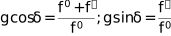
In the presence of resonant scattering, the non-centrosymmetric space group, the relation I(h) and I(−h) are different whereas in the centrosymmetric case both intensities are identical. We can calculate the four terms F(h) and its conjugate F*(h), and F(−h) and its conjugate F*(−h) and obtain




The intensities I(h) and I(−h) are proportional to the products F(h)F*(h) and F(−h)F*(−h) respectively. We can see that the products F(h)F*(h) and F(−h)F*(−h) are different by concentrating on the signs of the two exponential terms containing δj and h · xj. In the first product F(h)F*(h) the exponential signs of the first term are ++, whereas they are−− in the second term. In the second product F(−h)F*(−h) the exponential signs are +− in the first term and −+ in the second term, which are different from the first product. Consequently, we can conclude that for non-centrosymmetric structures I(h) and I(−h) are different.
One may wonder if this difference in intensities could be exploited in our spinel example? Unfortunately, this is not the case. The reason is that in both centro- and non-centrosymmetric cases, each pair of identical atoms A, B and X belong to identical lattice complexes in both space groups. In other words, the two space groups, centrosymmetric and non-centrosymmetric, cannot be distinguished in the harmonic approximation of the diffraction model and this is easily confirmed by simulations.
There is, however, some possibility offered by diffraction to distinguish between the centro- and non-centrosymmetric space groups. In the presence of anharmonicity, the Debye–Waller factor can be generalized by including higher-order terms in the power series. If we restrict ourselves to terms up to third-order, we obtain the following generalized expression of the Debye–Waller term (Trueblood et al., 1996):

Here γjkl are the components of a third-order tensor and for simplification we assume that the summations over the three pairs of identical indices are implied.
Table 2 shows that the independent ADPs are identical for the Fd3m and F4132 space groups up to second-order tensor approximations for each of A, B, X atom. Using the third-order ADP tensor allows them to be distinguished, provided, of course, that an optimized X-ray wavelength has been selected and that the sensitivity of the X-ray diffraction and the quality of the data are sufficient. The reason concerns the difference in the third-order independent ADP tensor parameters for atoms X and B: namely, C112 = C133 = C223 ≠ C113 ≠ 0 in F4132, while C112 = C133 = C223 = C113 ≠ 0 in Fd3m for X; C113 ≠ 0 in F4132, while C113 = 0 in Fd3m for B. Based on the simulation of the LiMo2O4 structure (see Section 2.4) using Co and Mo radiation (Table 3), Table 4 shows the influence of the choice of wavelength, since the f′′ value is decisive for F(h). For the B atom (B = Mn in the example), as the heaviest, this value primarily influences F(h). Another question arises: is there really an anharmonic shift for the B atom? The answer depends on the compound. Fig. 2 shows the dependence of the probability distribution function (p.d.f.) on the possible anharmonic contribution C113 of the B = Mn atom in the simulated LiMn2O4 structure. But it is impossible to predict whether the C113 term for B is realistic for a particular AB2X4 compound without experimental data.
| |||||||||||||||||||||||||||||||||||||||
| |||||||||||||||||||||||||||||||||||||||||||||||||||||||||||||||||||||||||||||||||||||||||||||||||||||||||||||||||||||||||||||||||||||||||||
| ||||||||||||||||||||||||||||||||||||||||||||||||||||||||||||||||||||||||
![[Figure 2]](dk5144fig2thm.gif) | Figure 2 Illustration of the probability distribution function (p.d.f.) obtained using the C113 term of the third-order ADP tensor for Mn in the simulated spinel structure LiMn2O4 using Co radiation. The same scale is used for all maps. |
2.4. Example
To simulate the structure of LiMn2O4 in the centrosymmetric, Fd3m, and non-centrosymmetric, F4132, space groups, the JANA2006 (Petříček et al., 2014) software package was used for two radiations, Mo and Co, to highlight the influence of the choice of wavelength on the results. The simulations were performed using ADPs up to the third-order tensor. The same set of atomic coordinates in the same Wyckoff positions was used. The ADPs up to the second-order tensor were fixed at the same values in both space groups. Other details of the structure simulation are given in Table 3.
Table 4 summarizes the results of the structure simulations. No difference between squared |F(h)|2 and |F(−h)|2 can be observed in the centrosymmetric Fd3m. However, in non-centrosymmetric F4132 space group, small differences between |F(h)|2 and |F(−h)|2 appear. This difference is higher when Co radiation with f′′(Mn) = 3.555 is applied in comparison to Mo radiation with f′′(Mn) = 0.728. This points to the importance of optimizing the wavelength selection if the result needs to discriminate between centrosymmetric and non-centrosymmetric space groups.
3. Discussion
The case of LiMn1.5Ni0.5O4 (Amin et al., 2020) is an interesting one showing the ambiguities resulting from the arbitrary selection of the origins of the specific space groups. This occur frequently while describing series of parent structures in the presence of phase transitions. The selection of the origins of space groups in International Tables of Crystallography is based on theoretical considerations which are independent of the behaviour of chemical compounds under considerations.
A convenient way to represent sequences of is often based on the Bärnighausen tree principle. The tree structure follows a sequence of maximal subgroups of the space groups which are of two types, either klassen- or translationengleich. We can clearly illustrate our point with the spinel structure LiMn1.5Ni0.5O4.
The first transformation from Fd3m (No. 227) to F4132 (No. 210) indicates very different atomic coordinates (Table 5 according to Figure 3 in the mentioned publication) which at a first glance hints to important structural changes. Once we realise that the higher-symmetry structure is described with origin choice 2 (not indicated in the mentioned publication) and that the lower symmetry one is described in an origin setting which is parent to choice 1 in Fd3m (Table 6), we find that the two structures are indistinguishable! The spinel structure can be described and presented by four conventional sets of atomic coordinates. Two of them correspond to two choices of origin in Fd3m: (i) at 43m (origin choice 1) and (ii) at 3m (origin choice 2). For each origin choice, two sets of atomic coordinates can be chosen; they are shifted by (1/2, 1/2, 1/2). Of course, the atomic coordinates are related to each other for these origins. Table 6 and Fig. 3 illustrate the identity of these choices.
| ||||||||||||||||||
| ||||||||||||||||||||||||||||||||||||||||||||||||||||||||||||||
 ;
; ;
; = (¼ −

![[Figure 3]](dk5144fig3thm.gif) | Figure 3 Representative cross-section of the cubic AB2X4 spinel structure. Four possible origin choices of the same conventional structure presentation are shown by four projections of the corresponding unit cells along the [110] direction. The A, B, and X independent atoms are located on the indicated threefold axis. Their (shown) is independent of the chosen structure representation options; it is systematically lower in F4132 compared to Fd3m. Origin shifts between the specified cells are indicated by arrows. Additional characteristics of the choice of coordinate origin and corresponding sets of atoms are given in Table 6 . |
In the same Figure 3 of the mentioned publication, the confusion is also present in the reordering transition from F4132 (No. 210) to P4132 with a maximal subgroup of index k4 (k for klassengleich). Here again we would expect small shifts in the atomic parameters. In reality the large difference in the atomic coordinates results from the arbitrariness of the position of the origin of P4132 described in the International Tables for Crystallography. Thus, while comparing different structures, it is always allowed and recommended to shift the origin of some space groups in order to better illustrate the close parenthood between the pair of structures under considerations.
The next important point to discuss is the concept of lattice complexes introduced and described by Fischer & Koch (2002) in International Tables of Crystallography. Identical lattice complexes are rarely (if ever) found in compounds with low symmetry, but they are indeed very important in compounds with high, especially cubic, symmetry, not only in the spinel group compounds but also in the perovskite group compounds. Indeed, the lattice complex of the perovskite-like ABX3 structures with the centrosymmetric Pm3m (No. 221) is identical to the of the non-centrosymmetric P432 (No. 207): site A – 1a m3m Pm3m a P; site B – 1b m3m Pm3m a P; site X – 3c 4/m m .m c J. This means that for perovskite-like compounds, the difference between centrosymmetric and non-centrosymmetric space groups is very difficult to determine based on X-ray experiments alone. The case of perovskite-like compounds is identical to that of spinel.
An additional point for discussion concerns the reflection conditions, which are very important in distinguishing between the Fd3m and F4132 space groups. The reflection condition k + l = 4n for 0kl is valid for both groups (see Table 1) and only for atoms for which harmonic or anharmonic displacements are absent. According to our simulations using Co radiation and the third-order tensor of ADPs for LiMn2O4 with F4132 space group, three independent reflections, namely 024, 046 and 028, are really present with their intensities 2.0, 7.2 and 7.2 respectively. For comparison, the maximal and minimal reflection intensities of other reflections are 135809.0 (for hkl = 004) and 32.3 (for hkl = 224), respectively. This means that if the third-order tensor of ADPs is meaningful in the experimental data, the difference between space groups Fd3m and F4132 could be observed. However, in practice, this might be difficult.
4. Conclusions
For spinel-like AB2X4 compounds, the centrosymmetric Fd3m and the non-centrosymmetric F4132 space group are difficult to distinguish based solely on the X-ray diffraction data. We have seen that in the harmonic approximation, X-ray resonance scattering effect cannot be used to distinguish spinel compounds where each atom type belongs to the same lattice complex in both centrosymmetric and non-centrosymmetric space groups. A possible method is to use anharmonic Debye–Waller tensor terms up to at least third order. Consequently, the physical properties of a particular compound are often decisive in determining the presence of inversion symmetry. Similar ambiguity can also arise in perovskite-like ABX3 compounds, which are also of great practical importance. Furthermore, when comparing different structures, it is always allowed and recommended to shift the origin of some space groups in order to better illustrate the close relationship between the pair of structures under consideration.
Acknowledgements
Open access publishing facilitated by Ecole polytechnique federale de Lausanne, as part of the Wiley–Ecole polytechnique federale de Lausanne agreement via the Consortium of Swiss Academic Libraries.
Conflict of interest
There are no conflicts of interest.
Funding information
The following funding is acknowledged: Swiss National Science Foundation (SNSF) Sinergia network NanoSkyrmionics (grant No. CRSII5-171003).
References
 Amin, R., Muralidharan, N., Petla, R. K., Ben Yahia, H., Jassim Al-Hail, S. A., Essehli, R., Daniel, C., Khaleel, M. A. & Belharouak, I. (2020). J. Power Sources 467, 228318. CrossRef Google Scholar
Arshad, S., Hussain, A., Noreen, S., Bibi, N., Tahir, M. B., Rehman, J. U., Jabeen, M., Munawar, H. B. & Rahman, S. (2024). J. Solid State Chem. 330, 124504. CrossRef Google Scholar
Dronova, M. G., Ye, F., Cooper, S. E., Krishnadas, A., Hoffmann, C. M., Fujisawa, Y., Okada, Y., Khomskii, D. I. & Feng, Y. (2022). Proc. Natl Acad. Sci. USA 119, e2208748119. CrossRef PubMed Google Scholar
Fischer, W. & Koch, E. (2002). International Tables for Crystallography, Vol. A, Space-group symmetry, ch. 14, pp. 845–878. Google Scholar
Grimes, N. W., Thompson, P. & Kay, H. F. (1983). Proc. R. Soc. Lond. A 386, 333–345. CrossRef CAS Google Scholar
He, B., Zhang, F., Xin, Y., Xu, C., Hu, X., Wu, X., Yang, Y. & Tian, H. (2023). Nat. Rev. Chem. 7, 826–842. PubMed Google Scholar
Narang, S.-B. & Pubby, K. (2021). J. Magn. Magn. Mater. 519, 167163. CrossRef Google Scholar
Petříček, V., Dušek, M. & Palatinus, L. (2014). Z. Kristallogr. Cryst. Mater. 229, 345–352. Google Scholar
Rafie, S. F., Abu-Zahra, N. & Sillanpää, M. (2025). Emerg. Contam. 11, 100429. CrossRef Google Scholar
Shan, C., Wang, Y., Li, J., Zhao, Q., Han, R., Liu, C. & Liu, Q. (2023). Environ. Sci. Technol. 57, 9495–9514. CrossRef CAS PubMed Google Scholar
Song, J., Wang, H., Zuo, Y., Zhang, K., Yang, T., Gao, C., Chen, T., Feng, G., Jiang, Z., Xiao, W., Luo, T. & Xia, D. (2023). Electrochem. Energy Rev. 6, 20. CrossRef Google Scholar
Srikala, D., Kaushik, S. D. & Verma, M. (2024). Phys. Solid State 66, 327–340. CrossRef CAS Google Scholar
Szablowski, L., Wojcik, M. & Dybinski, O. (2025). Energy 316, 134540. CrossRef Google Scholar
Trueblood, K. N., Bürgi, H.-B., Burzlaff, H., Dunitz, J. D., Gramaccioli, C. M., Schulz, H. H., Shmueli, U. & Abrahams, S. C. (1996). Acta Cryst. A52, 770–781. CrossRef CAS Web of Science IUCr Journals Google Scholar
Tsurkan, V., Krug von Nidda, H.-A., Deisenhofer, J., Lunkenheimer, P. & Loidl, A. (2021). Phys. Rep. 926, 1–86. CrossRef CAS Google Scholar
Wang, C., Liu, D., Liu, Q., Fan, Y., Wang, X., Jin, J. & Ma, J. (2023). Energy Fuels 37, 10023–10044. CrossRef CAS Google Scholar
Xu, H., Yuan, J., He, G. & Chen, H. (2023). Coord. Chem. Rev. 475, 214869. Web of Science CrossRef Google Scholar
This is an open-access article distributed under the terms of the Creative Commons Attribution (CC-BY) Licence, which permits unrestricted use, distribution, and reproduction in any medium, provided the original authors and source are cited.
| STRUCTURAL SCIENCE CRYSTAL ENGINEERING MATERIALS |


