

 journal menu


issue contents
June 2026 issue
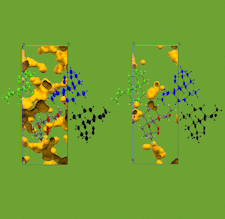
Cover illustration: The work by Banaz Fetah et al. [(2026), Acta Cryst. B82, 316–329) contributes to a deeper understanding of pressure-induced polymorphism in artemisinin and underscores the importance of external factors, such as the pressure-transmitting medium, in influencing solid-state transitions that may be relevant to pharmaceutical processing and formulation.
current research in crystal growth and related characterization


Free 
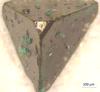
The special issue on crystal growth and related characterization is introduced. The articles were originally published in recent regular issues of Acta Crystallographica Section B.

Download citation


Download citation
Open access
access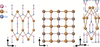
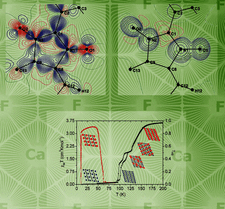
A systematic investigation is reported of the structural and magnetic evolution in the CeAlSi1–xGex series, combining X-ray and neutron diffraction with magnetization measurements on polycrystalline samples and single crystals. Chemical substitution leads to a continuous lattice expansion and a suppression of the ferromagnetic ordering temperature without a structural phase transition, revealing a crossover towards antiferromagnetic behaviour and establishing CeAlSi1–xGex as a model system for compositionally tuned magnetism in noncentrosymmetric materials.
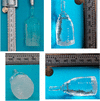
It is shown that even 1.25% of molybdenum in tungstate structure leads to significant decrease in X-ray luminescence intensity. On the other hand, 1.25% molybdenum doping shifts photoluminescence emission to longer wavelengths, the shift increasing with Mo concentration increasing to 5%, without decreasing photoluminescence intensity.
Download citation
Download citation
Open access
access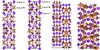
Structural investigations into Maus's salt derivatives reveal great sensitivity toward alkali metal and cocrystallized water content. Magnetic properties of the Maus's salt iron trimer are explored.
Download citation
Download citation
Open access
access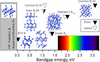
In situ X-ray diffraction is used for exploring Si crystallography and for studying phase-transformation mechanisms in elemental Si and Na–Si systems. We present original results of hexagonal silicon, Si-6H and a critical analysis of the past-decade discoveries of silicon Si-4H and Si24 using large-volume high-pressure techniques.
CCDC reference: 2547842
research papers
Download citation
Download citation
Open access
access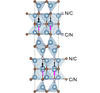
From experimental and theoretical techniques employed in this thorough reexamination of the structure of Al5C3N, the crystal structure is better described in centrosymmetric space group P63/mmc (No. 194) rather than in the previously reported noncentrosymmetric space group P63mc (No. 186).
CCDC reference: 2504685
Download citation
Download citation
Open access
access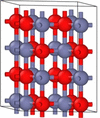
The planar hexagonal phase of ZnO is significant for understanding ferroelectricity in this class of materials, and it is well established for ZnO in layered systems. Previously it has been reported as freestanding nanocrystals, but the fitted unit-cell parameters differed from predictions by up to 16%; we resolve this anomaly to provide fundamental understanding of ferroelectric switching.
CCDC reference: 2545675
Download citation
Download citation
Open access
access
The polymorphic behaviour of the three forms of artemisinin was investigated using single-crystal X-ray diffraction in a diamond anvil cell, with notable observation of a pressure-induced phase transition from form (II) to form (III).
Download citation
Download citation
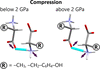
The effect of hydrostatic compression on the crystal structure of α-L-tyrosine was studied and compared with that reported previously for other amino acids, in particular, for structurally related L-alanine.
Download citation
Download citation
Open access
access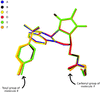
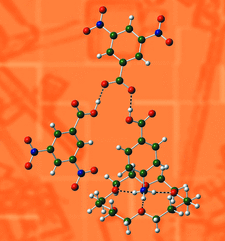
The crystal structure of a 2,3,9,9a-tetrahydro-1H-carbazole in the space group Ia is reported, showing Z′ = 6 and approximate Fdd2 symmetry, and compared to the low Z′ crystal structures of two closely related congeners.
Download citation

Download citation
Open access
access
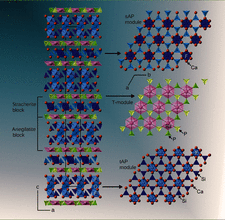
The incommensurately modulated structure of AlPO4-5 was elucidated by single-crystal X-ray diffraction, revealing correlated rotational displacements of AlO4 and PO4 tetrahedra.
B-IncStrDB reference: JorIihFWgvi
CCDC reference: 2550293
Download citation
Download citation
Open access
access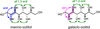
The sugar alcohol L-threo-D-galacto-octitol crystallizes in a structure with P43212 pseudo-symmetry and a highly elongated unit cell (c ≈ 88 Å). In distinct layers of the structure, symmetry is broken by an asymmetric hydrogen-bonding network leading to polytypism, which is discussed in the framework of order–disorder theory.
CCDC reference: 2553234
Open access
access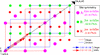
Both centrosymmetric, Fd3m, and non-centrosymmetric, F4132, space groups cannot be distinguished in solving, refining and describing AB2X4 spinel structures in the harmonic approximation. They can be distinguished only by using the third-order tensor approximation of anisotropic displacement parameters.