

 menu


A Tribute to George Sheldrick
 | STRUCTURAL CHEMISTRY |
 access
An unusual case of tetartohedral the low-temperature phase of bis[μ3-1,3-bis(tert-butylazanidyl)-1,1,3,3-tetramethyldisiloxane]tetralithium(I)

aInstitut für Anorganische Chemie, Universität Göttingen, Tammannstrasse 4, 37077 Göttingen, Germany, and bInstitut für Anorganische und Analytische Chemie, Technische Universität Braunschweig, Hagenring 30, 38106 Braunschweig, Germany
*Correspondence e-mail: [email protected], [email protected]
This article is part of the collection A Tribute to George Sheldrick: the Legacy of a Crystallographic Computing Pioneer.
The low-temperature phase of the title compound, [Li4(C12H30N2OSi2)2], crystallizes in the space group P21 with the pseudo-tetragonal cell constants a = 10.761 (2), b = 13.030 (3), c = 13.035 (3) Å, β = 90.05 (2)° and Z = 2. The special values of the cell constants (two equal axes, monoclinic β ≈ 90°) each lead to twinning, so that the usual SHELXL TWIN command cannot be used; instead an intensity file in HKLF5 format was constructed, involving sets of eight reflections, of equal intensity, with indices connected by the operations and by inversion; thus seven scale factors (defined by the BASF command) were refined. The final wR2 value is 0.067, with R1 = 0.026. In contrast to the previously known forms, both tetragonal, the Li atoms are not disordered; two of them are two-coordinate (bonded to two N atoms) and two are four-coordinate (bonded to two N and two O atoms). Some personal recollections of twin treatment over the last 40 years are presented.
Keywords: crystal structure; twinning; silylamine; siloxane; lithium.
CCDC reference: 2598515
1. Introduction
George Sheldrick will be remembered in particular for his powerful SHELX suite of programs for solving and refining X-ray crystal structures. In this article/memorial, we concentrate on one special aspect, the simplified and user-friendly handling of data from twinned crystals, introduced in SHELXL-93 (Herbst-Irmer & Sheldrick, 1998 ). There had already been programs for twin treatment (e.g. CRYSTALS; Betteridge et al., 2003; Watkin, 2026), but this version of SHELXL demonstrated that this treatment could also be applied to routine structures. Apart from a general method suitable for all kinds of twins, George also designed a more straightforward method, which needs only two extra commands in the instruction file: TWIN to define the and BASF for the fractional contribution of the minor component (which is then refined). This is only possible if all components of the twin matrix are integers and if there is only one twin operator (i.e. for or pseudomerohedry), although additional can also be treated in this manner; the default is [
 00/00/00], corresponding to inversion twinning alone. In the general approach, the information about the twinning, e.g. which reflections of the main domain overlap with which reflections of the minor domain(s), is incorporated in a special-format HKL file, the so-called HKLF5 file. Usually, this type of HKL file is used for non-merohedric twins. The overlap information is acquired during data processing of the diffractometer data (with routines internal to the diffractometer programs taking account of the experimental setup, for example, mosaicity, detector distance, goniostat position and rotation increment, without documenting this information for further programs). Additionally, a special program is needed that can manage the scaling and absorption correction for this type of data; George wrote the program TWINABS (Sevvana et al., 2019), which performs the same function as SADABS (Krause et al., 2015), used for single-crystal data, and is additionally able to merge the data in a valid manner and to detwin the data of such non-merohedric twins for structure solution. (It should be noted that some of George's auxiliary programs are specific to, and only obtainable from, a particular diffractometer firm; other brands have their own programs that perform similar functions.)
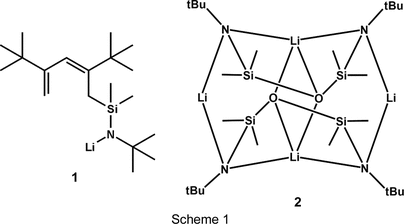
Here we describe the solution and of a structure from a tetartohedrally twinned crystal, where more than one is necessary for an appropriate description of the twinning.
Crystals of a compound believed to be the lithium silylamide 1 (see Scheme 1) were investigated at 100 K [for investigations of other silylamide-based complexes by Walter and co-workers, see e.g. a CSD Communication (Jones et al., 2021), reporting a structure determined at roughly the same time as that of the title compound, but deposited several years later, or a more recent publication (Münster et al., 2025)] (see Scheme 1). The diffraction pattern was, apparently successfully, indexed in terms of an effectively tetragonal cell, with a ≈ b ≈ 13.032 (3), c ≈ 10.761 (2) Å. The cell, if correct, seemed impossibly small for the suggested structure, but the data were collected anyway. Standard solution attempts with SHELXT (Sheldrick, 2015a) failed in Laue classes 4/m and 4/mmm. No systematic absences were detected by automatic procedures, but continued efforts to solve the structure in all possible tetragonal space groups (those lacking systematic absences) proved unsuccessful. The intensity distribution indicated probable twinning, with a very low <|E2 – 1|> value of 0.427 (for details, see the supporting information) (Herbst-Irmer & Sheldrick, 1998; Herbst-Irmer, 2016).
2. Experimental
Data were recorded at 101 K on an Agilent Xcalibur A diffractometer using mirror-focussed Cu Kα radiation and the control program CrysAlis PRO (Agilent, 2012). Absorption corrections, using the SCALE3 ABSPACK scaling algorithm of CrysAlis PRO, were based on multiscans. The structure was solved (see below) with SHELXS (Sheldrick, 2008) and refined with SHELXL (Sheldrick, 2015b) within the GUI ShelXle (Hübschle et al., 2011). Further details are given in Table S3.
3. Analysis of twinning
Use of the program XPREP (Sheldrick, 2015c) showed an interesting pattern of Rint values for cells of steadily decreasing symmetry. The value of 0.021 for a monoclinic cell with a = 10.761 (2), b = 13.030 (3), c = 13.035 (3) Å and β = 90.05 (2)° was significantly lower than the values of 0.057–0.090 for other symmetries (tetragonal, orthorhombic, other monoclinic settings) (for details, see the supporting information). It thus seemed worthwhile to investigate this monoclinic setting further. However, the lack of systematic absences seemed to indicate three possible space groups, namely P2, Pm or P2/m (the first two extremely rare), yet no structure solution could be found in these space groups, neither with SHELXT, SHELXS nor SHELXD (Sheldrick, 2008). However, SHELXT did propose P21, but without finding a sensible structure.
The solution to this problem relies on a correct interpretation of the twinning. First, the Rint values in 4/m and 4/mmm are identical: this could be connected with of the type well known for truly tetragonal structures in 4/m as [e.g. Taouss et al. (2013), see below]. Secondly, the (near) equality of the b and c axes allows further by a 180° rotation [also well known in the equivalent of monoclinic structures with a ≈ c, e.g. Armstrong et al. (1993)] that exchanges these axes, thus emulating a fourfold axis. If one now supposes that the true space group is the common space group P21, the systematic absences (0k0 absent for k odd) along the b* axis of one twin component would be masked by the lack of absences along the c* axis of the second component, so there would appear to be no absences.
The structure was then solved with SHELXS and also with SHELXD (for details, see the supporting information), showing that it is not the expected compound 1, but the oxygen-containing compound bis[μ3-1,3-bis(tert-butylazanidyl)-1,1,3,3-tetramethyldisiloxane]tetralithium(I), 2, which presumably arose by reaction with small amounts of adventitious water. The information about the twinning was not used for the structure solution. To refine the structure, the presence of tetartohedral twinning precludes the use of the simple procedure `twin matrix plus scale factor'. Here three twin matrices would be needed: [00/001/010] (twinning by pseudomerohedry of monoclinic structures with b ≈ c), [100/00/00] (twinning by pseudomerohedry of a monoclinic structure with β ≈ 90°) and the combination of both: [00/00/00]. Therefore, the HKL file was converted to HKLF5 format (using a locally written program) by generating further reflections −h, l, k; h, −k, −l and −h, −l, −k for each parent reflection hkl, whereby all reflections of the set of four were assigned equal intensities to that of the parent reflection, but different batch scale factors. This was also achievable with TWINROTMAT in PLATON (Spek, 2020) (see the supporting information). TWINABS would not be an option for this kind of because there is a nearly exact overlap of the reflections of the different domains and only one orientation matrix was used for the integration. The three fractional contributions of the additional domains refined to 0.2526 (12), 0.2481 (12) and 0.1460 (12), leading to a fractional contribution of the main domain of 0.3533. Since the structure is non-centrosymmetric, the was calculated as 0.49 (3) by the classical fit to all intensities (Flack, 1983) and 0.183 (9) from 3568 selected quotients (Parsons et al., 2013). Accordingly, SHELXL (Sheldrick, 2015b) produced the warning message `**Possible inversion twin or centrosymmetric space group**' and checkCIF (https://checkcif.iucr.org/) showed a similar B-alert. Here this would mean additional and the HKL file thus needs to be expanded by the addition of the reflections −h, −k, −l; h, −l, −k; −h, k, l and h, l, k. Table 1 compares the two refinements. The results are very similar. But the of silicon is limited, even for copper radiation, so that the Friedel differences will be small and the improvement by taking additional into account is marginal. Therefore, both files are made available (for details see the supporting information).
| |||||||||||||||||||||||||||||||||||||||||||||||
4. Discussion
Compound 2 was investigated crystallographically in some detail by Veith and co-workers. At room temperature, 2 crystallizes in the P42/nmc, with a = b = 13.095 (8), c = 11.045 (6) Å and imposed  m2 symmetry, whereby the Li atoms occupy alternative positions (Veith et al., 2000), leading to a molecular symmetry of 222. In the temperature region 163–243 K, the space group is P42/n, with a = b = 12.999 (2), c = 10.866 (2) Å and imposed symmetry, again with alternative Li-atom positions (Veith et al., 2009). The authors also reported a low-temperature phase (below 163 K), investigated using powder methods, with a monoclinic cell having a = 12.893 (6), b = 12.971 (6), c = 10.854 (7) Å and β = 91.06 (3)°, and formal symmetry probably 1. It seems tolerably certain that this low-temperature phase is in fact the one reported here for 2.
The structure of the room-temperature form of compound 2 was also investigated by Ikeda et al. (2002), but without mentioning the split Li-atom positions (the article centred on chromium complexes of 2).
The structure of 2 is shown in Fig. 1. The formal symmetry of the molecule is indeed reduced to 1, as must be the case in space group P21, which lacks special positions. The Li atoms are ordered, in contrast to the other two phases of 2, and occupy two types of positions. Li1 and Li3 are coordinated by two O- and two N-atom donors, whereas Li2 and Li4 are only coordinated by two N-atom donors. Table 2 compares selected bond lengths for the three phases. The bond lengths at the Si atoms are slightly longer than expected. The lowering of the is shown in the bond lengths of the now ordered Li atoms. The Li—O bond lengths can be divided into two groups [mean values: Li—O1 2.284 (11) and Li—O2 2.352 (11) Å], as can the N—Li bond lengths [mean values N—Li1/3 1.985 (11) and 2.025 (11), and N—Li2/4 1.950 (10) and 1.985 (10) Å].
|
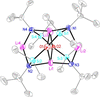 | Figure 1 The molecule of compound 2 in the crystal, with ellipsoids shown at the 50% probability level. H atoms have been omitted for clarity. |
The phase transitions of 2 show the typical behaviour on cooling, the symmetry being lowered from 2m to , and finally 1 and from Laue class 4/mmm to 4/m and then 2/m. This very often leads to twinning, as observed here (e.g. Attiwell et al., 2026).
5. Some reminiscences about twinning (PGJ)
Having recently noted the 50th anniversary of my first publication, I have clearly long since reached my anecdotage and have been allowed by considerate Editors to indulge in occasional reminiscences about the good/bad old days, e.g. the changing fashions in wavelength preferences (Abu-Zaied et al., 2024). It may thus be appropriate here to muse briefly on the subject of twinning.
In retrospect, my experiences of twinning began in the early 1980s with the attempted structure determination of cyclohexanone oxime, which crystallizes in the trigonal space group P . A dataset was registered and the structure was solved, but could not be refined satisfactorily; a second attempt with a new crystal also failed. As a comparative beginner, I put this down to bad luck or gremlins and abandoned the structure. Nowadays, with my somewhat reduced level of ignorance, I would of course suspect twinning by merohedry. Indeed, an article has since appeared presenting the structure of cyclohexanone oxime as such a twin (Lutz et al., 2004). It is however worth remembering that the standard methods of treating twinned data, specifically the TWIN command in the SHELX program (Sheldrick, 2015b), have only been available since the 1990s (Herbst-Irmer & Sheldrick, 1998). It is unfortunately probable that many structures abandoned in the pre-TWIN era might well have been rescuable, if suitable software had been available. It should also not be forgotten that this was the pre-area-detector era, when the diffraction patterns could not be directly visualized on the diffractometer as frames.
Similarly, in the early 1990s, I attempted to determine the structure of (tert-butyl)bis(isopropyl)iodophosphane iodide. Although recognising, from the Rint values, that the structure must be monoclinic despite the metrically orthorhombic cell, I was unable to refine the monoclinic structure successfully (with typical symptoms of which I did not recognise at the time: poor R values, large residual electron-density peaks, many badly-fitting reflections with Fo >> Fc) and again abandoned the attempt. While sorting out old structures for deposition in 2013, I rediscovered the dataset and realised that the structure must be twinned by pseudomerohedry (with hindsight, the Rint value for orthorhombic symmetry was not impossibly high); the addition of appropriate TWIN (180° rotation about the a axis) and BASF commands to the led to an entirely acceptable monoclinic structure, now deposited (Jones & Ruthe, 2013).
It took me several years to acquire enough practical knowledge of twinning phenomena, and the corresponding remedies, to deal with most of the obvious cases that I later encountered. During this time, I was helped considerably by two experts in the field; Regine Herbst-Irmer, co-author of this article, and Ina Dix (with whom we have unfortunately lost contact). Regine has also written many collections of useful tips for recognising the symptoms of twinning and for refining twinned structures (e.g. Herbst-Irmer, 2016). My previously hazy understanding of why and how twins form was also considerably clarified by the `asymmetric brick' analogy in the excellent general article on twinning by Parsons (2003).
Three further examples may be informative, even if they correspond to advice given earlier by Regine (her tips bear repetition!). The first is the structure of a homobenzene derivative (Wullbrandt et al., 2010). This was the reverse of the `cyclohexanone oxime' experience; I managed to interpret the structure as being twinned by pseudomerohedry, after an attempt by others to determine the structure in the 1980s, which was unsuccessful because they did not have the necessary software (for discovering the true cell and twinning law) at the time. The cell as found by the diffractometer program was C-centred monoclinic, but was discarded in favour of the corresponding primitive triclinic cell on the basis of the Rint values. Structure solution was successful in P, but the refinement led to high R values. I therefore assumed via 180° rotation about the `monoclinic' b axis; use of the corresponding twin matrix allowed the to be successfully completed. The general problem of determining the twin matrix is not always trivial; in this case, one needs the matrices for interconversion of the monoclinic and triclinic cells (one is necessarily the inverse of the other). The twin matrix is then the product [matrix triclinic → monoclinic] × [rotation matrix 180° around the monoclinic b axis] × [matrix monoclinic → triclinic]. One should also note in passing that the program XPREP (also written by George) can be used to determine the matrices and their products, and it also gives the Rint values for the different symmetries. Somewhat more recent programs/routines, such as TwinRotMat in PLATON (Spek, 2020), also help to identify the twin law.
The second example is one of twinning by merohedry (Taouss et al., 2013). The structure of the simple molecule imidazolin-2-one (2-imidazolidinone) had to our great surprise never been determined. We recorded a dataset that was assigned a tetragonal cell, space group I41/amd, by the diffractometer software (despite a rather high Rint value of 0.17). The structure was solved, but failed to refine satisfactorily; in particular, the five-membered ring, which should be non-planar, appeared to lie in a crystallographic mirror plane with high U value components perpendicular to this plane. We therefore reduced the symmetry to I41/a, leading to a more reasonable ring geometry, but the R values were still quite high. Particularly in view of the low <|E2 – 1|> value of 0.71, the obvious next step was to test for this indeed made the structure completely acceptable, whereby the well-known tetragonal [010/100/00] led to a BASF value of 0.208 (2). In general, it is worthwhile to test any structure in Laue group 4/m for such (similar considerations apply to the other high-symmetry crystal systems with more than one Laue group, namely cubic and hexagonal/trigonal). At the time, we cast doubt on an earlier structure of the compound in Fdd2 by Zhang et al. (2009), which had an R value of 0.14 but no deposited coordinates. A room-temperature structure in Fddd, clearly a new polymorph, was however later reported by Bellas & Matzger (2022).
The third example is the hydrocarbon C20H22 (Yildizhan et al., 2015), which crystallized in an apparently orthorhombic cell. The suggested space group was Pmc21, but the structure was not solvable. Rint values were also not helpful, being 0.22 for orthorhombic and 0.20 for all three possible monoclinic cells with β = 90°. The monoclinic cell that retained the same axis order however provided a recognisable solution; the initially poor refinement was improved to an entirely acceptable quality by assuming twinning by pseudomerohedry (rotation of 180° around the a axis), with a batch scale factor of ca 50%. It is perhaps surprising that such 50:50 twins can still lead to a structure solution. This leads to the one novel tip from this section: Pmc21 (and Pmn21) are rare space groups; if the structure cannot be solved or refined properly, it may be monoclinic P21/c or P21/n with β ≈ 90° (by no means a rare combination) and twinned by pseudomerohedry.
Thanks to the commands TWIN and BASF, `normal' twinning no longer holds many terrors, even for the non-expert. However, the structure of 2, as presented here, is an example of a probable twin that I was unable to interpret. In such cases one must approach an expert! For a further example of a complex twinning phenomenon that was successfully unravelled, see the recent structure of a new form of white phosphorus (Herbst-Irmer et al., 2023).
All of the above examples involve twinning by (pseudo)merohedry. The other major twinning type is non-merohedric twinning, where some, but not all, reflections of the twin components overlap. Older diffractometer types and their programs lacked the necessary software to analyse such twins adequately (auto-indexing routines found either no cell, or one with one or more impossibly long axes), and the only chance in general was to find a non-twinned crystal. The development of area detectors and suitable software has enabled such twins to be routinely identified, and new refinement techniques (in particular, the HKLF5 method developed by George) have allowed the twinned datasets to be refined. However, the increased efficiency in recording data to ever higher diffraction angles (powerful sources, sensitive detectors and, of course, low-temperature data collection) has blurred the different treatment of twinning by pseudomerohedry and non-merohedric twinning. For example, for a monoclinic compound with β = 90.5°, twinned by pseudomerohedry, the two twin components might yield effectively overlapped data to 2θmax 50° (Mo Kα radiation), thus enabling normal with an appropriate TWIN matrix (even if this forces the refined β angle to a value nearer 90° than the true value). For a more modern dataset, recorded to 2θmax 90° (often feasible these days), the reflections of the two twin components may however diverge appreciably at high angle, necessitating an HKLF5-type treatment if the integration box cannot be enlarged to encompass both parts of the split reflections.
6. Conclusion
Nowadays, the identification and of twinned structures is often routine. Many programs, such as PLATON (Spek, 2020) or OLEX2 (Bourhis et al., 2015), offer options to test for twinning, and even suggest a twin law. Data integration programs provide routines for determining multiple orientation matrices, which can be used for integration and to generate an HKL file containing information about the overlap. Modern refinement programs are capable of interpreting these files. We owe thanks for this development to George Sheldrick, who laid the groundwork with his HKLF5 format and, with TWIN/BASF, found a simple way of defining integer twin matrices. This article also relates how the handling of twinned structures – not only by experts, but by practising crystallographers – gradually developed.
Nevertheless, there are always interesting examples – such as structure 2 here – where the automatic routines are insufficient, where even the powerful structure-solving program SHELXT fails, where determining the is not trivial and where creating the HKLF5 file is not a routine task. It remains to be seen how the handling of twinned structures will be impacted by the use of AI.
7. Related literature
The following references are cited in the supporting information: Albrecht et al. (2020); Lutz et al. (2015); Petricek et al. (2014).
Supporting information
CCDC reference: 2598515
contains datablocks I, global. DOI: https://doi.org/10.1107/S2053229626011150/gz3275sup1.cif
Supporting information file. DOI: https://doi.org/10.1107/S2053229626011150/gz3275Isup2.cml
Structure factors: contains datablock I. DOI: https://doi.org/10.1107/S2053229626011150/gz3275Isup3.hkl
Supporting information file. DOI: https://doi.org/10.1107/S2053229626011150/gz3275sup4.pdf
data without DOI: https://doi.org/10.1107/S2053229626011150/gz3275sup5.cif
| [Li4(C12H30N2OSi2)2] | Dx = 1.048 Mg m−3 |
| Mr = 576.88 | Cu Kα radiation, λ = 1.54184 Å |
| Tetragonal, P21 | Cell parameters from 26532 reflections |
| a = 10.761 (2) Å | θ = 3.4–75.7° |
| c = 13.035 (3) Å | µ = 1.69 mm−1 |
| V = 1827.7 (7) Å3 | T = 101 K |
| Z = 2 | Prism, colourless |
| F(000) = 632 | 0.25 × 0.12 × 0.10 mm |
| Agilent Xcalibur Atlas Nova diffractometer | 7547 independent reflections |
| Radiation source: Nova (Cu) X-ray Source | 7547 reflections with I > 2σ(I) |
| Mirror monochromator | Rint = 0.040 |
| Detector resolution: 10.3543 pixels mm-1 | θmax = 76.0°, θmin = 3.4° |
| ω scans | h = −13→13 |
| Absorption correction: multi-scan (CrysAlis PRO; Agilent, 2012) | k = −16→16 |
| Tmin = 0.480, Tmax = 1.000 | l = −16→16 |
| 38449 measured reflections |
| Refinement on F2 | Primary atom site location: dual space |
| Least-squares matrix: full | Hydrogen site location: inferred from neighbouring sites |
| R[F2 > 2σ(F2)] = 0.026 | H-atom parameters constrained |
| wR(F2) = 0.067 | w = 1/[σ2(Fo2) + (0.0464P)2 + 0.316P] where P = (Fo2 + 2Fc2)/3 |
| S = 1.05 | (Δ/σ)max < 0.001 |
| 7547 reflections | Δρmax = 0.26 e Å−3 |
| 370 parameters | Δρmin = −0.27 e Å−3 |
| 19 restraints |
Geometry. All esds (except the esd in the dihedral angle between two l.s. planes) are estimated using the full covariance matrix. The cell esds are taken into account individually in the estimation of esds in distances, angles and torsion angles; correlations between esds in cell parameters are only used when they are defined by crystal symmetry. An approximate (isotropic) treatment of cell esds is used for estimating esds involving l.s. planes. |
Refinement. Refined as a 8-component twin |
| x | y | z | Uiso*/Ueq | ||
| Si1 | 0.50994 (10) | 0.28261 (8) | 0.76708 (9) | 0.0208 (2) | |
| Si2 | 0.54480 (11) | 0.52312 (8) | 0.76772 (9) | 0.0223 (2) | |
| Si3 | 0.94493 (11) | 0.34687 (8) | 0.60009 (9) | 0.0223 (2) | |
| Si4 | 0.98702 (10) | 0.36822 (8) | 0.84113 (9) | 0.0222 (2) | |
| O1 | 0.5777 (3) | 0.3983 (3) | 0.7615 (2) | 0.0237 (6) | |
| O2 | 0.9168 (3) | 0.3661 (2) | 0.7257 (3) | 0.0248 (6) | |
| N1 | 0.6363 (3) | 0.2090 (3) | 0.7470 (3) | 0.0226 (7) | |
| N2 | 0.6903 (4) | 0.5711 (3) | 0.7565 (3) | 0.0230 (8) | |
| N3 | 0.7996 (3) | 0.3620 (3) | 0.5538 (3) | 0.0223 (7) | |
| N4 | 0.8616 (4) | 0.3852 (3) | 0.9164 (3) | 0.0235 (7) | |
| C1 | 0.6438 (4) | 0.0968 (3) | 0.7474 (4) | 0.0246 (9) | |
| C2 | 0.6491 (7) | 0.0580 (4) | 0.6349 (5) | 0.0477 (14) | |
| H2A | 0.632433 | −0.015895 | 0.633257 | 0.072* | |
| H2B | 0.731809 | 0.071429 | 0.606443 | 0.072* | |
| H2C | 0.586423 | 0.094060 | 0.593862 | 0.072* | |
| C3 | 0.5317 (5) | 0.0453 (3) | 0.7956 (5) | 0.0387 (12) | |
| H3A | 0.545007 | −0.029108 | 0.797718 | 0.058* | |
| H3B | 0.457472 | 0.060436 | 0.754773 | 0.058* | |
| H3C | 0.520328 | 0.071192 | 0.865565 | 0.058* | |
| C4 | 0.7599 (6) | 0.0633 (4) | 0.8034 (7) | 0.0543 (19) | |
| H4A | 0.766586 | −0.011720 | 0.800969 | 0.081* | |
| H4B | 0.755565 | 0.085814 | 0.875019 | 0.081* | |
| H4C | 0.832902 | 0.093894 | 0.770521 | 0.081* | |
| C5 | 0.3823 (4) | 0.2767 (4) | 0.6662 (4) | 0.0316 (9) | |
| H5A | 0.346897 | 0.207407 | 0.664517 | 0.047* | |
| H5B | 0.417195 | 0.293367 | 0.598829 | 0.047* | |
| H5C | 0.317000 | 0.326235 | 0.683324 | 0.047* | |
| C6 | 0.4331 (5) | 0.2742 (4) | 0.8963 (4) | 0.0334 (10) | |
| H6A | 0.394614 | 0.206484 | 0.904221 | 0.050* | |
| H6B | 0.369261 | 0.327482 | 0.901835 | 0.050* | |
| H6C | 0.495516 | 0.284138 | 0.950215 | 0.050* | |
| C7 | 0.7242 (5) | 0.6781 (3) | 0.7402 (4) | 0.0302 (10) | |
| C8 | 0.7062 (6) | 0.7077 (5) | 0.6271 (5) | 0.0456 (14) | |
| H8A | 0.738125 | 0.777167 | 0.615698 | 0.068* | |
| H8B | 0.617569 | 0.705474 | 0.609950 | 0.068* | |
| H8C | 0.751495 | 0.659179 | 0.583447 | 0.068* | |
| C9 | 0.8626 (6) | 0.6922 (4) | 0.7660 (6) | 0.0481 (15) | |
| H9A | 0.888005 | 0.762505 | 0.749385 | 0.072* | |
| H9B | 0.912217 | 0.643632 | 0.725877 | 0.072* | |
| H9C | 0.875854 | 0.679548 | 0.839353 | 0.072* | |
| C10 | 0.6486 (7) | 0.7524 (4) | 0.8066 (6) | 0.0583 (19) | |
| H10A | 0.675594 | 0.822986 | 0.793119 | 0.087* | |
| H10B | 0.661731 | 0.736239 | 0.879265 | 0.087* | |
| H10C | 0.560149 | 0.745621 | 0.790016 | 0.087* | |
| C11 | 0.4331 (5) | 0.5547 (4) | 0.6627 (4) | 0.0354 (11) | |
| H11A | 0.414503 | 0.628276 | 0.664062 | 0.053* | |
| H11B | 0.356171 | 0.515618 | 0.672509 | 0.053* | |
| H11C | 0.469941 | 0.536641 | 0.596368 | 0.053* | |
| C12 | 0.4620 (5) | 0.5478 (4) | 0.8920 (4) | 0.0325 (10) | |
| H12A | 0.443975 | 0.621281 | 0.898216 | 0.049* | |
| H12B | 0.514820 | 0.526129 | 0.949311 | 0.049* | |
| H12C | 0.384069 | 0.508973 | 0.893292 | 0.049* | |
| C13 | 0.7642 (4) | 0.3730 (3) | 0.4445 (3) | 0.0261 (9) | |
| C14 | 0.6239 (5) | 0.3493 (4) | 0.4343 (4) | 0.0344 (11) | |
| H14A | 0.598131 | 0.357910 | 0.362705 | 0.052* | |
| H14B | 0.576486 | 0.396414 | 0.477895 | 0.052* | |
| H14C | 0.608046 | 0.278422 | 0.455945 | 0.052* | |
| C15 | 0.8332 (5) | 0.2991 (5) | 0.3744 (4) | 0.0403 (12) | |
| H15A | 0.802606 | 0.306848 | 0.304001 | 0.060* | |
| H15B | 0.819032 | 0.228490 | 0.397575 | 0.060* | |
| H15C | 0.922346 | 0.314268 | 0.376520 | 0.060* | |
| C16 | 0.7836 (6) | 0.4827 (4) | 0.4057 (5) | 0.0387 (12) | |
| H16A | 0.774205 | 0.484185 | 0.330938 | 0.058* | |
| H16B | 0.867262 | 0.505971 | 0.424263 | 0.058* | |
| H16C | 0.721817 | 0.528080 | 0.437094 | 0.058* | |
| C17 | 1.0174 (5) | 0.2169 (4) | 0.5871 (4) | 0.0352 (11) | |
| H17A | 1.023893 | 0.198994 | 0.514251 | 0.053* | |
| H17B | 0.965707 | 0.165988 | 0.622270 | 0.053* | |
| H17C | 1.100492 | 0.217693 | 0.617866 | 0.053* | |
| C18 | 1.0655 (4) | 0.4424 (4) | 0.5579 (4) | 0.0358 (10) | |
| H18A | 1.077815 | 0.436725 | 0.483634 | 0.054* | |
| H18B | 1.144053 | 0.428245 | 0.593276 | 0.054* | |
| H18C | 1.037455 | 0.511886 | 0.574808 | 0.054* | |
| C19 | 0.8561 (5) | 0.3721 (4) | 1.0284 (3) | 0.0254 (9) | |
| C20 | 0.8382 (5) | 0.2585 (4) | 1.0554 (4) | 0.0384 (12) | |
| H20A | 0.838429 | 0.250374 | 1.130182 | 0.058* | |
| H20B | 0.905987 | 0.218141 | 1.025711 | 0.058* | |
| H20C | 0.758623 | 0.234527 | 1.027746 | 0.058* | |
| C21 | 0.7427 (5) | 0.4321 (5) | 1.0692 (4) | 0.0375 (11) | |
| H21A | 0.738356 | 0.425048 | 1.143964 | 0.056* | |
| H21B | 0.666605 | 0.404640 | 1.038327 | 0.056* | |
| H21C | 0.751194 | 0.504834 | 1.051239 | 0.056* | |
| C22 | 0.9698 (5) | 0.4118 (5) | 1.0834 (4) | 0.0375 (10) | |
| H22A | 0.955988 | 0.409068 | 1.157658 | 0.056* | |
| H22B | 0.985503 | 0.482956 | 1.062685 | 0.056* | |
| H22C | 1.041709 | 0.369283 | 1.065614 | 0.056* | |
| C23 | 1.0749 (4) | 0.2430 (4) | 0.8592 (4) | 0.0322 (10) | |
| H23A | 1.115884 | 0.243077 | 0.926388 | 0.048* | |
| H23B | 1.137466 | 0.235917 | 0.805142 | 0.048* | |
| H23C | 1.016517 | 0.185336 | 0.855519 | 0.048* | |
| C24 | 1.1064 (5) | 0.4715 (4) | 0.8394 (4) | 0.0331 (11) | |
| H24A | 1.151088 | 0.472065 | 0.904870 | 0.050* | |
| H24B | 1.065735 | 0.537974 | 0.828867 | 0.050* | |
| H24C | 1.165132 | 0.458799 | 0.783379 | 0.050* | |
| Li1 | 0.7490 (11) | 0.4549 (7) | 0.6659 (7) | 0.0329 (15) | |
| Li2 | 0.6980 (9) | 0.2521 (8) | 0.6098 (7) | 0.0361 (19) | |
| Li3 | 0.7524 (10) | 0.3048 (7) | 0.8183 (8) | 0.0321 (16) | |
| Li4 | 0.7831 (8) | 0.5139 (7) | 0.8748 (6) | 0.0312 (19) |
| U11 | U22 | U33 | U12 | U13 | U23 | |
| Si1 | 0.0174 (5) | 0.0212 (4) | 0.0240 (5) | −0.0013 (4) | 0.0018 (4) | 0.0010 (4) |
| Si2 | 0.0182 (6) | 0.0207 (5) | 0.0279 (5) | 0.0024 (4) | 0.0014 (4) | −0.0007 (4) |
| Si3 | 0.0182 (5) | 0.0244 (5) | 0.0242 (5) | 0.0016 (4) | 0.0032 (5) | 0.0008 (4) |
| Si4 | 0.0150 (5) | 0.0261 (5) | 0.0256 (5) | −0.0015 (5) | −0.0004 (4) | 0.0014 (4) |
| O1 | 0.0158 (14) | 0.0300 (13) | 0.0253 (14) | −0.0009 (12) | −0.0022 (11) | −0.0011 (13) |
| O2 | 0.0201 (14) | 0.0230 (13) | 0.0313 (13) | 0.0026 (12) | 0.0040 (13) | 0.0049 (12) |
| N1 | 0.0245 (18) | 0.0198 (17) | 0.023 (2) | −0.0018 (14) | 0.0051 (15) | −0.0033 (14) |
| N2 | 0.0267 (19) | 0.0162 (16) | 0.026 (2) | 0.0027 (13) | 0.0042 (15) | −0.0007 (14) |
| N3 | 0.0227 (17) | 0.0244 (18) | 0.0197 (16) | −0.0008 (15) | 0.0040 (13) | 0.0008 (13) |
| N4 | 0.0205 (17) | 0.0266 (19) | 0.0235 (17) | 0.0002 (14) | −0.0044 (14) | 0.0017 (14) |
| C1 | 0.022 (2) | 0.0208 (18) | 0.031 (3) | −0.0008 (16) | 0.0027 (18) | 0.0036 (16) |
| C2 | 0.067 (4) | 0.027 (2) | 0.049 (3) | −0.002 (3) | 0.010 (3) | −0.005 (2) |
| C3 | 0.036 (3) | 0.019 (2) | 0.061 (3) | −0.0008 (19) | 0.008 (2) | 0.0068 (18) |
| C4 | 0.037 (3) | 0.026 (2) | 0.099 (6) | 0.003 (2) | −0.023 (3) | 0.002 (3) |
| C5 | 0.026 (2) | 0.030 (2) | 0.039 (3) | −0.0018 (19) | −0.0058 (19) | −0.003 (2) |
| C6 | 0.033 (2) | 0.032 (2) | 0.035 (2) | 0.000 (2) | 0.007 (2) | −0.0006 (19) |
| C7 | 0.032 (2) | 0.017 (2) | 0.041 (3) | 0.0001 (18) | 0.005 (2) | −0.0022 (19) |
| C8 | 0.052 (3) | 0.027 (2) | 0.058 (4) | −0.007 (2) | −0.001 (3) | 0.013 (2) |
| C9 | 0.039 (3) | 0.032 (3) | 0.073 (4) | −0.014 (2) | −0.008 (3) | 0.004 (3) |
| C10 | 0.074 (4) | 0.021 (2) | 0.079 (5) | −0.001 (3) | 0.033 (4) | −0.003 (3) |
| C11 | 0.033 (2) | 0.035 (2) | 0.038 (3) | 0.004 (2) | −0.003 (2) | 0.010 (2) |
| C12 | 0.026 (2) | 0.029 (2) | 0.042 (3) | 0.0010 (18) | 0.005 (2) | −0.0051 (18) |
| C13 | 0.030 (2) | 0.027 (2) | 0.021 (2) | −0.0008 (19) | −0.0014 (17) | −0.0029 (17) |
| C14 | 0.038 (3) | 0.038 (3) | 0.027 (2) | −0.007 (2) | −0.0044 (18) | −0.001 (2) |
| C15 | 0.043 (3) | 0.055 (3) | 0.022 (2) | 0.005 (3) | 0.008 (2) | −0.007 (2) |
| C16 | 0.042 (3) | 0.036 (2) | 0.038 (3) | −0.013 (2) | −0.007 (2) | 0.011 (2) |
| C17 | 0.031 (3) | 0.037 (2) | 0.038 (3) | 0.007 (2) | 0.002 (2) | −0.0065 (19) |
| C18 | 0.029 (2) | 0.041 (3) | 0.038 (3) | −0.006 (2) | 0.004 (2) | 0.006 (2) |
| C19 | 0.026 (2) | 0.031 (2) | 0.0184 (18) | 0.0018 (19) | 0.0015 (17) | −0.0048 (17) |
| C20 | 0.047 (3) | 0.044 (3) | 0.024 (2) | −0.006 (2) | 0.006 (2) | 0.005 (2) |
| C21 | 0.031 (2) | 0.053 (3) | 0.029 (2) | 0.009 (2) | 0.006 (2) | 0.002 (2) |
| C22 | 0.038 (3) | 0.044 (3) | 0.031 (2) | 0.003 (2) | −0.011 (2) | −0.011 (2) |
| C23 | 0.024 (2) | 0.030 (2) | 0.043 (3) | 0.0053 (18) | 0.002 (2) | 0.007 (2) |
| C24 | 0.027 (2) | 0.040 (3) | 0.032 (2) | −0.003 (2) | −0.005 (2) | −0.004 (2) |
| Li1 | 0.041 (4) | 0.025 (4) | 0.033 (5) | 0.001 (4) | 0.000 (4) | −0.011 (3) |
| Li2 | 0.028 (4) | 0.048 (5) | 0.033 (4) | −0.008 (4) | 0.000 (4) | −0.005 (4) |
| Li3 | 0.027 (3) | 0.025 (4) | 0.044 (5) | −0.003 (3) | −0.010 (4) | −0.004 (3) |
| Li4 | 0.040 (5) | 0.032 (4) | 0.022 (3) | 0.011 (4) | −0.010 (3) | −0.003 (3) |
| Si1—O1 | 1.676 (4) | N2—C7 | 1.457 (5) |
| Si1—N1 | 1.685 (4) | N2—Li4 | 1.981 (9) |
| Si1—C6 | 1.880 (5) | N2—Li1 | 2.022 (11) |
| Si1—C5 | 1.902 (5) | N3—C13 | 1.481 (6) |
| Si1—Li3 | 2.709 (10) | N3—Li2 | 1.945 (10) |
| Si1—Li2 | 2.909 (9) | N3—Li1 | 1.974 (11) |
| Si2—O1 | 1.667 (4) | N4—C19 | 1.470 (5) |
| Si2—N2 | 1.692 (4) | N4—Li4 | 1.955 (9) |
| Si2—C11 | 1.867 (5) | N4—Li3 | 2.027 (12) |
| Si2—C12 | 1.877 (5) | C1—C4 | 1.512 (7) |
| Si2—Li1 | 2.718 (11) | C1—C3 | 1.517 (6) |
| Si2—Li4 | 2.921 (8) | C1—C2 | 1.552 (7) |
| Si3—O2 | 1.684 (4) | C1—Li2 | 2.766 (11) |
| Si3—N3 | 1.687 (4) | C2—Li2 | 2.603 (12) |
| Si3—C17 | 1.872 (5) | C7—C10 | 1.534 (7) |
| Si3—C18 | 1.880 (5) | C7—C8 | 1.536 (8) |
| Si3—Li1 | 2.677 (11) | C7—C9 | 1.538 (8) |
| Si3—Li2 | 2.933 (9) | C13—C15 | 1.521 (7) |
| Si4—O2 | 1.683 (4) | C13—C16 | 1.530 (7) |
| Si4—N4 | 1.684 (4) | C13—C14 | 1.548 (7) |
| Si4—C24 | 1.860 (5) | C13—Li2 | 2.764 (11) |
| Si4—C23 | 1.901 (5) | C14—Li2 | 2.733 (11) |
| Si4—Li3 | 2.672 (10) | C19—C22 | 1.509 (7) |
| Si4—Li4 | 2.935 (8) | C19—C20 | 1.533 (7) |
| O1—Li1 | 2.345 (11) | C19—C21 | 1.545 (6) |
| O1—Li3 | 2.359 (10) | C21—Li4 | 2.784 (10) |
| O2—Li1 | 2.282 (11) | Li1—Li3 | 2.788 (11) |
| O2—Li3 | 2.286 (10) | Li1—Li2 | 2.796 (14) |
| N1—C1 | 1.463 (6) | Li1—Li4 | 2.853 (12) |
| N1—Li2 | 1.989 (10) | Li2—Li3 | 2.863 (14) |
| N1—Li3 | 1.996 (11) | Li3—Li4 | 2.842 (13) |
| O1—Si1—N1 | 98.86 (18) | N2—Li1—O1 | 71.3 (4) |
| O1—Si1—C6 | 106.4 (2) | O2—Li1—O1 | 106.3 (3) |
| N1—Si1—C6 | 117.5 (2) | N3—Li1—Si3 | 39.0 (2) |
| O1—Si1—C5 | 108.7 (2) | N2—Li1—Si3 | 145.8 (5) |
| N1—Si1—C5 | 116.9 (2) | O2—Li1—Si3 | 38.7 (2) |
| C6—Si1—C5 | 107.4 (2) | O1—Li1—Si3 | 128.7 (4) |
| O1—Si1—Li3 | 59.7 (2) | N3—Li1—Si2 | 141.8 (5) |
| N1—Si1—Li3 | 47.3 (3) | N2—Li1—Si2 | 38.4 (2) |
| C6—Si1—Li3 | 102.1 (3) | O2—Li1—Si2 | 129.7 (4) |
| C5—Si1—Li3 | 150.4 (3) | O1—Li1—Si2 | 37.55 (19) |
| O1—Si1—Li2 | 77.9 (2) | Si3—Li1—Si2 | 165.0 (3) |
| N1—Si1—Li2 | 41.5 (3) | N3—Li1—Li3 | 95.4 (5) |
| C6—Si1—Li2 | 158.4 (3) | N2—Li1—Li3 | 96.5 (5) |
| C5—Si1—Li2 | 90.6 (3) | O2—Li1—Li3 | 52.5 (3) |
| Li3—Si1—Li2 | 61.2 (3) | O1—Li1—Li3 | 53.9 (3) |
| O1—Si2—N2 | 99.19 (18) | Si3—Li1—Li3 | 81.4 (3) |
| O1—Si2—C11 | 108.4 (2) | Si2—Li1—Li3 | 83.8 (3) |
| N2—Si2—C11 | 116.8 (2) | N3—Li1—Li2 | 44.1 (3) |
| O1—Si2—C12 | 108.07 (19) | N2—Li1—Li2 | 143.1 (5) |
| N2—Si2—C12 | 116.8 (2) | O2—Li1—Li2 | 76.4 (3) |
| C11—Si2—C12 | 106.8 (2) | O1—Li1—Li2 | 71.8 (3) |
| O1—Si2—Li1 | 59.0 (2) | Si3—Li1—Li2 | 64.8 (3) |
| N2—Si2—Li1 | 48.0 (3) | Si2—Li1—Li2 | 106.2 (4) |
| C11—Si2—Li1 | 103.6 (3) | Li3—Li1—Li2 | 61.7 (4) |
| C12—Si2—Li1 | 149.5 (3) | N3—Li1—Li4 | 146.8 (5) |
| O1—Si2—Li4 | 78.3 (2) | N2—Li1—Li4 | 44.0 (3) |
| N2—Si2—Li4 | 40.9 (2) | O2—Li1—Li4 | 73.1 (3) |
| C11—Si2—Li4 | 157.5 (2) | O1—Li1—Li4 | 71.2 (3) |
| C12—Si2—Li4 | 90.7 (2) | Si3—Li1—Li4 | 110.3 (4) |
| Li1—Si2—Li4 | 60.7 (3) | Si2—Li1—Li4 | 63.2 (3) |
| O2—Si3—N3 | 99.40 (17) | Li3—Li1—Li4 | 60.5 (4) |
| O2—Si3—C17 | 107.3 (2) | Li2—Li1—Li4 | 122.0 (4) |
| N3—Si3—C17 | 117.3 (2) | N3—Li2—N1 | 137.2 (5) |
| O2—Si3—C18 | 108.1 (2) | N3—Li2—C2 | 151.2 (5) |
| N3—Si3—C18 | 117.2 (2) | N1—Li2—C2 | 63.0 (3) |
| C17—Si3—C18 | 106.5 (3) | N3—Li2—C14 | 60.5 (3) |
| O2—Si3—Li1 | 57.9 (2) | N1—Li2—C14 | 141.8 (5) |
| N3—Si3—Li1 | 47.4 (3) | C2—Li2—C14 | 119.7 (4) |
| C17—Si3—Li1 | 146.4 (3) | N3—Li2—C13 | 30.9 (2) |
| C18—Si3—Li1 | 106.8 (3) | N1—Li2—C13 | 161.6 (5) |
| O2—Si3—Li2 | 81.8 (2) | C2—Li2—C13 | 134.7 (4) |
| N3—Si3—Li2 | 39.2 (2) | C14—Li2—C13 | 32.70 (19) |
| C17—Si3—Li2 | 90.0 (3) | N3—Li2—C1 | 154.3 (5) |
| C18—Si3—Li2 | 156.4 (3) | N1—Li2—C1 | 30.7 (2) |
| Li1—Si3—Li2 | 59.6 (3) | C2—Li2—C1 | 33.4 (2) |
| O2—Si4—N4 | 99.43 (17) | C14—Li2—C1 | 145.1 (4) |
| O2—Si4—C24 | 108.1 (2) | C13—Li2—C1 | 167.7 (4) |
| N4—Si4—C24 | 117.8 (2) | N3—Li2—Li1 | 44.9 (3) |
| O2—Si4—C23 | 108.6 (2) | N1—Li2—Li1 | 95.6 (4) |
| N4—Si4—C23 | 116.0 (2) | C2—Li2—Li1 | 157.6 (4) |
| C24—Si4—C23 | 106.2 (2) | C14—Li2—Li1 | 80.7 (4) |
| O2—Si4—Li3 | 58.1 (2) | C13—Li2—Li1 | 67.3 (3) |
| N4—Si4—Li3 | 49.3 (3) | C1—Li2—Li1 | 124.3 (4) |
| C24—Si4—Li3 | 151.0 (2) | N3—Li2—Li3 | 93.7 (4) |
| C23—Si4—Li3 | 102.6 (3) | N1—Li2—Li3 | 44.2 (3) |
| O2—Si4—Li4 | 79.02 (19) | C2—Li2—Li3 | 98.9 (4) |
| N4—Si4—Li4 | 39.5 (2) | C14—Li2—Li3 | 138.0 (4) |
| C24—Si4—Li4 | 92.9 (3) | C13—Li2—Li3 | 123.4 (4) |
| C23—Si4—Li4 | 155.3 (2) | C1—Li2—Li3 | 66.6 (3) |
| Li3—Si4—Li4 | 60.7 (3) | Li1—Li2—Li3 | 59.0 (3) |
| Si2—O1—Si1 | 141.5 (2) | N3—Li2—Si1 | 123.8 (5) |
| Si2—O1—Li1 | 83.5 (3) | N1—Li2—Si1 | 34.1 (2) |
| Si1—O1—Li1 | 130.4 (3) | C2—Li2—Si1 | 84.5 (3) |
| Si2—O1—Li3 | 131.2 (3) | C14—Li2—Si1 | 108.9 (4) |
| Si1—O1—Li3 | 82.5 (3) | C13—Li2—Si1 | 130.7 (4) |
| Li1—O1—Li3 | 72.7 (4) | C1—Li2—Si1 | 59.7 (2) |
| Si4—O2—Si3 | 142.3 (2) | Li1—Li2—Si1 | 79.8 (3) |
| Si4—O2—Li1 | 130.6 (3) | Li3—Li2—Si1 | 56.0 (3) |
| Si3—O2—Li1 | 83.4 (3) | N3—Li2—Si3 | 33.27 (19) |
| Si4—O2—Li3 | 83.2 (3) | N1—Li2—Si3 | 117.4 (4) |
| Si3—O2—Li3 | 127.0 (3) | C2—Li2—Si3 | 126.7 (4) |
| Li1—O2—Li3 | 75.2 (4) | C14—Li2—Si3 | 91.9 (3) |
| C1—N1—Si1 | 127.8 (3) | C13—Li2—Si3 | 59.5 (2) |
| C1—N1—Li2 | 105.5 (4) | C1—Li2—Si3 | 121.8 (4) |
| Si1—N1—Li2 | 104.4 (4) | Li1—Li2—Si3 | 55.6 (3) |
| C1—N1—Li3 | 126.1 (4) | Li3—Li2—Si3 | 75.8 (3) |
| Si1—N1—Li3 | 94.4 (3) | Si1—Li2—Si3 | 127.1 (3) |
| Li2—N1—Li3 | 91.9 (4) | N1—Li3—N4 | 168.3 (5) |
| C7—N2—Si2 | 126.7 (3) | N1—Li3—O2 | 117.2 (5) |
| C7—N2—Li4 | 110.3 (4) | N4—Li3—O2 | 72.8 (3) |
| Si2—N2—Li4 | 105.1 (3) | N1—Li3—O1 | 71.2 (3) |
| C7—N2—Li1 | 123.6 (4) | N4—Li3—O1 | 113.1 (5) |
| Si2—N2—Li1 | 93.6 (4) | O2—Li3—O1 | 105.7 (3) |
| Li4—N2—Li1 | 90.9 (4) | N1—Li3—Si4 | 146.7 (6) |
| C13—N3—Si3 | 126.3 (3) | N4—Li3—Si4 | 39.0 (2) |
| C13—N3—Li2 | 106.8 (4) | O2—Li3—Si4 | 38.70 (19) |
| Si3—N3—Li2 | 107.5 (4) | O1—Li3—Si4 | 128.9 (3) |
| C13—N3—Li1 | 125.6 (4) | N1—Li3—Si1 | 38.3 (2) |
| Si3—N3—Li1 | 93.6 (4) | N4—Li3—Si1 | 140.2 (5) |
| Li2—N3—Li1 | 91.0 (4) | O2—Li3—Si1 | 130.8 (4) |
| C19—N4—Si4 | 126.6 (3) | O1—Li3—Si1 | 37.83 (18) |
| C19—N4—Li4 | 110.9 (4) | Si4—Li3—Si1 | 166.0 (3) |
| Si4—N4—Li4 | 107.3 (3) | N1—Li3—Li1 | 95.7 (4) |
| C19—N4—Li3 | 122.9 (4) | N4—Li3—Li1 | 95.4 (4) |
| Si4—N4—Li3 | 91.6 (4) | O2—Li3—Li1 | 52.3 (3) |
| Li4—N4—Li3 | 91.1 (4) | O1—Li3—Li1 | 53.4 (3) |
| N1—C1—C4 | 109.6 (4) | Si4—Li3—Li1 | 82.8 (3) |
| N1—C1—C3 | 113.6 (4) | Si1—Li3—Li1 | 83.5 (3) |
| C4—C1—C3 | 109.2 (4) | N1—Li3—Li4 | 142.5 (5) |
| N1—C1—C2 | 108.9 (4) | N4—Li3—Li4 | 43.5 (3) |
| C4—C1—C2 | 109.3 (5) | O2—Li3—Li4 | 73.3 (3) |
| C3—C1—C2 | 106.1 (4) | O1—Li3—Li4 | 71.2 (3) |
| N1—C1—Li2 | 43.9 (3) | Si4—Li3—Li4 | 64.2 (3) |
| C4—C1—Li2 | 110.5 (4) | Si1—Li3—Li4 | 106.1 (4) |
| C3—C1—Li2 | 139.5 (4) | Li1—Li3—Li4 | 60.9 (3) |
| C2—C1—Li2 | 67.5 (3) | N1—Li3—Li2 | 44.0 (3) |
| C1—C2—Li2 | 79.0 (3) | N4—Li3—Li2 | 147.2 (5) |
| N2—C7—C10 | 112.9 (4) | O2—Li3—Li2 | 75.0 (4) |
| N2—C7—C8 | 110.4 (4) | O1—Li3—Li2 | 70.3 (3) |
| C10—C7—C8 | 108.5 (5) | Si4—Li3—Li2 | 111.9 (4) |
| N2—C7—C9 | 109.0 (4) | Si1—Li3—Li2 | 62.9 (3) |
| C10—C7—C9 | 108.3 (5) | Li1—Li3—Li2 | 59.3 (4) |
| C8—C7—C9 | 107.5 (5) | Li4—Li3—Li2 | 120.0 (3) |
| N3—C13—C15 | 113.0 (4) | N4—Li4—N2 | 139.1 (5) |
| N3—C13—C16 | 111.9 (4) | N4—Li4—C21 | 59.1 (3) |
| C15—C13—C16 | 109.1 (4) | N2—Li4—C21 | 140.6 (4) |
| N3—C13—C14 | 108.2 (4) | N4—Li4—Li3 | 45.5 (3) |
| C15—C13—C14 | 107.4 (4) | N2—Li4—Li3 | 95.8 (4) |
| C16—C13—C14 | 107.0 (4) | C21—Li4—Li3 | 81.4 (3) |
| N3—C13—Li2 | 42.3 (3) | N4—Li4—Li1 | 95.1 (4) |
| C15—C13—Li2 | 103.5 (4) | N2—Li4—Li1 | 45.1 (3) |
| C16—C13—Li2 | 145.6 (4) | C21—Li4—Li1 | 138.2 (4) |
| C14—C13—Li2 | 72.6 (3) | Li3—Li4—Li1 | 58.6 (3) |
| C13—C14—Li2 | 74.7 (3) | N4—Li4—Si2 | 123.1 (4) |
| N4—C19—C22 | 113.5 (4) | N2—Li4—Si2 | 34.02 (18) |
| N4—C19—C20 | 110.2 (4) | C21—Li4—Si2 | 108.2 (3) |
| C22—C19—C20 | 108.9 (4) | Li3—Li4—Si2 | 79.3 (3) |
| N4—C19—C21 | 108.4 (4) | Li1—Li4—Si2 | 56.1 (3) |
| C22—C19—C21 | 107.6 (4) | N4—Li4—Si4 | 33.22 (19) |
| C20—C19—C21 | 108.0 (4) | N2—Li4—Si4 | 120.2 (4) |
| C19—C21—Li4 | 75.9 (3) | C21—Li4—Si4 | 90.3 (3) |
| N3—Li1—N2 | 167.9 (5) | Li3—Li4—Si4 | 55.1 (3) |
| N3—Li1—O2 | 73.9 (4) | Li1—Li4—Si4 | 77.2 (3) |
| N2—Li1—O2 | 115.3 (5) | Si2—Li4—Si4 | 127.7 (3) |
| N3—Li1—O1 | 114.7 (5) |
| Refinement | Without twinning by inversion | With twinning by inversion |
| Data | 7547 | 7547 |
| Parameters | 366 | 370 |
| R1 [I > 2σ(I)] | 0.0264 | 0.0257 |
| wR2 (all data) | 0.0689 | 0.0671 |
| k1 (h, k, l) | 0.3535 | 0.174 |
| k2 (-h, l, k) | 0.2526 (13) | 0.118 (17) |
| k3 (-h, -l, -k) | 0.2480 (13) | 0.148 (17) |
| k4 (h, -k, -l) | 0.1460 (12) | 0.074 (15) |
| k5 (-h, -k, -l) | 0.18 (2) | |
| k6 (h, -l, -k) | 0.134 (17) | |
| k7 (h, l, k) | 0.100(17 | |
| k8 (-h, k, l) | 0.072 (15) | |
| Bond precision C—C (Å) | 0.0078 | 0.0075 |
| α-phase (293 K)a | β-phase (230 K)b | γ-phase (101 K)c | |
| Si—O | 1.662 (2) | 1.656 (2) | 1.667 (4)–1.684 (4) |
| Si—N | 1.669 (4) | 1.664 (4) | 1.684 (4)–1.692 (4) |
| Si—C | 1.873 (5) | 1.863 (7) | 1.860 (5)–1.902 (5) |
| N—Li II | 1.917 (3) | 1.92 (2) | 1.945 (10), 1.955 (9) |
| 1.981 (10), 1.989 (10) | |||
| N—Li IV | 2.019 (6) | 2.01 (2) | 1.974 (11), 1.996 (11) |
| 2.022 (11), 2.027 (12) | |||
| O1—Li IV | 2.37 (2) | 2.36 (2) | 2.282 (11), 2.286 (10) |
| O2—Li IV | 2.345 (11), 2.359 (10) | ||
| Li—Li | 2.75 (2) | 2.92 (5) | 2.788 (11)–2.863 (14) |
| Notes and references: (a) Veith et al. (2000); (b) Veith et al. (2009); (c) this work, IV with 4 and II with 2. |
Acknowledgements
We are grateful to Professor Dr Marc D. Walter and Dr Matthias Reiners (TU Braunschweig) for providing the sample of compound 2. Open access funding enabled and organized by Projekt DEAL.
Conflict of interest
The authors declare no conflict of interest.
Data availability
More details of the are provided in the supporting information. The structure has been deposited in the Cambridge Structural Database and is accessible at no charge through the joint Cambridge Crystallographic Data Centre and Fachinformationszentrum Karlsruhe Access Structures Service.
References
 Abu-Zaied, M. A., Nawwar, G. A., Elgemeie, G. H. & Jones, P. G. (2024). Acta Cryst. E80, 829–839. Web of Science CSD CrossRef IUCr Journals Google Scholar
Agilent (2012). CrysAlis PRO. Agilent Technologies, Yarnton, Oxfordshire, England. Google Scholar
Albrecht, R., Hunger, J., Doert, T. & Ruck, M. (2020). Z. Anorg. Allg. Chem. 646, 1130–1137. CrossRef ICSD CAS Google Scholar
Armstrong, D. R., Herbst–Irmer, R., Kuhn, A., Moncrieff, D., Paver, M. A., Russell, C. A., Stalke, D., Steiner, A. & Wright, D. S. (1993). Angew. Chem. Int. Ed. Engl. 32, 1774–1776. CrossRef Web of Science Google Scholar
Attiwell, L., Hill, M. T., Sellars, J. D., Palatinus, L., Longcake, A. & Waddell, P. G. (2026). Cryst. Growth Des. 26, 1715–1728. CSD CrossRef CAS PubMed Google Scholar
Bellas, M. K. & Matzger, A. J. (2022). Chem. Sci. 13, 12100–12106. CSD CrossRef CAS PubMed Google Scholar
Betteridge, P. W., Carruthers, J. R., Cooper, R. I., Prout, K. & Watkin, D. J. (2003). J. Appl. Cryst. 36, 1487. Web of Science CrossRef IUCr Journals Google Scholar
Bourhis, L. J., Dolomanov, O. V., Gildea, R. J., Howard, J. A. K. & Puschmann, H. (2015). Acta Cryst. A71, 59–75. Web of Science CrossRef IUCr Journals Google Scholar
Flack, H. D. (1983). Acta Cryst. A39, 876–881. CrossRef CAS Web of Science IUCr Journals Google Scholar
Herbst-Irmer, R. (2016). Z. Kristallog. Cryst. Mater. 231, 573–581. CAS Google Scholar
Herbst-Irmer, R. & Sheldrick, G. M. (1998). Acta Cryst. B54, 443–449. Web of Science CSD CrossRef CAS IUCr Journals Google Scholar
Herbst-Irmer, R., Wang, X., Haberstock, L., Köhne, I., Oswald, R., Behler, J. & Stalke, D. (2023). IUCrJ 10, 766–771. CSD CrossRef CAS PubMed IUCr Journals Google Scholar
Hübschle, C. B., Sheldrick, G. M. & Dittrich, B. (2011). J. Appl. Cryst. 44, 1281–1284. Web of Science CrossRef IUCr Journals Google Scholar
Ikeda, H., Monoi, T., Nakayama, Y. & Yasuda, H. (2002). J. Organomet. Chem. 642, 156–162. CSD CrossRef CAS Google Scholar
Jones, P. G., Freytag, M., Reiners, M. & Walter, M. D. (2021). CSD Communication. Deposition No. 2090105. https://dx.doi.org/10.5517/ccdc.csd.cc284xr3. Google Scholar
Jones, P. G. & Ruthe, F. (2013). CSD Communication. Deposition No. 926123. https://dx.doi.org/10.5517/cc102pyq. Google Scholar
Krause, L., Herbst-Irmer, R., Sheldrick, G. M. & Stalke, D. (2015). J. Appl. Cryst. 48, 3–10. Web of Science CSD CrossRef ICSD CAS IUCr Journals Google Scholar
Lutz, M., de Klein, T. J. S. & Huijben, J. (2015). Acta Cryst. C71, 912–915. CSD CrossRef IUCr Journals Google Scholar
Lutz, M., Spek, A. L., Dabirian, R., van Walree, C. A. & Jenneskens, L. W. (2004). Acta Cryst. C60, o127–o129. CSD CrossRef CAS IUCr Journals Google Scholar
Münster, K., Baabe, D., Raeder, J., Kintzel, B., Akintola, O., Böhme, M., Plass, W. & Walter, M. D. (2025). Inorg. Chem. 64, 23487–23502. PubMed Google Scholar
Parsons, S. (2003). Acta Cryst. D59, 1995–2003. Web of Science CrossRef CAS IUCr Journals Google Scholar
Parsons, S., Flack, H. D. & Wagner, T. (2013). Acta Cryst. B69, 249–259. Web of Science CSD CrossRef CAS IUCr Journals Google Scholar
Petricek, V., Dusek, M. & Palatinus, L. (2014). Z. Kristallogr. Cryst. Mater. 229, 345–352. CAS Google Scholar
Sevvana, M., Ruf, M., Usón, I., Sheldrick, G. M. & Herbst-Irmer, R. (2019). Acta Cryst. D75, 1040–1050. Web of Science CSD CrossRef ICSD IUCr Journals Google Scholar
Sheldrick, G. M. (2008). Acta Cryst. A64, 112–122. Web of Science CrossRef CAS IUCr Journals Google Scholar
Sheldrick, G. M. (2015a). Acta Cryst. A71, 3–8. Web of Science CrossRef IUCr Journals Google Scholar
Sheldrick, G. M. (2015b). Acta Cryst. C71, 3–8. Web of Science CrossRef IUCr Journals Google Scholar
Sheldrick, G. M. (2015c). XPREP. University of Göttingen, Germany. Google Scholar
Spek, A. L. (2020). Acta Cryst. E76, 1–11. Web of Science CrossRef IUCr Journals Google Scholar
Taouss, C., Jones, P. G. & Tindall, D. J. (2013). Acta Cryst. C69, 1534–1536. CSD CrossRef IUCr Journals Google Scholar
Veith, M., Wieczorek, S., Fries, K. & Huch, V. (2000). Z. Anorg. Allg. Chem. 626, 1237–1245. CrossRef CAS Google Scholar
Veith, M., Zimmer, M. & Huch, V. (2009). Z. Anorg. Allg. Chem. 635, 674–681. CSD CrossRef CAS Google Scholar
Watkin, D. (2026). Personal communication Google Scholar
Wullbrandt, D., Hopf, H. & Jones, P. G. (2010). Eur. J. Org. Chem. 2010, 4046–4048. CSD CrossRef Google Scholar
Yildizhan, S., Hopf, H. & Jones, P. G. (2015). Beilstein J. Org. Chem. 11, 363–372. CSD CrossRef CAS PubMed Google Scholar
Zhang, J., Wu, T., Chen, S., Feng, P. & Bu, X. (2009). Angew. Chem. Int. Ed. 48, 3486–3490. Web of Science CSD CrossRef CAS Google Scholar
This is an open-access article distributed under the terms of the Creative Commons Attribution (CC-BY) Licence, which permits unrestricted use, distribution, and reproduction in any medium, provided the original authors and source are cited.
| STRUCTURAL CHEMISTRY |
access