

 menu


research papers
 | STRUCTURAL CHEMISTRY |
 access
Synthesis, and solution behaviour of a tetranuclear cyclometalated nickel(II) thiolate complex with a puckered Ni4S4 ring

aDepartment of Chemistry, Faculty of Science, Kanagawa University, Kanagawa-ku, Yokohama 221-8686, Japan
*Correspondence e-mail: [email protected]
The tetranuclear cyclometalated nickel(II) thiolate complex tetrakis(μ2-{(Z)-2-[2-(quinolin-8-yl)eth-1-en-2-id-1-yl]benzenethiolato(2−)-κ4N,C1,S:S}tetranickel(II) dichloromethane disolvate, [Ni4(C17H11NS)4]·2CH2Cl2 (1·2CH2Cl2), was synthesized by the reaction of 8-(benzo[b]thiophen-2-yl)quinoline (2) with [Ni(cod)2] (cod = 1,5-cyclooctadiene) via C—S bond cleavage. The Ni(C17H11NS) unit in 1 consists of a nickel(II) ion and a dianionic N,C,S-tridentate ligand. The thiolate S atom bridges two Ni centres to furnish a puckered Ni4S4 ring with elongated Ni—S bonds between the units, due to the trans influence of the C-donor atom. The electrochemical and spectroscopic properties of 1 suggest that the tetranuclear structure is preserved in non-coordinating solvents under inert atmospheric conditions.
Keywords: crystal structure; nickel(II) complex; thiolate; cyclometalation; N,C,S-tridentate ligand; cyclic voltammetry.
CCDC reference: 2603547
1. Introduction
Cyclometalation via chelation-assisted bond activation provides organometallic compounds with a strong metal–carbon bond. Group 10 pincer complexes with cyclometalated tridentate ligands have been extensively studied as catalysts, photosensitizers, light-emitting materials and drugs (Albrecht & van Koten, 2001 ; Niu et al., 2011; Chakraborty et al., 2015; Moreth et al., 2025; Wu et al., 2021). Furthermore, there is an increasing demand for the use of earth-abundant and inexpensive nickel complexes (Arora et al., 2021; Gafurov et al., 2021; John et al., 2026). The pincer platform is particularly useful for the development of nickel complexes because the meridional coordination mode enhances the stability of otherwise labile nickel species (Grove et al., 1983).
The first reported ligands with a pincer architecture were symmetrical with P,C,P- or N,C,N-donor atoms (Moulton et al., 1976; van Koten et al., 1978; Grove et al., 1983). Because the electronic effects of the pincer ligands are largely attributed to the type of heterodonor atoms, such as N, P and S, unsymmetrical pincer complexes have also been investigated to unveil unique properties (Gafurov et al., 2021). We have prepared N,C,S-pincer complexes of iron, ruthenium and rhodium using dibenzothiophene, benzothiophene and thiophene derivatives bearing N-heterocycles (Shibue et al., 2008; Hirotsu et al., 2011; Hirotsu et al., 2012; Matsunaga et al., 2017; Masuda et al., 2020). The C—S bond of the thiophene ring undergoes oxidative addition reactions with low-valent metal complexes, such as metal carbonyls, to form two cyclometalated rings: an S-containing six-membered ring and an N-containing five-membered ring. On the other hand, P,C,S-pincer iron complexes derived from diphenylphosphine-substituted benzothiophene have also been reported (Hooper et al., 2023). The π-acceptor properties of the phosphane P atom in the P,C,S-pincer system contrast with those of the less π-accepting sp2 N-donor sites in our studies; to address this issue, the N-donor moiety can be modified by the introduction of a diazine ring (Futaki et al., 2025). To further elucidate the N,C,S-pincer system, the characteristics of Group 10 metal complexes are of particular interest because of their reactivity.
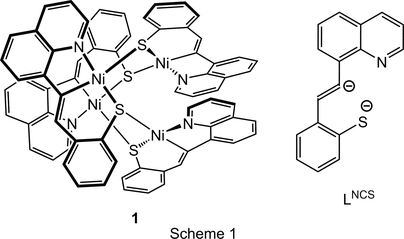
In this article, we report a tetrameric N,C,S-pincer nickel(II) complex, [{Ni(LNCS)}4] (1), where LNCS is a doubly deprotonated form of 2-[2-(quinolin-8-yl)ethenyl]benzenethiol (Scheme 1). The crystal structure of 1 features a thiolate-bridged Ni4S4 ring structure. The solution behaviour of this complex was investigated by NMR spectroscopy, electronic absorption spectroscopy and cyclic voltammetry.
2. Experimental
2.1. General procedures
NMR spectra were recorded on a JEOL ECA-400 or a JEOL ECZ-600 spectrometer at room temperature. Elemental analysis was performed by A Rabbit Science Co. Ltd. UV–Vis spectra were measured on a JASCO V-770 spectrometer. Cyclic voltammetry measurements were performed at room temperature using an ECstat-302 potentio/galvanostat analyzer (EC Frontier Co. Ltd) under a nitrogen atmosphere.
2.2. Synthesis and crystallization
2.2.1. Preparation of 8-(benzo[b]thiophen-2-yl)quinoline (2)
8-(Benzo[b]thiophen-2-yl)quinoline (2) was prepared according to literature procedures and the 1H NMR spectrum (CDCl3) was consistent with the reported data (Masuda et al., 2020; Brodnik et al., 2016). 1H NMR (400 MHz, C6D6): δ 6.75 (dd, J = 8.3, 4.1 Hz, 1H), 7.12 (ddd, J = 8.2, 7.2, 1.1 Hz, 1H), 7.15 (m, 1H), 7.21 (ddd, J = 8.2, 7.2, 1.0 Hz, 1H), 7.28 (dd, J = 8.1, 1.3 Hz, 1H), 7.49 (dd, J = 8.3, 1.8 Hz, 1H), 7.70–7.75 (m, 2H), 7.97 (dd, J = 7.3, 1.4 Hz, 1H), 8.20 (d, J = 0.4 Hz, 1H), 8.80 (dd, J = 4.1, 1.8 Hz, 1H). 1H NMR (400 MHz, pyridine-d5): δ 7.36–7.45 (m, 3H), 7.59 (t, J = 7.8 Hz, 1H), 7.82 (dd, J = 7.4, 1.4 Hz, 1H), 7.97 (m, 1H), 8.05 (m, 1H), 8.19 (dd, J = 8.3, 1.8 Hz, 1H), 8.35 (dd, J = 7.4, 1.4 Hz, 1H), 8.44 (s, 1H), 9.14 (dd, J = 4.1, 1.8 Hz, 1H). 1H NMR [400 MHz, dimethyl sulfoxide-d6 (DMSO-d6)]: δ 7.34–7.42 (m, 2H), 7.66 (dd, J = 8.3, 4.1 Hz, 1H), 7.73 (t, J = 7.8 Hz, 1H), 7.92 (m, 1H), 7.99–8.05 (m, 2H), 8.31 (s, 1H), 8.40 (dd, J = 7.4, 1.3 Hz, 1H), 8.48 (dd, J = 8.3, 1.8 Hz, 1H), 9.07 (dd, J = 4.1, 1.8 Hz, 1H).
2.2.2. Preparation of [{Ni(LNCS)}4] (1)
This complex was prepared in a nitrogen-filled glovebox. Compound 2 (52 mg, 0.2 mmol) and [Ni(cod)2] (cod = 1,5-cyclooctadiene) (55 mg, 0.2 mmol) were dissolved in tetrahydrofuran (THF; 6 ml) below 10 °C and stirred for 30 min. The resulting red–brown suspension was stirred at 25 °C for 12 h. After addition of diethyl ether (40 ml), the dark-brown precipitate of 1 was collected by filtration, washed with diethyl ether (10 ml) and then dried under reduced pressure (yield: 57 mg, 89%).
1H NMR (400 MHz, CDCl3): δ 5.97 (s, 1H, Fe—C=CH), 6.61 [dd, J = 5.3, 7.9 Hz, 1H, C(quinolinyl, 3)—H], 6.65 [m, 1H, C(quinolinyl, 5)—H], 6.90–6.95 [m, 3H, C(quinolinyl, 6)—H, C(benzenethiolate)—H], 7.07 [t, J = 7.6 Hz, 1H, C(benzenethiolate)—H], 7.52 [d, J = 7.8 Hz, 1H, C(benzenethiolate)—H], 8.02 [d, J = 7.9 Hz, 1H, C(quinolinyl, 4)—H], 8.60 [d, J = 4.8 Hz, 1H, C(quinolinyl, 2)—H], 8.97 [m, 1H, C(quinolinyl, 7)—H]. 1H NMR (600 MHz, C6D6): δ 6.17 (s, 1H), 6.21 (dd, J = 7.9, 5.2 Hz, 1H), 6.76 (dd, J = 7.7, 1.2 Hz, 1H), 6.77–6.83 (m, 2H), 6.88 (ddd, J = 8.0, 6.9, 1.4 Hz, 1H), 6.94 (m, 1H), 7.08 (dd, J = 7.5, 1.4 Hz, 1H), 7.38 (dd, J = 8.0, 1.1 Hz, 1H), 8.83 (dd, J = 5.2, 1.2 Hz, 1H), 9.42 (d, J = 7.8 Hz, 1H). 1H NMR (400 MHz, pyridine-d5): δ 7.10 (dd, J = 5.1, 8.1 Hz, 1H), 7.16 (m, 2H), 7.34 (d, J = 4.7 Hz, 1H), 7.54–7.63 (m, 2H), 7.76 (m, 1H), 7.93 (s, 1H), 8.15 (m, 1H), 8.19 (d, J = 8.1 Hz, 1H), 8.38 (d, J = 7.0 Hz, 1H). 1H NMR (400 MHz, DMSO-d6): δ 6.87 (m, 2H), 7.07 (s, 1H), 7.29 (d, J = 6.8 Hz, 1H), 7.51 (d, J = 7.2 Hz, 1H), 7.55–7.63 (m, 2H), 7.78 (d, J = 7.8 Hz, 1H), 8.18 (d, J = 7.2 Hz, 1H), 8.54 (d, J = 8.2 Hz, 1H), 8.67 (d, J = 4.6 Hz, 1H). 13C{1H} NMR (100 MHz, CDCl3): δ 118.9, 122.0, 122.5, 123.5, 125.5, 126.7, 127.2, 128.4, 131.4, 131.9, 132.7, 134.9, 137.4, 142.4, 148.3, 149.8, 150.8. UV–Vis (CH2Cl2): λmax/nm (ɛ/dm3 mol−1 cm−1) 246 (135000), 282 (77000, shoulder), 365 (42500), 430 (23000, shoulder). Analysis calculated (%) for C68H44N4Ni4S4: C 63.80, H 3.46, N 4.38; found: C 63.63, H 3.45, N 3.99.
The product can be recrystallized from dichloromethane–diethyl ether or o-dichlorobenzene–diethyl ether. Crystals of 1 suitable for X-ray were grown from a dichloromethane solution.
2.3. Refinement
Details of the crystal data, data collection and structure are summarized in Table 1. A dichloromethane molecule was modelled to be disordered over two positions, with occupancy factors of 0.85 and 0.15. H atoms were placed at calculated positions, with aromatic C—H = 0.95 Å and methylene C—H = 0.99 Å, and refined using a riding model with Uiso(H) = 1.2Ueq(C), except for the 2-positioned H atoms on the quinoline rings, which are involved in short contacts potentially associated with hydrogen bonding. These H atoms were found in the difference Fourier map and refined isotropically.
|
3. Results and discussion
3.1. Synthesis of complex 1
Treatment of 8-(benzo[b]thiophen-2-yl)quinoline (2) with [Ni(cod)2] (cod = 1,5-cyclooctadiene) in THF at room temperature produced the tetranuclear nickel(II) complex [{Ni(LNCS)}4] (1) in good yield, in which LNCS is an N,C,S-tridentate ligand derived from 2 via C—S bond cleavage. Although complex 1 can be handled in air in the solid state, it rapidly decomposes in solution under aerobic conditions to regenerate 2 (Fig. 1). In contrast, the corresponding reaction of 2-(dibenzo[b,d]thiophen-4-yl)pyridine (3; Fig. 1) with [Ni(cod)2] left most of 3 unreacted under the same conditions, suggesting that 3 is more resistant to cyclometalation via C—S bond cleavage than is 2.
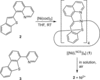 | Figure 1 The structures of ligand precursors 2 and 3, and the reaction of 2. |
3.2. Structure of complex 1
Complex 1 crystallizes as a CH2Cl2 solvate in the tetragonal I41/a (No. 88) with a half molecule of 1 and a CH2Cl2 molecule in the (Figs. 2 and 3). The complete molecule of 1, which is generated by the symmetry operation (−x + 1, −y +  , z), has a tetrameric structure consisting of four Ni(LNCS) units. The LNCS ligand acts as a tridentate ligand, ligated through its N, C and S atoms. The fourth coordination site at Ni is occupied by the thiolate S atom of another Ni(LNCS) unit to form an Ni—S bond and thus complete a square-planar coordination geometry. The geometric parameters around Ni1 and Ni2 are comparable to each other (Table 2). Two sets of the face-to-face dimer of Ni(LNCS) (Ni1/Ni1i and Ni2/Ni2i) are linked to each other through Ni—S bonds, giving the tetrameric molecule [{Ni(LNCS)}4]. Thiolate-bridged tetrameric structures similar to 1 have been reported for [{Ni(LCNS)}4] with C,N,S-tridentate ligands (Kawamoto & Kushi, 2004) and [{Ni(LONS)}4] with O,N,S-tridentate ligands (Bag & Pal, 2022), where LCNS is 2-[(2,4-dichlorobenzylidene)amino]benzenethiolate(2−) and LONS is 2-{[(2-mercaptophenyl)imino]methyl}-6-methoxyphenolate(2−). The Ni(LNCS) unit in 1 adopts an almost planar geometry; the r.m.s. deviation of the fitted atoms from the mean plane including the two chelate rings (Ni1/S1/N1/C1/C6–C10 and Ni2/S2/N2/C18/C23–C27) is 0.067 Å. The interplanar angles for the cofacial pairs of the Ni(LNCS) units are 16.02 (4) and 16.08 (4)°, which are larger, respectively, than those of [{Ni(LCNS)}4] and [{Ni(LONS)}4] (0.1–6.0°) (Kawamoto & Kushi, 2004; Bag & Pal, 2022). Relatively short (quinoline)C—H⋯S contacts are found between the Ni(LNCS) units in a molecule, with H⋯S distances of 2.52 (4) and 2.50 (3) Å (Fig. 3 and Table 3).
|
 .
| ||||||||||||||||||||||
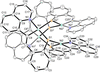 | Figure 2 Perspective view of 1, with displacement ellipsoids drawn at the 50% probability level. H atoms have been omitted for clarity. [Symmetry code: (i) −x + 1, −y + , z.] |
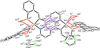 | Figure 3 View of the Ni4S4 ring (red) in the CH2Cl2 solvate of 1 and the π–π stacking interaction between the C9–C14 (blue) and C26ii–C31ii (magenta) rings. The half molecule of 1, excluding the Ni and S atoms, and H atoms have been omitted for clarity, except for the 2-positioned H atoms on the quinoline rings. [Symmetry codes: (i) −x + 1, −y + , z; (ii) y +  , −x +  , z + ; (iii) −y +  , x + , z + .] |
The four Ni—S—Ni bridging structures in 1 construct a puckered Ni4S4 ring (Figs. 2 and 3). Similar thiolate-bridged cyclic structures, M4S4 (M is a transition metal), have been reported for Group 10 metal complexes. The palladium(II) complexes (Pd4S4) contain C,N,S-tridentate ligands (Kawamoto et al., 1996; Kawamoto et al., 2003), O,N,S-tridentate ligands (Roy et al., 2009; Moosun et al., 2016), or an S,N,S-tridentate ligand (Ataie et al., 2025). The platinum(II) complexes (Pt4S4) contain C,N,S-tridentate ligands (Kawamoto et al., 1996; Kawamoto et al., 1997). However, a pincer unit containing a central C-donor atom has been applied to the M4S4 cyclic structures for the first time in this study. Therefore, the geometrical parameters of the Ni4S4 ring for 1 were compared with those of [{Ni(LCNS)}4] and [{Ni(LONS)}4], and the results are summarized in Table 4. To visualize the differences, the Ni4S4 rings of these complexes are overlaid in Fig. 4. The differences between the intra-unit and inter-unit Ni—S bond lengths in 1 (0.19 Å) are larger than those in [{Ni(LCNS)}4] and [{Ni(LONS)}4], which can be attributed to the trans influence of the C-donor atom in the LNCS ligand. The S—Ni—S and Ni—S—Ni angles in 1 are smaller and larger than those in the analogous Ni4S4 rings. The Ni⋯Ni distances in 1 [2.9639 (9) and 2.9486 (9) Å] are shorter than those of [{Ni(LCNS)}4] and [{Ni(LONS)}4], although no bonding interactions are suggested (Kawamoto & Kushi, 2004; Bag & Pal, 2022).
|
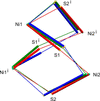 | Figure 4 Overlays of the Ni4S4 ring structures of 1 (red), [{Ni(LCNS)}4] (blue) (Kawamoto & Kushi, 2004 ) and [{Ni(LONS)}4] (green) (Bag & Pal, 2022). The atom labels are given for 1. Intra-unit and inter-unit Ni—S bonds are drawn as thick and thin lines, respectively. [Symmetry code: (i) −x + 1, −y + , z.] |
In the of 1, intermolecular π–π stacking interactions exist between the quinoline rings of neighbouring molecules (Figs. 3 and 5). The distance between the two centroids of the C9–C14 (at x, y, z) and C26–C31 (at y + , −x + , z + ) rings is 3.748 Å. The interplanar separation is 3.58 Å and the angle between the planes is 3.66°. The benzenethiolate moieties do not contribute to the stacking interactions, and the void space between these moieties is occupied by a CH2Cl2 molecule.
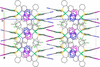 | Figure 5 The crystal packing of the CH2Cl2 solvate of 1. H atoms have been omitted for clarity. The C9–C14 and C26–C31 rings associated with intermolecular π–π stacking interactions are shown in blue and magenta, respectively. |
3.3. Electrochemical properties
The N,C,S-tridentate ligand LNCS and related ligands tend to stabilize the higher oxidation states of iron complexes (Masuda et al., 2020; Nakae et al., 2018). Fig. 6 shows the cyclic voltammograms of 1 and 2 in CH2Cl2. Measurements were performed in a 5.0 × 10⁻⁴ M (1 M = 1 mol dm−3) solution containing Bu4NPF6 (0.1 M), at a scan rate of 0.1 V s−1. The working electrode was a glassy carbon disk electrode with a diameter of 3 mm, the auxiliary electrode was a platinum wire, and the reference electrode was a Ag/Ag+ (0.010 M AgNO3) electrode. In the scanned potential range of −1.0 to 0.6 V versus ferrocenium/ferrocene (Fc+/Fc), overlapping anodic peaks were observed at 0.0 and 0.23 V, which revealed that complex 1 can be oxidized at low potentials. On the reverse scan, cathodic waves were observed at 0.1 V and in the more negative region. The reverse scan from 0.1 V revealed the irreversible nature of the first oxidation process. The cathodic currents in the range of −0.9 to −1.6 V are dependent on the switching potentials, implying that the are reduced in this potential region.
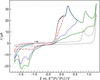 | Figure 6 Cyclic voltammograms of 1 (5.0 × 10⁻⁴ M) with different switching potentials (0.07 V, red dashed–dotted line; 0.57 V, blue dashed line; 1.27 V, green line) and 2 (5.0 × 10⁻⁴ M, black dotted line) in CH2Cl2. Potentials are versus ferrocenium/ferrocene (Fc+/Fc). |
The anodic scan to 1.3 V revealed an anodic peak at 0.86 V, similar to that observed for the ligand precursor 2. A possible explanation for these results is that the oxidation processes induce the reductive elimination of LNCS to form 2 via the cleavage of inter-unit Ni—S bonds. Furthermore, the multistep oxidation processes suggest the presence of the multinuclear structure of 1 in solution.
3.4. Spectroscopic features
The 1H and 13C{1H} NMR spectra of 1 in dry CDCl3 showed a set of signals corresponding to one LNCS ligand, indicating that four Ni(LNCS) units in 1 are equivalent in solution under inert atmospheric conditions. The vinyl proton signal of 1 (δ 5.97) showed an obvious high-field shift compared with the corresponding signal of 2 (δ 8.10). NMR monitoring at 22 °C revealed the slow decomposition of 1 to form precursor 2 (∼10% conversion after 17 h under inert atmospheric conditions). A similar high-field shift was also observed in C6D6 (δ 6.17 for 1 and δ 8.20 for 2). Fig. 7 shows the UV–Vis absorption spectral changes of a CH2Cl2 solution of 1 under ambient conditions at 26 °C. The absorption bands at around 365 and 430 nm are tentatively assigned to transitions with predominantly metal-to-ligand charge-transfer character (Huang et al., 2011; Gao et al., 2025). The intensities of these bands decreased with time, and the final spectrum after 130 min was largely similar to that of 2. Much slower spectral changes were observed under inert atmospheric conditions, which is consistent with the NMR experiments.
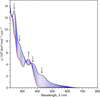 | Figure 7 Absorption spectral changes of a CH2Cl2 solution of 1 prepared under ambient conditions (26 °C, 130 min). The black and red lines represent the initial and final spectra, respectively. The spectra were recorded every 10 min (blue lines). |
A red–brown solution of 1 in pyridine-d5 also showed a set of 1H NMR signals assignable to the LNCS ligand under an inert atmosphere. The high-field shift of the vinyl proton signal (δ 7.93 for 1 and δ 8.44 for 2) is smaller than that observed in CDCl3 or C6D6, and the overall spectrum remained unchanged for two weeks. In the absorption spectrum of a pyridine solution of 1, the absorption bands at 387 and 468 nm disappeared within 20 min under ambient conditions at 24 °C (Fig. 8). A modest high-field shift (δ 7.07 for 1 and δ 8.31 for 2) and similarly rapid degradation in air were also observed in a DMSO-d6 (or DMSO) solution of 1. These results suggest that the solution species derived from 1 in solution is stabilized by coordinating solvents and undergoes of LNCS to generate precursor 2. The generated nickel(0) species can be readily oxidized to Ni2+ in air.
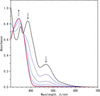 | Figure 8 Absorption spectral changes of a pyridine solution of 1 under ambient conditions (24 °C, 30 min). The black line represents the spectrum under inert atmospheric conditions. After exposure to the air, the spectra were recorded every 6 min (blue lines), and the red line represents the final spectrum. |
4. Conclusions
The of the tetranuclear nickel(II) complex [{Ni(LNCS)}4] (1) revealed that the N,C,S-pincer units, Ni(LNCS), form a puckered Ni4S4 ring structure in the solid state. The inter-unit Ni—S bonds in 1 are longer than those observed in related complexes containing C,N,S- or O,N,S-tridentate ligands, presumably because of the stronger trans influence of the central C-donor atom in LNCS. The NMR spectra and cyclic voltammograms of 1 suggest that the tetranuclear structure is retained in non-coordinating solvents, although 1 is sensitive to oxygen, particularly in the presence of coordinating solvents. On the other hand, complex 1 can be handled in air in the solid state and could potentially serve as a nickel(0) precursor.
Supporting information
CCDC reference: 2603547
contains datablocks I, global. DOI: https://doi.org/10.1107/S2053229626011952/qf3080sup1.cif
Structure factors: contains datablock I. DOI: https://doi.org/10.1107/S2053229626011952/qf3080Isup2.hkl
Supporting information file. DOI: https://doi.org/10.1107/S2053229626011952/qf3080Isup3.cml
NMR and UV-Vis spectra. DOI: https://doi.org/10.1107/S2053229626011952/qf3080sup4.docx
| [Ni4(C17H12NS)4]·2CH2Cl2 | Dx = 1.686 Mg m−3 |
| Mr = 1450.00 | Mo Kα radiation, λ = 0.71075 Å |
| Tetragonal, I41/a | Cell parameters from 12570 reflections |
| a = 16.649 (3) Å | θ = 3.1–27.5° |
| c = 41.225 (7) Å | µ = 1.68 mm−1 |
| V = 11427 (5) Å3 | T = 120 K |
| Z = 8 | Prism, brown |
| F(000) = 5920 | 0.07 × 0.06 × 0.04 mm |
| Rigaku AFC11 with Saturn 724+ CCD diffractometer | 6553 independent reflections |
| Radiation source: Rotating Anode | 5818 reflections with I > 2σ(I) |
| Detector resolution: 28.5714 pixels mm-1 | Rint = 0.054 |
| ω scans | θmax = 27.5°, θmin = 3.1° |
| Absorption correction: multi-scan (REQAB; Rigaku, 1998) | h = −21→21 |
| Tmin = 0.902, Tmax = 1.000 | k = −21→21 |
| 93479 measured reflections | l = −53→53 |
| Refinement on F2 | Primary atom site location: structure-invariant direct methods |
| Least-squares matrix: full | Hydrogen site location: mixed |
| R[F2 > 2σ(F2)] = 0.057 | H atoms treated by a mixture of independent and constrained refinement |
| wR(F2) = 0.151 | w = 1/[σ2(Fo2) + (0.0799P)2 + 32.993P] where P = (Fo2 + 2Fc2)/3 |
| S = 1.14 | (Δ/σ)max = 0.002 |
| 6553 reflections | Δρmax = 1.63 e Å−3 |
| 408 parameters | Δρmin = −0.70 e Å−3 |
| 2 restraints |
Geometry. All esds (except the esd in the dihedral angle between two l.s. planes) are estimated using the full covariance matrix. The cell esds are taken into account individually in the estimation of esds in distances, angles and torsion angles; correlations between esds in cell parameters are only used when they are defined by crystal symmetry. An approximate (isotropic) treatment of cell esds is used for estimating esds involving l.s. planes. |
| x | y | z | Uiso*/Ueq | Occ. (<1) | |
| Ni1 | 0.52197 (2) | 0.33626 (2) | 0.66106 (2) | 0.01694 (13) | |
| Ni2 | 0.58613 (2) | 0.22942 (2) | 0.58154 (2) | 0.01686 (13) | |
| Cl1 | 0.78353 (7) | 0.50018 (7) | 0.67290 (3) | 0.0473 (3) | |
| Cl2A | 0.72579 (12) | 0.52298 (12) | 0.60607 (3) | 0.0654 (5) | 0.85 |
| Cl2B | 0.7705 (7) | 0.4741 (6) | 0.60807 (19) | 0.065 (3) | 0.15 |
| S1 | 0.61194 (4) | 0.31258 (5) | 0.62553 (2) | 0.01902 (18) | |
| S2 | 0.56202 (4) | 0.13972 (4) | 0.61710 (2) | 0.01850 (17) | |
| N1 | 0.44142 (16) | 0.36724 (15) | 0.69251 (6) | 0.0191 (5) | |
| N2 | 0.62117 (15) | 0.30878 (16) | 0.55025 (6) | 0.0196 (5) | |
| C1 | 0.70593 (18) | 0.28064 (19) | 0.64002 (8) | 0.0213 (6) | |
| C2 | 0.7612 (2) | 0.2506 (2) | 0.61727 (8) | 0.0268 (7) | |
| H2 | 0.745798 | 0.245700 | 0.595172 | 0.032* | |
| C3 | 0.8378 (2) | 0.2281 (2) | 0.62668 (9) | 0.0295 (7) | |
| H3 | 0.874122 | 0.206285 | 0.611257 | 0.035* | |
| C4 | 0.8611 (2) | 0.2376 (2) | 0.65881 (9) | 0.0314 (8) | |
| H4 | 0.914167 | 0.224050 | 0.665266 | 0.038* | |
| C5 | 0.8072 (2) | 0.2667 (2) | 0.68132 (8) | 0.0262 (7) | |
| H5 | 0.823941 | 0.272466 | 0.703220 | 0.031* | |
| C6 | 0.72808 (19) | 0.28804 (19) | 0.67290 (8) | 0.0221 (6) | |
| C7 | 0.67374 (19) | 0.31547 (19) | 0.69796 (7) | 0.0225 (6) | |
| H7 | 0.697528 | 0.321739 | 0.718755 | 0.027* | |
| C8 | 0.59509 (19) | 0.33353 (18) | 0.69663 (7) | 0.0201 (6) | |
| C9 | 0.47151 (19) | 0.37610 (18) | 0.72353 (7) | 0.0210 (6) | |
| C10 | 0.5541 (2) | 0.35948 (19) | 0.72674 (8) | 0.0226 (6) | |
| C11 | 0.5870 (2) | 0.3695 (2) | 0.75738 (8) | 0.0280 (7) | |
| H11 | 0.642385 | 0.358394 | 0.760657 | 0.034* | |
| C12 | 0.5400 (2) | 0.3959 (2) | 0.78377 (8) | 0.0324 (8) | |
| H12 | 0.564759 | 0.403626 | 0.804296 | 0.039* | |
| C13 | 0.4602 (2) | 0.4106 (2) | 0.78058 (8) | 0.0297 (7) | |
| H13 | 0.429517 | 0.427507 | 0.798755 | 0.036* | |
| C14 | 0.4230 (2) | 0.4005 (2) | 0.74982 (8) | 0.0237 (7) | |
| C15 | 0.3408 (2) | 0.4142 (2) | 0.74370 (8) | 0.0270 (7) | |
| H15 | 0.306084 | 0.430388 | 0.760782 | 0.032* | |
| C16 | 0.3114 (2) | 0.4040 (2) | 0.71292 (8) | 0.0260 (7) | |
| H16 | 0.256022 | 0.412671 | 0.708572 | 0.031* | |
| C17 | 0.36372 (19) | 0.3807 (2) | 0.68774 (8) | 0.0229 (6) | |
| C18 | 0.53356 (18) | 0.04493 (18) | 0.60295 (7) | 0.0201 (6) | |
| C19 | 0.5101 (2) | −0.0128 (2) | 0.62587 (8) | 0.0261 (7) | |
| H19 | 0.505865 | 0.002263 | 0.648027 | 0.031* | |
| C20 | 0.4931 (2) | −0.0908 (2) | 0.61703 (9) | 0.0293 (7) | |
| H20 | 0.477229 | −0.128900 | 0.632944 | 0.035* | |
| C21 | 0.4993 (2) | −0.1133 (2) | 0.58449 (9) | 0.0302 (8) | |
| H21 | 0.488628 | −0.167148 | 0.578167 | 0.036* | |
| C22 | 0.5211 (2) | −0.05687 (19) | 0.56158 (8) | 0.0240 (6) | |
| H22 | 0.524728 | −0.072804 | 0.539495 | 0.029* | |
| C23 | 0.53825 (18) | 0.02350 (19) | 0.56976 (8) | 0.0210 (6) | |
| C24 | 0.56224 (19) | 0.07822 (19) | 0.54427 (7) | 0.0213 (6) | |
| H24 | 0.564380 | 0.055304 | 0.523183 | 0.026* | |
| C25 | 0.58208 (18) | 0.15679 (19) | 0.54579 (7) | 0.0196 (6) | |
| C26 | 0.63132 (18) | 0.27838 (19) | 0.51947 (7) | 0.0205 (6) | |
| C27 | 0.61179 (18) | 0.19633 (19) | 0.51597 (7) | 0.0198 (6) | |
| C28 | 0.6237 (2) | 0.1625 (2) | 0.48571 (8) | 0.0260 (7) | |
| H28 | 0.610735 | 0.107562 | 0.482407 | 0.031* | |
| C29 | 0.6549 (2) | 0.2079 (2) | 0.45957 (8) | 0.0298 (7) | |
| H29 | 0.663364 | 0.182558 | 0.439210 | 0.036* | |
| C30 | 0.6730 (2) | 0.2871 (2) | 0.46304 (8) | 0.0294 (7) | |
| H30 | 0.693335 | 0.316918 | 0.445192 | 0.035* | |
| C31 | 0.6611 (2) | 0.3250 (2) | 0.49367 (8) | 0.0239 (7) | |
| C32 | 0.6786 (2) | 0.4069 (2) | 0.49981 (8) | 0.0282 (7) | |
| H32 | 0.698713 | 0.440564 | 0.483060 | 0.034* | |
| C33 | 0.6658 (2) | 0.4368 (2) | 0.53041 (8) | 0.0266 (7) | |
| H33 | 0.676198 | 0.491751 | 0.534929 | 0.032* | |
| C34 | 0.6371 (2) | 0.38572 (19) | 0.55516 (8) | 0.0235 (6) | |
| C35A | 0.7022 (3) | 0.5164 (3) | 0.64696 (13) | 0.0434 (12) | 0.85 |
| H35A | 0.663244 | 0.472103 | 0.649948 | 0.052* | 0.85 |
| H35B | 0.675150 | 0.566833 | 0.653543 | 0.052* | 0.85 |
| C35B | 0.7155 (13) | 0.4817 (19) | 0.6425 (4) | 0.0434 (12) | 0.15 |
| H35C | 0.685945 | 0.431115 | 0.646660 | 0.052* | 0.15 |
| H35D | 0.676329 | 0.526181 | 0.640730 | 0.052* | 0.15 |
| H17 | 0.3469 (18) | 0.3742 (17) | 0.6651 (7) | 0.000 (7)* | |
| H34 | 0.628 (2) | 0.405 (2) | 0.5775 (9) | 0.018 (9)* |
| U11 | U22 | U33 | U12 | U13 | U23 | |
| Ni1 | 0.0189 (2) | 0.0188 (2) | 0.0132 (2) | 0.00020 (14) | −0.00029 (13) | −0.00131 (13) |
| Ni2 | 0.0196 (2) | 0.0180 (2) | 0.0130 (2) | −0.00020 (14) | 0.00159 (13) | 0.00020 (13) |
| Cl1 | 0.0503 (6) | 0.0456 (6) | 0.0459 (6) | 0.0006 (5) | −0.0061 (5) | 0.0051 (5) |
| Cl2A | 0.0843 (12) | 0.0812 (12) | 0.0307 (7) | −0.0468 (10) | −0.0022 (7) | −0.0014 (7) |
| Cl2B | 0.095 (7) | 0.069 (6) | 0.030 (4) | −0.049 (5) | −0.006 (4) | 0.009 (4) |
| S1 | 0.0200 (4) | 0.0220 (4) | 0.0151 (3) | 0.0003 (3) | 0.0007 (3) | −0.0020 (3) |
| S2 | 0.0218 (4) | 0.0198 (4) | 0.0139 (3) | −0.0007 (3) | 0.0012 (3) | 0.0008 (3) |
| N1 | 0.0231 (13) | 0.0175 (12) | 0.0166 (12) | −0.0009 (10) | 0.0016 (10) | −0.0002 (9) |
| N2 | 0.0208 (13) | 0.0220 (13) | 0.0162 (12) | 0.0011 (10) | −0.0002 (10) | −0.0012 (10) |
| C1 | 0.0201 (15) | 0.0222 (15) | 0.0216 (15) | −0.0007 (12) | −0.0004 (12) | 0.0005 (12) |
| C2 | 0.0261 (17) | 0.0332 (18) | 0.0211 (16) | 0.0006 (14) | 0.0040 (12) | −0.0023 (13) |
| C3 | 0.0236 (17) | 0.0353 (19) | 0.0296 (18) | 0.0051 (14) | 0.0069 (13) | 0.0002 (14) |
| C4 | 0.0205 (16) | 0.037 (2) | 0.037 (2) | 0.0019 (14) | −0.0005 (14) | 0.0024 (15) |
| C5 | 0.0242 (16) | 0.0289 (17) | 0.0254 (16) | −0.0012 (13) | −0.0035 (13) | 0.0020 (13) |
| C6 | 0.0234 (16) | 0.0200 (15) | 0.0228 (15) | −0.0014 (12) | −0.0003 (12) | −0.0006 (12) |
| C7 | 0.0242 (16) | 0.0266 (16) | 0.0168 (14) | −0.0035 (12) | −0.0064 (12) | −0.0012 (12) |
| C8 | 0.0249 (16) | 0.0187 (14) | 0.0166 (14) | −0.0033 (12) | −0.0013 (11) | 0.0000 (11) |
| C9 | 0.0267 (16) | 0.0202 (15) | 0.0159 (14) | 0.0003 (12) | 0.0003 (12) | 0.0010 (11) |
| C10 | 0.0272 (16) | 0.0214 (15) | 0.0193 (15) | 0.0012 (12) | −0.0006 (12) | 0.0005 (12) |
| C11 | 0.0319 (18) | 0.0344 (19) | 0.0175 (15) | 0.0026 (14) | −0.0050 (13) | −0.0002 (13) |
| C12 | 0.044 (2) | 0.0361 (19) | 0.0173 (16) | 0.0062 (16) | −0.0032 (14) | −0.0033 (14) |
| C13 | 0.042 (2) | 0.0322 (18) | 0.0150 (15) | 0.0037 (15) | 0.0037 (13) | −0.0028 (13) |
| C14 | 0.0301 (17) | 0.0261 (16) | 0.0151 (14) | 0.0008 (13) | 0.0047 (12) | −0.0002 (12) |
| C15 | 0.0305 (18) | 0.0295 (17) | 0.0209 (15) | 0.0016 (14) | 0.0081 (13) | −0.0004 (13) |
| C16 | 0.0218 (16) | 0.0294 (17) | 0.0269 (17) | −0.0007 (13) | 0.0044 (13) | 0.0015 (13) |
| C17 | 0.0230 (16) | 0.0262 (16) | 0.0194 (15) | 0.0010 (12) | 0.0005 (12) | 0.0002 (12) |
| C18 | 0.0198 (14) | 0.0200 (14) | 0.0204 (15) | 0.0009 (11) | 0.0022 (11) | 0.0006 (11) |
| C19 | 0.0308 (17) | 0.0260 (16) | 0.0215 (15) | −0.0005 (13) | −0.0007 (13) | 0.0036 (13) |
| C20 | 0.038 (2) | 0.0240 (17) | 0.0260 (17) | −0.0032 (14) | −0.0009 (14) | 0.0086 (13) |
| C21 | 0.039 (2) | 0.0195 (16) | 0.0319 (19) | −0.0027 (14) | −0.0005 (15) | −0.0012 (13) |
| C22 | 0.0283 (16) | 0.0222 (15) | 0.0214 (15) | −0.0011 (12) | 0.0004 (12) | −0.0049 (12) |
| C23 | 0.0194 (14) | 0.0219 (15) | 0.0216 (15) | 0.0016 (11) | 0.0001 (11) | −0.0019 (12) |
| C24 | 0.0239 (15) | 0.0255 (16) | 0.0145 (13) | 0.0014 (12) | 0.0003 (11) | −0.0025 (11) |
| C25 | 0.0198 (14) | 0.0265 (16) | 0.0124 (13) | 0.0025 (12) | −0.0002 (11) | −0.0009 (11) |
| C26 | 0.0203 (15) | 0.0234 (15) | 0.0179 (14) | 0.0015 (12) | −0.0014 (11) | 0.0017 (11) |
| C27 | 0.0196 (14) | 0.0234 (15) | 0.0165 (14) | 0.0000 (12) | 0.0010 (11) | 0.0008 (11) |
| C28 | 0.0305 (18) | 0.0273 (17) | 0.0203 (16) | −0.0004 (13) | 0.0023 (13) | −0.0008 (13) |
| C29 | 0.0337 (19) | 0.040 (2) | 0.0162 (15) | −0.0022 (15) | 0.0055 (13) | −0.0021 (13) |
| C30 | 0.0297 (17) | 0.044 (2) | 0.0149 (15) | 0.0002 (15) | 0.0045 (12) | 0.0080 (14) |
| C31 | 0.0257 (16) | 0.0271 (17) | 0.0190 (15) | −0.0018 (13) | −0.0007 (12) | 0.0034 (12) |
| C32 | 0.0300 (18) | 0.0291 (18) | 0.0254 (17) | −0.0001 (14) | −0.0001 (13) | 0.0099 (13) |
| C33 | 0.0328 (18) | 0.0203 (15) | 0.0268 (17) | −0.0004 (13) | 0.0002 (13) | 0.0040 (13) |
| C34 | 0.0249 (16) | 0.0233 (16) | 0.0223 (16) | 0.0004 (12) | −0.0010 (12) | 0.0021 (12) |
| C35A | 0.054 (3) | 0.030 (3) | 0.046 (3) | −0.015 (2) | 0.004 (2) | −0.009 (2) |
| C35B | 0.054 (3) | 0.030 (3) | 0.046 (3) | −0.015 (2) | 0.004 (2) | −0.009 (2) |
| Ni1—C8 | 1.906 (3) | C13—C14 | 1.421 (5) |
| Ni1—N1 | 1.935 (3) | C13—H13 | 0.9500 |
| Ni1—S1 | 2.1320 (9) | C14—C15 | 1.411 (5) |
| Ni1—S2i | 2.3241 (9) | C15—C16 | 1.371 (5) |
| Ni1—Ni1i | 2.9639 (9) | C15—H15 | 0.9500 |
| Ni2—C25 | 1.908 (3) | C16—C17 | 1.410 (4) |
| Ni2—N2 | 1.936 (3) | C16—H16 | 0.9500 |
| Ni2—S2 | 2.1308 (8) | C17—H17 | 0.98 (3) |
| Ni2—S1 | 2.3217 (9) | C18—C19 | 1.403 (4) |
| Ni2—Ni2i | 2.9486 (9) | C18—C23 | 1.416 (4) |
| Cl1—C35B | 1.718 (18) | C19—C20 | 1.378 (5) |
| Cl1—C35A | 1.747 (5) | C19—H19 | 0.9500 |
| Cl2A—C35A | 1.734 (5) | C20—C21 | 1.397 (5) |
| Cl2B—C35B | 1.693 (18) | C20—H20 | 0.9500 |
| S1—C1 | 1.757 (3) | C21—C22 | 1.381 (5) |
| S2—C18 | 1.748 (3) | C21—H21 | 0.9500 |
| N1—C17 | 1.328 (4) | C22—C23 | 1.409 (4) |
| N1—C9 | 1.381 (4) | C22—H22 | 0.9500 |
| N2—C34 | 1.324 (4) | C23—C24 | 1.447 (4) |
| N2—C26 | 1.376 (4) | C24—C25 | 1.351 (4) |
| C1—C2 | 1.406 (4) | C24—H24 | 0.9500 |
| C1—C6 | 1.410 (4) | C25—C27 | 1.480 (4) |
| C2—C3 | 1.384 (5) | C26—C31 | 1.407 (4) |
| C2—H2 | 0.9500 | C26—C27 | 1.412 (4) |
| C3—C4 | 1.389 (5) | C27—C28 | 1.383 (4) |
| C3—H3 | 0.9500 | C28—C29 | 1.415 (5) |
| C4—C5 | 1.379 (5) | C28—H28 | 0.9500 |
| C4—H4 | 0.9500 | C29—C30 | 1.360 (5) |
| C5—C6 | 1.407 (5) | C29—H29 | 0.9500 |
| C5—H5 | 0.9500 | C30—C31 | 1.425 (5) |
| C6—C7 | 1.447 (4) | C30—H30 | 0.9500 |
| C7—C8 | 1.345 (5) | C31—C32 | 1.418 (5) |
| C7—H7 | 0.9500 | C32—C33 | 1.373 (5) |
| C8—C10 | 1.481 (4) | C32—H32 | 0.9500 |
| C9—C10 | 1.408 (5) | C33—C34 | 1.411 (4) |
| C9—C14 | 1.411 (4) | C33—H33 | 0.9500 |
| C10—C11 | 1.387 (4) | C34—H34 | 0.99 (4) |
| C11—C12 | 1.411 (5) | C35A—H35A | 0.9900 |
| C11—H11 | 0.9500 | C35A—H35B | 0.9900 |
| C12—C13 | 1.356 (5) | C35B—H35C | 0.9900 |
| C12—H12 | 0.9500 | C35B—H35D | 0.9900 |
| C8—Ni1—N1 | 86.20 (12) | C9—C14—C13 | 118.0 (3) |
| C8—Ni1—S1 | 94.33 (10) | C16—C15—C14 | 119.5 (3) |
| N1—Ni1—S1 | 175.18 (8) | C16—C15—H15 | 120.3 |
| C8—Ni1—S2i | 171.21 (9) | C14—C15—H15 | 120.3 |
| N1—Ni1—S2i | 93.42 (8) | C15—C16—C17 | 119.7 (3) |
| S1—Ni1—S2i | 85.33 (3) | C15—C16—H16 | 120.2 |
| C8—Ni1—Ni1i | 97.74 (9) | C17—C16—H16 | 120.2 |
| N1—Ni1—Ni1i | 95.00 (8) | N1—C17—C16 | 122.7 (3) |
| S1—Ni1—Ni1i | 89.67 (3) | N1—C17—H17 | 113.6 (17) |
| S2i—Ni1—Ni1i | 91.04 (2) | C16—C17—H17 | 123.7 (18) |
| C25—Ni2—N2 | 85.90 (12) | C19—C18—C23 | 119.5 (3) |
| C25—Ni2—S2 | 94.62 (10) | C19—C18—S2 | 118.0 (2) |
| N2—Ni2—S2 | 173.32 (8) | C23—C18—S2 | 122.3 (2) |
| C25—Ni2—S1 | 171.13 (9) | C20—C19—C18 | 121.7 (3) |
| N2—Ni2—S1 | 93.31 (8) | C20—C19—H19 | 119.2 |
| S2—Ni2—S1 | 85.15 (3) | C18—C19—H19 | 119.2 |
| C25—Ni2—Ni2i | 96.48 (9) | C19—C20—C21 | 119.4 (3) |
| N2—Ni2—Ni2i | 97.73 (8) | C19—C20—H20 | 120.3 |
| S2—Ni2—Ni2i | 88.84 (3) | C21—C20—H20 | 120.3 |
| S1—Ni2—Ni2i | 92.38 (2) | C22—C21—C20 | 119.6 (3) |
| C1—S1—Ni1 | 116.61 (11) | C22—C21—H21 | 120.2 |
| C1—S1—Ni2 | 104.47 (11) | C20—C21—H21 | 120.2 |
| Ni1—S1—Ni2 | 121.13 (4) | C21—C22—C23 | 122.4 (3) |
| C18—S2—Ni2 | 117.02 (11) | C21—C22—H22 | 118.8 |
| C18—S2—Ni1i | 104.62 (10) | C23—C22—H22 | 118.8 |
| Ni2—S2—Ni1i | 121.96 (4) | C22—C23—C18 | 117.4 (3) |
| C17—N1—C9 | 118.2 (3) | C22—C23—C24 | 118.7 (3) |
| C17—N1—Ni1 | 128.4 (2) | C18—C23—C24 | 123.9 (3) |
| C9—N1—Ni1 | 113.4 (2) | C25—C24—C23 | 130.1 (3) |
| C34—N2—C26 | 118.2 (3) | C25—C24—H24 | 115.0 |
| C34—N2—Ni2 | 128.2 (2) | C23—C24—H24 | 115.0 |
| C26—N2—Ni2 | 113.6 (2) | C24—C25—C27 | 118.3 (3) |
| C2—C1—C6 | 120.1 (3) | C24—C25—Ni2 | 131.2 (2) |
| C2—C1—S1 | 117.6 (2) | C27—C25—Ni2 | 110.4 (2) |
| C6—C1—S1 | 122.2 (2) | N2—C26—C31 | 122.5 (3) |
| C3—C2—C1 | 120.8 (3) | N2—C26—C27 | 114.9 (3) |
| C3—C2—H2 | 119.6 | C31—C26—C27 | 122.5 (3) |
| C1—C2—H2 | 119.6 | C28—C27—C26 | 116.9 (3) |
| C2—C3—C4 | 119.6 (3) | C28—C27—C25 | 128.1 (3) |
| C2—C3—H3 | 120.2 | C26—C27—C25 | 115.0 (3) |
| C4—C3—H3 | 120.2 | C27—C28—C29 | 121.5 (3) |
| C5—C4—C3 | 120.0 (3) | C27—C28—H28 | 119.3 |
| C5—C4—H4 | 120.0 | C29—C28—H28 | 119.3 |
| C3—C4—H4 | 120.0 | C30—C29—C28 | 121.3 (3) |
| C4—C5—C6 | 122.1 (3) | C30—C29—H29 | 119.4 |
| C4—C5—H5 | 118.9 | C28—C29—H29 | 119.4 |
| C6—C5—H5 | 118.9 | C29—C30—C31 | 119.4 (3) |
| C5—C6—C1 | 117.4 (3) | C29—C30—H30 | 120.3 |
| C5—C6—C7 | 119.3 (3) | C31—C30—H30 | 120.3 |
| C1—C6—C7 | 123.4 (3) | C26—C31—C32 | 117.9 (3) |
| C8—C7—C6 | 130.6 (3) | C26—C31—C30 | 118.4 (3) |
| C8—C7—H7 | 114.7 | C32—C31—C30 | 123.7 (3) |
| C6—C7—H7 | 114.7 | C33—C32—C31 | 118.7 (3) |
| C7—C8—C10 | 118.7 (3) | C33—C32—H32 | 120.6 |
| C7—C8—Ni1 | 131.2 (2) | C31—C32—H32 | 120.6 |
| C10—C8—Ni1 | 110.1 (2) | C32—C33—C34 | 119.9 (3) |
| N1—C9—C10 | 114.8 (3) | C32—C33—H33 | 120.0 |
| N1—C9—C14 | 122.3 (3) | C34—C33—H33 | 120.0 |
| C10—C9—C14 | 122.9 (3) | N2—C34—C33 | 122.7 (3) |
| C11—C10—C9 | 116.6 (3) | N2—C34—H34 | 115 (2) |
| C11—C10—C8 | 128.0 (3) | C33—C34—H34 | 122 (2) |
| C9—C10—C8 | 115.4 (3) | Cl2A—C35A—Cl1 | 115.4 (3) |
| C10—C11—C12 | 121.3 (3) | Cl2A—C35A—H35A | 108.4 |
| C10—C11—H11 | 119.3 | Cl1—C35A—H35A | 108.4 |
| C12—C11—H11 | 119.3 | Cl2A—C35A—H35B | 108.4 |
| C13—C12—C11 | 121.6 (3) | Cl1—C35A—H35B | 108.4 |
| C13—C12—H12 | 119.2 | H35A—C35A—H35B | 107.5 |
| C11—C12—H12 | 119.2 | Cl2B—C35B—Cl1 | 105.6 (11) |
| C12—C13—C14 | 119.5 (3) | Cl2B—C35B—H35C | 110.6 |
| C12—C13—H13 | 120.3 | Cl1—C35B—H35C | 110.6 |
| C14—C13—H13 | 120.3 | Cl2B—C35B—H35D | 110.6 |
| C15—C14—C9 | 117.7 (3) | Cl1—C35B—H35D | 110.6 |
| C15—C14—C13 | 124.3 (3) | H35C—C35B—H35D | 108.8 |
| Ni1—S1—C1—C2 | 168.5 (2) | Ni2—S2—C18—C19 | −174.1 (2) |
| Ni2—S1—C1—C2 | 31.9 (3) | Ni1i—S2—C18—C19 | −35.8 (3) |
| Ni1—S1—C1—C6 | −14.6 (3) | Ni2—S2—C18—C23 | 9.9 (3) |
| Ni2—S1—C1—C6 | −151.2 (2) | Ni1i—S2—C18—C23 | 148.2 (2) |
| C6—C1—C2—C3 | −0.1 (5) | C23—C18—C19—C20 | 1.5 (5) |
| S1—C1—C2—C3 | 176.8 (3) | S2—C18—C19—C20 | −174.7 (3) |
| C1—C2—C3—C4 | −2.0 (6) | C18—C19—C20—C21 | 0.1 (6) |
| C2—C3—C4—C5 | 2.2 (6) | C19—C20—C21—C22 | −1.1 (6) |
| C3—C4—C5—C6 | −0.4 (6) | C20—C21—C22—C23 | 0.5 (6) |
| C4—C5—C6—C1 | −1.6 (5) | C21—C22—C23—C18 | 1.0 (5) |
| C4—C5—C6—C7 | 177.8 (3) | C21—C22—C23—C24 | 178.7 (3) |
| C2—C1—C6—C5 | 1.9 (5) | C19—C18—C23—C22 | −1.9 (4) |
| S1—C1—C6—C5 | −174.9 (2) | S2—C18—C23—C22 | 174.0 (2) |
| C2—C1—C6—C7 | −177.5 (3) | C19—C18—C23—C24 | −179.6 (3) |
| S1—C1—C6—C7 | 5.7 (5) | S2—C18—C23—C24 | −3.6 (4) |
| C5—C6—C7—C8 | −174.6 (3) | C22—C23—C24—C25 | −179.5 (3) |
| C1—C6—C7—C8 | 4.8 (6) | C18—C23—C24—C25 | −1.9 (5) |
| C6—C7—C8—C10 | 179.2 (3) | C23—C24—C25—C27 | 174.4 (3) |
| C6—C7—C8—Ni1 | −3.6 (6) | C23—C24—C25—Ni2 | −0.7 (5) |
| C17—N1—C9—C10 | 178.9 (3) | C34—N2—C26—C31 | 2.9 (5) |
| Ni1—N1—C9—C10 | −1.3 (3) | Ni2—N2—C26—C31 | −176.1 (2) |
| C17—N1—C9—C14 | −1.5 (5) | C34—N2—C26—C27 | −178.9 (3) |
| Ni1—N1—C9—C14 | 178.3 (2) | Ni2—N2—C26—C27 | 2.2 (3) |
| N1—C9—C10—C11 | 178.5 (3) | N2—C26—C27—C28 | −177.8 (3) |
| C14—C9—C10—C11 | −1.0 (5) | C31—C26—C27—C28 | 0.5 (5) |
| N1—C9—C10—C8 | −1.3 (4) | N2—C26—C27—C25 | 1.1 (4) |
| C14—C9—C10—C8 | 179.2 (3) | C31—C26—C27—C25 | 179.4 (3) |
| C7—C8—C10—C11 | 1.2 (5) | C24—C25—C27—C28 | −1.1 (5) |
| Ni1—C8—C10—C11 | −176.6 (3) | Ni2—C25—C27—C28 | 174.9 (3) |
| C7—C8—C10—C9 | −179.0 (3) | C24—C25—C27—C26 | −180.0 (3) |
| Ni1—C8—C10—C9 | 3.2 (3) | Ni2—C25—C27—C26 | −3.9 (3) |
| C9—C10—C11—C12 | −0.7 (5) | C26—C27—C28—C29 | 0.6 (5) |
| C8—C10—C11—C12 | 179.1 (3) | C25—C27—C28—C29 | −178.2 (3) |
| C10—C11—C12—C13 | 1.7 (6) | C27—C28—C29—C30 | −1.2 (6) |
| C11—C12—C13—C14 | −1.0 (6) | C28—C29—C30—C31 | 0.7 (5) |
| N1—C9—C14—C15 | 1.5 (5) | N2—C26—C31—C32 | −2.1 (5) |
| C10—C9—C14—C15 | −179.0 (3) | C27—C26—C31—C32 | 179.8 (3) |
| N1—C9—C14—C13 | −177.8 (3) | N2—C26—C31—C30 | 177.2 (3) |
| C10—C9—C14—C13 | 1.7 (5) | C27—C26—C31—C30 | −1.0 (5) |
| C12—C13—C14—C15 | −179.8 (3) | C29—C30—C31—C26 | 0.4 (5) |
| C12—C13—C14—C9 | −0.6 (5) | C29—C30—C31—C32 | 179.6 (3) |
| C9—C14—C15—C16 | −0.4 (5) | C26—C31—C32—C33 | 0.1 (5) |
| C13—C14—C15—C16 | 178.8 (3) | C30—C31—C32—C33 | −179.1 (3) |
| C14—C15—C16—C17 | −0.5 (5) | C31—C32—C33—C34 | 1.1 (5) |
| C9—N1—C17—C16 | 0.5 (5) | C26—N2—C34—C33 | −1.6 (5) |
| Ni1—N1—C17—C16 | −179.2 (2) | Ni2—N2—C34—C33 | 177.1 (2) |
| C15—C16—C17—N1 | 0.5 (5) | C32—C33—C34—N2 | −0.3 (5) |
| Symmetry code: (i) −x+1, −y+1/2, z. |
| D—H···A | D—H | H···A | D···A | D—H···A |
| C17—H17···S2i | 0.98 (3) | 2.50 (3) | 3.182 (3) | 126 (2) |
| C34—H34···S1 | 0.99 (4) | 2.52 (4) | 3.174 (3) | 124 (3) |
| Symmetry code: (i) −x+1, −y+1/2, z. |
| [{Ni(LNCS)}4] (1) | [{Ni(LCNS)}4]a | [{Ni(LONS)}4]b | |
| Ni—Sc | 2.1320 (9), 2.1308 (8) | 2.213 (18), 2.233 (19) | 2.1446 (9)–2.1535 (9) |
| Ni—Sd | 2.3241 (8), 2.3217 (9) | 2.209 (18), 2.184 (18) | 2.2211 (9)–2.2448 (9) |
| S—Ni—S | 85.33 (3), 85.15 (3) | 95.0 (7), 95.6 (7) | 90.36 (3)–90.95 (3) |
| Ni—S—Ni | 121.13 (4), 121.96 (4) | 111.4 (8), 115.0 (8) | 112.02 (4)–123.32 (4) |
| Ni···Ni | 2.9639 (9), 2.9486 (9) | 3.10 (1), 3.09 (1) | 2.9807 (8), 3.0327 (7) |
| Notes and references: (a) Kawamoto & Kushi (2004); (b) Bag & Pal (2022); (c) intraunit bond lengths; (d) interunit bond lengths. |
Funding information
Funding for this research was provided by: JSPS KAKENHI (grant No. JP23K04895).
References
 Albrecht, M. & van Koten, G. (2001). Angew. Chem. Int. Ed. 40, 3750–3781. Web of Science CrossRef CAS Google Scholar
Altomare, A., Burla, M. C., Camalli, M., Cascarano, G. L., Giacovazzo, C., Guagliardi, A., Moliterni, A. G. G., Polidori, G. & Spagna, R. (1999). J. Appl. Cryst. 32, 115–119. Web of Science CrossRef CAS IUCr Journals Google Scholar
Arora, V., Narjinari, H., Nandi, P. G. & Kumar, A. (2021). Dalton Trans. 50, 3394–3428. CrossRef PubMed Google Scholar
Ataie, S., Khanzadeh, A. & Tom Baker, R. (2025). Dalton Trans. 54, 8050–8054. CrossRef PubMed Google Scholar
Bag, J. & Pal, K. (2022). Polyhedron 224, 116030. CrossRef Google Scholar
Brodnik, H., Požgan, F. & Štefane, B. (2016). Org. Biomol. Chem. 14, 1969–1981. CrossRef PubMed Google Scholar
Chakraborty, S., Bhattacharya, P., Dai, H. & Guan, H. (2015). Acc. Chem. Res. 48, 1995–2003. CrossRef PubMed Google Scholar
Farrugia, L. J. (2012). J. Appl. Cryst. 45, 849–854. Web of Science CrossRef CAS IUCr Journals Google Scholar
Futaki, R., Chikaraishi Kasuga, N. & Hirotsu, M. (2025). Inorg. Chem. 64, 23225–23237. Web of Science CSD CrossRef CAS PubMed Google Scholar
Gafurov, Z. N., Kantyukov, A. O., Kagilev, A. A., Kagileva, A. A., Sakhapov, I. F., Mikhailov, I. K. & Yakhvarov, D. G. (2021). Molecules 26, 4063. CrossRef PubMed Google Scholar
Gao, M., To, W.-P., Tong, G. S. M., Du, L., Low, K.-H., Tang, Z., Lu, W. & Che, C.-M. (2025). Angew. Chem. Int. Ed. 64, e202414411. CrossRef Google Scholar
Grove, D. M., Van Koten, G., Zoet, R., Murrall, N. W. & Welch, A. J. (1983). J. Am. Chem. Soc. 105, 1379–1380. CrossRef Google Scholar
Hirotsu, M., Santo, K., Hashimoto, H. & Kinoshita, I. (2012). Organometallics 31, 7548–7557. Web of Science CSD CrossRef CAS Google Scholar
Hirotsu, M., Tsuboi, C., Nishioka, T. & Kinoshita, I. (2011). Dalton Trans. 40, 785–787. CrossRef PubMed Google Scholar
Hooper, R. X., Mercado, B. Q. & Holland, P. L. (2023). Organometallics 42, 2019–2027. CrossRef PubMed Google Scholar
Huang, D., Makhlynets, O. V., Tan, L. L., Lee, S. C., Rybak-Akimova, E. V. & Holm, R. H. (2011). Inorg. Chem. 50, 10070–10081. CrossRef PubMed Google Scholar
John, M. E., Koutsantonis, G. A., Dorta, R. & Stewart, S. G. (2026). Chem. A Eur. J. 32, e71481. CrossRef Google Scholar
Kawamoto, T. & Kushi, Y. (2004). Bull. Chem. Soc. Jpn 77, 289–294. CrossRef Google Scholar
Kawamoto, T., Nagasawa, I., Kuma, H. & Kushi, Y. (1996). Inorg. Chem. 35, 2427–2432. CrossRef PubMed Google Scholar
Kawamoto, T., Nagasawa, I., Kuma, H. & Kushi, Y. (1997). Inorg. Chim. Acta 265, 163–167. CrossRef Google Scholar
Kawamoto, T., Nagasawa, I., Kushi, Y. & Konno, T. (2003). Inorg. Chim. Acta 348, 217–220. CrossRef Google Scholar
Macrae, C. F., Sovago, I., Cottrell, S. J., Galek, P. T. A., McCabe, P., Pidcock, E., Platings, M., Shields, G. P., Stevens, J. S., Towler, M. & Wood, P. A. (2020). J. Appl. Cryst. 53, 226–235. Web of Science CrossRef CAS IUCr Journals Google Scholar
Masuda, Y., Yagami, Y., Nakazawa, K. & Hirotsu, M. (2020). Organometallics 39, 4051–4060. CrossRef Google Scholar
Matsunaga, T., Kinoshita, I. & Hirotsu, M. (2017). Organometallics 36, 2228–2236. CrossRef Google Scholar
Moosun, S. B., Bhowon, M. G., Hosten, E. C. & Jhaumeer-Laulloo, S. (2016). J. Coord. Chem. 69, 2736–2753. CrossRef Google Scholar
Moreth, D., Cappellari, M. V., Müller, A., Oster, A., Schwab, D., Doltsinis, N. L., Strassert, C. A. & Schatzschneider, U. (2025). Inorg. Chem. 64, 4223–4235. CrossRef PubMed Google Scholar
Moulton, C. J. & Shaw, B. L. (1976). J. Chem. Soc. Dalton Trans. pp. 1020–1024. CrossRef Web of Science Google Scholar
Nakae, T., Hirotsu, M. & Nakajima, H. (2018). Inorg. Chem. 57, 8615–8626. CrossRef PubMed Google Scholar
Niu, J.-L., Hao, X.-Q., Gong, J.-F. & Song, M.-P. (2011). Dalton Trans. 40, 5135–5150. CrossRef PubMed Google Scholar
Rigaku (1998). REQAB. Rigaku Corporation, Tokyo, Japan. Google Scholar
Rigaku (2008). CrystalClear. Rigaku Corporation, Tokyo, Japan. Google Scholar
Roy, N., Sproules, S., Bothe, E., Weyhermüller, T. & Wieghardt, K. (2009). Eur. J. Inorg. Chem. 2009, 2655–2663. CrossRef Google Scholar
Sheldrick, G. M. (2015). Acta Cryst. C71, 3–8. Web of Science CrossRef IUCr Journals Google Scholar
Shibue, M., Hirotsu, M., Nishioka, T. & Kinoshita, I. (2008). Organometallics 27, 4475–4483. CrossRef Google Scholar
van Koten, G., Timmer, K., Noltes, J. G. & Spek, A. L. (1978). J. Chem. Soc. Chem. Commun. pp. 250–252. CrossRef Google Scholar
Wu, S., Wu, Z., Ge, Q., Zheng, X. & Yang, Z. (2021). Org. Biomol. Chem. 19, 5254–5273. CrossRef PubMed Google Scholar
This is an open-access article distributed under the terms of the Creative Commons Attribution (CC-BY) Licence, which permits unrestricted use, distribution, and reproduction in any medium, provided the original authors and source are cited.
| STRUCTURAL CHEMISTRY |
access