


 journal menu


issue contents
August 2025 issue
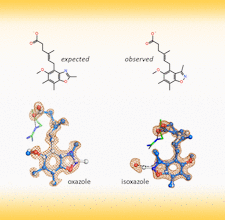
Cover illustration: An estimated 15% of the ligands in a high-resolution data set of fatty acid-binding protein structures had a different chemical composition to that expected from the starting materials or the final synthesis product [Ehler et al. (2025), Acta Cryst. D81, 451–464]. In this structure the ligand heterocycle is not the expected 1,3-oxazole but a 1,2-oxazole.
scientific commentaries


Free 
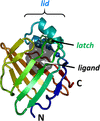
An introduction to a set of three related papers in this issue describing 216 ligand-bound fatty acid-binding protein structure determinations and the pitfalls that can arise in such a study.
CCPEM

Open access
access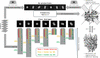
We introduce a new approach to probabilistic multi-volume single-particle cryo-EM ab initio 3D reconstruction for simultaneous estimation of the relative particle 3D orientations and partitioning of the particles into groups with distinct structural states.
Open access
access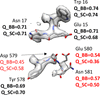
Q-scores are calculated for atomic models derived from 3D electron microscopy maps, measure how well the model fits the map and reflect the quality of the map itself. Here, we develop a statistical model for Q-scores applied to many maps and models in the EMDB and PDB, respectively, and show how it can be used to assess the reliability of entire models as well as their subcomponents.
research papers
Open access
access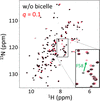
NMR studies on human FABP4 in solution and bound to micelles and bicelles delineate its dynamics in a ligand-dependent fashion. Residual ligands are co-purified with the protein, which may negatively influence binding studies with low-affinity ligands.

Open access
access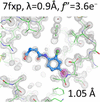
A high-quality set of 229 crystal structures of various isoforms of human and mouse fatty acid-binding proteins in apo and ligand-bound forms is presented. Many ligands have associated affinity data, which may help in the development of affinity- and pose-predicting algorithms.
Open access
access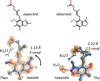
Very high-resolution fatty acid-binding protein structures identified a substantial number of ligands that differ strongly from their expected structure. If different ligand chemistry is a potentially overlooked problem in other, lower resolution, crystal structures of protein–ligand complexes, it has repercussions for any study using such structures, particularly when training machine-learning algorithms.
book reviews
Free

obituaries
Free

Rolf Hilgenfeld lived a life in the fast lane, devoted entirely to science, in which he absorbed a wealth of knowledge, conscientiously created new knowledge and passionately passed it on to his students.