


 journal menu


issue contents
November 2025 issue
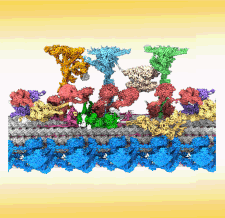
Cover illustration: Recent studies demonstrate that the range of samples suitable for cryo-EM single-particle analysis (SPA) is expanding towards increasingly more native samples. Tailored sample-preparation strategies make complex macromolecular assemblies amenable for SPA, while still keeping them in close-to-native conditions [Moecking & Zeev-Ben-Mordehai (2025), Acta Cryst. D81, 587–597]. The 96 nm repeat of axonemal doublet microtubules showing all the external complexes is shown here as an example.
CCPEM


Open  access
access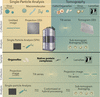
Cryo-EM single-particle analysis has revolutionized structural biology by allowing high-resolution analysis of large molecular assemblies that are not amenable to crystallography or NMR. Combination of this technology with innovative sample-preparation protocols further expands the range of potential targets.
CCP4

Open access
access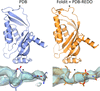
The results of the Foldit citizen science puzzles for crystallographic models and their integration into the PDB-REDO databank are discussed.
Open access
access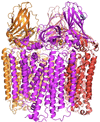
We have studied the copper sites in three cryogenic electron-microscopy structures of particulate methane monooxygenase with quantum refinement. We show that the CuA, CuC and CuD sites are correctly modelled and that the CuB site is mononuclear in all structures, whereas we find no support for copper in the suggested trinuclear active site or two sites in the so-called copper sponge in PDB entry 7ev9.
research papers
Open access
access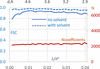
Calculating and plotting FSC curves on a uniform scale in inverse cubic resolution (Å−3) has several useful features.

Open access
access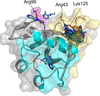
Two crystallographic fragment screening campaigns against SARS-CoV-2 nonstructural protein 1 resulted in the identification of 21 new hits.
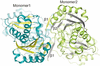
The crystal structure of NAD+-dependent methanol dehydrogenase 1 from B. methanolicus MGA3 was determined at 3.0 Å resolution, revealing a decameric assembly, a Rossmann-fold coenzyme-binding site and Mn2+-dependent catalytic activity.