

 journal menu


issue contents
January 2026 issue
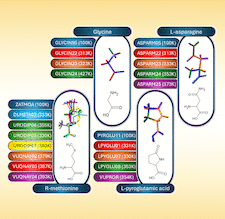
Cover illustration: Macromolecular and ligand structures that have been determined at elevated temperatures are considered in a data survey of the Protein Data Bank and Cambridge Structural Database [Brink et al. (2026), Acta Cryst. D82, 1–10]. Here, four biologically relevant amino-acid structures from the CSD Drug Subset that have been obtained at high temperatures are highlighted.
ISDSB2025


Open  access
access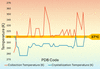
Regulation of pharmaceutical lead compounds does not yet involve the need for patient-relevant macromolecular structures determined at 37°C; nevertheless, we highlight the advantages of these to ensure chemical relevance and the identification of changes which may occur under physiological conditions. The PDB and CSD entries for diffraction data measured at ≥37°C, as well as a cryoEM 37°C freeze-trapped structure, are considered and the description includes structures obtained well above 37°C that are relevant to thermophile and hyperthermophile structural biology.
Open access
access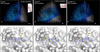
This work demonstrates that multi-position data acquisition mitigates radiation damage in electron diffraction of three-dimensional protein crystals and that merging data from selected crystals in distinct orientations enhances completeness. Application of the two approaches enables high-quality structural models to be obtained from limited or sensitive samples.

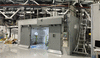
The construction of a new experimental station for macromolecular crystallography at NanoTerasu under the AMED/BINDS project is presented.
PDB reference: hen egg-white lysozyme, 9wks
research papers
Open access
access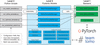
In situ cryo-EM coupled with 2D template matching (2DTM) holds the potential to visualize the cellular structureome in context, but further developments are required to make this a reality. We describe Leopard-EM (Location and orientation of particles found using two-dimensional tEmplate Matching), an extensible Python package for 2DTM to accelerate in situ structural biology.
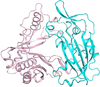
This study presents the first crystal structure of a hydroxycinnamoyl-CoA:tartaric acid hydroxycinnamoyl transferase from E. purpurea (EpHTT), a specialized BAHD acyltransferase central to the biosynthesis of chicoric acid. We successfully expressed, purified and crystallized the full-length EpHTT protein (residues 1–424) and determined its high-resolution structure at 2.38 Å.
PDB reference: EpHTT, 9wts
Open access
access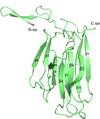
We present the crystal structure of a segment of human ADAMTS-5 that includes part of the cysteine-rich domain and the spacer domain.
PDB reference: human ADAMTS-5 CB and spacer domains, 9rwm