
Acta Crystallographica
Section E CRYSTALLOGRAPHIC COMMUNICATIONS


 menu


research communications
| CRYSTALLOGRAPHIC COMMUNICATIONS |
 access
Crystal structure of a 2:1 co-crystal of the anticancer drug lenalidomide with 1,3-resorcinol

aPhysical and Materials Chemistry Division, CSIR-National Chemical Laboratory, Dr. Homi Bhabha Road, Pashan, Pune, Maharashtra, 411008, India, and bAcademy of Scientific and Innovative Research (AcSIR), Ghaziabad 201002, India
*Correspondence e-mail: [email protected]
A 2:1 cocrystal of lenalidomide and 1,3-resorcinol [systematic name: 3-(4-amino-1-oxo-1,3-dihydro-2H-isoindol-2-yl)piperidine-2,6-dione–benzene-1,3-diol (2/1), 2C13H13N3O3·C6H6O2] was synthesized, and its crystal structure was elucidated by single-crystal X-ray diffraction (SCXRD). The cocrystal crystallizes in the triclinic space group P1. The two symmetry-independent lenalidomide molecules form a hydrogen-bonded dimeric assembly through N—H⋯O interactions, generating an R22(8) ring motif. In addition, O—H⋯O hydrogen bonds involving the hydroxyl groups of 1,3-resorcinol and the carbonyl oxygen atoms of the isoindolinone and glutarimide moieties of lenalidomide further contribute to the cohesion and organization of the crystal packing. The crystal structure is further consolidated by several close π–π stacking interactions involving the π-electrons of the isoindolinone moiety. Hirshfeld surface analysis and the corresponding two-dimensional fingerprint plots were employed to identify and quantify the principal intermolecular contacts contributing to the cohesion of the cocrystal structure.
Keywords: crystal structure; anticancer; lenalidomide; hydrogen bond; π-stacking.
CCDC reference: 2598460
1. Chemical context
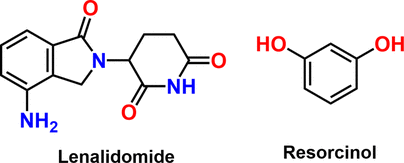
Lenalidomide (LEN), a synthetic thalidomide analogue, is an immunomodulatory drug used in the treatment of multiple myeloma and myelodysplastic syndromes associated with deletion of chromosome 5q [del(5q)] (Richardson et al., 2002 ; List et al., 2006). Reported pharmacological effects include immunomodulatory and antiangiogenic activity (Kotla et al., 2009). Also in multiple myeloma, lenalidomide has also been shown to promote cereblon-dependent degradation of IKZF1 and IKZF3 (Krönke et al., 2014). The solid-state landscape of LEN includes anhydrous and hydrated forms, polymorphs and solvates (Ravikumar & Sridhar, 2009; Chennuru et al., 2017; Jia et al., 2019). Cocrystals of LEN with urea and 3,5-dihydroxybenzoic acid, gallic acid and nicotinamide have been reported, with selected systems showing changes in apparent solubility or dissolution under the conditions studied (Song et al., 2014, Song et al., 2015; Wang et al., 2022). A crystalline form of lenalidomide (LEN) with resorcinol (RES) was previously disclosed in patent US 12098136 B2, accompanied by DSC, PXRD and NMR data; however, its crystal structure was not reported (Bhat et al., 2024). Here, we report the single-crystal X-ray structure of the LEN:RES cocrystal (2:1), providing a crystallographic description of its molecular arrangement and intermolecular interactions.
2. Structural commentary
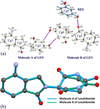
The crystal structure of the LEN:RES (2:1) cocrystal was unambiguously established by single-crystal X-ray diffraction (SCXRD) analysis. The cocrystal crystallizes in the triclinic crystal system with the centrosymmetric space group P (space group No. 2). The asymmetric unit comprises two independent molecules of LEN and one molecule of RES, corresponding to a 2:1 stoichiometric ratio (Fig. 1a). The two crystallographically independent LEN molecules are designated A and B. A structural overlay of molecules A and B reveals a distinct conformational difference in the glutarimide ring (Fig. 1b). The dihedral angle between a plane between the isoindolinone-derived aromatic system and the glutarimide ring is 86.93 (3)° for molecule A and 78.96 (3)° for molecule B. Thus, molecule A adopts a more orthogonal, and consequently less twisted, conformation with respect to the defined ring planes than molecule B. The molecules present in the asymmetric unit are interconnected through a network of hydrogen-bonding interactions. The two crystallographically independent LEN molecules, A and B, are connected through N—H⋯O hydrogen bonds, generating a cyclic
R22(8) ring motif. In addition, the RES molecule participates in O—H⋯O hydrogen bonding engaging its hydroxyl group with the carbonyl oxygen atom of adjacent LEN molecule B, thereby further linking the molecular components within the asymmetric unit.
|
Figure 1
(a) The LEN:RES cocrystal with thermal displacement ellipsoids drawn at the 30% probability level. Atom labelling is provided for identification; hydrogen atoms are depicted as spheres of arbitrary radii for clarity. Hydrogen-bonding interactions are shown as violet dashed lines. (b) Overlay of two symmetry-independent molecules of LEN within the asymmetric unit of the LEN:RES cocrystal. |
3. Supramolecular features
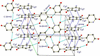
The molecular packing viewed along the b axis reveals that the LEN molecules are arranged along the a-axis direction through short π–π stacking interactions involving the isoindolinone moiety, with centroid-to-centroid distances ranging from 3.5410 (15) to 4.0014 (17) Å (see entries 14-25 of Table 1). These interactions generate a stacked one-dimensional supramolecular assembly extending along the a-axis direction. The stacked assemblies are further connected along the c-axis direction through dimeric C—H⋯O and N—H⋯O hydrogen-bonding interactions (C31—H31B⋯O2vii, N3—H3⋯O8, and N6—H6⋯O2; Table 1), both forming cyclic
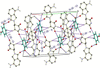
R22(8) ring motifs. Consequently, an extended and compact supramolecular architecture is generated in the ac plane (Fig. 2). The packing arrangement viewed along the a-axis shows that the RES molecule is positioned between two LEN molecules and is involved in N—H⋯O (N2—H2B⋯O5ii and N3—H3⋯O1iv), O—H⋯O (O5—H5A⋯O6) and C—H⋯π (C10—H10A⋯Cg9ii) interactions. In particular, C—H⋯π interactions occur between the hydrogen atoms associated with the glutarimide moiety of LEN and the π-electron cloud of the aromatic ring of RES, contributing to the formation of a one-dimensional supramolecular assembly along the b-axis direction. In addition, in the packing along the c-axis direction, RES interacts with adjacent LEN molecules through C—H⋯O contacts involving hydrogen atoms of RES and the carbonyl oxygen atoms of the glutarimide moieties of LEN (Fig. 3). These intermolecular interactions collectively consolidate the three-dimensional crystal packing.
|
 ; (ii)
 ; (iii)
 ; (iv)
 ; (v)
 ; (vi)
 ; (vii)
 ; (viii)
 .
|
Figure 2
View of the molecular packing along the b axis in the LEN:RES cocrystal, showing the intermolecular C—H⋯O and N—H⋯O hydrogen bonds and π–π stacking interactions. |
|
Figure 3
View of the molecular packing along the a axis in the LEN:RES cocrystal, joined using C—H⋯O, N—H⋯O, O—H⋯O and C—H⋯π interactions. |
4. Hirshfeld surface analysis
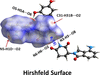
Hirshfeld surface (HS) analysis (Spackman & Jayatilaka, 2009) and two-dimensional fingerprint plots (Spackman & McKinnon, 2002) were performed using CrystalExplorer (Spackman et al., 2021). The Hirshfeld surface mapped over dnorm for molecule B of LEN in the cocrystal reveals several prominent red spots, indicating close contacts between LEN and RES. The Hirshfeld surface analysis was performed only for molecule B of LEN because it participates in O—H⋯O hydrogen bonding with the RES coformer, and N—H⋯O hydrogen bonding with molecule A of LEN, forming a dimeric motif. One of the most prominent red spots corresponds to the strong O—H⋯O hydrogen-bonding interaction between the hydroxyl group of RES and the carbonyl oxygen atom of LEN. The other prominent red spots are associated with N—H⋯O hydrogen-bonding interactions, which generate an
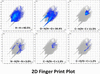
R22(8) hydrogen-bonded ring motif (Fig. 4). The two-dimensional fingerprint plots further illustrate the principal intermolecular contacts contributing to the consolidation of the cocrystal structure. In particular, the H⋯H and O⋯H/H⋯O contacts exhibit prominent features at (di + de) values of approximately 2.4 and 2.0 Å, respectively (Fig. 5). These values are shorter than the corresponding sums of the van der Waals radii, indicating the presence of significant close intermolecular contacts.
|
Figure 4
Visualization of the Hirshfeld surface of molecule B of LEN, within the LEN:RES cocrystal. |
|
Figure 5
Two-dimensional fingerprint plot of molecule B of LEN in the LEN:RES cocrystal, showing the percentage contributions of different intermolecular interactions to the Hirshfeld surface area. |
5. Database survey
A survey of the Cambridge Structural Database (CSD, Version 6.01, Groom et al., 2016) using ConQuest (Bruno et al., 2002) identified 16 crystal structures based on LEN. Among these, two structures correspond to polymorphs of LEN (AJISES; Ravikumar & Sridhar, 2009, AJISES01; Chennuru et al., 2017), while two are hydrate forms (AJISIW; Ravikumar & Sridhar, 2009, ICOSUR; Chennuru et al., 2017). Solvate structures containing DMF (ICOTEC; Chennuru et al., 2017), acetone (ICOTIG; Chennuru et al., 2017), DMSO (ICOTOM; Chennuru et al., 2017), and acetonitrile (UZULUZ) have also been reported. In addition, LEN cocrystals and cocrystal hydrates have been reported with gallic acid (HUVGAI and HUVFUB; Song et al., 2015), 3,5-dihydroxybenzoic acid (XODPIR and XODPEN; Song et al., 2014), urea (XODPOX; Song et al., 2014), melamine (NUNSAU; Screen et al., 2025) and acesulfame (ZIDQUB and ZIDQUB01; Chen et al., 2019). Interestingly, one of the reported crystal structures contains protonated LEN, with a chloride ion (Cl−) serving as the counter-ion to maintain charge neutrality (VAGMEZ; Valdivia-Berroeta et al., 2021). However, to the best of our knowledge, no crystal structure of a LEN:RES has been reported to date.
6. Synthesis and crystallization
The LEN:RES cocrystal was prepared by a combination of liquid-assisted grinding and slow-evaporation crystallization. LEN (60 mg, 0.231 mmol) and RES (25.5 mg, 0.231 mmol) were taken in a 1:1 molar ratio and manually ground together in a mortar and pestle for approximately 10 min in the presence of a few drops of a 1:1 (v/v) acetone-ethanol solvent mixture. The resulting solid was subsequently dissolved in 1:1:1:1 (v/v/v/v) mixture of isopropyl alcohol, methanol, acetonitrile, and water and gently heated to ensure complete dissolution. The resulting solution was filtered to remove any undissolved material and transferred to a crystallization vessel. The solvent was allowed to evaporate slowly at room temperature (298 K). After 4–5 days, yellow, plate-like crystals suitable for single-crystal X-ray diffraction analysis were obtained.
7. Refinement
Crystal data, data collection and structure refinement details are summarized in Table 2. All H atoms were placed in geometrically idealized positions. The H atoms attached to O4 and O5 were located in difference-Fourier maps and refined isotropically. The H atom attached to N3 was placed in a geometrically idealized position and the N3—H3 bond length was restrained to 0.95 Å using a DFIX restraint.
|
Supporting information
CCDC reference: 2598460
Crystal structure: contains datablock I. DOI: https://doi.org/10.1107/S205698902601114X/dx2074sup1.cif
Structure factors: contains datablock I. DOI: https://doi.org/10.1107/S205698902601114X/dx2074Isup3.hkl
Supporting information file. DOI: https://doi.org/10.1107/S205698902601114X/dx2074Isup3.cml
| 2C13H13N3O3·C6H6O2 | Z = 2 |
| Mr = 628.63 | F(000) = 660 |
| Triclinic, P1 | Dx = 1.458 Mg m−3 |
| a = 7.0508 (3) Å | Mo Kα radiation, λ = 0.71073 Å |
| b = 14.1141 (6) Å | Cell parameters from 7164 reflections |
| c = 16.3951 (9) Å | θ = 2.5–28.5° |
| α = 110.596 (2)° | µ = 0.11 mm−1 |
| β = 100.956 (2)° | T = 297 K |
| γ = 101.880 (2)° | Plate, pale yellow |
| V = 1431.91 (12) Å3 | 0.14 × 0.09 × 0.04 mm |
| Bruker D8 VENTURE Kappa Duo PHOTON II CPAD diffractometer | 7160 independent reflections |
| Radiation source: micro-focus sealed tube, Incoatech IµS HB | 3351 reflections with I > 2σ(I) |
| Multilayer mirrors monochromator | Rint = 0.138 |
| φ and ω scans | θmax = 28.5°, θmin = 2.5° |
| Absorption correction: multi-scan (SADABS; Krause et al., 2015) | h = −9→9 |
| Tmin = 0.632, Tmax = 0.746 | k = −18→18 |
| 44385 measured reflections | l = −21→21 |
| Refinement on F2 | 1 restraint |
| Least-squares matrix: full | Hydrogen site location: mixed |
| R[F2 > 2σ(F2)] = 0.061 | H atoms treated by a mixture of independent and constrained refinement |
| wR(F2) = 0.168 | w = 1/[σ2(Fo2) + (0.069P)2] where P = (Fo2 + 2Fc2)/3 |
| S = 0.99 | (Δ/σ)max = 0.001 |
| 7160 reflections | Δρmax = 0.30 e Å−3 |
| 439 parameters | Δρmin = −0.26 e Å−3 |
Geometry. All esds (except the esd in the dihedral angle between two l.s. planes) are estimated using the full covariance matrix. The cell esds are taken into account individually in the estimation of esds in distances, angles and torsion angles; correlations between esds in cell parameters are only used when they are defined by crystal symmetry. An approximate (isotropic) treatment of cell esds is used for estimating esds involving l.s. planes. |
| x | y | z | Uiso*/Ueq | ||
| O1 | 0.4392 (3) | 1.21869 (13) | 0.66753 (11) | 0.0466 (5) | |
| O2 | 0.1038 (3) | 0.70701 (13) | 0.37776 (11) | 0.0471 (5) | |
| O3 | 0.6444 (3) | 0.96443 (14) | 0.58963 (12) | 0.0526 (5) | |
| N1 | 0.4203 (3) | 1.06732 (14) | 0.69316 (12) | 0.0335 (5) | |
| N2 | 0.6294 (4) | 1.08409 (19) | 0.96980 (16) | 0.0551 (7) | |
| N3 | 0.3680 (3) | 0.83778 (15) | 0.48570 (14) | 0.0373 (5) | |
| C1 | 0.5573 (4) | 1.14192 (17) | 0.84840 (15) | 0.0322 (6) | |
| C2 | 0.5571 (3) | 1.22231 (18) | 0.81917 (16) | 0.0331 (6) | |
| C3 | 0.6287 (4) | 1.32822 (18) | 0.87877 (17) | 0.0402 (6) | |
| H3A | 0.628058 | 1.382037 | 0.858556 | 0.048* | |
| C4 | 0.7014 (4) | 1.34981 (19) | 0.97012 (17) | 0.0442 (7) | |
| H4 | 0.750506 | 1.419965 | 1.012339 | 0.053* | |
| C5 | 0.7028 (4) | 1.27023 (19) | 0.99993 (16) | 0.0401 (6) | |
| H5 | 0.753498 | 1.288036 | 1.061774 | 0.048* | |
| C6 | 0.6302 (4) | 1.16338 (19) | 0.93995 (16) | 0.0356 (6) | |
| C7 | 0.4697 (4) | 1.03661 (17) | 0.76899 (15) | 0.0340 (6) | |
| H7A | 0.567555 | 0.997243 | 0.762260 | 0.041* | |
| H7B | 0.349737 | 0.994421 | 0.774725 | 0.041* | |
| C8 | 0.4685 (4) | 1.17463 (18) | 0.71944 (16) | 0.0341 (6) | |
| C9 | 0.3236 (4) | 0.99346 (18) | 0.60035 (15) | 0.0335 (6) | |
| H9 | 0.299217 | 1.035799 | 0.565413 | 0.040* | |
| C10 | 0.1187 (4) | 0.91915 (19) | 0.58530 (16) | 0.0385 (6) | |
| H10A | 0.134266 | 0.876290 | 0.619736 | 0.046* | |
| H10B | 0.029641 | 0.960111 | 0.606562 | 0.046* | |
| C11 | 0.0268 (4) | 0.84802 (19) | 0.48517 (17) | 0.0416 (6) | |
| H11A | −0.097317 | 0.796450 | 0.477254 | 0.050* | |
| H11B | −0.007630 | 0.890553 | 0.452601 | 0.050* | |
| C12 | 0.1649 (4) | 0.79088 (19) | 0.44478 (16) | 0.0346 (6) | |
| C13 | 0.4619 (4) | 0.93194 (18) | 0.56100 (16) | 0.0345 (6) | |
| H3 | 0.443 (4) | 0.8010 (18) | 0.4577 (16) | 0.052* | |
| H2A | 0.670 (4) | 1.100 (2) | 1.0250 (19) | 0.052* | |
| H2B | 0.592 (4) | 1.026 (2) | 0.9329 (18) | 0.052* | |
| O4 | 1.2550 (3) | 0.3382 (2) | 0.38207 (14) | 0.0767 (7) | |
| O5 | 0.6176 (3) | 0.16702 (16) | 0.16464 (13) | 0.0563 (6) | |
| C14 | 1.0483 (4) | 0.3148 (2) | 0.36367 (19) | 0.0481 (7) | |
| C15 | 0.9331 (4) | 0.2529 (2) | 0.27456 (18) | 0.0470 (7) | |
| H15 | 0.995148 | 0.228355 | 0.229379 | 0.056* | |
| C16 | 0.7265 (4) | 0.22825 (19) | 0.25380 (17) | 0.0400 (6) | |
| C17 | 0.6315 (4) | 0.2623 (2) | 0.32043 (18) | 0.0447 (7) | |
| H17 | 0.491186 | 0.243909 | 0.306246 | 0.054* | |
| C18 | 0.7511 (5) | 0.3246 (2) | 0.40876 (18) | 0.0484 (7) | |
| H18 | 0.689303 | 0.348195 | 0.454229 | 0.058* | |
| C19 | 0.9582 (5) | 0.3523 (2) | 0.43099 (17) | 0.0469 (7) | |
| H19 | 1.036325 | 0.395666 | 0.490416 | 0.056* | |
| H1 | 1.308 (5) | 0.359 (2) | 0.444 (2) | 0.070* | |
| H5A | 0.494 (5) | 0.166 (2) | 0.152 (2) | 0.070* | |
| O6 | 0.2332 (3) | 0.17291 (13) | 0.11279 (11) | 0.0478 (5) | |
| O7 | 0.0550 (3) | 0.46102 (15) | 0.18180 (13) | 0.0553 (5) | |
| O8 | 0.5573 (3) | 0.63971 (15) | 0.44179 (12) | 0.0543 (5) | |
| N4 | 0.2641 (3) | 0.32938 (14) | 0.09561 (13) | 0.0360 (5) | |
| N5 | 0.1058 (4) | 0.3344 (2) | −0.17610 (17) | 0.0524 (7) | |
| N6 | 0.3138 (3) | 0.55180 (16) | 0.30871 (14) | 0.0415 (6) | |
| C20 | 0.1513 (4) | 0.26472 (18) | −0.06018 (16) | 0.0337 (6) | |
| C21 | 0.0881 (4) | 0.24901 (19) | −0.15121 (16) | 0.0375 (6) | |
| C22 | 0.0140 (4) | 0.1445 (2) | −0.21483 (17) | 0.0454 (7) | |
| H22 | −0.029956 | 0.130577 | −0.276211 | 0.054* | |
| C23 | 0.0040 (4) | 0.0602 (2) | −0.18903 (18) | 0.0482 (7) | |
| H23 | −0.047229 | −0.008665 | −0.233698 | 0.058* | |
| C24 | 0.0678 (4) | 0.07543 (19) | −0.09901 (17) | 0.0434 (7) | |
| H24 | 0.062888 | 0.019145 | −0.081646 | 0.052* | |
| C25 | 0.1398 (4) | 0.18046 (18) | −0.03610 (16) | 0.0345 (6) | |
| C26 | 0.2149 (4) | 0.22211 (18) | 0.06352 (17) | 0.0351 (6) | |
| C27 | 0.2335 (4) | 0.36639 (18) | 0.02291 (15) | 0.0369 (6) | |
| H27A | 0.359950 | 0.409290 | 0.022747 | 0.044* | |
| H27B | 0.137622 | 0.407037 | 0.028206 | 0.044* | |
| C28 | 0.3475 (4) | 0.39755 (18) | 0.19125 (16) | 0.0352 (6) | |
| H28 | 0.340619 | 0.351277 | 0.223981 | 0.042* | |
| C29 | 0.2221 (4) | 0.47085 (19) | 0.22422 (16) | 0.0358 (6) | |
| C30 | 0.5058 (4) | 0.57531 (18) | 0.36249 (17) | 0.0389 (6) | |
| C31 | 0.6447 (4) | 0.5217 (2) | 0.32072 (17) | 0.0452 (7) | |
| H31A | 0.670477 | 0.472816 | 0.347679 | 0.054* | |
| H31B | 0.772645 | 0.574642 | 0.335705 | 0.054* | |
| C32 | 0.5682 (4) | 0.46140 (19) | 0.21851 (17) | 0.0419 (6) | |
| H32A | 0.648126 | 0.414196 | 0.198385 | 0.050* | |
| H32B | 0.581853 | 0.510698 | 0.189556 | 0.050* | |
| H1C | 0.079 (5) | 0.388 (2) | −0.1394 (19) | 0.063* | |
| H1D | 0.046 (4) | 0.315 (2) | −0.2365 (19) | 0.063* | |
| H6 | 0.241 (4) | 0.596 (2) | 0.3330 (19) | 0.063* |
| U11 | U22 | U33 | U12 | U13 | U23 | |
| O1 | 0.0613 (13) | 0.0413 (10) | 0.0367 (11) | 0.0153 (9) | 0.0107 (10) | 0.0169 (9) |
| O2 | 0.0483 (12) | 0.0406 (10) | 0.0319 (10) | 0.0099 (9) | 0.0041 (9) | −0.0029 (9) |
| O3 | 0.0350 (12) | 0.0613 (12) | 0.0403 (11) | 0.0071 (10) | 0.0090 (10) | 0.0015 (10) |
| N1 | 0.0424 (13) | 0.0300 (10) | 0.0210 (11) | 0.0069 (9) | 0.0071 (10) | 0.0054 (9) |
| N2 | 0.083 (2) | 0.0437 (14) | 0.0260 (14) | 0.0064 (14) | 0.0098 (15) | 0.0093 (13) |
| N3 | 0.0346 (13) | 0.0359 (11) | 0.0312 (12) | 0.0108 (10) | 0.0107 (10) | 0.0009 (10) |
| C1 | 0.0339 (14) | 0.0323 (13) | 0.0257 (13) | 0.0064 (11) | 0.0114 (11) | 0.0070 (11) |
| C2 | 0.0279 (14) | 0.0361 (13) | 0.0307 (14) | 0.0080 (11) | 0.0096 (11) | 0.0086 (12) |
| C3 | 0.0431 (16) | 0.0291 (13) | 0.0390 (16) | 0.0075 (12) | 0.0106 (13) | 0.0055 (13) |
| C4 | 0.0427 (17) | 0.0335 (14) | 0.0363 (16) | 0.0059 (12) | 0.0076 (13) | −0.0035 (13) |
| C5 | 0.0383 (16) | 0.0432 (15) | 0.0241 (14) | 0.0057 (12) | 0.0069 (12) | 0.0014 (12) |
| C6 | 0.0322 (15) | 0.0402 (14) | 0.0281 (14) | 0.0067 (11) | 0.0090 (12) | 0.0086 (12) |
| C7 | 0.0400 (15) | 0.0316 (12) | 0.0281 (13) | 0.0086 (11) | 0.0109 (12) | 0.0099 (11) |
| C8 | 0.0353 (15) | 0.0329 (13) | 0.0312 (14) | 0.0086 (11) | 0.0127 (12) | 0.0090 (12) |
| C9 | 0.0388 (15) | 0.0338 (12) | 0.0196 (12) | 0.0091 (11) | 0.0065 (11) | 0.0035 (11) |
| C10 | 0.0381 (16) | 0.0380 (13) | 0.0330 (15) | 0.0132 (12) | 0.0124 (12) | 0.0049 (12) |
| C11 | 0.0368 (16) | 0.0415 (14) | 0.0351 (15) | 0.0111 (12) | 0.0047 (13) | 0.0057 (13) |
| C12 | 0.0388 (16) | 0.0370 (13) | 0.0238 (13) | 0.0114 (12) | 0.0057 (12) | 0.0090 (12) |
| C13 | 0.0366 (16) | 0.0369 (13) | 0.0257 (14) | 0.0083 (12) | 0.0099 (12) | 0.0088 (12) |
| O4 | 0.0509 (15) | 0.124 (2) | 0.0492 (14) | 0.0202 (14) | 0.0114 (12) | 0.0327 (16) |
| O5 | 0.0605 (14) | 0.0674 (13) | 0.0331 (11) | 0.0222 (12) | 0.0059 (11) | 0.0138 (10) |
| C14 | 0.0446 (19) | 0.0634 (18) | 0.0416 (17) | 0.0173 (15) | 0.0120 (14) | 0.0270 (15) |
| C15 | 0.0532 (19) | 0.0627 (18) | 0.0337 (16) | 0.0231 (15) | 0.0189 (14) | 0.0227 (15) |
| C16 | 0.0535 (19) | 0.0380 (14) | 0.0285 (15) | 0.0154 (13) | 0.0083 (13) | 0.0143 (13) |
| C17 | 0.0451 (17) | 0.0528 (16) | 0.0412 (17) | 0.0194 (14) | 0.0127 (14) | 0.0219 (15) |
| C18 | 0.060 (2) | 0.0560 (17) | 0.0375 (17) | 0.0286 (16) | 0.0190 (15) | 0.0192 (15) |
| C19 | 0.058 (2) | 0.0485 (16) | 0.0310 (15) | 0.0176 (15) | 0.0085 (14) | 0.0141 (14) |
| O6 | 0.0598 (13) | 0.0374 (10) | 0.0392 (11) | 0.0099 (9) | 0.0066 (10) | 0.0142 (9) |
| O7 | 0.0385 (12) | 0.0613 (12) | 0.0441 (12) | 0.0148 (10) | 0.0013 (10) | 0.0015 (10) |
| O8 | 0.0590 (13) | 0.0559 (12) | 0.0278 (10) | 0.0140 (10) | 0.0012 (10) | 0.0016 (10) |
| N4 | 0.0430 (13) | 0.0301 (11) | 0.0250 (11) | 0.0077 (10) | 0.0048 (10) | 0.0043 (10) |
| N5 | 0.0626 (18) | 0.0578 (16) | 0.0342 (14) | 0.0182 (14) | 0.0108 (13) | 0.0170 (14) |
| N6 | 0.0377 (14) | 0.0402 (12) | 0.0324 (13) | 0.0130 (10) | 0.0031 (11) | 0.0013 (11) |
| C20 | 0.0294 (14) | 0.0374 (13) | 0.0269 (14) | 0.0094 (11) | 0.0063 (11) | 0.0058 (12) |
| C21 | 0.0313 (15) | 0.0440 (15) | 0.0297 (14) | 0.0094 (12) | 0.0084 (12) | 0.0075 (13) |
| C22 | 0.0388 (16) | 0.0566 (17) | 0.0276 (15) | 0.0112 (14) | 0.0074 (13) | 0.0048 (14) |
| C23 | 0.0423 (17) | 0.0411 (15) | 0.0350 (16) | 0.0042 (13) | 0.0086 (14) | −0.0084 (13) |
| C24 | 0.0436 (17) | 0.0355 (14) | 0.0389 (16) | 0.0108 (12) | 0.0096 (14) | 0.0029 (13) |
| C25 | 0.0329 (15) | 0.0357 (13) | 0.0278 (14) | 0.0091 (11) | 0.0086 (12) | 0.0053 (12) |
| C26 | 0.0343 (15) | 0.0317 (13) | 0.0362 (15) | 0.0082 (11) | 0.0099 (12) | 0.0114 (13) |
| C27 | 0.0375 (15) | 0.0351 (13) | 0.0325 (14) | 0.0088 (12) | 0.0086 (12) | 0.0091 (12) |
| C28 | 0.0416 (16) | 0.0311 (12) | 0.0255 (13) | 0.0098 (12) | 0.0052 (12) | 0.0058 (11) |
| C29 | 0.0325 (16) | 0.0374 (14) | 0.0280 (14) | 0.0058 (12) | 0.0043 (12) | 0.0072 (12) |
| C30 | 0.0448 (17) | 0.0328 (13) | 0.0305 (15) | 0.0068 (12) | 0.0051 (13) | 0.0087 (13) |
| C31 | 0.0360 (16) | 0.0429 (15) | 0.0395 (16) | 0.0068 (12) | 0.0040 (13) | 0.0034 (13) |
| C32 | 0.0346 (15) | 0.0412 (14) | 0.0381 (16) | 0.0100 (12) | 0.0051 (13) | 0.0061 (13) |
| O1—C8 | 1.230 (3) | C15—C16 | 1.371 (4) |
| O2—C12 | 1.220 (3) | C16—C17 | 1.384 (3) |
| O3—C13 | 1.209 (3) | C17—C18 | 1.384 (4) |
| N1—C8 | 1.367 (3) | C18—C19 | 1.371 (4) |
| N1—C9 | 1.437 (3) | O6—C26 | 1.242 (3) |
| N1—C7 | 1.460 (3) | O7—C29 | 1.202 (3) |
| N2—C6 | 1.370 (3) | O8—C30 | 1.225 (3) |
| N3—C12 | 1.368 (3) | N4—C26 | 1.358 (3) |
| N3—C13 | 1.379 (3) | N4—C28 | 1.444 (3) |
| C1—C2 | 1.378 (3) | N4—C27 | 1.458 (3) |
| C1—C6 | 1.390 (3) | N5—C21 | 1.392 (3) |
| C1—C7 | 1.497 (3) | N6—C30 | 1.370 (3) |
| C2—C3 | 1.385 (3) | N6—C29 | 1.373 (3) |
| C2—C8 | 1.477 (3) | C20—C25 | 1.371 (3) |
| C3—C4 | 1.386 (3) | C20—C21 | 1.396 (3) |
| C4—C5 | 1.375 (3) | C20—C27 | 1.494 (3) |
| C5—C6 | 1.397 (3) | C21—C22 | 1.389 (3) |
| C9—C10 | 1.519 (3) | C22—C23 | 1.390 (4) |
| C9—C13 | 1.522 (3) | C23—C24 | 1.382 (4) |
| C10—C11 | 1.514 (3) | C24—C25 | 1.391 (3) |
| C11—C12 | 1.493 (3) | C25—C26 | 1.470 (3) |
| O4—C14 | 1.375 (3) | C28—C29 | 1.519 (3) |
| O5—C16 | 1.373 (3) | C28—C32 | 1.519 (3) |
| C14—C19 | 1.377 (4) | C30—C31 | 1.482 (3) |
| C14—C15 | 1.384 (4) | C31—C32 | 1.513 (3) |
| C8—N1—C9 | 122.6 (2) | C15—C16—C17 | 121.2 (3) |
| C8—N1—C7 | 113.20 (19) | O5—C16—C17 | 121.4 (3) |
| C9—N1—C7 | 124.16 (18) | C16—C17—C18 | 118.2 (3) |
| C12—N3—C13 | 127.7 (2) | C19—C18—C17 | 121.7 (3) |
| C2—C1—C6 | 121.4 (2) | C18—C19—C14 | 118.7 (3) |
| C2—C1—C7 | 109.99 (19) | C26—N4—C28 | 122.7 (2) |
| C6—C1—C7 | 128.6 (2) | C26—N4—C27 | 112.5 (2) |
| C1—C2—C3 | 122.2 (2) | C28—N4—C27 | 124.77 (18) |
| C1—C2—C8 | 108.6 (2) | C30—N6—C29 | 127.0 (2) |
| C3—C2—C8 | 129.2 (2) | C25—C20—C21 | 121.0 (2) |
| C2—C3—C4 | 116.5 (2) | C25—C20—C27 | 110.0 (2) |
| C5—C4—C3 | 121.7 (2) | C21—C20—C27 | 129.0 (2) |
| C4—C5—C6 | 121.8 (2) | C22—C21—N5 | 122.4 (2) |
| N2—C6—C1 | 121.8 (2) | C22—C21—C20 | 116.5 (2) |
| N2—C6—C5 | 121.8 (2) | N5—C21—C20 | 121.1 (2) |
| C1—C6—C5 | 116.3 (2) | C21—C22—C23 | 121.6 (2) |
| N1—C7—C1 | 102.00 (18) | C24—C23—C22 | 122.0 (2) |
| O1—C8—N1 | 124.7 (2) | C23—C24—C25 | 115.6 (3) |
| O1—C8—C2 | 129.1 (2) | C20—C25—C24 | 123.2 (2) |
| N1—C8—C2 | 106.2 (2) | C20—C25—C26 | 108.2 (2) |
| N1—C9—C10 | 114.20 (18) | C24—C25—C26 | 128.6 (2) |
| N1—C9—C13 | 111.7 (2) | O6—C26—N4 | 123.9 (2) |
| C10—C9—C13 | 111.10 (19) | O6—C26—C25 | 129.0 (2) |
| C11—C10—C9 | 109.87 (19) | N4—C26—C25 | 107.1 (2) |
| C12—C11—C10 | 113.0 (2) | N4—C27—C20 | 102.16 (18) |
| O2—C12—N3 | 120.2 (2) | N4—C28—C29 | 112.0 (2) |
| O2—C12—C11 | 123.0 (2) | N4—C28—C32 | 114.32 (19) |
| N3—C12—C11 | 116.8 (2) | C29—C28—C32 | 109.95 (19) |
| O3—C13—N3 | 120.5 (2) | O7—C29—N6 | 120.8 (2) |
| O3—C13—C9 | 123.3 (2) | O7—C29—C28 | 124.4 (2) |
| N3—C13—C9 | 116.1 (2) | N6—C29—C28 | 114.8 (2) |
| O4—C14—C19 | 121.5 (3) | O8—C30—N6 | 119.8 (2) |
| O4—C14—C15 | 117.6 (2) | O8—C30—C31 | 122.6 (2) |
| C19—C14—C15 | 120.9 (3) | N6—C30—C31 | 117.6 (2) |
| C16—C15—C14 | 119.1 (2) | C30—C31—C32 | 114.8 (2) |
| C15—C16—O5 | 117.4 (2) | C31—C32—C28 | 109.7 (2) |
| C6—C1—C2—C3 | 0.0 (4) | O5—C16—C17—C18 | −179.5 (2) |
| C7—C1—C2—C3 | 179.5 (2) | C16—C17—C18—C19 | −0.2 (4) |
| C6—C1—C2—C8 | −179.2 (2) | C17—C18—C19—C14 | −1.6 (4) |
| C7—C1—C2—C8 | 0.4 (3) | O4—C14—C19—C18 | −178.7 (2) |
| C1—C2—C3—C4 | 0.0 (4) | C15—C14—C19—C18 | 2.0 (4) |
| C8—C2—C3—C4 | 179.0 (2) | C25—C20—C21—C22 | 0.0 (3) |
| C2—C3—C4—C5 | 0.2 (4) | C27—C20—C21—C22 | −178.8 (2) |
| C3—C4—C5—C6 | −0.3 (4) | C25—C20—C21—N5 | −177.9 (2) |
| C2—C1—C6—N2 | 179.4 (2) | C27—C20—C21—N5 | 3.3 (4) |
| C7—C1—C6—N2 | −0.1 (4) | N5—C21—C22—C23 | 177.7 (2) |
| C2—C1—C6—C5 | −0.1 (3) | C20—C21—C22—C23 | −0.2 (4) |
| C7—C1—C6—C5 | −179.6 (2) | C21—C22—C23—C24 | −0.3 (4) |
| C4—C5—C6—N2 | −179.2 (2) | C22—C23—C24—C25 | 0.9 (4) |
| C4—C5—C6—C1 | 0.3 (4) | C21—C20—C25—C24 | 0.6 (4) |
| C8—N1—C7—C1 | 0.1 (2) | C27—C20—C25—C24 | 179.7 (2) |
| C9—N1—C7—C1 | −177.6 (2) | C21—C20—C25—C26 | −179.5 (2) |
| C2—C1—C7—N1 | −0.3 (2) | C27—C20—C25—C26 | −0.4 (3) |
| C6—C1—C7—N1 | 179.2 (2) | C23—C24—C25—C20 | −1.0 (4) |
| C9—N1—C8—O1 | −1.6 (4) | C23—C24—C25—C26 | 179.1 (2) |
| C7—N1—C8—O1 | −179.4 (2) | C28—N4—C26—O6 | 1.3 (4) |
| C9—N1—C8—C2 | 177.9 (2) | C27—N4—C26—O6 | 178.2 (2) |
| C7—N1—C8—C2 | 0.1 (3) | C28—N4—C26—C25 | −178.7 (2) |
| C1—C2—C8—O1 | 179.2 (2) | C27—N4—C26—C25 | −1.9 (3) |
| C3—C2—C8—O1 | 0.1 (4) | C20—C25—C26—O6 | −178.7 (2) |
| C1—C2—C8—N1 | −0.3 (3) | C24—C25—C26—O6 | 1.2 (4) |
| C3—C2—C8—N1 | −179.4 (2) | C20—C25—C26—N4 | 1.4 (3) |
| C8—N1—C9—C10 | −119.2 (2) | C24—C25—C26—N4 | −178.7 (2) |
| C7—N1—C9—C10 | 58.3 (3) | C26—N4—C27—C20 | 1.6 (3) |
| C8—N1—C9—C13 | 113.7 (2) | C28—N4—C27—C20 | 178.4 (2) |
| C7—N1—C9—C13 | −68.8 (3) | C25—C20—C27—N4 | −0.7 (3) |
| N1—C9—C10—C11 | 177.73 (19) | C21—C20—C27—N4 | 178.3 (2) |
| C13—C9—C10—C11 | −54.9 (3) | C26—N4—C28—C29 | −124.1 (2) |
| C9—C10—C11—C12 | 53.1 (3) | C27—N4—C28—C29 | 59.5 (3) |
| C13—N3—C12—O2 | 179.7 (2) | C26—N4—C28—C32 | 110.0 (3) |
| C13—N3—C12—C11 | 0.6 (4) | C27—N4—C28—C32 | −66.5 (3) |
| C10—C11—C12—O2 | 154.8 (2) | C30—N6—C29—O7 | −176.8 (2) |
| C10—C11—C12—N3 | −26.2 (3) | C30—N6—C29—C28 | 3.6 (3) |
| C12—N3—C13—O3 | −179.5 (2) | N4—C28—C29—O7 | 13.1 (3) |
| C12—N3—C13—C9 | −3.2 (3) | C32—C28—C29—O7 | 141.4 (2) |
| N1—C9—C13—O3 | −24.3 (3) | N4—C28—C29—N6 | −167.24 (19) |
| C10—C9—C13—O3 | −153.0 (2) | C32—C28—C29—N6 | −39.0 (3) |
| N1—C9—C13—N3 | 159.58 (19) | C29—N6—C30—O8 | −169.0 (2) |
| C10—C9—C13—N3 | 30.8 (3) | C29—N6—C30—C31 | 11.9 (4) |
| O4—C14—C15—C16 | −179.9 (2) | O8—C30—C31—C32 | −168.9 (2) |
| C19—C14—C15—C16 | −0.6 (4) | N6—C30—C31—C32 | 10.2 (3) |
| C14—C15—C16—O5 | 179.8 (2) | C30—C31—C32—C28 | −44.5 (3) |
| C14—C15—C16—C17 | −1.3 (4) | N4—C28—C32—C31 | −174.74 (19) |
| C15—C16—C17—C18 | 1.6 (4) | C29—C28—C32—C31 | 58.3 (3) |
| Ring centroids are defined as: Cg1 = N1/C7/C1/C2/C8; Cg2 = N3/C9–C13; Cg3 = C1–C6;Cg5 = N4/C20/C25–C27; Cg6 = N6/C28–C32; Cg7 = C20–C25; and Cg9 = C14–C19. Cg···Cg denotes the centroid—centroid distance associated with π–π interactions. |
| D—H···A | D—H | H···A | D···A | D—H···A |
| O4—H1···O8i | 0.93 (3) | 1.92 (3) | 2.816 (3) | 161 (3) |
| O5—H5A···O6 | 0.85 (3) | 1.87 (3) | 2.710 (3) | 171 (3) |
| N2—H2B···O5ii | 0.78 (3) | 2.56 (3) | 3.310 (3) | 163 (3) |
| N2—H2A···O5iii | 0.83 (3) | 2.28 (3) | 3.015 (3) | 148 (3) |
| N3—H3···O1iv | 0.89 (2) | 2.31 (2) | 3.022 (3) | 137 (2) |
| N3—H3···O8 | 0.89 (2) | 2.51 (2) | 3.256 (3) | 141 (2) |
| N5—H1D···O2v | 0.92 (3) | 2.23 (3) | 3.144 (3) | 172 (2) |
| N6—H6···O2 | 0.92 (3) | 2.00 (3) | 2.915 (3) | 171 (2) |
| C9—H9···O3iv | 0.98 | 2.65 | 3.409 (3) | 135 |
| C17—H17···O4vi | 0.93 | 2.57 | 3.263 (3) | 131 |
| C27—H27B···O7 | 0.97 | 2.58 | 3.106 (3) | 114 |
| C31—H31B···O2vii | 0.97 | 2.47 | 3.440 (3) | 178 |
| C10—H10A···Cg9ii | 2.65 | 3.581 (3) | 161 | |
| Cg1···Cg7iii | 3.7109 (16) | |||
| Cg1···Cg7viii | 4.0014 (17) | |||
| Cg3···Cg5iii | 3.7997 (17) | |||
| Cg3···Cg5viii | 3.9603 (17) | |||
| Cg3···Cg7iii | 3.6971 (17) | |||
| Cg3···Cg7viii | 3.6644 (17) | |||
| Cg3···Cg8iii | 3.5854 (15) | |||
| Cg3···Cg8viii | 3.6382 (15) | |||
| Cg4···Cg7iii | 3.5410 (15) | |||
| Cg4···Cg7viii | 3.6602 (15) | |||
| Cg4···Cg8iii | 3.6763 (13) | |||
| Cg4···Cg8viii | 3.8723 (13) |
| Symmetry codes: (i) −x+2, −y+1, −z+1; (ii) −x+1, −y+1, −z+1; (iii) x, y+1, z+1; (iv) −x+1, −y+2, −z+1; (v) −x, −y+1, −z; (vi) x−1, y, z; (vii) x+1, y, z; (viii) x+1, y+1, z+1. |
Funding information
This work was supported by the CSIR-National Laboratories Scheme under the NCL-CAI (MLP002629).
References
 Bhat, R. P., Matti, L., Palle, V. R. & Regalla, V. R. (2024). Crystalline forms of lenalidomide. United States Patent US 12098136 B2.
Google Scholar
Bruker (2016). APEX3 and SAINT-Plus. Bruker AXS Inc., Madison, Wisconsin, USA.
Google Scholar
Bruno, I. J., Cole, J. C., Edgington, P. R., Kessler, M., Macrae, C. F., McCabe, P., Pearson, J. & Taylor, R. (2002). Acta Cryst. B58, 389–397.
Web of Science
CrossRef
CAS
IUCr Journals
Google Scholar
Chen, X., Li, D., Wang, J., Deng, Z. & Zhang, H. (2019). J. Mol. Struct. 1175, 852–857.
CrossRef
CAS
Google Scholar
Chennuru, R., Muthudoss, P., Voguri, R. S., Ramakrishnan, S., Vishweshwar, P., Babu, R. R. C. & Mahapatra, S. (2017). Cryst. Growth Des. 17, 612–628.
Web of Science
CSD
CrossRef
CAS
Google Scholar
Farrugia, L. J. (2012). J. Appl. Cryst. 45, 849–854.
Web of Science
CrossRef
CAS
IUCr Journals
Google Scholar
Groom, C. R., Bruno, I. J., Lightfoot, M. P. & Ward, S. C. (2016). Acta Cryst. B72, 171–179.
Web of Science
CrossRef
IUCr Journals
Google Scholar
Jia, L., Li, Z. & Gong, J. (2019). Pharm. Dev. Technol. 24, 1175–1180.
Web of Science
CrossRef
CAS
PubMed
Google Scholar
Kotla, V., Goel, S., Nischal, S., Heuck, C., Vivek, K., Das, B. & Verma, A. (2009). Journal of Hematology & Oncology 2, 36, 1–10.
Google Scholar
Krause, L., Herbst-Irmer, R., Sheldrick, G. M. & Stalke, D. (2015). J. Appl. Cryst. 48, 3–10.
Web of Science
CSD
CrossRef
ICSD
CAS
IUCr Journals
Google Scholar
Krönke, J., Udeshi, N. D., Narla, A., Grauman, P., Hurst, S. N., McConkey, M., Svinkina, T., Heckl, D., Comer, E., Li, X., Ciarlo, C., Hartman, E., Munshi, N., Schenone, M., Schreiber, S. L., Carr, S. A. & Ebert, B. L. (2014). Science 343, 301–305.
PubMed
Google Scholar
List, A., Dewald, G., Bennett, J., Giagounidis, A., Raza, A., Feldman, E., Powell, B., Greenberg, P., Thomas, D., Stone, R., Reeder, C., Wride, K., Patin, J., Schmidt, M., Zeldis, J., Knight, R. & Myelodysplastic Syndrome-003 Study Investigators (2006). N. Engl. J. Med. 355, 1456–1465.
Google Scholar
Macrae, C. F., Sovago, I., Cottrell, S. J., Galek, P. T. A., McCabe, P., Pidcock, E., Platings, M., Shields, G. P., Stevens, J. S., Towler, M. & Wood, P. A. (2020). J. Appl. Cryst. 53, 226–235.
Web of Science
CrossRef
CAS
IUCr Journals
Google Scholar
Ravikumar, K. & Sridhar, B. (2009). Acta Cryst. C65, o502–o505.
Web of Science
CrossRef
IUCr Journals
Google Scholar
Richardson, P. G., Schlossman, R. L., Weller, E., Hideshima, T., Mitsiades, C., Davies, F., LeBlanc, R., Catley, L. P., Doss, D., Kelly, K., McKenney, M., Mechlowicz, J., Freeman, A., Deocampo, R., Rich, R., Ryoo, J. J., Chauhan, D., Balinski, K., Zeldis, J. & Anderson, K. C. (2002). Blood 100, 3063–3067.
CrossRef
PubMed
CAS
Google Scholar
Screen, M. A., Tomkinson, G., McCabe, J. F., Askin, S., Mahon, C. S., Wilson, M. R. & Steed, J. W. (2025). New J. Chem. 49, 6535–6543.
CrossRef
CAS
Google Scholar
Sheldrick, G. M. (2008). Acta Cryst. A64, 112–122.
Web of Science
CrossRef
CAS
IUCr Journals
Google Scholar
Sheldrick, G. M. (2015). Acta Cryst. C71, 3–8.
Web of Science
CrossRef
IUCr Journals
Google Scholar
Song, J. X., Chen, J. M. & Lu, T. B. (2015). Cryst. Growth Des. 15, 4869–4875.
CrossRef
CAS
Google Scholar
Song, J. X., Yan, Y., Yao, J., Chen, J. M. & Lu, T. B. (2014). Cryst. Growth Des. 14, 3069–3077.
CrossRef
CAS
Google Scholar
Spackman, M. A. & Jayatilaka, D. (2009). CrystEngComm 11, 19–32.
Web of Science
CrossRef
CAS
Google Scholar
Spackman, M. A. & McKinnon, J. J. (2002). CrystEngComm 4, 378–392.
Web of Science
CrossRef
CAS
Google Scholar
Spackman, P. R., Turner, M. J., McKinnon, J. J., Wolff, S. K., Grimwood, D. J., Jayatilaka, D. & Spackman, M. A. (2021). J. Appl. Cryst. 54, 1006–1011.
Web of Science
CrossRef
CAS
IUCr Journals
Google Scholar
Spek, A. L. (2020). Acta Cryst. E76, 1–11.
Web of Science
CrossRef
IUCr Journals
Google Scholar
Valdivia-Berroeta, G. A., Sarpal, K. & Gonnella, N. C. (2021). Cryst. Growth Des. 21, 5904–5913.
CAS
Google Scholar
Wang, L., Yan, Y., Zhang, X. & Zhou, X. (2022). Int. J. Pharm. 613, 121394, 1–10.
Google Scholar
Westrip, S. P. (2010). J. Appl. Cryst. 43, 920–925.
Web of Science
CrossRef
CAS
IUCr Journals
Google Scholar
This is an open-access article distributed under the terms of the Creative Commons Attribution (CC-BY) Licence, which permits unrestricted use, distribution, and reproduction in any medium, provided the original authors and source are cited.
| CRYSTALLOGRAPHIC COMMUNICATIONS |
access