
Acta Crystallographica
Section E CRYSTALLOGRAPHIC COMMUNICATIONS


 menu


research communications
| CRYSTALLOGRAPHIC COMMUNICATIONS |
 access
Synthesis and crystal structure of the mixed-valent TeIV/VI compound PbTe3O8

aInstitute for Chemical Technologies and Analytics, Division of Applied Solid State Chemistry, TU Wien, Getreidemarkt 9/E164-05-1, A-1060, Vienna, Austria
*Correspondence e-mail: [email protected]
The crystal structure of the mixed-valent compound PbTe3O8 (= PbIITeIV2TeVIO8), lead(II) bis[oxidotellurate(IV)] tellurate(VI), is isotypic with that of SrTe3O8. It comprises 1∞[Te3O8]2– chains sharing O atoms to form a framework with two types of square channels extending parallel to [001]. The smaller channels (diameter ∼4 Å) are occupied by 12-coordinate PbII atoms in the centre of the channel, whereas the slightly larger channels (diameter ∼4.5 Å) accommodate the stereoactive 5s2 electron lone pair of TeIV.
Keywords: crystal structure; isotypism; mixed-valent compound; structural comparison.
CCDC reference: 2597291
1. Chemical context
In addition to the interest in the crystal-chemical peculiarities of compounds containing PbII and TeIV atoms that are characterized by their lone pair electrons (Walsh et al., 2011 ), phases in the Pb/Te/O system are also relevant in terms of application-related problems. This applies, for example, to PbTe-based thermoelectrics (Kanatzidis, 2010) or to Pb/Te/O-based high-refractive index glasses (Alazoumi et al., 2018), where they can occur as unwanted surfacial oxidation products and as (re)crystallized phases, respectively. It is therefore important to have a thorough knowledge of the formation conditions and crystal structures of such phases.
Taking lead(II) oxidotellurate(VI), PbTeO4, as an example, polycrystalline material from it was prepared at a temperature of 973 K and a pressure of 3000 atm (Sleight et al., 1972). In an attempt to grow PbTeO4 crystals under more moderate hydrothermal conditions following a modified procedure reported by Mathers & Graham (1929), crystals of the so far unknown compound PbTe3O8 were obtained serendipitously, and its crystal structure is reported in the present communication. As it turned out, PbTeO4 can only be prepared at higher pressure and temperature conditions (Hladik et al., 2024).
2. Structural commentary
PbTe3O8 expands our knowledge of ternary phases in the Pb/Te/O system (all contain lead solely in oxidation state +II), of which the following are currently known. For oxidotellurates(IV): α-PbTeO3 (Mariolacos, 1969; Zavodnik et al., 2008; Missen et al., 2019b), β-PbTeO3 (Sciau et al., 1986; Ma et al., 2017; Weil et al., 2018), γ-PbTeO3 (Weil et al., 2018; Kampf et al., 2022), Pb2Te3O8 (Dewan et al., 1978; Champarnaud-Mesjard et al., 2001), PbTe5O11 (Oufkir et al., 2001); for oxidotellurates(VI): PbTeO4 (Hladik et al., 2024), Pb2TeO5 (Kampf et al., 2010; Artner & Weil, 2013), Pb5TeO8 (Artner & Weil, 2013). This makes PbTe3O8 the first mixed-valent TeIV/VI compound (= PbIITeIV2TeVIO8) in the ternary Pb/Te/O system. It belongs to class I of the Robin & Day (1967) classification, with the different valence states each clearly located on their own atomic sites.
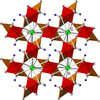
The crystal structure of PbTe3O8 is isotypic with that of SrTe3O8 (Barrier et al., 2006; Weil & Stöger, 2007). It can be considered as being composed of ∞1[Te2IVTeVIO8]2– chains, with adjacent chains sharing O atoms to form a framework with two types of square channels extending parallel to [001] (Fig. 1).
|
Figure 1
View of the crystal structure of PbTe3O8 in a projection along [001]. Displacement ellipsoids are drawn at the 90% probability level. Colour code: Pb green, O colourless, {Te1O5} square pyramid orange, {Te2O6} octahedron red; the 5s2 lone pair at the Te1 site is indicated as a blue sphere of arbitrary size. |
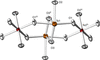
The ∞1[Te2IVTeVIO8]2– chains consist of {Te12O8} double polyhedra, which are formed by two symmetry-related {Te1IVO5} pyramids (Te1, site symmetry m..), and of {Te2VIO6} octahedra (Te2, 2/m..) by sharing corners and edges (Fig. 2). In the framework, each {Te2O6} octahedron is connected to four {Te12O8} double polyhedra, two via shared edges and two via shared corners, and each {Te12O8} double polyhedron is connected in the same way to four {Te2O6} octahedra. The {Te1O5} pyramid deviates somewhat from an ideal square-pyramidal coordination geometry (the τ5 index is 0.23, with extreme values of 0 for ideal square-pyramidal and 1 for ideal trigonal-bipyramidal geometry; Addison et al., 1984). The Te—O bond lengths span a range from 1.948 (10) to 2.170 (9) Å (Table 1). The {Te2O6} octahedron shows no variance in bond lengths (Table 1) and only minor angular distortions for the equatorial O atoms [range 85.2 (4)–94.8 (4)°]. All Te—O bond lengths are in characteristic ranges for tetra- and hexavalent tellurium atoms (Christy et al., 2016). The LPLoc software (Hamani et al., 2020) revealed the position of the presumed 5s2 electron lone pair at the Te1IV site with resulting fractional coordinates of x = 0.49158, y = 0.35089, z = 0. The radius of the electron lone pair was calculated to be 1.03 Å with a distance of 1.027 Å from the Te1 position. The electron lone pair protrudes into the larger of the two channels (diameter ∼4.5 Å), and thus is stereochemically active, as shown in Fig. 1.
|
 ; (ii)
 ; (iii)
 ; (iv)
 .
|
Figure 2
Part of a ∞1[Te2IVTeVIO8]2– chain. Displacement ellipsoids are drawn at the 90% probability level. Symmetry codes refer to Table 1 . |
The PbII cation is located in the smaller channel (diameter ∼4 Å, Fig. 1). It exhibits site symmetry  .. and has a coordination number of 12, with three groups of short, medium and long Pb—O bond lengths (Table 1). The corresponding [PbO12] coordination polyhedron was analysed using the Polynator program (Link & Niewa, 2023). It has a volume of 52.82 Å3 and can be described as a distorted cuboctahedron that differs from the ideal polyhedron (point group 2m) by a δ value (Link & Niewa, 2023) of 5.736. The average Pb[12]—O distance (2.853 Å) is in good agreement with the value of 2.827 (113) Å provided by Gagné & Hawthorne (2018). Localization of the electron lone pair at the PbII site using LPLoc shows that it is situated directly at the metal site (calculated lone pair radius 1.16 Å) and apparently exhibits no stereochemical activity.
A quantitative comparison between the isotypic MTe3O8 (M = Pb, Sr) structures was carried out using the compstru software (de la Flor et al., 2016), available at the Bilbao Crystallographic Server (Aroyo et al., 2006). The absolute distances between paired atoms are 0 Å for Pb1/Sr1, 0 Å for Te2, 0.0235 Å for Te1, 0.0247 Å for O3, 0.0252 Å for O1, and 0.0600 Å for O2; the arithmetic mean of the distance between paired atoms is 0.0264 Å. The degree of lattice distortion (0.0070), and the low value for the measure of similarity (0.024) indicate a high degree of simiularity for the two crystal structures.
In addition to the two isotypic MTe3O8 (M = Pb, Sr) structures, there is another compound with the same formula type (M = Ca) that occurs in nature as the rare mineral carlfriesite. Its monoclinic crystal structure (Effenberger et al., 1978; Missen et al., 2019a) can also be described as a nanoporous framework, although it exhibits a different topology for the [Te2IVTeVIO8]2– anion. Here, the metal cation is situated in slightly larger channels with a diameter of approximately 6 Å and exhibits a coordination number of eight with a distorted tetragonal antiprismatic oxygen coordination.
3. Synthesis and crystallization
The chemicals were supplied by Merck and were used without further purification. Equimolar amounts of PbO2 and TeO2 (total load 0.3 g) were thoroughly mixed and placed in a Teflon container. The container was filled to about two-thirds of its inner volume (5 ml) with water, closed with a Teflon lid and placed in a steel autoclave, which was heated at 483 K for two days. The greyish solid product was filtered off and washed with water and ethanol. A few colourless crystals with a rod-like form of the title compound were isolated under a polarising microscope. Qualitative phase analysis of the bulk product from laboratory X-ray powder diffraction data revealed the starting materials TeO2 and PbO2 as well as PbTe3O8 as products, together with unassigned reflections. This shows that, in a redox reaction, parts of PbIV and TeIV have reacted to form PbII and TeVI.
4. Refinement
Crystal data, data collection and structure refinement details are summarized in Table 2. For better comparison with isotypic SrTe3O8 (Weil & Stöger, 2007), the same atom numbering scheme and starting coordinates for refinement were used. The residual maximum and minimum difference-electron densities are located 0.61 Å from Te2 and 0.49 Å from Pb1, respectively.
|
Compared with the other atoms, the displacement parameters of the Pb site are large. The same phenomenon is observed in the isotypic Sr structure (Weil & Stöger, 2007). We assume that this property is characteristic of this type of structure and is primarily caused by the position of the metal site within the large pores. It is also possible that the Pb site shows positional order around the 4 axis or is under-occupied with a potential PbII/IV co-occupation, but this cannot be conclusively demonstrated by the available X-ray data. To obtain a more detailed picture, supplementary analytical data are required, for example through wet chemical methods or microprobe analysis.
Supporting information
CCDC reference: 2597291
Crystal structure: contains datablocks I, global. DOI: https://doi.org/10.1107/S2056989026010996/nu2020sup1.cif
Structure factors: contains datablock I. DOI: https://doi.org/10.1107/S2056989026010996/nu2020Isup2.hkl
| PbTe3O8 | Dx = 7.360 Mg m−3 |
| Mr = 717.99 | Mo Kα radiation, λ = 0.71073 Å |
| Tetragonal, P42/m | Cell parameters from 4370 reflections |
| a = 6.9345 (3) Å | θ = 3.0–29.4° |
| c = 6.7369 (4) Å | µ = 39.29 mm−1 |
| V = 323.96 (3) Å3 | T = 296 K |
| Z = 2 | Fragment, colourless |
| F(000) = 604 | 0.10 × 0.02 × 0.01 mm |
| Bruker APEXII CCD diffractometer | 499 reflections with I > 2σ(I) |
| ω– and φ–scans | Rint = 0.031 |
| Absorption correction: multi-scan (SADABS; Krause et al., 2015) | θmax = 29.9°, θmin = 2.9° |
| Tmin = 0.155, Tmax = 0.349 | h = −9→9 |
| 7237 measured reflections | k = −9→9 |
| 514 independent reflections | l = −9→9 |
| Refinement on F2 | 0 restraints |
| Least-squares matrix: full | Primary atom site location: isomorphous structure methods |
| R[F2 > 2σ(F2)] = 0.037 | w = 1/[σ2(Fo2) + (0.0619P)2 + 13.4507P] where P = (Fo2 + 2Fc2)/3 |
| wR(F2) = 0.112 | (Δ/σ)max < 0.001 |
| S = 1.12 | Δρmax = 3.82 e Å−3 |
| 514 reflections | Δρmin = −4.85 e Å−3 |
| 34 parameters |
Geometry. All esds (except the esd in the dihedral angle between two l.s. planes) are estimated using the full covariance matrix. The cell esds are taken into account individually in the estimation of esds in distances, angles and torsion angles; correlations between esds in cell parameters are only used when they are defined by crystal symmetry. An approximate (isotropic) treatment of cell esds is used for estimating esds involving l.s. planes. |
| x | y | z | Uiso*/Ueq | ||
| Pb1 | 0.000000 | 0.000000 | 0.250000 | 0.0409 (4) | |
| Te1 | 0.43446 (12) | 0.21418 (12) | 0.000000 | 0.0105 (3) | |
| Te2 | 0.000000 | 0.500000 | 0.000000 | 0.0066 (3) | |
| O1 | 0.4112 (10) | 0.1842 (10) | 0.3063 (10) | 0.0125 (12) | |
| O2 | 0.1237 (14) | 0.2511 (13) | 0.000000 | 0.0111 (17) | |
| O3 | 0.6731 (15) | 0.0454 (14) | 0.000000 | 0.0129 (18) |
| U11 | U22 | U33 | U12 | U13 | U23 | |
| Pb1 | 0.0373 (4) | 0.0373 (4) | 0.0480 (7) | 0.000 | 0.000 | 0.000 |
| Te1 | 0.0105 (4) | 0.0101 (4) | 0.0109 (4) | 0.0020 (3) | 0.000 | 0.000 |
| Te2 | 0.0086 (5) | 0.0052 (5) | 0.0061 (5) | 0.0025 (3) | 0.000 | 0.000 |
| O1 | 0.019 (3) | 0.012 (3) | 0.007 (3) | 0.007 (2) | 0.001 (2) | 0.001 (2) |
| O2 | 0.009 (4) | 0.007 (4) | 0.017 (4) | 0.003 (3) | 0.000 | 0.000 |
| O3 | 0.012 (4) | 0.013 (4) | 0.014 (4) | 0.007 (3) | 0.000 | 0.000 |
| Pb1—O2i | 2.570 (7) | Te1—O3vii | 1.948 (10) |
| Pb1—O2ii | 2.570 (7) | Te1—O3 | 2.027 (9) |
| Pb1—O2iii | 2.570 (7) | Te1—O1 | 2.080 (7) |
| Pb1—O2 | 2.570 (7) | Te1—O1x | 2.080 (7) |
| Pb1—O3iv | 2.842 (8) | Te1—O2 | 2.170 (9) |
| Pb1—O3v | 2.842 (8) | Te2—O1iv | 1.927 (7) |
| Pb1—O3vi | 2.842 (8) | Te2—O1xi | 1.927 (7) |
| Pb1—O3vii | 2.842 (8) | Te2—O1ix | 1.927 (7) |
| Pb1—O1 | 3.147 (8) | Te2—O1xii | 1.927 (7) |
| Pb1—O1viii | 3.147 (8) | Te2—O2 | 1.927 (9) |
| Pb1—O1ii | 3.147 (7) | Te2—O2xiii | 1.927 (9) |
| Pb1—O1ix | 3.147 (7) | ||
| O2i—Pb1—O2ii | 115.43 (15) | O1—Pb1—O1ii | 90.83 (3) |
| O2i—Pb1—O2iii | 115.43 (15) | O1viii—Pb1—O1ii | 90.83 (3) |
| O2ii—Pb1—O2iii | 98.1 (3) | O2i—Pb1—O1ix | 113.5 (2) |
| O2i—Pb1—O2 | 98.1 (3) | O2ii—Pb1—O1ix | 131.0 (2) |
| O2ii—Pb1—O2 | 115.43 (15) | O2iii—Pb1—O1ix | 60.1 (2) |
| O2iii—Pb1—O2 | 115.43 (15) | O2—Pb1—O1ix | 56.1 (2) |
| O2i—Pb1—O3iv | 165.0 (3) | O3iv—Pb1—O1ix | 52.7 (2) |
| O2ii—Pb1—O3iv | 78.6 (3) | O3v—Pb1—O1ix | 60.3 (2) |
| O2iii—Pb1—O3iv | 54.6 (3) | O3vi—Pb1—O1ix | 138.5 (2) |
| O2—Pb1—O3iv | 79.10 (19) | O3vii—Pb1—O1ix | 110.6 (2) |
| O2i—Pb1—O3v | 54.6 (3) | O1—Pb1—O1ix | 90.83 (3) |
| O2ii—Pb1—O3v | 165.0 (3) | O1viii—Pb1—O1ix | 90.83 (3) |
| O2iii—Pb1—O3v | 79.10 (19) | O1ii—Pb1—O1ix | 166.2 (3) |
| O2—Pb1—O3v | 78.6 (3) | O3vii—Te1—O3 | 77.2 (5) |
| O3iv—Pb1—O3v | 110.57 (12) | O3vii—Te1—O1 | 83.0 (2) |
| O2i—Pb1—O3vi | 79.10 (19) | O3—Te1—O1 | 90.32 (18) |
| O2ii—Pb1—O3vi | 54.6 (3) | O3vii—Te1—O1x | 83.0 (2) |
| O2iii—Pb1—O3vi | 78.6 (3) | O3—Te1—O1x | 90.32 (18) |
| O2—Pb1—O3vi | 165.0 (3) | O1—Te1—O1x | 165.5 (4) |
| O3iv—Pb1—O3vi | 107.3 (2) | O3vii—Te1—O2 | 74.3 (4) |
| O3v—Pb1—O3vi | 110.57 (12) | O3—Te1—O2 | 151.5 (4) |
| O2i—Pb1—O3vii | 78.6 (3) | O1—Te1—O2 | 86.3 (2) |
| O2ii—Pb1—O3vii | 79.10 (19) | O1x—Te1—O2 | 86.3 (2) |
| O2iii—Pb1—O3vii | 165.0 (3) | O1iv—Te2—O1xi | 180.0 |
| O2—Pb1—O3vii | 54.6 (3) | O1iv—Te2—O1ix | 94.8 (4) |
| O3iv—Pb1—O3vii | 110.57 (12) | O1xi—Te2—O1ix | 85.2 (4) |
| O3v—Pb1—O3vii | 107.3 (2) | O1iv—Te2—O1xii | 85.2 (4) |
| O3vi—Pb1—O3vii | 110.57 (12) | O1xi—Te2—O1xii | 94.8 (4) |
| O2i—Pb1—O1 | 131.0 (2) | O1ix—Te2—O1xii | 180.0 (4) |
| O2ii—Pb1—O1 | 56.1 (2) | O1iv—Te2—O2 | 89.5 (3) |
| O2iii—Pb1—O1 | 113.5 (2) | O1xi—Te2—O2 | 90.5 (3) |
| O2—Pb1—O1 | 60.1 (2) | O1ix—Te2—O2 | 90.5 (3) |
| O3iv—Pb1—O1 | 60.3 (2) | O1xii—Te2—O2 | 89.5 (3) |
| O3v—Pb1—O1 | 138.5 (2) | O1iv—Te2—O2xiii | 90.5 (3) |
| O3vi—Pb1—O1 | 110.6 (2) | O1xi—Te2—O2xiii | 89.5 (3) |
| O3vii—Pb1—O1 | 52.7 (2) | O1ix—Te2—O2xiii | 89.5 (3) |
| O2i—Pb1—O1viii | 60.1 (2) | O1xii—Te2—O2xiii | 90.5 (3) |
| O2ii—Pb1—O1viii | 113.5 (2) | O2—Te2—O2xiii | 180.0 |
| O2iii—Pb1—O1viii | 56.1 (2) | Te2xiv—O1—Te1 | 135.5 (3) |
| O2—Pb1—O1viii | 131.0 (2) | Te2xiv—O1—Pb1 | 95.9 (3) |
| O3iv—Pb1—O1viii | 110.6 (2) | Te1—O1—Pb1 | 89.5 (2) |
| O3v—Pb1—O1viii | 52.7 (2) | Te2—O2—Te1 | 123.2 (5) |
| O3vi—Pb1—O1viii | 60.3 (2) | Te2—O2—Pb1i | 117.3 (3) |
| O3vii—Pb1—O1viii | 138.5 (2) | Te1—O2—Pb1i | 104.6 (3) |
| O1—Pb1—O1viii | 166.2 (3) | Te2—O2—Pb1 | 117.3 (3) |
| O2i—Pb1—O1ii | 56.1 (2) | Te1—O2—Pb1 | 104.6 (3) |
| O2ii—Pb1—O1ii | 60.1 (2) | Pb1i—O2—Pb1 | 81.9 (3) |
| O2iii—Pb1—O1ii | 131.0 (2) | Te1vii—O3—Te1 | 102.8 (5) |
| O2—Pb1—O1ii | 113.5 (2) | Te1vii—O3—Pb1xv | 101.7 (3) |
| O3iv—Pb1—O1ii | 138.5 (2) | Te1—O3—Pb1xv | 135.7 (3) |
| O3v—Pb1—O1ii | 110.6 (2) | Te1vii—O3—Pb1vii | 101.7 (3) |
| O3vi—Pb1—O1ii | 52.7 (2) | Te1—O3—Pb1vii | 135.7 (3) |
| O3vii—Pb1—O1ii | 60.3 (2) | Pb1xv—O3—Pb1vii | 72.7 (2) |
| Symmetry codes: (i) −x, −y, −z; (ii) y, −x, −z+1/2; (iii) −y, x, z+1/2; (iv) y, −x+1, −z+1/2; (v) x−1, y, z; (vi) −y, x−1, z+1/2; (vii) −x+1, −y, −z; (viii) −x, −y, z; (ix) −y, x, −z+1/2; (x) x, y, −z; (xi) −y, x, z−1/2; (xii) y, −x+1, z−1/2; (xiii) −x, −y+1, −z; (xiv) −y+1, x, z+1/2; (xv) x+1, y, z. |
Acknowledgements
The X-ray Centre of TU Wien is acknowledged for providing access to instrumentation and analysis software and TU Wien Bibliothek for financial support through its Open Access Funding Program.
References
 Addison, A. W., Rao, T. N., Reedijk, J., van Rijn, J. & Verschoor, G. C. (1984). J. Chem. Soc. Dalton Trans. pp. 1349–1356.
CSD
CrossRef
Web of Science
Google Scholar
Alazoumi, S. H., Sidek, H. A. A., El-Mallawany, R., Kamari, H. M., Zaid, M. H. M. & Ali, E. A. G. E. (2018). Appl. Phys. A 124, 845.
CrossRef
Google Scholar
Aroyo, M. I., Perez-Mato, J. M., Capillas, C., Kroumova, E., Ivantchev, S., Madariaga, G., Kirov, A. & Wondratschek, H. (2006). Z. Kristallogr. 221, 15–27.
Web of Science
CrossRef
CAS
Google Scholar
Artner, C. & Weil, M. (2013). J. Solid State Chem. 199, 240–247.
CrossRef
CAS
Google Scholar
Barrier, N., Malo, S., Hernandez, O., Hervieu, M. & Raveau, B. (2006). J. Solid State Chem. 179, 3484–3488.
Web of Science
CrossRef
CAS
Google Scholar
Bruker (2018). APEX3 and SAINT. Bruker AXS Inc., Madison, Wisconsin, USA
Google Scholar
Champarnaud-Mesjard, J. C., Thomas, P., Colas-Dutreilh, M. & Oufkir, A. (2001). Z. Kristallogr. New Cryst. Struct. 216, 185–186.
CAS
Google Scholar
Christy, A. G., Mills, S. J. & Kampf, A. R. (2016). Mineral. Mag. 80, 415–545.
Web of Science
CrossRef
CAS
Google Scholar
Dewan, J. C., Edwards, A. J., Jones, G. R. & Young, I. M. (1978). J. Chem. Soc. Dalton Trans. pp. 1528–1532.
CrossRef
Google Scholar
Dowty, E. (2006). ATOMS for Windows. Shape Software, Kingsport, Tennessee, USA.
Google Scholar
Effenberger, H., Zemann, J. & Mayer, H. (1978). Am. Mineral. 63, 847–852.
CAS
Google Scholar
Flor, G. de la, Orobengoa, D., Tasci, E., Perez-Mato, J. M. & Aroyo, M. I. (2016). J. Appl. Cryst. 49, 653–664.
Web of Science
CrossRef
IUCr Journals
Google Scholar
Gagné, O. C. & Hawthorne, F. C. (2018). Acta Cryst. B74, 79–96.
Web of Science
CrossRef
IUCr Journals
Google Scholar
Hamani, D., Masson, O. & Thomas, P. (2020). J. Appl. Cryst. 53, 1243–1251.
Web of Science
CrossRef
CAS
IUCr Journals
Google Scholar
Hladik, M., Penz, A., Purtscher, F. R. S., Hofer, T. S., Heymann, G. & Weil, M. (2024). Dalton Trans. 53, 19214–19225.
CrossRef
CAS
PubMed
Google Scholar
Kampf, A. R., Housley, R. M., Mills, S. J., Marty, J. & Thorne, B. (2010). Am. Mineral. 95, 1329–1336.
Web of Science
CrossRef
CAS
Google Scholar
Kampf, A. R., Missen, O. P., Mills, S. J., Ma, C., Housley, R. M., Chorazewicz, M., Marty, J., Coolbaugh, M. & Momma, K. (2022). Can. Mineral. 60, 805–814.
CrossRef
CAS
Google Scholar
Kanatzidis, M. G. (2010). Chem. Mater. 22, 648–659.
CrossRef
CAS
Google Scholar
Krause, L., Herbst-Irmer, R., Sheldrick, G. M. & Stalke, D. (2015). J. Appl. Cryst. 48, 3–10.
Web of Science
CSD
CrossRef
ICSD
CAS
IUCr Journals
Google Scholar
Link, L. & Niewa, R. (2023). J. Appl. Cryst. 56, 1855–1864.
Web of Science
CrossRef
CAS
IUCr Journals
Google Scholar
Ma, Y., Wang, W., Liu, Q., Zhang, L., Lei, L., Zhang, L. & Liu, Z. (2017). Solid State Commun. 260, 1–5.
CrossRef
CAS
Google Scholar
Mariolacos, K. (1969). Anz. Oesterr. Akad. Wiss. Math. Naturwiss. Kl. 106, 129–131.
Google Scholar
Mathers, F. C. & Graham, F. V. (1929). J. Am. Chem. Soc. 51, 3225–3228.
CrossRef
CAS
Google Scholar
Missen, O. P., Kampf, A. R., Mills, S. J., Housley, R. M., Spratt, J., Welch, M. D., Coolbaugh, M. F., Marty, J., Chorazewicz, M. & Ferraris, F. (2019a). Mineral. Mag. 83, 539–549.
CrossRef
CAS
Google Scholar
Missen, O. P., Rumsey, M. S., Kampf, A. R., Mills, S. J., Back, M. E. & Spratt, J. (2019b). Mineral. Mag. 83, 791–797.
CrossRef
CAS
Google Scholar
Oufkir, A., Dutreilh, M., Thomas, P., Champarnaud-Mesjard, J. C., Marchet, P. & Frit, B. (2001). Mater. Res. Bull. 36, 693–703.
CrossRef
CAS
Google Scholar
Robin, M. B. & Day, P. (1967). Adv. Inorg. Chem. Radiochem. 10, 247–422.
CrossRef
CAS
Google Scholar
Sciau, P., Lapasset, J. & Moret, J. (1986). Acta Cryst. C42, 1688–1690.
CrossRef
CAS
Web of Science
IUCr Journals
Google Scholar
Sheldrick, G. M. (2015). Acta Cryst. C71, 3–8.
Web of Science
CrossRef
IUCr Journals
Google Scholar
Sleight, A. W., Foris, C. M. & Licis, M. S. (1972). Inorg. Chem. 11, 1157–1158.
CrossRef
CAS
Web of Science
Google Scholar
Walsh, A., Payne, D. J., Egdell, R. G. & Watson, G. W. (2011). Chem. Soc. Rev. 40, 4455–4463.
Web of Science
CrossRef
CAS
PubMed
Google Scholar
Weil, M., Shirkhanlou, M., Füglein, E. & Libowitzky, E. (2018). Crystals 8, 51.
CrossRef
Google Scholar
Weil, M. & Stöger, B. (2007). Acta Cryst. E63, i116–i118.
Web of Science
CrossRef
IUCr Journals
Google Scholar
Westrip, S. P. (2010). J. Appl. Cryst. 43, 920–925.
Web of Science
CrossRef
CAS
IUCr Journals
Google Scholar
Zavodnik, V. E., Ivanov, S. A. & Stash, A. I. (2008). Acta Cryst. E64, i16.
CrossRef
IUCr Journals
Google Scholar
This is an open-access article distributed under the terms of the Creative Commons Attribution (CC-BY) Licence, which permits unrestricted use, distribution, and reproduction in any medium, provided the original authors and source are cited.
| CRYSTALLOGRAPHIC COMMUNICATIONS |
access