
Acta Crystallographica
Section E CRYSTALLOGRAPHIC COMMUNICATIONS


 menu


research communications
| CRYSTALLOGRAPHIC COMMUNICATIONS |
 access
Structures of the reaction products of lithium metal with N,N-dimethylacetamide and tetramethylurea

aNaval Research Laboratory, Chemistry Division, Code 6100, 4555 Overlook Av, SW, Washington DC 20375, USA, and bDepartment of Chemistry, Howard University, 525 College Street NW, Washington DC 20059, USA
*Correspondence e-mail: [email protected]
The reaction of lithium metal with dry N,N-dimethylacetamide produced crystals of catena-poly[(μ3-N,N-dimethylacetoacetamidato)lithium(I)], [Li(C6H10NO2)]n, (I), which crystallizes as a coordination polymer with a chain of fused Li2O2 rings. A similar reaction of lithium metal with N,N-tetramethylurea produces crystals of hexakis[μ3-1,2-bis(dimethylamino)-2-oxoethan-1-olato]hexalithium(I), [Li6(C6H13N2O2)6], (II), which crystallizes as a hexamer, with the alkoxide O atoms in a Li6O6 barrel-shaped cluster with threefold symmetry, and the keto O atoms bonded to the lithium atoms outside the cage.
Keywords: crystal structure; β-diketonate; Li reactivity; alkoxide.
1. Chemical context
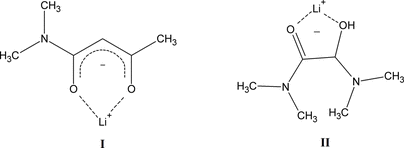
Even though highly polar solvents containing carbonyl groups like propylene carbonate are generally believed to be unreactive with alkali metals, they actually do react, albeit slowly. To search for less reactive solvents, Li foil was immersed in a vial containing a number of dry solvents of this type in an argon-filled drybox. The reactions took many days to months to proceed to completion, with the non-cyclic amide solvents reacting the quickest, and the cyclic CHO solvents reacting the slowest. Years later, crystals were isolated from reactions with N,N-dimethylacetamide [DMAC, Me2NC(=O)Me] and tetramethyl urea [TMU, Me2N(C=O)NMe2]. The DMAC formed a Li salt of N,N-dimethylacetoacetamide (I), possibly from deprotonation of a methyl group on one DMAC molecule, which then undergoes a nucleophilic attack on a second DMAC molecule. However, formation of the N,N-dimethylacetoacetamide ligand has been reported during solution of cellulose in DMAC containing LiCl (Potthast, et al., 2003 ). The reaction with TMU appears to have cleaved a Me2N group, followed by coupling of two Me2N(C=O) radicals, and protonation, producing the hexameric Li salt of Me2NCH(OH)C(=O)NMe2. Such a coupling has been observed before from a reaction between potassium t-butoxide and dimethylformamide (DMF) (Barham et al., 2016), and from a reduction using rubidium amalgam in DMF (Boeddinghaus et al., 2012). While N,N-dimethylacetoacetamide is commercially available and has been used as a standard β-diketonate ligand, for which the V, Ti and Pd complexes have been structurally characterized (Crans et al., 2001, CSD refcode ICITUJ; Gornshtein et al., 2007, XEVNOC; Kiers et al., 1992, JUFJID), and its Li salt has been prepared before and characterized by infrared spectroscopy (Coll, 1985), assembly of this ligand from coupling two DMAC moieties is relatively unusual, with very few references in the literature.
2. Structural commentary
Compound I crystallizes in the P21/n. Its N,N-dimethylacetoacetamidate ligand coordinates as a typical β-diketonate, which is chelated to the Li+ ion. Selected geometrical parameters are given in Table 1. Both C=O distances of 1.2731 (10) and 1.2882 (10) Å are ordinary for molecules of this type. The molecules assemble into a chain of fused four-membered Li2O2 rings that zigzag along the a-axis direction, and the rings are slightly offset. The basic dimeric unit is shown in Fig. 1, and the assemblage in a chain is shown in Fig. 2. A plane drawn through Li1/O1/Li1i/O1i makes an angle of 66.71 (8)° with a plane drawn through Li1/O2/Li1ii/O2ii [symmetry codes: (i) 1 − x,−y, −z; (ii) 2 − x,−y, −z] on the adjacent Li2O2 ring along this zigzagging chain. Bond distances in the Li chelate are normal, as expected for an unstrained chelate of this type, and the Li-O rings with bond lengths of 1.9045 (17)–1.9626 (18) Å are normal as well.
|
 ; (ii)
 .
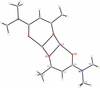 | Figure 1 The dimer of the molecular unit of I, showing the Li2O2 ring. Unlabeled atoms are generated by the 1 − x, −y, −z. Atomic displacement parameters are at the 30% probability level. |
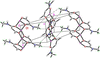 | Figure 2 A view of I showing the fused Li2O2 ring chain, overlaid with the along with the weak C—H⋯O interactions that support the chain. |
In 2015 the parameter τ4′ was developed to distinguish whether the geometry of the coordination center tends towards square planar or tetrahedral (Okuniewski et al., 2015). When τ4′ is close to 0 the geometry is similar to square planar, while if τ4′ is close to 1 then the geometry is similar to tetrahedral. In this structure, the value τ4′ was found to be 0.714, which indicates a distorted tetrahedral geometry. A search of the Cambridge Structural Database (version 6.00, update August 2025; Groom et al., 2016) for similar compounds containing a five-membered chelate ring with an O–C–C–O backbone with at least one C—O bond yielded seven hits (FAQFEK, Chen et al., 2009; IDOXIL, Al-Khafaji et al., 2017; KIJZUZ01, Budanow et al., 2010; NEFNAQ, Kingsbury et al., 2017; OZUCUI, Sazama & Betley, 2011; UCUSUK, Vuković et al., 2021; and VAYCUV, Wan et al., 2012.). In these structures the τ4′ value was found to be 0.930, 0.760–0.826 (four different Li sites), 0.675 and 0.784 (two different Li sites),
Compound II crystallizes in the trigonal R . Selected geometrical parameters are given in Table 2. The core of II is a barrel-shaped hexamer consisting of two Li3O3 rings in a slightly puckered chair conformation, facially bonded together around a threefold rotation axis, (Fig. 3), which is a fairly common structural motif for Li alkoxides. For example, lithium-t-butoxide (Nekola et al., 2002, ZZZJZU01) has a similar motif without the high crystal symmetry, and a lithium siloxide (Jones et al., 1992, JOTROZ) has the threefold symmetry as well. However, this particular ligand is unusual and has been structurally characterized only once previously (Boeddinghaus et al., 2012, TEXHUB), where it is coordinated to rubidium. The C1—O1 distance of 1.379 (3) Å, and the C2—O2 distance of 1.242 (3) Å are consistent with a C—O single bond and double bond, respectively, and are very similar to the corresponding distances in TEXHUB [1.346 (6) Å and 1.221 (7) Å]. Also similar are the C—N bond distances between the C=O carbon atom and its attached NMe2 group [C2—N2 = 1.348 (4) Å versus 1.345 (8) Å in TEXHUB], and the C—O (alkoxide) carbon atom and its attached NMe2 group [C1—N1 = 1.466 (4) Å, versus 1.520 (7) Å in TEXHUB], which shows some double-bond character exists between the NMe2 group and the carbonyl group. This results in different conformations for the two NMe2 groups with the environment of N1 being pyramidal while the environment for N2 being trigonal planar [C1, C2 O2, N2, C5 and C6 are almost coplanar with an r.m.s. deviation of only 0.030 (2) Å]. The O—C—C bond angles in both compounds are also almost identical [O1—C1—C2 = 110.6 (2)° and O2—C2—C1 =120.0 (3)° versus 110.3 (4) and 118.2 (5) ° in TEXHUB].
|
 ; (ii)
 .
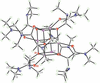 | Figure 3 A structural diagram of II showing a side view of the Li6O6 cage and the bonding of the keto O atoms O2 to the cage. Unlabeled atoms are generated by the symmetry operations: −  + y, − x + y, − z;  + x − y, + x, − z. Atomic displacement parameters are at the 30% probability level. |
The τ4′ value for the coordination environment of Li in II is 0.760, indicating a distorted tetrahedral conformation. A search of the Cambridge Structural Database for related Li structures containing a β-diketone ligand with both C and N substituents gave zero hits. However there are 46 structures where both substituents are carbon atoms. A typical example is BOWMAE (Petrus et al., 2020) where the τ4′ value was found to be 0.772, a value similar to that in II.
3. Supramolecular features
In the extended structure of I, as indicated above, the molecules assemble into a chain of fused four-membered Li2O2 rings that zigzag along the a-axis direction. These chains are supported on both sides by interactions involving C5. This is a remarkable case of methyl group involved into the two types of common interactions simultaneously: C5 is donor of a weak C—H⋯O bond to O1 [H5C⋯O1( − x,
 + y, − z) = 2.81 Å], with a C—O distance of 3.5908 (12) Å as well as being involved in a typical tetrel bond (Varadwaj et al., 2023) [C3—H3⋯O2( + x, − y, + z)] with a very short C—O distance of 3.0815 (12) Å as shown in Fig. 2
There is weak hydrogen bonding in II between C—H groups and O and N donors. Both C5—H5B⋯N1 and C1—H1⋯O2 are notable, and help to consolidate overall structure (Table 3, Fig. 4). In the structure, the orientation of the CH3 methyl group involving C5 is such that there is a weak intramolecular C5—H5B⋯N1 hydrogen bond.
| ||||||||||||||||||||||
 .
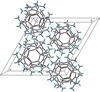 | Figure 4 A packing diagram of II down the c axis showing the threefold symmetry. |
4. Database survey
A search of the CSD database (version 6.00, update August 2025; Groom et al., 2016) found 35 instances of a barrel-shaped Li6O6 cluster similar to that in II, mostly in lithium alkoxides and siloxides, with additional structures where that motif is a subunit of a larger cluster. The great structural flexibility of Li–O clusters results in many other structural patterns, for example, stacked cubes (Goldfuss et al., 1997, NOXWEC) or prism structures (Dell'Aera et al. 2024, UHUWUT01). While the polymeric fused Li2O2 chains of I are less common, there are still plenty of examples of this general motif, particularly with β-diketonate salts such as the lithium salt of 1-ethoxy-3-difluoromethyl-1,3-dipropanone, and its trifluoromethyl analog (Slepukhin et al., 2009 EJUZIT, EJUZOZ), and the phenyl difluoromethyl analog as well (Karpenko et al., 2005, REGQAW).
5. Synthesis and crystallization
A piece of Li foil of about 0.1 g was added to scintillation vials containing ∼10 mL of dry tetramethyl urea (TMU), N,N-dimethylacetamide (DMAC), γ-valerolactone, and N,N-dimethylimidazolidinone (DMIZ) inside an argon-filled drybox. Within three days, the Li in the TMU dissolved to an orange solution, and the piece in DMAC reacted to form a yellow solution and a white precipitate, but the ones in DMIZ and γ-valerolactone did not fully react until three months had passed. Suitable crystals were isolated several years later from the DMAC and TMU mixtures. The solids isolated from the other two vials were not suitable for x-ray diffraction.
6. Refinement
Crystal data, data collection and structure details are summarized in Table 4. For both I and II, all H atoms were located in difference maps and treated as riding in geometrically idealized positions with C—H distances of 0.98 Å for the methyl groups. For II there was unresolved solvent peaks along the threefold axis. This was treated by using the SQUEEZE routine in PLATON (Spek, 2015)
|
Supporting information
contains datablocks I, II. DOI: https://doi.org/10.1107/S2056989026009989/vu2021sup1.cif
Structure factors: contains datablock I. DOI: https://doi.org/10.1107/S2056989026009989/vu2021Isup2.hkl
Structure factors: contains datablock II. DOI: https://doi.org/10.1107/S2056989026009989/vu2021IIsup3.hkl
| [Li(C6H10NO2)] | F(000) = 288 |
| Mr = 135.09 | Dx = 1.291 Mg m−3 |
| Monoclinic, P21/n | Mo Kα radiation, λ = 0.71073 Å |
| a = 5.2478 (2) Å | Cell parameters from 6211 reflections |
| b = 12.3868 (5) Å | θ = 3.3–30.6° |
| c = 10.9921 (5) Å | µ = 0.09 mm−1 |
| β = 103.461 (2)° | T = 100 K |
| V = 694.90 (5) Å3 | Prism, colourless |
| Z = 4 | 0.26 × 0.18 × 0.12 mm |
| Bruker APEXII CCD diffractometer | 2619 reflections with I > 2σ(I) |
| φ and ω scans | Rint = 0.050 |
| Absorption correction: multi-scan (SADABS; Krause et al., 2015) | θmax = 36.8°, θmin = 3.3° |
| Tmin = 0.635, Tmax = 0.743 | h = −8→8 |
| 17985 measured reflections | k = −19→19 |
| 3219 independent reflections | l = −18→17 |
| Refinement on F2 | Primary atom site location: dual |
| Least-squares matrix: full | Secondary atom site location: difference Fourier map |
| R[F2 > 2σ(F2)] = 0.048 | Hydrogen site location: inferred from neighbouring sites |
| wR(F2) = 0.126 | H-atom parameters constrained |
| S = 1.06 | w = 1/[σ2(Fo2) + (0.0607P)2 + 0.1969P] where P = (Fo2 + 2Fc2)/3 |
| 3219 reflections | (Δ/σ)max < 0.001 |
| 96 parameters | Δρmax = 0.57 e Å−3 |
| 0 restraints | Δρmin = −0.23 e Å−3 |
Geometry. All esds (except the esd in the dihedral angle between two l.s. planes) are estimated using the full covariance matrix. The cell esds are taken into account individually in the estimation of esds in distances, angles and torsion angles; correlations between esds in cell parameters are only used when they are defined by crystal symmetry. An approximate (isotropic) treatment of cell esds is used for estimating esds involving l.s. planes. |
| x | y | z | Uiso*/Ueq | ||
| O1 | 0.59962 (12) | −0.01383 (5) | 0.13056 (6) | 0.01357 (13) | |
| O2 | 1.01783 (12) | 0.09654 (5) | 0.06579 (6) | 0.01264 (12) | |
| N1 | 1.23735 (15) | 0.21292 (6) | 0.21082 (7) | 0.01497 (14) | |
| C1 | 0.61051 (18) | −0.02321 (8) | 0.34787 (8) | 0.01594 (16) | |
| H1A | 0.712848 | 0.006620 | 0.426777 | 0.024* | |
| H1B | 0.622423 | −0.102169 | 0.350360 | 0.024* | |
| H1C | 0.426848 | −0.001393 | 0.335987 | 0.024* | |
| C2 | 0.71778 (16) | 0.01900 (7) | 0.24042 (7) | 0.01192 (14) | |
| C3 | 0.92905 (16) | 0.08955 (7) | 0.26828 (7) | 0.01299 (14) | |
| H3 | 0.991510 | 0.110908 | 0.353001 | 0.016* | |
| C4 | 1.05980 (15) | 0.13250 (6) | 0.17718 (7) | 0.01154 (14) | |
| C5 | 1.3038 (2) | 0.25888 (8) | 0.33664 (9) | 0.02047 (18) | |
| H5A | 1.428371 | 0.318298 | 0.339481 | 0.031* | |
| H5B | 1.383134 | 0.203015 | 0.396732 | 0.031* | |
| H5C | 1.144541 | 0.286157 | 0.358115 | 0.031* | |
| C6 | 1.38164 (17) | 0.25529 (7) | 0.12269 (9) | 0.01694 (16) | |
| H6A | 1.361515 | 0.333922 | 0.117195 | 0.025* | |
| H6B | 1.312649 | 0.223310 | 0.040036 | 0.025* | |
| H6C | 1.567660 | 0.237110 | 0.151656 | 0.025* | |
| Li1 | 0.7387 (3) | 0.00402 (14) | −0.01375 (15) | 0.0151 (3) |
| U11 | U22 | U33 | U12 | U13 | U23 | |
| O1 | 0.0121 (3) | 0.0182 (3) | 0.0102 (2) | −0.0017 (2) | 0.00199 (19) | −0.0012 (2) |
| O2 | 0.0130 (3) | 0.0150 (3) | 0.0101 (2) | −0.0012 (2) | 0.00284 (18) | −0.00230 (19) |
| N1 | 0.0155 (3) | 0.0144 (3) | 0.0145 (3) | −0.0036 (2) | 0.0025 (2) | −0.0038 (2) |
| C1 | 0.0161 (4) | 0.0207 (4) | 0.0118 (3) | 0.0009 (3) | 0.0049 (3) | 0.0025 (3) |
| C2 | 0.0114 (3) | 0.0142 (3) | 0.0102 (3) | 0.0023 (2) | 0.0026 (2) | 0.0006 (2) |
| C3 | 0.0133 (3) | 0.0160 (3) | 0.0094 (3) | −0.0003 (2) | 0.0022 (2) | −0.0018 (2) |
| C4 | 0.0109 (3) | 0.0116 (3) | 0.0116 (3) | 0.0009 (2) | 0.0013 (2) | −0.0010 (2) |
| C5 | 0.0234 (4) | 0.0185 (4) | 0.0175 (4) | −0.0040 (3) | 0.0006 (3) | −0.0072 (3) |
| C6 | 0.0151 (4) | 0.0152 (4) | 0.0203 (4) | −0.0023 (3) | 0.0038 (3) | 0.0011 (3) |
| Li1 | 0.0140 (7) | 0.0192 (7) | 0.0122 (6) | −0.0015 (5) | 0.0031 (5) | −0.0023 (5) |
| O1—C2 | 1.2882 (10) | C1—H1C | 0.9800 |
| O1—Li1 | 1.9071 (17) | C2—C3 | 1.3888 (12) |
| O1—Li1i | 1.9376 (18) | C3—C4 | 1.4410 (11) |
| O2—C4 | 1.2731 (10) | C3—H3 | 0.9500 |
| O2—Li1 | 1.9045 (17) | C5—H5A | 0.9800 |
| O2—Li1ii | 1.9626 (18) | C5—H5B | 0.9800 |
| N1—C4 | 1.3553 (11) | C5—H5C | 0.9800 |
| N1—C6 | 1.4590 (12) | C6—H6A | 0.9800 |
| N1—C5 | 1.4608 (12) | C6—H6B | 0.9800 |
| C1—C2 | 1.5149 (11) | C6—H6C | 0.9800 |
| C1—H1A | 0.9800 | Li1—Li1i | 2.594 (3) |
| C1—H1B | 0.9800 | Li1—Li1ii | 2.690 (3) |
| C2—O1—Li1 | 123.31 (7) | H5A—C5—H5B | 109.5 |
| C2—O1—Li1i | 140.20 (7) | N1—C5—H5C | 109.5 |
| Li1—O1—Li1i | 84.87 (7) | H5A—C5—H5C | 109.5 |
| C4—O2—Li1 | 126.47 (7) | H5B—C5—H5C | 109.5 |
| C4—O2—Li1ii | 121.59 (7) | N1—C6—H6A | 109.5 |
| Li1—O2—Li1ii | 88.14 (7) | N1—C6—H6B | 109.5 |
| C4—N1—C6 | 120.89 (7) | H6A—C6—H6B | 109.5 |
| C4—N1—C5 | 122.83 (8) | N1—C6—H6C | 109.5 |
| C6—N1—C5 | 116.23 (7) | H6A—C6—H6C | 109.5 |
| C2—C1—H1A | 109.5 | H6B—C6—H6C | 109.5 |
| C2—C1—H1B | 109.5 | O2—Li1—O1 | 95.19 (8) |
| H1A—C1—H1B | 109.5 | O2—Li1—O1i | 139.00 (10) |
| C2—C1—H1C | 109.5 | O1—Li1—O1i | 95.13 (7) |
| H1A—C1—H1C | 109.5 | O2—Li1—O2ii | 91.86 (7) |
| H1B—C1—H1C | 109.5 | O1—Li1—O2ii | 124.75 (9) |
| O1—C2—C3 | 126.21 (7) | O1i—Li1—O2ii | 113.88 (8) |
| O1—C2—C1 | 115.90 (7) | O2—Li1—Li1i | 129.06 (11) |
| C3—C2—C1 | 117.89 (7) | O1—Li1—Li1i | 48.06 (6) |
| C2—C3—C4 | 124.33 (7) | O1i—Li1—Li1i | 47.07 (6) |
| C2—C3—H3 | 117.8 | O2ii—Li1—Li1i | 136.17 (11) |
| C4—C3—H3 | 117.8 | O2—Li1—Li1ii | 46.82 (5) |
| O2—C4—N1 | 118.27 (7) | O1—Li1—Li1ii | 118.67 (10) |
| O2—C4—C3 | 122.38 (7) | O1i—Li1—Li1ii | 146.07 (11) |
| N1—C4—C3 | 119.35 (7) | O2ii—Li1—Li1ii | 45.04 (5) |
| N1—C5—H5A | 109.5 | Li1i—Li1—Li1ii | 166.50 (14) |
| N1—C5—H5B | 109.5 | ||
| Li1—O1—C2—C3 | 13.93 (13) | Li1—O2—C4—C3 | 13.19 (13) |
| Li1i—O1—C2—C3 | −114.50 (12) | Li1ii—O2—C4—C3 | −100.84 (10) |
| Li1—O1—C2—C1 | −166.94 (8) | C6—N1—C4—O2 | −1.56 (12) |
| Li1i—O1—C2—C1 | 64.63 (14) | C5—N1—C4—O2 | −178.94 (8) |
| O1—C2—C3—C4 | −3.85 (14) | C6—N1—C4—C3 | 177.40 (8) |
| C1—C2—C3—C4 | 177.04 (8) | C5—N1—C4—C3 | 0.02 (12) |
| Li1—O2—C4—N1 | −167.88 (8) | C2—C3—C4—O2 | −10.97 (13) |
| Li1ii—O2—C4—N1 | 78.09 (11) | C2—C3—C4—N1 | 170.12 (8) |
| Symmetry codes: (i) −x+1, −y, −z; (ii) −x+2, −y, −z. |
| [Li6(C6H13N2O2)6] | Dx = 1.163 Mg m−3 |
| Mr = 912.74 | Mo Kα radiation, λ = 0.71073 Å |
| Trigonal, R3 | Cell parameters from 894 reflections |
| a = 18.156 (4) Å | θ = 3.0–24.8° |
| c = 13.698 (4) Å | µ = 0.09 mm−1 |
| V = 3911 (2) Å3 | T = 116 K |
| Z = 3 | Prism, colorless |
| F(000) = 1476 | 0.15 × 0.12 × 0.05 mm |
| Bruker APEXII CCD diffractometer | 915 reflections with I > 2σ(I) |
| φ and ω scans | Rint = 0.094 |
| Absorption correction: multi-scan (SADABS; Krause et al., 2015) | θmax = 25.3°, θmin = 3.0° |
| Tmin = 0.393, Tmax = 0.745 | h = −21→18 |
| 5186 measured reflections | k = −19→21 |
| 1589 independent reflections | l = −13→16 |
| Refinement on F2 | Primary atom site location: dual |
| Least-squares matrix: full | Secondary atom site location: difference Fourier map |
| R[F2 > 2σ(F2)] = 0.064 | Hydrogen site location: inferred from neighbouring sites |
| wR(F2) = 0.163 | H-atom parameters constrained |
| S = 1.01 | w = 1/[σ2(Fo2) + (0.0741P)2] where P = (Fo2 + 2Fc2)/3 |
| 1589 reflections | (Δ/σ)max < 0.001 |
| 104 parameters | Δρmax = 0.43 e Å−3 |
| 0 restraints | Δρmin = −0.22 e Å−3 |
Geometry. All esds (except the esd in the dihedral angle between two l.s. planes) are estimated using the full covariance matrix. The cell esds are taken into account individually in the estimation of esds in distances, angles and torsion angles; correlations between esds in cell parameters are only used when they are defined by crystal symmetry. An approximate (isotropic) treatment of cell esds is used for estimating esds involving l.s. planes. |
| x | y | z | Uiso*/Ueq | ||
| O1 | 0.35939 (12) | 0.57409 (12) | 0.24712 (13) | 0.0223 (5) | |
| O2 | 0.50447 (13) | 0.67719 (13) | 0.33958 (15) | 0.0282 (6) | |
| N1 | 0.38352 (16) | 0.46658 (15) | 0.32016 (17) | 0.0276 (7) | |
| N2 | 0.46926 (16) | 0.59789 (17) | 0.47645 (17) | 0.0333 (7) | |
| C1 | 0.37433 (18) | 0.54192 (18) | 0.3312 (2) | 0.0232 (7) | |
| H1 | 0.325206 | 0.526187 | 0.376097 | 0.028* | |
| C2 | 0.45485 (18) | 0.61048 (19) | 0.3831 (2) | 0.0227 (7) | |
| C3 | 0.3028 (2) | 0.3907 (2) | 0.2969 (3) | 0.0533 (11) | |
| H3A | 0.309407 | 0.340456 | 0.301229 | 0.080* | |
| H3B | 0.285549 | 0.395578 | 0.230512 | 0.080* | |
| H3C | 0.259255 | 0.385195 | 0.343320 | 0.080* | |
| C4 | 0.4479 (2) | 0.4799 (2) | 0.2475 (2) | 0.0403 (9) | |
| H4A | 0.459547 | 0.432748 | 0.250370 | 0.061* | |
| H4B | 0.500227 | 0.533471 | 0.261159 | 0.061* | |
| H4C | 0.427018 | 0.482353 | 0.182310 | 0.061* | |
| C5 | 0.4119 (2) | 0.5224 (2) | 0.5341 (2) | 0.0505 (11) | |
| H5A | 0.445502 | 0.506740 | 0.576227 | 0.076* | |
| H5B | 0.376906 | 0.475082 | 0.489987 | 0.076* | |
| H5C | 0.374993 | 0.535034 | 0.574409 | 0.076* | |
| C6 | 0.5401 (2) | 0.6652 (2) | 0.5305 (2) | 0.0484 (10) | |
| H6A | 0.573690 | 0.642522 | 0.560430 | 0.073* | |
| H6B | 0.518138 | 0.686848 | 0.581628 | 0.073* | |
| H6C | 0.576184 | 0.711568 | 0.485828 | 0.073* | |
| Li1 | 0.3600 (3) | 0.5773 (3) | 0.1068 (3) | 0.0268 (12) |
| U11 | U22 | U33 | U12 | U13 | U23 | |
| O1 | 0.0223 (12) | 0.0237 (11) | 0.0194 (11) | 0.0106 (9) | −0.0005 (9) | 0.0045 (9) |
| O2 | 0.0244 (12) | 0.0263 (12) | 0.0294 (12) | 0.0092 (10) | −0.0032 (10) | 0.0013 (10) |
| N1 | 0.0329 (15) | 0.0223 (14) | 0.0266 (14) | 0.0130 (13) | −0.0032 (12) | 0.0040 (11) |
| N2 | 0.0299 (16) | 0.0381 (17) | 0.0180 (13) | 0.0065 (13) | −0.0027 (12) | 0.0008 (12) |
| C1 | 0.0236 (17) | 0.0286 (18) | 0.0189 (15) | 0.0142 (14) | −0.0007 (13) | 0.0020 (13) |
| C2 | 0.0198 (16) | 0.0278 (17) | 0.0207 (16) | 0.0121 (15) | 0.0024 (13) | 0.0012 (14) |
| C3 | 0.054 (2) | 0.0229 (19) | 0.066 (3) | 0.0070 (18) | −0.025 (2) | −0.0015 (18) |
| C4 | 0.064 (3) | 0.039 (2) | 0.0335 (19) | 0.037 (2) | −0.0022 (18) | −0.0027 (16) |
| C5 | 0.050 (2) | 0.060 (3) | 0.0223 (17) | 0.013 (2) | 0.0010 (17) | 0.0122 (18) |
| C6 | 0.047 (2) | 0.057 (3) | 0.0276 (19) | 0.016 (2) | −0.0081 (17) | −0.0070 (18) |
| Li1 | 0.021 (3) | 0.036 (3) | 0.024 (3) | 0.014 (2) | −0.001 (2) | −0.001 (2) |
| O1—C1 | 1.379 (3) | C3—H3A | 0.9800 |
| O1—Li1 | 1.923 (5) | C3—H3B | 0.9800 |
| O1—Li1i | 1.940 (5) | C3—H3C | 0.9800 |
| O1—Li1ii | 1.974 (5) | C4—H4A | 0.9800 |
| O2—C2 | 1.242 (3) | C4—H4B | 0.9800 |
| O2—Li1ii | 1.944 (5) | C4—H4C | 0.9800 |
| N1—C3 | 1.459 (4) | C5—H5A | 0.9800 |
| N1—C4 | 1.460 (4) | C5—H5B | 0.9800 |
| N1—C1 | 1.466 (4) | C5—H5C | 0.9800 |
| N2—C2 | 1.348 (4) | C6—H6A | 0.9800 |
| N2—C6 | 1.458 (4) | C6—H6B | 0.9800 |
| N2—C5 | 1.469 (4) | C6—H6C | 0.9800 |
| C1—C2 | 1.540 (4) | Li1—Li1ii | 2.518 (7) |
| C1—Li1ii | 2.779 (5) | Li1—Li1i | 2.519 (7) |
| C1—H1 | 1.0000 | Li1—Li1iii | 3.310 (9) |
| C2—Li1ii | 2.649 (6) | Li1—Li1iv | 3.310 (9) |
| C1—O1—Li1 | 148.1 (2) | H6A—C6—H6B | 109.5 |
| C1—O1—Li1i | 116.6 (2) | N2—C6—H6C | 109.5 |
| Li1—O1—Li1i | 81.4 (2) | H6A—C6—H6C | 109.5 |
| C1—O1—Li1ii | 110.7 (2) | H6B—C6—H6C | 109.5 |
| Li1—O1—Li1ii | 80.5 (2) | O1—Li1—O1ii | 99.6 (2) |
| Li1i—O1—Li1ii | 115.5 (3) | O1—Li1—O2i | 141.2 (3) |
| C2—O2—Li1ii | 110.6 (2) | O1ii—Li1—O2i | 111.4 (2) |
| C3—N1—C4 | 110.5 (3) | O1—Li1—O1i | 98.4 (2) |
| C3—N1—C1 | 112.0 (2) | O1ii—Li1—O1i | 120.4 (3) |
| C4—N1—C1 | 111.8 (2) | O2i—Li1—O1i | 85.8 (2) |
| C2—N2—C6 | 120.3 (3) | O1—Li1—Li1ii | 50.6 (2) |
| C2—N2—C5 | 124.1 (3) | O1ii—Li1—Li1ii | 49.02 (11) |
| C6—N2—C5 | 115.2 (3) | O2i—Li1—Li1ii | 153.5 (3) |
| O1—C1—N1 | 116.6 (2) | O1i—Li1—Li1ii | 118.64 (17) |
| O1—C1—C2 | 110.6 (2) | O1—Li1—Li1i | 49.6 (2) |
| N1—C1—C2 | 107.3 (2) | O1ii—Li1—Li1i | 119.20 (18) |
| O1—C1—Li1ii | 41.64 (16) | O2i—Li1—Li1i | 123.9 (2) |
| N1—C1—Li1ii | 129.9 (2) | O1i—Li1—Li1i | 48.86 (11) |
| C2—C1—Li1ii | 68.94 (18) | Li1ii—Li1—Li1i | 82.2 (3) |
| O1—C1—H1 | 107.4 | O1—Li1—C2i | 142.9 (3) |
| N1—C1—H1 | 107.4 | O1ii—Li1—C2i | 117.3 (2) |
| C2—C1—H1 | 107.4 | O2i—Li1—C2i | 26.03 (11) |
| Li1ii—C1—H1 | 121.7 | O1i—Li1—C2i | 60.49 (15) |
| O2—C2—N2 | 120.9 (3) | Li1ii—Li1—C2i | 165.2 (3) |
| O2—C2—C1 | 120.0 (3) | Li1i—Li1—C2i | 104.1 (2) |
| N2—C2—C1 | 119.1 (3) | O1—Li1—C1i | 120.8 (2) |
| O2—C2—Li1ii | 43.38 (17) | O1ii—Li1—C1i | 124.5 (2) |
| N2—C2—Li1ii | 158.4 (2) | O2i—Li1—C1i | 58.31 (15) |
| C1—C2—Li1ii | 78.21 (18) | O1i—Li1—C1i | 27.65 (10) |
| N1—C3—H3A | 109.5 | Li1ii—Li1—C1i | 144.72 (16) |
| N1—C3—H3B | 109.5 | Li1i—Li1—C1i | 73.54 (16) |
| H3A—C3—H3B | 109.5 | C2i—Li1—C1i | 32.85 (10) |
| N1—C3—H3C | 109.5 | O1—Li1—Li1iii | 91.59 (16) |
| H3A—C3—H3C | 109.5 | O1ii—Li1—Li1iii | 32.56 (17) |
| H3B—C3—H3C | 109.5 | O2i—Li1—Li1iii | 127.03 (16) |
| N1—C4—H4A | 109.5 | O1i—Li1—Li1iii | 90.95 (15) |
| N1—C4—H4B | 109.5 | Li1ii—Li1—Li1iii | 48.92 (13) |
| H4A—C4—H4B | 109.5 | Li1i—Li1—Li1iii | 90.0 |
| N1—C4—H4C | 109.5 | C2i—Li1—Li1iii | 116.97 (12) |
| H4A—C4—H4C | 109.5 | C1i—Li1—Li1iii | 105.04 (14) |
| H4B—C4—H4C | 109.5 | O1—Li1—Li1iv | 90.98 (16) |
| N2—C5—H5A | 109.5 | O1ii—Li1—Li1iv | 91.57 (16) |
| N2—C5—H5B | 109.5 | O2i—Li1—Li1iv | 110.2 (2) |
| H5A—C5—H5B | 109.5 | O1i—Li1—Li1iv | 31.93 (16) |
| N2—C5—H5C | 109.5 | Li1ii—Li1—Li1iv | 90.0 |
| H5A—C5—H5C | 109.5 | Li1i—Li1—Li1iv | 48.92 (13) |
| H5B—C5—H5C | 109.5 | C2i—Li1—Li1iv | 84.46 (17) |
| N2—C6—H6A | 109.5 | C1i—Li1—Li1iv | 54.75 (16) |
| N2—C6—H6B | 109.5 | Li1iii—Li1—Li1iv | 60.0 |
| Li1—O1—C1—N1 | −15.2 (6) | Li1ii—O2—C2—C1 | 17.4 (3) |
| Li1i—O1—C1—N1 | 104.1 (3) | C6—N2—C2—O2 | 4.6 (4) |
| Li1ii—O1—C1—N1 | −121.1 (3) | C5—N2—C2—O2 | 177.4 (3) |
| Li1—O1—C1—C2 | 107.6 (4) | C6—N2—C2—C1 | −173.7 (3) |
| Li1i—O1—C1—C2 | −133.1 (2) | C5—N2—C2—C1 | −0.9 (4) |
| Li1ii—O1—C1—C2 | 1.7 (3) | C6—N2—C2—Li1ii | −33.1 (8) |
| Li1—O1—C1—Li1ii | 105.9 (4) | C5—N2—C2—Li1ii | 139.7 (6) |
| Li1i—O1—C1—Li1ii | −134.8 (3) | O1—C1—C2—O2 | −13.3 (4) |
| C3—N1—C1—O1 | −71.2 (3) | N1—C1—C2—O2 | 114.8 (3) |
| C4—N1—C1—O1 | 53.4 (3) | Li1ii—C1—C2—O2 | −12.1 (2) |
| C3—N1—C1—C2 | 164.3 (2) | O1—C1—C2—N2 | 165.0 (2) |
| C4—N1—C1—C2 | −71.1 (3) | N1—C1—C2—N2 | −66.9 (3) |
| C3—N1—C1—Li1ii | −119.0 (3) | Li1ii—C1—C2—N2 | 166.2 (3) |
| C4—N1—C1—Li1ii | 5.6 (4) | O1—C1—C2—Li1ii | −1.2 (2) |
| Li1ii—O2—C2—N2 | −160.9 (3) | N1—C1—C2—Li1ii | 126.9 (2) |
| Symmetry codes: (i) y−1/3, −x+y+1/3, −z+1/3; (ii) x−y+2/3, x+1/3, −z+1/3; (iii) −y+1, x−y+1, z; (iv) −x+y, −x+1, z. |
| D—H···A | D—H | H···A | D···A | D—H···A |
| C1—H1···O2iv | 1.00 | 2.59 | 3.322 (4) | 130 |
| C5—H5B···N1 | 0.98 | 2.34 | 3.059 (4) | 130 |
| Symmetry code: (iv) −x+y, −x+1, z. |
Funding information
Funding for this research was provided by: The Office of Naval Research through the NRL Base Program.
References
 Al-Khafaji, Y. F., Prior, T. J., Horsburgh, L., Elsegood, M. R. J. & Redshaw, C. (2017). Chem. Sel 2, 759–768. Google Scholar
Barham, J. P., Coulthard, G., Emery, K. J., Doni, E., Cumine, F., Nocera, G., John, M. P., Berlouis, L. E. A., McGuire, T., Tuttle, T. & Murphy, J. A. (2016). J. Am. Chem. Soc. 138, 7402–7410. CrossRef CAS PubMed Google Scholar
Boeddinghaus, M. B., Wahl, B., Fässler, T. F., Jakes, P. & Eichel, R. A. (2012). Z. Anorg. Allg. Chem. 638, 2205–2212. CrossRef CAS Google Scholar
Bruker (2002). SAINT. Bruker AXS Inc., Madison, Wisconsin, USA. Google Scholar
Bruker (2005). APEX2.Bruker AXS Inc., Madison, Wisconsin, USA. Google Scholar
Budanow, A., Tutughamiarso, M., Lerner, H.-W. & Bolte, M. (2010). CSD Communication (refcode KIJZUZ01). CCDC, Cambridge, England. Google Scholar
Chen, H., Poizot, P., Dolhem, F., Basir, N. I., Mentré, O. J.-M. & Tarascon, J. (2009). Electrochem. Solid-State Lett. 12, A102–A106. CrossRef CAS Google Scholar
Coll, A. P. (1985). Afinidad 42, 289–295. Google Scholar
Crans, D. C., Khan, R., Mahroof-Tahir, M., Mondal, S., Miller, S. M., la Cour, A., Anderson, O. P., Jakusch, T. & Kiss, T. (2001). J. Chem. Soc. Dalton Trans. pp. 3337–3345. CrossRef Google Scholar
Dell'Aera, M., Maria Perna, F., Vitale, P., Altomare, A., Hevia, A. & Capriati, V. (2024). Eur. J. Inorg. Chem. 27, e202400505. Google Scholar
Goldfuss, B., Schleyer, P. R. & Hampel, F. (1997). Organometallics 16, 5032–5041. CrossRef CAS Google Scholar
Gornshtein, F., Kapon, M., Botoshansky, M. & Eisen, M. S. (2007). Organometallics 26, 497–507. CrossRef CAS Google Scholar
Groom, C. R., Bruno, I. J., Lightfoot, M. P. & Ward, S. C. (2016). Acta Cryst. B72, 171–179. Web of Science CrossRef IUCr Journals Google Scholar
Jones, R. A., Koschmieder, S. U., Atwood, J. L. & Bott, S. G. (1992). J. Chem. Soc. Chem. Commun. pp. 726–727. CrossRef Google Scholar
Karpenko, N. S., Filyakova, V. I., Aleksandrov, G. G. & Charushin, V. N. (2005). Zh. Strukt. Khim. (Russ. J. Struct. Chem.) 46, 987. Google Scholar
Kiers, N. H., Feringa, B. L., Kooijman, H., Spek, A. L. & van Leeuwen, P. W. N. M. (1992). J. Chem. Soc. Chem. Commun. pp. 1169–1170. CrossRef Google Scholar
Kingsbury, C. J., Abrahams, B. F. & Robson, R. (2017). CSD Communication (refcode NEFNAQ). CCDC, Cambridge, England. Google Scholar
Krause, L., Herbst-Irmer, R., Sheldrick, G. M. & Stalke, D. (2015). J. Appl. Cryst. 48, 3–10. Web of Science CSD CrossRef ICSD CAS IUCr Journals Google Scholar
Nekola, H., Olbrich, F. & Behrens, U. (2002). Z. Anorg. Allg. Chem. 628, 2067–2070. CrossRef CAS Google Scholar
Okuniewski, A., Rosiak, D., Chojnacki, J. & Becker, B. (2015). Polyhedron 90, 47–57. Web of Science CSD CrossRef CAS Google Scholar
Petrus, R., Fałat, P. & Sobota, P. (2020). Dalton Trans. 49, 866–876. CrossRef CAS PubMed Google Scholar
Potthast, A., Rosenau, T., Sartori, J., Sixta, H. & Kosma, P. (2003). Polymer 44, 7–17. CrossRef CAS Google Scholar
Sazama, G. T. & Betley, T. A. (2011). Organometallics 30, 4315–4319. CrossRef CAS Google Scholar
Sheldrick, G. M. (2008). Acta Cryst. A64, 112–122. Web of Science CrossRef CAS IUCr Journals Google Scholar
Sheldrick, G. M. (2015a). Acta Cryst. C71, 3–8. Web of Science CrossRef IUCr Journals Google Scholar
Sheldrick, G. M. (2015b). Acta Cryst. C71, 3–8. Web of Science CrossRef IUCr Journals Google Scholar
Slepukhin, P. A., Boltacheva, N. S., Filyakova, V. I. & Charushin, N. (2009). Russ. Chem. Bull. 58, 1228–1232. CrossRef CAS Google Scholar
Spek, A. L. (2015). Acta Cryst. C71, 9–18. Web of Science CrossRef IUCr Journals Google Scholar
Varadwaj, P. R., Varadwaj, A., Marques, H. M. & Yamashita, K. (2023). CrystEngComm 25, 1411–1423. Web of Science CrossRef CAS Google Scholar
Vuković, V., Piteša, T., Jelsch, C., Wenger, E. & Molčanov, K. (2021). Cryst. Growth Des. 21, 5651–5658. Google Scholar
Wan, W., Zhu, Z.-B., Huo, L.-H., Deng, Z.-P., Zhao, H. & Gao, S. (2012). CrystEngComm 14, 5274–5284. CrossRef CAS Google Scholar
This is an open-access article distributed under the terms of the Creative Commons Attribution (CC-BY) Licence, which permits unrestricted use, distribution, and reproduction in any medium, provided the original authors and source are cited.
| CRYSTALLOGRAPHIC COMMUNICATIONS |
access