
Acta Crystallographica
Section E CRYSTALLOGRAPHIC COMMUNICATIONS


 menu


research communications
| CRYSTALLOGRAPHIC COMMUNICATIONS |
 access
Synthesis and structure of 6,6′-bis(4-chlorophenyl)-3,3′-bis(pyridin-2-yl)-5,5′-bi(1,2,4-triazine)

aThe Ural Federal University, named after the first president of Russia, B. N. Yeltsin, Mira. 19 st., 620002, Yekaterinburg, Russian Federation, bPostovsky Institute of Organic Synthesis, Ural Branch of the Russian Academy of Sciences, Sof'i Kovalevskoy 22 st., 620137, Yekaterinburg, Russian Federation, cHacettepe University, Department of Physics, 06800 Beytepe-Ankara, Türkiye, dSRI Geotechnological Problems of Oil, Gas and Chemistry, Dilara Aliyeva str. 227, AZ1010, Baku, Azerbaijan, eDepartment of Chemical Engineering, Baku Engineering University, Hasan Aliyev str. 120, AZ0101, Khirdalan, Absheron, Azerbaijan, and fDepartment of Chemistry, Bahir Dar University, PO Box 79, Bahir Dar, Ethiopia
*Correspondence e-mail: [email protected]
The complete molecule of the title compound, C28H16Cl2N8, is generated by a crystallographic twofold axis: the dihedral angle between the triazine rings is 65.86 (18)°. In the asymmetric fragment, the pyridine and triazine rings are almost coplanar at a dihedral angle of 1.81 (7)° and they are oriented with respect to the phenyl ring at 43.69 (6)° and 44.67 (8)°, respectively. In the crystal, aromatic π–π stacking interactions between the pyridine and triazine rings and between the phenyl rings with centroid-to-centroid distances of 3.6490 (4) Å and 3.8098 (5) Å, respectively, consolidate the packing. The Hirshfeld surface analysis indicates that the most important contributions for the crystal packing are from H⋯H (30.6%), H⋯Cl/Cl⋯H (19.5%), H⋯N/N⋯H (18.3%), H⋯C/C⋯H (12.8%) and C⋯N/N⋯C (9.2%) contacts.
Keywords: triazine; crystal structure; non-covalent interactions.
CCDC reference: 2601326
1. Chemical context
2,2′:6′,2′′:6′′,2′′′-Quaterpyridines are valuable synthetic building blocks in metallosupramolecular chemistry, as this specific arrangement of pyridine rings can accommodate various coordination numbers characteristic of specific metals, such as RuII (Renouard et al., 2002 ), AgI, CuI (Adamski et al., 2016) or CoII (Chen et al., 2021), thereby opening up possibilities for creating materials for diverse applications, such as efficient photosensitizers for solar cells (Renouard et al., 2002) or catalysts for the low-temperature aerobic oxidation of hydrocarbons (Chen et al., 2021).
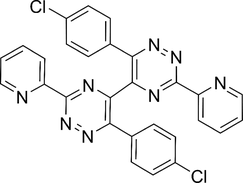
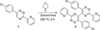
One common method for synthesizing oligopyridines is the Boger reaction of 1,2,4-triazine precursors with various dienophiles (Shabunina et al., 2021). When 5,5′-bis(1,2,4-triazines) are used as the heterodiene precursors, the synthesis of quaterpyridines becomes possible (Fatykhov et al., 2026). The key step in this process is the dimerization of the starting 1,2,4-triazine, achieved by maintaining the compound in an aqueous KCN solution (Fatykhov et al., 2026). In the present work, we investigated the feasibility of carrying out this reaction by heating to 473 K in the presence of morpholine, using 6-(4-chlorophenyl)-3-(2-pyridinyl)-1,2,4- triazine as a substrate, and we now report the structure of the title compound, C28H16Cl2N8 (I), that resulted.
2. Structural commentary
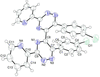
The asymmetric unit of the title compound (I) contains one-half molecule, consisting of the pyridine, triazine and chlorophenyl rings (Fig. 1). The complete molecule is generated by a crystallographic twofold axis at the midpoint of the C8—C8i [symmetry code: (i) 1 − x, 1 − y, z] bond and the dihedral angle between the N1–N3/C7–C9 triazine ring and its symmetry-generated partner is 65.86 (18)°, which is also reflected in the N1—C8—C8i—N1i torsion angle of −67.18 (4)°. Within the asymmetric fragment, the phenyl, A (C1–C6), triazine, B (N1–N3/C7–C9), and pyridine, C (N4/C10–C14), rings are oriented at dihedral angles of A/B = 44.67 (8)°, A/C = 43.69 (6)° and B/C = 1.81 (7)°. The C9—C10 [1.489 (5) Å] and N3—C7 [1.344 (5) Å] bonds are longer, while the C1—C7 [1.472 (5) Å] and N1—C8 [1.317 (4) Å] bonds are shorter than the corresponding values in 6-(4-methoxyphenyl)-5-(pentafluorophenyl)-3-(pyridin-2-yl)-1,2,4-triazine (II) (Moseev et al., 2023). The N3—C7—C1 [116.7 (3)°], N4—C10—C9 [117.1 (3)°], N4—C10—C14 [122.9 (4)°] and C11—C12—C13 [119.3 (4)°] bond angles are significantly widened, while the C10—C14—C13 [118.5 (4)°] and C12—C13—C14 [118.9 (4)°] bond angles are significantly narrowed with respect to the corresponding values in (II).
|
Figure 1
The molecular structure of (I) with 50% probability ellipsoids. Unlabelled atoms are generated by the symmetry operation 1 − x, 1 − y, z. |
3. Supramolecular features
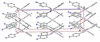
In the extended structure of (I), aromatic π–π stacking interactions between the pyridine and triazine rings and between the phenyl rings with centroid-to-centroid distances of 3.6490 (4) Å [α = 2.40 (5)° and slippage = 1.345 Å] and 3.8098 (5) Å [α = 3.89 (7)° and slippage = 1.827 Å] consolidate the packing (Fig. 2). Neither classical hydrogen bonds nor C—H⋯π interactions are observed.
|
Figure 2
A partial packing diagram of (I) viewed down the b-axis direction. Hydrogen atoms have been omitted for clarity. |
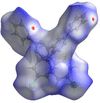
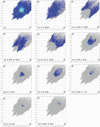
The intermolecular interactions in the crystal are visualized by carrying out the Hirshfeld surface (HS) analysis using CrystalExplorer17.5 (Spackman et al., 2021). Fig. 3 shows the Hirshfeld surface for (I) plotted over dnorm. The overall two-dimensional fingerprint plot is shown in Fig. 4a and those delineated into the different contact types in Fig. 4b–k. According to the two-dimensional fingerprint plots, the H⋯H, H⋯Cl/Cl⋯H, H⋯N/N⋯H, H⋯C/C⋯H, and C⋯N/N⋯C contacts make the most significant contributions to the HS, at 30.6, 19.5, 18.3, 12.8 and 9.2%, respectively.
|
Figure 3
View of the three-dimensional Hirshfeld surface for (I) plotted over dnorm in the range −0.07 to 1.62 a.u. |
|
Figure 4
The full two-dimensional fingerprint plots for (I), showing (a) all interactions, and (b)–(k) delineated into different contact types. |
4. Synthesis and crystallization
The starting compound 1,2,4-triazine 1 was prepared according to a literature procedure (Kozhevnikov et al., 2005). Then, 120 mg (0.45 mmol) of 6-(4-chlorophenyl)-3-(2-pyridinyl)-1,2,4-triazine 1 and 0.19 ml (2.23 mmol) of morpholine were added to a round-bottom flask and the resulting mixture was heated at 473 K for 8 h under an inert atmosphere. The product was isolated by column chromatography (eluent AcOEt: CHCl3 = 1:9; Rf = 0.1) (Fig. 5). An analytical sample was obtained by slow evaporation of its acetonitrile solution. Yield, 53 mg (44%). 1H NMR (400 MHz, CDCl3): δ 6.69–6.74 (m, 2H, Py, Py′), 7.23–7.38 (m, 6H, Py, Py′, Ar, Ar′), 7.49–7.56 (m, 4H, Py, Py′, Ar, Ar′), 7.56–7.65 (m, 2H, Py, Py′), 8.50–8.55 (m, 2H, Py, Py′). Mass spectrum, m/z: 535.10 [M + H]+. Found (%): C 62.81, H 2.99, N 20.90. Calculated for C28H16Cl2N8 (%): C 62.82, H 3.01, N 20.93.
|
Figure 5
Synthesis scheme for (I). |
5. Refinement
Crystal data, data collection and structure refinement details are summarized in Table 1. The C-bound hydrogen-atom positions were calculated geometrically at distances of 0.93 Å and refined using a riding model by applying the constraint of Uiso(H) = 1.2Ueq(C).
|
Supporting information
CCDC reference: 2601326
Crystal structure: contains datablocks I, global. DOI: https://doi.org/10.1107/S2056989026011643/hb8274sup1.cif
Structure factors: contains datablock I. DOI: https://doi.org/10.1107/S2056989026011643/hb8274Isup2.hkl
| C28H16Cl2N8 | Dx = 1.411 Mg m−3 |
| Mr = 535.39 | Mo Kα radiation, λ = 0.71073 Å |
| Orthorhombic, Aba2 | Cell parameters from 1783 reflections |
| a = 7.9614 (8) Å | θ = 3.9–28.0° |
| b = 12.6942 (15) Å | µ = 0.29 mm−1 |
| c = 24.938 (2) Å | T = 296 K |
| V = 2520.3 (4) Å3 | Block, yellow |
| Z = 4 | 0.47 × 0.38 × 0.21 mm |
| F(000) = 1096 |
| Xcalibur, Sapphire3 diffractometer | 2379 independent reflections |
| Radiation source: fine-focus sealed X-ray tube | 1850 reflections with I > 2σ(I) |
| Detector resolution: 0 pixels mm-1 | Rint = 0.037 |
| ω scans | θmax = 28.3°, θmin = 3.9° |
| Absorption correction: multi-scan (SADABS; Krause et al., 2015) | h = −6→10 |
| Tmin = 0.819, Tmax = 0.904 | k = −16→16 |
| 6101 measured reflections | l = −25→33 |
| Refinement on F2 | Hydrogen site location: inferred from neighbouring sites |
| Least-squares matrix: full | H-atom parameters constrained |
| R[F2 > 2σ(F2)] = 0.047 | w = 1/[σ2(Fo2) + (0.0615P)2 + 0.7909P] where P = (Fo2 + 2Fc2)/3 |
| wR(F2) = 0.135 | (Δ/σ)max < 0.001 |
| S = 1.03 | Δρmax = 0.20 e Å−3 |
| 2379 reflections | Δρmin = −0.23 e Å−3 |
| 172 parameters | Absolute structure: Flack x determined using 422 quotients [(I+)-(I-)]/[(I+)+(I-)] (Parsons et al., 2013) |
| 1 restraint | Absolute structure parameter: 0.10 (10) |
| Primary atom site location: dual |
Geometry. All esds (except the esd in the dihedral angle between two l.s. planes) are estimated using the full covariance matrix. The cell esds are taken into account individually in the estimation of esds in distances, angles and torsion angles; correlations between esds in cell parameters are only used when they are defined by crystal symmetry. An approximate (isotropic) treatment of cell esds is used for estimating esds involving l.s. planes. |
| x | y | z | Uiso*/Ueq | ||
| Cl1 | 0.8565 (2) | 0.61745 (11) | 0.69341 (6) | 0.0982 (5) | |
| N1 | 0.4339 (4) | 0.3905 (2) | 0.42228 (11) | 0.0430 (6) | |
| N2 | 0.5226 (5) | 0.2295 (2) | 0.46146 (13) | 0.0549 (7) | |
| N3 | 0.6011 (5) | 0.2810 (2) | 0.50112 (14) | 0.0545 (7) | |
| N4 | 0.2799 (5) | 0.2787 (2) | 0.34248 (15) | 0.0569 (8) | |
| C1 | 0.6775 (4) | 0.4384 (3) | 0.54838 (15) | 0.0501 (8) | |
| C2 | 0.6499 (6) | 0.3992 (3) | 0.60018 (17) | 0.0616 (10) | |
| H2 | 0.591179 | 0.336427 | 0.604644 | 0.074* | |
| C3 | 0.7084 (6) | 0.4523 (4) | 0.64452 (17) | 0.0693 (12) | |
| H3 | 0.690363 | 0.425758 | 0.678792 | 0.083* | |
| C4 | 0.7938 (6) | 0.5451 (3) | 0.63730 (18) | 0.0658 (12) | |
| C5 | 0.8312 (6) | 0.5828 (3) | 0.58722 (18) | 0.0650 (11) | |
| H5 | 0.895695 | 0.643358 | 0.583305 | 0.078* | |
| C6 | 0.7723 (5) | 0.5301 (3) | 0.54273 (17) | 0.0551 (9) | |
| H6 | 0.796042 | 0.555916 | 0.508656 | 0.066* | |
| C7 | 0.5976 (5) | 0.3868 (3) | 0.50207 (14) | 0.0456 (8) | |
| C8 | 0.5090 (4) | 0.4406 (2) | 0.46185 (13) | 0.0422 (7) | |
| C9 | 0.4450 (5) | 0.2845 (3) | 0.42359 (14) | 0.0434 (7) | |
| C10 | 0.3597 (5) | 0.2235 (3) | 0.38050 (15) | 0.0457 (7) | |
| C11 | 0.2009 (5) | 0.2239 (4) | 0.30403 (18) | 0.0636 (11) | |
| H11 | 0.145339 | 0.260885 | 0.277181 | 0.076* | |
| C12 | 0.1982 (6) | 0.1154 (4) | 0.30241 (19) | 0.0675 (12) | |
| H12 | 0.141209 | 0.080515 | 0.275123 | 0.081* | |
| C13 | 0.2796 (6) | 0.0599 (3) | 0.3410 (2) | 0.0675 (11) | |
| H13 | 0.279823 | −0.013325 | 0.340435 | 0.081* | |
| C14 | 0.3624 (6) | 0.1143 (3) | 0.38146 (17) | 0.0562 (10) | |
| H14 | 0.418465 | 0.078350 | 0.408570 | 0.067* |
| U11 | U22 | U33 | U12 | U13 | U23 | |
| Cl1 | 0.1435 (13) | 0.0837 (9) | 0.0674 (7) | 0.0011 (8) | −0.0315 (8) | −0.0237 (7) |
| N1 | 0.0540 (16) | 0.0351 (14) | 0.0397 (14) | −0.0010 (12) | 0.0026 (12) | −0.0019 (11) |
| N2 | 0.0746 (19) | 0.0362 (14) | 0.0540 (17) | 0.0013 (15) | −0.0060 (16) | −0.0019 (14) |
| N3 | 0.076 (2) | 0.0351 (15) | 0.0527 (18) | 0.0043 (15) | −0.0085 (16) | 0.0025 (13) |
| N4 | 0.071 (2) | 0.0502 (18) | 0.0498 (16) | −0.0037 (15) | −0.0052 (16) | −0.0016 (14) |
| C1 | 0.062 (2) | 0.0419 (18) | 0.0469 (19) | 0.0025 (16) | −0.0080 (16) | 0.0021 (15) |
| C2 | 0.086 (3) | 0.050 (2) | 0.049 (2) | −0.0061 (18) | −0.010 (2) | 0.0069 (17) |
| C3 | 0.102 (3) | 0.063 (3) | 0.043 (2) | −0.001 (3) | −0.011 (2) | 0.0052 (18) |
| C4 | 0.087 (3) | 0.058 (3) | 0.053 (2) | 0.005 (2) | −0.018 (2) | −0.0069 (18) |
| C5 | 0.080 (3) | 0.050 (2) | 0.065 (3) | −0.0062 (19) | −0.014 (2) | 0.002 (2) |
| C6 | 0.070 (2) | 0.046 (2) | 0.049 (2) | −0.0038 (18) | −0.0112 (18) | 0.0044 (15) |
| C7 | 0.058 (2) | 0.0375 (18) | 0.0418 (18) | 0.0001 (15) | −0.0008 (15) | 0.0017 (13) |
| C8 | 0.0546 (18) | 0.0336 (15) | 0.0383 (14) | −0.0013 (14) | 0.0020 (13) | −0.0002 (13) |
| C9 | 0.0533 (18) | 0.0337 (15) | 0.0432 (17) | −0.0003 (14) | 0.0060 (14) | 0.0011 (13) |
| C10 | 0.0512 (18) | 0.0421 (17) | 0.0440 (18) | −0.0038 (15) | 0.0077 (14) | −0.0035 (13) |
| C11 | 0.072 (3) | 0.068 (3) | 0.050 (2) | −0.007 (2) | −0.0054 (19) | 0.0014 (19) |
| C12 | 0.079 (3) | 0.070 (3) | 0.053 (2) | −0.016 (2) | 0.001 (2) | −0.018 (2) |
| C13 | 0.088 (3) | 0.046 (2) | 0.069 (3) | −0.015 (2) | 0.007 (2) | −0.014 (2) |
| C14 | 0.075 (3) | 0.0372 (18) | 0.057 (2) | −0.0028 (18) | 0.0015 (19) | −0.0068 (16) |
| Cl1—C4 | 1.747 (4) | C4—C5 | 1.370 (6) |
| N1—C8 | 1.317 (4) | C5—C6 | 1.377 (6) |
| N1—C9 | 1.349 (4) | C5—H5 | 0.9300 |
| N2—C9 | 1.327 (4) | C6—H6 | 0.9300 |
| N2—N3 | 1.340 (5) | C7—C8 | 1.404 (5) |
| N3—C7 | 1.344 (5) | C8—C8i | 1.515 (6) |
| N4—C10 | 1.339 (5) | C9—C10 | 1.489 (5) |
| N4—C11 | 1.341 (5) | C10—C14 | 1.386 (5) |
| C1—C6 | 1.394 (5) | C11—C12 | 1.378 (7) |
| C1—C2 | 1.402 (6) | C11—H11 | 0.9300 |
| C1—C7 | 1.472 (5) | C12—C13 | 1.358 (7) |
| C2—C3 | 1.377 (6) | C12—H12 | 0.9300 |
| C2—H2 | 0.9300 | C13—C14 | 1.389 (6) |
| C3—C4 | 1.372 (6) | C13—H13 | 0.9300 |
| C3—H3 | 0.9300 | C14—H14 | 0.9300 |
| C8—N1—C9 | 115.7 (3) | N3—C7—C1 | 116.7 (3) |
| C9—N2—N3 | 119.0 (3) | C8—C7—C1 | 124.1 (3) |
| N2—N3—C7 | 119.4 (3) | N1—C8—C7 | 121.9 (3) |
| C10—N4—C11 | 117.2 (3) | N1—C8—C8i | 115.9 (3) |
| C6—C1—C2 | 118.4 (4) | C7—C8—C8i | 122.1 (3) |
| C6—C1—C7 | 121.7 (3) | N2—C9—N1 | 125.0 (3) |
| C2—C1—C7 | 119.8 (3) | N2—C9—C10 | 116.9 (3) |
| C3—C2—C1 | 120.8 (4) | N1—C9—C10 | 118.2 (3) |
| C3—C2—H2 | 119.6 | N4—C10—C14 | 122.9 (4) |
| C1—C2—H2 | 119.6 | N4—C10—C9 | 117.1 (3) |
| C4—C3—C2 | 118.9 (4) | C14—C10—C9 | 120.0 (3) |
| C4—C3—H3 | 120.6 | N4—C11—C12 | 123.2 (4) |
| C2—C3—H3 | 120.6 | N4—C11—H11 | 118.4 |
| C5—C4—C3 | 121.8 (4) | C12—C11—H11 | 118.4 |
| C5—C4—Cl1 | 119.0 (3) | C13—C12—C11 | 119.3 (4) |
| C3—C4—Cl1 | 119.2 (4) | C13—C12—H12 | 120.3 |
| C4—C5—C6 | 119.4 (4) | C11—C12—H12 | 120.3 |
| C4—C5—H5 | 120.3 | C12—C13—C14 | 118.9 (4) |
| C6—C5—H5 | 120.3 | C12—C13—H13 | 120.5 |
| C5—C6—C1 | 120.5 (4) | C14—C13—H13 | 120.5 |
| C5—C6—H6 | 119.7 | C10—C14—C13 | 118.5 (4) |
| C1—C6—H6 | 119.7 | C10—C14—H14 | 120.7 |
| N3—C7—C8 | 118.9 (3) | C13—C14—H14 | 120.7 |
| C9—N2—N3—C7 | 0.9 (5) | C1—C7—C8—N1 | −177.2 (4) |
| C6—C1—C2—C3 | 2.8 (6) | N3—C7—C8—C8i | 176.5 (4) |
| C7—C1—C2—C3 | −173.1 (4) | C1—C7—C8—C8i | 1.5 (6) |
| C1—C2—C3—C4 | 0.4 (7) | N3—N2—C9—N1 | −2.0 (5) |
| C2—C3—C4—C5 | −4.1 (7) | N3—N2—C9—C10 | −180.0 (3) |
| C2—C3—C4—Cl1 | 175.8 (4) | C8—N1—C9—N2 | 0.9 (5) |
| C3—C4—C5—C6 | 4.3 (7) | C8—N1—C9—C10 | 178.8 (3) |
| Cl1—C4—C5—C6 | −175.6 (3) | C11—N4—C10—C14 | −0.3 (6) |
| C4—C5—C6—C1 | −0.9 (6) | C11—N4—C10—C9 | −179.1 (3) |
| C2—C1—C6—C5 | −2.6 (6) | N2—C9—C10—N4 | 179.4 (3) |
| C7—C1—C6—C5 | 173.3 (4) | N1—C9—C10—N4 | 1.3 (5) |
| N2—N3—C7—C8 | 1.1 (6) | N2—C9—C10—C14 | 0.6 (5) |
| N2—N3—C7—C1 | 176.5 (4) | N1—C9—C10—C14 | −177.5 (3) |
| C6—C1—C7—N3 | 140.4 (4) | C10—N4—C11—C12 | 0.3 (6) |
| C2—C1—C7—N3 | −43.8 (5) | N4—C11—C12—C13 | −0.4 (7) |
| C6—C1—C7—C8 | −44.6 (6) | C11—C12—C13—C14 | 0.5 (7) |
| C2—C1—C7—C8 | 131.3 (4) | N4—C10—C14—C13 | 0.4 (6) |
| C9—N1—C8—C7 | 1.2 (5) | C9—C10—C14—C13 | 179.1 (4) |
| C9—N1—C8—C8i | −177.6 (3) | C12—C13—C14—C10 | −0.5 (7) |
| N3—C7—C8—N1 | −2.3 (5) |
| Symmetry code: (i) −x+1, −y+1, z. |
Acknowledgements
The authors' contributions are as follows. Conceptualization, TH and ANB; synthesis, APK, DSK and PAS; X-ray analysis, APK, DSK and PAS; Hirshfeld surface analysis, TH; writing (review and editing of the manuscript) TH, THM and NAG; supervision, TH and ANB. This work has been supported by the Ural Federation as well as by the SRI Geotechnological Problems of Oil, Gas and Chemistry and Baku Engineering University. TH is also grateful to Hacettepe University Scientific Research Project Unit (grant No. 013 D04 602 004).
References
 Adamski, A., Fik, M. A., Kubicki, M., Hnatejko, Z., Gurda, D., Fedoruk-Wyszomirska, A., Wyszko, E., Kruszka, D., Dutkiewicz, Z. & Patroniak, V. (2016). New J. Chem. 40, 7943–7957.
CrossRef
CAS
Google Scholar
Chen, Y., Shi, H., Lee, C. S., Yiu, S. M., Man, W. L. & Lau, T. C. (2021). J. Am. Chem. Soc. 143, 14445–14450.
CrossRef
CAS
PubMed
Google Scholar
Dolomanov, O. V., Bourhis, L. J., Gildea, R. J., Howard, J. A. K. & Puschmann, H. (2009). J. Appl. Cryst. 42, 339–341.
Web of Science
CrossRef
CAS
IUCr Journals
Google Scholar
Fatykhov, R. F., Khalymbadzha, I. A., Ladin, E. D., Potapova, S. S., Gurina, E. M., Chirkov, D. D., Ovsyannikov, A. S., Litvinov, I. A., Solovieva, S. E., Antipin, I. S., Gaviko, V. S., Kopchuk, D. S. & Zyryanov, G. V. (2026). New J. Chem. 50, 14547–14553.
CrossRef
CAS
Google Scholar
Kozhevnikov, V. N., Kozhevnikov, D. N., Shabunina, O. V., Rusinov, V. L. & Chupakhin, O. N. (2005). Tetrahedron Lett. 46, 1521–1523.
CrossRef
CAS
Google Scholar
Krause, L., Herbst-Irmer, R., Sheldrick, G. M. & Stalke, D. (2015). J. Appl. Cryst. 48, 3–10.
Web of Science
CSD
CrossRef
ICSD
CAS
IUCr Journals
Google Scholar
Moseev, T. D., Nikiforov, E. A., Varaksin, M. V., Valieva, M. I., Kopchuk, D. S., Litvinov, I. A., Gaviko, V. S., Slepukhin, P. A., Zyryanov, G. V., Charushin, V. N. & Chupakhin, O. N. (2023). Inorg. Chim. Acta 558, 121727.
CrossRef
Google Scholar
Parsons, S., Flack, H. D. & Wagner, T. (2013). Acta Cryst. B69, 249–259.
Web of Science
CSD
CrossRef
CAS
IUCr Journals
Google Scholar
Renouard, T., Fallahpour, R. A., Nazeeruddin, M. K., Humphry-Baker, R., Gorelsky, S. I., Lever, A. B. P. & Grätzel, M. (2002). Inorg. Chem. 41, 367–378.
CrossRef
PubMed
CAS
Google Scholar
Rigaku OD (2017). CrysAlis PRO. Rigaku Oxford Diffraction, Yarnton, England.
Google Scholar
Shabunina, O. V., Starnovskaya, E. S., Shaitz, Y. K., Kopchuk, D. S., Sadieva, L. K., Kim, G. A., Taniya, O. S., Nikonov, I. L., Santra, S., Zyryanov, G. V. & Charushin, V. N. (2021). J. Photochem. Photobiol. A 408, 113101.
CrossRef
Google Scholar
Sheldrick, G. M. (2015a). Acta Cryst. A71, 3–8.
Web of Science
CrossRef
IUCr Journals
Google Scholar
Sheldrick, G. M. (2015b). Acta Cryst. C71, 3–8.
Web of Science
CrossRef
IUCr Journals
Google Scholar
Spackman, P. R., Turner, M. J., McKinnon, J. J., Wolff, S. K., Grimwood, D. J., Jayatilaka, D. & Spackman, M. A. (2021). J. Appl. Cryst. 54, 1006–1011.
Web of Science
CrossRef
CAS
IUCr Journals
Google Scholar
This is an open-access article distributed under the terms of the Creative Commons Attribution (CC-BY) Licence, which permits unrestricted use, distribution, and reproduction in any medium, provided the original authors and source are cited.
| CRYSTALLOGRAPHIC COMMUNICATIONS |