
Acta Crystallographica
Section E CRYSTALLOGRAPHIC COMMUNICATIONS


 menu


research communications
| CRYSTALLOGRAPHIC COMMUNICATIONS |
 access
Syntheses and structures of five Aib (2-aminoisobutyric acid) derivatives prepared via azirine coupling

aDepartment of Chemistry, University of Zurich, Winterthurerstrasse 190, CH-8057 Zurich, Switzerland
*Correspondence e-mail: [email protected]
A series of derivatives of the α,α-disubstituted amino acid Aib (2-aminoisobutyric acid) were prepared via the ‘azirine coupling' method in which a carboxylic acid reacts with 2,2-dimethyl-3-(N-methyl-N-phenylamino)-2H-azirine to give an N-acylated 2-aminoisobutyric amide. For example, salicylic acid and (1R,2S)-2-hydroxycyclohexanoic acid, respectively, yielded 2-hydroxy-N-[1-methyl-1-(N-methyl-N-phenylcarbamoyl)ethyl]benzamide, C18H20N2O3, and (1R,2S)-2-hydroxy-N-[1-methyl-1-(N-methyl-N-phenylcarbamoyl)ethyl]cyclohexanecarboxamide, C18H26N2O3. The analogous reactions with 4-hydroxy-4-phenylbutanoic acid and 4-oxo-4-phenylbutanoic acid, respectively, led to rac-4-hydroxy-4-phenyl-N-[1-methyl-1-(N-methyl-N-phenylcarbamoyl)ethyl]butanamide, C21H26N2O3, and N-[1-methyl-1-(N-methyl-N-phenylcarbamoyl)ethyl]-4-oxo-4-phenylbutanamide, C21H24N2O3. In the case of the reaction with 4-benzyloxy-3,3-dimethylbutanoic acid, the primarily formed 3-benzyloxy-2,2-dimethyl-N-[1-methyl-1-(N-methyl-N-phenylcarbamoyl)ethyl]butanamide was selectively hydrolysed to give 2-[(4-benzyloxy-3,3-dimethylbutanoyl)amino]-2-methylpropanoic acid, C17H25NO4. The crystal structures of these five compounds have been determined and the conformations of the molecules compared with each other and with those of related structures reported in the literature. In general, the molecular conformations of the backbone segment from the secondary amide group through to the terminal –N(Me)Ph group are very similar in all known structures of molecules of this kind and show a progressive turn between the two amide groups. In contrast, and unusually, the related backbone in the propanoic acid-based molecule, whose structure is reported here, is almost planar.
1. Chemical context
The influence of α,α-disubstituted α-amino acids – the most simple and well-known example is 2-aminoisobutyric acid (also called 2-amino-2-methylpropanoic acid; C4H9NO2; Aib) – on the structure of peptides and proteins, i.e. the strong preference of the α-helical or 310-helical conformation, is well known (e.g. Nagaraj & Balaram, 1981 ; Karle & Balaram, 1990; Pavone et al., 1990; Marshall et al., 1990; Toniolo & Benedetti, 1991; De Filippis et al., 1998; Banerjee et al., 2009) and studies of Aib-containing peptides and their role in the formation of ion-channels through membranes are still of current interest (e.g. Tsuji et al., 2018; Locarno et al., 2020; Beyer et al., 2020; Zieleniewski et al., 2020; Terada et al., 2020; Law et al., 2024; Yamaguchi et al., 2025; Yuan et al., 2025). A typical class of such peptides are the so-called peptaibiotics, i.e. fungal peptide antibiotics with a high proportion of Aib (Toniolo & Brückner, 2009; Stoppacher et al., 2013; Pereira-Dias et al., 2023). A prominent group among them are the peptaibols (e.g. 1a–e, Fig. 1), Aib-containing peptides with 5–20 amino acids, with an acylated N-terminus, and a C-terminal 2-amino alcohol (Chugh & Wallace, 2001; Whitmore & Wallace, 2006; Das et al., 2018; Hou et al., 2022). The best-known example is alamethicin F30 (1a, Fig. 1) (Nagaraj & Balaram, 1981; Mathew & Balaram, 1983; Leitgeb et al., 2007; Nagao et al., 2015).
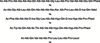 | Figure 1 Peptaibols alamethicin F30 (1a), trichotoxin A-50(G) (1b), antiamoebin I (1c), zervamicin II-2 (1d) and hypomurocin A1 (1e). |
In our earlier studies on the use of 3-amino-2,2-dimethyl-2H-azirines (e.g. 2) as Aib synthons in the preparation of heterocycles and peptides (Heimgartner, 1979, 1986, 1991) it was shown that their reaction with carboxylic acids leads to N-acylated Aib-amides 3 (Fig. 2). Their selective hydrolysis yields the corresponding acids 4, which, via the intermediate oxazolones 5, can be coupled with amino acid esters 6 to give 7. This reaction sequence is called the ‘azirine/oxazolone method'.
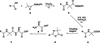 | Figure 2 Synthesis of Aib-containing peptides by the ‘azirine/oxazolone method'. |
Using this methodology, we have prepared a series of peptaibol segments, e.g. of alamethicin F30 (Wipf & Heimgartner, 1990), trichotoxin A-50(G) (Altherr et al., 2007), antiamoebin I (Blaser et al., 2013) and zervamicin II-2 (Pradeille & Heimgartner, 2003). Furthermore, the first total syntheses of hypomurocin A1 (Pradeille et al., 2005), A3 and A5 (Pradeille et al., 2012) have been carried out with the ‘azirine/oxazolone method'.
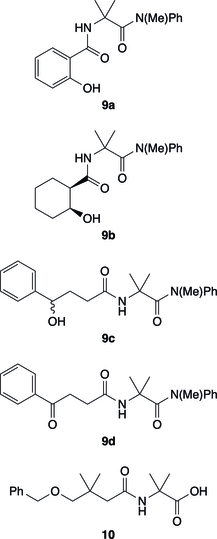
Moreover, we have shown in our syntheses of linear and cyclic depsipeptides containing Aib units (Obrecht & Heimgartner, 1990; Villalgordo & Heimgartner, 1997; Koch et al., 2000, 2001; Iliev et al., 2003, 2006; Köttgen et al., 2006, 2009; Linden et al., 2020) that carboxylic acids bearing a free hydroxy group react smoothly with aminoazirines of type 2 to give the corresponding N-acylated Aib-amides 3 with R being an OH-substituted residue exclusively. As model reactions, we transformed salicylic acid (8a) and (1R,2S)-2-hydroxycyclohexanoic acid (8b), respectively, by treatment with 2 in tetrahydrofuran (THF) at room temperature (r.t.) into 2-hydroxy-N-[1-methyl-1-(N-methyl-N-phenylcarbamoyl)ethyl]benzamide (9a) (Villalgordo & Heimgartner, 1997; Iliev et al., 2006) and (1R,2S)-2-hydroxy-N-[1-methyl-1-(N-methyl-N-phenylcarbamoyl)ethyl]cyclohexanecarboxamide (9b) (Fig. 3) (Iliev et al., 2006), respectively. Under the same conditions, 4-hydroxy-4-phenylbutanoic acid (8c) reacted with the aminoazirine 2 to give the previously unreported rac-4-hydroxy-4-phenyl-N-[1-methyl-1-(N-methyl-N-phenylcarbamoyl)ethyl]butanamide (9c).
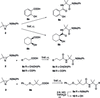 | Figure 3 Reactions of carboxylic acids 8 containing oxygen functions with 3-amino-2,2-dimethyl-2H-azirine 2. |
Different approaches to N-acylated Aib-amides 3 with a hydroxy group in the residue R are the selective reduction of a carbonyl group or the deprotection of a protected hydroxy group, such as a benzyloxy group, of the corresponding precursors. For this reason, we reacted aminoazirine 2 with 4-oxo-4-phenylbutanoic acid (8d) under standard conditions (THF, r.t.) and obtained the previously unreported 4-oxo-4-phenyl-N-[1-methyl-1-(N-methyl-N-phenylcarbamoyl)ethyl]butanamide (9d) as a single product in high yield (Fig. 3). Analogously, the reaction of 2 with 4-benzyloxy-3,3-dimethylbutanoic acid (8e) yielded 3-benzyloxy-2,2-dimethyl-N-[1-methyl-1-(N-methyl-N-πhenylcarbamoyl)ethyl]butanamide (9e), which was selectively hydrolysed by treatment with 3N HCl in THF/H2O at r.t. (cf. Iliev et al., 2003) to give 2-methyl-2-[(4-benzyloxy-3,3-dimethyl)butanoyl]amino propanoic acid (10).
The crystal structures of 9a–9d and 10 were determined and are discussed here along with a comparison of the molecular backbone conformations of these and other related compounds whose crystal structures are included in the Cambridge Structural Database (CSD, Version 6.01, update of September 2026; Groom et al., 2016). The patterns of inter- and intramolecular O—H⋯O and N—H⋯O hydrogen bonds in these structures are also compared.
2. Structural commentary
The molecules of compounds 9a–d all contain one set of linked secondary and tertiary amide groups with the tertiary amide having the terminal N-methyl-N-phenyl [–N(Me)Ph] substituent. In their crystal structures, the molecular conformations (Figs. 4 and 5) of the backbone of the molecule from the secondary amide group through to the terminal –N(Me)Ph group are very similar, as exemplified by their overlay shown in Fig. 6. In particular, the adjacent C1—N2—C3—C4 and N2—C3—C4—N5 torsion angles both have the same sign and similar values across all structures (Table 1) with a range of 46.96 (14)–54.63 (13) and 44.81 (13)–53.65 (13)°, respectively. This indicates the presence of a progressive turn between the alignments of the two amide groups. In addition, the plane of the terminal phenyl ring of the –N(Me)Ph group is consistently steeply inclined or even nearly perpendicular to that of its parent amide group. The C4—N5—C6—C7 torsion angles range from 60.6 (3) to 94.72 (13)°. The conformations of the substituents on the other side of the secondary amide group of the molecules of 9a–d vary considerably, partly because of different chain lengths. Even in the structures of 9a and 9b, where the only difference is the replacement of the hydroxyphenyl ring in the former by a hydroxycyclohexane ring in the latter, these two rings are oriented quite differently with respect to the plane of the parent secondary amide group: nearly coplanar for 9a and roughly perpendicular for 9b. It is likely that this difference is preferred in order to facilitate the observed intramolecular O—H⋯O hydrogen bonds between the hydroxy group and the immediately adjacent amide O atom (Tables 2 and 3).
| ||||||||||||||||||||||||||||||||||||||||||||||||||||||||||||||
| ||||||||||||||||||||||
 .
| ||||||||||||||||||||||
 .
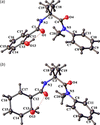 | Figure 4 Views of the molecular structures of (a) 9a and (b) 9b with displacement ellipsoids drawn at the 50% probability level. The dotted lines represent intramolecular hydrogen bonds. |
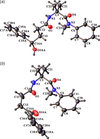 | Figure 5 Views of the molecular structures of (a) 9c and (b) 9d with displacement ellipsoids drawn at the 50% probability level. The atoms of the minor disordered component have been omitted in each case for clarity. |
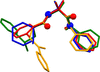 | Figure 6 An overlay of the symmetry-unique molecules in the structures of 9a (red), 9b (blue), 9c (green) and 9d (orange). Representative positions of the amide N and O atoms are indicated by blue and red spheres, respectively. The minor-occupancy disordered regions (B component) of 9c and 9d, as well as all H atoms, have been omitted for clarity. |
The CSD includes error-free single-crystal data for 22 related purely organic compounds containing the same two amide and –N(Me)Ph terminal groups as 9a–d. Of these, five structures have two molecules in the asymmetric unit (Z′ = 2). All of those structure determinations were carried out within the Heimgartner group and most of them are polypeptides of various lengths. The above-described turn between the secondary and tertiary amide groups is evident in all of these structures. The C1—N2—C3—C4 and N2—C3—C4—N5 pairs of torsion angles always have the same sign as each other, and their absolute values fall within the range of 41–66° [mean = 52 (5)°] and 37–62° [mean = 51 (6)°], respectively. The corresponding torsion angles for 9a–d fall well within these ranges. The plane of the phenyl ring of the –N(Me)Ph group in these database structures is also consistently inclined to that of the parent amide group; the range of absolute values of the corresponding C4—N5—C6—C7 torsion angles is 47–121° [mean 89 (21)°].
Compound 9c has a stereogenic centre at the hydroxy-substituted C atom, C14, of the hydroxymethylphenyl end of the molecule. The hydroxymethylphenyl component is disordered over two configurations, which represent a random distribution of both enantiomers over the same crystallographic sites in the crystal. Although the site occupancies of the disordered components in the model are unequal, the centrosymmetric indicates that the compound in the crystal is racemic. The hydroxy group forms an intermolecular O—H⋯O hydrogen bond with the same neighbouring O atom (Table 4), regardless of which enantiomer is being considered, so the energy environment around each enantiomer must be very similar. Compound 9d, which is similar to 9c, but has a carbonyl group instead of a hydroxy group at C14, exhibits similar disorder to that seen in the structure of 9c, even though the compound is achiral and the disordered carbonyl O atom is not involved in any significant hydrogen bonds (Table 5). The superposition of two enantiomers at the same crystallographic site is therefore not the rationale behind the disorder in this case. However, the presence of an unreasonably short H20B⋯H20B(2 − x, −y, z) contact of 2.04 Å across a crystallographic twofold axis between adjacent molecules with the B disorder conformation suggests that any B conformation molecule must have an A molecule adjacent to it such that the short contact and energetic frustration is avoided. No unreasonably short contacts exist between AA or AB pairs of conformers. As only 28.5 (2)% of the sites in the crystal are occupied by B conformers, BB interactions can be avoided entirely.
| |||||||||||||||||||||||||||
 ; (ii)
 .
| |||||||||||||||||
 .
The molecular conformation of compound 10 (Fig. 7) in its crystal structure is quite different. The –N(Me)Ph amide group has been replaced by a carboxylic acid function and the backbone of the molecule from the secondary amide group through to the carboxylic acid group is almost planar (Table 1). One might surmise that the planarity arises in order to facilitate a short intramolecular N—H⋯O hydrogen bond between the amide group and the adjacent carboxylic acid carbonyl O atom, O4 (Table 6). However, this appears to be more of an exception than a rule. The CSD includes error-free single-crystal data for 51 related purely organic compounds containing a secondary amide group with an adjacent terminal carboxylic acid group. Of these, 8 structures have Z′ > 1. Many of these structures are, again, In general, the absolute values of the C1—N2—C3—C4 and N2—C3—C4—O5 torsion angles also display progressive twists within the backbone, similar to those described above. Only two structures have the same degree of planarity and the intramolecular N—H⋯O hydrogen bond that are observed for 10. These are those of N-t-butoxycarbonyl-L-alanyl-2-methylalanine (Bosch et al., 1983) and N-(indol-3-ylacetyl)-α-aminoisobutyric acid (Kojić-Prodić et al., 1993). Excluding these two structures, the absolute values of the C1—N2—C3—C4 torsion angles are in the range of 35–68° [mean = 52 (6)°], which is very similar to the range found in the structures of 9a–d and related compounds described above. The N2—C3—C4—O5 torsion angles of the related carboxylic acid compounds vary more widely, with only seven structures having absolute values > 150°, as in the case of 10, and three structures having absolute values < 30°, which indicates that the acid hydroxy group is on the same side of the backbone as the amid H atom. The range of N2—C3—C4—O5 torsion angles for the remaining 41 carboxylic acid structures is 30–150°, but the range between the lower and upper quartiles is only 40–50°, which is again quite similar to the corresponding torsion angle ranges found for the –N(Me)Ph compounds discussed above. The larger N2—C3—C4—O5 torsion angle range found across these carboxylic acid structures is likely related to the influence of the propensity of these structures to have intermolecular O—H⋯O hydrogen bonds emanating from the acid –OH group combined with the requirement for an efficient packing arrangement of the molecule in question.
| |||||||||||||||||||||||||||
 .
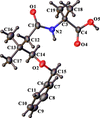 | Figure 7 View of the molecular structure of 10 with displacement ellipsoids drawn at the 50% probability level. |
3. Supramolecular features
The crystal structures of compounds 9a and 9b exhibit the same pattern of classical O—H⋯O and N—H⋯O hydrogen-bonding interactions. The hydroxy group forms an intramolecular hydrogen bond with the immediately adjacent secondary amide O atom to give a six-membered loop with a graph-set motif of S(6) (Tables 2 and 3; Bernstein et al., 1995). The secondary amide N—H group forms an intermolecular hydrogen bond with the tertiary amide O atom of a neighbouring molecule and thereby links the molecules into extended chains, which run parallel to the [010] direction and have a graph set motif of C(5) (Fig. 8). The crystal structures of 9c and 9d also display the same intermolecular N—H⋯O interactions, which generate C(5) chains running parallel to the [010] and [001] directions respectively (Tables 4 and 5; Figs. S1 and S2 in the supporting information).
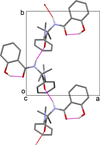 | Figure 8 A view down [001] showing a hydrogen-bonded chain of molecules in the crystal structure of 9a. The intra- and intermolecular hydrogen bonds are shown as dashed lines and uninvolved H atoms have been omitted for clarity. |
Additionally for 9c, both orientations of the disordered hydroxy group form an intermolecular O—H⋯O hydrogen bond with the secondary amide O atom of a different neighbouring molecule. This interaction links pairs of molecules across a centre of inversion into dimeric units which have a graph-set motif of R22(14). The combination of all classic hydrogen bonding interactions links the molecules of 9c into extended two-dimensional networks which lie perpendicular to the [101] direction (Fig. 9).
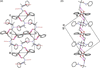 | Figure 9 A hydrogen-bonded layer in the crystal structure of 9c, viewed (a) down [101], perpendicular to the plane of the layer, and (b) down [010], parallel to the plane of the layer. The intermolecular hydrogen bonds are shown as dashed lines and uninvolved H atoms have been omitted for clarity. Both disordered conformations are displayed in order to highlight the common O—H⋯O interaction. |
For 10, the carboxylic acid hydroxy group forms an intermolecular O—H⋯O hydrogen bond with the amide O atom of a neighbouring molecule and thereby links the molecules into extended chains which run parallel to the [001] direction and have a graph-set motif of C(7) (Table 6). The amide N—H group forms bifurcated N—H⋯(O,O) intramolecular hydrogen bonds with the carboxylic acid carbonyl O atom and with the ether O atom. These interactions form closed loops with graph-set motifs of S(5) and S(7), respectively (Fig. 10).
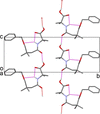 | Figure 10 A view down [100] showing two hydrogen-bonded chains of molecules in the crystal structure of 10. The intra- and intermolecular hydrogen bonds are shown as dashed lines and uninvolved H atoms have been omitted for clarity. |
4. Synthesis and crystallization
The synthesis of the Aib-amides 9a and 9b and their analytical and spectroscopic data have been described earlier (Iliev et al., 2006). Suitable crystals were obtained by slow crystallization from their solution in a CH2Cl2/acetone/ethyl acetate (EtOAc) mixture.
Analogously, the hydroxy acids 8c–e were reacted with 3-amino-2,2-dimethyl-2H-azirine 2: to a solution of 2–6 mmol of each of the hydroxy acids 8c–e in 5–20 ml of THF, 1.05 equivalents of the aminoazirine 2 were added dropwise at r.t. The mixture was stirred at r.t. for 12–36 h, then the solvent was evaporated and the remaining solid purified by (CC) over silica gel with acetone/CH2Cl2 mixtures and dried under high vacuum to give Aib-amides 9c–e in high yields. Crystallization of 9c from the mixed solvents of CH2Cl2/acetone/hexane and 9d from CH2Cl2/acetonitrile yielded crystals suitable for X-ray diffraction analysis.
The Aib-amide 9e was hydrolysed according to a standard procedure: to a solution of 9e in THF, 3N HCl was added dropwise at 273 K and the mixture was left overnight at r.t. The organic solvent was evaporated, the residue was extracted with EtOAc, the organic fraction was washed with brine and dried over MgSO4. After evaporation of the solvent, the crystalline material 10 was washed with diethyl ether/hexane and recrystallized from the mixed solvents of dichloromethane/acetone/hexane/diethyl ether to give suitable crystals for X-ray diffraction analysis.
5. Refinement details
The crystal data, data collection and structure details for all reported structures are summarized in Table 7. The molecule of 9b has two stereogenic centres and the compound has crystallised in a The enantiomer used as the model in the of 9b was chosen to match that of the starting material, (1R,2S)-2-hydroxycyclohexanoic acid, used in the synthesis. Compounds 9d and 10 are achiral molecules that have crystallized in non-centrosymmetric achiral space groups. Given that Mo Kα radiation was used for all data collections and the compounds are purely organic, Bijvoet pairs were merged during data reduction at the diffractometer for 9b and 10. Consequently, the absolute structure parameter for these two structures is not meaningful and is not reported. Although Bijvoet pairs were not merged for 9d, the absolute structure parameter is too imprecise to allow any conclusions about the absolute structure to be drawn.
|
For 9c, the hydroxy group, its parent C atom and its neighbouring phenyl group are disordered over two conformations. Two positions were defined for these atoms and the site occupation factor of the major conformation of the group refined to 0.715 (2). Similarity restraints were applied to the chemically equivalent bond lengths and angles involving all disordered atoms. Furthermore, neighbouring atoms within and between each conformation of the disordered component were restrained to have similar atomic displacement parameters. The disorder indicates that both enantiomers of this chiral compound randomly occupy the same crystallographic site in the structure.
For 9d, the keto group and its neighbouring phenyl group are disordered over two conformations. Two positions were defined for these atoms and the site occupation factor of the major conformation of the group refined to 0.572 (10). Rigid group constraints were applied to the atoms of each orientation of the disordered phenyl ring, while bond length restraints were applied to the bonds involving all other disordered non-hydrogen atoms [C—C = 1.520 (5), C=O = 1.230 (5) Å]. In addition, pseudo-isotropic restraints were applied to the anisotropic displacement parameters of all disordered atoms.
For 9a–9d, six, two, three and one low-angle reflections, respectively, whose low intensities suggested that they were partially obscured by the beam stop, were omitted from the final refinement. A secondary extinction parameter was refined for 9b–d and 10. Except for the disordered hydroxy group of 9c, any hydroxy, amide, or carboxylic acid H atoms in the structures were placed in the positions indicated by a difference electron density map and their positions were allowed to refine together with individual isotropic displacement parameters. The methyl H atoms of each structure and the disordered hydroxy H atoms in 9c were constrained to an ideal geometry (C—H = 0.98, O—H = 0.84 Å) with Uiso(H) = 1.5Ueq(C,O), but were allowed to rotate freely about the respective parent C—C or C—O bonds. All other H atoms were placed in geometrically idealised positions and constrained to ride on their parent atoms with C—H distances of 0.95 (aromatic), 0.99 (methylene) or 1.00 Å (methine) and Uiso(H) = 1.2Ueq(C).
Supporting information
contains datablocks 9a, 9b, 9c, 9d, 10. DOI: https://doi.org/10.1107/S2056989026011552/hb8276sup1.cif
Structure factors: contains datablock 9a. DOI: https://doi.org/10.1107/S2056989026011552/hb82769asup2.hkl
Structure factors: contains datablock 9b. DOI: https://doi.org/10.1107/S2056989026011552/hb82769bsup3.hkl
Structure factors: contains datablock 9c. DOI: https://doi.org/10.1107/S2056989026011552/hb82769csup4.hkl
Structure factors: contains datablock 9d. DOI: https://doi.org/10.1107/S2056989026011552/hb82769dsup5.hkl
Structure factors: contains datablock 10. DOI: https://doi.org/10.1107/S2056989026011552/hb827610sup6.hkl
Supporting information file. DOI: https://doi.org/10.1107/S2056989026011552/hb8276sup7.pdf
Supporting information file. DOI: https://doi.org/10.1107/S2056989026011552/hb82769asup8.cdx
Supporting information file. DOI: https://doi.org/10.1107/S2056989026011552/hb82769bsup9.cdx
Supporting information file. DOI: https://doi.org/10.1107/S2056989026011552/hb82769csup10.cdx
Supporting information file. DOI: https://doi.org/10.1107/S2056989026011552/hb82769dsup11.cdx
Supporting information file. DOI: https://doi.org/10.1107/S2056989026011552/hb827610sup12.cdx
Supporting information file. DOI: https://doi.org/10.1107/S2056989026011552/hb82769asup12.cml
Supporting information file. DOI: https://doi.org/10.1107/S2056989026011552/hb82769bsup13.cml
Supporting information file. DOI: https://doi.org/10.1107/S2056989026011552/hb82769csup14.cml
Supporting information file. DOI: https://doi.org/10.1107/S2056989026011552/hb82769dsup15.cml
Supporting information file. DOI: https://doi.org/10.1107/S2056989026011552/hb827610sup16.cml
| C18H20N2O3 | Dx = 1.275 Mg m−3 |
| Mr = 312.36 | Melting point: 420 K |
| Monoclinic, P21/n | Mo Kα radiation, λ = 0.71073 Å |
| a = 10.4492 (2) Å | Cell parameters from 4987 reflections |
| b = 11.4071 (2) Å | θ = 2.0–30.0° |
| c = 14.2774 (3) Å | µ = 0.09 mm−1 |
| β = 107.0562 (11)° | T = 160 K |
| V = 1626.95 (6) Å3 | Prism, colourless |
| Z = 4 | 0.27 × 0.27 × 0.20 mm |
| F(000) = 664 |
| Nonius KappaCCD area-detector diffractometer | 3746 reflections with I > 2σ(I) |
| Radiation source: Nonius FR590 sealed tube generator | Rint = 0.045 |
| Horizontally mounted graphite crystal monochromator | θmax = 30.0°, θmin = 2.3° |
| Detector resolution: 9 pixels mm-1 | h = 0→14 |
| φ and ω scans with κ offsets | k = 0→16 |
| 42366 measured reflections | l = −20→19 |
| 4756 independent reflections |
| Refinement on F2 | Primary atom site location: structure-invariant direct methods |
| Least-squares matrix: full | Secondary atom site location: difference Fourier map |
| R[F2 > 2σ(F2)] = 0.045 | Hydrogen site location: difference Fourier map |
| wR(F2) = 0.123 | H atoms treated by a mixture of independent and constrained refinement |
| S = 1.05 | w = 1/[σ2(Fo2) + (0.0574P)2 + 0.3575P] where P = (Fo2 + 2Fc2)/3 |
| 4756 reflections | (Δ/σ)max < 0.001 |
| 219 parameters | Δρmax = 0.23 e Å−3 |
| 0 restraints | Δρmin = −0.26 e Å−3 |
Experimental. Solvent used: dichloromethane / acetone / ethyl acetate Cooling Device: Oxford Cryosystems Cryostream 700 Crystal mount: glued on a glass fibre Mosaicity (deg.): 0.471 (1) Frames collected: 348 Seconds exposure per frame: 26 Degrees rotation per frame: 2.0 Crystal-Detector distance (mm): 30.0 |
Geometry. All esds (except the esd in the dihedral angle between two l.s. planes) are estimated using the full covariance matrix. The cell esds are taken into account individually in the estimation of esds in distances, angles and torsion angles; correlations between esds in cell parameters are only used when they are defined by crystal symmetry. An approximate (isotropic) treatment of cell esds is used for estimating esds involving l.s. planes. |
| x | y | z | Uiso*/Ueq | ||
| O1 | −0.04433 (8) | 0.22043 (7) | 0.17802 (6) | 0.0325 (2) | |
| O4 | 0.25118 (8) | 0.07638 (6) | 0.22469 (6) | 0.02592 (18) | |
| O13 | −0.29167 (9) | 0.27689 (8) | 0.11887 (7) | 0.0371 (2) | |
| H13 | −0.2136 (19) | 0.2312 (17) | 0.1351 (13) | 0.068 (6)* | |
| N2 | 0.10958 (9) | 0.34736 (8) | 0.26484 (6) | 0.02244 (19) | |
| H2 | 0.1344 (15) | 0.4204 (15) | 0.2813 (11) | 0.044 (4)* | |
| N5 | 0.24687 (9) | 0.23663 (7) | 0.13253 (6) | 0.0236 (2) | |
| C1 | −0.01384 (11) | 0.32286 (9) | 0.20677 (8) | 0.0232 (2) | |
| C3 | 0.21123 (10) | 0.25546 (9) | 0.29914 (7) | 0.0223 (2) | |
| C4 | 0.23455 (10) | 0.18313 (9) | 0.21408 (7) | 0.0205 (2) | |
| C6 | 0.25935 (11) | 0.16289 (9) | 0.05357 (8) | 0.0224 (2) | |
| C7 | 0.14939 (11) | 0.09913 (10) | 0.00003 (8) | 0.0262 (2) | |
| H7 | 0.068671 | 0.100384 | 0.017863 | 0.031* | |
| C8 | 0.15766 (13) | 0.03326 (10) | −0.07999 (9) | 0.0326 (3) | |
| H8 | 0.082843 | −0.011185 | −0.116686 | 0.039* | |
| C9 | 0.27519 (14) | 0.03272 (10) | −0.10590 (9) | 0.0353 (3) | |
| H9 | 0.280829 | −0.011822 | −0.160775 | 0.042* | |
| C10 | 0.38463 (13) | 0.09676 (11) | −0.05225 (9) | 0.0347 (3) | |
| H10 | 0.464845 | 0.096457 | −0.070771 | 0.042* | |
| C11 | 0.37779 (12) | 0.16162 (10) | 0.02871 (9) | 0.0289 (2) | |
| H11 | 0.453380 | 0.204442 | 0.066379 | 0.035* | |
| C12 | −0.11409 (10) | 0.41884 (9) | 0.17892 (8) | 0.0235 (2) | |
| C13 | −0.24975 (11) | 0.38883 (10) | 0.13755 (8) | 0.0276 (2) | |
| C14 | −0.34673 (12) | 0.47699 (12) | 0.11565 (9) | 0.0356 (3) | |
| H14 | −0.438459 | 0.456805 | 0.089036 | 0.043* | |
| C15 | −0.31058 (13) | 0.59270 (12) | 0.13229 (9) | 0.0360 (3) | |
| H15 | −0.377694 | 0.651695 | 0.117382 | 0.043* | |
| C16 | −0.17700 (13) | 0.62438 (10) | 0.17065 (9) | 0.0332 (3) | |
| H16 | −0.152352 | 0.704603 | 0.180607 | 0.040* | |
| C17 | −0.08026 (11) | 0.53752 (10) | 0.19418 (9) | 0.0282 (2) | |
| H17 | 0.011019 | 0.558914 | 0.221257 | 0.034* | |
| C18 | 0.34362 (12) | 0.31360 (10) | 0.35488 (9) | 0.0324 (3) | |
| H181 | 0.371075 | 0.368121 | 0.311331 | 0.049* | |
| H182 | 0.412567 | 0.253320 | 0.377754 | 0.049* | |
| H183 | 0.332027 | 0.356589 | 0.411265 | 0.049* | |
| C19 | 0.16867 (13) | 0.17267 (10) | 0.36918 (9) | 0.0315 (3) | |
| H191 | 0.145885 | 0.218671 | 0.420028 | 0.047* | |
| H192 | 0.242505 | 0.119206 | 0.399801 | 0.047* | |
| H193 | 0.090433 | 0.127221 | 0.332494 | 0.047* | |
| C20 | 0.23505 (15) | 0.36197 (10) | 0.10908 (10) | 0.0377 (3) | |
| H201 | 0.142397 | 0.380102 | 0.071889 | 0.057* | |
| H202 | 0.294658 | 0.382014 | 0.069760 | 0.057* | |
| H203 | 0.260186 | 0.407630 | 0.169893 | 0.057* |
| U11 | U22 | U33 | U12 | U13 | U23 | |
| O1 | 0.0294 (4) | 0.0218 (4) | 0.0424 (5) | −0.0024 (3) | 0.0044 (4) | −0.0066 (3) |
| O4 | 0.0329 (4) | 0.0169 (4) | 0.0283 (4) | 0.0044 (3) | 0.0096 (3) | 0.0014 (3) |
| O13 | 0.0280 (5) | 0.0352 (5) | 0.0420 (5) | −0.0065 (4) | 0.0008 (4) | 0.0007 (4) |
| N2 | 0.0229 (4) | 0.0172 (4) | 0.0266 (5) | 0.0013 (3) | 0.0063 (4) | −0.0019 (3) |
| N5 | 0.0307 (5) | 0.0167 (4) | 0.0251 (4) | −0.0008 (3) | 0.0109 (4) | −0.0012 (3) |
| C1 | 0.0247 (5) | 0.0211 (5) | 0.0245 (5) | −0.0005 (4) | 0.0081 (4) | −0.0017 (4) |
| C3 | 0.0237 (5) | 0.0185 (5) | 0.0230 (5) | 0.0027 (4) | 0.0043 (4) | −0.0013 (4) |
| C4 | 0.0190 (5) | 0.0183 (5) | 0.0233 (5) | −0.0002 (4) | 0.0049 (4) | −0.0014 (4) |
| C6 | 0.0271 (5) | 0.0174 (4) | 0.0233 (5) | 0.0025 (4) | 0.0083 (4) | 0.0012 (4) |
| C7 | 0.0273 (5) | 0.0240 (5) | 0.0276 (5) | −0.0005 (4) | 0.0085 (4) | 0.0000 (4) |
| C8 | 0.0424 (7) | 0.0256 (6) | 0.0273 (6) | −0.0025 (5) | 0.0064 (5) | −0.0028 (4) |
| C9 | 0.0564 (8) | 0.0257 (6) | 0.0277 (6) | 0.0060 (5) | 0.0182 (5) | −0.0006 (4) |
| C10 | 0.0397 (7) | 0.0322 (6) | 0.0399 (7) | 0.0075 (5) | 0.0234 (5) | 0.0045 (5) |
| C11 | 0.0272 (6) | 0.0272 (5) | 0.0340 (6) | 0.0006 (4) | 0.0114 (5) | 0.0013 (4) |
| C12 | 0.0229 (5) | 0.0248 (5) | 0.0233 (5) | 0.0013 (4) | 0.0076 (4) | 0.0007 (4) |
| C13 | 0.0254 (5) | 0.0325 (6) | 0.0243 (5) | −0.0007 (4) | 0.0061 (4) | 0.0037 (4) |
| C14 | 0.0232 (5) | 0.0463 (7) | 0.0362 (6) | 0.0054 (5) | 0.0068 (5) | 0.0122 (5) |
| C15 | 0.0335 (6) | 0.0393 (7) | 0.0383 (7) | 0.0140 (5) | 0.0154 (5) | 0.0159 (5) |
| C16 | 0.0374 (7) | 0.0257 (6) | 0.0405 (7) | 0.0071 (5) | 0.0176 (5) | 0.0081 (5) |
| C17 | 0.0262 (5) | 0.0245 (5) | 0.0350 (6) | 0.0020 (4) | 0.0107 (5) | 0.0019 (4) |
| C18 | 0.0270 (6) | 0.0286 (6) | 0.0345 (6) | 0.0027 (4) | −0.0018 (5) | −0.0079 (5) |
| C19 | 0.0439 (7) | 0.0266 (6) | 0.0268 (5) | 0.0064 (5) | 0.0148 (5) | 0.0025 (4) |
| C20 | 0.0643 (9) | 0.0185 (5) | 0.0379 (7) | −0.0003 (5) | 0.0267 (6) | 0.0013 (5) |
| O1—C1 | 1.2484 (13) | C10—C11 | 1.3918 (17) |
| O4—C4 | 1.2330 (12) | C10—H10 | 0.9500 |
| O13—C13 | 1.3509 (15) | C11—H11 | 0.9500 |
| O13—H13 | 0.938 (19) | C12—C17 | 1.4000 (15) |
| N2—C1 | 1.3421 (14) | C12—C13 | 1.4086 (15) |
| N2—C3 | 1.4703 (13) | C13—C14 | 1.3964 (17) |
| N2—H2 | 0.884 (17) | C14—C15 | 1.3743 (19) |
| N5—C4 | 1.3538 (13) | C14—H14 | 0.9500 |
| N5—C6 | 1.4428 (13) | C15—C16 | 1.3894 (19) |
| N5—C20 | 1.4654 (14) | C15—H15 | 0.9500 |
| C1—C12 | 1.4866 (15) | C16—C17 | 1.3846 (16) |
| C3—C18 | 1.5301 (15) | C16—H16 | 0.9500 |
| C3—C19 | 1.5331 (15) | C17—H17 | 0.9500 |
| C3—C4 | 1.5455 (14) | C18—H181 | 0.9800 |
| C6—C11 | 1.3841 (16) | C18—H182 | 0.9800 |
| C6—C7 | 1.3850 (15) | C18—H183 | 0.9800 |
| C7—C8 | 1.3911 (16) | C19—H191 | 0.9800 |
| C7—H7 | 0.9500 | C19—H192 | 0.9800 |
| C8—C9 | 1.3826 (19) | C19—H193 | 0.9800 |
| C8—H8 | 0.9500 | C20—H201 | 0.9800 |
| C9—C10 | 1.3835 (19) | C20—H202 | 0.9800 |
| C9—H9 | 0.9500 | C20—H203 | 0.9800 |
| C13—O13—H13 | 105.6 (12) | C17—C12—C13 | 118.51 (10) |
| C1—N2—C3 | 121.78 (9) | C17—C12—C1 | 123.00 (10) |
| C1—N2—H2 | 121.0 (10) | C13—C12—C1 | 118.47 (10) |
| C3—N2—H2 | 117.2 (10) | O13—C13—C14 | 117.68 (11) |
| C4—N5—C6 | 117.54 (8) | O13—C13—C12 | 122.72 (10) |
| C4—N5—C20 | 127.84 (9) | C14—C13—C12 | 119.59 (11) |
| C6—N5—C20 | 114.28 (9) | C15—C14—C13 | 120.55 (11) |
| O1—C1—N2 | 120.29 (10) | C15—C14—H14 | 119.7 |
| O1—C1—C12 | 120.63 (10) | C13—C14—H14 | 119.7 |
| N2—C1—C12 | 119.07 (9) | C14—C15—C16 | 120.76 (11) |
| N2—C3—C18 | 108.59 (8) | C14—C15—H15 | 119.6 |
| N2—C3—C19 | 109.70 (9) | C16—C15—H15 | 119.6 |
| C18—C3—C19 | 108.58 (9) | C17—C16—C15 | 119.14 (11) |
| N2—C3—C4 | 112.57 (8) | C17—C16—H16 | 120.4 |
| C18—C3—C4 | 108.25 (9) | C15—C16—H16 | 120.4 |
| C19—C3—C4 | 109.05 (8) | C16—C17—C12 | 121.41 (11) |
| O4—C4—N5 | 120.35 (9) | C16—C17—H17 | 119.3 |
| O4—C4—C3 | 118.67 (9) | C12—C17—H17 | 119.3 |
| N5—C4—C3 | 120.79 (9) | C3—C18—H181 | 109.5 |
| C11—C6—C7 | 120.82 (10) | C3—C18—H182 | 109.5 |
| C11—C6—N5 | 119.94 (10) | H181—C18—H182 | 109.5 |
| C7—C6—N5 | 119.14 (9) | C3—C18—H183 | 109.5 |
| C6—C7—C8 | 119.71 (10) | H181—C18—H183 | 109.5 |
| C6—C7—H7 | 120.1 | H182—C18—H183 | 109.5 |
| C8—C7—H7 | 120.1 | C3—C19—H191 | 109.5 |
| C9—C8—C7 | 119.75 (11) | C3—C19—H192 | 109.5 |
| C9—C8—H8 | 120.1 | H191—C19—H192 | 109.5 |
| C7—C8—H8 | 120.1 | C3—C19—H193 | 109.5 |
| C8—C9—C10 | 120.28 (11) | H191—C19—H193 | 109.5 |
| C8—C9—H9 | 119.9 | H192—C19—H193 | 109.5 |
| C10—C9—H9 | 119.9 | N5—C20—H201 | 109.5 |
| C9—C10—C11 | 120.34 (11) | N5—C20—H202 | 109.5 |
| C9—C10—H10 | 119.8 | H201—C20—H202 | 109.5 |
| C11—C10—H10 | 119.8 | N5—C20—H203 | 109.5 |
| C6—C11—C10 | 119.09 (11) | H201—C20—H203 | 109.5 |
| C6—C11—H11 | 120.5 | H202—C20—H203 | 109.5 |
| C10—C11—H11 | 120.5 | ||
| C3—N2—C1—O1 | −1.98 (16) | C6—C7—C8—C9 | −0.53 (17) |
| C3—N2—C1—C12 | 176.84 (9) | C7—C8—C9—C10 | 0.40 (18) |
| C1—N2—C3—C18 | 174.48 (10) | C8—C9—C10—C11 | 0.48 (18) |
| C1—N2—C3—C19 | −66.99 (12) | C7—C6—C11—C10 | 1.09 (16) |
| C1—N2—C3—C4 | 54.63 (13) | N5—C6—C11—C10 | −175.23 (10) |
| C6—N5—C4—O4 | 9.26 (15) | C9—C10—C11—C6 | −1.21 (18) |
| C20—N5—C4—O4 | −177.85 (11) | O1—C1—C12—C17 | −168.50 (11) |
| C6—N5—C4—C3 | −175.88 (9) | N2—C1—C12—C17 | 12.69 (16) |
| C20—N5—C4—C3 | −2.99 (17) | O1—C1—C12—C13 | 13.15 (15) |
| N2—C3—C4—O4 | −140.25 (10) | N2—C1—C12—C13 | −165.66 (10) |
| C18—C3—C4—O4 | 99.71 (11) | C17—C12—C13—O13 | 179.05 (10) |
| C19—C3—C4—O4 | −18.25 (13) | C1—C12—C13—O13 | −2.53 (16) |
| N2—C3—C4—N5 | 44.81 (13) | C17—C12—C13—C14 | −1.87 (16) |
| C18—C3—C4—N5 | −75.23 (12) | C1—C12—C13—C14 | 176.55 (10) |
| C19—C3—C4—N5 | 166.80 (10) | O13—C13—C14—C15 | −179.55 (11) |
| C4—N5—C6—C11 | −113.22 (11) | C12—C13—C14—C15 | 1.32 (18) |
| C20—N5—C6—C11 | 72.93 (14) | C13—C14—C15—C16 | 0.36 (19) |
| C4—N5—C6—C7 | 70.39 (13) | C14—C15—C16—C17 | −1.45 (19) |
| C20—N5—C6—C7 | −103.46 (12) | C15—C16—C17—C12 | 0.86 (18) |
| C11—C6—C7—C8 | −0.23 (16) | C13—C12—C17—C16 | 0.79 (17) |
| N5—C6—C7—C8 | 176.12 (10) | C1—C12—C17—C16 | −177.56 (11) |
| D—H···A | D—H | H···A | D···A | D—H···A |
| O13—H13···O1 | 0.938 (19) | 1.698 (19) | 2.5548 (12) | 150.1 (18) |
| N2—H2···O4i | 0.884 (17) | 2.159 (17) | 2.9727 (12) | 152.8 (14) |
| Symmetry code: (i) −x+1/2, y+1/2, −z+1/2. |
| C18H26N2O3 | Dx = 1.256 Mg m−3 |
| Mr = 318.41 | Melting point: 445 K |
| Monoclinic, C2 | Mo Kα radiation, λ = 0.71073 Å |
| a = 31.3330 (11) Å | Cell parameters from 1626 reflections |
| b = 5.9603 (2) Å | θ = 2.0–25.0° |
| c = 9.0440 (3) Å | µ = 0.09 mm−1 |
| β = 94.416 (2)° | T = 160 K |
| V = 1683.99 (10) Å3 | Plate, colourless |
| Z = 4 | 0.45 × 0.15 × 0.05 mm |
| F(000) = 688 |
| Nonius KappaCCD area-detector diffractometer | 1559 reflections with I > 2σ(I) |
| Radiation source: Nonius FR590 sealed tube generator | Rint = 0.052 |
| Horizontally mounted graphite crystal monochromator | θmax = 25.0°, θmin = 2.3° |
| Detector resolution: 9 pixels mm-1 | h = 0→36 |
| ω scans with κ offsets | k = 0→7 |
| 13467 measured reflections | l = −10→10 |
| 1626 independent reflections |
| Refinement on F2 | Hydrogen site location: mixed |
| Least-squares matrix: full | H atoms treated by a mixture of independent and constrained refinement |
| R[F2 > 2σ(F2)] = 0.031 | w = 1/[σ2(Fo2) + (0.0486P)2 + 0.627P] where P = (Fo2 + 2Fc2)/3 |
| wR(F2) = 0.082 | (Δ/σ)max < 0.001 |
| S = 1.08 | Δρmax = 0.18 e Å−3 |
| 1626 reflections | Δρmin = −0.19 e Å−3 |
| 220 parameters | Extinction correction: SHELXL-2025 (Sheldrick, 2015), Fc*=kFc[1+0.001xFc2λ3/sin(2θ)]-1/4 |
| 1 restraint | Extinction coefficient: 0.012 (3) |
| Primary atom site location: structure-invariant direct methods | Absolute structure: Bijvoet pairs were merged during data reduction, so the absolute structure parameter is not meaningful. The enantiomer used in the refinement was chosen to match that of the chiral starting material used in the synthesis. |
| Secondary atom site location: difference Fourier map |
Experimental. Solvent used: dichloromethane / acetone / ethyl acetate Cooling Device: Oxford Cryosystems Cryostream 700 Crystal mount: glued on a glass fibre Mosaicity (deg.): 0.792 (2) Frames collected: 240 Seconds exposure per frame: 150 Degrees rotation per frame: 2.0 Crystal-Detector distance (mm): 30.0 |
Geometry. All esds (except the esd in the dihedral angle between two l.s. planes) are estimated using the full covariance matrix. The cell esds are taken into account individually in the estimation of esds in distances, angles and torsion angles; correlations between esds in cell parameters are only used when they are defined by crystal symmetry. An approximate (isotropic) treatment of cell esds is used for estimating esds involving l.s. planes. |
| x | y | z | Uiso*/Ueq | ||
| O1 | 0.10121 (6) | 0.1017 (3) | 0.56826 (16) | 0.0326 (4) | |
| O4 | 0.09861 (4) | 0.4219 (3) | 0.27865 (15) | 0.0255 (4) | |
| O13 | 0.14385 (5) | −0.0854 (3) | 0.81239 (17) | 0.0316 (4) | |
| H13 | 0.1347 (13) | 0.027 (9) | 0.755 (4) | 0.087 (13)* | |
| N2 | 0.07545 (5) | −0.1270 (3) | 0.38359 (18) | 0.0227 (4) | |
| H2 | 0.0744 (7) | −0.264 (5) | 0.353 (2) | 0.021 (6)* | |
| N5 | 0.14406 (5) | 0.1335 (3) | 0.25330 (18) | 0.0220 (4) | |
| C1 | 0.09256 (6) | −0.0902 (4) | 0.5230 (2) | 0.0239 (4) | |
| C3 | 0.06567 (6) | 0.0580 (4) | 0.2784 (2) | 0.0228 (5) | |
| C4 | 0.10433 (6) | 0.2191 (4) | 0.2714 (2) | 0.0207 (4) | |
| C6 | 0.18031 (6) | 0.2819 (4) | 0.2679 (2) | 0.0248 (5) | |
| C7 | 0.19012 (6) | 0.3928 (4) | 0.4014 (2) | 0.0281 (5) | |
| H7 | 0.171485 | 0.381584 | 0.479110 | 0.034* | |
| C8 | 0.22726 (7) | 0.5199 (4) | 0.4208 (3) | 0.0359 (6) | |
| H8 | 0.234037 | 0.595896 | 0.511915 | 0.043* | |
| C9 | 0.25439 (7) | 0.5359 (5) | 0.3078 (3) | 0.0410 (6) | |
| H9 | 0.279755 | 0.623205 | 0.321406 | 0.049* | |
| C10 | 0.24481 (7) | 0.4263 (5) | 0.1760 (3) | 0.0427 (6) | |
| H10 | 0.263704 | 0.437023 | 0.099008 | 0.051* | |
| C11 | 0.20728 (7) | 0.2986 (4) | 0.1544 (3) | 0.0336 (5) | |
| H11 | 0.200446 | 0.224215 | 0.062672 | 0.040* | |
| C12 | 0.10007 (6) | −0.2933 (4) | 0.6211 (2) | 0.0234 (5) | |
| H12 | 0.100901 | −0.429133 | 0.556477 | 0.028* | |
| C13 | 0.14334 (7) | −0.2741 (4) | 0.7138 (2) | 0.0251 (5) | |
| H131 | 0.166758 | −0.256559 | 0.645529 | 0.030* | |
| C14 | 0.15148 (7) | −0.4832 (4) | 0.8066 (2) | 0.0280 (5) | |
| H141 | 0.178885 | −0.466477 | 0.867717 | 0.034* | |
| H142 | 0.154148 | −0.613636 | 0.740180 | 0.034* | |
| C15 | 0.11560 (7) | −0.5274 (4) | 0.9079 (2) | 0.0292 (5) | |
| H151 | 0.116171 | −0.409773 | 0.985368 | 0.035* | |
| H152 | 0.120600 | −0.673781 | 0.957955 | 0.035* | |
| C16 | 0.07129 (7) | −0.5294 (4) | 0.8223 (2) | 0.0288 (5) | |
| H161 | 0.068665 | −0.665560 | 0.759631 | 0.035* | |
| H162 | 0.048976 | −0.536864 | 0.893970 | 0.035* | |
| C17 | 0.06352 (6) | −0.3225 (4) | 0.7243 (2) | 0.0264 (5) | |
| H171 | 0.061742 | −0.187584 | 0.787447 | 0.032* | |
| H172 | 0.035945 | −0.338567 | 0.664073 | 0.032* | |
| C18 | 0.02794 (6) | 0.1940 (4) | 0.3289 (3) | 0.0315 (5) | |
| H181 | 0.003204 | 0.094989 | 0.335966 | 0.047* | |
| H182 | 0.020576 | 0.313321 | 0.256895 | 0.047* | |
| H183 | 0.035904 | 0.260566 | 0.426209 | 0.047* | |
| C19 | 0.05320 (7) | −0.0408 (4) | 0.1247 (2) | 0.0308 (5) | |
| H191 | 0.076979 | −0.130699 | 0.092481 | 0.046* | |
| H192 | 0.046798 | 0.081221 | 0.053810 | 0.046* | |
| H193 | 0.027861 | −0.136093 | 0.129512 | 0.046* | |
| C20 | 0.15500 (7) | −0.0980 (5) | 0.2200 (3) | 0.0399 (6) | |
| H201 | 0.131212 | −0.196703 | 0.241150 | 0.060* | |
| H202 | 0.180750 | −0.142132 | 0.281523 | 0.060* | |
| H203 | 0.160398 | −0.110582 | 0.115046 | 0.060* |
| U11 | U22 | U33 | U12 | U13 | U23 | |
| O1 | 0.0514 (10) | 0.0190 (9) | 0.0269 (8) | −0.0011 (7) | −0.0006 (7) | −0.0018 (7) |
| O4 | 0.0271 (7) | 0.0181 (9) | 0.0315 (8) | 0.0020 (7) | 0.0042 (5) | 0.0004 (7) |
| O13 | 0.0399 (8) | 0.0227 (9) | 0.0313 (8) | −0.0033 (8) | −0.0035 (6) | −0.0045 (8) |
| N2 | 0.0287 (8) | 0.0160 (10) | 0.0235 (9) | −0.0001 (7) | 0.0026 (6) | 0.0007 (8) |
| N5 | 0.0219 (9) | 0.0179 (9) | 0.0264 (8) | 0.0018 (7) | 0.0032 (6) | 0.0004 (7) |
| C1 | 0.0271 (9) | 0.0203 (11) | 0.0246 (10) | 0.0013 (10) | 0.0044 (7) | −0.0002 (10) |
| C3 | 0.0228 (10) | 0.0200 (11) | 0.0255 (10) | 0.0014 (9) | 0.0003 (7) | 0.0032 (9) |
| C4 | 0.0252 (10) | 0.0184 (11) | 0.0182 (9) | 0.0011 (9) | 0.0008 (7) | 0.0002 (8) |
| C6 | 0.0221 (10) | 0.0186 (11) | 0.0334 (11) | 0.0033 (8) | 0.0004 (8) | 0.0045 (9) |
| C7 | 0.0260 (9) | 0.0250 (12) | 0.0327 (11) | 0.0031 (10) | −0.0003 (8) | −0.0001 (10) |
| C8 | 0.0295 (11) | 0.0276 (13) | 0.0492 (14) | 0.0009 (10) | −0.0068 (10) | −0.0013 (11) |
| C9 | 0.0246 (11) | 0.0307 (14) | 0.0672 (16) | −0.0015 (10) | −0.0003 (11) | 0.0066 (13) |
| C10 | 0.0297 (11) | 0.0438 (16) | 0.0563 (15) | 0.0010 (12) | 0.0148 (10) | 0.0131 (14) |
| C11 | 0.0310 (11) | 0.0345 (13) | 0.0359 (11) | 0.0034 (10) | 0.0065 (9) | 0.0051 (11) |
| C12 | 0.0290 (10) | 0.0183 (10) | 0.0229 (10) | −0.0020 (9) | 0.0031 (8) | −0.0030 (9) |
| C13 | 0.0281 (10) | 0.0205 (11) | 0.0270 (10) | −0.0013 (9) | 0.0041 (8) | −0.0003 (9) |
| C14 | 0.0296 (11) | 0.0238 (12) | 0.0303 (11) | 0.0009 (10) | 0.0003 (9) | 0.0007 (10) |
| C15 | 0.0378 (11) | 0.0278 (13) | 0.0223 (10) | 0.0012 (10) | 0.0036 (8) | 0.0025 (9) |
| C16 | 0.0313 (10) | 0.0275 (13) | 0.0283 (10) | −0.0024 (9) | 0.0062 (8) | 0.0004 (9) |
| C17 | 0.0264 (9) | 0.0255 (13) | 0.0274 (10) | 0.0001 (9) | 0.0028 (8) | 0.0000 (9) |
| C18 | 0.0247 (10) | 0.0268 (13) | 0.0434 (12) | 0.0013 (10) | 0.0049 (9) | 0.0041 (11) |
| C19 | 0.0322 (11) | 0.0291 (14) | 0.0296 (11) | −0.0027 (10) | −0.0063 (8) | 0.0014 (10) |
| C20 | 0.0299 (11) | 0.0202 (12) | 0.0703 (16) | 0.0035 (11) | 0.0074 (10) | −0.0082 (13) |
| O1—C1 | 1.238 (3) | C12—C13 | 1.542 (3) |
| O4—C4 | 1.225 (3) | C12—C17 | 1.543 (3) |
| O13—C13 | 1.435 (3) | C12—H12 | 1.0000 |
| O13—H13 | 0.88 (5) | C13—C14 | 1.513 (3) |
| N2—C1 | 1.349 (3) | C13—H131 | 1.0000 |
| N2—C3 | 1.473 (3) | C14—C15 | 1.527 (3) |
| N2—H2 | 0.86 (3) | C14—H141 | 0.9900 |
| N5—C4 | 1.367 (3) | C14—H142 | 0.9900 |
| N5—C6 | 1.438 (3) | C15—C16 | 1.537 (3) |
| N5—C20 | 1.458 (3) | C15—H151 | 0.9900 |
| C1—C12 | 1.509 (3) | C15—H152 | 0.9900 |
| C3—C18 | 1.532 (3) | C16—C17 | 1.527 (3) |
| C3—C19 | 1.532 (3) | C16—H161 | 0.9900 |
| C3—C4 | 1.551 (3) | C16—H162 | 0.9900 |
| C6—C11 | 1.383 (3) | C17—H171 | 0.9900 |
| C6—C7 | 1.390 (3) | C17—H172 | 0.9900 |
| C7—C8 | 1.388 (3) | C18—H181 | 0.9800 |
| C7—H7 | 0.9500 | C18—H182 | 0.9800 |
| C8—C9 | 1.382 (3) | C18—H183 | 0.9800 |
| C8—H8 | 0.9500 | C19—H191 | 0.9800 |
| C9—C10 | 1.372 (4) | C19—H192 | 0.9800 |
| C9—H9 | 0.9500 | C19—H193 | 0.9800 |
| C10—C11 | 1.402 (4) | C20—H201 | 0.9800 |
| C10—H10 | 0.9500 | C20—H202 | 0.9800 |
| C11—H11 | 0.9500 | C20—H203 | 0.9800 |
| C13—O13—H13 | 104 (3) | O13—C13—H131 | 109.2 |
| C1—N2—C3 | 121.97 (19) | C14—C13—H131 | 109.2 |
| C1—N2—H2 | 117.2 (15) | C12—C13—H131 | 109.2 |
| C3—N2—H2 | 120.0 (15) | C13—C14—C15 | 112.00 (18) |
| C4—N5—C6 | 118.66 (18) | C13—C14—H141 | 109.2 |
| C4—N5—C20 | 127.48 (18) | C15—C14—H141 | 109.2 |
| C6—N5—C20 | 113.86 (16) | C13—C14—H142 | 109.2 |
| O1—C1—N2 | 121.4 (2) | C15—C14—H142 | 109.2 |
| O1—C1—C12 | 121.76 (17) | H141—C14—H142 | 107.9 |
| N2—C1—C12 | 116.8 (2) | C14—C15—C16 | 112.17 (17) |
| N2—C3—C18 | 109.28 (16) | C14—C15—H151 | 109.2 |
| N2—C3—C19 | 108.91 (18) | C16—C15—H151 | 109.2 |
| C18—C3—C19 | 108.99 (17) | C14—C15—H152 | 109.2 |
| N2—C3—C4 | 111.42 (15) | C16—C15—H152 | 109.2 |
| C18—C3—C4 | 107.93 (18) | H151—C15—H152 | 107.9 |
| C19—C3—C4 | 110.27 (16) | C17—C16—C15 | 112.55 (18) |
| O4—C4—N5 | 120.88 (19) | C17—C16—H161 | 109.1 |
| O4—C4—C3 | 119.40 (18) | C15—C16—H161 | 109.1 |
| N5—C4—C3 | 119.69 (19) | C17—C16—H162 | 109.1 |
| C11—C6—C7 | 120.3 (2) | C15—C16—H162 | 109.1 |
| C11—C6—N5 | 119.9 (2) | H161—C16—H162 | 107.8 |
| C7—C6—N5 | 119.53 (18) | C16—C17—C12 | 110.48 (17) |
| C8—C7—C6 | 119.8 (2) | C16—C17—H171 | 109.6 |
| C8—C7—H7 | 120.1 | C12—C17—H171 | 109.6 |
| C6—C7—H7 | 120.1 | C16—C17—H172 | 109.6 |
| C9—C8—C7 | 120.1 (2) | C12—C17—H172 | 109.6 |
| C9—C8—H8 | 119.9 | H171—C17—H172 | 108.1 |
| C7—C8—H8 | 119.9 | C3—C18—H181 | 109.5 |
| C10—C9—C8 | 120.2 (2) | C3—C18—H182 | 109.5 |
| C10—C9—H9 | 119.9 | H181—C18—H182 | 109.5 |
| C8—C9—H9 | 119.9 | C3—C18—H183 | 109.5 |
| C9—C10—C11 | 120.3 (2) | H181—C18—H183 | 109.5 |
| C9—C10—H10 | 119.8 | H182—C18—H183 | 109.5 |
| C11—C10—H10 | 119.8 | C3—C19—H191 | 109.5 |
| C6—C11—C10 | 119.3 (2) | C3—C19—H192 | 109.5 |
| C6—C11—H11 | 120.4 | H191—C19—H192 | 109.5 |
| C10—C11—H11 | 120.4 | C3—C19—H193 | 109.5 |
| C1—C12—C13 | 110.56 (17) | H191—C19—H193 | 109.5 |
| C1—C12—C17 | 110.92 (17) | H192—C19—H193 | 109.5 |
| C13—C12—C17 | 109.98 (16) | N5—C20—H201 | 109.5 |
| C1—C12—H12 | 108.4 | N5—C20—H202 | 109.5 |
| C13—C12—H12 | 108.4 | H201—C20—H202 | 109.5 |
| C17—C12—H12 | 108.4 | N5—C20—H203 | 109.5 |
| O13—C13—C14 | 107.90 (16) | H201—C20—H203 | 109.5 |
| O13—C13—C12 | 111.30 (18) | H202—C20—H203 | 109.5 |
| C14—C13—C12 | 110.13 (18) | ||
| C3—N2—C1—O1 | −0.7 (3) | C6—C7—C8—C9 | −0.1 (4) |
| C3—N2—C1—C12 | 178.55 (17) | C7—C8—C9—C10 | −0.1 (4) |
| C1—N2—C3—C18 | −69.6 (2) | C8—C9—C10—C11 | 0.5 (4) |
| C1—N2—C3—C19 | 171.48 (17) | C7—C6—C11—C10 | 0.7 (3) |
| C1—N2—C3—C4 | 49.6 (2) | N5—C6—C11—C10 | −173.6 (2) |
| C6—N5—C4—O4 | 10.4 (3) | C9—C10—C11—C6 | −0.8 (4) |
| C20—N5—C4—O4 | −169.8 (2) | O1—C1—C12—C13 | −41.7 (3) |
| C6—N5—C4—C3 | −171.38 (16) | N2—C1—C12—C13 | 139.01 (18) |
| C20—N5—C4—C3 | 8.5 (3) | O1—C1—C12—C17 | 80.6 (2) |
| N2—C3—C4—O4 | −132.59 (19) | N2—C1—C12—C17 | −98.7 (2) |
| C18—C3—C4—O4 | −12.6 (3) | C1—C12—C13—O13 | 62.9 (2) |
| C19—C3—C4—O4 | 106.3 (2) | C17—C12—C13—O13 | −59.9 (2) |
| N2—C3—C4—N5 | 49.1 (2) | C1—C12—C13—C14 | −177.47 (17) |
| C18—C3—C4—N5 | 169.11 (17) | C17—C12—C13—C14 | 59.7 (2) |
| C19—C3—C4—N5 | −71.9 (2) | O13—C13—C14—C15 | 64.5 (2) |
| C4—N5—C6—C11 | −125.1 (2) | C12—C13—C14—C15 | −57.1 (2) |
| C20—N5—C6—C11 | 55.0 (3) | C13—C14—C15—C16 | 52.6 (3) |
| C4—N5—C6—C7 | 60.6 (3) | C14—C15—C16—C17 | −50.8 (3) |
| C20—N5—C6—C7 | −119.3 (2) | C15—C16—C17—C12 | 53.5 (2) |
| C11—C6—C7—C8 | −0.3 (3) | C1—C12—C17—C16 | 179.61 (17) |
| N5—C6—C7—C8 | 174.1 (2) | C13—C12—C17—C16 | −57.8 (2) |
| D—H···A | D—H | H···A | D···A | D—H···A |
| O13—H13···O1 | 0.88 (5) | 1.97 (4) | 2.729 (2) | 143 (4) |
| N2—H2···O4i | 0.86 (3) | 2.15 (3) | 2.960 (2) | 157 (2) |
| Symmetry code: (i) x, y−1, z. |
| C21H26N2O3 | F(000) = 760 |
| Mr = 354.44 | Dx = 1.221 Mg m−3 |
| Monoclinic, P21/n | Mo Kα radiation, λ = 0.71073 Å |
| a = 10.6878 (2) Å | Cell parameters from 5890 reflections |
| b = 11.1971 (2) Å | θ = 2.0–30.0° |
| c = 16.1449 (3) Å | µ = 0.08 mm−1 |
| β = 93.7334 (6)° | T = 160 K |
| V = 1928.00 (6) Å3 | Prism, colourless |
| Z = 4 | 0.25 × 0.25 × 0.15 mm |
| Nonius KappaCCD diffractometer | 3368 reflections with I > 2σ(I) |
| Radiation source: Nonius FR591 sealed tube generator | Rint = 0.068 |
| Horizontally mounted graphite crystal monochromator | θmax = 30.0°, θmin = 2.5° |
| Detector resolution: 9 pixels mm-1 | h = 0→15 |
| φ and ω scans with κ offsets | k = 0→15 |
| 53347 measured reflections | l = −22→22 |
| 5616 independent reflections |
| Refinement on F2 | Secondary atom site location: difference Fourier map |
| Least-squares matrix: full | Hydrogen site location: mixed |
| R[F2 > 2σ(F2)] = 0.049 | H atoms treated by a mixture of independent and constrained refinement |
| wR(F2) = 0.134 | w = 1/[σ2(Fo2) + (0.0695P)2] where P = (Fo2 + 2Fc2)/3 |
| S = 1.01 | (Δ/σ)max < 0.001 |
| 5616 reflections | Δρmax = 0.26 e Å−3 |
| 318 parameters | Δρmin = −0.23 e Å−3 |
| 258 restraints | Extinction correction: SHELXL-2025 (Sheldrick, 2015), Fc*=kFc[1+0.001xFc2λ3/sin(2θ)]-1/4 |
| Primary atom site location: structure-invariant direct methods | Extinction coefficient: 0.021 (3) |
Experimental. Solvent used: dichloromethane / acetone / hexane Cooling Device: Oxford Cryosystems Cryostream 700 Crystal mount: glued on a glass fibre Mosaicity (deg.): 0.457 (1) Frames collected: 370 Seconds exposure per frame: 60 Degrees rotation per frame: 2.0 Crystal-Detector distance (mm): 30.0 |
Geometry. All esds (except the esd in the dihedral angle between two l.s. planes) are estimated using the full covariance matrix. The cell esds are taken into account individually in the estimation of esds in distances, angles and torsion angles; correlations between esds in cell parameters are only used when they are defined by crystal symmetry. An approximate (isotropic) treatment of cell esds is used for estimating esds involving l.s. planes. |
Refinement. The hydroxy group, its parent C-atom and its neighbouring phenyl group are disordered over two conformations. Two positions were defined for these atoms and the site occupation factor of the major conformation of the group refined to 0.715 (2). Similarity restraints were applied to the chemically equivalent bond lengths and angles across the two disordered conformations, including both sets of the disordered C13–C14 bond. Furthermore, neighbouring atoms within and between each conformation of the disordered component were restrained to have similar atomic displacement parameters. |
| x | y | z | Uiso*/Ueq | Occ. (<1) | |
| O1 | −0.08985 (8) | 0.59404 (7) | 0.18426 (5) | 0.0408 (2) | |
| O4 | −0.34556 (7) | 0.66901 (7) | 0.27544 (5) | 0.0346 (2) | |
| N2 | −0.14431 (8) | 0.42600 (9) | 0.24942 (6) | 0.0319 (3) | |
| H2 | −0.1356 (11) | 0.3471 (12) | 0.2548 (8) | 0.044 (4)* | |
| N5 | −0.38855 (8) | 0.53079 (8) | 0.17708 (6) | 0.0338 (3) | |
| C1 | −0.07456 (10) | 0.48552 (10) | 0.19728 (7) | 0.0327 (3) | |
| C3 | −0.23823 (10) | 0.48289 (9) | 0.29894 (7) | 0.0310 (3) | |
| C4 | −0.32556 (10) | 0.56912 (9) | 0.24778 (7) | 0.0285 (3) | |
| C6 | −0.47901 (11) | 0.61137 (10) | 0.13763 (7) | 0.0337 (3) | |
| C7 | −0.44612 (11) | 0.68537 (10) | 0.07467 (7) | 0.0368 (3) | |
| H7 | −0.362703 | 0.684839 | 0.057620 | 0.044* | |
| C8 | −0.53455 (12) | 0.76056 (11) | 0.03617 (8) | 0.0435 (3) | |
| H8 | −0.511632 | 0.812843 | −0.006636 | 0.052* | |
| C9 | −0.65597 (13) | 0.75948 (12) | 0.06004 (9) | 0.0505 (4) | |
| H9 | −0.717134 | 0.810072 | 0.032942 | 0.061* | |
| C10 | −0.68878 (13) | 0.68568 (15) | 0.12275 (10) | 0.0609 (4) | |
| H10 | −0.772423 | 0.685652 | 0.139379 | 0.073* | |
| C11 | −0.60007 (12) | 0.61114 (13) | 0.16188 (9) | 0.0528 (4) | |
| H11 | −0.622733 | 0.559938 | 0.205369 | 0.063* | |
| C12 | 0.01982 (11) | 0.41337 (11) | 0.15407 (8) | 0.0384 (3) | |
| H121 | 0.052573 | 0.349105 | 0.191613 | 0.046* | |
| H122 | 0.091056 | 0.465348 | 0.141460 | 0.046* | |
| C13 | −0.03638 (11) | 0.35769 (11) | 0.07335 (7) | 0.0371 (3) | |
| H131 | −0.090644 | 0.289560 | 0.086575 | 0.045* | 0.715 (2) |
| H132 | −0.088987 | 0.417592 | 0.042336 | 0.045* | 0.715 (2) |
| H133 | −0.072767 | 0.422553 | 0.037743 | 0.045* | 0.285 (2) |
| H134 | −0.106066 | 0.304521 | 0.087107 | 0.045* | 0.285 (2) |
| O14A | 0.00564 (10) | 0.27073 (10) | −0.05408 (7) | 0.0379 (4) | 0.715 (2) |
| H14A | 0.032562 | 0.306677 | −0.094979 | 0.057* | 0.715 (2) |
| C14A | 0.0666 (4) | 0.3145 (3) | 0.0194 (2) | 0.0340 (8) | 0.715 (2) |
| H141 | 0.121540 | 0.383185 | 0.006089 | 0.041* | 0.715 (2) |
| C15A | 0.1441 (5) | 0.2198 (3) | 0.0653 (3) | 0.0322 (7) | 0.715 (2) |
| C16A | 0.2597 (5) | 0.2469 (4) | 0.1056 (5) | 0.0396 (8) | 0.715 (2) |
| H16A | 0.292893 | 0.325323 | 0.102182 | 0.047* | 0.715 (2) |
| C17A | 0.3268 (5) | 0.1598 (4) | 0.1507 (5) | 0.0480 (10) | 0.715 (2) |
| H17A | 0.404467 | 0.179994 | 0.179260 | 0.058* | 0.715 (2) |
| C18A | 0.2824 (5) | 0.0447 (4) | 0.1547 (5) | 0.0488 (11) | 0.715 (2) |
| H18A | 0.330010 | −0.015243 | 0.184029 | 0.059* | 0.715 (2) |
| C19A | 0.1674 (5) | 0.0180 (4) | 0.1153 (4) | 0.0489 (10) | 0.715 (2) |
| H19A | 0.134890 | −0.060796 | 0.118163 | 0.059* | 0.715 (2) |
| C20A | 0.0992 (4) | 0.1047 (4) | 0.0716 (4) | 0.0385 (9) | 0.715 (2) |
| H20A | 0.019809 | 0.084838 | 0.045411 | 0.046* | 0.715 (2) |
| O14B | 0.1358 (3) | 0.3661 (3) | −0.0167 (2) | 0.0441 (10) | 0.285 (2) |
| H14B | 0.109226 | 0.376948 | −0.066281 | 0.066* | 0.285 (2) |
| C14B | 0.0556 (10) | 0.2845 (7) | 0.0218 (7) | 0.039 (2) | 0.285 (2) |
| H142 | 0.004409 | 0.242326 | −0.023252 | 0.047* | 0.285 (2) |
| C15B | 0.1334 (12) | 0.1912 (9) | 0.0696 (8) | 0.0286 (17) | 0.285 (2) |
| C16B | 0.2518 (13) | 0.2173 (9) | 0.1066 (12) | 0.0389 (19) | 0.285 (2) |
| H16B | 0.286730 | 0.294859 | 0.101771 | 0.047* | 0.285 (2) |
| C17B | 0.3185 (13) | 0.1278 (10) | 0.1509 (13) | 0.045 (2) | 0.285 (2) |
| H17B | 0.399167 | 0.145306 | 0.176225 | 0.054* | 0.285 (2) |
| C18B | 0.2700 (14) | 0.0156 (11) | 0.1586 (13) | 0.046 (2) | 0.285 (2) |
| H18B | 0.316981 | −0.044782 | 0.187875 | 0.055* | 0.285 (2) |
| C19B | 0.1521 (12) | −0.0086 (8) | 0.1232 (11) | 0.0398 (18) | 0.285 (2) |
| H19B | 0.117382 | −0.086260 | 0.127821 | 0.048* | 0.285 (2) |
| C20B | 0.0845 (11) | 0.0790 (8) | 0.0812 (9) | 0.0346 (18) | 0.285 (2) |
| H20B | 0.001712 | 0.061877 | 0.059524 | 0.042* | 0.285 (2) |
| C21 | −0.31830 (12) | 0.38582 (11) | 0.33570 (9) | 0.0431 (3) | |
| H211 | −0.355330 | 0.335381 | 0.290946 | 0.065* | |
| H212 | −0.385235 | 0.423012 | 0.365429 | 0.065* | |
| H213 | −0.265708 | 0.336774 | 0.374304 | 0.065* | |
| C22 | −0.17027 (12) | 0.55309 (12) | 0.36904 (8) | 0.0423 (3) | |
| H221 | −0.112001 | 0.500193 | 0.400831 | 0.063* | |
| H222 | −0.231591 | 0.585302 | 0.405695 | 0.063* | |
| H223 | −0.123472 | 0.618948 | 0.345704 | 0.063* | |
| C23 | −0.37513 (12) | 0.41763 (11) | 0.13297 (9) | 0.0484 (4) | |
| H231 | −0.337857 | 0.432647 | 0.080078 | 0.073* | |
| H232 | −0.457793 | 0.380768 | 0.122381 | 0.073* | |
| H233 | −0.320771 | 0.363775 | 0.166933 | 0.073* |
| U11 | U22 | U33 | U12 | U13 | U23 | |
| O1 | 0.0523 (5) | 0.0272 (5) | 0.0438 (5) | 0.0005 (4) | 0.0108 (4) | 0.0040 (4) |
| O4 | 0.0435 (5) | 0.0239 (4) | 0.0363 (5) | 0.0034 (3) | 0.0018 (4) | −0.0040 (3) |
| N2 | 0.0336 (5) | 0.0222 (5) | 0.0399 (6) | 0.0024 (4) | 0.0025 (4) | 0.0024 (4) |
| N5 | 0.0359 (5) | 0.0284 (5) | 0.0363 (6) | 0.0050 (4) | −0.0045 (4) | −0.0062 (4) |
| C1 | 0.0334 (6) | 0.0287 (6) | 0.0357 (7) | −0.0015 (5) | −0.0005 (5) | −0.0007 (5) |
| C3 | 0.0349 (6) | 0.0257 (6) | 0.0323 (6) | 0.0010 (5) | 0.0024 (5) | 0.0012 (5) |
| C4 | 0.0321 (6) | 0.0235 (6) | 0.0302 (6) | −0.0025 (4) | 0.0048 (5) | 0.0001 (5) |
| C6 | 0.0355 (6) | 0.0332 (6) | 0.0320 (7) | 0.0044 (5) | −0.0018 (5) | −0.0036 (5) |
| C7 | 0.0391 (7) | 0.0368 (7) | 0.0342 (7) | −0.0021 (5) | −0.0004 (5) | −0.0054 (5) |
| C8 | 0.0590 (8) | 0.0390 (7) | 0.0317 (7) | 0.0016 (6) | −0.0030 (6) | −0.0003 (6) |
| C9 | 0.0541 (9) | 0.0558 (9) | 0.0403 (8) | 0.0211 (7) | −0.0068 (6) | −0.0004 (7) |
| C10 | 0.0426 (8) | 0.0794 (11) | 0.0616 (10) | 0.0212 (7) | 0.0093 (7) | 0.0155 (9) |
| C11 | 0.0440 (8) | 0.0628 (9) | 0.0525 (9) | 0.0130 (7) | 0.0107 (7) | 0.0184 (7) |
| C12 | 0.0339 (6) | 0.0371 (7) | 0.0444 (8) | 0.0023 (5) | 0.0040 (5) | −0.0008 (6) |
| C13 | 0.0356 (6) | 0.0419 (7) | 0.0339 (7) | 0.0082 (5) | 0.0034 (5) | 0.0038 (5) |
| O14A | 0.0449 (7) | 0.0415 (7) | 0.0277 (7) | −0.0021 (5) | 0.0057 (5) | −0.0010 (5) |
| C14A | 0.0341 (13) | 0.0381 (16) | 0.0301 (12) | 0.0004 (12) | 0.0056 (10) | 0.0045 (11) |
| C15A | 0.0342 (15) | 0.0333 (17) | 0.0304 (12) | 0.0033 (13) | 0.0124 (11) | −0.0009 (13) |
| C16A | 0.0307 (13) | 0.0385 (18) | 0.0501 (14) | 0.0033 (13) | 0.0075 (12) | 0.0022 (18) |
| C17A | 0.0351 (14) | 0.055 (2) | 0.0538 (15) | 0.0078 (15) | 0.0010 (12) | 0.000 (2) |
| C18A | 0.050 (2) | 0.041 (3) | 0.0565 (16) | 0.0191 (19) | 0.0078 (16) | 0.011 (2) |
| C19A | 0.053 (2) | 0.0337 (19) | 0.0622 (18) | 0.0034 (16) | 0.0174 (15) | 0.0030 (16) |
| C20A | 0.0372 (17) | 0.037 (2) | 0.0414 (17) | 0.0024 (14) | 0.0057 (14) | 0.0002 (15) |
| O14B | 0.0513 (19) | 0.0391 (18) | 0.0432 (19) | 0.0023 (14) | 0.0136 (15) | 0.0083 (15) |
| C14B | 0.040 (3) | 0.044 (4) | 0.036 (3) | −0.005 (3) | 0.016 (2) | 0.010 (3) |
| C15B | 0.026 (3) | 0.031 (4) | 0.029 (3) | 0.000 (3) | 0.004 (2) | −0.001 (3) |
| C16B | 0.037 (3) | 0.033 (4) | 0.048 (3) | −0.012 (3) | 0.011 (3) | −0.002 (4) |
| C17B | 0.033 (3) | 0.044 (5) | 0.057 (3) | 0.010 (3) | −0.001 (3) | 0.001 (4) |
| C18B | 0.049 (3) | 0.037 (4) | 0.052 (4) | 0.001 (3) | 0.007 (3) | 0.001 (4) |
| C19B | 0.038 (3) | 0.025 (3) | 0.057 (4) | −0.003 (3) | 0.007 (3) | −0.001 (3) |
| C20B | 0.032 (3) | 0.028 (3) | 0.046 (4) | −0.006 (2) | 0.015 (3) | −0.009 (3) |
| C21 | 0.0423 (7) | 0.0357 (7) | 0.0521 (8) | 0.0022 (5) | 0.0091 (6) | 0.0128 (6) |
| C22 | 0.0446 (7) | 0.0464 (7) | 0.0348 (7) | 0.0040 (6) | −0.0066 (6) | −0.0021 (6) |
| C23 | 0.0473 (8) | 0.0396 (7) | 0.0565 (9) | 0.0083 (6) | −0.0111 (7) | −0.0193 (6) |
| O1—C1 | 1.2421 (13) | C15A—C20A | 1.382 (3) |
| O4—C4 | 1.2283 (13) | C15A—C16A | 1.392 (3) |
| N2—C1 | 1.3380 (15) | C16A—C17A | 1.388 (3) |
| N2—C3 | 1.4687 (14) | C16A—H16A | 0.9500 |
| N2—H2 | 0.892 (13) | C17A—C18A | 1.377 (4) |
| N5—C4 | 1.3566 (15) | C17A—H17A | 0.9500 |
| N5—C6 | 1.4402 (14) | C18A—C19A | 1.380 (4) |
| N5—C23 | 1.4652 (15) | C18A—H18A | 0.9500 |
| C1—C12 | 1.4995 (16) | C19A—C20A | 1.379 (3) |
| C3—C22 | 1.5229 (16) | C19A—H19A | 0.9500 |
| C3—C21 | 1.5271 (16) | C20A—H20A | 0.9500 |
| C3—C4 | 1.5443 (15) | O14B—C14B | 1.423 (8) |
| C6—C7 | 1.3748 (17) | O14B—H14B | 0.8400 |
| C6—C11 | 1.3760 (18) | C14B—C15B | 1.514 (6) |
| C7—C8 | 1.3827 (17) | C14B—H142 | 1.0000 |
| C7—H7 | 0.9500 | C15B—C20B | 1.378 (6) |
| C8—C9 | 1.3776 (19) | C15B—C16B | 1.395 (6) |
| C8—H8 | 0.9500 | C16B—C17B | 1.400 (7) |
| C9—C10 | 1.370 (2) | C16B—H16B | 0.9500 |
| C9—H9 | 0.9500 | C17B—C18B | 1.368 (7) |
| C10—C11 | 1.3844 (19) | C17B—H17B | 0.9500 |
| C10—H10 | 0.9500 | C18B—C19B | 1.376 (7) |
| C11—H11 | 0.9500 | C18B—H18B | 0.9500 |
| C12—C13 | 1.5316 (17) | C19B—C20B | 1.370 (6) |
| C12—H121 | 0.9900 | C19B—H19B | 0.9500 |
| C12—H122 | 0.9900 | C20B—H20B | 0.9500 |
| C13—C14A | 1.526 (3) | C21—H211 | 0.9800 |
| C13—C14B | 1.561 (7) | C21—H212 | 0.9800 |
| C13—H131 | 0.9900 | C21—H213 | 0.9800 |
| C13—H132 | 0.9900 | C22—H221 | 0.9800 |
| C13—H133 | 0.9900 | C22—H222 | 0.9800 |
| C13—H134 | 0.9900 | C22—H223 | 0.9800 |
| O14A—C14A | 1.403 (4) | C23—H231 | 0.9800 |
| O14A—H14A | 0.8400 | C23—H232 | 0.9800 |
| C14A—C15A | 1.510 (3) | C23—H233 | 0.9800 |
| C14A—H141 | 1.0000 | ||
| C1—N2—C3 | 123.71 (9) | C20A—C15A—C16A | 118.1 (2) |
| C1—N2—H2 | 119.7 (8) | C20A—C15A—C14A | 120.6 (2) |
| C3—N2—H2 | 116.6 (8) | C16A—C15A—C14A | 121.3 (3) |
| C4—N5—C6 | 117.13 (9) | C17A—C16A—C15A | 120.3 (3) |
| C4—N5—C23 | 128.59 (9) | C17A—C16A—H16A | 119.8 |
| C6—N5—C23 | 114.26 (9) | C15A—C16A—H16A | 119.8 |
| O1—C1—N2 | 121.41 (11) | C18A—C17A—C16A | 120.9 (3) |
| O1—C1—C12 | 122.24 (11) | C18A—C17A—H17A | 119.5 |
| N2—C1—C12 | 116.33 (10) | C16A—C17A—H17A | 119.5 |
| N2—C3—C22 | 108.58 (9) | C17A—C18A—C19A | 118.8 (3) |
| N2—C3—C21 | 108.84 (9) | C17A—C18A—H18A | 120.6 |
| C22—C3—C21 | 109.32 (10) | C19A—C18A—H18A | 120.6 |
| N2—C3—C4 | 113.00 (9) | C20A—C19A—C18A | 120.5 (3) |
| C22—C3—C4 | 108.49 (9) | C20A—C19A—H19A | 119.7 |
| C21—C3—C4 | 108.56 (9) | C18A—C19A—H19A | 119.7 |
| O4—C4—N5 | 120.35 (10) | C19A—C20A—C15A | 121.3 (3) |
| O4—C4—C3 | 119.23 (10) | C19A—C20A—H20A | 119.3 |
| N5—C4—C3 | 120.12 (9) | C15A—C20A—H20A | 119.3 |
| C7—C6—C11 | 120.13 (11) | C14B—O14B—H14B | 109.5 |
| C7—C6—N5 | 120.53 (10) | O14B—C14B—C15B | 109.9 (6) |
| C11—C6—N5 | 119.32 (11) | O14B—C14B—C13 | 108.3 (6) |
| C6—C7—C8 | 119.94 (11) | C15B—C14B—C13 | 115.7 (9) |
| C6—C7—H7 | 120.0 | O14B—C14B—H142 | 107.5 |
| C8—C7—H7 | 120.0 | C15B—C14B—H142 | 107.5 |
| C9—C8—C7 | 119.85 (12) | C13—C14B—H142 | 107.5 |
| C9—C8—H8 | 120.1 | C20B—C15B—C16B | 118.3 (5) |
| C7—C8—H8 | 120.1 | C20B—C15B—C14B | 119.9 (6) |
| C10—C9—C8 | 120.21 (12) | C16B—C15B—C14B | 121.7 (6) |
| C10—C9—H9 | 119.9 | C15B—C16B—C17B | 119.1 (5) |
| C8—C9—H9 | 119.9 | C15B—C16B—H16B | 120.4 |
| C9—C10—C11 | 120.01 (13) | C17B—C16B—H16B | 120.4 |
| C9—C10—H10 | 120.0 | C18B—C17B—C16B | 121.4 (6) |
| C11—C10—H10 | 120.0 | C18B—C17B—H17B | 119.3 |
| C6—C11—C10 | 119.85 (13) | C16B—C17B—H17B | 119.3 |
| C6—C11—H11 | 120.1 | C17B—C18B—C19B | 119.1 (6) |
| C10—C11—H11 | 120.1 | C17B—C18B—H18B | 120.5 |
| C1—C12—C13 | 112.14 (10) | C19B—C18B—H18B | 120.5 |
| C1—C12—H121 | 109.2 | C20B—C19B—C18B | 120.2 (5) |
| C13—C12—H121 | 109.2 | C20B—C19B—H19B | 119.9 |
| C1—C12—H122 | 109.2 | C18B—C19B—H19B | 119.9 |
| C13—C12—H122 | 109.2 | C19B—C20B—C15B | 121.9 (5) |
| H121—C12—H122 | 107.9 | C19B—C20B—H20B | 119.1 |
| C14A—C13—C12 | 110.96 (19) | C15B—C20B—H20B | 119.1 |
| C12—C13—C14B | 116.2 (5) | C3—C21—H211 | 109.5 |
| C14A—C13—H131 | 109.4 | C3—C21—H212 | 109.5 |
| C12—C13—H131 | 109.4 | H211—C21—H212 | 109.5 |
| C14A—C13—H132 | 109.4 | C3—C21—H213 | 109.5 |
| C12—C13—H132 | 109.4 | H211—C21—H213 | 109.5 |
| H131—C13—H132 | 108.0 | H212—C21—H213 | 109.5 |
| C12—C13—H133 | 108.2 | C3—C22—H221 | 109.5 |
| C14B—C13—H133 | 108.2 | C3—C22—H222 | 109.5 |
| C12—C13—H134 | 108.2 | H221—C22—H222 | 109.5 |
| C14B—C13—H134 | 108.2 | C3—C22—H223 | 109.5 |
| H133—C13—H134 | 107.4 | H221—C22—H223 | 109.5 |
| C14A—O14A—H14A | 109.5 | H222—C22—H223 | 109.5 |
| O14A—C14A—C15A | 112.3 (3) | N5—C23—H231 | 109.5 |
| O14A—C14A—C13 | 106.3 (3) | N5—C23—H232 | 109.5 |
| C15A—C14A—C13 | 109.6 (3) | H231—C23—H232 | 109.5 |
| O14A—C14A—H141 | 109.5 | N5—C23—H233 | 109.5 |
| C15A—C14A—H141 | 109.5 | H231—C23—H233 | 109.5 |
| C13—C14A—H141 | 109.5 | H232—C23—H233 | 109.5 |
| C3—N2—C1—O1 | −3.73 (17) | C1—C12—C13—C14B | 177.8 (3) |
| C3—N2—C1—C12 | 177.94 (9) | C12—C13—C14A—O14A | −177.22 (16) |
| C1—N2—C3—C22 | −73.44 (13) | C12—C13—C14A—C15A | 61.1 (3) |
| C1—N2—C3—C21 | 167.65 (10) | O14A—C14A—C15A—C20A | −41.0 (6) |
| C1—N2—C3—C4 | 46.96 (14) | C13—C14A—C15A—C20A | 76.9 (6) |
| C6—N5—C4—O4 | −0.62 (15) | O14A—C14A—C15A—C16A | 141.9 (5) |
| C23—N5—C4—O4 | 177.67 (12) | C13—C14A—C15A—C16A | −100.1 (6) |
| C6—N5—C4—C3 | 173.10 (9) | C20A—C15A—C16A—C17A | −0.1 (9) |
| C23—N5—C4—C3 | −8.62 (18) | C14A—C15A—C16A—C17A | 177.0 (6) |
| N2—C3—C4—O4 | −132.56 (10) | C15A—C16A—C17A—C18A | 1.8 (11) |
| C22—C3—C4—O4 | −12.11 (14) | C16A—C17A—C18A—C19A | −2.2 (11) |
| C21—C3—C4—O4 | 106.59 (11) | C17A—C18A—C19A—C20A | 1.0 (10) |
| N2—C3—C4—N5 | 53.65 (13) | C18A—C19A—C20A—C15A | 0.7 (9) |
| C22—C3—C4—N5 | 174.10 (10) | C16A—C15A—C20A—C19A | −1.1 (9) |
| C21—C3—C4—N5 | −67.19 (13) | C14A—C15A—C20A—C19A | −178.2 (5) |
| C4—N5—C6—C7 | 94.72 (13) | C12—C13—C14B—O14B | −73.5 (7) |
| C23—N5—C6—C7 | −83.80 (13) | C12—C13—C14B—C15B | 50.3 (7) |
| C4—N5—C6—C11 | −87.21 (14) | O14B—C14B—C15B—C20B | −151.9 (12) |
| C23—N5—C6—C11 | 94.26 (14) | C13—C14B—C15B—C20B | 85.1 (15) |
| C11—C6—C7—C8 | 0.64 (18) | O14B—C14B—C15B—C16B | 31.6 (18) |
| N5—C6—C7—C8 | 178.68 (10) | C13—C14B—C15B—C16B | −91.4 (15) |
| C6—C7—C8—C9 | −1.18 (17) | C20B—C15B—C16B—C17B | 3 (2) |
| C7—C8—C9—C10 | 1.1 (2) | C14B—C15B—C16B—C17B | 179.2 (16) |
| C8—C9—C10—C11 | −0.5 (2) | C15B—C16B—C17B—C18B | 0 (3) |
| C7—C6—C11—C10 | 0.0 (2) | C16B—C17B—C18B—C19B | −1 (3) |
| N5—C6—C11—C10 | −178.11 (12) | C17B—C18B—C19B—C20B | 0 (3) |
| C9—C10—C11—C6 | 0.0 (2) | C18B—C19B—C20B—C15B | 3 (2) |
| O1—C1—C12—C13 | −90.96 (14) | C16B—C15B—C20B—C19B | −4 (2) |
| N2—C1—C12—C13 | 87.36 (13) | C14B—C15B—C20B—C19B | 179.2 (14) |
| C1—C12—C13—C14A | 164.51 (16) |
| D—H···A | D—H | H···A | D···A | D—H···A |
| O14A—H14A···O1i | 0.84 | 1.95 | 2.7868 (14) | 174 |
| O14B—H14B···O1i | 0.84 | 1.93 | 2.754 (3) | 166 |
| N2—H2···O4ii | 0.892 (13) | 2.060 (14) | 2.9064 (12) | 158.1 (12) |
| Symmetry codes: (i) −x, −y+1, −z; (ii) −x−1/2, y−1/2, −z+1/2. |
| C21H24N2O3 | Dx = 1.227 Mg m−3 |
| Mr = 352.42 | Mo Kα radiation, λ = 0.71073 Å |
| Orthorhombic, Aea2 | Cell parameters from 1904 reflections |
| a = 13.0433 (4) Å | θ = 2.0–25.0° |
| b = 25.8095 (8) Å | µ = 0.08 mm−1 |
| c = 11.3381 (3) Å | T = 160 K |
| V = 3816.87 (19) Å3 | Tablet, colourless |
| Z = 8 | 0.30 × 0.18 × 0.10 mm |
| F(000) = 1504 |
| Nonius KappaCCD diffractometer | 2823 reflections with I > 2σ(I) |
| Radiation source: Nonius FR591 sealed tube generator | Rint = 0.069 |
| Horizontally mounted graphite crystal monochromator | θmax = 25.0°, θmin = 3.1° |
| Detector resolution: 9 pixels mm-1 | h = −15→15 |
| φ and ω scans with κ offsets | k = −30→30 |
| 26178 measured reflections | l = −13→13 |
| 3258 independent reflections |
| Refinement on F2 | Hydrogen site location: mixed |
| Least-squares matrix: full | H atoms treated by a mixture of independent and constrained refinement |
| R[F2 > 2σ(F2)] = 0.039 | w = 1/[σ2(Fo2) + (0.0423P)2 + 1.3647P] where P = (Fo2 + 2Fc2)/3 |
| wR(F2) = 0.092 | (Δ/σ)max < 0.001 |
| S = 1.06 | Δρmax = 0.15 e Å−3 |
| 3258 reflections | Δρmin = −0.15 e Å−3 |
| 292 parameters | Extinction correction: SHELXL-2025 (Sheldrick, 2015), Fc*=kFc[1+0.001xFc2λ3/sin(2θ)]-1/4 |
| 103 restraints | Extinction coefficient: 0.0043 (7) |
| Primary atom site location: structure-invariant direct methods | Absolute structure: Flack x determined using 1135 quotients [(I+)-(I-)]/[(I+)+(I-)] (Parsons et al., 2013). The compound in the crystal is itself achiral. |
| Secondary atom site location: difference Fourier map | Absolute structure parameter: 0.1 (7) |
Experimental. Solvent used: dichloromethane / acetonitrile Cooling Device: Oxford Cryosystems Cryostream 700 Crystal mount: glued on a glass fibre Mosaicity (deg.): 0.809 (2) Frames collected: 204 Seconds exposure per frame: 100 Degrees rotation per frame: 2.0 Crystal-Detector distance (mm): 30.0 |
Geometry. All esds (except the esd in the dihedral angle between two l.s. planes) are estimated using the full covariance matrix. The cell esds are taken into account individually in the estimation of esds in distances, angles and torsion angles; correlations between esds in cell parameters are only used when they are defined by crystal symmetry. An approximate (isotropic) treatment of cell esds is used for estimating esds involving l.s. planes. |
Refinement. The keto group and its neighbouring phenyl group are disordered over two conformations. Two positions were defined for these atoms and the site occupation factor of the major conformation of the group refined to 0.572 (10). Rigid group constraints were applied to each orientation of the disordered phenyl ring, while bond length restraints were applied to both sets of the disordered C13–C14, C14–O14 and C14–C15 bonds. In addition, pseudo-isotropic restraints were applied to the anisotropic displacement parameters of all disordered atoms. |
| x | y | z | Uiso*/Ueq | Occ. (<1) | |
| O1 | 0.80609 (15) | 0.19224 (8) | 0.45049 (18) | 0.0420 (5) | |
| O4 | 0.95872 (13) | 0.23387 (7) | 0.66415 (16) | 0.0336 (5) | |
| N2 | 0.90974 (18) | 0.25104 (10) | 0.3632 (2) | 0.0335 (5) | |
| H2 | 0.939 (2) | 0.2599 (11) | 0.296 (3) | 0.033 (8)* | |
| N5 | 1.04461 (16) | 0.19148 (9) | 0.52324 (19) | 0.0305 (5) | |
| C1 | 0.8409 (2) | 0.21248 (12) | 0.3601 (3) | 0.0372 (7) | |
| C3 | 0.9483 (2) | 0.27344 (11) | 0.4735 (2) | 0.0324 (6) | |
| C4 | 0.9838 (2) | 0.23098 (10) | 0.5596 (2) | 0.0291 (6) | |
| C6 | 1.0565 (2) | 0.14857 (10) | 0.6042 (2) | 0.0311 (6) | |
| C7 | 0.9814 (2) | 0.11081 (11) | 0.6066 (3) | 0.0384 (7) | |
| H7 | 0.923665 | 0.113319 | 0.555835 | 0.046* | |
| C8 | 0.9907 (2) | 0.06926 (12) | 0.6833 (3) | 0.0466 (8) | |
| H8 | 0.939288 | 0.043221 | 0.685266 | 0.056* | |
| C9 | 1.0749 (3) | 0.06575 (11) | 0.7568 (3) | 0.0444 (8) | |
| H9 | 1.080903 | 0.037577 | 0.810296 | 0.053* | |
| C10 | 1.1504 (2) | 0.10335 (11) | 0.7524 (3) | 0.0400 (7) | |
| H10 | 1.208880 | 0.100541 | 0.801891 | 0.048* | |
| C11 | 1.1411 (2) | 0.14493 (11) | 0.6766 (3) | 0.0359 (7) | |
| H11 | 1.192764 | 0.170870 | 0.674294 | 0.043* | |
| C12 | 0.8070 (3) | 0.19600 (16) | 0.2384 (3) | 0.0606 (11) | |
| H121 | 0.866898 | 0.196186 | 0.184759 | 0.073* | |
| H122 | 0.756470 | 0.221276 | 0.207879 | 0.073* | |
| C13 | 0.7594 (3) | 0.14244 (13) | 0.2386 (3) | 0.0555 (9) | |
| H131 | 0.745808 | 0.132428 | 0.155813 | 0.067* | 0.572 (10) |
| H132 | 0.692319 | 0.144673 | 0.279154 | 0.067* | 0.572 (10) |
| H133 | 0.706857 | 0.139767 | 0.301343 | 0.067* | 0.428 (10) |
| H134 | 0.726483 | 0.135196 | 0.161711 | 0.067* | 0.428 (10) |
| O14A | 0.9170 (4) | 0.0939 (3) | 0.2773 (8) | 0.078 (2) | 0.572 (10) |
| C14A | 0.8228 (5) | 0.0979 (3) | 0.2979 (8) | 0.059 (2) | 0.572 (10) |
| C15A | 0.7787 (4) | 0.05687 (18) | 0.3830 (5) | 0.048 (2) | 0.572 (10) |
| C16A | 0.6861 (4) | 0.06490 (16) | 0.4407 (5) | 0.056 (2) | 0.572 (10) |
| H16A | 0.648186 | 0.095751 | 0.426956 | 0.067* | 0.572 (10) |
| C17A | 0.6488 (5) | 0.02779 (19) | 0.5185 (4) | 0.065 (2) | 0.572 (10) |
| H17A | 0.585461 | 0.033277 | 0.557962 | 0.078* | 0.572 (10) |
| C18A | 0.7042 (6) | −0.01735 (17) | 0.5387 (5) | 0.074 (3) | 0.572 (10) |
| H18A | 0.678762 | −0.042716 | 0.591865 | 0.088* | 0.572 (10) |
| C19A | 0.7969 (5) | −0.02538 (16) | 0.4810 (6) | 0.073 (4) | 0.572 (10) |
| H19A | 0.834790 | −0.056235 | 0.494763 | 0.088* | 0.572 (10) |
| C20A | 0.8342 (4) | 0.0117 (2) | 0.4032 (6) | 0.069 (2) | 0.572 (10) |
| H20A | 0.897518 | 0.006239 | 0.363757 | 0.082* | 0.572 (10) |
| O14B | 0.9259 (5) | 0.1117 (3) | 0.2172 (8) | 0.061 (2) | 0.428 (10) |
| C14B | 0.8431 (6) | 0.1056 (4) | 0.2604 (10) | 0.049 (3) | 0.428 (10) |
| C15B | 0.8115 (5) | 0.0634 (2) | 0.3414 (6) | 0.042 (3) | 0.428 (10) |
| C16B | 0.7297 (6) | 0.0654 (2) | 0.4198 (6) | 0.043 (3) | 0.428 (10) |
| H16B | 0.686173 | 0.094872 | 0.421320 | 0.052* | 0.428 (10) |
| C17B | 0.7114 (7) | 0.0241 (3) | 0.4959 (6) | 0.063 (3) | 0.428 (10) |
| H17B | 0.655446 | 0.025511 | 0.549440 | 0.075* | 0.428 (10) |
| C18B | 0.7750 (8) | −0.0190 (2) | 0.4937 (7) | 0.072 (5) | 0.428 (10) |
| H18B | 0.762546 | −0.047206 | 0.545671 | 0.087* | 0.428 (10) |
| C19B | 0.8569 (7) | −0.0210 (2) | 0.4153 (8) | 0.070 (3) | 0.428 (10) |
| H19B | 0.900376 | −0.050561 | 0.413782 | 0.084* | 0.428 (10) |
| C20B | 0.8751 (5) | 0.0202 (2) | 0.3392 (7) | 0.056 (3) | 0.428 (10) |
| H20B | 0.931105 | 0.018800 | 0.285660 | 0.068* | 0.428 (10) |
| C21 | 1.0374 (2) | 0.31005 (12) | 0.4448 (3) | 0.0400 (7) | |
| H211 | 1.016562 | 0.334152 | 0.382514 | 0.060* | |
| H212 | 1.096529 | 0.289779 | 0.417969 | 0.060* | |
| H213 | 1.056210 | 0.329613 | 0.515688 | 0.060* | |
| C22 | 0.8626 (2) | 0.30456 (12) | 0.5314 (3) | 0.0413 (7) | |
| H221 | 0.804407 | 0.281674 | 0.548138 | 0.062* | |
| H222 | 0.840613 | 0.332312 | 0.478138 | 0.062* | |
| H223 | 0.887635 | 0.319687 | 0.605301 | 0.062* | |
| C23 | 1.0850 (2) | 0.18181 (13) | 0.4036 (2) | 0.0399 (7) | |
| H231 | 1.085634 | 0.214309 | 0.358945 | 0.060* | |
| H232 | 1.041232 | 0.156538 | 0.363307 | 0.060* | |
| H233 | 1.154940 | 0.168162 | 0.409254 | 0.060* |
| U11 | U22 | U33 | U12 | U13 | U23 | |
| O1 | 0.0387 (12) | 0.0570 (13) | 0.0303 (11) | −0.0107 (10) | 0.0026 (9) | −0.0003 (10) |
| O4 | 0.0384 (10) | 0.0390 (11) | 0.0234 (11) | 0.0030 (9) | −0.0002 (9) | −0.0006 (8) |
| N2 | 0.0337 (13) | 0.0467 (14) | 0.0203 (12) | −0.0005 (11) | 0.0013 (11) | 0.0026 (10) |
| N5 | 0.0326 (12) | 0.0351 (13) | 0.0238 (12) | 0.0018 (10) | 0.0028 (9) | 0.0009 (9) |
| C1 | 0.0303 (14) | 0.0509 (17) | 0.0304 (16) | −0.0030 (13) | −0.0021 (13) | 0.0003 (14) |
| C3 | 0.0352 (15) | 0.0375 (15) | 0.0244 (14) | 0.0016 (12) | −0.0025 (12) | 0.0017 (12) |
| C4 | 0.0252 (13) | 0.0354 (15) | 0.0266 (15) | −0.0043 (11) | −0.0014 (11) | 0.0000 (11) |
| C6 | 0.0337 (15) | 0.0316 (14) | 0.0279 (14) | 0.0027 (11) | 0.0038 (12) | −0.0020 (12) |
| C7 | 0.0376 (15) | 0.0379 (15) | 0.0398 (15) | 0.0014 (13) | −0.0013 (13) | −0.0023 (14) |
| C8 | 0.0510 (18) | 0.0351 (16) | 0.054 (2) | −0.0037 (14) | 0.0028 (17) | 0.0022 (15) |
| C9 | 0.063 (2) | 0.0310 (15) | 0.0396 (17) | 0.0055 (15) | 0.0008 (16) | 0.0041 (13) |
| C10 | 0.0455 (16) | 0.0401 (16) | 0.0344 (16) | 0.0092 (14) | −0.0055 (14) | −0.0012 (14) |
| C11 | 0.0363 (15) | 0.0367 (15) | 0.0348 (16) | 0.0009 (12) | 0.0026 (13) | −0.0013 (13) |
| C12 | 0.053 (2) | 0.099 (3) | 0.0303 (18) | −0.028 (2) | −0.0017 (15) | −0.0070 (18) |
| C13 | 0.0436 (18) | 0.076 (2) | 0.0469 (19) | −0.0053 (18) | −0.0065 (16) | −0.0223 (17) |
| O14A | 0.038 (3) | 0.096 (5) | 0.101 (6) | −0.004 (3) | 0.005 (3) | −0.037 (4) |
| C14A | 0.036 (3) | 0.076 (5) | 0.066 (5) | −0.006 (4) | 0.006 (4) | −0.048 (4) |
| C15A | 0.046 (4) | 0.047 (4) | 0.052 (5) | 0.014 (3) | −0.013 (4) | −0.022 (3) |
| C16A | 0.058 (5) | 0.054 (4) | 0.055 (4) | 0.008 (3) | −0.003 (4) | −0.008 (3) |
| C17A | 0.080 (5) | 0.061 (4) | 0.054 (4) | 0.003 (3) | −0.007 (3) | −0.002 (3) |
| C18A | 0.099 (5) | 0.060 (4) | 0.063 (4) | 0.004 (4) | −0.032 (4) | −0.002 (3) |
| C19A | 0.085 (6) | 0.060 (5) | 0.075 (6) | 0.015 (4) | −0.034 (5) | −0.004 (4) |
| C20A | 0.060 (4) | 0.069 (4) | 0.076 (5) | 0.011 (3) | −0.023 (4) | −0.022 (4) |
| O14B | 0.059 (4) | 0.061 (4) | 0.064 (5) | 0.004 (3) | 0.020 (4) | 0.005 (3) |
| C14B | 0.039 (5) | 0.057 (5) | 0.050 (6) | −0.007 (4) | 0.005 (4) | −0.018 (4) |
| C15B | 0.041 (5) | 0.046 (5) | 0.038 (5) | −0.005 (4) | −0.013 (4) | −0.009 (4) |
| C16B | 0.049 (6) | 0.037 (4) | 0.044 (5) | 0.003 (4) | 0.002 (4) | −0.001 (3) |
| C17B | 0.077 (6) | 0.061 (5) | 0.050 (5) | −0.016 (4) | −0.005 (4) | 0.011 (4) |
| C18B | 0.088 (7) | 0.060 (6) | 0.069 (7) | −0.002 (5) | −0.025 (5) | −0.001 (5) |
| C19B | 0.083 (6) | 0.055 (5) | 0.072 (6) | −0.004 (4) | −0.029 (5) | 0.003 (4) |
| C20B | 0.062 (5) | 0.055 (5) | 0.052 (5) | 0.007 (4) | −0.017 (4) | −0.003 (4) |
| C21 | 0.0466 (18) | 0.0387 (16) | 0.0348 (16) | −0.0059 (13) | −0.0066 (14) | 0.0042 (13) |
| C22 | 0.0500 (18) | 0.0402 (16) | 0.0337 (17) | 0.0104 (14) | −0.0013 (13) | 0.0038 (13) |
| C23 | 0.0372 (16) | 0.0516 (19) | 0.0310 (16) | 0.0087 (14) | 0.0058 (13) | 0.0005 (13) |
| O1—C1 | 1.237 (4) | C15A—C16A | 1.3900 |
| O4—C4 | 1.232 (3) | C15A—C20A | 1.3900 |
| N2—C1 | 1.341 (4) | C16A—C17A | 1.3900 |
| N2—C3 | 1.467 (4) | C16A—H16A | 0.9500 |
| N2—H2 | 0.88 (3) | C17A—C18A | 1.3900 |
| N5—C4 | 1.356 (3) | C17A—H17A | 0.9500 |
| N5—C6 | 1.447 (3) | C18A—C19A | 1.3900 |
| N5—C23 | 1.476 (4) | C18A—H18A | 0.9500 |
| C1—C12 | 1.510 (4) | C19A—C20A | 1.3900 |
| C3—C22 | 1.526 (4) | C19A—H19A | 0.9500 |
| C3—C21 | 1.533 (4) | C20A—H20A | 0.9500 |
| C3—C4 | 1.539 (4) | O14B—C14B | 1.196 (6) |
| C6—C11 | 1.379 (4) | C14B—C15B | 1.484 (6) |
| C6—C7 | 1.382 (4) | C15B—C16B | 1.3900 |
| C7—C8 | 1.386 (4) | C15B—C20B | 1.3900 |
| C7—H7 | 0.9500 | C16B—C17B | 1.3900 |
| C8—C9 | 1.381 (5) | C16B—H16B | 0.9500 |
| C8—H8 | 0.9500 | C17B—C18B | 1.3900 |
| C9—C10 | 1.383 (4) | C17B—H17B | 0.9500 |
| C9—H9 | 0.9500 | C18B—C19B | 1.3900 |
| C10—C11 | 1.380 (4) | C18B—H18B | 0.9500 |
| C10—H10 | 0.9500 | C19B—C20B | 1.3900 |
| C11—H11 | 0.9500 | C19B—H19B | 0.9500 |
| C12—C13 | 1.515 (5) | C20B—H20B | 0.9500 |
| C12—H121 | 0.9900 | C21—H211 | 0.9800 |
| C12—H122 | 0.9900 | C21—H212 | 0.9800 |
| C13—C14B | 1.468 (6) | C21—H213 | 0.9800 |
| C13—C14A | 1.567 (6) | C22—H221 | 0.9800 |
| C13—H131 | 0.9900 | C22—H222 | 0.9800 |
| C13—H132 | 0.9900 | C22—H223 | 0.9800 |
| C13—H133 | 0.9900 | C23—H231 | 0.9800 |
| C13—H134 | 0.9900 | C23—H232 | 0.9800 |
| O14A—C14A | 1.255 (6) | C23—H233 | 0.9800 |
| C14A—C15A | 1.544 (6) | ||
| C1—N2—C3 | 123.0 (3) | C16A—C15A—C20A | 120.0 |
| C1—N2—H2 | 117.1 (19) | C16A—C15A—C14A | 121.0 (4) |
| C3—N2—H2 | 119.3 (19) | C20A—C15A—C14A | 119.0 (4) |
| C4—N5—C6 | 116.5 (2) | C15A—C16A—C17A | 120.0 |
| C4—N5—C23 | 128.0 (2) | C15A—C16A—H16A | 120.0 |
| C6—N5—C23 | 114.5 (2) | C17A—C16A—H16A | 120.0 |
| O1—C1—N2 | 122.5 (3) | C18A—C17A—C16A | 120.0 |
| O1—C1—C12 | 122.0 (3) | C18A—C17A—H17A | 120.0 |
| N2—C1—C12 | 115.4 (3) | C16A—C17A—H17A | 120.0 |
| N2—C3—C22 | 108.9 (2) | C17A—C18A—C19A | 120.0 |
| N2—C3—C21 | 108.8 (2) | C17A—C18A—H18A | 120.0 |
| C22—C3—C21 | 108.8 (2) | C19A—C18A—H18A | 120.0 |
| N2—C3—C4 | 111.3 (2) | C18A—C19A—C20A | 120.0 |
| C22—C3—C4 | 108.8 (2) | C18A—C19A—H19A | 120.0 |
| C21—C3—C4 | 110.2 (2) | C20A—C19A—H19A | 120.0 |
| O4—C4—N5 | 119.5 (2) | C19A—C20A—C15A | 120.0 |
| O4—C4—C3 | 119.2 (2) | C19A—C20A—H20A | 120.0 |
| N5—C4—C3 | 121.3 (2) | C15A—C20A—H20A | 120.0 |
| C11—C6—C7 | 120.5 (3) | O14B—C14B—C13 | 121.1 (6) |
| C11—C6—N5 | 121.1 (2) | O14B—C14B—C15B | 126.9 (7) |
| C7—C6—N5 | 118.4 (2) | C13—C14B—C15B | 112.0 (5) |
| C6—C7—C8 | 119.7 (3) | C16B—C15B—C20B | 120.0 |
| C6—C7—H7 | 120.1 | C16B—C15B—C14B | 125.5 (5) |
| C8—C7—H7 | 120.1 | C20B—C15B—C14B | 114.4 (5) |
| C9—C8—C7 | 119.9 (3) | C15B—C16B—C17B | 120.0 |
| C9—C8—H8 | 120.0 | C15B—C16B—H16B | 120.0 |
| C7—C8—H8 | 120.0 | C17B—C16B—H16B | 120.0 |
| C8—C9—C10 | 119.8 (3) | C18B—C17B—C16B | 120.0 |
| C8—C9—H9 | 120.1 | C18B—C17B—H17B | 120.0 |
| C10—C9—H9 | 120.1 | C16B—C17B—H17B | 120.0 |
| C11—C10—C9 | 120.4 (3) | C17B—C18B—C19B | 120.0 |
| C11—C10—H10 | 119.8 | C17B—C18B—H18B | 120.0 |
| C9—C10—H10 | 119.8 | C19B—C18B—H18B | 120.0 |
| C6—C11—C10 | 119.6 (3) | C20B—C19B—C18B | 120.0 |
| C6—C11—H11 | 120.2 | C20B—C19B—H19B | 120.0 |
| C10—C11—H11 | 120.2 | C18B—C19B—H19B | 120.0 |
| C1—C12—C13 | 112.1 (3) | C19B—C20B—C15B | 120.0 |
| C1—C12—H121 | 109.2 | C19B—C20B—H20B | 120.0 |
| C13—C12—H121 | 109.2 | C15B—C20B—H20B | 120.0 |
| C1—C12—H122 | 109.2 | C3—C21—H211 | 109.5 |
| C13—C12—H122 | 109.2 | C3—C21—H212 | 109.5 |
| H121—C12—H122 | 107.9 | H211—C21—H212 | 109.5 |
| C14B—C13—C12 | 106.6 (5) | C3—C21—H213 | 109.5 |
| C12—C13—C14A | 117.0 (4) | H211—C21—H213 | 109.5 |
| C12—C13—H131 | 108.1 | H212—C21—H213 | 109.5 |
| C14A—C13—H131 | 108.1 | C3—C22—H221 | 109.5 |
| C12—C13—H132 | 108.1 | C3—C22—H222 | 109.5 |
| C14A—C13—H132 | 108.1 | H221—C22—H222 | 109.5 |
| H131—C13—H132 | 107.3 | C3—C22—H223 | 109.5 |
| C14B—C13—H133 | 110.4 | H221—C22—H223 | 109.5 |
| C12—C13—H133 | 110.4 | H222—C22—H223 | 109.5 |
| C14B—C13—H134 | 110.4 | N5—C23—H231 | 109.5 |
| C12—C13—H134 | 110.4 | N5—C23—H232 | 109.5 |
| H133—C13—H134 | 108.6 | H231—C23—H232 | 109.5 |
| O14A—C14A—C15A | 115.1 (6) | N5—C23—H233 | 109.5 |
| O14A—C14A—C13 | 119.8 (6) | H231—C23—H233 | 109.5 |
| C15A—C14A—C13 | 125.1 (5) | H232—C23—H233 | 109.5 |
| C3—N2—C1—O1 | −1.3 (5) | C1—C12—C13—C14A | −51.9 (5) |
| C3—N2—C1—C12 | 177.5 (3) | C12—C13—C14A—O14A | −44.4 (10) |
| C1—N2—C3—C22 | −70.5 (3) | C12—C13—C14A—C15A | 135.3 (7) |
| C1—N2—C3—C21 | 171.0 (3) | O14A—C14A—C15A—C16A | 160.7 (6) |
| C1—N2—C3—C4 | 49.4 (4) | C13—C14A—C15A—C16A | −19.1 (10) |
| C6—N5—C4—O4 | 14.1 (3) | O14A—C14A—C15A—C20A | −18.1 (10) |
| C23—N5—C4—O4 | −178.4 (3) | C13—C14A—C15A—C20A | 162.1 (6) |
| C6—N5—C4—C3 | −168.1 (2) | C20A—C15A—C16A—C17A | 0.0 |
| C23—N5—C4—C3 | −0.5 (4) | C14A—C15A—C16A—C17A | −178.9 (6) |
| N2—C3—C4—O4 | −135.1 (2) | C15A—C16A—C17A—C18A | 0.0 |
| C22—C3—C4—O4 | −15.2 (3) | C16A—C17A—C18A—C19A | 0.0 |
| C21—C3—C4—O4 | 104.1 (3) | C17A—C18A—C19A—C20A | 0.0 |
| N2—C3—C4—N5 | 47.0 (3) | C18A—C19A—C20A—C15A | 0.0 |
| C22—C3—C4—N5 | 167.0 (2) | C16A—C15A—C20A—C19A | 0.0 |
| C21—C3—C4—N5 | −73.8 (3) | C14A—C15A—C20A—C19A | 178.9 (6) |
| C4—N5—C6—C11 | −98.2 (3) | C12—C13—C14B—O14B | −38.9 (13) |
| C23—N5—C6—C11 | 92.6 (3) | C12—C13—C14B—C15B | 139.7 (8) |
| C4—N5—C6—C7 | 82.5 (3) | O14B—C14B—C15B—C16B | 157.5 (11) |
| C23—N5—C6—C7 | −86.7 (3) | C13—C14B—C15B—C16B | −21.0 (13) |
| C11—C6—C7—C8 | 0.7 (4) | O14B—C14B—C15B—C20B | −19.0 (16) |
| N5—C6—C7—C8 | −180.0 (3) | C13—C14B—C15B—C20B | 162.5 (6) |
| C6—C7—C8—C9 | 0.0 (5) | C20B—C15B—C16B—C17B | 0.0 |
| C7—C8—C9—C10 | −0.9 (5) | C14B—C15B—C16B—C17B | −176.4 (9) |
| C8—C9—C10—C11 | 1.3 (5) | C15B—C16B—C17B—C18B | 0.0 |
| C7—C6—C11—C10 | −0.4 (4) | C16B—C17B—C18B—C19B | 0.0 |
| N5—C6—C11—C10 | −179.7 (2) | C17B—C18B—C19B—C20B | 0.0 |
| C9—C10—C11—C6 | −0.6 (4) | C18B—C19B—C20B—C15B | 0.0 |
| O1—C1—C12—C13 | −20.4 (5) | C16B—C15B—C20B—C19B | 0.0 |
| N2—C1—C12—C13 | 160.7 (3) | C14B—C15B—C20B—C19B | 176.8 (8) |
| C1—C12—C13—C14B | −70.5 (6) |
| D—H···A | D—H | H···A | D···A | D—H···A |
| N2—H2···O4i | 0.88 (3) | 2.01 (3) | 2.862 (3) | 161 (3) |
| Symmetry code: (i) −x+2, −y+1/2, z−1/2. |
| C17H25NO4 | Dx = 1.207 Mg m−3 |
| Mr = 307.38 | Mo Kα radiation, λ = 0.71073 Å |
| Orthorhombic, Pca21 | Cell parameters from 1757 reflections |
| a = 10.1569 (5) Å | θ = 2.0–25.0° |
| b = 21.3548 (10) Å | µ = 0.09 mm−1 |
| c = 7.7969 (3) Å | T = 160 K |
| V = 1691.14 (13) Å3 | Plate, colourless |
| Z = 4 | 0.45 × 0.32 × 0.07 mm |
| F(000) = 664 |
| Nonius KappaCCD area-detector diffractometer | 1306 reflections with I > 2σ(I) |
| Radiation source: Nonius FR590 sealed tube generator | Rint = 0.091 |
| Horizontally mounted graphite crystal monochromator | θmax = 25.0°, θmin = 2.2° |
| Detector resolution: 9 pixels mm-1 | h = 0→12 |
| φ and ω scans with κ offsets | k = 0→25 |
| 21591 measured reflections | l = 0→9 |
| 1614 independent reflections |
| Refinement on F2 | Hydrogen site location: mixed |
| Least-squares matrix: full | H atoms treated by a mixture of independent and constrained refinement |
| R[F2 > 2σ(F2)] = 0.038 | w = 1/[σ2(Fo2) + (0.0475P)2 + 0.0521P] where P = (Fo2 + 2Fc2)/3 |
| wR(F2) = 0.094 | (Δ/σ)max < 0.001 |
| S = 1.11 | Δρmax = 0.14 e Å−3 |
| 1614 reflections | Δρmin = −0.15 e Å−3 |
| 212 parameters | Extinction correction: SHELXL-2025 (Sheldrick, 2015), Fc*=kFc[1+0.001xFc2λ3/sin(2θ)]-1/4 |
| 1 restraint | Extinction coefficient: 0.016 (3) |
| Primary atom site location: structure-invariant direct methods | Absolute structure: Bijvoet pairs were merged during data reduction, so the absolute structure parameter was not meaningful. The compound in the crystal is itself achiral. |
| Secondary atom site location: difference Fourier map |
Experimental. Solvent used: dichloromethane / acetone / hexane / diethyl ether Cooling Device: Oxford Cryosystems Cryostream 700 Crystal mount: glued on a glass fibre Mosaicity (deg.): 0.791 (2) Frames collected: 295 Seconds exposure per frame: 25 Degrees rotation per frame: 1.4 Crystal-Detector distance (mm): 32.2 |
Geometry. All esds (except the esd in the dihedral angle between two l.s. planes) are estimated using the full covariance matrix. The cell esds are taken into account individually in the estimation of esds in distances, angles and torsion angles; correlations between esds in cell parameters are only used when they are defined by crystal symmetry. An approximate (isotropic) treatment of cell esds is used for estimating esds involving l.s. planes. |
| x | y | z | Uiso*/Ueq | ||
| O1 | 0.9617 (2) | 0.39458 (9) | 0.5515 (3) | 0.0428 (6) | |
| O2 | 0.92737 (19) | 0.20388 (10) | 0.8381 (3) | 0.0401 (5) | |
| O4 | 0.9173 (2) | 0.32388 (9) | 1.1370 (3) | 0.0435 (6) | |
| O5 | 0.9778 (2) | 0.41924 (10) | 1.2227 (3) | 0.0518 (7) | |
| H5 | 0.977 (4) | 0.4009 (18) | 1.321 (6) | 0.072 (13)* | |
| N2 | 0.9239 (3) | 0.35057 (12) | 0.8109 (3) | 0.0347 (7) | |
| H2 | 0.903 (3) | 0.3168 (14) | 0.866 (4) | 0.040 (10)* | |
| C1 | 0.9285 (3) | 0.34893 (14) | 0.6396 (4) | 0.0356 (7) | |
| C3 | 0.9615 (3) | 0.40335 (13) | 0.9229 (4) | 0.0358 (8) | |
| C4 | 0.9492 (3) | 0.37728 (15) | 1.1058 (4) | 0.0348 (7) | |
| C6 | 1.0277 (3) | 0.11840 (13) | 1.0044 (4) | 0.0351 (7) | |
| C7 | 1.1444 (3) | 0.10925 (14) | 1.0913 (4) | 0.0428 (8) | |
| H7 | 1.183597 | 0.143365 | 1.150588 | 0.051* | |
| C8 | 1.2055 (3) | 0.05136 (16) | 1.0938 (4) | 0.0538 (9) | |
| H8 | 1.286151 | 0.045773 | 1.153655 | 0.065* | |
| C9 | 1.1480 (4) | 0.00178 (15) | 1.0082 (4) | 0.0509 (9) | |
| H9 | 1.188112 | −0.038379 | 1.011869 | 0.061* | |
| C10 | 1.0338 (4) | 0.00998 (14) | 0.9185 (5) | 0.0468 (8) | |
| H10 | 0.995957 | −0.024006 | 0.857258 | 0.056* | |
| C11 | 0.9736 (3) | 0.06816 (14) | 0.9172 (4) | 0.0410 (8) | |
| H11 | 0.893887 | 0.073672 | 0.855371 | 0.049* | |
| C12 | 0.8889 (3) | 0.28694 (12) | 0.5606 (4) | 0.0355 (7) | |
| H121 | 0.860135 | 0.294462 | 0.441042 | 0.043* | |
| H122 | 0.812405 | 0.270191 | 0.624610 | 0.043* | |
| C13 | 0.9986 (3) | 0.23688 (13) | 0.5594 (4) | 0.0374 (7) | |
| C14 | 1.0408 (3) | 0.21885 (13) | 0.7395 (4) | 0.0382 (7) | |
| H141 | 1.100577 | 0.182273 | 0.734856 | 0.046* | |
| H142 | 1.088719 | 0.254080 | 0.793479 | 0.046* | |
| C15 | 0.9599 (3) | 0.18142 (15) | 1.0056 (4) | 0.0430 (8) | |
| H151 | 0.878225 | 0.178229 | 1.074342 | 0.052* | |
| H152 | 1.018140 | 0.212277 | 1.062457 | 0.052* | |
| C16 | 1.1198 (3) | 0.26040 (16) | 0.4630 (5) | 0.0514 (9) | |
| H161 | 1.154083 | 0.297949 | 0.519765 | 0.077* | |
| H162 | 1.095413 | 0.270603 | 0.344615 | 0.077* | |
| H163 | 1.187574 | 0.227750 | 0.462680 | 0.077* | |
| C17 | 0.9428 (4) | 0.17882 (15) | 0.4706 (5) | 0.0503 (9) | |
| H171 | 1.012662 | 0.147532 | 0.457108 | 0.075* | |
| H172 | 0.908585 | 0.190466 | 0.357512 | 0.075* | |
| H173 | 0.871533 | 0.161259 | 0.540269 | 0.075* | |
| C18 | 0.8661 (3) | 0.45760 (13) | 0.9016 (4) | 0.0459 (9) | |
| H181 | 0.866515 | 0.471548 | 0.781835 | 0.069* | |
| H182 | 0.893093 | 0.492279 | 0.976014 | 0.069* | |
| H183 | 0.777241 | 0.443960 | 0.933144 | 0.069* | |
| C19 | 1.1039 (3) | 0.42274 (15) | 0.8920 (4) | 0.0477 (9) | |
| H191 | 1.161778 | 0.386617 | 0.909827 | 0.072* | |
| H192 | 1.127881 | 0.456156 | 0.972304 | 0.072* | |
| H193 | 1.113544 | 0.437935 | 0.774089 | 0.072* |
| U11 | U22 | U33 | U12 | U13 | U23 | |
| O1 | 0.0729 (16) | 0.0311 (12) | 0.0242 (12) | −0.0031 (10) | 0.0010 (11) | 0.0044 (10) |
| O2 | 0.0484 (13) | 0.0443 (13) | 0.0277 (11) | 0.0100 (10) | 0.0062 (10) | 0.0089 (9) |
| O4 | 0.0714 (16) | 0.0327 (13) | 0.0264 (11) | −0.0088 (10) | 0.0002 (11) | 0.0044 (10) |
| O5 | 0.0981 (19) | 0.0352 (12) | 0.0223 (12) | −0.0159 (11) | −0.0040 (13) | 0.0001 (12) |
| N2 | 0.0522 (18) | 0.0287 (14) | 0.0231 (16) | −0.0016 (12) | −0.0022 (12) | 0.0012 (11) |
| C1 | 0.0457 (19) | 0.0367 (18) | 0.0246 (18) | 0.0063 (14) | −0.0039 (14) | −0.0014 (14) |
| C3 | 0.053 (2) | 0.0296 (16) | 0.0245 (17) | −0.0058 (14) | 0.0005 (14) | −0.0011 (13) |
| C4 | 0.048 (2) | 0.0345 (18) | 0.0214 (16) | −0.0013 (14) | −0.0029 (14) | −0.0017 (13) |
| C6 | 0.0397 (18) | 0.0414 (17) | 0.0242 (15) | −0.0026 (14) | 0.0020 (13) | 0.0045 (13) |
| C7 | 0.0431 (19) | 0.0508 (19) | 0.0345 (18) | −0.0070 (15) | −0.0042 (15) | 0.0039 (14) |
| C8 | 0.044 (2) | 0.072 (2) | 0.046 (2) | 0.0100 (17) | −0.0008 (17) | 0.0198 (17) |
| C9 | 0.060 (2) | 0.043 (2) | 0.049 (2) | 0.0128 (16) | 0.0136 (18) | 0.0161 (16) |
| C10 | 0.059 (2) | 0.0360 (19) | 0.045 (2) | −0.0045 (16) | 0.0091 (17) | −0.0022 (16) |
| C11 | 0.0404 (18) | 0.0460 (19) | 0.0364 (18) | −0.0035 (15) | −0.0014 (14) | 0.0027 (16) |
| C12 | 0.0470 (18) | 0.0344 (16) | 0.0252 (16) | 0.0025 (14) | −0.0059 (14) | −0.0035 (13) |
| C13 | 0.0462 (17) | 0.0359 (17) | 0.0301 (16) | 0.0017 (14) | 0.0058 (14) | 0.0030 (14) |
| C14 | 0.0428 (17) | 0.0387 (17) | 0.0330 (17) | 0.0053 (13) | 0.0030 (16) | 0.0054 (16) |
| C15 | 0.057 (2) | 0.046 (2) | 0.0255 (18) | 0.0080 (16) | 0.0024 (15) | 0.0056 (14) |
| C16 | 0.058 (2) | 0.053 (2) | 0.043 (2) | 0.0066 (17) | 0.0114 (17) | 0.0079 (16) |
| C17 | 0.075 (3) | 0.037 (2) | 0.039 (2) | 0.0064 (16) | 0.0063 (18) | −0.0060 (15) |
| C18 | 0.072 (2) | 0.0337 (17) | 0.0318 (17) | 0.0056 (16) | −0.0024 (16) | 0.0010 (14) |
| C19 | 0.061 (2) | 0.0473 (19) | 0.0346 (18) | −0.0145 (16) | 0.0002 (16) | 0.0019 (15) |
| O1—C1 | 1.239 (4) | C11—H11 | 0.9500 |
| O2—C14 | 1.421 (3) | C12—C13 | 1.545 (4) |
| O2—C15 | 1.430 (4) | C12—H121 | 0.9900 |
| O4—C4 | 1.210 (4) | C12—H122 | 0.9900 |
| O5—C4 | 1.310 (4) | C13—C14 | 1.518 (5) |
| O5—H5 | 0.86 (4) | C13—C16 | 1.527 (5) |
| N2—C1 | 1.337 (4) | C13—C17 | 1.529 (5) |
| N2—C3 | 1.476 (4) | C14—H141 | 0.9900 |
| N2—H2 | 0.86 (3) | C14—H142 | 0.9900 |
| C1—C12 | 1.515 (4) | C15—H151 | 0.9900 |
| C3—C18 | 1.519 (4) | C15—H152 | 0.9900 |
| C3—C19 | 1.523 (4) | C16—H161 | 0.9800 |
| C3—C4 | 1.536 (4) | C16—H162 | 0.9800 |
| C6—C7 | 1.380 (4) | C16—H163 | 0.9800 |
| C6—C11 | 1.384 (4) | C17—H171 | 0.9800 |
| C6—C15 | 1.512 (4) | C17—H172 | 0.9800 |
| C7—C8 | 1.384 (4) | C17—H173 | 0.9800 |
| C7—H7 | 0.9500 | C18—H181 | 0.9800 |
| C8—C9 | 1.381 (5) | C18—H182 | 0.9800 |
| C8—H8 | 0.9500 | C18—H183 | 0.9800 |
| C9—C10 | 1.365 (5) | C19—H191 | 0.9800 |
| C9—H9 | 0.9500 | C19—H192 | 0.9800 |
| C10—C11 | 1.385 (4) | C19—H193 | 0.9800 |
| C10—H10 | 0.9500 | ||
| C14—O2—C15 | 112.5 (2) | C14—C13—C17 | 108.5 (2) |
| C4—O5—H5 | 108 (3) | C16—C13—C17 | 110.0 (3) |
| C1—N2—C3 | 127.0 (3) | C14—C13—C12 | 111.9 (2) |
| C1—N2—H2 | 119 (2) | C16—C13—C12 | 110.9 (2) |
| C3—N2—H2 | 114 (2) | C17—C13—C12 | 107.2 (3) |
| O1—C1—N2 | 122.9 (3) | O2—C14—C13 | 109.2 (2) |
| O1—C1—C12 | 122.3 (3) | O2—C14—H141 | 109.8 |
| N2—C1—C12 | 114.8 (3) | C13—C14—H141 | 109.8 |
| N2—C3—C18 | 110.7 (3) | O2—C14—H142 | 109.8 |
| N2—C3—C19 | 111.1 (2) | C13—C14—H142 | 109.8 |
| C18—C3—C19 | 112.4 (3) | H141—C14—H142 | 108.3 |
| N2—C3—C4 | 104.6 (2) | O2—C15—C6 | 113.5 (3) |
| C18—C3—C4 | 109.0 (3) | O2—C15—H151 | 108.9 |
| C19—C3—C4 | 108.8 (3) | C6—C15—H151 | 108.9 |
| O4—C4—O5 | 124.3 (3) | O2—C15—H152 | 108.9 |
| O4—C4—C3 | 123.4 (3) | C6—C15—H152 | 108.9 |
| O5—C4—C3 | 112.3 (3) | H151—C15—H152 | 107.7 |
| C7—C6—C11 | 118.2 (3) | C13—C16—H161 | 109.5 |
| C7—C6—C15 | 120.9 (3) | C13—C16—H162 | 109.5 |
| C11—C6—C15 | 120.9 (3) | H161—C16—H162 | 109.5 |
| C6—C7—C8 | 121.3 (3) | C13—C16—H163 | 109.5 |
| C6—C7—H7 | 119.4 | H161—C16—H163 | 109.5 |
| C8—C7—H7 | 119.4 | H162—C16—H163 | 109.5 |
| C9—C8—C7 | 119.2 (3) | C13—C17—H171 | 109.5 |
| C9—C8—H8 | 120.4 | C13—C17—H172 | 109.5 |
| C7—C8—H8 | 120.4 | H171—C17—H172 | 109.5 |
| C10—C9—C8 | 120.6 (3) | C13—C17—H173 | 109.5 |
| C10—C9—H9 | 119.7 | H171—C17—H173 | 109.5 |
| C8—C9—H9 | 119.7 | H172—C17—H173 | 109.5 |
| C9—C10—C11 | 119.6 (3) | C3—C18—H181 | 109.5 |
| C9—C10—H10 | 120.2 | C3—C18—H182 | 109.5 |
| C11—C10—H10 | 120.2 | H181—C18—H182 | 109.5 |
| C6—C11—C10 | 121.1 (3) | C3—C18—H183 | 109.5 |
| C6—C11—H11 | 119.4 | H181—C18—H183 | 109.5 |
| C10—C11—H11 | 119.4 | H182—C18—H183 | 109.5 |
| C1—C12—C13 | 114.6 (3) | C3—C19—H191 | 109.5 |
| C1—C12—H121 | 108.6 | C3—C19—H192 | 109.5 |
| C13—C12—H121 | 108.6 | H191—C19—H192 | 109.5 |
| C1—C12—H122 | 108.6 | C3—C19—H193 | 109.5 |
| C13—C12—H122 | 108.6 | H191—C19—H193 | 109.5 |
| H121—C12—H122 | 107.6 | H192—C19—H193 | 109.5 |
| C14—C13—C16 | 108.2 (3) | ||
| C3—N2—C1—O1 | −2.9 (5) | C7—C6—C11—C10 | 0.8 (4) |
| C3—N2—C1—C12 | 177.5 (3) | C15—C6—C11—C10 | −178.7 (3) |
| C1—N2—C3—C18 | 68.0 (4) | C9—C10—C11—C6 | 0.5 (5) |
| C1—N2—C3—C19 | −57.5 (4) | O1—C1—C12—C13 | 99.2 (3) |
| C1—N2—C3—C4 | −174.7 (3) | N2—C1—C12—C13 | −81.3 (4) |
| N2—C3—C4—O4 | 1.3 (4) | C1—C12—C13—C14 | 62.9 (3) |
| C18—C3—C4—O4 | 119.7 (3) | C1—C12—C13—C16 | −58.0 (4) |
| C19—C3—C4—O4 | −117.4 (3) | C1—C12—C13—C17 | −178.2 (3) |
| N2—C3—C4—O5 | −179.1 (3) | C15—O2—C14—C13 | 175.2 (2) |
| C18—C3—C4—O5 | −60.7 (3) | C16—C13—C14—O2 | 173.1 (2) |
| C19—C3—C4—O5 | 62.1 (3) | C17—C13—C14—O2 | −67.5 (3) |
| C11—C6—C7—C8 | −0.9 (4) | C12—C13—C14—O2 | 50.6 (3) |
| C15—C6—C7—C8 | 178.6 (3) | C14—O2—C15—C6 | −67.5 (3) |
| C6—C7—C8—C9 | −0.3 (5) | C7—C6—C15—O2 | 128.5 (3) |
| C7—C8—C9—C10 | 1.7 (5) | C11—C6—C15—O2 | −52.0 (4) |
| C8—C9—C10—C11 | −1.7 (5) |
| D—H···A | D—H | H···A | D···A | D—H···A |
| O5—H5···O1i | 0.86 (4) | 1.81 (4) | 2.622 (3) | 157 (4) |
| N2—H2···O2 | 0.86 (3) | 2.43 (3) | 3.140 (3) | 139 (3) |
| N2—H2···O4 | 0.86 (3) | 2.13 (3) | 2.606 (3) | 115 (2) |
| Symmetry code: (i) x, y, z+1. |
| 9a | 9b | 9c | 9d | 10 | |
| C1—N2—C3—C4 | 54.63 (13) | 49.6 (2) | 46.96 (14) | 49.4 (4) | –174.7 (3) |
| N2—C3—C4—N5 | 44.81 (13) | 49.1 (2) | 53.65 (13) | 47.0 (3) | |
| N2—C3—C4—O5 | –179.1 (3) | ||||
| C3—C4—N5—C6 | -175.88 (9) | –171.38 (16) | 173.10 (9) | –168.1 (2) | |
| C4—N5—C6—C7 | 70.39 (13) | 60.6 (3) | 94.72 (13) | 82.5 (3) | |
| C3—N2—C1—C12 | 176.84 (9) | 178.55 (17) | 177.94 (9) | 177.5 (3) | 177.5 (3) |
| N2—C1—C12—C13 | –165.66 (10) | 139.01 (18) | 87.36 (13) | 160.7 (3) | –81.3 (4) |
| O1—C1—C12—C13 | 13.15 (15) | –41.7 (3) | –90.96 (14) | –20.4 (5) | 99.2 (3) |
Footnotes
‡Experiments carried out as part of a PhD thesis, University of Zurich, 2005.
Acknowledgements
We thank the Swiss National Science Foundation and F. Hoffmann-La Roche AG, Basel for financial support.
References
 Altherr, W., Linden, A. & Heimgartner, H. (2007). Chem. Biodivers. 4, 1144–1169. Web of Science CSD CrossRef PubMed CAS Google Scholar
Altomare, A., Cascarano, G., Giacovazzo, C., Guagliardi, A., Burla, M. C., Polidori, G. & Camalli, M. (1994). J. Appl. Cryst. 27, 435. CrossRef Web of Science IUCr Journals Google Scholar
Banerjee, R., Chattopadhyay, S. & Basu, G. (2009). Proteins 76, 184–200. CrossRef PubMed CAS Google Scholar
Bernstein, J., Davis, R. E., Shimoni, L. & Chang, N.-L. (1995). Angew. Chem. Int. Ed. Engl. 34, 1555–1573. CrossRef CAS Web of Science Google Scholar
Beyer, C. D., Reback, M. L., Gopal, S. M., Nolte, K. A., Finlay, J. A., Clare, A. S., Schäfer, L. V., Metzler-Nolte, N. & Rosenhahn, A. (2020). ACS Sustainable Chem. Eng. 8, 2665–2671. CrossRef CAS Google Scholar
Blaser, P., Altherr, W., Linden, A. & Heimgartner, H. (2013). Chem. Biodivers. 10, 920–941. CrossRef CAS PubMed Google Scholar
Bosch, R., Voges, K.-P., Jung, G. & Winter, W. (1983). Acta Cryst. C39, 481–483. CrossRef CAS IUCr Journals Google Scholar
Chugh, J. K. & Wallace, B. A. (2001). Biochem. Soc. Trans. 29, 565–570. Web of Science CrossRef PubMed CAS Google Scholar
Das, S., Ben Haj Salah, K., Djibo, M. & Inguimbert, N. (2018). Arch. Biochem. Biophys. 658, 16–30. CrossRef CAS PubMed Google Scholar
De Filippis, V., De Antoni, F., Frigo, M., Polverino de Laureto, P. & Fontana, A. (1998). Biochemistry 37, 1686–1696. CrossRef CAS PubMed Google Scholar
Dolomanov, O. V., Bourhis, L. J., Gildea, R. J., Howard, J. A. K. & Puschmann, H. (2009). J. Appl. Cryst. 42, 339–341. Web of Science CrossRef CAS IUCr Journals Google Scholar
Groom, C. R., Bruno, I. J., Lightfoot, M. P. & Ward, S. C. (2016). Acta Cryst. B72, 171–179. Web of Science CrossRef IUCr Journals Google Scholar
Heimgartner, H. (1979). Chimia 33, 111–118. CrossRef CAS Google Scholar
Heimgartner, H. (1986). Isr. J. Chem. 27, 3–15. CrossRef CAS Google Scholar
Heimgartner, H. (1991). Angew. Chem. Int. Ed. Engl. 30, 238–264. CrossRef Web of Science Google Scholar
Hou, X., Sun, R., Feng, Y., Zhang, R., Zhu, T., Che, Q., Zhang, G. & Li, D. (2022). Eng. Microbiol. 2, 100026. CrossRef PubMed Google Scholar
Iliev, B., Linden, A. & Heimgartner, H. (2003). Helv. Chim. Acta 86, 3215–3234. CrossRef CAS Google Scholar
Iliev, B., Linden, A., Kunz, R. & Heimgartner, H. (2006). Tetrahedron 62, 1079–1094. CrossRef CAS Google Scholar
Karle, I. L. & Balaram, P. (1990). Biochemistry 29, 6747–6756. CrossRef CAS PubMed Google Scholar
Koch, K. N., Linden, A. & Heimgartner, H. (2000). Helv. Chim. Acta 83, 233–257. CrossRef CAS Google Scholar
Koch, K. N., Linden, A. & Heimgartner, H. (2001). Tetrahedron 57, 2311–2326. CrossRef CAS Google Scholar
Kojić-Prodić, B., Nigović, B., Puntarec, V., Tomić, S. & Magnus, V. (1993). Acta Cryst. B49, 367–374. CrossRef IUCr Journals Google Scholar
Köttgen, P., Linden, A. & Heimgartner, H. (2006). Helv. Chim. Acta 89, 731–746. Google Scholar
Köttgen, P., Linden, A. & Heimgartner, H. (2009). Z. Naturforsch. Teil B 64, 689–698. Google Scholar
Law, S. S. Y., Kuzumoto, M., Fujita, S., Fujigaya, T. & Numata, K. (2024). Polym. J. 56, 915–924. CrossRef CAS Google Scholar
Leitgeb, B., Szekeres, A., Manczinger, L., Vágvölgyi, C. & Kredics, L. (2007). Chem. Biodivers. 4, 1027–1051. CrossRef PubMed CAS Google Scholar
Linden, A., Magirius, J. E. F. & Heimgartner, H. (2020). Acta Cryst. C76, 1–9. CrossRef IUCr Journals Google Scholar
Locarno, S., Argentiere, S., Ruffoni, A., Maggioni, D., Soave, R., Bucci, R., Erba, E., Lenardi, C., Gelmi, M. L. & Clerici, F. (2020). RSC Adv. 10, 9964–9975. CrossRef CAS PubMed Google Scholar
Macrae, C. F., Sovago, I., Cottrell, S. J., Galek, P. T. A., McCabe, P., Pidcock, E., Platings, M., Shields, G. P., Stevens, J. S., Towler, M. & Wood, P. A. (2020). J. Appl. Cryst. 53, 226–235. Web of Science CrossRef CAS IUCr Journals Google Scholar
Marshall, G. R., Hodgkin, E. E., Langs, D. A., Smith, G. D., Zabrocki, J. & Leplawy, M. T. (1990). Proc. Natl Acad. Sci. USA 87, 487–491. CrossRef CAS PubMed Google Scholar
Mathew, M. K. & Balaram, P. (1983). Mol. Cell. Biochem. 50, 47–64. CrossRef CAS PubMed Google Scholar
Nagao, T., Mishima, D., Javkhlantugs, N., Wang, J., Ishioka, D., Yokota, K., Norisada, K., Kawamura, I., Ueda, K. & Naito, A. (2015). Biochim. Biophys. Acta 1848, 2789–2798. CrossRef CAS PubMed Google Scholar
Nagaraj, R. & Balaram, P. (1981). Acc. Chem. Res. 14, 356–362. CrossRef CAS Web of Science Google Scholar
Nonius (2000). COLLECT. Nonius BV, Delft, The Netherlands. Google Scholar
Obrecht, D. & Heimgartner, H. (1990). Helv. Chim. Acta 73, 221–228. CrossRef CAS Google Scholar
Otwinowski, Z. & Minor, W. (1997). Methods in Enzymology Vol. 276, Macromolecular Crystallography Part A, edited by C. W. Carter Jr & R. M. Sweet, pp. 307–326. New York: Academic Press. Google Scholar
Parsons, S., Flack, H. D. & Wagner, T. (2013). Acta Cryst. B69, 249–259. Web of Science CSD CrossRef CAS IUCr Journals Google Scholar
Pavone, V., di Blasio, B., Santini, A., Benedetti, E., Pedone, C., Toniolo, C. & Crisma, M. (1990). J. Mol. Biol. 214, 633–635. CrossRef CAS PubMed Google Scholar
Pereira-Dias, L., Oliveira-Pinto, P. R., Fernandes, J. O., Regalado, L., Mendes, R., Teixeira, C., Mariz-Ponte, N., Gomes, P. & Santos, C. (2023). Biotechnol. Adv. 68, 108223. PubMed Google Scholar
Pradeille, N. & Heimgartner, H. (2003). J. Pept. Sci. 9, 827–837. CrossRef PubMed CAS Google Scholar
Pradeille, N., Tzouros, M., Möhle, K., Linden, A. & Heimgartner, H. (2012). Chem. Biodivers. 9, 2528–2558. Web of Science CSD CrossRef CAS PubMed Google Scholar
Pradeille, N., Zerbe, O., Möhle, K., Linden, A. & Heimgartner, H. (2005). Chem. Biodivers. 2, 1127–1152. CrossRef PubMed CAS Google Scholar
Sheldrick, G. M. (2015). Acta Cryst. C71, 3–8. Web of Science CrossRef IUCr Journals Google Scholar
Spek, A. L. (2020). Acta Cryst. E76, 1–11. Web of Science CrossRef IUCr Journals Google Scholar
Stoppacher, N., Neumann, N. K. N., Burgstaller, L., Zeilinger, S., Degenkolb, T., Brückner, H. & Schuhmacher, R. (2013). Chem. Biodivers. 10, 734–743. Web of Science CrossRef CAS PubMed Google Scholar
Terada, K., Giminez-Dejoz, J., Miyagi, Y., Oikawa, K., Tsuchiya, K. & Numata, K. (2020). ACS Biomater. Sci. Eng. 6, 3287–3298. CrossRef CAS PubMed Google Scholar
Toniolo, C. & Benedetti, E. (1991). Macromolecules 24, 4004–4009. CrossRef CAS Google Scholar
Toniolo, C. & Brückner, H. (2009). Editors. Peptaibiotics; Fungal Peptides Containing α-Dialkyl α-Amino Acids. Weinheim: Wiley-VCH. Google Scholar
Tsuji, G., Misawa, T., Doi, M. & Demizu, Y. (2018). ACS Omega 3, 6395–6399. CrossRef CAS PubMed Google Scholar
Villalgordo, J. M. & Heimgartner, H. (1997). Helv. Chim. Acta 80, 748–766. CrossRef CAS Google Scholar
Westrip, S. P. (2010). J. Appl. Cryst. 43, 920–925. Web of Science CrossRef CAS IUCr Journals Google Scholar
Whitmore, L. & Wallace, B. A. (2006). In Handbook of Biologically Active Peptides edited by A. J. Kastin, pp. 83–88. Burlington: Academic Press. Google Scholar
Wipf, P. & Heimgartner, H. (1990). Helv. Chim. Acta 73, 13–24. CrossRef CAS Google Scholar
Yamaguchi, K., Kusumoto, T., Araki, T., Gomibuchi, Y., Yasunaga, T., Osada, S. & Taira, J. (2025). ACS Omega 10, 22184–22190. CrossRef CAS PubMed Google Scholar
Yuan, W., Pirillo, J., Hijikata, Y., Aida, T. & Sato, H. (2025). J. Am. Chem. Soc. 147, 22290–22295. CrossRef CAS PubMed Google Scholar
Zieleniewski, F., Woolfson, D. N. & Clayden, J. (2020). Chem. Commun. 56, 12049–12052. CrossRef CAS Google Scholar
This is an open-access article distributed under the terms of the Creative Commons Attribution (CC-BY) Licence, which permits unrestricted use, distribution, and reproduction in any medium, provided the original authors and source are cited.
| CRYSTALLOGRAPHIC COMMUNICATIONS |