
Acta Crystallographica
Section E CRYSTALLOGRAPHIC COMMUNICATIONS


 menu


research communications
| CRYSTALLOGRAPHIC COMMUNICATIONS |
 access
Crystal structure and Hirshfeld surface analysis of 3-isoamyl-6-nitroquinazolin-4-one

aInstitute of the Chemistry of Plant Substances, Uzbekistan Academy of Sciences, Mirzo Ulugbek Str. 77, Tashkent 100170, Uzbekistan, bUniversity of Business and Science, Beshkapa street, Namangan 160100, Uzbekistan, cSamarkand State University, University blv. 15, Samarkand 140104, Uzbekistan, and dInstitute of the Chemistry of Plant Substances, Mirzo Ulugbek Str. 77, Tashkent 100170, Uzbekistan
*Correspondence e-mail: [email protected]
The title compound [systematic name: 3-(3-methylbutyl)-6-nitro-3,4-dihydroquinazolin-4-one], C13H15N3O3, crystallizes in the monoclinic space group P21/c (Z = 4). In the crystal, molecules are connected through C—H⋯O and C—H⋯N hydrogen bonds, forming supramolecular layers parallel to (201). Centroid-to-centroid separations indicate that π–π stacking interactions are negligible. A Hirshfeld surface analysis was performed to quantify the close intermolecular contacts, indicating that H⋯H (39.2%), O⋯H/H⋯O (28.4%), and C⋯H/H⋯C (16.0%) interactions represent the main contributors to the crystal packing.
Keywords: 3-isoamyl-6-nitroquinazolin-4-one; crystal structure; hydrogen-bonding; intermolecular interactions; Hirshfeld surface analysis.
CCDC reference: 2515307
1. Chemical context
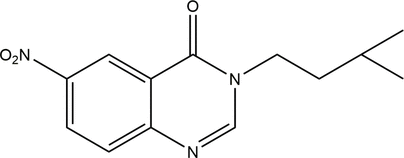
Quinazoline and quinazolinone derivatives constitute an important class of nitrogen-containing heterocyclic compounds. Their chemistry and reported biological activities have motivated considerable research (Wu et al., 2011 ; Singh et al., 2013). Several quinazoline-based compounds, including the epidermal growth factor receptor inhibitors erlotinib and gefitinib, have been studied in anticancer drug development (Cohen et al., 2005; Petrov et al., 2006; Wu et al., 2010). Structural characterization of related quinazolinone derivatives is valuable for understanding their molecular conformations and solid-state intermolecular interactions. In this context, we report the molecular and crystal structures of 3-isoamyl-6-nitroquinazolin-4-one, (I), accompanied by the results of a Hirshfeld surface analysis.
2. Structural commentary
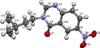
The molecular structure of (I) comprises a nearly planar bicyclic quinazolinone system (Fig. 1). The root-mean-square (r.m.s.) deviation for the ten non-hydrogen ring atoms (N1, N3, C2, C4, C4A, C5, C6, C7, C8, C8A) from their mean plane is 0.010 Å, with a maximum deviation of 0.015 (2) Å observed for atom N3. The isoamyl chain attached at atom N3 adopts an extended conformation, characterized by the torsion angles N3—C9—C10—C11 = 168.0 (2)°, C9—C10—C11—C12 = 60.6 (3)° and C9—C10—C11—C13 = −172.9 (4)°. The nitro group at position C6 is essentially coplanar with the quinazolinone ring, as shown by the dihedral angle of 1.7 (3)° between the two moieties [torsion angle O2—N4—C6—C7 = 1.3 (2)°].
|
Figure 1
Molecular structure of (I) , showing the atom-labelling scheme. Displacement ellipsoids are drawn at the 50% probability level. |
3. Supramolecular features
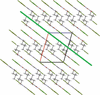
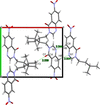
In the crystal structure of (I), molecules are linked by intermolecular C—H⋯O and C—H⋯N hydrogen bonds (Table 1), forming supramolecular layers parallel to ( 01), Fig. 2. A selection of these non-classical hydrogen-bonding interactions is shown in Fig. 3. Although centroid-to-centroid contacts exist between quinazolinone rings of neighbouring molecules [e.g., Cg1⋯Cg2i = 4.7241 (13) Å, symmetry code: (i) 2 − x, −
 + y,
 − z; Cg1 is the centroid of the N1/C2/N3/C4/C4A/C8A ring, Cg2 is the centroid of the C4A/C5–C8/C8A ring], the large slippage (3.446 Å) indicates that π–π stacking interactions are negligible and do not contribute significantly to the consolidation of the crystal packing.
|
||||||||||||||||||||||
 ; (ii)
 .
|
Figure 2
Crystal packing of (I) viewed along [010], showing intermolecular C—H⋯O and C—H⋯N contacts (green lines). The thick green line indicates the projected trace of a hydrogen-bonded layer parallel to (01). |
|
Figure 3
Detail of the packing with intermolecular C—H⋯O and C—H⋯N contacts indicated by green dashed lines. |
4. Hirshfeld surface analysis
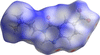
A Hirshfeld surface (HS) analysis (Hirshfeld, 1977) was carried out using CrystalExplorer (Spackman et al., 2021) to visualize and quantify non-covalent interactions in the crystal packing of (I). The HS mapped over dnorm is represented in Fig. 4, where the white surface indicates contacts with distances equal to the sum of van der Waals radii, while the red and blue colours indicate distances shorter and longer than the sum of van der Waals radii, respectively. The bright-red spots on the dnorm surface originate from intermolecular hydrogen-bonding interactions, with N and O atoms as acceptors and C—H as donor groups.
|
Figure 4
Hirshfeld surface of (I) mapped over dnorm. |
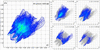
Two-dimensional fingerprint plots (Spackman & McKinnon, 2002) for the full surface and those delineated into the most abundant contributions are shown in Fig. 5. The highest contributions to the Hirshfeld surface arise from H⋯H contacts at 39.2%, followed by O⋯H/H⋯O, C⋯H/H⋯C and N⋯H/H⋯N interactions with contributions of 28.4%, 16.0% and 7.5% respectively. Minor contributors not shown in Fig. 5 are from C⋯O/O⋯C (4.3%), N⋯O/O⋯N (2.1%), N⋯C/C⋯N (1.1%), N⋯N (0.8%), O⋯O (0.3%) and C⋯C (0.3%) interactions.
|
Figure 5
Two-dimensional fingerprint plots for the title compound, showing (a) all interactions, and decomposed into (b) H⋯H, (c) O⋯H/H⋯O, (d) C⋯H/H⋯C, (e) N⋯H/H⋯N interactions. Values for di and de represent the closest internal and external distances (in Å) from given points on the Hirshfeld surface. |
5. Database survey
A search of the Cambridge Structural Database (CSD, version 2025.3.1; Groom et al., 2016) identifies related quinazolin-4-one structures with refcodes JOJWOY (Zhang et al., 2024), AFEWIT (Al-Suwaidan et al., 2013), BOTMUT (Samarov et al., 2009), DUVFEH (Gnanasekaran et al., 2015), EVECEQ (Tojiboev et al., 2025), GABHEZ (Elmuradov et al., 2016), GAPPUK (Yu, 2012), QOQGOW (Davlatboyev et al., 2024), PUFMAI (Davlatboyev et al., 2025), AWABUY (El-Azab et al., 2021), and RUGKEK (Wu et al., 2009). For compounds with a nitro group attached to the ring system differences of the orientations of the nitro groups relative to compound (I) are found. In JOJWOY (2-amino-6,8-dinitroquinazolin-4-one hydrate), the O3—N1—C1—C2 torsion angle is 59.1 (9)°, while the O2—N4—C6—C7 torsion angle in (I) is 1.3 (2)°; in RUGKEK (7-fluoro-6-nitroquinazolin-4(3H)-one), the comparable torsion angle O3—N3—C5—C4 is −12.3 (3)°. The more extensively fused analogue DUVFEH (6-acetyl-2-nitrobenzo[4,5]imidazo[2,1-b]quinazolin-12(6H)-one) has an O3—N4—C7—C8 torsion angle of −4.0 (11)°. In comparison, the O2—N4—C6—C7 torsion angle in the title compound is 1.3 (2)°, indicating that its nitro substituent is nearly coplanar with the quinazolinone aromatic ring. Because the compared compounds differ in their substitution patterns, these values describe local nitro-group conformations rather than an identical four-atom fragment in every case.
The N3-bound isoamyl substituent in compound (I) has an extended conformation. This flexible branched chain differs from the 2,3-pentamethylene unit in BOTMUT (6,8-dinitro-2,3-pentamethylene-3,4-dihydroquinazolin-4-one), in which the aliphatic segment is incorporated into a cyclic framework. A further structurally distinct example is AFEWIT {methyl 3-[(6-nitro-4-oxo-3-phenyl-3,4-dihydroquinazolin-2-yl)sulfanyl]propanoate}, which contains an ester-bearing aliphatic substituent attached at the sulfur atom.
6. Synthesis and crystallization
Synthesis of 3-isoamylquinazolin-4-one. 1.46 g (0.01 mol) of quinazolin-4-one, 30 ml of ethyl alcohol (C2H5OH) and 0.672 g (0.012 mol) of KOH were placed into a 100 ml round-bottomed flask and mixed. Then 1.4 ml (1.6 g, d = 0.87 g ml−1; 0.015 mol) of isoamyl chloride (C5H11Cl) was added to the cooled reaction mixture and heated at 348–353 K for 9 h. After cooling, 30 ml of 5%wt NaOH aqueous solution was added, and 70 ml of chloroform was poured into the solution for extraction, which resulted in 1.9 g of the intermediate (yield: 88%); melting point 338–340 K, Rf = 0.68 (benzene:acetone – 3:1).
Synthesis of 3-isoamyl-6-nitroquinazolin-4-one, (I). 20 ml of concentrated sulfuric acid were placed in a round-bottomed flask, cooled and connected to a magnetic stirrer (200 rotations per minute). Then 3-iso-amylquinazolin-4-one 2.16 g (0.01 mol) was added and dissolved. Sulfuric acid (0.005 mol) and nitric acid (0.005 mol) were mixed in a flask, cooled and dripped onto the solution with a dropping funnel (200 drops per minute). After complete addition, the mixture was heated at 313–315 K for 2 h and then placed in a refrigerator overnight. The mixture was then neutralized (pH 7), and the resulting precipitate filtered off. Colourless crystals suitable for X-ray diffraction analysis were recrystallized from ethanol; yield 91%.
7. Refinement
Crystal data, data collection and structure refinement details are summarized in Table 2. H atoms bonded to carbon were positioned geometrically and refined using a riding model with Uiso(H) = 1.2Ueq(C) for CH and CH2 groups and 1.5Ueq(C) for methyl groups. The latter were treated as rotating groups.
|
Supporting information
CCDC reference: 2515307
Crystal structure: contains datablock I. DOI: https://doi.org/10.1107/S2056989026011874/wm5817sup1.cif
Structure factors: contains datablock I. DOI: https://doi.org/10.1107/S2056989026011874/wm5817Isup2.hkl
Supporting information file. DOI: https://doi.org/10.1107/S2056989026011874/wm5817Isup3.cml
| C13H15N3O3 | F(000) = 552.0 |
| Mr = 261.28 | Dx = 1.288 Mg m−3 |
| Monoclinic, P21/c | Cu Kα radiation, λ = 1.54184 Å |
| a = 13.3282 (9) Å | Cell parameters from 1864 reflections |
| b = 10.2832 (6) Å | θ = 5.5–69.4° |
| c = 10.2474 (6) Å | µ = 0.78 mm−1 |
| β = 106.416 (7)° | T = 293 K |
| V = 1347.21 (15) Å3 | Prism, colourless |
| Z = 4 | 0.20 × 0.15 × 0.05 mm |
| XtaLAB Synergy, Single source at home/near, HyPix3000 diffractometer | 2640 independent reflections |
| Radiation source: micro-focus sealed X-ray tube, PhotonJet (Cu) X-ray Source | 1718 reflections with I ≥ 2u(I) |
| Mirror monochromator | Rint = 0.037 |
| Detector resolution: 10.0000 pixels mm-1 | θmax = 71.7°, θmin = 3.5° |
| ω scans | h = −14→16 |
| Absorption correction: multi-scan (CrysAlisPro; Rigaku OD, 2020) | k = −12→12 |
| Tmin = 0.239, Tmax = 1.000 | l = −12→8 |
| 6643 measured reflections |
| Refinement on F2 | 24 constraints |
| Least-squares matrix: full | Primary atom site location: dual |
| R[F2 > 2σ(F2)] = 0.059 | H-atom parameters constrained |
| wR(F2) = 0.199 | w = 1/[σ2(Fo2) + (0.1092P)2 + 0.0954P] where P = (Fo2 + 2Fc2)/3 |
| S = 1.01 | (Δ/σ)max = 0.030 |
| 2613 reflections | Δρmax = 0.22 e Å−3 |
| 175 parameters | Δρmin = −0.19 e Å−3 |
| 0 restraints |
| x | y | z | Uiso*/Ueq | ||
| O2 | 0.91337 (16) | 1.04756 (17) | 0.8360 (2) | 0.0794 (6) | |
| N3 | 0.78714 (14) | 0.41230 (18) | 0.57360 (18) | 0.0551 (5) | |
| N4 | 0.86433 (16) | 0.98032 (19) | 0.7405 (2) | 0.0652 (6) | |
| N1 | 0.89582 (15) | 0.43903 (18) | 0.79896 (19) | 0.0609 (5) | |
| O3 | 0.8103 (2) | 1.02617 (19) | 0.6352 (2) | 0.1086 (9) | |
| C6 | 0.87157 (17) | 0.8389 (2) | 0.7541 (2) | 0.0537 (5) | |
| C8A | 0.88591 (16) | 0.5727 (2) | 0.7819 (2) | 0.0508 (5) | |
| C4A | 0.82610 (15) | 0.6284 (2) | 0.6599 (2) | 0.0493 (5) | |
| C5 | 0.81855 (17) | 0.7634 (2) | 0.6464 (2) | 0.0535 (5) | |
| H5 | 0.77847 (17) | 0.8012 (2) | 0.5661 (2) | 0.0642 (7)* | |
| C4 | 0.77133 (17) | 0.5454 (2) | 0.5468 (2) | 0.0547 (6) | |
| C8 | 0.93880 (18) | 0.6537 (2) | 0.8895 (2) | 0.0595 (6) | |
| H8 | 0.97873 (18) | 0.6174 (2) | 0.9707 (2) | 0.0714 (7)* | |
| C9 | 0.73215 (18) | 0.3191 (2) | 0.4681 (2) | 0.0635 (6) | |
| H13a | 0.72927 (18) | 0.3537 (2) | 0.3791 (2) | 0.0761 (8)* | |
| H13b | 0.77093 (18) | 0.2381 (2) | 0.4798 (2) | 0.0761 (8)* | |
| C2 | 0.84695 (17) | 0.3690 (2) | 0.6965 (2) | 0.0589 (6) | |
| H2 | 0.85320 (17) | 0.2793 (2) | 0.7076 (2) | 0.0706 (7)* | |
| C7 | 0.93173 (18) | 0.7863 (2) | 0.8750 (2) | 0.0584 (6) | |
| H7 | 0.96708 (18) | 0.8403 (2) | 0.9460 (2) | 0.0701 (7)* | |
| C10 | 0.6228 (2) | 0.2930 (3) | 0.4754 (3) | 0.0768 (8) | |
| H23a | 0.6269 (2) | 0.2429 (3) | 0.5569 (3) | 0.0921 (10)* | |
| H23b | 0.5899 (2) | 0.3755 (3) | 0.4842 (3) | 0.0921 (10)* | |
| C11 | 0.5536 (2) | 0.2207 (3) | 0.3540 (3) | 0.0913 (10) | |
| H33 | 0.5521 (2) | 0.2720 (3) | 0.2729 (3) | 0.1096 (12)* | |
| C12 | 0.5951 (3) | 0.0888 (4) | 0.3342 (4) | 0.1238 (14) | |
| H4Ba | 0.602 (2) | 0.0371 (11) | 0.4142 (13) | 0.186 (2)* | |
| H4Bb | 0.5478 (13) | 0.0471 (13) | 0.257 (2) | 0.186 (2)* | |
| H4Bc | 0.6624 (11) | 0.0978 (4) | 0.318 (3) | 0.186 (2)* | |
| C13 | 0.4431 (3) | 0.2152 (6) | 0.3640 (5) | 0.150 (2) | |
| H1a | 0.4419 (6) | 0.169 (4) | 0.445 (3) | 0.224 (3)* | |
| H1b | 0.4175 (13) | 0.3020 (6) | 0.368 (5) | 0.224 (3)* | |
| H1c | 0.3995 (8) | 0.171 (4) | 0.286 (2) | 0.224 (3)* | |
| O1 | 0.71749 (14) | 0.58364 (17) | 0.43714 (17) | 0.0741 (5) |
| U11 | U22 | U33 | U12 | U13 | U23 | |
| O2 | 0.0929 (13) | 0.0491 (10) | 0.0934 (13) | −0.0111 (9) | 0.0220 (10) | −0.0173 (9) |
| N3 | 0.0590 (10) | 0.0429 (9) | 0.0595 (10) | −0.0032 (8) | 0.0107 (8) | −0.0035 (8) |
| N4 | 0.0720 (13) | 0.0428 (11) | 0.0775 (14) | −0.0003 (10) | 0.0160 (11) | −0.0024 (10) |
| N1 | 0.0680 (12) | 0.0428 (10) | 0.0639 (11) | 0.0022 (9) | 0.0055 (9) | 0.0045 (8) |
| O3 | 0.147 (2) | 0.0465 (11) | 0.1019 (16) | 0.0072 (12) | −0.0144 (14) | 0.0134 (11) |
| C6 | 0.0572 (12) | 0.0377 (11) | 0.0649 (13) | 0.0006 (9) | 0.0153 (10) | −0.0016 (10) |
| C8A | 0.0507 (11) | 0.0433 (11) | 0.0560 (11) | 0.0025 (9) | 0.0111 (9) | 0.0020 (9) |
| C4A | 0.0487 (10) | 0.0432 (11) | 0.0531 (11) | 0.0017 (9) | 0.0099 (9) | 0.0004 (9) |
| C5 | 0.0558 (12) | 0.0449 (12) | 0.0562 (12) | 0.0031 (10) | 0.0099 (10) | 0.0032 (10) |
| C4 | 0.0567 (12) | 0.0470 (12) | 0.0558 (12) | −0.0011 (10) | 0.0087 (10) | 0.0007 (10) |
| C8 | 0.0636 (13) | 0.0514 (14) | 0.0555 (12) | 0.0034 (11) | 0.0039 (10) | 0.0010 (10) |
| C9 | 0.0703 (15) | 0.0511 (13) | 0.0670 (14) | −0.0092 (11) | 0.0162 (12) | −0.0098 (11) |
| C2 | 0.0619 (13) | 0.0410 (11) | 0.0693 (13) | 0.0015 (11) | 0.0116 (11) | 0.0024 (11) |
| C7 | 0.0614 (13) | 0.0516 (13) | 0.0576 (12) | −0.0026 (10) | 0.0092 (10) | −0.0092 (10) |
| C10 | 0.0765 (16) | 0.083 (2) | 0.0721 (16) | −0.0216 (15) | 0.0237 (13) | −0.0174 (14) |
| C11 | 0.085 (2) | 0.103 (2) | 0.0822 (19) | −0.0324 (18) | 0.0166 (15) | −0.0238 (18) |
| C12 | 0.143 (3) | 0.100 (3) | 0.123 (3) | −0.043 (2) | 0.029 (2) | −0.041 (2) |
| C13 | 0.087 (2) | 0.203 (6) | 0.153 (4) | −0.056 (3) | 0.025 (2) | −0.065 (4) |
| O1 | 0.0886 (12) | 0.0598 (10) | 0.0582 (9) | −0.0003 (9) | −0.0050 (8) | 0.0018 (8) |
| O2—N4 | 1.225 (2) | C9—H13a | 0.9700 |
| N3—C4 | 1.400 (3) | C9—H13b | 0.9700 |
| N3—C9 | 1.475 (3) | C9—C10 | 1.504 (3) |
| N3—C2 | 1.361 (3) | C2—H2 | 0.9300 |
| N4—O3 | 1.210 (3) | C7—H7 | 0.9300 |
| N4—C6 | 1.462 (3) | C10—H23a | 0.9700 |
| N1—C8A | 1.387 (3) | C10—H23b | 0.9700 |
| N1—C2 | 1.288 (3) | C10—C11 | 1.518 (4) |
| C6—C5 | 1.371 (3) | C11—H33 | 0.9800 |
| C6—C7 | 1.382 (3) | C11—C12 | 1.500 (5) |
| C8A—C4A | 1.401 (3) | C11—C13 | 1.507 (4) |
| C8A—C8 | 1.402 (3) | C12—H4Ba | 0.9600 |
| C4A—C5 | 1.395 (3) | C12—H4Bb | 0.9600 |
| C4A—C4 | 1.458 (3) | C12—H4Bc | 0.9600 |
| C5—H5 | 0.9300 | C13—H1a | 0.9600 |
| C4—O1 | 1.215 (3) | C13—H1b | 0.9600 |
| C8—H8 | 0.9300 | C13—H1c | 0.9600 |
| C8—C7 | 1.373 (3) | ||
| C9—N3—C4 | 118.39 (18) | N1—C2—N3 | 126.9 (2) |
| C2—N3—C4 | 121.16 (19) | H2—C2—N3 | 116.54 (12) |
| C2—N3—C9 | 120.34 (19) | H2—C2—N1 | 116.54 (13) |
| O3—N4—O2 | 122.7 (2) | C8—C7—C6 | 119.3 (2) |
| C6—N4—O2 | 118.6 (2) | H7—C7—C6 | 120.33 (13) |
| C6—N4—O3 | 118.6 (2) | H7—C7—C8 | 120.33 (13) |
| C2—N1—C8A | 116.30 (18) | H23a—C10—C9 | 108.57 (14) |
| C5—C6—N4 | 118.8 (2) | H23b—C10—C9 | 108.57 (15) |
| C7—C6—N4 | 118.7 (2) | H23b—C10—H23a | 107.5 |
| C7—C6—C5 | 122.5 (2) | C11—C10—C9 | 114.8 (2) |
| C4A—C8A—N1 | 121.83 (19) | C11—C10—H23a | 108.57 (17) |
| C8—C8A—N1 | 118.74 (19) | C11—C10—H23b | 108.57 (18) |
| C8—C8A—C4A | 119.43 (19) | H33—C11—C10 | 107.02 (17) |
| C5—C4A—C8A | 120.1 (2) | C12—C11—C10 | 113.1 (3) |
| C4—C4A—C8A | 120.0 (2) | C12—C11—H33 | 107.0 (2) |
| C4—C4A—C5 | 119.82 (19) | C13—C11—C10 | 110.0 (3) |
| C4A—C5—C6 | 118.5 (2) | C13—C11—H33 | 107.0 (3) |
| H5—C5—C6 | 120.76 (13) | C13—C11—C12 | 112.4 (3) |
| H5—C5—C4A | 120.76 (13) | H4Ba—C12—C11 | 109.5 |
| C4A—C4—N3 | 113.75 (18) | H4Bb—C12—C11 | 109.5 |
| O1—C4—N3 | 120.9 (2) | H4Bb—C12—H4Ba | 109.5 |
| O1—C4—C4A | 125.3 (2) | H4Bc—C12—C11 | 109.5 |
| H8—C8—C8A | 119.94 (12) | H4Bc—C12—H4Ba | 109.5 |
| C7—C8—C8A | 120.1 (2) | H4Bc—C12—H4Bb | 109.5 |
| C7—C8—H8 | 119.94 (13) | H1a—C13—C11 | 109.5 |
| H13a—C9—N3 | 109.32 (12) | H1b—C13—C11 | 109.5 |
| H13b—C9—N3 | 109.32 (12) | H1b—C13—H1a | 109.5 |
| H13b—C9—H13a | 108.0 | H1c—C13—C11 | 109.5 |
| C10—C9—N3 | 111.54 (19) | H1c—C13—H1a | 109.5 |
| C10—C9—H13a | 109.32 (14) | H1c—C13—H1b | 109.5 |
| C10—C9—H13b | 109.32 (16) | ||
| O2—N4—C6—C5 | −178.7 (2) | N1—C8A—C4A—C4 | 0.6 (2) |
| O2—N4—C6—C7 | 1.3 (2) | N1—C8A—C8—C7 | 179.1 (2) |
| N3—C4—C4A—C8A | −1.2 (2) | C6—C5—C4A—C8A | 0.7 (2) |
| N3—C4—C4A—C5 | 178.99 (18) | C6—C5—C4A—C4 | −179.5 (2) |
| N3—C9—C10—C11 | 168.0 (2) | C6—C7—C8—C8A | 0.4 (3) |
| N3—C2—N1—C8A | 0.2 (3) | C8A—C4A—C4—O1 | 179.9 (2) |
| N4—C6—C5—C4A | 179.8 (2) | C9—C10—C11—C12 | 60.6 (3) |
| N4—C6—C7—C8 | 179.7 (2) | C9—C10—C11—C13 | −172.9 (4) |
| N1—C8A—C4A—C5 | −179.6 (2) |
| D—H···A | D—H | H···A | D···A | D—H···A |
| C13—H1c···O1i | 0.96 (3) | 2.54 (2) | 3.493 (5) | 172 (3) |
| C8—H8···N1ii | 0.93 (1) | 2.54 (1) | 3.462 (3) | 169 (1) |
| Symmetry codes: (i) −x+1, y−1/2, −z+1/2; (ii) −x+2, −y+1, −z+2. |
Acknowledgements
The authors thank the Institute of the chemistry of plant substances, Institute of Bioorganic Chemistry of the Academy of Sciences of Uzbekistan, Tashkent, Uzbekistan for providing the single-crystal XRD facility
References
 Al-Suwaidan, I. A., Abdel-Aziz, A. A.-M., El-Azab, A. S., Chidan Kumar, C. S. & Fun, H.-K. (2013). Acta Cryst. E69, o1111.
CrossRef
IUCr Journals
Google Scholar
Bourhis, L. J., Dolomanov, O. V., Gildea, R. J., Howard, J. A. K. & Puschmann, H. (2015). Acta Cryst. A71, 59–75.
Web of Science
CrossRef
IUCr Journals
Google Scholar
Cohen, M. H., Johnson, J. R., Chen, Y.-F., Sridhara, R. & Pazdur, R. (2005). Oncologist 10, 461–466.
CrossRef
PubMed
CAS
Google Scholar
Davlatboyev, M., Allabergenova, S., Zulpanov, F., Yakubov, U., Tojiboev, A. & Sattarov, T. (2025). Acta Cryst. E81, 144–147.
CrossRef
IUCr Journals
Google Scholar
Davlatboyev, M., Sattarov, T., Yakubov, U., Zulpanov, F. & Tojiboyev, A. (2024). CSD Communication (CCDC 2349187). CCDC, Cambridge, England.
Google Scholar
Dolomanov, O. V., Bourhis, L. J., Gildea, R. J., Howard, J. A. K. & Puschmann, H. (2009). J. Appl. Cryst. 42, 339–341.
Web of Science
CrossRef
CAS
IUCr Journals
Google Scholar
El-Azab, A. S., Khalil, N. Y. & Abdel-Aziz, A. A.-M. (2021). J. Chem. 6612177.
Google Scholar
Elmuradov, B., Shakhidoyatov, K., Dräger, G. & Butenschön, H. (2016). Eur. J. Org. Chem. 2016, 483–492.
CSD
CrossRef
CAS
Google Scholar
Gnanasekaran, K. K., Muddala, N. P. & Bunce, R. A. (2015). Tetrahedron Lett. 56, 7180–7183.
CrossRef
CAS
Google Scholar
Groom, C. R., Bruno, I. J., Lightfoot, M. P. & Ward, S. C. (2016). Acta Cryst. B72, 171–179.
Web of Science
CrossRef
IUCr Journals
Google Scholar
Hirshfeld, F. L. (1977). Theor. Chim. Acta 44, 129–138.
CrossRef
CAS
Web of Science
Google Scholar
Petrov, K. G., Zhang, Y., Carter, M., Cockerill, G. S., Dickerson, S., Gauthier, C. A., Guo, Y., Mook, R. A. Jr, Rusnak, D. W., Walker, A. L., Wood, E. R. & Lackey, K. E. (2006). Bioorg. Med. Chem. Lett. 16, 4686–4691.
CrossRef
PubMed
CAS
Google Scholar
Rigaku OD (2020). CrysAlis PRO. Rigaku Oxford Diffraction, Wroclaw, Poland.
Google Scholar
Samarov, Z. U., Khakimova, Z. M., Okmanov, R., Tashkhodzhaev, B. & Shakhidoyatov, Kh. M. (2009). CSD Communication (CCDC 685459). CCDC, Cambridge, England.
Google Scholar
Sheldrick, G. M. (2015). Acta Cryst. A71, 3–8.
Web of Science
CrossRef
IUCr Journals
Google Scholar
Singh, K., Sharma, P. P., Kumar, A., Chaudhary, A. & Roy, R. K. (2013). Mini Rev. Med. Chem. 13, 1177–1194.
CrossRef
CAS
PubMed
Google Scholar
Spackman, M. A. & McKinnon, J. J. (2002). CrystEngComm 4, 378–392.
Web of Science
CrossRef
CAS
Google Scholar
Spackman, P. R., Turner, M. J., McKinnon, J. J., Wolff, S. K., Grimwood, D. J., Jayatilaka, D. & Spackman, M. A. (2021). J. Appl. Cryst. 54, 1006–1011.
Web of Science
CrossRef
CAS
IUCr Journals
Google Scholar
Tojiboev, A. G., Elmurodov, B. Z., Muhib, X., Turg'unov, K. K., Abdurazakov, A. S., Maxmadiyarova, C. E., Toshxo'jaev, B. & Mirzaev, S. Z. (2025). CSD Communication (CCDC 2074782). CCDC, Cambridge, England.
Google Scholar
Westrip, S. P. (2010). J. Appl. Cryst. 43, 920–925.
Web of Science
CrossRef
CAS
IUCr Journals
Google Scholar
Wu, X., Li, M., Qu, Y., Tang, W., Zheng, Y., Lian, J., Ji, M. & Xu, L. (2010). Bioorg. Med. Chem. 18, 3812–3822.
CrossRef
CAS
PubMed
Google Scholar
Wu, X., Li, M., Tang, W., Zheng, Y., Lian, J., Xu, L. & Ji, M. (2011). Chem. Biol. Drug Des. 78, 932–940.
CrossRef
CAS
PubMed
Google Scholar
Wu, Y., Ji, A., Zhang, A. & Shen, Y. (2009). Acta Cryst. E65, o3075.
Web of Science
CSD
CrossRef
IUCr Journals
Google Scholar
Yu, Y. (2012). Acta Cryst. E68, o304.
Web of Science
CSD
CrossRef
IUCr Journals
Google Scholar
Zhang, X., Lei, C., Tang, J., Cheng, G. & Yang, H. (2024). Cryst. Growth Des. 24, 1350–1356.
CrossRef
CAS
Google Scholar
This is an open-access article distributed under the terms of the Creative Commons Attribution (CC-BY) Licence, which permits unrestricted use, distribution, and reproduction in any medium, provided the original authors and source are cited.
| CRYSTALLOGRAPHIC COMMUNICATIONS |