
Acta Crystallographica Section F
Acta Crystallographica
Section F STRUCTURAL BIOLOGY COMMUNICATIONS
Acta Crystallographica
Section F STRUCTURAL BIOLOGY COMMUNICATIONS


 menu
|
|
Figure 2
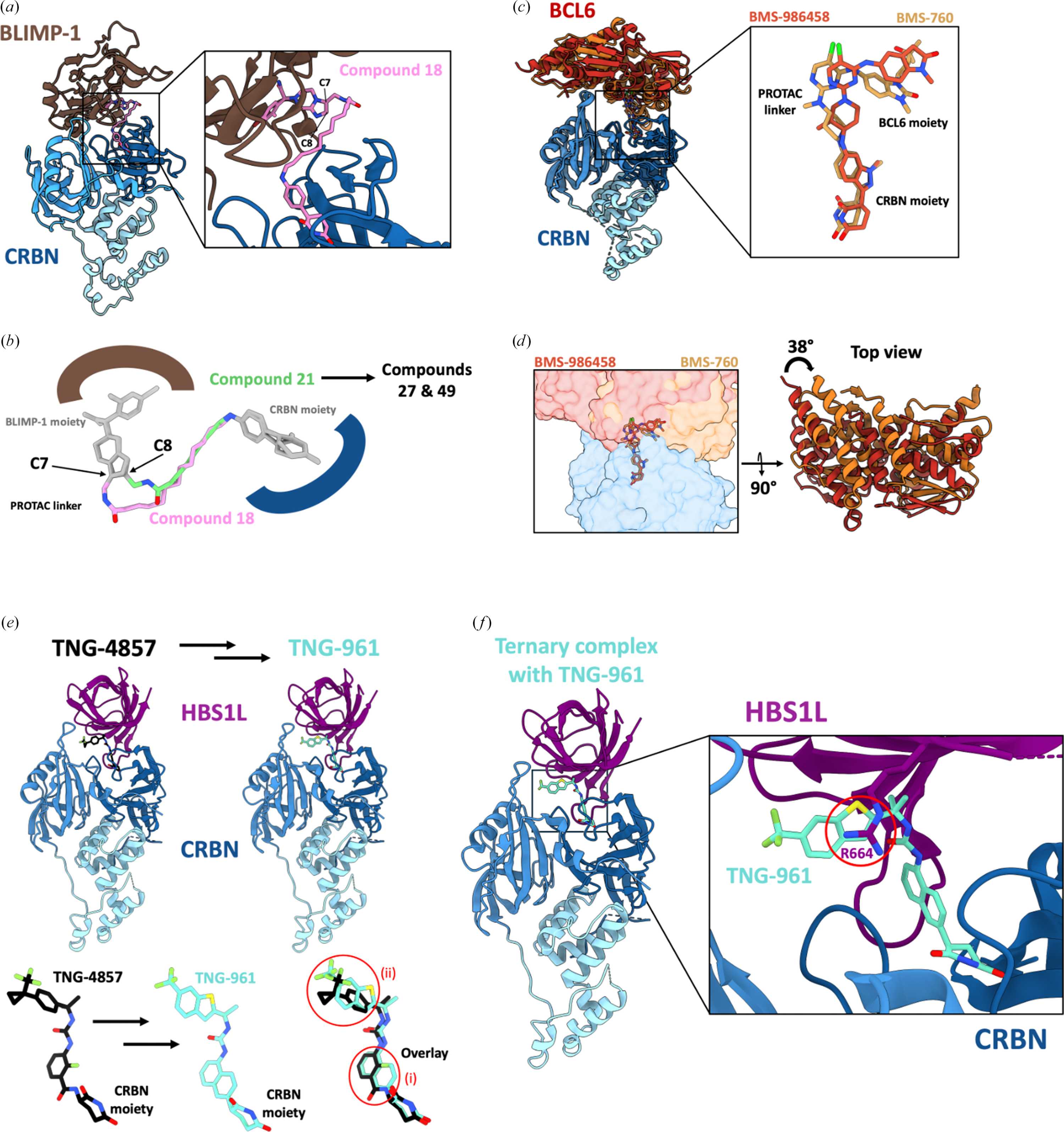
Cereblon degrader potency optimization using structure-based drug design. (a) The cryo-EM structure of the ternary complex formed by BLIMP-1 (brown), compound 18 (pink) and CRBN (blue) is shown (PDB entry 9q33). The inset shows the structure and position of the BLIMP-1 targeting heterobifunctional degrader compound 18. Note the linker position change from carbon 7 (C7) to carbon 8 (C8) on the imidazole ring in the BLIMP-1 binding moiety. (b) Composition differences in linker chemistry and 3D geometry of compounds 18, 21 and 27 in the optimization series. (c) Ternary complex solved by cryo-EM of BCL-6, BMS-986458 (PDB entry 9ya9) or BMS-760 (PDB entry 9q03), and CRBN. The inset shows the comparative positions of both BCL-6 heterobifunctional degraders. (d) Surface complementarity of both BCL-6 BTB domain positions in the ternary complex with surface modes shown. The flipped top view shows the shift of the BCL-6 BTB domains relative to each other in the presence of the respective heterobifunctional degraders. (e) Cryo-EM structure of HBS1L/GSPT3 in complex with TNG-4857 (PDB entry 11mr) or TNG-961 (PDB entry 10ay) and CRBN. TNG-4857 optimization led to TNG-961, with the bottom panel showing differences in molecular-glue degrader composition and positioning. (i) The fused-ring structure in TNG-961 (cyan) compared with TNG-4857 (black); (ii) the benzothiophene group in the TNG-961 structure (cyan) compared with TNG-4857 (black). (f) The inset shows favorable interaction of Arg664 in HBS1L mediated by the benzothiophene group in TNG-961. |
| STRUCTURAL BIOLOGY COMMUNICATIONS |
ISSN: 2053-230X
 access