

 journal menu


research papers
 | JOURNAL OF APPLIED CRYSTALLOGRAPHY |
 access
A refinable three-parameter equation for phenomenological absorption in quantitative – determining the equation

aDepartment of Materials Science and Engineering, Monash University, Victoria 3800, Australia, bInstitute of Multidisciplinary Research for Advanced Materials, Tohoku University, Sendai 980-8577, Japan, cSchool of Physics and Astronomy, Monash University, Victoria 3800, Australia, and dMonash Centre for Electron Microscopy, Monash University, Victoria 3800, Australia
*Correspondence e-mail: [email protected]
This article is part of a collection of articles on Quantum Crystallography, and commemorates the 100th anniversary of the development of Quantum Mechanics.
A three-term equation for phenomenological absorption of electron beams in materials is derived for use in quantitative simulations. This is motivated by differential quantitative convergent-beam electron diffraction (QCBED) using CBED patterns that have not been electron-optically energy filtered. As a starting point, this three-parameter function reproduces factors generated by the ubiquitous ATOM subroutine of Bird & King [Acta Cryst. (1990), A46, 202–208] to within a few per cent, spanning elements Z = 1 to 98, Debye–Waller parameters from B = 0.05 Å2 to B = 2.0 Å2, scattering angles from s = 0 Å−1 to s = 6.0 Å−1 and electron energies from E0 = 1 keV to E0 = 1 MeV. As such, it is applicable to zero-energy-loss electron-optically filtered pattern matching for which the Bird and King ATOM subroutine was designed. Crucially, the coefficients of the three terms in the present equation can be refined to produce factors with differing local and non-local contributions, which are better suited to unfiltered differential QCBED pattern matching.
Keywords: phenomenological absorption; quantitative convergent-beam electron diffraction; differential QCBED; quantitative transmission electron microscopy; electron scattering calculations; inelastic scattering factors.
1. Introduction
The highly dynamic process of electron scattering from even the thinnest material samples complicates the accurate simulation of electron microscope images and diffraction patterns. The problem is considerably simplified if an electron-optical energy filter is used to exclude almost all of the inelastically scattered electrons. With the advent of electron energy-loss spectrometers and energy-filtered imaging with transmission electron microscopes (TEMs) in the late 1980s and early 1990s, Bird & King (1990 ) met the need for a description of absorption due to thermal diffuse scattering (TDS) in elastic electron scattering simulations through their ATOM subroutine.
Phenomenological absorption collectively accounts for all electrons that are lost from the signal recorded in a TEM that is to be matched by simulations, irrespective of whether the intensities correspond to an image of the specimen or a diffraction pattern from it. In the context of quantitative the matching of an experimental image or diffraction pattern with a simulated one allows fundamental materials properties to be accurately measured via as variable parameters in pattern-matching processes. Electrons lost from the signal to be matched can include those that have lost energy due to
(i) core–shell excitations,
(ii) bremsstrahlung,
(iii) plasmon excitations and
(iv) TDS arising from phonon excitation.
Electron energy filters allow the removal of (i), (ii) and (iii) above but not (iv) due to the sub-0.1 eV losses associated with TDS. The lack of an energy filter means that all of these components will be present.
The `10% rule' – i.e. that the imaginary absorptive part of a is approximately one-tenth the elastic component (Hashimoto et al., 1962; Hall & Hirsch, 1965; Humphreys & Hirsch, 1968; Allen & Rossouw, 1990; Bird & King, 1990; Rossouw et al., 1990) – was used widely in early work that attempted to incorporate the effects of absorption into quantitative analyses of electron diffraction and imaging. The growing need for more accurate descriptors of inelastic electron scattering (and thus absorption) led to the analysis of quantum mechanical atomic models and tabulations of inelastic scattering factors resulting from them (e.g. Radi, 1970). Meanwhile, experimental studies were carried out to examine the effects of absorption on individual reflections in electron diffraction patterns (Ishida et al., 1975; Buxton & Loveluck, 1977; Ichimiya & Lehmpfuhl, 1988; Rossouw et al., 1990). Analytical approaches that were based on a two-beam treatment of dynamical scattering (e.g. Hall & Hirsch, 1965; Radi, 1970) were extended to many-beam treatments in succeeding studies (e.g. Bird & King, 1990; Rossouw et al., 1990; Rossouw & Miller, 1993).
Coincident with the advent of computer-automated quantitative convergent-beam electron diffraction (QCBED), Bird & King (1990) identified and satisfied the need for a subroutine that could be used in computer programming to provide a more complete n-beam analytical treatment of phenomenological absorption. Their resulting ATOM subroutine became an intrinsic component of many QCBED algorithms (Bird & Saunders, 1992; Zuo, 1993; Deininger et al., 1994; Midgley & Saunders, 1996; Tsuda & Tanaka, 1999; Holmestad et al., 1999; Saunders et al., 1999a; Saunders et al., 1999b; Streltsov et al., 2003; Friis et al., 2004; Zuo, 2004; Nakashima, 2007; Nakashima & Muddle, 2010b; Sang et al., 2010) as well as a variety of other TEM image and diffraction pattern simulation programs (Peng & Whelan, 1992; Pennycook & Jesson, 1992; Gajdardziska-Josifovska et al., 1993; Zuo & Spence, 1993; Twesten et al., 1997; Jansen et al., 1998; Tabira et al., 2000; Cosgriff & Nellist, 2007; Tsuda et al., 2007; Neish et al., 2013; Hosokawa et al., 2015; Palatinus et al., 2015; Shao & Zuo, 2017).
Since the ATOM subroutine of Bird & King (1990), which applies an Einstein model of TDS in determining inelastic scattering factors, numerous other theoretical and experimental treatments of absorption potentials have emerged in the quest for improved accuracy (e.g. Weickenmeier & Kohl, 1991; Anstis, 1996; Peng, 1997; Weickenmeier & Kohl, 1998; Saunders et al., 1999a; Allen et al., 2001; Ishizuka, 2002; Zuo, 2004; Neish et al., 2013; Allen et al., 2015; Pennington et al., 2018; Thomas et al., 2024). Even so, the ATOM subroutine remains very widely used as a good approximation to absorption that is also easy to implement.
In the past two decades, a new approach to QCBED has been developed that does not require the use of energy-filtering electron optics (Nakashima, 2007; Nakashima & Muddle, 2010b; Nakashima et al., 2011; Nakashima, 2012; Nakashima, 2017; Peng & Nakashima, 2017; Peng & Nakashima, 2019; Nakashima, 2019; Peng & Nakashima, 2021; Tan et al., 2024). The new approach encompasses development of two different types of differential techniques that involve (a) differentiation with respect to specimen thickness (Nakashima, 2007; Nakashima & Muddle, 2010b) and (b) differentiation with respect to scattering angle (Nakashima & Muddle, 2010a; Nakashima & Muddle, 2010b). In the development of these techniques, it was shown that both types of differentiation result in almost complete annulment of the diffuse slowly varying inelastic signal in CBED patterns that contributes a significant background deleterious to QCBED pattern-matching measurements of bonding-sensitive structure factors.
With the advent of differential QCBED, three options have become available for conducting QCBED pattern-matching refinements. These are listed in the left-most column of Table 1. The different inelastic contributions to CBED intensities, according to what is known of the angular distribution of inelastically scattered electrons in CBED patterns (e.g Bird & King, 1990; Nakashima & Muddle, 2010a; Nakashima & Muddle, 2010b; Egerton, 2011; Dwyer, 2014; Egoavil et al., 2014), are listed in the top row of the table. Table 1 shows that the three different modes of QCBED will contain different inelastic contributions.
| |||||||||||||||||||||||||||
In conventional QCBED with energy filtering, the standard practice was to remove the TDS diffuse background remaining in CBED patterns by measuring the magnitude of this background surrounding each reflection disc and subtracting a constant average value from each disc individually (e.g. Streltsov et al., 2003). This was reasonable as the TDS background is very slowly varying. The calculated patterns in conventional QCBED included the Bird & King (1990) inelastic scattering factors from the ATOM subroutine.
Differential QCBED with energy filtering does not need the diffuse TDS background to be subtracted in pre-processing of the CBED pattern being matched as this is differentiated out. The factors from the ATOM subroutine (Bird & King, 1990) can be used in the pattern-matching calculations since the rocking curve to be matched is only affected by TDS.
In the case of differential QCBED without energy filtering, the effect on the rocking curve signal is different due to the contribution of plasmon-loss electrons, which mimics the elastic intensity distribution, albeit with a slight amount of blurring (Egerton, 2011). This is a significant contribution as plasmon losses constitute the largest component of inelastic scattering in an electron energy-loss spectrum, especially at the specimen thicknesses QCBED typically requires (500–4000 Å). In this case, inelastic scattering factors need to be included that are different from those of Bird and King or similar TDS-based models (e.g. Thomas et al., 2024).
To furnish this requirement, a parametrized function has been developed that, at its base, approximates the ATOM subroutine of Bird & King (1990). This has the following form:

The coefficients A, CG and CL are refinable by QCBED, and the factor for the jth atom in the unit cell, fj′, depends on the atom's atomic number (Zj), its Debye–Waller parameter at the relevant temperature (Bj), the incident electron energy (E0) and s [s = sin(θ)/λ] as inputs. The first term summarizes the non-local contributions in the form of a Dirac delta function, and the second and third terms describe the atom-localized contributions – the second term being Gaussian (with coefficient CG) and the third term being Lorentzian (with coefficient CL).
The first term is usually redundant because it is automatically taken care of when calculated CBED intensities are normalized to the experimental intensities. However, it is included in the present formulation because one can measure the incident electron beam intensity and fix it as the normalizing factor, and then refine the A, CG and CL parameters to measure the relative local versus non-local contributions. The requirement for separate Gaussian and Lorentzian terms for the atom-localized contributions comes from the form of the Bird & King (1990) inelastic scattering factors embodied in the ATOM subroutine. The aim of the present work is to find functions for  and
and  so that, when A = 0 and CG = CL = 1, equation (1) will reproduce the Bird & King (1990) inelastic scattering factors as a starting point but is applicable to both forms of QCBED employing electron-optical zero-loss energy filtering.
For the case of differential QCBED without energy filtering, the coefficients in equation (1) can be refined so that inelastic scattering factors that depart from those of Bird & King (1990) can be applied in the presence of the additional plasmon contribution to the rocking curves being pattern matched. It is expected that the coefficients for the Gaussian and Lorentzian terms, CG and CL, will no longer be equal in this case (as well as departing from unity) because the angular dependence of the magnitude of the plasmon contribution to the differential rocking curve will be different from that of the TDS contribution. This can be inferred from the way in which the diffuse background in an unfiltered CBED pattern falls off much more rapidly as a function of angle from the central beam than the TDS background in a zero-loss filtered CBED pattern, which is much more uniform throughout the pattern.
2. Analysis
An empirical determination of the function summarized by equation (1) is now described in detail. Considering not only Bird & King (1990) but also other descriptions of absorption (e.g. Humphreys & Hirsch, 1968; Ishida et al., 1975; Ichimiya, 1985; Ichimiya & Lehmpfuhl, 1988; Peng et al., 1998), the inclusion of a Gaussian term appears necessary. Even the most primitive approximations used prior to the work of Bird & King (1990) suggest this because they set Vg′ = 0.1Vg (Hashimoto et al., 1962; Hall & Hirsch, 1965; Humphreys & Hirsch, 1968; Allen & Rossouw, 1990; Bird & King, 1990; Rossouw et al., 1990). Here, Vg is the of the crystal potential for scattering vector g in units of volts and Vg′ is the associated absorption (inelastic scattering) factor. Following this crude approximation, and given

where fj(s) is the atomic scattering factor for the jth atom and rj is its position in the then,

and so,

Given fj(s) is very well approximated by a sum of Gaussians in s (e.g. Fox et al., 1989; Peng et al., 1996; Brown et al., 2006; Colliex et al., 2006), it follows that fj′(Zj, Bj, E0, s) would include a significant Gaussian term as a function of s.
Bird & King (1990) and a number of other investigators (e.g. Humphreys & Hirsch, 1968; Ishida et al., 1975; Ichimiya, 1985; Ichimiya & Lehmpfuhl, 1988) suggested that fj′(Zj, Bj, E0, s) may be Lorentzian in form in its tail region (higher values of s), so the approach adopted in this work is to test sums of Gaussians and Lorentzians in fitting a range of output from the ATOM subroutine.
The present aim is to mimic the model of Bird & King (1990), fj′B&K(Zj, Bj, E0, s), by a single function, fj′local(Zj, Bj, E0, s), so that fj′local(Zj, Bj, E0, s) ≃ fj′B&K(Zj, Bj, E0, s) and fj′local(Zj, Bj, E0, s) = C[fj′local(Zj, Bj, E0, s)G + fj′local(Zj, Bj, E0, s)L], where fj′local(Zj, Bj, E0, s)G and fj′local(Zj, Bj, E0, s)L are the Gaussian and Lorentzian atom-localized components of equation (1), respectively. In other words, C = CG = CL, and fj′local(Zj, Bj, E0, s) = CGfj′local(Zj, Bj, E0, s)G + CLfj′local(Zj, Bj, E0, s)L in the present context and in relation to equation (1).
Fig. 1 plots fAl′B&K(ZAl = 13, 0.05 Å2 ≤ BAl ≤ 2.0 Å2, E0 = 200 keV, 0 Å−1 ≤ s ≤ 6 Å−1), i.e. the absorption factor for aluminium with 200 keV incident electrons over the full range of Debye–Waller parameters and s calculable by ATOM. Aluminium was chosen as the subject of Fig. 1 for no other reason than that it is the focal element in recent QCBED work by some of the authors (e.g. Nakashima et al., 2011; Nakashima, 2012; Nakashima, 2017; Nakashima, 2019; Tan et al., 2024). A two-dimensional colour plot of fAl′B&K as a function of both s (horizontal axis) and BAl (vertical axis) is shown in Fig. 1(a) and is constructed from a grid of 200 × 200 pixels uniformly spanning the full range of BAl and s stated above. Five different coloured lines (four horizontal and one vertical) are drawn within this plot. The single vertical (grey) line is the locus of s = 0 Å−1 from which the plot of fAl′B&K as a function of BAl at s = 0 Å−1 is obtained as shown in Fig. 1(b). The four horizontal lines correspond to the loci BAl = 0.197 Å2 (lilac), BAl = 0.334 Å2 (green), BAl = 0.863 Å2 (blue) and BAl = 1.94 Å2 (red), and were chosen because these Debye–Waller parameters correspond to temperatures attainable by liquid helium cooling (T = 10 K), liquid nitrogen cooling (T = 90 K), ambient conditions (T = 293 K) and in situ annealing (T = 573 K for aluminium) experiments in TEMs, respectively. It is along these four loci that fAl′B&K as a function of s is plotted in Fig. 1(c). The positions of these lines in terms of BAl are also indicated in the plot of fAl′B&K as a function of BAl in Fig. 1(b).
![[Figure 1]](pl5049fig1thm.gif) | Figure 1 (a) The Bird and King absorption factor for aluminium, fAl′B&K, plotted at E0 = 200 keV over the range 0 Å−1 ≤ s ≤ 6 Å−1 and 0.05 Å2 ≤ BAl ≤ 2.0 Å2, with s along the horizontal axis and BAl along the vertical axis. The magnitude of fAl′B&K as computed by the ATOM subroutine is given by the colour scale, and this plot is constructed from a grid of 200 × 200 pixels uniformly spanning the full range of BAl and s specified above. (b) A plot of fAl′B&K as a function of BAl at s = 0 Å−1. The coloured lines in (a) and (b) correspond to four different temperatures (T = 10 K, T = 90 K, T = 293 K and T = 573 K) attainable with liquid helium cooling, liquid nitrogen cooling, ambient conditions and in situ annealing, respectively. (c) Profiles of fAl′B&K as a function of s are plotted for each of these four temperatures. |
The most notable trend from Fig. 1 is that, as the temperature and therefore the Debye–Waller parameter increase, the absorption at s = 0 Å−1 increases while the tail of fAl′B&K is very rapidly damped as s increases. This is readily explained by the increase in TDS with increasing temperature, meaning that the average absorption will increase and thus fAl′B&K(s = 0 Å−1) will increase. The increased thermal displacement of atoms at higher temperatures means that the Debye–Waller factor,  for all atoms j, becomes rapidly smaller with increasing s due to the larger value of Bj at higher temperatures, thus damping fAl′B&K very rapidly as s increases. ATOM-computed absorption factors, fAl′B&K, already include the Debye–Waller factor (Bird & King, 1990). Furthermore, fj′B&K(Zj, Bj, E0, s) < 0 for some intermediate values of s. This can be seen on close inspection of Fig. 1(c), especially for the case of BAl = 1.94 Å2. This is a product of the Einstein model and was also evident in earlier work for other elements (e.g. Humphreys & Hirsch, 1968). This happens with fj′B&K(Zj, Bj, E0, s) for many cases, and although the magnitudes of the dips below 0 are small they are not physically realistic. The development of the function for fj′local(Zj, Bj, E0, s) in this paper must avoid situations in which fj′local(Zj, Bj, E0, s) < 0. From Fig. 1(b), it is also evident that fAl′B&K(s = 0 Å−1) is approximately proportional to
  . This is informative in the choice of function to be used for fj′local(Zj, Bj, E0, s), with the aim of closely approximating fj′B&K(Zj, Bj, E0, s).
The next step is to determine a suitable form for fj′local(Zj, Bj, E0, s). By experimenting with different combinations of Gaussians and Lorentzians, it was found that the best fit to the plot of fAl′B&K(ZAl = 13, 0.05 Å2 ≤ BAl ≤ 2.0 Å2, E0 = 200 keV, 0 Å−1 ≤ s ≤ 6 Å−1) in Fig. 1 was obtained if one sets

where a, b, c, d, f, g and h are treated as parameters. Examining this function closely, the first term in the square brackets is Gaussian in terms of s, and this term will dominate when s is small because the Lorentzian second term vanishes as s approaches 0. The multiplier Bjb is included in the Gaussian term as there is an obvious dependence of fj′B&K(Zj, Bj, E0, s = 0 Å−1) on Bjb in Fig. 1, where one might estimate that parameter b ≃ 0.5 for the case of aluminium with E0 = 200 keV, as stated above. The Debye–Waller factor,  , modifies the entire function in the square brackets.
Fig. 2(a) repeats Fig. 1(a), which shows fAl′B&K(ZAl = 13, 0.05 Å2 ≤ BAl ≤ 2.0 Å2, E0 = 200 keV, 0 Å−1 ≤ s ≤ 6 Å−1) as a function of BAl and s. Fig. 2(b) shows fAl′local(ZAl = 13, 0.05 Å2 ≤ BAl ≤ 2.0 Å2, E0 = 200 keV, 0 Å−1 ≤ s ≤ 6 Å−1) as a function of BAl and s after fitting equation (5) to the plot of Fig. 2(a). From the values of the refined parameters listed in the caption to Fig. 2, the prediction that b ≃ 0.5 is satisfied in the present example for aluminium with 200 keV electrons. Furthermore, g ≃ 2 suggests that the Lorentzian term in equation (5) has even parity, which is a natural consequence of the radial symmetry expected from the absorption processes being accounted for.
![[Figure 2]](pl5049fig2thm.gif) | Figure 2 A comparison of (a) fAl′B&K(ZAl = 13, 0.05 Å2 ≤ BAl ≤ 2.0 Å2, E0 = 200 keV, 0 Å−1 ≤ s ≤ 6 Å−1) and (b) fAl′local(ZAl = 13, 0.05 Å2 ≤ BAl ≤ 2.0 Å2, E0 = 200 keV, 0 Å−1 ≤ s ≤ 6 Å−1) after fitting equation (5 ) to the former. The parameters producing the best fit of equation (5) to fAl′B&K calculated by the ATOM subroutine are a = 0.048395, b = 0.51240, c = 1.49948, d = 1.69455, f = 0.0122095, g = 2.00334 and h = 0.8985707. The difference map (c) is shown with a colour scale that spans magnitudes ten times smaller than those in the individual images of fAl′B&K and fAl′local. Graph (d) compares fAl′B&K and fAl′local along the black locus in (a) and (b) at s = 0 [as in Figs. 1(a) and 1(b)], and graph (e) compares fAl′B&K and fAl′local along the coloured loci at BAl corresponding to T = 10 K, T = 90 K, T = 293 K and T = 573 K as in Fig. 1(c), but only over the range 0 Å−1 ≤ s ≤ 3 Å−1 as values beyond s = 3 Å are vanishingly small. |
Fig. 2(c) shows a map of the difference between Figs. 2(a) and 2(b), i.e. fAl′B&K − fAl′local. The mismatch is at least an order of magnitude smaller than the individual magnitudes of fAl′B&K and fAl′local. In the process of optimizing the fit between fAl′B&K and fAl′local, a mismatch parameter was minimized, which is defined as

This is the root mean square (RMS) fractional difference between fj′B&K and fj′local, where the sums are over the i = 1 to n pixels that make up both images for element j with beam electrons of energy E0 in the generalized case. For the present example of aluminium and 200 keV beam electrons,  = 0.041 for Figs. 2(a) and 2(b), and the difference between them is shown in Fig. 2(c).
Fig. 2(d) plots fAl′B&K and fAl′local as functions of BAl along the locus s = 0 Å−1 (black), and Fig. 2(e) shows both fAl′B&K and fAl′local plotted as functions of s for the same values of BAl examined in Fig. 1 but over the reduced range of 0 Å−1 ≤ s ≤ 3 Å−1, for the sake of magnifying the differences between fAl′B&K and the fitted fAl′local at low values of s. From all of these plots, it appears that equation (5) with best-fit refined parameters a to h is a very close approximation to the ATOM subroutine and thereby the Bird and King model for phenomenological absorption localized to each atom.
Using the values of the best-fit parameters in the caption of Fig. 2, the relative contributions and forms of the terms in equation (5) can be examined. This is done in Fig. 3, where the blue plot in Fig. 2(e), corresponding to ambient temperature (T = 293 K and BAl = 0.863 Å2), is decomposed into its different components as per equation (5).
![[Figure 3]](pl5049fig3thm.gif) | Figure 3 (a) Plots of fAl′B&K and the fitted fAl′local showing the contributions of each term in equation (5 ). (b) Magnifying the region 1 Å−1 ≤ s ≤ 3 Å−1 in (a) shows that the fAl′B&K values calculated by the ATOM subroutine are negative at intermediate values of s. Equation (5), which constitutes fj′local and approximates fj′B&K, is always positive. In the present case of aluminium (j = Al) and beam electrons with E0 = 200 keV, the Lorentzian component dominates fAl′local for values of s > 1.2 Å−1. |
At least for this case (aluminium at room temperature with 200 keV beam electrons), it appears that the Gaussian term is dominant for the lower values of s, which, in terms of elastic scattering, includes the components of the electrostatic potential distribution associated with bonding. This suggests that techniques like QCBED, which measures the bonding-sensitive elastic structure factors of the crystal potential, can reasonably approximate fj′local with just a Gaussian term. In fact, QCBED using small Laue circle geometries is likely to be much less sensitive to the Lorentzian component of fAl′local given in equation (5).
Accepting equation (5) as a suitable and likely form for fj′local(Zj, Bj, E0, s), it is important to establish whether the number of refineable variables can be reduced by replacing them with functions of the variables Zj, Bj, E0 and s. As a first test, in the same manner as was done for aluminium and 200 keV electrons in Fig. 2, the fitting of equation (5) to fj′B&K(Zj, Bj, E0, s) from the ATOM subroutine was repeated for Al (Z = 13), Cu (Z = 29), Ag (Z = 47), Nd (Z = 60), Au (Z = 79) and U (Z = 92), and, in each of these cases, with beam electron energies in the range 1 keV ≤ E0 ≤ 1 MeV. In other words, this meant that optimized sets of parameters and their associated RMS misfits {a, b, c, d, f, g, h,  } were obtained as a function of both Zj and E0 from comparisons of fAl′B&K(Zj, 0.05 Å2 ≤ BAl ≤ 2.0 Å2, E0, 0 Å−1 ≤ s ≤ 6 Å−1) and fAl′local(Zj, 0.05 Å2 ≤ BAl ≤ 2.0 Å2, E0, 0 Å−1 ≤ s ≤ 6 Å−1) for each of the elements given above, for 1 keV ≤ E0 ≤ 1 MeV. The only difference in procedure for these refinements was that a 100 × 100 grid of pixels spanning 0.05 Å2 ≤ Bj ≤ 2.0 Å2 and 0 Å−1 ≤ s ≤ 6 Å−1 was used instead of 200 × 200 pixels as in Figs. 1 and 2.
In performing these fits, it transpired that the parameters b, c, d, g and h were completely independent of E0 and only dependent on Zj, remaining constant during each refinement of equation (5) in fitting fAl′B&K(Zj, 0.05 Å2 ≤ BAl ≤ 2.0 Å2, E0, 0 Å−1 ≤ s ≤ 6 Å−1) for any one element Zj. Only the parameters a and f are dependent on E0, and their dependence on electron energy is plotted in Fig. 4 for each of the six elements given above.
![[Figure 4]](pl5049fig4thm.gif) | Figure 4 Graphs of parameters a and f in equation (5 ) (shown as red and blue squares, respectively) versus the beam electron energy, E0, after fitting equation (5) to fj′B&K(Zj, 0.05 Å2 ≤ Bj ≤ 2.0 Å2, E0, 0 Å−1 ≤ s ≤ 6 Å−1) for Al (Z = 13), Cu (Z = 29), Ag (Z = 47), Nd (Z = 60), Au (Z = 79) and U (Z = 92). The fitted functions for a versus E0 and f versus E0 (red and blue lines, respectively) all have the same form (given explicitly below the plots), independent of the element and independent of the parameter a or f. The only difference is in the relative magnitudes of the functions, so these are assigned new parameters m and n for the functions describing a and f, respectively. The functions for a and f versus E0 fit the plotted points perfectly without any mismatch at all. |
As becomes clear from Fig. 4, parameters a and f in equation (5) have the same form when plotted as a function of E0, independent of atomic number. Their magnitudes increase with increasing atomic number. A variety of asymptotic functions were tested in fitting a and f versus E0, with the following form yielding perfect fits in every case:

where p, q, r and t are introduced as refinable variables in fitting equation (7) to the points in the plots of a and f versus E0 for each of the elements shown in Fig. 4. Thus, 12 fits were carried out, and, in all cases, the parameters q, r and t were found to be constant between different elements and between a and f versus E0. It turned out that q = t = 0.5 and r = 0.0041225 in all cases, and that only p changed from element to element and between a and f. One can therefore express a and f as follows:

and

where m and n are retained as variable parameters that simply allow for different magnitudes of these functions, as observed in Fig. 4.
Substituting equations (8) and (9) into equation (5) builds in the energy dependence of fj′local(Zj, Bj, E0, s), and equation (5) becomes
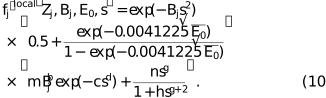
The next step is to determine the dependence of the variable parameters m, n, b, c, d, g and h in equation (10) on atomic number, Zj. Given that the dependence of fj′local(Zj, Bj, E0, s) on E0 has already been dealt with completely, the electron energy for all future analyses is set to E0 = 200 keV. The same approach as described in Fig. 2 and the surrounding text is now taken for all elements accommodated by the ATOM subroutine, resulting in a comparison between fj′B&K(Zj, 0.05 Å2 ≤ Bj ≤ 2.0 Å2, E0 = 200 keV, 0 Å−1 ≤ s ≤ 6 Å−1) and fj′local(Zj, 0.05 Å2 ≤ Bj ≤ 2.0 Å2, E0 = 200 keV, 0 Å−1 ≤ s ≤ 6 Å−1) for Zj = 1 to 98 (H to Cf). Again, as with the examination of the dependence of fj′local(Zj, Bj, E0, s) on E0, the only difference in procedure for these comparisons from that shown in Fig. 2 was that a 100 × 100 grid of pixels spanning 0.05 Å2 ≤ Bj ≤ 2.0 Å2 and 0 Å−1 ≤ s ≤ 6 Å−1 was used instead of 200 × 200 pixels as was used for Figs. 1 and 2.
For each element j, an optimal set of parameters and associated RMS misfit were returned, i.e. {mj, nj, bj, cj, dj, gj, hj,  }. An overall assessment of the ability of equation (10) to approximate fj′B&K(Zj, 0.05 Å2 ≤ Bj ≤ 2.0 Å2, E0 = 200 keV, 0 Å−1 ≤ s ≤ 6 Å−1) – in other words, the ability of equation (10) to approximate the entirety of the ATOM subroutine – can be gained by considering the mean RMS misfit,
  , averaged over all of the elements considered. With all seven parameters – m, n, b, c, d, g and h – allowed to vary, = 0.0407 ± 0.0007. This figure can be regarded as the benchmark RMS misfit with all degrees of freedom in equation (10) available. As each of the parameters – m, n, b, c, d, g and h – is replaced, the performance of equation (10) in approximating fj′B&K(Zj, Bj, E0, s) is expected to deteriorate.
The optimal parameters {mj, nj, bj, cj, dj, gj, hj} for each element are plotted as a function of Zj in Fig. 5. The parameters are grouped into each of the graphs on the basis of similar behaviours with respect to Z, and functions have been found that give the best fit to the plot of each parameter.
![[Figure 5]](pl5049fig5thm.gif) | Figure 5 Plots of the variable parameters m, n, b, c, d, g and h (shown as coloured squares with colour coding indicated on the vertical axes) versus Z after fitting equation (10 ) to fj′B&K(Zj, 0.05 Å2 ≤ Bj ≤ 2.0 Å2, E0 = 200 keV, 0 Å−1 ≤ s ≤ 6 Å−1) obtained from the ATOM subroutine. Parameters have been grouped into plots on the basis of similar behaviours with respect to Z. In every case, functions have been found that best fit the refined values of each of the parameters as a function of Z (solid lines in each of the plots) and these are written explicitly into each plot. |
Parameters m and n are fitted quite well by the function

where l = m or n, and tl and ul are refined in the fit of equation (11) to m and n versus Z. Parameters b, c and h in equation (10) have general trends in terms of Z that can be fitted with

where l = b, c or h, and the refinable fit parameters are tl, ul and vl. The result of each fit of equation (11) to m and n versus Z is written into the first graph in Fig. 5 for the red and blue sets, respectively, whilst the result of each fit of equation (12) to b, c and h versus Z is written into the second graph in Fig. 5 for the red, blue and green sets, respectively. Parameters d and g from equation (10) were fitted with constants, d = 1.83 and g = 2.00, as shown in the third graph in Fig. 5. That g is 2 is rather unsurprising because this confirms the expected even parity of the Lorentzian component in fj′local(Zj, Bj, E0, s) as a function of s.
The plots of the individual points determined by fitting equation (10) to fj′B&K(Zj, 0.05 Å2 ≤ Bj ≤ 2.0 Å2, E0 = 200 keV, 0 Å−1 ≤ s ≤ 6 Å−1) for each element j show varying degrees of oscillation in addition to the general trends fitted by equations (11) and (12) in the cases of m, n, b, c and h and constants in the cases of d and g. These oscillations are much more pronounced for b, c, h, d and g than for m and n. An additional improvement in the fits might be obtained if a sine component was incorporated into each of the fits; however, given that the periods of the oscillations seem to change with increasing Z and that the oscillations are not particularly regular in form, it was decided that the replacement functions for all seven parameters – m, n, b, c, h, d and g – should be kept as simple as possible if this does not result in a large deterioration in the fit of equation (10) to fj′B&K(Zj, 0.05 Å2 ≤ Bj ≤ 2.0 Å2, E0 = 200 keV, 0 Å−1 ≤ s ≤ 6 Å−1) averaged over all elements j.
Replacing m, n, b, c, h, d and g in equation (10) with the fitted functions detailed above results in
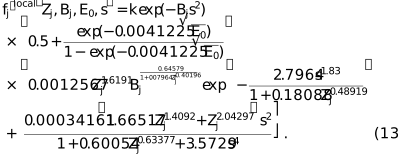
A proportionality constant, k, has been introduced as a means of fitting equation (13) to fj′B&K(Zj, 0.05 Å2 ≤ Bj ≤ 2.0 Å2, E0 = 200 keV, 0 Å−1 ≤ s ≤ 6 Å−1) for each element j in order to check how well the function above approximates the entire ATOM subroutine. Repeating the fitting process for all elements returned = 0.044 ± 0.006, which is only a very slight increase in overall mismatch compared with the performance of equation (10) where = 0.0407 ± 0.0007 with seven variable parameters. Although the value of k was expected to be constant and close to 1 for all elements, this proportionality parameter added for the sake of the fitting process was seen to vary with respect to Z. This is shown in Fig. 6. This parameter is likely to be absorbing errors incurred by the substitution of parameters m and n in equation (10) with the fitted functions whose forms are given in equation (11) because the fits (as seen in Fig. 5) were by no means perfect.
![[Figure 6]](pl5049fig6thm.gif) | Figure 6 Plots of the proportionality constants k in equation (13 ) and k′ in equation (15) (red and blue coloured squares, respectively) versus Z. The general trend in k with respect to Z is fitted by equation (14) (solid red line), yielding the values of the parameters written into the equation in the plot. In contrast, k′ is seen to oscillate about 1 (solid blue line). |
The form of the function fitted to k versus Z is

where t, u and v are fitting parameters whose final values are given in the left-most plot in Fig. 6. Substitution of this result into equation (13) returns
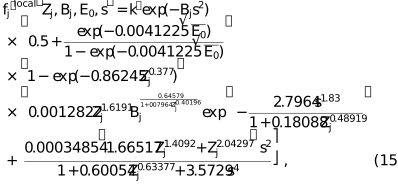
with the value of t = 1.0203 absorbed into the coefficients of the two terms in the final set of square brackets of equation (15). Again, a proportionality constant, k′, is retained to test equation (15) against fj′B&K(Zj, 0.05 Å2 ≤ Bj ≤ 2.0 Å2, E0 = 200 keV, 0 Å−1 ≤ s ≤ 6 Å−1) from the ATOM subroutine. This time, the graph of k′ versus Z simply oscillates about k′ = 1, as seen in the plot on the right in Fig. 6. As with previous parameters fitted with equations, the oscillations are not dealt with, and it is at this point that the determination of fj′local(Zj, Bj, E0, s) concludes.
3. Discussion
Revisiting equation (1) in the Introduction, substitution of equation (15) for both of the local terms gives
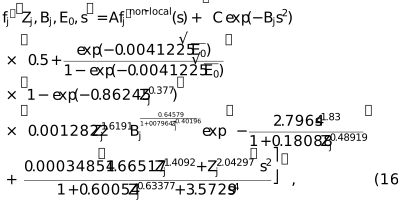
where the parameter k′ in equation (15) is replaced by parameter C = CG = CL in keeping with equation (1). At this point, the non-local component is replaced by a Dirac delta function in s:

where the multiplier of 1012 in the exponential is arbitrarily chosen just because it is a large number with respect to the range of s over which fj′(Zj, Bj, E0, s) is considered significant. The expression involves a proportionality constant, k, which can be absorbed into the parameter A in equation (16). Using a Dirac delta function for fj′non-local(s) makes the approximation that the sum of all the non-local contributions to the phenomenological absorption can be considered as adding a constant to fj′(Zj, Bj, E0, s = 0). This approximation is equivalent to saying that the non-local contributions are uniformly distributed at all distances from the atoms in real space.
Substituting equation (17) into equation (16) yields:
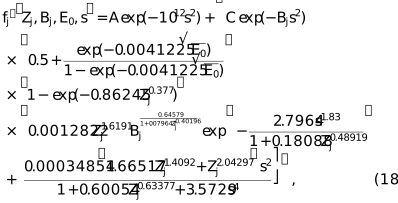
with k from equation (17) absorbed into parameter A in this equation. This represents a two-parameter model for all phenomenological absorption that can be refined by an experimental technique such as QCBED. However, if one were to apply equation (18) in its present form, the values of A and C obtained from refinements would not provide a direct indication of the relative contributions of fj′non-local(Zj, Bj, E0, s) and fj′local(Zj, Bj, E0, s). This can be seen if one considers fj′(Zj, Bj, E0, s = 0):
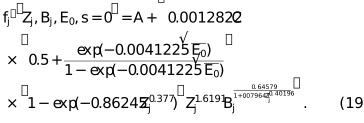
The parameter C is modified by a factor that is dependent on Zj, Bj and E0, whilst A is not. Therefore equation (18) must be factorized in a way where both A and C are modified by the same factors that are independent of s. This factorization transforms equation (18) into
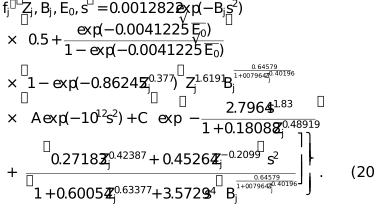
In this form, at s = 0,
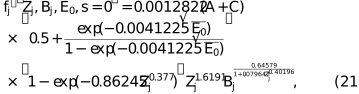
and therefore, the magnitudes of A and C obtained experimentally are directly comparable and representative of the relative magnitudes of the non-local and local contributions to phenomenological absorption, respectively.
Finally, by segmenting equation (20) into Gaussian and Lorentzian contributions as per equation (1), the following is obtained:
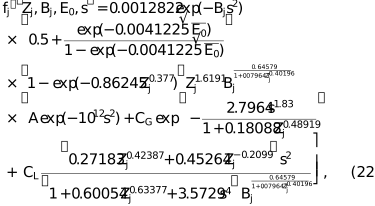
where CG and CL are variable coefficients for the Gaussian and Lorentzian contributions, respectively, as per the Introduction. Setting the coefficients to A = 0 and CG = CL = 1 returns the closest fit to the output from the ATOM subroutine by Bird & King (1990).
The central aim was to produce a function that mimics the Bird & King (1990) inelastic scattering factors (TDS only) as a starting point, but that can be adjusted via a small number of parameters to accommodate contributions from plasmon scattering to QCBED of unfiltered CBED data. Equation (22) is the outcome of this aim. The physical meaning behind each of the terms developed in the equation is purely heuristic as only a parametrized functional mimic of the ATOM subroutine was sought. This work was not motivated by improvements to computational speed because this part of QCBED is negligible in terms of computational cost compared with the determinations of diffracted intensities from the many-beam electron scattering equations.
Unfiltered CBED patterns contain a slowly varying diffuse background, which is eliminated by differential QCBED. It is precisely because of its absence from differentiated data that it is desirable to take it into account by adding the Dirac delta function, because this provides two options when it comes to normalizing the simulated differential CBED patterns to the experimental ones:
(i) setting the A coefficient in equation (22) to 0 and using equal counts or minimum misfit for normalization, or
(ii) setting the normalization factor in QCBED to a pre-measured incident intensity (measured in the absence of the specimen) and refining the relative contributions of each of the three terms in equation (22) by including A, CG and CL as refined parameters.
Considering option (ii), it is expected that the magnitude of A and its ratio to CG and CL will differ significantly from QCBED with energy filtering to unfiltered differential QCBED, and this is of interest in itself. For both options above, it is expected that CG and CL will refine to less than unity when performing unfiltered differential QCBED because of the presence of additional differential signal due to plasmon losses (Nakashima & Muddle, 2010b; Egerton, 2011). This is of particular importance if differential QCBED is to be accurate without energy-filtered data, and this is the main motivation of this paper.
While one can also refine Bj, E0 and s (the latter via of the lattice parameters) in QCBED, should one wish to refine A, CG and CL, it is better to fix Bj, E0 and s as constant inputs into equation (22) to avoid parameter correlations. Furthermore, while this work has parametrically mimicked the ATOM subroutine, which deals with isotropic Debye–Waller parameters, Bj, a more advanced approach in future would follow those of Peng (1997) or Weickenmeier & Kohl (1998) who accommodated anisotropic atomic displacement parameters.
In closing, we note that equation (22) has already been implemented successfully in a small number of QCBED studies (Liu, 2019; Tan et al., 2024) involving a multislice-based (Cowley & Moodie, 1957) QCBED algorithm. Future work aims to produce a sequel to this paper where experimental refinements of coefficients A, CG and CL will be investigated for a compound rather than elemental metals, and for both electron-optically filtered and unfiltered data in both the conventional and differential regimes of QCBED.
4. Conclusions
Using Bird and King's ATOM subroutine, the present work has empirically developed a functional approximation to the atom-localized contribution to phenomenological absorption [see equation (15)] and followed this up with an equation that approximates all contributions to absorption [see equation (22)]. This functional approximation can be used to replace the ATOM subroutine with a single line of code, but more importantly, it is written in a form where all contributions are separated such that their individual relative magnitudes could be refined using experimental data.
With recent developments that allow TEM data collected without electron-optical energy filtering to be used quantitatively in techniques like QCBED (Nakashima, 2007; Nakashima & Muddle, 2010b; Nakashima et al., 2011; Nakashima, 2012; Nakashima, 2017; Peng & Nakashima, 2017; Peng & Nakashima, 2019; Nakashima, 2019; Peng & Nakashima, 2021; Tan et al., 2024), the availability of a fully flexible phenomenological absorption model where different contributions can be refined as independent components becomes important. Incorporating equation (22) into the calculations of scattered intensities reduces the number of assumptions about what can and cannot be absorbed into the calculated versus experimental intensity normalization process (Nakashima & Muddle, 2010b). Furthermore, by refining only CG and CL in dealing with absorption (usually A is set to 0 since it is eliminated by the standard normalization process), the number of refined parameters in a QCBED analysis is reduced compared with previous standard practice. The norm in QCBED has been to refine three to six structure factors per pattern, together with their corresponding absorption factors (Nakashima, 2017). The new approach replaces the refinement of three to six individual absorption factors with the refinement of just CG and CL. This not only reduces the number of refined parameters but is also more canonical since refining CG and CL in equation (22) adjusts all absorption factors in the scattering equations, not just individual ones.
The application of the presently determined phenomenological absorption function in differential QCBED without energy filtering removes errors incurred by using the Bird and King ATOM subroutine alone because the normalization process no longer needs to compensate for the unaccounted components (plasmon-loss electrons). Furthermore, as was pointed out in the example of aluminium, the ATOM subroutine often returns negative values for the absorption factor at intermediate values of s = sin(θ)/λ. This is not the case for the present function as its form prohibits negative values of fj′(Zj, Bj, E0, s).
So far, equation (22) has been applied to QCBED studies in elemental metals (Liu, 2019; Tan et al., 2024). A sequel to the present paper is planned where experimental QCBED refinements of coefficients A, CG and CL in equation (22) will be investigated for a compound, and for both electron-optically filtered and unfiltered data in both the conventional and differential regimes of QCBED.
Acknowledgements
Open access publishing facilitated by Monash University, as part of the Wiley–Monash University agreement via the Council of Australian University Librarians.
Funding information
TL thanks Monash University's Faculty of Engineering, Department of Materials Science and Engineering, and Monash Centre for for funding his PhD candidature and scholarships. We acknowledge funding from the Australian Research Council through grants DP210100308 and FT110100427.
References
 Allen, L. J., D'Alfonso, A. J. & Findlay, S. D. (2015). Ultramicroscopy 151, 11–22. Web of Science CrossRef CAS PubMed Google Scholar
Allen, L. J., Faulkner, H. M. L., Oxley, M. & Paganin, D. (2001). Ultramicroscopy 88, 85–97. Web of Science CrossRef PubMed CAS Google Scholar
Allen, L. J. & Rossouw, C. J. (1990). Phys. Rev. B 42, 11644–11654. CrossRef CAS Web of Science Google Scholar
Anstis, G. R. (1996). Acta Cryst. A52, 450–455. CrossRef CAS Web of Science IUCr Journals Google Scholar
Bird, D. M. & King, Q. A. (1990). Acta Cryst. A46, 202–208. CrossRef CAS Web of Science IUCr Journals Google Scholar
Bird, D. M. & Saunders, M. (1992). Acta Cryst. A48, 555–562. CrossRef Web of Science IUCr Journals Google Scholar
Brown, P. J., Fox, A. G., Maslen, E. N., O'Keefe, M. A. & Willis, B. T. M. (2006). Intensity of diffracted intensities, in International tables for crystallography, Vol. C, Mathematical, physical and chemical tables, 1st online ed., ch. 6.1, https://doi.org/10.1107/97809553602060000600. International Union of Crystallography. Google Scholar
Buxton, B. F. & Loveluck, J. E. (1977). J. Phys. C Solid State Phys. 10, 3941–3958. CrossRef CAS Web of Science Google Scholar
Colliex, C., Cowley, J. M., Dudarev, S. L., Fink, M., Gjønnes, J., Hilderbrandt, R., Howie, A., Lynch, D. F., Peng, L. M., Ren, G., Ross, A. W., Smith, V. H., Spence, J. C. H., Steeds, J. W., Wang, J., Whelan, M. J. & Zvyagin, B. B. (2006). Electron diffraction, in International tables for crystallography, Vol. C, Mathematical, physical and chemical tables, 1st online ed., ch. 4.3, pp. 259–429, https://doi.org/10.1107/97809553602060000593. International Union of Crystallography. Google Scholar
Cosgriff, E. C. & Nellist, P. D. (2007). Ultramicroscopy 107, 626–634. Web of Science CrossRef PubMed CAS Google Scholar
Cowley, J. M. & Moodie, A. F. (1957). Acta Cryst. 10, 609–619. CrossRef IUCr Journals Web of Science Google Scholar
Deininger, C., Necker, G. & Mayer, J. (1994). Ultramicroscopy 54, 15–30. CrossRef CAS Web of Science Google Scholar
Dwyer, C. (2014). Phys. Rev. B 89, 054103. Web of Science CrossRef Google Scholar
Egerton, R. F. (2011). Electron energy-loss spectroscopy in the electron microscope, 3rd ed. Springer. Google Scholar
Egoavil, R., Gauquelin, N., Martinez, G. T., Van Aert, S., Van Tendeloo, G. & Verbeeck, J. (2014). Ultramicroscopy 147, 1–7. Web of Science CrossRef CAS PubMed Google Scholar
Fox, A. G., O'Keefe, M. A. & Tabbernor, M. A. (1989). Acta Cryst. A45, 786–793. CrossRef CAS Web of Science IUCr Journals Google Scholar
Friis, J., Jiang, B., Spence, J., Marthinsen, K. & Holmestad, R. (2004). Acta Cryst. A60, 402–408. Web of Science CrossRef IUCr Journals Google Scholar
Gajdardziska-Josifovska, M., McCartney, M. R., de Ruijter, W. J., Smith, D. J., Weiss, J. K. & Zuo, J. M. (1993). Ultramicroscopy 50, 285–299. CAS Google Scholar
Hall, C. R. & Hirsch, P. B. (1965). Proc. R. Soc. London Ser. A 286, 158–177. CAS Google Scholar
Hashimoto, H., Howie, A. & Whelan, M. J. (1962). Proc. R. Soc. London Ser. A 269, 80–103. CAS Google Scholar
Holmestad, R., Birkeland, C. R., Marthinsen, K., Høier, R. & Zuo, J. M. (1999). Microsc. Res. Tech. 46, 130–145. CrossRef PubMed CAS Google Scholar
Hosokawa, F., Shinkawa, T., Arai, Y. & Sannomiya, T. (2015). Ultramicroscopy 158, 56–64. Web of Science CrossRef CAS PubMed Google Scholar
Humphreys, C. J. & Hirsch, P. B. (1968). Philos. Mag. A J. Theor. Exp. Appl. Phys. 18, 115–122. CAS Google Scholar
Ichimiya, A. (1985). Jpn. J. Appl. Phys. 24, 1579–1580. CrossRef CAS Web of Science Google Scholar
Ichimiya, A. & Lehmpfuhl, G. (1988). Acta Cryst. A44, 806–809. CrossRef CAS Web of Science IUCr Journals Google Scholar
Ishida, K., Johnson, A. W. S. & Lehmpfuhl, G. (1975). Z. Naturforsch. A 30, 1715–1729. CrossRef Google Scholar
Ishizuka, K. (2002). Ultramicroscopy 90, 71–83. Web of Science CrossRef CAS Google Scholar
Jansen, J., Tang, D., Zandbergen, H. W. & Schenk, H. (1998). Acta Cryst. A54, 91–101. Web of Science CrossRef ICSD CAS IUCr Journals Google Scholar
Liu, T. (2019). PhD thesis, Monash University, Australia. Google Scholar
Midgley, P. A. & Saunders, M. (1996). Contemp. Phys. 37, 441–456. CrossRef CAS Web of Science Google Scholar
Nakashima, P. N. H. (2007). Phys. Rev. Lett. 99, 125506. Web of Science CrossRef PubMed Google Scholar
Nakashima, P. N. H. (2012). Opt. Lett. 37, 1023–1025. Web of Science CrossRef PubMed Google Scholar
Nakashima, P. N. H. (2017). Struct. Chem. 28, 1319–1332. Web of Science CrossRef CAS Google Scholar
Nakashima, P. N. H. (2019). Encyclopedia of aluminum and its alloys, Vol. 1, pp. 488–586. Boca Raton: CRC Press. Google Scholar
Nakashima, P. N. H. & Muddle, B. C. (2010a). J. Appl. Cryst. 43, 280–284. Web of Science CrossRef CAS IUCr Journals Google Scholar
Nakashima, P. N. H. & Muddle, B. C. (2010b). Phys. Rev. B 81, 115135. Web of Science CrossRef Google Scholar
Nakashima, P. N. H., Smith, A. E., Etheridge, J. & Muddle, B. C. (2011). Science 331, 1583–1586. Web of Science CrossRef CAS PubMed Google Scholar
Neish, M. J., Lugg, N. R., Findlay, S. D., Haruta, M., Kimoto, K. & Allen, L. J. (2013). Phys. Rev. B 88, 115120. Web of Science CrossRef Google Scholar
Palatinus, L., Petříček, V. & Corrêa, C. A. (2015). Acta Cryst. A71, 235–244. Web of Science CrossRef IUCr Journals Google Scholar
Peng, D. & Nakashima, P. N. H. (2017). J. Appl. Cryst. 50, 602–611. Web of Science CrossRef CAS IUCr Journals Google Scholar
Peng, D. & Nakashima, P. N. H. (2019). Acta Cryst. A75, 489–500. Web of Science CrossRef IUCr Journals Google Scholar
Peng, D. & Nakashima, P. N. H. (2021). Phys. Rev. Lett. 126, 176402. Web of Science CrossRef PubMed Google Scholar
Peng, L.-M. (1997). Acta Cryst. A53, 663–672. CrossRef CAS Web of Science IUCr Journals Google Scholar
Peng, L. M., Dudarev, S. L. & Whelan, M. J. (1998). Phys. Rev. B 57, 7259–7265. Web of Science CrossRef CAS Google Scholar
Peng, L.-M., Ren, G., Dudarev, S. L. & Whelan, M. J. (1996). Acta Cryst. A52, 257–276. CrossRef CAS Web of Science IUCr Journals Google Scholar
Peng, L. M. & Whelan, M. J. (1992). Surf. Sci. 268, L325–L329. CrossRef CAS Web of Science Google Scholar
Pennington, R. S., Coll, C., Estradé, S., Peiró, F. & Koch, C. T. (2018). Phys. Rev. B 97, 024112. Web of Science CrossRef Google Scholar
Pennycook, S. J. & Jesson, D. E. (1992). Acta Metall. Mater. 40, S149–S159. CrossRef CAS Web of Science Google Scholar
Radi, G. (1970). Acta Cryst. A26, 41–56. CrossRef IUCr Journals Web of Science Google Scholar
Rossouw, C. J. & Miller, P. R. (1993). Philos. Mag. B 67, 733–745. CrossRef CAS Web of Science Google Scholar
Rossouw, C. J., Miller, P. R., Drennan, J. & Allen, L. J. (1990). Ultramicroscopy 34, 149–163. CrossRef Web of Science Google Scholar
Sang, X. H., Kulovits, A. & Wiezorek, J. M. K. (2010). Acta Cryst. A66, 685–693. Web of Science CrossRef IUCr Journals Google Scholar
Saunders, M., Fox, A. G. & Midgley, P. A. (1999a). Acta Cryst. A55, 471–479. Web of Science CrossRef CAS IUCr Journals Google Scholar
Saunders, M., Fox, A. G. & Midgley, P. A. (1999b). Acta Cryst. A55, 480–488. Web of Science CrossRef CAS IUCr Journals Google Scholar
Shao, Y.-T. & Zuo, J.-M. (2017). Acta Cryst. B73, 708–714. Web of Science CrossRef IUCr Journals Google Scholar
Streltsov, V. A., Nakashima, P. N. H. & Johnson, A. W. S. (2003). Microsc. Microanal. 9, 419–427. Web of Science CrossRef PubMed CAS Google Scholar
Tabira, Y., Withers, R. L., Minervini, L. & Grimes, R. W. (2000). J. Solid State Chem. 153, 16–25. Web of Science CrossRef CAS Google Scholar
Tan, X., Bourgeois, L. & Nakashima, P. N. H. (2024). J. Appl. Cryst. 57, 351–357. Web of Science CrossRef CAS IUCr Journals Google Scholar
Thomas, M., Cleverley, A. & Beanland, R. (2024). Acta Cryst. A80, 146–150. Web of Science CrossRef IUCr Journals Google Scholar
Tsuda, K., Mitsuishi, H., Terauchi, M. & Kawamura, K. (2007). J. Electron Microsc. 56, 57–61. Web of Science CrossRef CAS Google Scholar
Tsuda, K. & Tanaka, M. (1999). Acta Cryst. A55, 939–954. Web of Science CrossRef CAS IUCr Journals Google Scholar
Twesten, R. D., Gibson, J. M. & Hellman, O. C. (1997). Surf. Rev. Lett. 4, 245–269. CrossRef CAS Web of Science Google Scholar
Weickenmeier, A. & Kohl, H. (1991). Acta Cryst. A47, 590–597. CrossRef CAS Web of Science IUCr Journals Google Scholar
Weickenmeier, A. L. & Kohl, H. (1998). Acta Cryst. A54, 283–289. Web of Science CrossRef CAS IUCr Journals Google Scholar
Zuo, J. M. (1993). Acta Cryst. A49, 429–435. CrossRef CAS Web of Science IUCr Journals Google Scholar
Zuo, J. M. (2004). Rep. Prog. Phys. 67, 2053–2103. Web of Science CrossRef CAS Google Scholar
Zuo, J. M. & Spence, J. C. H. (1993). Philos. Mag. A 68, 1055–1078. CrossRef CAS Web of Science Google Scholar
This is an open-access article distributed under the terms of the Creative Commons Attribution (CC-BY) Licence, which permits unrestricted use, distribution, and reproduction in any medium, provided the original authors and source are cited.
| JOURNAL OF APPLIED CRYSTALLOGRAPHY |
access


