

 menu
|
|
Figure 4
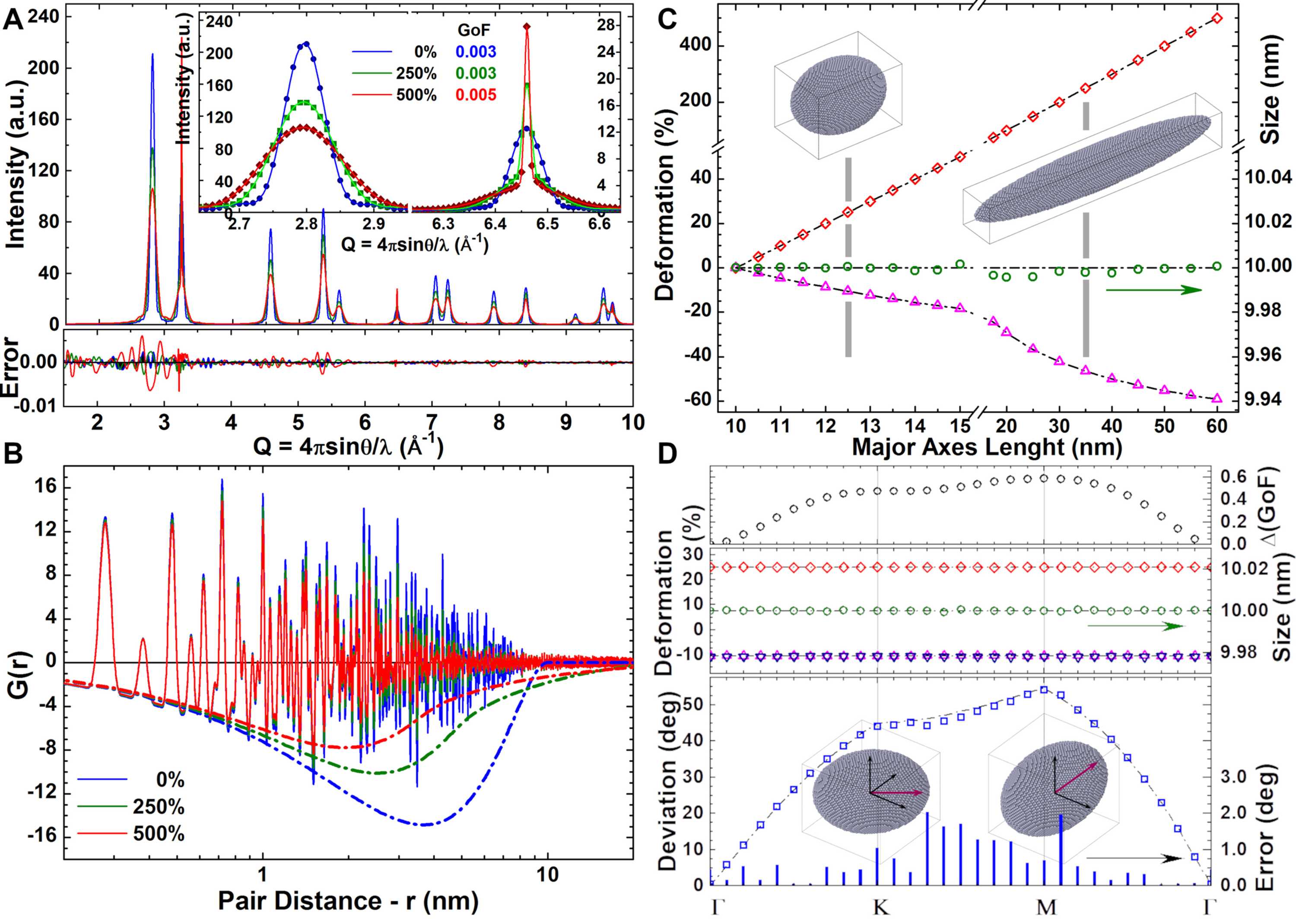
Shape deformation: deformation states (A–C)  and (D)  . Modelling of powder-scattering data from powders of f.c.c. Pd ellipsoidal nanocrystals with constant volume (unit cell 0.389070 nm, crystal volume ∼524 nm3). (A) Comparison between DSE simulation (dots) and WPDFM modelling (lines), and (B) reduced pair distribution function (continuous lines) and small-angle shape function corrections (dot–dashed lines) for the ellipsoids elongated along [100] by 0%, 250% and 500%. (C) Ellipsoid axes and corresponding deformation obtained via WPDFM modelling of the profiles (symbols) are compared with expected values (black lines). (D) Difference in goodness of fit between refinements performed with optimized crystal shape–lattice relative orientation and with the ellipsoid principal axis constrained along [100] (top), together with the refined crystal size and longitudinal and transverse deformation parameters (middle), and the deviation of the elongation axis from the [100] direction (bottom). Parameters estimated via global optimization of the agreement between Debye-simulated and WPDFM-modelled profiles (symbols) are compared with the nominal values (black lines) for crystals whose principal axis follows the geodesic orientation path  on the unit sphere, connecting the high-symmetry crystallographic directions  ,  and  . |
 | JOURNAL OF APPLIED CRYSTALLOGRAPHY |
ISSN: 1600-5767
 access