


 journal menu


- 1. Introduction: motivations for a new continuous asymmetry of crystals
- 2. Generically complete and continuous isometry invariants of crystals
- 3. A continuous invariant-based asymmetry (CIA) of periodic crystals
- 4. Fast detection of asymmetric crystals in large simulated CSP datasets
- 5. Continuous asymmetries of all experimental crystals in the CSD
- References


- 1. Introduction: motivations for a new continuous asymmetry of crystals
- 2. Generically complete and continuous isometry invariants of crystals
- 3. A continuous invariant-based asymmetry (CIA) of periodic crystals
- 4. Fast detection of asymmetric crystals in large simulated CSP datasets
- 5. Continuous asymmetries of all experimental crystals in the CSD
- References
research papers
 access
Continuous invariant-based asymmetries of periodic crystals quantify deviations from higher symmetry

aComputer Science Department, University of Liverpool, Liverpool L69 3BX, United Kingdom, bMaterials Innovation Factory, University of Liverpool, Liverpool L7 3NY, United Kingdom, cNational Institute for Theory and Mathematics in Biology, Chicago, USA, and dSchool of Chemistry and Chemical Engineering, University of Southampton, Southampton SO17 1NX, United Kingdom
*Correspondence e-mail: [email protected]
Ideal symmetry is known to break down under almost any noise. One measure of asymmetry in a periodic crystal is the relative multiplicity Z′ of geometrically non-equivalent units. However, Z′ discontinuously changes under almost any displacement of atoms, which can arbitrarily scale up a primitive cell. This discontinuity was recently resolved by a hierarchy of invariant descriptors that continuously change under all small perturbations. We introduce a Continuous Invariant-based Asymmetry (CIA) to quantify (in physically meaningful ångstroms) the deviation of a periodic crystal from a higher-symmetry form. Our experiments on several crystal structure prediction datasets show that about a half of simulated crystals have high values of CIA, while all experimental structures in these datasets have CIA = 0. On another hand, many crystals with high values of Z′ in the Cambridge Structural Database (CSD) turned out to be close to more symmetric forms with Z′ ≤ 1 due to low values of CIAs.
Keywords: nanocrystals; molecular crystals; structure prediction; nanostructure.
1. Introduction: motivations for a new continuous asymmetry of crystals
Many periodic crystals are highly symmetric, because a globally stable structure is usually formed by a few energetically favourable interactions, bonds, molecules or formula units, that are repeated in  by symmetries (Lax, 2001
 ). Though we were motivated by molecular crystals, our invariant-based approach to asymmetry extends to all non-molecular crystals and periodic sets in any Euclidean space
  .
.
While molecular crystals can contain many molecules in primitive unit cells, they are often obtained from a smaller number of molecules by symmetry operations that are isometries (distance-preserving transformations) of preserving the whole crystal (Chapuis, 2024). For a non-molecular crystal, the chemical analogue of a molecule is a formula unit that is an electronically neutral group of atoms or ions, embedded in and representing their relative numbers in a given compound, reduced to the smallest integer numbers. For example, table salt has the NaCl with a formula unit consisting of two ions, Na+ and Cl−. This pair of ions can be chosen in many geometrically different ways, because ionic bonds in NaCl do not define a finite bounded object, such as a molecule. Formula units of non-molecular crystals should be single ions, or metal blocks and organic linkers in a metal–organic framework.
In this paper, a crystal S means a periodic crystal, while Z can be non-integer for disordered or aperiodic crystals (Senechal, 1996). The multiplicity Z(S) usually denotes the number of formula units in a primitive unit cell U of S. If S consists of chemically equivalent molecules, the relative multiplicity Z′ (Z prime) often denotes the number of symmetry-independent molecules that can not be matched by symmetries of S (Steed & Steed, 2015). An asymmetric unit of S is a minimal and simply connected subset  , whose images under all symmetry operations of S tile the space . For co-crystals with chemically different molecules, van Eijck & Kroon (2000) used another notation, Z′′, for the total number of molecules in an asymmetric unit. To cover non-molecular crystals, we define the relative multiplicity Z′(S) below for any periodic point set
  with a motif M split into geometric blocks.
Definition 1 (a periodic point set S and its relative multiplicity Z′)
Any linear basis  of defines the lattice
  and the primitive unit cell
  . For a finite set of points
  (called a motif), a periodic point set is
  . Let an asymmetric unit A of S overlap with geometric blocks F1, …, Fg, which in the case of a periodic crystal S are formula units, such as full molecules, atoms or ions. For i = 1, …, g, let Fi have ki symmetry operations (including the identity) that preserve both S and Fi. Then the relative multiplicity is defined as
  , see Fig. 1.
![[Figure 1]](gq5020fig1thm.gif) | Figure 1 An asymmetric unit A in orange can be a half of a U in yellow. Almost any noise can arbitrarily scale up a U and discontinuously changes the relative multiplicity Z′ of a crystal, where molecules are represented by Y graphs whose terminal vertices have initial positions shown by red circles. |
□
The most general option for any periodic point set is to split the finite subset S ∩ A of size (say) g into individual points B1, …, Bg. For molecular crystals  , geometric blocks B1, …, Bg will be connected parts of molecules, as specified in a (CIF). For example, if S is a crystal of benzene molecules C6H6, then one block Bi can be a half-molecule, C3H3, or one sixth, CH.
Blocks Bi, Bj of any are (isometrically) equivalent if there is an of that maps S to S, and Bi to Bj. If all molecules of a crystal are equivalent, then an A of S overlaps with one molecule F. In this case,  , where k is the number of symmetry operations preserving both S and F.
The periodic point set  in Fig. 1 (middle) has one full geometric block Y in a U, which is preserved together with Sm by k = 2 symmetries, including the reflection across the vertical line that splits U into an A and its mirror image, so
  . The table salt crystal NaCl has one ion (Na+ or Cl−) in its asymmetric unit with point group of order 48, so
  .
.
In about 90% of entries in the Cambridge Structural Database (CSD), an asymmetric unit includes only one molecule, so Z′ ≤ 1 (Anderson et al., 2006). However, the CSD has many crystals with high Z′ (Brock, 2016), e.g. OGUROZ has Z′ = 56.
Crystal structure prediction (CSP) often starts with simulating Z′ = 1 crystals for the most frequent space groups, but a final energy relaxation can produce structures with Z′ values up to 36 (Pulido et al., 2017). More importantly, almost any displacement of atoms or a whole rigid molecule discontinuously changes the size of a primitive (or reduced) cell and hence arbitrarily scales up Z′. Fig. 1 shows nearly identical structures with  and similarly applies to any periodic crystal.
Ignoring any noise up to a small threshold ɛ only shifts the problem from 0 to another number without guarantees of a continuous change. This sorites paradox (when a heap of sand stops being a heap while grains are removed one by one) has been known since ancient times (Wikipedia, 2024). Its rigorous solution requires an invariant that is preserved by any rigid transformation and continuously changes under perturbations of atoms.
While a full hierarchy of invariants for periodic crystals from the computationally fastest to complete is being finalized (Anosova & Kurlin, 2025; Widdowson & Kurlin, 2025b), our continuous asymmetry will be based on the Pointwise Distance Distribution (PDD), which distinguishes all non-duplicate crystals in the world's largest databases within two hours on a modest desktop computer (Widdowson & Kurlin, 2022).
2. Generically complete and continuous isometry invariants of crystals
This section recalls invariants, which will be used to define a continuous invariant-based asymmetry in Section 3. Definition 1 introducing a periodic crystal S in terms of a basis and a motif is widely used for representing crystals in Crystallographic Information Files (CIFs), but is highly ambiguous in the sense that infinitely many pairs (basis, motif) represent the same crystal S. This ambiguity motivated us to distinguish between a crystal S and its structure, defined as the equivalence class of all periodic sets of atoms that are represented by different CIFs but can be exactly matched with each other by rigid motion, see Definition 6 in Anosova et al. (2024).
Any canonical (standard or conventional) choice of a cell for a periodic crystal is discontinuous under almost any noise, as in Fig. 1, which was experimentally demonstrated already in 1965 (see p. 80 in Lawton & Jacobson, 1965). The new definition of a crystal structure as a rigid class (consisting of all crystals that can be exactly matched under rigid motion) has become practical due to the hierarchy of invariants that uniquely identify any independent of its initial representation.
Definition 2 introduces the invariant PDD for any periodic set of points in , which can be all atomic centres of a crystal in , or other points defined by a crystal, for example, atoms of one specific type, or molecular centres, which form a periodic set.
Definition 2 (Pointwise Distance Distribution PDD)
Let be a periodic point set with a motif M = {p1, p2, …, pm}. Fix an integer k ≥ 1. For every pi ∈ M, let  be the distances from pi to its k nearest neighbours within the full set S, not restricted to any cell. The matrix D(S; k) has m rows consisting of the distances d1(pi), …, dk(pi) for i = 1, …, m. If any l ≥ 1 rows are identical to each other, we collapse them into a single row and assign the weight l/m to this row. The resulting matrix of k columns and at most m rows, complemented by an extra (say 0th) column listing the weights, is the Pointwise Distance Distribution PDD(S; k).
□
The columns of the matrix PDD(S; k) are ordered because each row consists of increasing values of distances to neighbours but without their indices. So PDD(S; k) importantly differs from the matrix of pairwise distances between m points in the motif M, also because neighbours are not restricted to any (extended) cell of S.
Since many crystals consist of indistinguishable atoms, we consider all points of S unordered. Then PDD(S; k) has unordered rows and can be interpreted as a discrete distribution of rows (or unordered points in  ) with probabilities equal to the weights assigned to rows. The Pair Distribution Function is obtained from a single collection of all interatomic distances (usually normalized by frequencies and then smoothed) and hence is naturally weaker than PDD(S; k), which splits distances per point and avoids losing information under smoothing, see the discussion at the end of Section 3 in Widdowson & Kurlin (2022). This probabilistic interpretation allows one to compare PDDs by many distance metrics on discrete distributions. We usually use the simplest metric called Earth Mover's Distance (EMD), which was adapted for comparing chemical compositions (Hargreaves et al., 2020). Theorem 4.2 in Widdowson & Kurlin (2026) proved that PDD(S; k) continuously changes in EMD under perturbations, including those that arbitrarily scale up a minimal cell as in Fig. 1.
The most important strength of the PDD is its generic completeness: Theorem 5.8 in Widdowson & Kurlin (2026) proved that PDD(S; k) with a lattice of S and the number m of points in a motif of S suffice to reconstruct any generic periodic point set , uniquely under isometry, for a large enough k with an explicit upper bound. In other words, PDD(S; k) with a few extra invariants provably distinguishes all crystals, possibly except singular examples that form a subspace of measure 0 within the continuous space of all periodic crystals. In practice, PDD(S; k) distinguished all non-duplicate crystals in the world's major databases within two hours on a modest desktop computer, see Table 3 in Widdowson & Kurlin (2026). Theorem 3.7 in Widdowson & Kurlin (2026) proved that, as k → +∞, the distances in each row of PDD(S; k) asymptotically approach  , where the Point Packing Coefficient PPC(S) is inversely proportional to the point density, as defined below. This fact motivated us to subtract this asymptotic curve from PDD(S; k) to neutralize the influence of density.
Definition 3 (invariants PPC(S) and PDA(S; k))
Let be a periodic set with m points in a U of S. The Point Packing Coefficient is  , where vol(U) is the volume of U, and Vn is the volume of the unit ball in . The Pointwise Deviation from Asymptotic is the matrix PDA(S; k) obtained from PDD(S; k) by subtracting
  from each distance in columns j = 1, …, k.
□
Another advantage of PDA(S; k) versus the original PDD(S; k) is the experimental convergence to 0 of the kth values from the last column of PDA(S; k) as k → +∞, see Fig. 4 in Widdowson & Kurlin (2025a). This convergence to 0 was formally proved for any cubic lattice  with n ≥ 2, see Example SM3.1 in Widdowson & Kurlin (2026).
Hence, there is no need to substantially increase the number k of neighbours, because more distant neighbours bring smaller contributions. We consider k not as a parameter that seriously affects PDA(S; k), but as a degree of approximation like the number of decimal places on a calculator. Column averages of PDA(S; k) for k = 100 suffice to distinguish all non-duplicate crystals in the CSD (Widdowson & Kurlin, 2024) and can be used as analytic coordinates on geographic-style maps of any materials database, first done for 2D lattices in Bright et al. (2023b), Bright et al. (2023a) and Kurlin (2024).
3. A continuous invariant-based asymmetry (CIA) of periodic crystals
The discontinuity of Z′ from Definition 1 under almost any perturbation has been known for over 30 years. The quote `two fairly unsymmetrical objects can be combined into a less unsymmetrical structural dimer' from Wilson (1993) means that a crystal with Z′ = 2 can be geometrically close to a more symmetric crystal with Z′ = 1.
This section first defines the Earth Mover's Distance (EMD) between geometric blocks within a periodic point set by using the invariant PDA(S; k) from Definition 3. The continuous invariant-based asymmetry of S will be defined through EMDs between all blocks in an of S. The EMD needs a ground metric between vectors  and
and  in , which can be rows of PDA(S; k). The simplest choices are the Chebyshev metric
  and the Root Mean Square (RMS)
  .
.
These ground metrics respect the continuity under perturbations as follows. If any bi, ci are perturbed up to ɛ, then |bi − ci| ≤ 2ɛ for i = 1, …, k, and both  ,
,  . We usually write d without a subscript for brevity. If d∞ is used in computations, all relevant distances and asymmetry will have the subscript ∞.
For any periodic set in , Definition 4 introduces a distance between geometric blocks B, C (considered as finite sets of points), which can represent molecules, ions or other well defined disjoint subsets for crystals in . This distance measures how the positions of B, C differ within a common periodic set S containing both B, C. If B, C can be exactly matched by of preserving S, then this distance is 0. In real examples, any deviation from symmetry should be positive due to noise.
Though the EMD makes sense for distributions of different sizes, our experiments on real crystals will use the EMD only for geometric blocks that are chemically identical. In general, we assume that every point in a periodic set has a categorical label, which is an analogue of an atomic type, such as Na+ and Cl−.
Briefly, the EMD optimally splits and transports objects from one distribution to another by minimizing the overall cost based on a ground distance between objects. If we need to guarantee matching of points only with the same label (atomic types in a crystal), the ground distance can be adjusted by taking the maximum of d∞ or d = RMS with a discrete metric that is infinite between points of different labels.
Definition 4 (Earth Mover's Distance EMD between geometric blocks)
Let be a periodic set of labelled points with an A. Let  be geometric blocks (finite sets) that have m(B), m(C) points of weights 1/m(B),1/m(C), respectively. For a fixed k ≥ 1, i = 1, …, m(B), and j = 1, …, m(C), let Ri(B), Rj(C) be the rows of ith and jth points of B, C, respectively, in the matrix PDA(S; k) from Definition 3. The Earth Mover's Distance is
  =
=  , where the minimum is over all variable parameters fij ∈ [0, 1] subject to the conditions
  for any fixed index i = 1, …, m(B), and
  for any fixed index j = 1, …, m(C).
□
The distance EMD(B, C) measures the minimum perturbation of the rows of the geometric blocks B, C in PDA(S; k) to match (distance-based invariants of) B and C within the ambient periodic set S. This perturbation matching B and C reduces the number of isometrically non-equivalent blocks and hence makes S more symmetric.
If an A of S has only one geometric block B, then S has no asymmetry because all blocks in S are images of B under symmetry operations of S. If A has only two blocks B and C, then EMD(B, C) can be considered an asymmetry of S. Definition 5 introduces the continuous asymmetry in the most general case.
Definition 5 (Continuous Invariant-based Asymmetry CIA(S))
Let a periodic set with labelled points have an A consisting of geometric blocks B1, …, Bg. We represent each block Bi by an unordered distribution of rows of adjusted distances in PDA(S; k) from Definition 3 for all p ∈ Bi. Then EMD(Bi, Bj) denotes the Earth Mover's Distance between these distributions in Definition 4. For any fixed i = 1, …, g, set  . The Continuous Invariant-based Asymmetry is
  . The average version is
  .
.
□
Lemma 7 will prove that CIA(S) is independent of an asymmetric unit of S.
Example 6 (CIAs of periodic sequences in  )
)
The periodic sequence  of integers has the motif
  in the U = [0, 1), which coincides with an A. The only 1-point block
  is preserved together with by two symmetry operations (identity and p → −p), so
  . For k = 4, the point 0 ∈ M has four neighbours ± 1, ± 2 in at distances 1, 1, 2, 2, respectively. In Definition 2,
  is the single row (1; 1, 1, 2, 2), where the first (0th) entry is weight 1 of 0 ∈ M. In Definition 3, we have V1 = 2, m = 1, vol(U) = 1, so
  . Then
  is the single row
  . Since has an of one point (block),
  by Definition 5.
For any small ɛ > 0, consider the perturbed periodic sequence  with the larger motif Mɛ = {0, 1, 2 + ɛ, 3 + ɛ} and primitive cell U′ = [0, 4). Each point p ∈ Mɛ has only one (identity) that preserves both p and
  , so
, so  is very different from . Since the size |Mɛ| equals vol(U′) = 4, we get
  . The four points p ∈ Mɛ have distances to four nearest neighbours in listed below for k = 4 in the PDD rows:
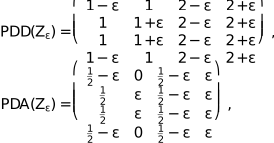
where we skipped the first (0th) column containing equal weights  of points. The coincidences of rows 1,4 and rows 2,3 is explained by the symmetry
  of . If all four points pi ∈ Mɛ are considered as individual blocks, they are represented by the corresponding rows in
  . The Earth Mover's Distances EMD(pi, pj) for i ≠ j coincide with the
  between these points (PDD rows). Then
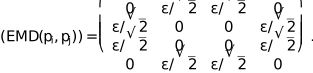
By Definition 5, for any i = 1, 2, 3, 4, we get di =  . Hence
  and
and  . If instead of
  , we use the Chebyshev metric L∞ = ɛ between non-equal PDD rows, we similarly get
  .
.
For , if we choose an asymmetric unit  of length 2, which contains only points p1 = 0 and p2 = 1, we get the same CIAs by using distance
  or EMD∞(p1, p2) = ɛ instead of the 4 × 4 matrix of EMD(pi, pj) above.
If we consider pairs B1 = {0, 1} and B2 = {2 + ɛ, 3 + ɛ} within Mɛ as geometric blocks, the A contains only B1. This splitting into blocks gives  , because B2 is obtained from B1 by the symmetry
  . Hence has a higher symmetry at this block level than at the point level.
□
In general, the g × g matrix of distances (EMD(Bi, Bj)) describes the relative positions of g blocks within an of S in terms of their distances to atomic neighbours within the full S. For i = 1, …, g, the distance di measures how far Bi is from all other blocks. The standard (min-max) formula of CIA(S) means that the optimal ith block Bi serves as a centre minimizing its distance EMD(Bi, Bj) to the farthest block Bj, while  averages maximum deviations di from all blocks considered as centres. The default notation CIA(S) uses EMD based on the ground distance d = RMS between rows of PDA(S; k) with k = 100. For the Chebyshev distance d∞, we keep the subscript ∞ in the notations EMD∞, CIA∞ and
  .
.
For all versions of CIA(S), the zero value implies that all geometric blocks are isometrically equivalent (transitive under the action of the symmetry group of S), i.e. any blocks Bi, Bj can be exactly matched by an of that maps S to itself.
Lemma 7 (invariance of CIAs)
All CIAs in Definition 5 are invariant under and independent of an A of any periodic point set .
□
Lemma 7 and all further results below are proved in Appendix B.
Lemma 8 (inequalities for CIAs)
In the notations of Definition 5, CIA ≤ CIA∞,  and
and  hold for any periodic point set .
□
Since Definition 5 is based on the invariant PDA(S; k), the full notation should be CIA(PDA(S; k)), where PDA(S; k) can be replaced with another `pointwise' invariant, such as the higher-order PDA(h) (Widdowson & Kurlin, 2025b) or complete isoset (Anosova et al., 2026). In this paper, we use only PDA(S; 100) and write CIA(S) for brevity. Theorem 9 justifies the continuity of the asymmetry CIA(S) under small perturbations of points, including those that arbitrarily scale up a primitive cell of S.
Theorem 9 (continuity of CIA under perturbations)
Let be a periodic point set and r(S) denote the minimum half-distance between any points of S. For any 0 < ɛ < r(S), let a periodic point set  be obtained by perturbing every point of S up to Euclidean distance ɛ. Then all versions of CIAs in Definition 5 based on the invariant PDA(S; k) for any k ≥ 1 satisfy |CIA(S) − CIA(Q)| ≤ 4ɛ.
□
For a periodic point set with a motif of m points, the invariant PDD(S; k) based on k atomic neighbours can be computed in asymptotic time  , which is near-linear in both m, k, see details in Theorem 3.10 in Widdowson & Kurlin (2026). Theorem 10 estimates extra time for computing CIAs in Definition 5.
Theorem 10 (computational complexity of CIA)
Let a periodic point set have an A of g blocks B1, …, Bg, each consisting of at most m points, respectively. Starting with PDD(S; k), all versions of CIAs can be computed in time  . If A consists of m single-point blocks, then the time is O(m3).
□
The polynomial-time complexity in Theorem 10 speeds up another approach to molecular asymmetries via the Continuous Similarity Measure, which is minimized over exponentially many permutations of given atoms (Tuvi-Arad & Alon, 2026).
4. Fast detection of asymmetric crystals in large simulated CSP datasets
This section visualizes several versions of CIA for over fifty thousand simulated crystals from four CSP datasets reported in Pulido et al. (2017). At that time, the synthesized crystals predicted by these CSPs substantially extended the small population of nanoporous crystals in the CSD. However, these predictions took more than 12 weeks on a supercomputer, also due to predictions of properties, such as gas capture.
In these cases, all experimental crystals have an asymmetric unit consisting of a single molecule, hence CIA = 0 for all versions, which confirms the symmetry principle saying that real crystals tend to be highly symmetric. All simulated crystals in the four CSP datasets are based on one of the four molecules in Fig. 2.
![[Figure 2]](gq5020fig2thm.gif) | Figure 2 From left to right: T0, T1, T2 and T2E molecules in the four CSP datasets in Section 4. |
Since each molecule has a rigid shape of three symmetric `arms', its position in is uniquely determined by three base points at the ends of these `arms', selected as follows. T0: mid-points defined by three pairs of the most distant carbons from the centre. T1: three nitrogens. T2 and T2E: three oxygens. All values of CIAs in this section were computed on periodic sets obtained by replacing each molecule with its three base points. The alternative option of considering all atoms is slower and unnecessary in these cases, because three base points per molecule suffice to completely reconstruct every crystal based on one of the molecules T0, T1, T2 and T2E in Fig. 2.
Fig. 3 has four histograms of the default CIA across four CSP datasets. In each histogram, the vertical y axis shows the number of crystal structures on the log scale (as powers of 10) whose CIAs fall in a bin of size 0.01 Å. The first vertical bin with CIA = 0 represents all crystals with CIA = 0. Since any CIA in Definition 5 is a min-max or an average of non-negative distances, all versions of CIAs vanish simultaneously.
![[Figure 3]](gq5020fig3thm.gif) | Figure 3 The histograms of CIA for simulated crystals represented by three base points at `ends' of molecules in Fig. 2. Row 1: T0. Row 2: T1. Row 3: T2. Row 4: T2E. |
All structures in the four CSP datasets were generated with Z′ = 1. The last stage of energy minimization allowed this symmetry to be broken, which explains many cases of Z′ > 1 in Table 1. If the generation stage included structures with Z′ ≥ 2, optimized crystals might have different distribution of CIAs than in Fig. 3.
| |||||||||||||||||||||||||||||||||||||||||||||||||||||||||
In Appendix A, Fig. 20 contains histograms of CIA∞ based on EMD∞ with the ground metric d∞ in Definition 4. The Chebyshev metric d∞ captures the largest deviations, while d = RMS averages over k = 100 adjusted interatomic distances, hence CIA∞ has a larger range in comparison with CIA, see the maximum values in Table 1.
CSP datasets are often visualized via energy–density plots, because density is a fast and continuous invariant. Moreover, density usually indicates stability, because real crystals tend to be dense. Figs. 4, 5, 6 and 7 show these energy–density plots, where each crystal is represented by a point (density, energy), coloured according to its CIA. The colour bars on the right-hand side of the plots show the CIA range, with the bright red colour corresponding to high-symmetry structures with CIA = 0.
![[Figure 4]](gq5020fig4thm.gif) | Figure 4 Energy versus density for simulated T0 crystals, coloured by their CIA. |
![[Figure 5]](gq5020fig5thm.gif) | Figure 5 Energy versus density for simulated T1 crystals, coloured by their CIA. |
![[Figure 6]](gq5020fig6thm.gif) | Figure 6 Energy versus density for simulated T2 crystals, coloured by their CIA. |
![[Figure 7]](gq5020fig7thm.gif) | Figure 7 Energy versus density for simulated T2E crystals, coloured by their CIA. |
Table 1 highlights that large subsets (between 30% and 55%) of each CSP dataset have CIA > 0. Since all experimental crystals based on these molecules have CIA = 0, all non-symmetric crystals with CIA > 0 are likely non-ideal approximations to symmetric synthesized crystals. Indeed, if all non-red dots are removed from Figs. 4, 5, 6 and 7, the remaining red dots will still form roughly similar landscapes with all `minimal spikes' of density represented by only symmetric crystals with CIA = 0 in red.
The Pearson correlation r(energy, density) in Table 1 reflects the inverse dependence on density, because denser crystals tend to be more stable and have lower energies. This inverse correlation is the strongest with r = −0.909 for crystals based on the smaller molecule T0 and is still noticeable for crystals based on the larger molecules T1, T2 and T2E. The new asymmetry CIA is linearly independent of density and energy due to its low correlations, especially for the T2 and T2E datasets. All experimental crystals based on these molecules have CIA = 0, but their closest simulated analogues may not have the lowest energies as for the nanoporous polymorph T2-γ.
Figs. 8, 9, 10 and 11 show experimental crystals by red marks of various shapes in the coordinates (density, CIA) and indicate their apparent independence. In each figure, the top right corner includes a zoomed-in image containing experimental crystals that are closest by density. While many simulated crystals are symmetric with CIA = 0, all non-symmetric crystals form noisy clouds with energies across full colour bars.
![[Figure 8]](gq5020fig8thm.gif) | Figure 8 CIA versus density for simulated and experimental T0 crystals in the CSD. |
![[Figure 9]](gq5020fig9thm.gif) | Figure 9 CIA versus density for simulated and experimental T1 crystals in the CSD. |
![[Figure 10]](gq5020fig10thm.gif) | Figure 10 CIA versus density for simulated and experimental T2 crystals in the CSD. |
![[Figure 11]](gq5020fig11thm.gif) | Figure 11 CIA versus density for simulated and experimental T2E crystals in the CSD. |
The visible gaps between these clouds and the horizontal axis CIA = 0 confirm a local version of the symmetry principle saying that a nearly symmetric simulated structure likely converges to a higher symmetry structure with CIA = 0.
Fig. 12 shows the average running times versus the number Z of molecular components in a This number Z goes up to 36 and coincides with g, because all finally optimized crystals are saved in the simplest translation group P1.
![[Figure 12]](gq5020fig12thm.gif) | Figure 12 Average running times (in seconds) of CIA calculations on four CSP datasets versus the number g of molecules in asymmetric units, performed on a modest machine with CPU 13th Gen Intel(R) Core(TM) i7-1355U (1.70 GHz) and RAM 16GB. |
5. Continuous asymmetries of all experimental crystals in the CSD
This section describes a large-scale analysis of asymmetries in the whole CSD. Each crystal is represented by a periodic set of all its atoms. We considered all periodic crystals with complete 3D geometry, no disorder and based on a chemically unique molecule. Though Definition 5 can be applied to geometric blocks of different sizes, we postpone the more complicated case of co-crystals to future work.
The snapshot of the CSD on 12 November 2025 contained 1 394 755 entries, including 907 223 crystals without disorder. Among them, 69 196 crystals have asymmetric units containing G ≥ 2 molecules that all have the same composition, where g was computed by the CSD Python API as the number of components in the list crystal.asymmetric_unit_molecules. Some crystals with the highest Z′ values from https://zprime.co.uk/database, such as OGUROZ (Z′ = 56), TMESNH (Z′ = 32), IDOSID (Z′ = 24) and VIFXEQ (Z′ = 24), were excluded because of disorder.
Figs. 13, 14 and 15 show the histograms of G, Z′ and four CIAs for this subset of the CSD, respectively, where Z′ was computed as crystal.z_prime by the CSD Python API. The number Z[CIF] of molecules in the full motif was taken from the items _cell_formula_units_Z in CIFs from the CSD, which sometimes differ from Z[CSD], computed as the number of components in the list crystal.molecule.
![[Figure 13]](gq5020fig13thm.gif) | Figure 13 The histogram of integer numbers g for all 69 196 periodic crystals in the CSD that have G ≥ 2 chemically equivalent blocks in their asymmetric units. |
![[Figure 14]](gq5020fig14thm.gif) | Figure 14 The histogram of Z′ with bin size 0.5 for all 69 196 periodic crystals in the CSD that have G ≥ 2 chemically equivalent blocks in their asymmetric units. |
![[Figure 15]](gq5020fig15thm.gif) | Figure 15 The histograms of CIAs on the log scale with bin size 0.01 Å for all 69 196 periodic crystals in the CSD that have G ≥ 2 chemically equivalent molecules in their asymmetric units. Row 1: CIA. Row 2:  . Row 3: CIA∞. Row 4: . . Row 3: CIA∞. Row 4: . |
Table 2 shows all four versions of CIAs for the most extreme crystals in the CSD: five crystals with the lowest Z′ ≤ 0.33 and five crystals with the highest Z′ ≥ 28.
| ||||||||||||||||||||||||||||||||||||||||||||||||||||||||||||||||||||||||||||||||||||||||||||||||||||||||||
In Table 2, crystal VESWEZ has g = 2 geometric blocks CN2 in isometrically non-equivalent positions: in one CN2, both nitrogen atoms are linked to two carbon atoms; in another CN2, the two nitrogen atoms are linked to two and three carbon atoms, see Fig. 16. Crystal ELIQIZ02 has molecules C6H6 and C2H2, and its asymmetric unit consists of g = 2 isometrically different carbon atoms: one from C6H6 and another from C2H2. Crystal ZOKYEH01 consists of a big molecule of C60 with extra tails, but its was also split into g = 2 blocks C10O2, which apparently have isometrically non-equivalent positions within the full crystal. Crystals RARTEK and ZAVJOV similarly consist of big molecules based on g = 2 blocks in asymmetric units, whose positions can not be matched by any preserving the whole crystal.
![[Figure 16]](gq5020fig16thm.gif) | Figure 16 The crystals with the lowest Z′ from Table 2 shown without hydrogen atoms. From left to right: VESWEZ, ELIQIZ02, ZOKYEH01, RARTEK and ZAVJOV. |
Table 3 includes the CIAs of the six famous polymorphs from the CSD in Fig. 17. Table 4 lists the ten crystals from the CSD with the lowest values of CIAs. The first three crystals have CIA = 0 within three decimal places, so their Z′ ≥ 2 might be corrected.
| ||||||||||||||||||||||||||||||||||||||||||||||||||||||||||||||||||
| ||||||||||||||||||||||||||||||||||||||||||||||||||||||||||||||||||||||||||||||||||||||||||||||||||
![[Figure 17]](gq5020fig17thm.gif) | Figure 17 Six famous polymorphs whose CIAs are listed in Table 3. From left to right: QNGHSU01, QAXMEH31, QAXMEH57, CLPHOL12, CLPHOL13 and PYRDNA04. |
The value CIA = 0 means that all molecules are geometrically equivalent, i.e. can be exactly matched by that preserves the whole crystal. In this case, an should intersect only one molecule (g = 1), so Z′ ≤ 1 is expected.
The unexpected values Z′ > 1 are likely explained by a wrong (Henling & Marsh, 2014). Crystal IYIWIY has the group P1, but looks more symmetric in the first picture of Fig. 18. Both structures IYIWIY and YOSNEZ05 were obtained from powder data, so their space groups might need re-checking. Since all CIAs continuously change under perturbations by Theorem 9, there is no need to search for a higher-symmetry group, which drops to the simplest group P1 under almost any noise.
![[Figure 18]](gq5020fig18thm.gif) | Figure 18 Ten crystals (some shown without hydrogen atoms) from Table 4 with very low CIA ≥ 0. Top from left to right: IYIWIY, GIBVOG, GLYCIN81, YOSNEZ05, GLYCIN82. Bottom: CINMAC13, KAVXUE, ADUWED, XOTRAB, COTZES. |
The values of Z[CIF] can be corrected for all entries with Z < g in Tables 4 and 5, because a unit cell should not have fewer molecules than blocks in an asymmetric unit.
| ||||||||||||||||||||||||||||||||||||||||||||||||||||||||||||||||||||||||||||||||||||||||||||||||||
In conclusion, the relative multiplicity Z′ discontinuously changes under almost any perturbation, while the proposed CIA in Definition 5 is continuous by Theorem 9. For the CSP datasets in Section 4, about a half of all the over fifty thousand simulated crystals have CIA > 0, while all experimental crystals have CIA = 0, see Table 1. Moreover, these continuous and fast asymmetries are not correlated with density and energy. The large-scale experiments on the CSD show that many non-symmetric crystals with high Z′ have low CIAs in Table 5 and hence are geometrically close to more symmetric forms.
Further continuous asymmetries based on other invariants of periodic point sets (Anosova & Kurlin, 2021; Widdowson et al., 2022; Anosova & Kurlin, 2022; Anosova & Kurlin, 2023; Kurlin, 2025) are postponed for future work.
APPENDIX A
Extra experimental results for simulated crystals
This appendix illustrates three other versions of CIAs from Definition 5 in addition to the default Continuous Invariant-based Asymmetry (CIA). For example, Table 6 and Figs. 19, 20 and 21 illustrate ranges of CIAs similar to Table 1 and Fig. 3. Figs. 22, 23, 24 and 25 plot the CIA (Å) versus the (lattice) energy (kJ mol−1) for T0, T1, T2 and T2E simulated crystals, respectively.
| ||||||||||||||||||||||||||||||||||||||||||||||||||||
 for the four CSP datasets from Pulido



![[Figure 19]](gq5020fig19thm.gif) | Figure 19 The histograms of for simulated crystals represented by three base points at `ends' of molecules in Fig. 2. Row 1: T0. Row 2: T1. Row 3: T2. Row 4: T2E. |
![[Figure 20]](gq5020fig20thm.gif) | Figure 20 The histograms of CIA∞ for simulated crystals represented by three base points at `ends' of molecules in Fig. 2. Row 1: T0. Row 2: T1. Row 3: T2. Row 4: T2E. |
![[Figure 21]](gq5020fig21thm.gif) | Figure 21 The histograms of for simulated crystals represented by three base points at `ends' of molecules in Fig. 2. Row 1: T0. Row 2: T1. Row 3: T2. Row 4: T2E. |
![[Figure 22]](gq5020fig22thm.gif) | Figure 22 CIA versus energy plot for simulated T0 crystals, coloured by their density. |
![[Figure 23]](gq5020fig23thm.gif) | Figure 23 CIA versus energy plot for simulated T1 crystals, coloured by their density. |
![[Figure 24]](gq5020fig24thm.gif) | Figure 24 CIA versus energy plot for simulated T2 crystals, coloured by their density. |
![[Figure 25]](gq5020fig25thm.gif) | Figure 25 CIA versus energy plot for simulated T2E crystals, coloured by their density. |
The colour bar for density is shown at the right side of each plot. While symmetric crystals exist across the full range of energies and densities, crystals with higher energies tend to have larger asymmetries. High-density structures can have both zero and non-zero asymmetries, indicating that density alone does not determine symmetry or thermodynamic stability.
APPENDIX B
Detailed proofs of mathematical results
Proof of Lemma 7
Let an A of a periodic point set be replaced with another A′ such that S ∩ A and S ∩ A′ have the same size. Since both A, A′ can be expanded by symmetry operations of S to the same periodic set S, there is a bijection β : S ∩ A → S ∩ A′ between finite sets of points that respects their global neighbourhoods. In other words, for any point p ∈ S ∩ A, there is an isometry f of such that f(p) = β(p) and f(S) = S. This β induces a bijection between geometric blocks if the splitting into blocks is fixed in advance, e.g. into connected parts of molecules as in CIFs of periodic crystals. Since the bijection is realized by global isometries of , which preserve all inter-point distances, the corresponding geometric blocks of A, A′ have the same distributions of rows in PDA(S; k) from Definition 5. Then all distances EMD(Bi, Bj) and di, and hence CIA(S) in Definition 5, have the same values for both A, A′. As a partial case, if an asymmetric unit A is transformed by a matrix from the group  or by any of , all inter-point distances remain the same same, and hence CIA(S) is preserved.
Let asymmetric units A, A′ differ by sizes. Each of them can be expanded to a primitive unit cell of S that has a minimum number of points. We now check that scaling A by any integer factor c > 1 keeps CIA(S). The set S ∩ A transforms into the c-times larger set containing c isometric copies of S ∩ A. The scaled-up asymmetric unit A′ contains c times more blocks  , which can be considered c copies of the original blocks. The matrix of pairwise distances EMD(Bi, Bj) between cg blocks consists of c × c copies of the original matrix g × g of EMD values. The distances to the farthest units
  are obtained by concatenating c copies of the original vector (di1, …, dig). Then the maximum and average values for each vector remain the same, so CIA(S) remains invariant under scaling of an asymmetric unit. All arguments given above similarly apply to all other versions of CIA.
□
Proof of Lemma 8
The inequalities CIA(S) ≤ CIA∞(S) and  hold, because the RMS distance d is bounded from above by the Chebyshev distance d∞. The inequality
  holds, because
  =
=  . To prove the inequality
  , let Bi minimize
  = . For j, k = 1, …, g, the triangle inequality

implies that  for each k = 1, …, g. Then
  .
.
□
Proof of Theorem 9
By Lemma 4.1 in Edelsbrunner et al. (2021), if periodic point sets  are related by an ɛ-perturbation with ɛ < r(S), then S, Q have a common lattice. Since CIA is invariant under changes of a by Lemma 7, we can assume that S, Q have the same number m of points in a common and equal Point Packing Coefficients PPC(S) = PPC(Q) in Definition 3. By Lemma SM3.4 in Widdowson & Kurlin (2026), all corresponding elements of PDD(S; k), PDD(Q; k) differ by at most 2ɛ, which generalizes the fact that perturbing any two points up to ɛ changes the distance between them up to 2ɛ by the triangle inequality. The same upper bound of 2ɛ holds for differences between all corresponding elements of PDA(S; k), PDA(Q; k) in Definition 3 due to PPC(S) = PPC(Q). For both Chebyshev and Root Mean Square distances between rows of k distances, the upper bound of 2ɛ between corresponding distances |bi − ci| ≤ 2ɛ, i = 1…, k, guarantees the same upper bound for
  and
and

Let B1, …, Bg be all geometric blocks in an of S. Denote by C1, …, Cg the corresponding blocks in an of Q so that each Ci is an ɛ-perturbation of Bi for i = 1, …, g. By the argument above, all mi corresponding points of Bi and Ci have 2ɛ-close rows in PDA(S; k) and PDA(Q; k), respectively, for i = 1, …, g. Then d(Rj(Bi), Rj(Ci)) ≤ 2ɛ for j = 1, …, mi, where the ground distance d is Chebyshev or RMS. In the notations of Definition 4, if we set  for j = 1, …, mi, else 0, then EMD(Bi, Ci) ≤ 2ɛ.
The triangle inequality implies that

Swapping the B-blocks and C-blocks, we similarly get EMD(Ci, Cj) ≤ EMD(Bi, Bj) + 4ɛ and |EMD(Bi, Bj) − EMD(Ci, Cj)| ≤ 4ɛ, so the corresponding elements of the matrix of EMDs differ by at most 4ɛ. Then the maximum distances di in Definition 5 and hence the minima and averages over j = 1, …, g differ by at most 4ɛ.
□
Proof of Theorem 10
By Definition 5, starting with the matrix PDA(S; k), we need O(g2) distances EMD(Bi, Bj) for all 1 ≤ i < j ≤ g. Every Earth Mover's Distance EMD(Bi, Bj) is exactly computed in time  for any distributions of a maximum size m (Orlin & Ahuja, 1992). Then all CIAs are computed in extra time O(g2). For the splitting into m single-point blocks, every distance EMD(pi, pj) is RMS and L∞ between rows of m values, which requires time O(m). The total time to get each CIA in Definition 5 from O(m2) distances EMD(pi, pj) is O(m3).
□
Funding information
The completed research was supported by the Royal Society APEX fellowship `New geometric methods for mapping the space of periodic crystals' (APX/R1/231152) of Vitaliy Kurlin.
References
 Anderson, K. M., Afarinkia, K., Yu, H., Goeta, A. E. & Steed, J. W. (2006). Cryst. Growth Des. 6, 2109–2113. Web of Science CSD CrossRef CAS Google Scholar
Anosova, O. & Kurlin, V. (2021). LNCS (Proceedings of DGMM) 12708, 229–241. Google Scholar
Anosova, O. & Kurlin, V. (2022). LNCS (Proceedings of DGMM) 13493, 395–408. Google Scholar
Anosova, O. & Kurlin, V. (2023). J. Math. Imaging Vis. 65, 689–701. Web of Science CrossRef Google Scholar
Anosova, O. & Kurlin, V. (2025). arXiv, 2512.05040. Google Scholar
Anosova, O., Kurlin, V. & Senechal, M. (2024). IUCrJ 11, 453–463. Web of Science CrossRef CAS PubMed IUCr Journals Google Scholar
Anosova, O., Widdowson, D. & Kurlin, V. (2026). Pattern Recognit. 171, 112108. Google Scholar
Bright, M. J., Cooper, A. I. & Kurlin, V. A. (2023a). Chirality 35, 920–936. Web of Science CrossRef CAS PubMed Google Scholar
Bright, M., Cooper, A. I. & Kurlin, V. (2023b). Acta Cryst. A79, 1–13. Web of Science CrossRef IUCr Journals Google Scholar
Brock, C. P. (2016). Acta Cryst. B72, 807–821. Web of Science CrossRef IUCr Journals Google Scholar
Chapuis, G. (2024). Z and Z′. IUCr Online Dictionary of Crystallography, https://dictionary.iucr.org/Z_and_Z'. Google Scholar
Edelsbrunner, H., Heiss, T., Kurlin, V., Smith, P. & Wintraecken, M. (2021). In Proceedings of the Symposium on Computational Geometry 189, 32:1–32:16. Google Scholar
Hargreaves, C. J., Dyer, M. S., Gaultois, M. W., Kurlin, V. A. & Rosseinsky, M. J. (2020). Chem. Mater. 32, 10610–10620. Web of Science CrossRef CAS Google Scholar
Henling, L. M. & Marsh, R. E. (2014). Acta Cryst. C70, 834–836. Web of Science CSD CrossRef IUCr Journals Google Scholar
Kurlin, V. (2024). Found. Comput. Math. 24, 805–863. Web of Science CrossRef Google Scholar
Kurlin, V. (2025). SIAM J. Math. Data Sci. 7, 1643–1663. Web of Science CrossRef Google Scholar
Lawton, S. L. & Jacobson, R. A. (1965). The Reduced Cell and its Crystallographic Applications. Technical Report, Ames Laboratory, Iowa State University of Science and Technology, USA. Google Scholar
Lax, M. (2001). Symmetry Principles in Solid State and Molecular Physics. Courier Corporation. Google Scholar
Orlin, J. B. & Ahuja, R. K. (1992). Math. Program. 54, 41–56. CrossRef Web of Science Google Scholar
Pulido, A., Chen, L., Kaczorowski, T., Holden, D., Little, M. A., Chong, S. Y., Slater, B. J., McMahon, D. P., Bonillo, B., Stackhouse, C. J., Stephenson, A., Kane, C. M., Clowes, R., Hasell, T., Cooper, A. I. & Day, G. M. (2017). Nature 543, 657–664. Web of Science CSD CrossRef CAS PubMed Google Scholar
Senechal, M. (1996). Quasicrystals and Geometry. CUP Archive. Google Scholar
Steed, K. M. & Steed, J. W. (2015). Chem. Rev. 115, 2895–2933. Web of Science CrossRef CAS PubMed Google Scholar
Tuvi-Arad, I. & Alon, G. (2026). CrystEngComm 28, 1921–1930. CAS Google Scholar
van Eijck, B. P. & Kroon, J. (2000). Acta Cryst. B56, 535–542. Web of Science CrossRef CAS IUCr Journals Google Scholar
Widdowson, D. & Kurlin, V. (2022). Adv. Neural Inf. Process. Syst. (NeurIPS) 35, 24625–24638. CrossRef Google Scholar
Widdowson, D. & Kurlin, V. (2024). Cryst. Growth Des. 24, 5627–5636. Web of Science CrossRef CAS PubMed Google Scholar
Widdowson, D. & Kurlin, V. (2025a). Sci. Rep. 15, 27588. Web of Science CrossRef PubMed Google Scholar
Widdowson, D. & Kurlin, V. (2025b). arXiv, 2509.15088. Google Scholar
Widdowson, D. & Kurlin, V. (2026). SIAM J. Appl. Math. 86, 898–918. Web of Science CrossRef Google Scholar
Widdowson, D., Mosca, M. M., Pulido, A., Cooper, A. I. & Kurlin, V. (2022). match 87, 529–559. Web of Science CrossRef Google Scholar
Wikipedia (2024). Continuum fallacy within the sorites paradox. https://en.wikipedia.org/wiki/Sorites_paradox#Continuum_fallacy. Google Scholar
Wilson, A. J. C. (1993). Acta Cryst. A49, 795–806. CrossRef CAS Web of Science IUCr Journals Google Scholar
This is an open-access article distributed under the terms of the Creative Commons Attribution (CC-BY) Licence, which permits unrestricted use, distribution, and reproduction in any medium, provided the original authors and source are cited.
access


