


 menu
menu


issue contents
 access
July 2026 issue
scientific commentaries



In this issue of IUCrJ, Subramaniam, Kühlbrandt & Henderson present an overview of the remarkable progress that has been made in electron cryo-microscopy and electron cryo-tomography.
lead articles
CRYO | EM
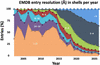
The increasing democratization and implementation of electron cryo-microscopy appears poised to drive a new revolution in digital structural biology.
topical reviews
CRYO | EM
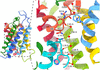
Recent advances in single-particle cryo-electron microscopy have enabled a deeper understanding of the structural diversity and higher-order organization of aquaporin complexes. These insights have important implications for disease biology and drug discovery.
CRYO | EM

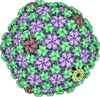
Two recent cryogenic electron microscopy (cryoEM) structures provide a unique opportunity to compare a bacteriophage and a bacteriocin targeted at the same host. CryoEM reveals the most detailed view of contractile injection systems interacting with Clostridioides difficile.
research papers
CRYO | EM

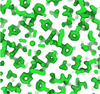
An atomic resolution of 1.24 Å was achieved on an upgraded 200 kV electron microscope featuring a cold field emission gun, a high-resolution objective lens polepiece and an energy filter. These components transform the instrument into a cost-effective single-particle cryo-EM platform with performance comparable to that of significantly more expensive 300 kV systems.
CRYO | EM
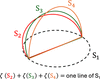
We present a compact mathematical framework for ab initio single-particle 3D reconstruction that reformulates the inverse problem in polar Fourier coordinates, enabling direct orientation recovery from extremely noisy 2D projection images without explicit 3D density reconstruction.
CRYO | EM
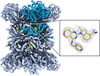
Our studies show that cryo-EM structure-guided optimization to eliminate the off-target liability of CB-5083 yields a potent and selective inhibitor of the AAA ATPase VCP/p97, a cancer target.
CRYO | EM

Download citation


Download citation
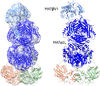
High-resolution cryoEM structures of MAT enzyme complexes help to explain why MATα1 selectively forms a stable complex with MATβV1 but not with MATβV2, despite sharing high sequence and structural identity with MATα2.
CRYO | EM
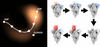
Analysis of SARS-CoV-2 spike protein heterogeneity using cryo-EM data reveals cooperativity between receptor-binding domains.
CRYO | EM
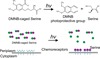
We present an integrated sample preparation workflow that combines photocaged ligand activation and controlled triggering, coupled with rapid vitrification to enable time-resolved cryoET studies on bacterial chemotaxis at millisecond timescales.
NEUTRON | SYNCHROTRON
Download citation

Download citation
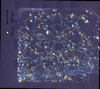
Computer vision algorithms are employed in situ to locate crystal targets for small-molecule fixed-target crystallography. This methodology is shown to be significantly faster and of comparable data quality to previously published methods.
CHEMISTRY | CRYSTENG
Download citation
Download citation
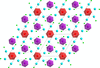
The compounds [M(XeF2)6][AF6]2, where M = Cu or Zn and A = As or Sb, contain unusual homoleptic complexes of XeF2 which form a series of different phases under varying conditions of temperature and pressure. The phases are related to the CdCl2 aristotype and are connected through symmetry-lowering reorientations of the cations and anions.
NEUTRON | SYNCHROTRON
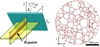
We present a dual line–beam X-point scanning method for inclined scanning three-dimensional X-ray diffraction microscopy that significantly reduces measurement time while providing three-dimensional orientation maps comparable to those obtained by conventional point–beam raster scanning.
PHYSICS | FELS
Download citation
Download citation
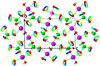
A charge density wave (CDW) instability is discovered in the m = 2 monophosphate tungsten bronze, with an incommensurate modulation q = 0.245b* + 0.02c* appearing at 290 K and locking in to the commensurate vector q = 0.25b* at 130 K. Diffraction, resistivity and diffuse/inelastic X-ray scattering jointly establish the transition mechanism, showing that lattice distortions dominate while the electronic CDW is only weakly coupled to the structural reorganization.
MATERIALS | COMPUTATION
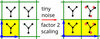
New continuous invariant-based asymmetries quantify deviations of any periodic crystal from its closest higher-symmetry neighbour where all molecules are geometrically equivalent.
PHYSICS | FELS
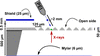
The design and implementation of a strategy for a drop-on-fixed-target approach for time-resolved serial crystallography are described. The strategy has been tested at both synchrotron and XFEL facilities.
PDB references: HEWL uncomplexed resting state, 9toq; HEWL+GlcNAc, 1.9s checkerboard control, 9tos; HEWL+GlcNAc, 1.9s, 9tor; HEWL+GlcNAc, 600s, 9tot; CTX-M-15 uncomplexed resting state, PAL-XFEL, 9to1; CTX-M-15 uncomplexed resting state, DLS, 9to5; CTX-M-15, 2.6s, checkerboard control, contaminated, DLS, 9top; CTX-M-15+avibactam, 2.6s, contaminated, DLS, 9too; CTX-M-15+avibactam, PAL-XFEL, 80ms, 9tok; CTX-M-15+avibactam, PAL-XFEL, 80ms checkerboard control, 9tol; CTX-M-15+avibactam, DLS, 2.6s, 9tom; CTX-M-15+avibactam, DLS, 2.6s checkerboard control, 9ton; AmpC uncomplexed resting state, 9tou; AmpC+avibactam, 80ms, 9tov; AmpC+avibactam, 80ms control, 9tow
MATERIALS | COMPUTATION
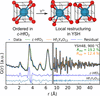
Local disorder in nanoparticles of yttria-stabilized hafnia (YSH) is identified by combined powder X-ray diffraction (PXRD) and pair distribution function (PDF) analysis. The aliovalent doping with Y3+ introduces oxygen vacancies that electrostatically distort the local coordination of the neighbouring ions, thus resulting in both vacancy disorder, mass disorder and displacive disorder in these otherwise well-crystalline YSH nanoparticles.
BIOLOGY | MEDICINE
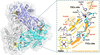
The combination of targeted mutations of a C-terminal cytochrome c tethered copper-containing nitrite reductase with functional studies and atomic resolution structures suggests complex roles of the tethered domain rather than simple fusion of a redox partner.
PDB references: as-isolated Ser321Met mutant of RpNiR, 7qq2; as-isolated Met148Leu mutant of RpNiR, 8qgf; as-isolated Gln262Asn mutant of RpNiR, 7r2u; as-isolated Phe295Leu mutant of RpNiR, 9fom; reduced Phe295Leu mutant of RpNiR, 9fuj; reduced wtRpNiR, 9fuh; NO-treated Gln262Asn mutant of RpNiR, 9fuk; NO-treated Phe295Leu mutant of RpNiR, 9fui
ELECTRON CRYSTALLOGRAPHY
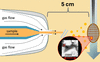
This article establishes the feasibility of time-resolved microcrystal electron diffraction by using a microfluidic mixing device to deposit microcrystals onto electron microscopy grids during plunge-freezing. The resulting vitrified crystals were of sufficient quality to solve a model protein structure.
addenda and errata
CHEMISTRY | CRYSTENG
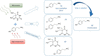
The article by Grabowski et al. [(2025), IUCrJ, 12, 403–416] is corrected.
