


 menu


research papers
 access
Two calcium pyrene phosphonate frameworks with contrasting dimensionality and porosity

aDepartment of Inorganic Chemistry, University of Granada, Avda. Fuente nueva s/n, 18071 Granada, Spain, bNantes Université, CNRS, Institut des Matériaux de Nantes Jean Rouxel, IMN, 44000 Nantes, France, cIMDEA Energy Institute, Advanced Porous Materials Unit (APMU), Avda. Ramón de la Sagra 3, 28935 Móstoles, Madrid, Spain, dCatalan Institute of Nanoscience and Nanotechnology (ICN2), CSIC and The Barcelona Institute for Science and Technology, Campus UAB, Bellaterra, 08193 Barcelona, Spain, and eICREA, Pg. Lluís Companys 23, 08010 Barcelona, Spain
*Correspondence e-mail: [email protected]
This article is part of the special issue Metal–organic frameworks – frontiers and perspectives.
Two new calcium phosphonate metal–organic frameworks (P-MOFs), IEF-33 and IEF-34, have been solvothermally synthesized from a pyrene tetraphosphonate ligand and structurally characterized by single-crystal X-ray diffraction. The two compounds arise from different degrees of ligand hydrolysis and exhibit distinct architectures: IEF-33 forms a 2D layered framework interacting through hydrogen bonds with interlayer water-filled channels, whereas IEF-34 adopts a 3D porous network with 1D channels. Gas sorption measurements demonstrate the permanent porosity of IEF-34, which exhibits a BET surface area of 491 m2 g−1 and a CO2 uptake of 1.6 mmol g−1 at 273 K. Both materials show good chemical stability in aqueous and organic media, and moderate thermal stability. In addition, IEF-33 and IEF-34 show strong visible-light absorption with optical band gaps of 2.51 and 2.62 eV, respectively.
1. Introduction
Metal–organic frameworks (MOFs) have emerged over the last few decades as one of the most interesting and versatile classes of crystalline porous materials. Built from inorganic nodes interconnected by organic linkers, these materials present an extraordinary structural and functional diversity combined with high modularity, resulting in an exponential growth of the number of reported structures of MOFs [there are now >110 000 entries in the Cambridge Structural Database (CSD); see https://support.ccdc.cam.ac.uk/support/solutions/articles/103000306242-how-many-mofs-are-there-in-the-csd-] as well as of their potential applications in diverse fields such as fluid storage and separation, catalysis, sensing, medicine and energy (Furukawa et al., 2013 ; Li et al., 2009; Kumar et al., 2015; Horcajada et al., 2012; Xia et al., 2015).
Despite this remarkable structural diversity, the vast majority of reported MOFs rely on carboxylate-based linkers. While these materials often exhibit excellent porosity and functionality, their chemical and hydrothermal stability remain significant challenges (An et al., 2024). In this context, phosphonate-based MOFs (P-MOFs) have attracted researchers' attention because of the stronger metal–oxygen bonds associated with the phosphonate group, which generally confer superior thermal, chemical and hydrolytic robustness than their carboxylate counterparts (Gagnon et al., 2012; Shearan et al., 2019; Mysore Ramesha & Meynen, 2020). However, because of this coordination versatility and the high charge of the phosphonate groups, these types of ligands frequently promote the formation of dense inorganic sublattices with complex connectivity and low crystallinity, complicating their structural elucidation. As a result, despite their attractive stability, the number of structurally resolved and permanently porous P-MOFs remains relatively limited (Zheng et al., 2024).
In parallel, the growing dependence on critical raw materials and the increasing geopolitical uncertainties affecting their availability have stimulated the search for MOFs based on earth-abundant sustainable elements (see https://single-market-economy.ec.europa.eu/sectors/raw-materials/areas-specific-interest/critical-raw-materials_en). In this context, calcium appears particularly attractive owing to its abundant nature (it is the fifth most abundant element in the Earth's crust, at 3.6–4.1%), low toxicity, low cost and excellent environmental compatibility. Nevertheless, calcium-based MOFs remain severely under-represented compared with their transition-metal counterparts. This scarcity can be largely attributed to the large ionic radius and high coordination versatility of Ca2+, which typically favor dense crystal packing and structural instability upon activation, thereby hindering the development of permanently porous materials (Fromm, 2008; Xian et al., 2021).
Such structural challenges are further exacerbated in calcium phosphonate frameworks, where the strong metal–oxygen interactions and multitopic nature of phosphonate ligands often favor the crystallization of compact, non-porous architectures rather than the intended open-framework materials. To date, fewer than 160 calcium phosphonate structures have been reported in the CSD, and fewer than 60 correspond to coordination polymers exclusively constructed from Ca2+ cations and phosphonate ligands (i.e. without additional coordinating functionalities). Among these, only around 20 structures satisfy the IUPAC definition of a MOF (i.e. structures containing potential voids) (Batten et al., 2013). From these structures, only two studies have explored their adsorption properties through H2O and NH3 sorption measurements (Colodrero et al., 2009) or by N2 and CO2 uptake (Glavinović et al., 2022). This scarcity of adsorption studies highlights a significant knowledge gap regarding the true porous potential of this family of materials.
Within this context, the use of rigid, multitopic phosphonate ligands emerges as a promising strategy for obtaining porous structures (Taddei et al., 2016; Firmino et al., 2018). Pyrene-based tetraphosphonates are particularly interesting because of their aromatic core, high rigidity and intrinsic optoelectronic properties, which have already demonstrated good performance when incorporated into hybrid materials (Salcedo-Abraira, Serrano-Nieto et al., 2023; Serrano-Nieto et al., 2025; Firmino et al., 2020; Salcedo-Abraira, Biglione et al., 2023). Nevertheless, only one calcium pyrene tetraphosphonate structure has been reported so far. This material corresponds to a non-porous coordination network (Serrano-Nieto et al., 2025), leaving the exploration of porosity and adsorption behavior in this system essentially unexplored.
In this work, we report the synthesis and full structural characterization of two novel calcium-based P-MOFs (labeled IEF-33 and IEF-34 from IMDEA Energy Framework) containing the pyrene tetraphosphonate ligand. The thermal and structural stability, and textural and optoelectronic properties of both materials were also investigated. IEF-33 is built from the fully hydrolyzed and partially deprotonated version of the ligand [Py(PO3Et2)4], i.e. [Py(PO3H)4]4−, resulting in a two-dimensional coordination network connectivity in which Ca2+ centers are coordinated by both phosphonate groups and water molecules, with adjacent layers interconnected through hydrogen bonds. In contrast, IEF-34 contains the partially hydrolyzed and deprotonated ligand [Py(PO3Et)2(PO3HEt)2]2− with the Ca atoms totally surrounded by the phosphonate groups, leading to a three-dimensional network with void channels (with a specific surface BET area of 490 m2 g−1) that are accessible to both N2 and CO2 gases. Both materials combined a good structural stability in organic media, relative stability in aqueous media and enhanced light absorption compared with the pristine ligand.
2. Materials and methods
All the chemicals were used as received without further purification: Ca(NO3)2·4H2O (99%, Alfa Aesar, 236.15 g mol−1), pyrene (98%, Sigma Aldrich, 202.25 g mol−1), bromine (≥95.5%, Sigma Aldrich, 159.81 g mol−1), nitrobenzene (99%, Thermo Scientific), P(OEt)3 (98%, Sigma Aldrich, 166.16 g mol−1), [Pd(PPh3)4] (99%, Sigma Aldrich, 1155.56 g mol−1), EtOH (≥99.8%, ACS reagent), MeOH (≥99.8%, ACS reagent), n-hexane (technical grade, VWR Chemicals) and HCl (37%, ACS reagent). Py(PO3Et2)4 was synthesized using a previously reported procedure (see the supporting information for further information) (Salcedo-Abraira, Serrano-Nieto et al., 2023).
2.1. Synthesis
2.1.1. Single-crystal synthesis of IEF-33, {[Ca2(C16H10P4O12)(H2O)4]·3H2O}n (molecular weight 724.39 g mol−1)
In a 2.5 ml Teflon-lined reactor, 10.63 mg (0.045 mmol) of Ca(NO3)2·4H2O and 16.79 mg (0.0225 mmol) of Py(PO3Et2)4 were dissolved in 0.5 ml of MeOH and 1 ml of distilled water, then the reactor was closed. The reactor was heated in an oven to 120 °C over 6 h, maintained at this temperature for 48 h and finally cooled down to 30 °C over 6 h. The resulting brown crystals were recovered by filtration and washed with distilled water and methanol, and were dried at room temperature (RT).
2.1.2. Scaled-up synthesis of IEF-33
In a 25 ml Teflon-lined reactor, 106.3 mg (0.45 mmol) of Ca(NO3)2·4H2O and 167.9 mg (0.225 mmol) of Py(PO3Et2)4 were dissolved in 5 ml of MeOH and 10 ml of distilled water, then the reactor was closed. The reactor was heated in an oven at 120 °C for 87 h. The resulting brown crystals were recovered by filtration and washed with distilled water and methanol, and were dried at RT. Solid recovered: 90 mg (70 ± 5% yield based on the linker).
2.1.3. Single-crystal synthesis of IEF-34, [Ca(C20H20P4O12)]n (molecular weight 616.32 g mol−1)
In a 2.5 ml Teflon-lined reactor, 10.63 mg (0.045 mmol) of Ca(NO3)2·4H2O and 16.79 mg (0.0225 mmol) of Py(PO3Et2)4 were dissolved in 1 ml of EtOH and 0.5 ml of distilled water. Then 10 µl of 5 M HCl were added and the reactor was closed. The reactor was heated in an oven to 120 °C over 8 h, maintained at this temperature for 48 h and finally cooled down to 30 °C over 8 h. The resulting yellow crystals were recovered by filtration and washed with distilled water and ethanol, and were dried at 100 °C for 12 h.
2.1.4. Scaled-up synthesis of IEF-34
In a 25 ml Teflon-lined reactor, 98.52 mg (0.42 mmol) of Ca(NO3)2·4H2O and 155.84 mg (0.21 mmol) of Py(PO3Et2)4 were dissolved in 9.2 ml of EtOH and 4.6 ml of distilled water. Then 100 µl of 5 M HCl were added and the reactor was closed. The reactor was heated in an oven to 130 °C over 8 h, maintained at this temperature for 48 h and finally cooled down to 30 °C over 8 h. The resulting yellow crystals were recovered by filtration and washed with distilled water and ethanol, and were dried at 100 °C for 12 h. Solid recovered: 77 ± 4 mg (60 ± 3% yield based on the linker).
2.2. Crystallographic studies
Suitable single crystals of Py(PO3Et2)4, IEF-33 and IEF-34 were mounted on a MiTeGen polymer loop and covered with oil. Data were collected at room temperature using a Bruker Venture and a Rigaku XtaLAB Synergy diffractometer with Mo Kα radiation (λ = 0.71073 Å) for Py(PO3Et2)4 and IEF-34, respectively. Data for IEF-33 were collected at the ALBA synchrotron (Spain) on the XALOC beamline at 100 K using a single φ-scan data acquisition strategy (Juanhuix et al., 2014). The data for Py(PO3Et2)4 were reduced using APEX3 and an absorption correction was applied using SADABS. For IEF-33, data indexing, integration and scaling were performed with the XDS program (Kabsch, 2010) and an absorption correction was not applied. Data reduction for IEF-34 was performed with the CrysAlisPro suite and a semi-empirical absorption correction (ABSPACK) was applied. The structures were solved using SHELXT (Sheldrick, 2015b) and refined with SHELXL (Sheldrick, 2015a) integrated within the Olex2 graphical interface (Dolomanov et al., 2009). The volumes of the solvent-accessible voids were calculated using a 1.2 Å probe. All non-H atoms were refined anisotropically. Hydrogen atoms were placed in calculated positions and refined with idealized geometries.
Powder X-ray diffraction (PXRD) data used for crystallographic studies were collected on a BRUKER D8 DISCOVER equipped with a microfocus Cu Kα radiation source (λ = 1.54059 Å) over a 2θ range of 4–50° with a 0.02° step size and 40 s of acquisition time per step.
2.3. Instrumentation
Routine PXRD data were collected using an Empyrean Panalytical diffractometer (Cu Kα, λ = 1.5406 Å) equipped with a PIXcel3D detector, operating at 45 kV and 40 mA from 3 to 35° 2θ with a step size of 0.013° and a scan rate of 0.1° s−1. Scanning electron microscopy (SEM) micrographs were collected on a Hitachi TM-1000 microscope operating at 15 kV. Fourier-transform infrared (FTIR) spectra were collected in the 4000 to 400 cm−1 range using a Thermo Nicolet 6700 FTIR spectrometer with an ATR accessory instrument (Thermo Scientific, USA). Elemental analyses were carried out in a Flash 2000 analyzer from Thermo Scientific. Inductively coupled plasma optical emission spectroscopy (ICP-OES) analyses were carried out using a 2300 DV spectrometer from Perkin Elmer. TGA was performed using an SDT650 thermobalance (TA instruments) over the 25–1000 °C range at 5 °C min−1 and under an air flow of 100 ml min−1. Variable-temperature (VT) PXRD data were acquired on a D8 Advance Bruker AXS θ–2θ diffractometer (Cu Kα radiation, λ = 1.54060 Å) equipped with a LYNXEYE XE detector, operating at 40 kV and 40 mA, and an Anton Paar XRK 900 high-temperature chamber. Both nitrogen (at 77 K) and CO2 (at both 273 K and 293 K) sorption isotherms were collected using a 3Flex instrument from Micromeritics. Prior to the gas sorption experiments, samples were degassed at 120 °C for 6 h under secondary vacuum. Diffuse reflectance UV–Vis measurements were recorded using a Perkin Elmer spectrometer (Lambda 19) equipped with an integrating sphere and a praying mantis accessory.
3. Results and discussion
3.1. Synthesis and structural elucidation
The reactivity of Ca2+ cations with the lab-made pyrene octaethyl tetraphosphonate ligand was investigated using the solvothermal high-throughput method (Stock, 2010). Upon synthetic optimization, two novel calcium phosphonate phases were isolated, labeled as IEF-33 and IEF-34. The generation of one or the other phase was mostly determined by the mixture of solvents employed: IEF-33 required the use of an MeOH/H2O mixture in a 1:2 (v/v) ratio, while IEF-34 was obtained using an EtOH/H2O 2:1 (v/v) mixture with the addition of 1 equivalent of HCl per metal. Interestingly, the IEF-33 structure contained the totally hydrolyzed ligand, whereas in IEF-34 half of the phosphonate groups in the ligand were in their esterified version (where HCl is used during the synthesis). Compared with the synthetic conditions previously reported for the dense calcium pyrene tetraphosphonate framework IEF-22(Ca) (Serrano-Nieto et al., 2025), the preparation of the more open and porous IEF-33 and IEF-34 relies on significantly milder reaction conditions and a more straightforward synthetic approach. Specifically, both MOFs were obtained at lower temperatures (120–130 versus 150 °C), using a lower metal concentration (0.03 versus 0.1 M) and employing the esterified version of the ligand (Table 1, Tables S1 and S2, and Fig. S1) instead of its acidic counterpart. The latter was employed for IEF-22, requiring an additional synthetic step during ligand preparation.
|
||||||||||||||||||||||||||||||||||||||||||||||||||||||||||||||||||||||||||||||||||||||||||||||||||||||||||||||||||||||||||
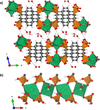
IEF-33 was obtained as small brown needle-shaped crystals (∼75 µm long, Fig. S2), hindering structural determination by conventional SCXRD. Therefore, synchrotron SCXRD was employed, revealing that IEF-33, formulated as {[Ca2(C16H10P4O12)(H2O)4]·3H2O}n or {[Ca2(Py(PO3)4)(H2O)4]·3H2O}n, crystallizes in the triclinic space group P1 (No. 2) with unit-cell parameters a = 8.4993 (3) Å, b = 12.5656 (9) Å, c = 12.5832 (1) Å, α = 103.252 (7)°, β = 98.700 (5)°, γ = 97.446 (4)°, V = 1274.05 (2) Å3 and Z = 2 (Table 1). The IEF-33 structure is built from [Ca2(Py(PO3)4)(H2O)4]n layers along the (001) plane, interacting through hydrogen bonds [Fig. 1(a)]. The asymmetric unit contains one fully hydrolyzed pyrene tetraphosphonate ligand coordinating two crystallographically independent Ca2+ cations (Ca1 and Ca2), each one with two coordinated water molecules, and three crystallization water molecules. The secondary building unit (SBU) consists of [Ca2(PO3H)4(H2O)4]n chains running along the [100] direction [Fig. 1(b)]. These chains contain the Ca1 and Ca2 cations alternating in two different coordination spheres. Ca1 is found in a highly distorted [CaO7] pentagonal bipyramid environment with d(Ca1—O) distances between 2.362 (1) and 2.761 (1) Å [Tables S4 and S5, and Fig. S3(a)] and in a distorted [CaO6] octahedral environment with d(Ca2—O) distances between 2.279 (1) and 2.415 (1) Å [Tables S4 and S5, and Fig. S3(b)]. The Ca1 coordination sphere contains the P2 phosphonate group of one ligand, which is acting as a chelating ligand (through O5 and O6), the P3 and P4 phosphonate groups from different ligands acting as monodentate ligands (by O1, O8 and O11, respectively) and two coordinated water molecules [O1W and O2W, Fig. S3(a)]. On the other hand, Ca2 contains four phosphonate groups (P1, P2, P3 and P4, each one from a different ligand) acting as monodentate ligands in the octahedra basal positions (by O2, O5, O7 and O11, respectively) with the O3W and O4W from two water molecules occupying the apical positions [Fig. S3(b)]. These pentagonal bipyramids and octahedra share two vertices (O11 and O5), generating chains in the [100] direction [Figs. 1(b) and S4]. Bonds between these chains are formed by the ligands, creating layers in the (001) plane in which the pyrene cores are π stacked [d(Py–Py) ≃ 4 Å, Fig. S5]. Each ligand is bonded to eight different Ca atoms. The P1 and P3 groups act as bidentate ligands through O1 and O2 (from P1) and through O8 and O7 (from P3), bonding to one Ca1 and one Ca2, respectively; the P2 group acts as a chelating ligand (through O5 and O6) to one Ca1, and also a bidentate ligand, bridging Ca1 and Ca2 by O5; and finally the P4 group acts as a monodentate ligand (O11), bridging one Ca1 and one Ca2 (Fig. S6). It is worth noting that during the synthesis all the ethoxy groups were hydrolyzed, remaining as four OH groups in the coordinated ligand. This resulted in the connection of four chains, one per phosphonate group of the ligand, where the octahedra and the pentagonal bipyramids alternate between the chains, establishing intra-layer hydrogen bonds through the coordinated water molecules (Fig. S7). Finally, the stacking of the layers generates elongated channels of ca 7.5 × 3.5 Å (considering van der Waals radii). These voids are occupied by free water molecules that participate in an extended hydrogen-bonding network with adjacent layers (Fig. S8). These channels account for approximately 12.8% of the unit-cell volume (according to PLATON calculations).
|
Figure 1
IEF-33 crystal structure viewed along the [100] direction (a) and the IEF-33 SBU viewed along the [001] direction (b). Calcium, phosphorus, oxygen, carbon and hydrogen atoms are represented in green, orange, red, black and white, respectively. |
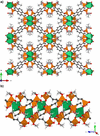
IEF-34 was obtained as small rhombohedral pale yellow crystals (100 µm in length, Fig. S9), allowing its structure to be determined using conventional SCXRD (Table 1). IEF-34, with the formula [Ca(C20H20P4O12)]n (or [Ca(Py(PO3H0.5Et0.5)2(PO3H1.5Et0.5)2)]n), crystallizes in the monoclinic space group C2/c (No. 15) with unit-cell parameters a = 21.6124 (1) Å, b = 18.4191 (8) Å, c = 8.3124 (4) Å, β = 108.823 (4)°, V = 3132.0 (3) Å3 and Z = 4. The asymmetric unit contains half a pyrene tetraethyl tetraphosphonate ligand coordinated to one Ca2+ cation. Unlike IEF-33, where complete hydrolysis of the phosphonate ester groups occurs, IEF-34 retains one ethyl substituent disordered between the two phosphonate moieties of the asymmetric unit, yielding the partially hydrolyzed ligand [Py(PO3H0.5Et0.5)2(PO3H1.5Et0.5)2]2−. The three-dimensional structure of IEF-34 is built up from distorted [CaO6] octahedra [Figs. 2 and S10(a), and Tables 1, S6 and S7] acting as SBUs bonded by [Py(PO3H0.5Et0.5)2(PO3H1.5Et0.5)2]2− with d(Ca1—O) distances ranging from 2.304 (4) to 2.412 (4) Å. These octahedra are interconnected by the different phosphonate groups, creating a zigzag chain along the [001] direction. Each calcium center is bound to six different phosphonate groups from neighboring ligands. Specifically, the coordination sphere is composed of four P1 and two P2 phosphonate groups from different ligands: two O1 and two O2 from the P1 groups, and two O5 atoms from the P2 groups, where the O1 and O5 pairs of atoms are in the cis position and the O2 pair is in the trans position [Fig. S10(a)]. On the other hand, each ligand, where each phosphonate group presents half a non-hydrolyzed ethyl group, is connected to six different Ca atoms: two per P1 group (O1 and O2) and one per P2 group (O5), as illustrated in Fig. S10(b). A notable feature of IEF-34 is the presence of one-dimensional channels running parallel to the [001] direction. Two types of apertures can be identified: narrower channels (7.5 × 2 Å) in between disordered ethyl groups and larger cavities of ca 10 × 10 Å delimited by the pyrene cores along the [001] direction with the ethyl groups located inside (considering the van der Waals radii). These channels represent 13.2% of the unit-cell volume according to solvent-accessible volume calculations in PLATON, being the permanent porosity further confirmed by N2 and CO2 gas sorption experiments (see below).
|
Figure 2
Crystal structure of IEF-34 viewed along the [001] direction (a) and [CaO6] octahedra chains in the [001] direction (b). Calcium, phosphorus, oxygen, carbon and hydrogen atoms are represented in green, orange, red, black and white, respectively. |
3.2. Physicochemical characterization
The purity of the polycrystalline samples of both IEF-33 and IEF-34 was confirmed by powder X-ray diffraction (PXRD) combined with chemical analysis. (IEF-33: theoretical (%) Ca 11.06, P 17.10, C 26.52, H 3.34, O 41.96; experimental (%) Ca 11.2 ± 0.6, P 18.8 ± 0.9, C 27.26 ± 0.08, H 2.96 ± 0.08. IEF-34: theoretical (%) Ca 6.50, P 20.10, C 38.97, H 3.27, O 31.15; experimental (%) Ca 6.8 ± 0.3, P 19.0 ± 0.9, C 39.4 ± 0.1, H 3.66 ± 0.01; see the supporting information for further details). Comparison of the position and intensity of the main reflections in the experimental PXRD patterns with the simulated ones confirmed the successful formation of the phases (Fig. S11), while a Pawley profile fitting (Fig. S12 and Table S7) showed the absence of other crystalline impurities. The ligand connectivity was confirmed by Fourier-transform infrared spectroscopy (FTIR, Fig. S13), where the elimination of the νCaliphatic—H, δCaliphatic—H and νP—O—C bands (at 2900–2982, 1370–1478 and 798 cm−1, respectively) (Pretsch et al., 2009) was observed in IEF-33 due to the hydrolysis of the ethoxy groups of the phosphonate (while those signals are still present in IEF-34), combined with a shift in the main νP—O and νP=O bands with respect to the Py(PO3Et2)4 ligand (from 1247 and 1217 cm−1 to 1127 cm−1 for IEF-33 and to 1216 and 1175 cm−1 for IEF-34; and from 1012 and 957 to 1017 and 913 for IEF-33 and to 1027 and 944 cm−1 for IEF-34).
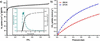
The potential permanent porosity of both IEF-33 and IEF-34 was evaluated by N2 and CO2 sorption isotherms. IEF-33 showed almost no N2 or CO2 uptake (Fig. S14) despite the a priori accessible porosity according to the crystallographic data (pore dimensions: 7.5 × 3.5 Å versus the kinetic diameters of N2 and CO2 of 3.6 and 3.3 Å, respectively). This behavior can be rationalized by considering the phase transition occurring upon activation (see Thermal and chemical stability below). On the other hand, IEF-34 presented permanent porosity accessible to N2 and CO2 (Fig. 3), with an SBET surface area of 491.3 ± 0.5 m2 g−1 and a total pore volume (Vp) of 0.19 cm3 g−1 according to the N2 isotherm [Fig. 3(a)]. The Horvath–Kawazoe pore size distribution [inset to Fig. 3(a)] showed a broad pore size distribution between 6–7.5 Å, in good agreement with the crystallographic data considering the free rotation inside the pore and the disordered nature of the ethoxy groups and their partial occupancy. Finally, IEF-34 showed a CO2 uptake of 1.6 and 1.1 mmol g−1 at 1 bar [at 273 and 293 K, respectively; Fig. 3(b)], in line with previously reported P-MOFs (Salcedo-Abraira et al., 2021; Taddei et al., 2014; Serrano-Nieto et al., 2026; Glavinović et al., 2022) but still far from the benchmarked Mg carboxylate MOF-74, which has the record for CO2 uptake in the field of MOFs (8 mmol g−1 at 296 K and 1 bar; Li et al., 2020).
|
Figure 3
(a) N2 sorption isotherm at 77 K and Horvath–Kawazoe pore size distribution (inset), and (b) CO2 sorption isotherms at 273 K (blue) and 293 K (red) of IEF-34. Adsorption and desorption points are represented by solid and open symbols, respectively. |
3.3. Thermal and chemical stability
In order to assess the thermal stability of the two MOFs, thermogravimetric analyses coupled with differential scanning calorimetry (TGA–DSC) and variable-temperature PXRD (VTPXRD) experiments were carried out. TGA of IEF-33 showed three consecutive weight losses associated with the removal of water molecules (Fig. S15). The first weight loss (from RT to 80 °C) of 7.7% corresponds to the departure of three free water molecules located between the layers (theoretical loss 7.45%). A second weight loss of 6.1% from 80 to 100 °C is attributed to the removal of three of the four coordinated water molecules (theoretical loss 7.45%). The remaining coordinated water molecule seems to be released more gradually from 100 to 200 °C, resulting in an additional weight loss of 2.5% (theoretical loss 2.48%). After complete dehydration, a plateau is observed up to 400 °C where IEF-33 is oxidized prior to decomposition (Fig. S15). This oxidation may be attributed to the formation of phosphates from the phosphonate groups (Howell, 2022). VTPXRD (Fig. S16) revealed an initial phase transition as a consequence of water departure starting at 30 °C and finishing at 150 °C, in line with the TGA. This transition was found to be irreversible, as the original structure was not recovered after cooling back to room temperature or following subsequent exposure to water, indicating a permanent structural rearrangement upon dehydration (Fig. S17). This phase remained stable up to 360 °C, where it evolved due to oxidation prior to the decomposition. Note that it was not possible to identify the nature of the final residue because of its amorphous nature, hindering complete compositional characterization. These observations are consistent with the absence of N2 and CO2 uptake from IEF-33 despite its a priori structural porosity.
On the other hand, and consistent with its rigid 3D network and permanent porosity, IEF-34 showed a progressive initial weight loss (∼5%) from room temperature to ca 120 °C that might correspond to some residual solvent molecules trapped within the pores during the synthesis. Then a plateau is observed up to 300 °C, where IEF-34 started to decompose (Fig. S18; note that the final residue was not identified). VTPXRD showed no significant structural evolution up to 270 °C, where the structure collapsed due to decomposition (Fig. S19), in agreement with the TGA data.
The chemical stability of IEF-33 and IEF-34 was evaluated by suspending the materials (5 mg ml−1) under stirring for 24 h in a series of organic solvents (methanol, MeOH; ethanol, EtOH; acetonitrile, ACN; tetrahydrofuran, THF; N,N′-dimethylformamide, DMF; dimethylsulfoxide, DMSO; CH2Cl2; hexane; octane; and toluene). In addition, their hydrolytic stability was evaluated over a broad range of pH. After treatment, the solids were recovered and their structural integrity was evaluated by PXRD. IEF-33 retained its crystallinity over the 2 > pH > 10 range, losing its crystallinity at pH 13 (Fig. S20). Upon exposure to different organic solvents, IEF-33 preserved its crystalline structure with only minor changes in peak positions and relative intensities in most cases. The only exception was for DMSO, where the appearance of additional diffraction peaks suggested the formation of a secondary phase. This behavior is probably associated with the replacement of the interlayer water molecules by DMSO, leading to a partial structural reorganization of the layered framework (Fig. S21).
On the other hand, IEF-34 exhibited remarkable hydrolytic structural stability, maintaining its crystallinity across almost the entire pH range (pH 1–12). Under strongly basic conditions (pH 14), the material was transformed into Ca(OH)2 (JCPDS Card No. 87-s0315, Fig. S22). IEF-34 presented negligible changes in PXRD patterns when exposed to the various organic solvents (Fig. S23), showing superior stability in organic media to IEF-33. We hypothesize that the enhanced chemical stability of IEF-34 relative to IEF-33 originates from the different coordination environment of the Ca2+ centers; specifically, while IEF-33 features labile coordinated water molecules, the calcium atoms in IEF-34 are exclusively coordinated by phosphonate groups, resulting in a more robust inorganic framework that effectively resists chemical degradation.
Complementary gravimetric measurements after solvent treatment revealed solvent-dependent mass variations (Fig. S24). The largest mass loss was observed after exposure to deionized water (>40 wt%), whereas hydrocarbon solvents led to more moderate values (<30 wt%). Intermediate mass changes were measured for THF and toluene (<20 wt%), while ethanol, acetonitrile, DMF and DMSO exhibited the lowest variations (<10 wt%). Interestingly, despite these differences in mass variation, PXRD patterns confirmed that the crystalline framework was preserved after treatment in all cases (except for the partial structural reorganization observed in DMSO).
3.4. Optoelectronic properties
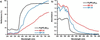
Given the promising photoactive properties previously reported for pyrene-tetraphosphonate-based materials (Serrano-Nieto et al., 2025; Salcedo-Abraira, Serrano-Nieto et al., 2023), the optoelectronic properties of IEF-33 and IEF-34 were investigated by solid-state diffuse reflectance UV–Vis spectroscopy. Identifying their light-absorption behavior is particularly relevant for assessing their potential in applications such as photocatalysis, optoelectronics and solar energy conversion. These MOFs showed light absorption across almost all the visible range (Fig. 4), with a broad absorption maximum ranging from 250 to 400 nm due to the aromatic pyrene core, and in line with the optoelectronic properties of the ligand. Between 400 and 800 nm, IEF-33 presented stronger absorption than IEF-34, absorbing within the whole range (while IEF-34 started to absorb at ca 650 nm). These differences in terms of optical properties are probably related to the pyrene core π–π stacking present in the IEF-33 structure, which is also responsible for the different colors of the two materials (brown for IEF-33 and pale yellow for IEF-34), and are also reflected in the estimated optical band gap: 2.51 versus 2.62 eV for IEF-33 and IEF-34, respectively (Fig. S25), which both correspond to indirect transitions.
|
Figure 4
Solid-state UV–Vis diffuse reflectance (a) and absorption (b) spectra of the Py(PO3Et2)4 ligand (black), IEF-33 (red) and IEF-34 (blue). |
The combination of permanent porosity (in IEF-34), broad visible light absorption and high chemical stability across a wide pH range suggests that these calcium-based frameworks could be of interest for several applications. For instance, while the CO2 uptake at low pressures remains modest and further selectivity studies are required, the robust 3D structure and high stability of IEF-34 provide a baseline for exploring gas sorption in chemically demanding environments (Xian et al., 2021). Furthermore, the photoactive pyrene core, coupled with the observed narrow band gaps, indicates that these materials may serve as platforms for the (photo)catalytic degradation of organic pollutants or solar-to-chemical energy conversion (Serrano-Nieto et al., 2025; Lustig & Li, 2018). Finally, the inherent biocompatibility of the calcium-phosphonate backbone opens up potential avenues for future exploration in biomedical fields, such as drug delivery or biosensing (Alvarez et al., 2013; Liu et al., 2012).
4. Conclusions
Two novel calcium-based P-MOFs were solvothermally synthesized using a photoactive pyrene tetraphosphonate ligand. Single-crystal X-ray diffraction revealed that differences in ligand hydrolysis led to markedly different architectures: hydrogen-bonded 2D coordination layers in IEF-33 and a 3D porous network with 1D channels in IEF-34. These MOFs have open structures with free water molecules (IEF-33) or voids (IEF-34), showing their potential porosity. Furthermore, IEF-34 had a CO2 adsorption of ca 1.6 mmol g−1 at 273 K, which is in the range of the highest values reported for P-MOFs. Additionally, both materials showed moderate thermal stability (up to 350 and 270 °C for IEF-33 and IEF-34, respectively) and good chemical stability in aqueous and organic solvents, which when combined with their optoelectronic properties (band gaps of 2.51 and 2.62 eV) make IEF-33 and IEF-34 potential candidates for several applications [e.g. molecule adsorption, sensing, (photo)catalysis]. Specifically, the permanent porosity of IEF-34 opens up potential avenues for energy-efficient gas separation in harsh environments and future biomedical exploration. More broadly, this work expands the still-limited family of porous calcium P-MOFs and provides new insights into the crystal engineering of sustainable MOFs.
5. Related literature
The following reference is cited in the supporting information: Bernhardt et al. (2006).
Supporting information
Crystal structure: contains datablocks Py(PO3Et2)4, IEF-33, IEF-34. DOI: https://doi.org/10.1107/S2052252526009875/hay5002sup1.cif
Structure factors: contains datablock . DOI: https://doi.org/10.1107/S2052252526009875/hay5002Py(PO3Et2)4sup2.hkl
Structure factors: contains datablock IEF-33. DOI: https://doi.org/10.1107/S2052252526009875/hay5002IEF-33sup3.hkl
Structure factors: contains datablock IEF-34. DOI: https://doi.org/10.1107/S2052252526009875/hay5002IEF-34sup4.hkl
Supporting results and additional experimental details. DOI: https://doi.org/10.1107/S2052252526009875/hay5002sup5.pdf
| C32H46O12P4 | Z = 1 |
| Mr = 746.57 | F(000) = 394 |
| Triclinic, P1 | Dx = 1.272 Mg m−3 |
| a = 10.0133 (4) Å | Mo Kα radiation, λ = 0.71073 Å |
| b = 10.1039 (4) Å | Cell parameters from 9650 reflections |
| c = 10.9607 (4) Å | θ = 2.2–26.6° |
| α = 66.725 (1)° | µ = 0.25 mm−1 |
| β = 74.407 (1)° | T = 296 K |
| γ = 89.869 (2)° | Needle, yellow |
| V = 974.40 (7) Å3 | 0.1 × 0.003 × 0.003 mm |
| Bruker SMART APEX2 area detector diffractometer | 4852 independent reflections |
| Radiation source: microfocus sealed X-ray tube, Incoatec Iµs | 3437 reflections with I > 2σ(I) |
| Mirror optics monochromator | Rint = 0.073 |
| Detector resolution: 7.9 pixels mm-1 | θmax = 28.3°, θmin = 2.1° |
| ω and φ scans | h = −13→13 |
| Absorption correction: multi-scan SADABS-2016/2 (Bruker,2016/2) was used for absorption correction. wR2(int) was 0.1474 before and 0.0820 after correction. The Ratio of minimum to maximum transmission is 0.7089. The λ/2 correction factor is Not present. | k = −13→13 |
| Tmin = 0.529, Tmax = 0.746 | l = −14→14 |
| 49829 measured reflections |
| Refinement on F2 | Primary atom site location: dual |
| Least-squares matrix: full | Hydrogen site location: inferred from neighbouring sites |
| R[F2 > 2σ(F2)] = 0.071 | H-atom parameters constrained |
| wR(F2) = 0.242 | w = 1/[σ2(Fo2) + (0.1433P)2 + 0.2979P] where P = (Fo2 + 2Fc2)/3 |
| S = 1.05 | (Δ/σ)max < 0.001 |
| 4852 reflections | Δρmax = 0.46 e Å−3 |
| 241 parameters | Δρmin = −0.35 e Å−3 |
| 179 restraints |
Geometry. All esds (except the esd in the dihedral angle between two l.s. planes) are estimated using the full covariance matrix. The cell esds are taken into account individually in the estimation of esds in distances, angles and torsion angles; correlations between esds in cell parameters are only used when they are defined by crystal symmetry. An approximate (isotropic) treatment of cell esds is used for estimating esds involving l.s. planes. |
| x | y | z | Uiso*/Ueq | Occ. (<1) | |
| P1 | 0.43806 (7) | 0.68662 (8) | 0.29357 (8) | 0.0625 (3) | |
| P2 | 0.93545 (7) | 0.86643 (11) | 0.32008 (11) | 0.0826 (3) | |
| O3 | 0.5524 (2) | 0.6130 (2) | 0.2211 (2) | 0.0710 (5) | |
| O2 | 0.3996 (3) | 0.8024 (2) | 0.1676 (3) | 0.0839 (6) | |
| O5 | 0.9768 (2) | 0.8080 (3) | 0.4584 (3) | 0.0894 (7) | |
| O1 | 0.3224 (2) | 0.5849 (3) | 0.4043 (2) | 0.0847 (7) | |
| O4 | 0.9751 (3) | 0.7839 (4) | 0.2351 (4) | 0.1151 (11) | |
| C5 | 0.5357 (2) | 0.9587 (2) | 0.4634 (2) | 0.0475 (5) | |
| C4 | 0.4590 (2) | 0.8804 (2) | 0.4157 (2) | 0.0501 (5) | |
| C7 | 0.3123 (2) | 0.8895 (3) | 0.4401 (3) | 0.0592 (6) | |
| H7 | 0.261579 | 0.840299 | 0.407986 | 0.071* | |
| C3 | 0.5297 (3) | 0.7983 (3) | 0.3468 (3) | 0.0538 (5) | |
| C6 | 0.6823 (2) | 0.9546 (3) | 0.4395 (3) | 0.0524 (5) | |
| O6 | 1.0057 (3) | 1.0270 (4) | 0.2548 (4) | 0.1122 (10) | |
| C8 | 0.2454 (2) | 0.9675 (3) | 0.5083 (3) | 0.0604 (6) | |
| H8 | 0.149904 | 0.970719 | 0.521736 | 0.072* | |
| C1 | 0.7503 (2) | 0.8754 (3) | 0.3653 (3) | 0.0594 (6) | |
| C2 | 0.6730 (3) | 0.7976 (3) | 0.3212 (3) | 0.0606 (6) | |
| H2 | 0.718693 | 0.744148 | 0.273685 | 0.073* | |
| C9 | 0.3218 (5) | 0.7580 (5) | 0.0942 (4) | 0.1026 (12) | |
| H9A | 0.347365 | 0.665621 | 0.093359 | 0.123* | |
| H9B | 0.222618 | 0.745969 | 0.140888 | 0.123* | |
| C11 | 0.5747 (6) | 0.4639 (4) | 0.2945 (5) | 0.1100 (14) | |
| H11A | 0.629576 | 0.460616 | 0.356097 | 0.132* | |
| H11B | 0.485204 | 0.406861 | 0.351054 | 0.132* | |
| C13 | 0.9424 (7) | 0.6577 (6) | 0.5468 (8) | 0.153 (2) | |
| H13A | 0.842208 | 0.634222 | 0.570954 | 0.184* | |
| H13B | 0.986393 | 0.603032 | 0.494508 | 0.184* | |
| C10 | 0.3504 (10) | 0.8618 (8) | −0.0404 (6) | 0.192 (4) | |
| H10A | 0.446087 | 0.864289 | −0.089811 | 0.288* | |
| H10B | 0.334734 | 0.955015 | −0.039080 | 0.288* | |
| H10C | 0.290412 | 0.838065 | −0.085772 | 0.288* | |
| C14 | 0.9798 (11) | 0.6104 (8) | 0.6682 (8) | 0.207 (4) | |
| H14A | 1.071080 | 0.656498 | 0.649862 | 0.311* | |
| H14B | 0.980900 | 0.507099 | 0.703788 | 0.311* | |
| H14C | 0.913590 | 0.634622 | 0.735386 | 0.311* | |
| C12 | 0.6408 (12) | 0.4043 (8) | 0.2078 (8) | 0.256 (6) | |
| H12A | 0.704453 | 0.477739 | 0.126832 | 0.384* | |
| H12B | 0.573426 | 0.363318 | 0.180694 | 0.384* | |
| H12C | 0.691643 | 0.329560 | 0.254072 | 0.384* | |
| C15A | 1.024 (2) | 1.1071 (17) | 0.1218 (16) | 0.179 (5) | 0.613 (17) |
| H15A | 0.937678 | 1.147926 | 0.111771 | 0.215* | 0.613 (17) |
| H15B | 1.039539 | 1.043772 | 0.073293 | 0.215* | 0.613 (17) |
| C16A | 1.134 (2) | 1.222 (2) | 0.0542 (16) | 0.223 (8) | 0.613 (17) |
| H16A | 1.184382 | 1.220554 | 0.117966 | 0.335* | 0.613 (17) |
| H16B | 1.096374 | 1.313031 | 0.022813 | 0.335* | 0.613 (17) |
| H16C | 1.196202 | 1.211130 | −0.023860 | 0.335* | 0.613 (17) |
| C15B | 1.114 (2) | 1.099 (2) | 0.133 (2) | 0.160 (6) | 0.387 (17) |
| H15C | 1.142952 | 1.027981 | 0.095194 | 0.191* | 0.387 (17) |
| H15D | 1.073087 | 1.170314 | 0.068754 | 0.191* | 0.387 (17) |
| C16B | 1.235 (3) | 1.169 (4) | 0.129 (4) | 0.266 (15) | 0.387 (17) |
| H16D | 1.250538 | 1.127820 | 0.218751 | 0.399* | 0.387 (17) |
| H16E | 1.225492 | 1.270555 | 0.104094 | 0.399* | 0.387 (17) |
| H16F | 1.312861 | 1.158572 | 0.061454 | 0.399* | 0.387 (17) |
| U11 | U22 | U33 | U12 | U13 | U23 | |
| P1 | 0.0599 (4) | 0.0669 (4) | 0.0772 (5) | 0.0029 (3) | −0.0231 (3) | −0.0442 (4) |
| P2 | 0.0424 (4) | 0.1023 (7) | 0.1273 (8) | 0.0059 (4) | −0.0131 (4) | −0.0792 (6) |
| O3 | 0.0784 (13) | 0.0691 (11) | 0.0785 (12) | 0.0099 (9) | −0.0226 (10) | −0.0434 (10) |
| O2 | 0.1007 (16) | 0.0806 (13) | 0.1008 (15) | 0.0179 (12) | −0.0553 (13) | −0.0510 (12) |
| O5 | 0.0586 (12) | 0.0879 (15) | 0.157 (2) | 0.0176 (10) | −0.0486 (13) | −0.0756 (16) |
| O1 | 0.0720 (13) | 0.0905 (15) | 0.0983 (15) | −0.0206 (11) | −0.0093 (11) | −0.0552 (13) |
| O4 | 0.0576 (13) | 0.163 (3) | 0.178 (3) | 0.0204 (15) | −0.0188 (15) | −0.134 (2) |
| C5 | 0.0430 (10) | 0.0481 (11) | 0.0565 (12) | 0.0012 (8) | −0.0166 (9) | −0.0254 (9) |
| C4 | 0.0430 (11) | 0.0531 (11) | 0.0602 (12) | 0.0006 (9) | −0.0167 (9) | −0.0280 (10) |
| C7 | 0.0460 (12) | 0.0668 (14) | 0.0833 (16) | 0.0032 (10) | −0.0251 (11) | −0.0455 (13) |
| C3 | 0.0505 (12) | 0.0578 (12) | 0.0639 (13) | 0.0022 (9) | −0.0192 (10) | −0.0340 (11) |
| C6 | 0.0404 (11) | 0.0569 (12) | 0.0671 (13) | 0.0030 (9) | −0.0164 (10) | −0.0321 (11) |
| O6 | 0.0738 (15) | 0.120 (2) | 0.135 (2) | −0.0275 (15) | 0.0135 (16) | −0.0734 (19) |
| C8 | 0.0399 (11) | 0.0707 (15) | 0.0862 (17) | 0.0050 (10) | −0.0229 (11) | −0.0451 (13) |
| C1 | 0.0436 (11) | 0.0675 (14) | 0.0788 (16) | 0.0040 (10) | −0.0160 (11) | −0.0431 (13) |
| C2 | 0.0483 (12) | 0.0693 (15) | 0.0752 (15) | 0.0041 (11) | −0.0146 (11) | −0.0429 (13) |
| C9 | 0.113 (3) | 0.116 (3) | 0.112 (3) | 0.016 (2) | −0.063 (2) | −0.061 (2) |
| C11 | 0.141 (4) | 0.080 (2) | 0.112 (3) | 0.039 (2) | −0.037 (3) | −0.043 (2) |
| C13 | 0.166 (5) | 0.101 (3) | 0.219 (6) | −0.009 (3) | −0.114 (5) | −0.054 (4) |
| C10 | 0.309 (11) | 0.156 (5) | 0.114 (4) | −0.029 (6) | −0.096 (5) | −0.035 (4) |
| C14 | 0.310 (11) | 0.135 (5) | 0.162 (6) | −0.061 (6) | −0.074 (7) | −0.042 (5) |
| C12 | 0.440 (17) | 0.120 (5) | 0.177 (7) | 0.112 (8) | −0.034 (8) | −0.066 (5) |
| C15A | 0.152 (10) | 0.189 (9) | 0.166 (8) | −0.040 (9) | 0.012 (9) | −0.080 (7) |
| C16A | 0.246 (16) | 0.218 (13) | 0.144 (10) | −0.128 (12) | 0.045 (9) | −0.077 (9) |
| C15B | 0.113 (9) | 0.141 (9) | 0.173 (9) | −0.058 (8) | 0.058 (9) | −0.077 (8) |
| C16B | 0.22 (2) | 0.23 (2) | 0.23 (2) | −0.04 (2) | 0.063 (19) | −0.054 (19) |
| P1—O3 | 1.571 (2) | C9—C10 | 1.382 (7) |
| P1—O2 | 1.559 (2) | C11—H11A | 0.9700 |
| P1—O1 | 1.461 (2) | C11—H11B | 0.9700 |
| P1—C3 | 1.808 (2) | C11—C12 | 1.347 (7) |
| P2—O5 | 1.564 (3) | C13—H13A | 0.9700 |
| P2—O4 | 1.461 (3) | C13—H13B | 0.9700 |
| P2—O6 | 1.567 (3) | C13—C14 | 1.380 (8) |
| P2—C1 | 1.797 (3) | C10—H10A | 0.9600 |
| O3—C11 | 1.451 (4) | C10—H10B | 0.9600 |
| O2—C9 | 1.442 (4) | C10—H10C | 0.9600 |
| O5—C13 | 1.423 (6) | C14—H14A | 0.9600 |
| C5—C5i | 1.439 (4) | C14—H14B | 0.9600 |
| C5—C4 | 1.426 (3) | C14—H14C | 0.9600 |
| C5—C6 | 1.424 (3) | C12—H12A | 0.9600 |
| C4—C7 | 1.430 (3) | C12—H12B | 0.9600 |
| C4—C3 | 1.401 (3) | C12—H12C | 0.9600 |
| C7—H7 | 0.9300 | C15A—H15A | 0.9700 |
| C7—C8 | 1.350 (4) | C15A—H15B | 0.9700 |
| C3—C2 | 1.387 (3) | C15A—C16A | 1.416 (14) |
| C6—C8i | 1.432 (3) | C16A—H16A | 0.9600 |
| C6—C1 | 1.407 (3) | C16A—H16B | 0.9600 |
| O6—C15A | 1.319 (16) | C16A—H16C | 0.9600 |
| O6—C15B | 1.391 (15) | C15B—H15C | 0.9700 |
| C8—H8 | 0.9300 | C15B—H15D | 0.9700 |
| C1—C2 | 1.398 (3) | C15B—C16B | 1.390 (18) |
| C2—H2 | 0.9300 | C16B—H16D | 0.9600 |
| C9—H9A | 0.9700 | C16B—H16E | 0.9600 |
| C9—H9B | 0.9700 | C16B—H16F | 0.9600 |
| O3—P1—C3 | 106.19 (12) | C12—C11—H11A | 109.1 |
| O2—P1—O3 | 102.14 (13) | C12—C11—H11B | 109.1 |
| O2—P1—C3 | 101.95 (12) | O5—C13—H13A | 108.1 |
| O1—P1—O3 | 114.16 (13) | O5—C13—H13B | 108.1 |
| O1—P1—O2 | 116.28 (15) | H13A—C13—H13B | 107.3 |
| O1—P1—C3 | 114.55 (12) | C14—C13—O5 | 116.6 (5) |
| O5—P2—O6 | 99.53 (17) | C14—C13—H13A | 108.1 |
| O5—P2—C1 | 107.14 (13) | C14—C13—H13B | 108.1 |
| O4—P2—O5 | 115.42 (18) | C9—C10—H10A | 109.5 |
| O4—P2—O6 | 116.45 (18) | C9—C10—H10B | 109.5 |
| O4—P2—C1 | 111.17 (14) | C9—C10—H10C | 109.5 |
| O6—P2—C1 | 106.01 (15) | H10A—C10—H10B | 109.5 |
| C11—O3—P1 | 120.9 (2) | H10A—C10—H10C | 109.5 |
| C9—O2—P1 | 120.1 (2) | H10B—C10—H10C | 109.5 |
| C13—O5—P2 | 118.3 (3) | C13—C14—H14A | 109.5 |
| C4—C5—C5i | 119.8 (2) | C13—C14—H14B | 109.5 |
| C6—C5—C5i | 120.0 (2) | C13—C14—H14C | 109.5 |
| C6—C5—C4 | 120.2 (2) | H14A—C14—H14B | 109.5 |
| C5—C4—C7 | 118.3 (2) | H14A—C14—H14C | 109.5 |
| C3—C4—C5 | 119.1 (2) | H14B—C14—H14C | 109.5 |
| C3—C4—C7 | 122.6 (2) | C11—C12—H12A | 109.5 |
| C4—C7—H7 | 119.0 | C11—C12—H12B | 109.5 |
| C8—C7—C4 | 121.9 (2) | C11—C12—H12C | 109.5 |
| C8—C7—H7 | 119.0 | H12A—C12—H12B | 109.5 |
| C4—C3—P1 | 121.67 (18) | H12A—C12—H12C | 109.5 |
| C2—C3—P1 | 118.03 (19) | H12B—C12—H12C | 109.5 |
| C2—C3—C4 | 120.3 (2) | O6—C15A—H15A | 108.0 |
| C5—C6—C8i | 118.3 (2) | O6—C15A—H15B | 108.0 |
| C1—C6—C5 | 119.0 (2) | O6—C15A—C16A | 117.1 (14) |
| C1—C6—C8i | 122.7 (2) | H15A—C15A—H15B | 107.3 |
| C15A—O6—P2 | 119.4 (7) | C16A—C15A—H15A | 108.0 |
| C15B—O6—P2 | 129.2 (8) | C16A—C15A—H15B | 108.0 |
| C7—C8—C6i | 121.7 (2) | C15A—C16A—H16A | 109.5 |
| C7—C8—H8 | 119.2 | C15A—C16A—H16B | 109.5 |
| C6i—C8—H8 | 119.2 | C15A—C16A—H16C | 109.5 |
| C6—C1—P2 | 124.26 (18) | H16A—C16A—H16B | 109.5 |
| C2—C1—P2 | 115.81 (19) | H16A—C16A—H16C | 109.5 |
| C2—C1—C6 | 119.9 (2) | H16B—C16A—H16C | 109.5 |
| C3—C2—C1 | 121.5 (2) | O6—C15B—H15C | 106.5 |
| C3—C2—H2 | 119.3 | O6—C15B—H15D | 106.5 |
| C1—C2—H2 | 119.3 | H15C—C15B—H15D | 106.5 |
| O2—C9—H9A | 109.8 | C16B—C15B—O6 | 123 (2) |
| O2—C9—H9B | 109.8 | C16B—C15B—H15C | 106.5 |
| H9A—C9—H9B | 108.2 | C16B—C15B—H15D | 106.5 |
| C10—C9—O2 | 109.5 (4) | C15B—C16B—H16D | 109.5 |
| C10—C9—H9A | 109.8 | C15B—C16B—H16E | 109.5 |
| C10—C9—H9B | 109.8 | C15B—C16B—H16F | 109.5 |
| O3—C11—H11A | 109.1 | H16D—C16B—H16E | 109.5 |
| O3—C11—H11B | 109.1 | H16D—C16B—H16F | 109.5 |
| H11A—C11—H11B | 107.8 | H16E—C16B—H16F | 109.5 |
| C12—C11—O3 | 112.5 (4) | ||
| P1—O3—C11—C12 | 159.9 (7) | C5i—C5—C6—C8i | 0.9 (4) |
| P1—O2—C9—C10 | −154.4 (5) | C5i—C5—C6—C1 | −178.7 (3) |
| P1—C3—C2—C1 | −176.8 (2) | C5—C4—C7—C8 | −1.1 (4) |
| P2—O5—C13—C14 | −179.6 (6) | C5—C4—C3—P1 | 175.79 (17) |
| P2—O6—C15A—C16A | −154.0 (13) | C5—C4—C3—C2 | −2.2 (4) |
| P2—O6—C15B—C16B | −126 (2) | C5—C6—C1—P2 | 177.1 (2) |
| P2—C1—C2—C3 | −178.5 (2) | C5—C6—C1—C2 | −2.5 (4) |
| O3—P1—O2—C9 | 71.2 (3) | C4—C5—C6—C8i | −178.8 (2) |
| O3—P1—C3—C4 | −179.9 (2) | C4—C5—C6—C1 | 1.6 (4) |
| O3—P1—C3—C2 | −1.8 (2) | C4—C7—C8—C6i | −0.1 (4) |
| O2—P1—O3—C11 | −152.7 (3) | C4—C3—C2—C1 | 1.3 (4) |
| O2—P1—C3—C4 | 73.5 (2) | C7—C4—C3—P1 | −4.4 (4) |
| O2—P1—C3—C2 | −108.4 (2) | C7—C4—C3—C2 | 177.5 (3) |
| O5—P2—O6—C15A | 164.4 (11) | C3—P1—O3—C11 | 100.9 (3) |
| O5—P2—O6—C15B | 116.1 (17) | C3—P1—O2—C9 | −179.1 (3) |
| O5—P2—C1—C6 | 57.0 (3) | C3—C4—C7—C8 | 179.1 (3) |
| O5—P2—C1—C2 | −123.4 (2) | C6—C5—C4—C7 | −179.0 (2) |
| O1—P1—O3—C11 | −26.3 (3) | C6—C5—C4—C3 | 0.8 (3) |
| O1—P1—O2—C9 | −53.7 (3) | C6—C1—C2—C3 | 1.2 (4) |
| O1—P1—C3—C4 | −52.9 (3) | O6—P2—O5—C13 | −174.8 (4) |
| O1—P1—C3—C2 | 125.1 (2) | O6—P2—C1—C6 | −48.6 (3) |
| O4—P2—O5—C13 | −49.3 (5) | O6—P2—C1—C2 | 131.1 (3) |
| O4—P2—O6—C15A | 39.7 (11) | C8i—C6—C1—P2 | −2.5 (4) |
| O4—P2—O6—C15B | −8.6 (17) | C8i—C6—C1—C2 | 177.8 (3) |
| O4—P2—C1—C6 | −176.1 (3) | C1—P2—O5—C13 | 75.1 (4) |
| O4—P2—C1—C2 | 3.6 (3) | C1—P2—O6—C15A | −84.6 (11) |
| C5i—C5—C4—C7 | 1.3 (4) | C1—P2—O6—C15B | −132.8 (17) |
| C5i—C5—C4—C3 | −178.9 (3) |
| Symmetry code: (i) −x+1, −y+2, −z+1. |
| C16H18Ca2O16P4·3(H2O) | Z = 2 |
| Mr = 724.39 | F(000) = 744 |
| Triclinic, P1 | Dx = 1.888 Mg m−3 |
| a = 8.4993 (3) Å | Synchrotron radiation, λ = 0.82656 Å |
| b = 12.5656 (9) Å | Cell parameters from 973 reflections |
| c = 12.5832 (13) Å | θ = 2.4–25.9° |
| α = 103.252 (7)° | µ = 1.21 mm−1 |
| β = 98.700 (5)° | T = 100 K |
| γ = 97.446 (4)° | Needle, white |
| V = 1274.05 (17) Å3 | 0.1 × 0.01 × 0.01 mm |
| Pilatus DECTRIS 6M diffractometer | Rint = 0.269 |
| Radiation source: synchrotron | θmax = 26.4°, θmin = 2.0° |
| phi scan | h = −9→9 |
| 10741 measured reflections | k = −12→12 |
| 3082 independent reflections | l = 0→13 |
| 1564 reflections with I > 2σ(I) |
| Refinement on F2 | 1 restraint |
| Least-squares matrix: full | Hydrogen site location: mixed |
| R[F2 > 2σ(F2)] = 0.121 | H-atom parameters constrained |
| wR(F2) = 0.323 | w = 1/[σ2(Fo2) + (0.2P)2] where P = (Fo2 + 2Fc2)/3 |
| S = 1.04 | (Δ/σ)max < 0.001 |
| 3082 reflections | Δρmax = 1.67 e Å−3 |
| 377 parameters | Δρmin = −0.71 e Å−3 |
Geometry. All esds (except the esd in the dihedral angle between two l.s. planes) are estimated using the full covariance matrix. The cell esds are taken into account individually in the estimation of esds in distances, angles and torsion angles; correlations between esds in cell parameters are only used when they are defined by crystal symmetry. An approximate (isotropic) treatment of cell esds is used for estimating esds involving l.s. planes. |
| x | y | z | Uiso*/Ueq | ||
| Ca2 | 0.2964 (3) | 0.0567 (3) | 0.7165 (3) | 0.0599 (12) | |
| Ca1 | 0.8233 (3) | 1.0756 (3) | 0.7818 (3) | 0.0597 (12) | |
| P1 | 0.5173 (3) | 0.8398 (3) | 0.6831 (4) | 0.0552 (14) | |
| P3 | 0.0725 (3) | 0.2579 (3) | 0.6782 (4) | 0.0541 (14) | |
| P2 | 0.3759 (3) | 0.7283 (3) | 0.2330 (4) | 0.0571 (15) | |
| P4 | −0.0079 (3) | 0.1387 (3) | 0.2284 (4) | 0.0539 (14) | |
| O9 | 0.0300 (9) | 0.3590 (8) | 0.7594 (11) | 0.067 (4) | |
| H9 | 0.091231 | 0.370593 | 0.821416 | 0.101* | |
| O4W | 0.2481 (10) | 0.0073 (9) | 0.5233 (12) | 0.080 (4) | |
| H4WA | 0.201500 | −0.047526 | 0.466706 | 0.120* | |
| H4WB | 0.285142 | 0.059295 | 0.493822 | 0.120* | |
| O3 | 0.5962 (8) | 0.7846 (8) | 0.7718 (10) | 0.058 (3) | |
| H3 | 0.694346 | 0.785566 | 0.768745 | 0.087* | |
| O10 | −0.1636 (8) | 0.1693 (7) | 0.1667 (9) | 0.050 (3) | |
| H10 | −0.244001 | 0.146819 | 0.192011 | 0.075* | |
| O3W | 0.3743 (9) | 0.1010 (8) | 0.9164 (10) | 0.069 (4) | |
| H3WA | 0.431452 | 0.160839 | 0.968420 | 0.103* | |
| H3WB | 0.347088 | 0.052986 | 0.956733 | 0.103* | |
| O1 | 0.6450 (8) | 0.9186 (7) | 0.6583 (10) | 0.054 (3) | |
| O11 | −0.0474 (8) | 0.0327 (7) | 0.2644 (10) | 0.056 (3) | |
| O12 | 0.1098 (8) | 0.1300 (8) | 0.1505 (10) | 0.057 (3) | |
| O5 | 0.4381 (9) | 0.8495 (9) | 0.2676 (10) | 0.064 (3) | |
| O4 | 0.4860 (9) | 0.6601 (9) | 0.1659 (10) | 0.060 (3) | |
| H4 | 0.549311 | 0.636172 | 0.209173 | 0.090* | |
| O8 | −0.0640 (9) | 0.1592 (8) | 0.6513 (10) | 0.059 (3) | |
| O6 | 0.2114 (9) | 0.7042 (8) | 0.1603 (10) | 0.060 (3) | |
| O2 | 0.3819 (8) | 0.8920 (8) | 0.7256 (10) | 0.057 (3) | |
| O7 | 0.2312 (9) | 0.2285 (8) | 0.7258 (11) | 0.067 (4) | |
| O2W | 1.0256 (9) | 1.1649 (8) | 0.9389 (11) | 0.070 (4) | |
| H2WA | 1.119316 | 1.132345 | 0.941861 | 0.106* | |
| H2WB | 0.994064 | 1.156997 | 1.005183 | 0.106* | |
| C8 | 0.1577 (13) | 0.3901 (13) | 0.2526 (15) | 0.050 (4) | |
| H8 | 0.115999 | 0.338301 | 0.182883 | 0.060* | |
| O1W | 0.6922 (8) | 1.0535 (8) | 0.9378 (11) | 0.063 (4) | |
| H1WA | 0.597412 | 1.077647 | 0.932616 | 0.095* | |
| H1WB | 0.749063 | 1.096636 | 1.002679 | 0.095* | |
| C13 | 0.1394 (12) | 0.3586 (13) | 0.3538 (15) | 0.047 (4) | |
| C12 | 0.1981 (12) | 0.4330 (13) | 0.4529 (15) | 0.044 (4) | |
| C2 | 0.4356 (13) | 0.7579 (13) | 0.4572 (17) | 0.054 (5) | |
| H2 | 0.483633 | 0.830705 | 0.457793 | 0.065* | |
| C7 | 0.2301 (13) | 0.4880 (14) | 0.2557 (16) | 0.057 (5) | |
| H7 | 0.240952 | 0.505285 | 0.187205 | 0.069* | |
| C15 | 0.0468 (12) | 0.2262 (14) | 0.4522 (18) | 0.061 (6) | |
| H15 | 0.000002 | 0.152801 | 0.450387 | 0.073* | |
| C5 | 0.2828 (13) | 0.5439 (14) | 0.4586 (16) | 0.054 (5) | |
| C4 | 0.2949 (13) | 0.5717 (12) | 0.3564 (17) | 0.054 (5) | |
| C11 | 0.1834 (12) | 0.4086 (14) | 0.5549 (17) | 0.058 (5) | |
| C1 | 0.4298 (12) | 0.7264 (12) | 0.5562 (18) | 0.063 (6) | |
| C6 | 0.3465 (14) | 0.6250 (13) | 0.5601 (17) | 0.055 (5) | |
| C9 | 0.3225 (14) | 0.5948 (13) | 0.6596 (16) | 0.060 (5) | |
| H9A | 0.361303 | 0.648326 | 0.728530 | 0.072* | |
| C14 | 0.0612 (12) | 0.2507 (12) | 0.3540 (14) | 0.046 (4) | |
| C10 | 0.2461 (13) | 0.4922 (12) | 0.6608 (16) | 0.057 (5) | |
| H10A | 0.233760 | 0.475288 | 0.729231 | 0.069* | |
| C16 | 0.0974 (12) | 0.3039 (13) | 0.5570 (16) | 0.052 (5) | |
| C3 | 0.3685 (13) | 0.6790 (13) | 0.3569 (16) | 0.053 (5) | |
| O7W | 0.5298 (14) | 0.6815 (11) | 0.9421 (12) | 0.098 (5) | |
| H7WA | 0.623272 | 0.670671 | 0.972626 | 0.147* | |
| H7WB | 0.549874 | 0.709092 | 0.887128 | 0.147* | |
| O6W | 0.2059 (12) | 0.5951 (13) | 0.9408 (14) | 0.116 (6) | |
| H6WA | 0.204294 | 0.623071 | 1.010512 | 0.173* | |
| H6WB | 0.305437 | 0.614177 | 0.934433 | 0.173* | |
| O5W | 0.1852 (15) | 0.3815 (12) | 0.9979 (15) | 0.114 (6) | |
| H5WA | 0.224428 | 0.445405 | 0.988365 | 0.171* | |
| H5WB | 0.086065 | 0.386653 | 1.005046 | 0.171* |
| U11 | U22 | U33 | U12 | U13 | U23 | |
| Ca2 | 0.0297 (12) | 0.053 (2) | 0.096 (3) | −0.0050 (12) | 0.0097 (14) | 0.023 (2) |
| Ca1 | 0.0293 (12) | 0.061 (2) | 0.088 (3) | 0.0016 (12) | 0.0115 (14) | 0.021 (2) |
| P1 | 0.0233 (15) | 0.055 (3) | 0.086 (4) | −0.0018 (14) | 0.0098 (18) | 0.021 (3) |
| P3 | 0.0273 (15) | 0.047 (3) | 0.090 (4) | 0.0015 (14) | 0.0135 (18) | 0.023 (3) |
| P2 | 0.0259 (15) | 0.053 (3) | 0.097 (5) | −0.0004 (15) | 0.0137 (18) | 0.030 (3) |
| P4 | 0.0227 (14) | 0.049 (2) | 0.091 (4) | 0.0014 (14) | 0.0147 (18) | 0.019 (2) |
| O9 | 0.030 (4) | 0.060 (7) | 0.110 (12) | −0.013 (4) | 0.019 (5) | 0.025 (7) |
| O4W | 0.040 (5) | 0.065 (8) | 0.136 (14) | −0.007 (5) | 0.023 (6) | 0.030 (8) |
| O3 | 0.020 (4) | 0.062 (7) | 0.090 (10) | −0.002 (4) | 0.009 (4) | 0.020 (6) |
| O10 | 0.029 (4) | 0.050 (6) | 0.076 (10) | 0.007 (4) | 0.014 (4) | 0.023 (6) |
| O3W | 0.044 (5) | 0.063 (7) | 0.111 (12) | 0.014 (4) | 0.021 (5) | 0.040 (7) |
| O1 | 0.031 (4) | 0.042 (6) | 0.089 (10) | 0.007 (4) | 0.011 (5) | 0.019 (6) |
| O11 | 0.025 (4) | 0.048 (6) | 0.098 (10) | −0.008 (4) | 0.010 (4) | 0.030 (6) |
| O12 | 0.031 (4) | 0.057 (7) | 0.076 (10) | 0.005 (4) | 0.004 (5) | 0.009 (6) |
| O5 | 0.033 (4) | 0.067 (7) | 0.092 (11) | −0.006 (4) | 0.016 (5) | 0.025 (7) |
| O4 | 0.037 (4) | 0.056 (7) | 0.091 (11) | 0.005 (4) | 0.013 (5) | 0.027 (7) |
| O8 | 0.036 (4) | 0.057 (7) | 0.085 (10) | 0.000 (4) | 0.008 (5) | 0.023 (6) |
| O6 | 0.036 (4) | 0.063 (7) | 0.088 (11) | 0.003 (4) | 0.019 (5) | 0.034 (7) |
| O2 | 0.030 (4) | 0.046 (6) | 0.106 (11) | 0.005 (4) | 0.014 (5) | 0.038 (6) |
| O7 | 0.031 (4) | 0.057 (7) | 0.113 (12) | 0.001 (4) | 0.016 (5) | 0.026 (7) |
| O2W | 0.032 (4) | 0.061 (7) | 0.118 (12) | 0.004 (4) | 0.022 (5) | 0.021 (7) |
| C8 | 0.028 (6) | 0.060 (11) | 0.066 (15) | 0.011 (6) | 0.001 (6) | 0.030 (9) |
| O1W | 0.027 (4) | 0.055 (7) | 0.110 (12) | 0.007 (4) | 0.017 (5) | 0.023 (7) |
| C13 | 0.019 (5) | 0.074 (11) | 0.047 (13) | 0.018 (6) | 0.007 (6) | 0.009 (10) |
| C12 | 0.019 (5) | 0.065 (10) | 0.049 (14) | 0.008 (6) | 0.003 (6) | 0.020 (10) |
| C2 | 0.026 (6) | 0.045 (10) | 0.106 (18) | 0.008 (6) | 0.026 (8) | 0.036 (11) |
| C7 | 0.028 (6) | 0.079 (13) | 0.074 (16) | 0.011 (7) | 0.023 (7) | 0.026 (11) |
| C15 | 0.012 (5) | 0.072 (12) | 0.112 (19) | 0.008 (6) | 0.011 (7) | 0.050 (13) |
| C5 | 0.024 (5) | 0.074 (12) | 0.063 (14) | −0.009 (6) | 0.012 (7) | 0.025 (11) |
| C4 | 0.033 (6) | 0.035 (9) | 0.086 (17) | 0.002 (6) | −0.004 (7) | 0.012 (10) |
| C11 | 0.014 (5) | 0.077 (12) | 0.081 (16) | 0.017 (6) | 0.002 (7) | 0.017 (12) |
| C1 | 0.018 (5) | 0.045 (10) | 0.14 (2) | 0.009 (6) | 0.026 (8) | 0.049 (11) |
| C6 | 0.034 (6) | 0.049 (10) | 0.083 (17) | 0.010 (6) | 0.014 (8) | 0.015 (11) |
| C9 | 0.033 (6) | 0.058 (10) | 0.075 (16) | −0.012 (6) | 0.011 (7) | 0.001 (10) |
| C14 | 0.027 (6) | 0.052 (10) | 0.068 (14) | 0.006 (6) | 0.016 (7) | 0.032 (9) |
| C10 | 0.030 (6) | 0.057 (10) | 0.089 (17) | −0.011 (6) | 0.015 (7) | 0.036 (11) |
| C16 | 0.019 (5) | 0.062 (10) | 0.067 (14) | −0.001 (6) | 0.001 (6) | 0.010 (10) |
| C3 | 0.028 (6) | 0.052 (10) | 0.076 (15) | 0.002 (6) | 0.007 (7) | 0.015 (10) |
| O7W | 0.100 (8) | 0.109 (12) | 0.094 (14) | 0.009 (7) | 0.022 (8) | 0.043 (10) |
| O6W | 0.056 (6) | 0.161 (15) | 0.123 (16) | 0.028 (7) | 0.015 (7) | 0.019 (12) |
| O5W | 0.104 (9) | 0.097 (11) | 0.134 (18) | −0.015 (8) | 0.021 (9) | 0.032 (11) |
| Ca2—Ca1i | 4.250 (3) | O3W—H3WA | 0.9023 |
| Ca2—Ca1ii | 4.394 (3) | O3W—H3WB | 0.9027 |
| Ca2—O4W | 2.325 (15) | O4—H4 | 0.8400 |
| Ca2—O3W | 2.415 (13) | O2W—H2WA | 0.9412 |
| Ca2—O11iii | 2.336 (7) | O2W—H2WB | 0.9356 |
| Ca2—O5iv | 2.364 (7) | C8—H8 | 0.9500 |
| Ca2—O2ii | 2.301 (9) | C8—C13 | 1.44 (2) |
| Ca2—O7 | 2.279 (11) | C8—C7 | 1.29 (2) |
| Ca1—P3v | 3.518 (5) | O1W—H1WA | 0.8957 |
| Ca1—O1 | 2.390 (10) | O1W—H1WB | 0.8963 |
| Ca1—O11iv | 2.543 (9) | C13—C12 | 1.35 (2) |
| Ca1—O12iv | 2.995 (10) | C13—C14 | 1.43 (2) |
| Ca1—O5vi | 2.569 (10) | C12—C5 | 1.46 (2) |
| Ca1—O8v | 2.392 (11) | C12—C11 | 1.41 (2) |
| Ca1—O6vi | 2.761 (11) | C2—H2 | 0.9500 |
| Ca1—O2W | 2.362 (12) | C2—C1 | 1.40 (2) |
| Ca1—O1W | 2.449 (11) | C2—C3 | 1.40 (2) |
| P1—O3 | 1.557 (11) | C7—H7 | 0.9500 |
| P1—O1 | 1.490 (9) | C7—C4 | 1.43 (2) |
| P1—O2 | 1.503 (10) | C15—H15 | 0.9500 |
| P1—C1 | 1.86 (2) | C15—C14 | 1.36 (2) |
| P3—O9 | 1.556 (12) | C15—C16 | 1.42 (2) |
| P3—O8 | 1.521 (9) | C5—C4 | 1.42 (2) |
| P3—O7 | 1.517 (10) | C5—C6 | 1.42 (2) |
| P3—C16 | 1.782 (18) | C4—C3 | 1.41 (2) |
| P2—O5 | 1.486 (11) | C11—C10 | 1.47 (3) |
| P2—O4 | 1.562 (11) | C11—C16 | 1.43 (2) |
| P2—O6 | 1.503 (10) | C1—C6 | 1.39 (2) |
| P2—C3 | 1.812 (18) | C6—C9 | 1.42 (2) |
| P4—O10 | 1.569 (9) | C9—H9A | 0.9500 |
| P4—O11 | 1.516 (10) | C9—C10 | 1.37 (2) |
| P4—O12 | 1.499 (11) | C10—H10A | 0.9500 |
| P4—C14 | 1.819 (17) | O7W—H7WA | 0.8700 |
| O9—H9 | 0.8400 | O7W—H7WB | 0.8700 |
| O4W—H4WA | 0.8700 | O6W—H6WA | 0.8700 |
| O4W—H4WB | 0.8700 | O6W—H6WB | 0.8700 |
| O3—H3 | 0.8400 | O5W—H5WA | 0.8700 |
| O10—H10 | 0.8400 | O5W—H5WB | 0.8700 |
| Ca1i—Ca2—Ca1ii | 159.01 (15) | O4—P2—C3 | 106.9 (6) |
| O4W—Ca2—Ca1ii | 99.4 (2) | O6—P2—Ca2iv | 132.8 (4) |
| O4W—Ca2—Ca1i | 101.6 (2) | O6—P2—Ca1vi | 59.9 (4) |
| O4W—Ca2—O3W | 173.8 (3) | O6—P2—O4 | 106.9 (7) |
| O4W—Ca2—O11iii | 96.4 (4) | O6—P2—C3 | 110.8 (6) |
| O4W—Ca2—O5iv | 93.9 (4) | C3—P2—Ca2iv | 109.7 (5) |
| O3W—Ca2—Ca1i | 84.3 (2) | C3—P2—Ca1vi | 113.9 (5) |
| O3W—Ca2—Ca1ii | 74.7 (2) | Ca1iv—P4—Ca2iii | 77.61 (10) |
| O11iii—Ca2—Ca1i | 30.8 (2) | O10—P4—Ca2iii | 81.5 (3) |
| O11iii—Ca2—Ca1ii | 146.2 (3) | O10—P4—Ca1iv | 138.7 (4) |
| O11iii—Ca2—O3W | 87.7 (4) | O10—P4—C14 | 105.3 (6) |
| O11iii—Ca2—O5iv | 169.5 (5) | O11—P4—Ca2iii | 31.0 (3) |
| O5iv—Ca2—Ca1i | 147.5 (3) | O11—P4—Ca1iv | 48.6 (3) |
| O5iv—Ca2—Ca1ii | 28.3 (3) | O11—P4—O10 | 111.1 (4) |
| O5iv—Ca2—O3W | 81.9 (4) | O11—P4—C14 | 107.3 (7) |
| O2ii—Ca2—Ca1ii | 65.14 (18) | O12—P4—Ca2iii | 133.1 (4) |
| O2ii—Ca2—Ca1i | 114.5 (2) | O12—P4—Ca1iv | 65.9 (4) |
| O2ii—Ca2—O4W | 92.2 (4) | O12—P4—O10 | 106.9 (6) |
| O2ii—Ca2—O3W | 83.5 (4) | O12—P4—O11 | 112.6 (6) |
| O2ii—Ca2—O11iii | 84.6 (3) | O12—P4—C14 | 113.4 (5) |
| O2ii—Ca2—O5iv | 92.9 (3) | C14—P4—Ca2iii | 108.1 (4) |
| O7—Ca2—Ca1ii | 110.6 (2) | C14—P4—Ca1iv | 114.8 (5) |
| O7—Ca2—Ca1i | 67.5 (2) | P3—O9—H9 | 108.6 |
| O7—Ca2—O4W | 93.3 (5) | Ca2—O4W—H4WA | 141.2 |
| O7—Ca2—O3W | 90.8 (4) | Ca2—O4W—H4WB | 114.2 |
| O7—Ca2—O11iii | 98.0 (3) | H4WA—O4W—H4WB | 104.5 |
| O7—Ca2—O5iv | 83.4 (3) | P1—O3—H3 | 109.5 |
| O7—Ca2—O2ii | 173.6 (5) | P4—O10—H10 | 109.4 |
| P3v—Ca1—Ca2v | 51.38 (8) | Ca2—O3W—H3WA | 134.3 |
| O1—Ca1—Ca2v | 107.6 (2) | Ca2—O3W—H3WB | 122.7 |
| O1—Ca1—P3v | 120.6 (3) | H3WA—O3W—H3WB | 103.1 |
| O1—Ca1—O11iv | 85.4 (3) | P1—O1—Ca1 | 129.1 (7) |
| O1—Ca1—O12iv | 70.9 (3) | Ca2iii—O11—Ca1iv | 121.1 (4) |
| O1—Ca1—O5vi | 76.0 (3) | P4—O11—Ca2iii | 129.4 (5) |
| O1—Ca1—O8v | 100.5 (4) | P4—O11—Ca1iv | 104.8 (4) |
| O1—Ca1—O6vi | 130.2 (3) | P4—O12—Ca1iv | 86.9 (5) |
| O1—Ca1—O1W | 91.7 (3) | Ca2iv—O5—Ca1vi | 125.9 (4) |
| O11iv—Ca1—Ca2v | 28.07 (17) | P2—O5—Ca2iv | 128.7 (5) |
| O11iv—Ca1—P3v | 77.4 (2) | P2—O5—Ca1vi | 100.3 (4) |
| O11iv—Ca1—O12iv | 53.1 (3) | P2—O4—H4 | 109.5 |
| O11iv—Ca1—O5vi | 153.8 (4) | P3—O8—Ca1i | 126.6 (7) |
| O11iv—Ca1—O6vi | 136.9 (2) | P2—O6—Ca1vi | 92.0 (5) |
| O12iv—Ca1—Ca2v | 77.83 (16) | P1—O2—Ca2vii | 131.8 (5) |
| O12iv—Ca1—P3v | 129.21 (17) | P3—O7—Ca2 | 128.2 (6) |
| O5vi—Ca1—Ca2v | 145.1 (3) | Ca1—O2W—H2WA | 113.5 |
| O5vi—Ca1—P3v | 96.2 (2) | Ca1—O2W—H2WB | 112.1 |
| O5vi—Ca1—O12iv | 133.0 (3) | H2WA—O2W—H2WB | 100.9 |
| O5vi—Ca1—O6vi | 54.8 (3) | C13—C8—H8 | 119.7 |
| O8v—Ca1—Ca2v | 56.2 (2) | C7—C8—H8 | 119.7 |
| O8v—Ca1—P3v | 20.3 (3) | C7—C8—C13 | 120.7 (17) |
| O8v—Ca1—O11iv | 76.3 (3) | Ca1—O1W—H1WA | 111.0 |
| O8v—Ca1—O12iv | 128.7 (3) | Ca1—O1W—H1WB | 111.7 |
| O8v—Ca1—O5vi | 89.0 (3) | H1WA—O1W—H1WB | 103.3 |
| O8v—Ca1—O6vi | 74.1 (3) | C12—C13—C8 | 119.4 (15) |
| O8v—Ca1—O1W | 160.8 (4) | C12—C13—C14 | 118.1 (16) |
| O6vi—Ca1—Ca2v | 108.96 (17) | C14—C13—C8 | 122.4 (16) |
| O6vi—Ca1—P3v | 64.1 (2) | C13—C12—C5 | 120.9 (16) |
| O6vi—Ca1—O12iv | 149.6 (4) | C13—C12—C11 | 122.6 (16) |
| O2W—Ca1—Ca2v | 67.6 (2) | C11—C12—C5 | 116.5 (16) |
| O2W—Ca1—P3v | 77.3 (3) | C1—C2—H2 | 121.0 |
| O2W—Ca1—O1 | 154.2 (4) | C1—C2—C3 | 118.0 (14) |
| O2W—Ca1—O11iv | 80.7 (3) | C3—C2—H2 | 121.0 |
| O2W—Ca1—O12iv | 83.4 (3) | C8—C7—H7 | 118.2 |
| O2W—Ca1—O5vi | 123.2 (4) | C8—C7—C4 | 123.6 (17) |
| O2W—Ca1—O8v | 97.2 (4) | C4—C7—H7 | 118.2 |
| O2W—Ca1—O6vi | 72.9 (3) | C14—C15—H15 | 118.1 |
| O2W—Ca1—O1W | 76.8 (4) | C14—C15—C16 | 123.8 (15) |
| O1W—Ca1—Ca2v | 133.7 (2) | C16—C15—H15 | 118.1 |
| O1W—Ca1—P3v | 145.6 (3) | C4—C5—C12 | 117.5 (16) |
| O1W—Ca1—O11iv | 119.9 (3) | C6—C5—C12 | 123.2 (17) |
| O1W—Ca1—O12iv | 69.3 (3) | C6—C5—C4 | 119.3 (15) |
| O1W—Ca1—O5vi | 79.6 (3) | C5—C4—C7 | 117.9 (14) |
| O1W—Ca1—O6vi | 86.7 (3) | C3—C4—C7 | 122.3 (18) |
| O3—P1—Ca2vii | 129.3 (5) | C3—C4—C5 | 119.8 (17) |
| O3—P1—C1 | 106.8 (7) | C12—C11—C10 | 121.0 (15) |
| O1—P1—Ca2vii | 86.4 (4) | C12—C11—C16 | 120.2 (17) |
| O1—P1—O3 | 108.9 (5) | C16—C11—C10 | 118.6 (17) |
| O1—P1—O2 | 114.4 (5) | C2—C1—P1 | 113.7 (11) |
| O1—P1—C1 | 109.8 (7) | C6—C1—P1 | 122.7 (16) |
| O2—P1—Ca2vii | 29.5 (4) | C6—C1—C2 | 123.0 (18) |
| O2—P1—O3 | 108.3 (6) | C5—C6—C9 | 116.8 (15) |
| O2—P1—C1 | 108.4 (5) | C1—C6—C5 | 118.5 (19) |
| C1—P1—Ca2vii | 112.8 (4) | C1—C6—C9 | 124.7 (18) |
| O9—P3—Ca1i | 90.2 (4) | C6—C9—H9A | 118.4 |
| O9—P3—C16 | 104.9 (7) | C10—C9—C6 | 123.3 (17) |
| O8—P3—Ca1i | 33.1 (5) | C10—C9—H9A | 118.4 |
| O8—P3—O9 | 110.3 (5) | C13—C14—P4 | 123.1 (13) |
| O8—P3—C16 | 111.0 (7) | C15—C14—P4 | 117.1 (12) |
| O7—P3—Ca1i | 96.3 (4) | C15—C14—C13 | 119.7 (16) |
| O7—P3—O9 | 111.0 (7) | C11—C10—H10A | 120.4 |
| O7—P3—O8 | 111.2 (6) | C9—C10—C11 | 119.2 (17) |
| O7—P3—C16 | 108.3 (6) | C9—C10—H10A | 120.4 |
| C16—P3—Ca1i | 143.6 (5) | C15—C16—P3 | 118.2 (12) |
| Ca1vi—P2—Ca2iv | 82.13 (11) | C15—C16—C11 | 115.2 (16) |
| O5—P2—Ca2iv | 31.9 (3) | C11—C16—P3 | 126.1 (14) |
| O5—P2—Ca1vi | 52.4 (4) | C2—C3—P2 | 115.0 (12) |
| O5—P2—O4 | 113.3 (5) | C2—C3—C4 | 120.8 (17) |
| O5—P2—O6 | 110.6 (6) | C4—C3—P2 | 124.1 (14) |
| O5—P2—C3 | 108.3 (8) | H7WA—O7W—H7WB | 104.5 |
| O4—P2—Ca2iv | 83.1 (4) | H6WA—O6W—H6WB | 104.5 |
| O4—P2—Ca1vi | 139.3 (5) | H5WA—O5W—H5WB | 104.5 |
| Ca2vii—P1—O1—Ca1 | 72.2 (5) | O7—P3—C16—C15 | 96.7 (10) |
| Ca2vii—P1—C1—C2 | 65.8 (9) | O7—P3—C16—C11 | −74.5 (12) |
| Ca2vii—P1—C1—C6 | −105.7 (10) | C8—C13—C12—C5 | −1.3 (18) |
| Ca2iv—P2—O5—Ca1vi | 155.4 (11) | C8—C13—C12—C11 | 179.4 (10) |
| Ca2iv—P2—O6—Ca1vi | −41.3 (7) | C8—C13—C14—P4 | 5.3 (16) |
| Ca2iv—P2—C3—C2 | 27.5 (10) | C8—C13—C14—C15 | −179.6 (10) |
| Ca2iv—P2—C3—C4 | −155.5 (9) | C8—C7—C4—C5 | 2.0 (19) |
| Ca2iii—P4—O11—Ca1iv | 155.3 (11) | C8—C7—C4—C3 | −177.8 (12) |
| Ca2iii—P4—O12—Ca1iv | −42.3 (6) | C13—C8—C7—C4 | −0.8 (19) |
| Ca2iii—P4—C14—C13 | −160.3 (8) | C13—C12—C5—C4 | 2.4 (18) |
| Ca2iii—P4—C14—C15 | 24.5 (10) | C13—C12—C5—C6 | 179.9 (12) |
| Ca1i—P3—O7—Ca2 | 48.3 (8) | C13—C12—C11—C10 | −178.8 (11) |
| Ca1i—P3—C16—C15 | −33.1 (15) | C13—C12—C11—C16 | −2.9 (18) |
| Ca1i—P3—C16—C11 | 155.7 (7) | C12—C13—C14—P4 | −174.5 (9) |
| Ca1vi—P2—O5—Ca2iv | −155.4 (11) | C12—C13—C14—C15 | 0.6 (17) |
| Ca1vi—P2—C3—C2 | −62.5 (9) | C12—C5—C4—C7 | −2.7 (18) |
| Ca1vi—P2—C3—C4 | 114.5 (10) | C12—C5—C4—C3 | 177.1 (11) |
| Ca1iv—P4—O11—Ca2iii | −155.3 (11) | C12—C5—C6—C1 | 177.7 (11) |
| Ca1iv—P4—C14—C13 | 115.4 (9) | C12—C5—C6—C9 | −1 (2) |
| Ca1iv—P4—C14—C15 | −59.9 (9) | C12—C11—C10—C9 | −1.1 (19) |
| P1—C1—C6—C5 | 179.4 (9) | C12—C11—C16—P3 | 177.9 (9) |
| P1—C1—C6—C9 | −1.9 (18) | C12—C11—C16—C15 | 6.5 (17) |
| O9—P3—O8—Ca1i | −55.9 (9) | C2—C1—C6—C5 | 8.7 (19) |
| O9—P3—O7—Ca2 | 140.9 (7) | C2—C1—C6—C9 | −172.6 (12) |
| O9—P3—C16—C15 | −144.6 (9) | C7—C8—C13—C12 | 0.4 (18) |
| O9—P3—C16—C11 | 44.2 (11) | C7—C8—C13—C14 | −179.4 (11) |
| O3—P1—O1—Ca1 | −58.3 (8) | C7—C4—C3—P2 | 5.3 (17) |
| O3—P1—O2—Ca2vii | 140.6 (8) | C7—C4—C3—C2 | −177.8 (12) |
| O3—P1—C1—C2 | −146.5 (8) | C5—C12—C11—C10 | 1.7 (17) |
| O3—P1—C1—C6 | 42.0 (11) | C5—C12—C11—C16 | 177.6 (11) |
| O10—P4—O11—Ca2iii | −18.1 (11) | C5—C4—C3—P2 | −174.4 (10) |
| O10—P4—O11—Ca1iv | 137.2 (5) | C5—C4—C3—C2 | 2.4 (18) |
| O10—P4—O12—Ca1iv | −136.4 (4) | C5—C6—C9—C10 | 2 (2) |
| O10—P4—C14—C13 | −74.4 (10) | C4—C5—C6—C1 | −4.8 (19) |
| O10—P4—C14—C15 | 110.3 (10) | C4—C5—C6—C9 | 176.4 (11) |
| O1—P1—O2—Ca2vii | 19.0 (12) | C11—C12—C5—C4 | −178.1 (11) |
| O1—P1—C1—C2 | −28.7 (10) | C11—C12—C5—C6 | −0.6 (19) |
| O1—P1—C1—C6 | 159.9 (10) | C1—P1—O1—Ca1 | −174.9 (6) |
| O11—P4—O12—Ca1iv | −14.1 (6) | C1—P1—O2—Ca2vii | −103.9 (9) |
| O11—P4—C14—C13 | 167.1 (9) | C1—C2—C3—P2 | 178.2 (8) |
| O11—P4—C14—C15 | −8.1 (10) | C1—C2—C3—C4 | 1.1 (18) |
| O12—P4—O11—Ca2iii | −138.0 (7) | C1—C6—C9—C10 | −176.9 (12) |
| O12—P4—O11—Ca1iv | 17.3 (7) | C6—C5—C4—C7 | 179.7 (11) |
| O12—P4—C14—C13 | 42.2 (12) | C6—C5—C4—C3 | −0.5 (19) |
| O12—P4—C14—C15 | −133.1 (9) | C6—C9—C10—C11 | −1 (2) |
| O5—P2—O6—Ca1vi | −13.9 (7) | C14—P4—O11—Ca2iii | 96.5 (8) |
| O5—P2—C3—C2 | −6.2 (11) | C14—P4—O11—Ca1iv | −108.2 (5) |
| O5—P2—C3—C4 | 170.8 (10) | C14—P4—O12—Ca1iv | 107.9 (6) |
| O4—P2—O5—Ca2iv | −20.2 (12) | C14—C13—C12—C5 | 178.6 (10) |
| O4—P2—O5—Ca1vi | 135.2 (6) | C14—C13—C12—C11 | −0.8 (18) |
| O4—P2—O6—Ca1vi | −137.7 (5) | C14—C15—C16—P3 | −179.1 (9) |
| O4—P2—C3—C2 | 116.2 (10) | C14—C15—C16—C11 | −7.0 (18) |
| O4—P2—C3—C4 | −66.9 (11) | C10—C11—C16—P3 | −6.1 (17) |
| O8—P3—O7—Ca2 | 17.8 (11) | C10—C11—C16—C15 | −177.5 (11) |
| O8—P3—C16—C15 | −25.5 (11) | C16—P3—O8—Ca1i | −171.8 (6) |
| O8—P3—C16—C11 | 163.3 (10) | C16—P3—O7—Ca2 | −104.4 (9) |
| O6—P2—O5—Ca2iv | −140.2 (8) | C16—C15—C14—P4 | 179.0 (9) |
| O6—P2—O5—Ca1vi | 15.2 (7) | C16—C15—C14—C13 | 3.5 (18) |
| O6—P2—C3—C2 | −127.7 (10) | C16—C11—C10—C9 | −177.1 (11) |
| O6—P2—C3—C4 | 49.2 (12) | C3—P2—O5—Ca2iv | 98.1 (9) |
| O2—P1—O1—Ca1 | 62.9 (9) | C3—P2—O5—Ca1vi | −106.4 (5) |
| O2—P1—C1—C2 | 97.0 (9) | C3—P2—O6—Ca1vi | 106.3 (6) |
| O2—P1—C1—C6 | −74.5 (12) | C3—C2—C1—P1 | −178.3 (9) |
| O7—P3—O8—Ca1i | 67.7 (9) | C3—C2—C1—C6 | −6.8 (18) |
| Symmetry codes: (i) x−1, y−1, z; (ii) x, y−1, z; (iii) −x, −y, −z+1; (iv) −x+1, −y+1, −z+1; (v) x+1, y+1, z; (vi) −x+1, −y+2, −z+1; (vii) x, y+1, z. |
| 2(C20H20CaO12P4) | F(000) = 1264 |
| Mr = 616.32 | Dx = 1.307 Mg m−3 |
| Monoclinic, C2/c | Mo Kα radiation, λ = 0.71073 Å |
| a = 21.6124 (10) Å | Cell parameters from 10348 reflections |
| b = 18.4191 (8) Å | θ = 3.2–29.8° |
| c = 8.3124 (4) Å | µ = 0.46 mm−1 |
| β = 108.823 (4)° | T = 296 K |
| V = 3132.0 (3) Å3 | Rhombohedral, clear colourless |
| Z = 4 | 0.1 × 0.05 × 0.02 mm |
| XtaLAB Synergy, Single source at home/near, HyPix diffractometer | 2761 independent reflections |
| Radiation source: micro-focus sealed X-ray tube, PhotonJet (Mo) X-ray Source | 1911 reflections with I > 2σ(I) |
| Mirror monochromator | Rint = 0.088 |
| Detector resolution: 10.0000 pixels mm-1 | θmax = 25.0°, θmin = 3.2° |
| ω scans | h = −25→25 |
| Absorption correction: multi-scan CrysAlisPro 1.171.41.123a (Rigaku Oxford Diffraction, 2022) Empirical absorption correction using spherical harmonics, implemented in SCALE3 ABSPACK scaling algorithm. | k = −21→21 |
| Tmin = 0.790, Tmax = 1.000 | l = −9→9 |
| 36413 measured reflections |
| Refinement on F2 | Primary atom site location: dual |
| Least-squares matrix: full | Hydrogen site location: mixed |
| R[F2 > 2σ(F2)] = 0.062 | H-atom parameters constrained |
| wR(F2) = 0.173 | w = 1/[σ2(Fo2) + (0.0781P)2 + 6.7439P] where P = (Fo2 + 2Fc2)/3 |
| S = 1.10 | (Δ/σ)max < 0.001 |
| 2761 reflections | Δρmax = 0.40 e Å−3 |
| 216 parameters | Δρmin = −0.29 e Å−3 |
| 179 restraints |
Geometry. All esds (except the esd in the dihedral angle between two l.s. planes) are estimated using the full covariance matrix. The cell esds are taken into account individually in the estimation of esds in distances, angles and torsion angles; correlations between esds in cell parameters are only used when they are defined by crystal symmetry. An approximate (isotropic) treatment of cell esds is used for estimating esds involving l.s. planes. |
| x | y | z | Uiso*/Ueq | Occ. (<1) | |
| Ca1 | −0.500000 | 0.55883 (7) | −0.250000 | 0.0470 (4) | |
| P1 | −0.61779 (6) | 0.44226 (7) | −0.57048 (17) | 0.0529 (4) | |
| P2 | −0.57772 (7) | 0.28918 (8) | 0.00841 (17) | 0.0625 (4) | |
| O5 | −0.52735 (16) | 0.34560 (19) | 0.0541 (4) | 0.0644 (9) | |
| O2 | −0.60578 (16) | 0.41324 (19) | −0.7262 (4) | 0.0645 (9) | |
| O1 | −0.56080 (16) | 0.47723 (19) | −0.4482 (5) | 0.0687 (10) | |
| O4 | −0.62252 (19) | 0.2888 (2) | 0.1234 (4) | 0.0797 (11) | |
| H4 | −0.620922 | 0.328650 | 0.168648 | 0.119* | |
| O6 | −0.5519 (2) | 0.2107 (2) | 0.0267 (6) | 0.1038 (15) | |
| H6 | −0.530960 | 0.202327 | 0.126337 | 0.156* | 0.5 |
| O3 | −0.6815 (4) | 0.4901 (5) | −0.6770 (9) | 0.047 (2) | 0.5 |
| C5 | −0.7215 (2) | 0.2712 (2) | −0.4591 (5) | 0.0491 (11) | |
| C6 | −0.7027 (2) | 0.3278 (3) | −0.5480 (6) | 0.0510 (11) | |
| C10 | −0.7750 (6) | 0.5637 (8) | −0.6911 (17) | 0.103 (5) | 0.5 |
| H10A | −0.765407 | 0.607464 | −0.741248 | 0.155* | 0.5 |
| H10B | −0.804488 | 0.574442 | −0.629243 | 0.155* | 0.5 |
| H10C | −0.794797 | 0.529079 | −0.778895 | 0.155* | 0.5 |
| C2 | −0.6113 (2) | 0.3548 (3) | −0.2991 (6) | 0.0521 (12) | |
| H2 | −0.574747 | 0.382916 | −0.245208 | 0.062* | |
| C8 | −0.7577 (2) | 0.1592 (3) | −0.2784 (6) | 0.0677 (15) | |
| H8 | −0.769204 | 0.121902 | −0.218133 | 0.081* | |
| C1 | −0.6465 (2) | 0.3695 (3) | −0.4661 (6) | 0.0506 (11) | |
| C4 | −0.6840 (2) | 0.2571 (3) | −0.2878 (6) | 0.0537 (11) | |
| C3 | −0.6284 (2) | 0.3000 (3) | −0.2094 (6) | 0.0533 (12) | |
| C7 | −0.7047 (2) | 0.1995 (3) | −0.2014 (6) | 0.0674 (15) | |
| H7 | −0.680720 | 0.189727 | −0.088771 | 0.081* | |
| C9 | −0.7144 (4) | 0.5335 (6) | −0.5750 (12) | 0.056 (2) | 0.5 |
| H9A | −0.723989 | 0.502640 | −0.491532 | 0.067* | 0.5 |
| H9B | −0.685845 | 0.572364 | −0.515518 | 0.067* | 0.5 |
| C11 | −0.4926 (14) | 0.1936 (17) | 0.000 (5) | 0.107 (7) | 0.25 |
| H11A | −0.457882 | 0.222393 | 0.076351 | 0.129* | 0.25 |
| H11B | −0.495730 | 0.206440 | −0.115546 | 0.129* | 0.25 |
| O3A | −0.6726 (5) | 0.5035 (6) | −0.5971 (15) | 0.081 (3) | 0.5 |
| H3A | −0.663679 | 0.527684 | −0.509751 | 0.122* | 0.5 |
| C12 | −0.4396 (12) | 0.179 (2) | 0.052 (4) | 0.127 (9) | 0.25 |
| H12A | −0.418079 | 0.146122 | −0.001882 | 0.191* | 0.25 |
| H12B | −0.440223 | 0.158757 | 0.157908 | 0.191* | 0.25 |
| H12C | −0.416371 | 0.224433 | 0.073303 | 0.191* | 0.25 |
| C12A | −0.4755 (18) | 0.1150 (16) | 0.028 (5) | 0.140 (10) | 0.25 |
| H12D | −0.506616 | 0.086531 | −0.056997 | 0.210* | 0.25 |
| H12E | −0.476295 | 0.100826 | 0.138723 | 0.210* | 0.25 |
| H12F | −0.432528 | 0.107038 | 0.021241 | 0.210* | 0.25 |
| C11A | −0.5093 (11) | 0.192 (2) | −0.063 (3) | 0.100 (7) | 0.25 |
| H11C | −0.509288 | 0.230490 | −0.142595 | 0.120* | 0.25 |
| H11D | −0.525232 | 0.148194 | −0.128415 | 0.120* | 0.25 |
| U11 | U22 | U33 | U12 | U13 | U23 | |
| Ca1 | 0.0300 (6) | 0.0374 (7) | 0.0618 (8) | 0.000 | −0.0016 (5) | 0.000 |
| P1 | 0.0431 (7) | 0.0528 (8) | 0.0676 (8) | −0.0144 (6) | 0.0246 (6) | −0.0062 (6) |
| P2 | 0.0600 (8) | 0.0646 (9) | 0.0534 (8) | −0.0226 (7) | 0.0052 (6) | −0.0045 (6) |
| O5 | 0.059 (2) | 0.072 (2) | 0.0549 (19) | −0.0234 (17) | 0.0077 (16) | −0.0140 (16) |
| O2 | 0.067 (2) | 0.073 (2) | 0.060 (2) | −0.0243 (18) | 0.0282 (17) | −0.0069 (17) |
| O1 | 0.063 (2) | 0.069 (2) | 0.081 (2) | −0.0298 (18) | 0.0327 (18) | −0.0247 (19) |
| O4 | 0.089 (3) | 0.088 (3) | 0.064 (2) | −0.037 (2) | 0.028 (2) | −0.014 (2) |
| O6 | 0.095 (3) | 0.074 (3) | 0.112 (3) | −0.007 (2) | −0.009 (3) | −0.003 (2) |
| O3 | 0.042 (4) | 0.063 (5) | 0.038 (4) | −0.009 (3) | 0.015 (3) | −0.018 (4) |
| C5 | 0.043 (2) | 0.056 (3) | 0.049 (2) | −0.020 (2) | 0.0164 (19) | −0.008 (2) |
| C6 | 0.041 (2) | 0.061 (3) | 0.051 (3) | −0.018 (2) | 0.015 (2) | −0.008 (2) |
| C10 | 0.071 (8) | 0.133 (12) | 0.093 (9) | 0.033 (8) | 0.008 (7) | −0.015 (8) |
| C2 | 0.044 (2) | 0.060 (3) | 0.053 (3) | −0.018 (2) | 0.017 (2) | −0.013 (2) |
| C8 | 0.059 (3) | 0.076 (4) | 0.062 (3) | −0.031 (3) | 0.012 (2) | 0.007 (3) |
| C1 | 0.044 (2) | 0.058 (3) | 0.054 (3) | −0.016 (2) | 0.022 (2) | −0.009 (2) |
| C4 | 0.047 (2) | 0.063 (3) | 0.048 (3) | −0.017 (2) | 0.012 (2) | −0.003 (2) |
| C3 | 0.045 (2) | 0.062 (3) | 0.051 (3) | −0.020 (2) | 0.013 (2) | −0.015 (2) |
| C7 | 0.060 (3) | 0.081 (4) | 0.053 (3) | −0.027 (3) | 0.006 (2) | 0.004 (3) |
| C9 | 0.039 (5) | 0.078 (6) | 0.050 (5) | 0.021 (5) | 0.014 (4) | −0.017 (5) |
| C11 | 0.103 (13) | 0.097 (11) | 0.117 (13) | 0.025 (11) | 0.028 (12) | −0.030 (12) |
| O3A | 0.075 (7) | 0.071 (7) | 0.110 (9) | −0.010 (5) | 0.046 (7) | 0.006 (7) |
| C12 | 0.114 (18) | 0.124 (18) | 0.138 (18) | 0.061 (16) | 0.032 (16) | −0.030 (17) |
| C12A | 0.15 (2) | 0.094 (17) | 0.16 (2) | 0.060 (16) | 0.033 (17) | −0.017 (17) |
| C11A | 0.094 (12) | 0.097 (11) | 0.111 (13) | 0.025 (11) | 0.035 (11) | −0.027 (11) |
| Ca1—O5i | 2.341 (3) | C10—H10B | 0.9600 |
| Ca1—O5ii | 2.341 (3) | C10—H10C | 0.9600 |
| Ca1—O2iii | 2.413 (3) | C10—C9 | 1.463 (14) |
| Ca1—O2iv | 2.413 (3) | C2—H2 | 0.9300 |
| Ca1—O1 | 2.303 (3) | C2—C1 | 1.377 (6) |
| Ca1—O1v | 2.303 (3) | C2—C3 | 1.376 (6) |
| P1—O2 | 1.498 (4) | C8—H8 | 0.9300 |
| P1—O1 | 1.469 (3) | C8—C7 | 1.342 (6) |
| P1—O3 | 1.633 (8) | C4—C3 | 1.409 (6) |
| P1—C1 | 1.810 (5) | C4—C7 | 1.432 (7) |
| P1—O3A | 1.599 (10) | C7—H7 | 0.9300 |
| P2—O5 | 1.464 (3) | C9—H9A | 0.9700 |
| P2—O4 | 1.565 (4) | C9—H9B | 0.9700 |
| P2—O6 | 1.539 (5) | C11—H11A | 0.9700 |
| P2—C3 | 1.799 (5) | C11—H11B | 0.9700 |
| O4—H4 | 0.8200 | C11—C12A | 1.494 (19) |
| O6—H6 | 0.8200 | O3A—H3A | 0.8200 |
| O6—C11 | 1.41 (2) | C12—H12A | 0.9600 |
| O6—C11A | 1.405 (19) | C12—H12B | 0.9600 |
| O3—C9 | 1.501 (12) | C12—H12C | 0.9600 |
| C5—C5vi | 1.432 (8) | C12—C11A | 1.520 (18) |
| C5—C6 | 1.412 (6) | C12A—H12D | 0.9600 |
| C5—C4 | 1.416 (6) | C12A—H12E | 0.9600 |
| C6—C8vi | 1.440 (7) | C12A—H12F | 0.9600 |
| C6—C1 | 1.413 (6) | C11A—H11C | 0.9700 |
| C10—H10A | 0.9600 | C11A—H11D | 0.9700 |
| O5i—Ca1—O5ii | 82.46 (17) | C1—C2—H2 | 118.9 |
| O5ii—Ca1—O2iv | 82.15 (12) | C3—C2—H2 | 118.9 |
| O5ii—Ca1—O2iii | 79.39 (12) | C3—C2—C1 | 122.3 (4) |
| O5i—Ca1—O2iv | 79.39 (12) | C6vi—C8—H8 | 119.1 |
| O5i—Ca1—O2iii | 82.15 (12) | C7—C8—C6vi | 121.7 (5) |
| O2iii—Ca1—O2iv | 155.38 (18) | C7—C8—H8 | 119.1 |
| O1v—Ca1—O5ii | 161.14 (12) | C6—C1—P1 | 123.1 (3) |
| O1—Ca1—O5i | 161.14 (12) | C2—C1—P1 | 117.8 (3) |
| O1—Ca1—O5ii | 92.02 (13) | C2—C1—C6 | 119.2 (4) |
| O1v—Ca1—O5i | 92.02 (13) | C5—C4—C7 | 118.0 (4) |
| O1—Ca1—O2iii | 114.67 (12) | C3—C4—C5 | 119.2 (4) |
| O1—Ca1—O2iv | 82.00 (12) | C3—C4—C7 | 122.7 (4) |
| O1v—Ca1—O2iii | 82.00 (12) | C2—C3—P2 | 116.3 (3) |
| O1v—Ca1—O2iv | 114.67 (12) | C2—C3—C4 | 119.9 (4) |
| O1—Ca1—O1v | 98.5 (2) | C4—C3—P2 | 123.7 (4) |
| O2—P1—O3 | 94.3 (3) | C8—C7—C4 | 121.9 (5) |
| O2—P1—C1 | 109.3 (2) | C8—C7—H7 | 119.1 |
| O2—P1—O3A | 117.3 (5) | C4—C7—H7 | 119.1 |
| O1—P1—O2 | 114.44 (19) | O3—C9—H9A | 110.0 |
| O1—P1—O3 | 120.7 (4) | O3—C9—H9B | 110.0 |
| O1—P1—C1 | 109.5 (2) | C10—C9—O3 | 108.5 (8) |
| O1—P1—O3A | 101.8 (5) | C10—C9—H9A | 110.0 |
| O3—P1—C1 | 107.5 (4) | C10—C9—H9B | 110.0 |
| O3A—P1—C1 | 103.6 (5) | H9A—C9—H9B | 108.4 |
| O5—P2—O4 | 113.5 (2) | O6—C11—H11A | 109.1 |
| O5—P2—O6 | 115.2 (2) | O6—C11—H11B | 109.1 |
| O5—P2—C3 | 110.1 (2) | O6—C11—C12A | 113 (2) |
| O4—P2—C3 | 108.6 (2) | H11A—C11—H11B | 107.8 |
| O6—P2—O4 | 102.2 (3) | C12A—C11—H11A | 109.1 |
| O6—P2—C3 | 106.7 (2) | C12A—C11—H11B | 109.1 |
| P2—O5—Ca1i | 135.6 (2) | P1—O3A—H3A | 108.0 |
| P1—O2—Ca1ii | 115.31 (17) | H12A—C12—H12B | 109.5 |
| P1—O1—Ca1 | 159.9 (2) | H12A—C12—H12C | 109.5 |
| P2—O4—H4 | 109.5 | H12B—C12—H12C | 109.5 |
| P2—O6—H6 | 109.9 | C11A—C12—H12A | 109.5 |
| C11—O6—P2 | 120.9 (14) | C11A—C12—H12B | 109.5 |
| C11A—O6—P2 | 117.2 (17) | C11A—C12—H12C | 109.5 |
| C9—O3—P1 | 116.8 (6) | C11—C12A—H12D | 109.5 |
| C6—C5—C5vi | 120.2 (5) | C11—C12A—H12E | 109.5 |
| C6—C5—C4 | 119.6 (4) | C11—C12A—H12F | 109.5 |
| C4—C5—C5vi | 120.2 (5) | H12D—C12A—H12E | 109.5 |
| C5—C6—C8vi | 117.9 (4) | H12D—C12A—H12F | 109.5 |
| C5—C6—C1 | 119.8 (4) | H12E—C12A—H12F | 109.5 |
| C1—C6—C8vi | 122.2 (4) | O6—C11A—C12 | 113 (2) |
| H10A—C10—H10B | 109.5 | O6—C11A—H11C | 109.0 |
| H10A—C10—H10C | 109.5 | O6—C11A—H11D | 109.0 |
| H10B—C10—H10C | 109.5 | C12—C11A—H11C | 109.0 |
| C9—C10—H10A | 109.5 | C12—C11A—H11D | 109.0 |
| C9—C10—H10B | 109.5 | H11C—C11A—H11D | 107.8 |
| C9—C10—H10C | 109.5 | ||
| P1—O3—C9—C10 | −172.0 (9) | C5vi—C5—C4—C7 | 0.4 (8) |
| P2—O6—C11—C12A | 179 (2) | C5—C6—C1—P1 | 179.1 (4) |
| P2—O6—C11A—C12 | 110 (3) | C5—C6—C1—C2 | −1.0 (7) |
| O5—P2—O6—C11 | −31.9 (19) | C5—C4—C3—P2 | 178.6 (4) |
| O5—P2—O6—C11A | −56.6 (13) | C5—C4—C3—C2 | 0.2 (7) |
| O5—P2—C3—C2 | 2.9 (5) | C5—C4—C7—C8 | 0.3 (8) |
| O5—P2—C3—C4 | −175.5 (4) | C6—C5—C4—C3 | −0.1 (7) |
| O2—P1—O1—Ca1 | 141.3 (6) | C6—C5—C4—C7 | 179.8 (5) |
| O2—P1—O3—C9 | −179.5 (8) | C6vi—C8—C7—C4 | −0.7 (9) |
| O2—P1—C1—C6 | −57.1 (4) | C8vi—C6—C1—P1 | −0.8 (7) |
| O2—P1—C1—C2 | 122.9 (4) | C8vi—C6—C1—C2 | 179.1 (5) |
| O1—P1—O2—Ca1ii | −5.7 (3) | C1—P1—O2—Ca1ii | −128.9 (2) |
| O1—P1—O3—C9 | −57.7 (10) | C1—P1—O1—Ca1 | −95.6 (7) |
| O1—P1—C1—C6 | 176.8 (4) | C1—P1—O3—C9 | 68.7 (9) |
| O1—P1—C1—C2 | −3.2 (4) | C1—C2—C3—P2 | −179.2 (4) |
| O4—P2—O5—Ca1i | −4.2 (4) | C1—C2—C3—C4 | −0.6 (7) |
| O4—P2—O6—C11 | −155.5 (18) | C4—C5—C6—C8vi | −179.6 (5) |
| O4—P2—O6—C11A | 179.8 (13) | C4—C5—C6—C1 | 0.5 (7) |
| O4—P2—C3—C2 | 127.8 (4) | C3—P2—O5—Ca1i | 117.8 (3) |
| O4—P2—C3—C4 | −50.6 (5) | C3—P2—O6—C11 | 90.6 (18) |
| O6—P2—O5—Ca1i | −121.5 (3) | C3—P2—O6—C11A | 65.9 (13) |
| O6—P2—C3—C2 | −122.7 (4) | C3—C2—C1—P1 | −179.0 (4) |
| O6—P2—C3—C4 | 58.8 (5) | C3—C2—C1—C6 | 1.0 (7) |
| O3—P1—O2—Ca1ii | 120.9 (4) | C3—C4—C7—C8 | −179.9 (5) |
| O3—P1—O1—Ca1 | 29.9 (8) | C7—C4—C3—P2 | −1.3 (7) |
| O3—P1—C1—C6 | 44.0 (5) | C7—C4—C3—C2 | −179.7 (5) |
| O3—P1—C1—C2 | −136.0 (4) | O3A—P1—O2—Ca1ii | 113.6 (5) |
| C5vi—C5—C6—C8vi | −0.2 (8) | O3A—P1—O1—Ca1 | 13.7 (8) |
| C5vi—C5—C6—C1 | 179.9 (5) | O3A—P1—C1—C6 | 68.7 (6) |
| C5vi—C5—C4—C3 | −179.5 (5) | O3A—P1—C1—C2 | −111.2 (6) |
| Symmetry codes: (i) −x−1, −y+1, −z; (ii) x, −y+1, z−1/2; (iii) −x−1, −y+1, −z−1; (iv) x, −y+1, z+1/2; (v) −x−1, y, −z−1/2; (vi) −x−3/2, −y+1/2, −z−1. |
Acknowledgements
We thank Judith Juanhuix and the beamline staff for support at the BL13-XALOC beamline at the ALBA synchrotron (Barcelona, Spain).
Conflict of interest
The authors declare that there are no conflicts of interest.
Data availability
The data supporting this article are included as part of the supporting information. Crystal data (excluding structure factors) have also been deposited with the Cambridge Crystallographic Data Centre as supplementary publications No. 2548440, 2548343 and 2248686 for Py(PO3Et2)4, IEF-33 and IEF-34, respectively. These data are provided free of charge by the joint Cambridge Crystallographic Data Centre and Fachinformationszentrum Karlsruhe Access Structures service.
Funding information
The authors acknowledge funding for the NAPOLION (PID2022-139956OB-I00) and HYDRAGON (PCI2025-163274) projects, both funded by MICIU/AEI/10.13039/501100011033 and by ERDF A Way of Making Europe, as well as the CMOFs4water-CM project (TEC-2024/ECO-332) from the `Comunidad de Madrid' through the R&D activities programme `Tecnologías2024'. ICN2 is supported by the Severo Ochoa Centres of Excellence programme, grant CEX2021-001214-S, funded by MCIN/AEI/10.13039.501100011033. ALBA beamtime access was granted through proposal ID 20250330096.
References
 Alvarez, E., Marquez, A. G., Devic, T., Steunou, N., Serre, C., Bonhomme, C., Gervais, C., Izquierdo-Barba, I., Vallet-Regi, M., Laurencin, D., Mauri, F. & Horcajada, P. (2013). CrystEngComm 15, 9899–9905.
CSD
CrossRef
CAS
Google Scholar
An, Y., Lv, X., Jiang, W., Wang, L., Shi, Y., Hang, X. & Pang, H. (2024). Green Chem. Eng. 5, 187–204.
CrossRef
CAS
Google Scholar
Batten, S. R., Champness, N. R., Chen, X.-M., Garcia-Martinez, J., Kitagawa, S., Öhrström, L., O'Keeffe, M., Paik Suh, M. & Reedijk, J. (2013). Pure Appl. Chem. 85, 1715–1724.
Web of Science
CrossRef
CAS
Google Scholar
Bernhardt, S. M., Kastler, V., Enkelmann, M., Baumgarten, K. & Müllen, K. (2006). Chem. A Eur. J. 12, 6117–6128.
CSD
CrossRef
CAS
Google Scholar
Colodrero, R. M. P., Cabeza, A., Olivera–Pastor, P., Infantes–Molina, A., Barouda, E., Demadis, K. D. & Aranda, M. A. G. (2009). Chem. A Eur. J. 15, 6612–6618.
CSD
CrossRef
CAS
Google Scholar
Dolomanov, O. V., Bourhis, L. J., Gildea, R. J., Howard, J. A. K. & Puschmann, H. (2009). J. Appl. Cryst. 42, 339–341.
Web of Science
CrossRef
CAS
IUCr Journals
Google Scholar
Firmino, A. D. G., Figueira, F., Tomé, J. P. C., Paz, F. A. A. & Rocha, J. (2018). Coord. Chem. Rev. 355, 133–149.
Web of Science
CrossRef
CAS
Google Scholar
Firmino, A. D. G., Mendes, R. F., Ananias, D., Figueira, F., Tomé, J. P. C., Rocha, J. & Almeida Paz, F. A. (2020). Eur. J. Inorg. Chem. 2020, 3565–3572.
CSD
CrossRef
CAS
Google Scholar
Fromm, K. M. (2008). Coord. Chem. Rev. 252, 856–885.
Web of Science
CrossRef
CAS
Google Scholar
Furukawa, H., Cordova, K. E., O'Keeffe, M. & Yaghi, O. M. (2013). Science 341, 1230444.
Web of Science
CrossRef
PubMed
Google Scholar
Gagnon, K. J., Perry, H. P. & Clearfield, A. (2012). Chem. Rev. 112, 1034–1054.
Web of Science
CrossRef
CAS
PubMed
Google Scholar
Glavinović, M., Perras, J. H., Gelfand, B. S., Lin, J.-B. & Shimizu, G. K. H. (2022). Chem. A Eur. J. 28, e202200874.
Google Scholar
Horcajada, P., Gref, R., Baati, T., Allan, P. K., Maurin, G., Couvreur, P., Férey, G., Morris, R. E. & Serre, C. (2012). Chem. Rev. 112, 1232–1268.
Web of Science
CrossRef
CAS
PubMed
Google Scholar
Howell, B. A. (2022). Polymers 14, 4929.
CrossRef
PubMed
Google Scholar
Juanhuix, J., Gil-Ortiz, F., Cuní, G., Colldelram, C., Nicolás, J., Lidón, J., Boter, E., Ruget, C., Ferrer, S. & Benach, J. (2014). J. Synchrotron Rad. 21, 679–689.
Web of Science
CrossRef
CAS
IUCr Journals
Google Scholar
Kabsch, W. (2010). Acta Cryst. D66, 133–144.
Web of Science
CrossRef
CAS
IUCr Journals
Google Scholar
Kumar, P., Deep, A. & Kim, K. H. (2015). TrAC Trends Anal. Chem. 73, 39–53.
Web of Science
CrossRef
CAS
Google Scholar
Li, J.-R., Kuppler, R. J. & Zhou, H.-C. (2009). Chem. Soc. Rev. 38, 1477–1504.
Web of Science
CrossRef
PubMed
CAS
Google Scholar
Li, Z., Liu, P., Ou, C. & Dong, X. (2020). ACS Sustain. Chem. Eng. 8, 15378–15404.
CrossRef
CAS
Google Scholar
Liu, D., Kramer, S. A., Huxford-Phillips, R. C., Wang, S., Della Rocca, J. & Lin, W. (2012). Chem. Commun. 48, 2668.
CSD
CrossRef
Google Scholar
Lustig, W. P. & Li, J. (2018). Coord. Chem. Rev. 373, 116–147.
CrossRef
CAS
Google Scholar
Mysore Ramesha, B. & Meynen, V. (2020). Materials 13, 5366.
CrossRef
PubMed
Google Scholar
Pretsch, E., Bühlmann, P. & Badertscher, M. (2009). Structure Determination of Organic Compounds. Berlin, Heidelberg: Springer.
Google Scholar
Salcedo-Abraira, P., Biglione, C., Vilela, S. M. F., Svensson Grape, E., Ureña, N., Salles, F., Pérez-Prior, M. T., Willhammar, T., Trens, P., Várez, A., Inge, A. K. & Horcajada, P. (2023). Chem. Mater. 35, 4329–4337.
CAS
Google Scholar
Salcedo-Abraira, P., Serrano-Nieto, R., Biglione, C., Cabrero-Antonino, M., Vilela, S. M. F., Babaryk, A. A., Tilve-Martínez, D., Rodriguez-Diéguez, A., Navalón, S., García, H. & Horcajada, P. (2023). Chem. Mater. 35, 4211–4219.
CAS
Google Scholar
Salcedo-Abraira, P., Vilela, S. M. F., Babaryk, A. A., Cabrero-Antonino, M., Gregorio, P., Salles, F., Navalón, S., García, H. & Horcajada, P. (2021). Nano Res. 14, 450–457.
CAS
Google Scholar
Serrano-Nieto, R., Abán, M., Mosquera, M. E. G., Hidalgo, T., Ayala, C., Álvarez-Miguel, I. & Horcajada, P. (2026). Inorg. Chem. Front. 13, 708–717.
CAS
Google Scholar
Serrano-Nieto, R., Carrasco, S., Morales-Cámara, S., Rodríguez-Diéguez, A., Biglione, C., Salcedo-Abraira, P., Pérez, Y., Rojas, S. & Horcajada, P. (2025). J. Environ. Chem. Eng. 13, 115647.
Google Scholar
Shearan, S. J. I., Stock, N., Emmerling, F., Demel, J., Wright, P. A., Demadis, K. D., Vassaki, M., Costantino, F., Vivani, R., Sallard, S., Ruiz Salcedo, I., Cabeza, A. & Taddei, M. (2019). Crystals 9, 270.
CrossRef
Google Scholar
Sheldrick, G. M. (2015a). Acta Cryst. C71, 3–8.
Web of Science
CrossRef
IUCr Journals
Google Scholar
Sheldrick, G. M. (2015b). Acta Cryst. A71, 3–8.
Web of Science
CrossRef
IUCr Journals
Google Scholar
Stock, N. (2010). Microporous Mesoporous Mater. 129, 287–295.
Web of Science
CrossRef
CAS
Google Scholar
Taddei, M., Costantino, F., Marmottini, F., Comotti, A., Sozzani, P. & Vivani, R. (2014). Chem. Commun. 50, 14831–14834.
Web of Science
CrossRef
CAS
Google Scholar
Taddei, M., Costantino, F. & Vivani, R. (2016). Eur. J. Inorg. Chem. 2016, 4300–4309.
Web of Science
CrossRef
CAS
Google Scholar
Xia, W., Mahmood, A., Zou, R. & Xu, Q. (2015). Energy Environ. Sci. 8, 1837–1866.
CrossRef
CAS
Google Scholar
Xian, S., Lin, Y., Wang, H. & Li, J. (2021). Small 17, 2005165.
CrossRef
Google Scholar
Zheng, T., Tan, W. & Zheng, L.-M. (2024). Acc. Chem. Res. 57, 2973–2984.
CrossRef
CAS
PubMed
Google Scholar
This is an open-access article distributed under the terms of the Creative Commons Attribution (CC-BY) Licence, which permits unrestricted use, distribution, and reproduction in any medium, provided the original authors and source are cited.
access