

 journal menu


research papers
 | JOURNAL OF SYNCHROTRON RADIATION |
Observation of scissors modes in solid state systems with a SQUID

aDépartement Matériaux Nanosciences, Institut de Physique de Rennes, UMR UR1-CNRS 6251, Université de Rennes 1, F-35042 Rennes Cedex, France, bPhysics Division, School of Science and Technology, Università di Camerino, Via Madonna delle Carceri 9, I-62032 Camerino (MC), Italy, cINFN Laboratori Nazionali di Frascati, Via E. Fermi 40, CP 13, I-00044 Frascati, Italy, and dRome International Center for Materials Science Superstripes (RICMASS), 00185 Rome, Italy
*Correspondence e-mail: [email protected]
The occurrence of scissors modes in crystals that have deformed ions in their unit cells was predicted some time ago. The theoretical value of their energy is rather uncertain, however, ranging between ten and a few tens of eV, with the corresponding widths of 10−7 to 10−6 eV. Their observation by resonance fluorescence experiments therefore requires a photon spectrometer covering a wide energy range with a very high resolving power. Here, a new experiment is proposed and discussed in which such difficulties are overcome by measuring with a superconducting quantum interference device (SQUID) the variation of the magnetic field associated with the excitation of scissors modes.
1. Introduction
In a series of papers it has been suggested that deformed atoms in crystal unit cells might have collective excitations called scissors modes (Hatada et al., 2005![[Hatada, K., Hayakawa, K. & Palumbo, F. (2005). Phys. Rev. B, 71, 092402.]](../../../../../../logos/arrows/s_arr.gif "Hatada, K., Hayakawa, K. & Palumbo, F. (2005). Phys. Rev. B, 71, 092402.") , 2010, 2012). These are states in which two particle systems move with respect to each other conserving their shape. They were first predicted to occur in deformed atomic nuclei (Iudice & Palumbo, 1978) by a semiclassical two-rotor model (TRM) in which protons and neutrons were assumed to form two interacting rotors to be identified with the blades of scissors. Their relative motion (Fig. 1) generates a magnetic dipole moment whose coupling with the electromagnetic field provides their signature.
, 2010, 2012). These are states in which two particle systems move with respect to each other conserving their shape. They were first predicted to occur in deformed atomic nuclei (Iudice & Palumbo, 1978) by a semiclassical two-rotor model (TRM) in which protons and neutrons were assumed to form two interacting rotors to be identified with the blades of scissors. Their relative motion (Fig. 1) generates a magnetic dipole moment whose coupling with the electromagnetic field provides their signature.
![[Figure 1]](pp5077fig1thm.gif) | Figure 1 Scissors mode in atomic nuclei: the proton and neutron symmetry axes precess around their bisector. |
After their discovery (Bohle et al., 1984) in a rare-earth nucleus, 156Gd, and their systematic experimental and theoretical investigation (Iudice, 2000; Enders et al., 1999) in all deformed atomic nuclei, scissors modes were predicted to occur in several other systems including metal clusters (Lipparini & Stringari, 1989; Portales et al., 2001), quantum dots (Serra et al., 1999), Bose–Einstein (Guéry-Odelin & Stringari, 1999) and Fermi (Minguzzi & Tosi, 2001) condensates and crystals (Hatada et al., 2005, 2010, 2012). In all these systems one of the blades of the scissors must be identified with a moving cloud of particles (electrons in metal clusters and quantum dots, atoms in Bose–Einstein and Fermi condensates, individual atoms in crystal unit cells) and the other one with a structure at rest (the trap in Bose–Einstein and Fermi condensates, the lattice in metal clusters, quantum dots and crystals). The dynamics of such systems can then be described by a one-rotor model (ORM).
More recently the TRM has been used (Hatada et al., 2014) also for single-domain free nanoparticles (Chudnovsky, 1979, 1992, 1994; Chudnovsky & Gunther, 1988; Grabert & Weiss, 1984; Chudnovsky & Garanin, 1997; Garanin & Chudnovsky, 1997; Friedman, 2003). These objects consist of a magnetic structure, called macrospin, that rotates with respect to a non-magnetic lattice. They have been represented as a couple of rigid rotors, one associated with the non-magnetic lattice and the other one, with a spin attached, with the macrospin. If the nanoparticles are not free, but stuck in rigid matrices, the dynamics are determined by a ORM with spin, representing the macrospin.
Scissors modes have been observed not only in atomic nuclei but also in Bose–Einstein condensates (Maragò et al., 2000). Moreover, nanoparticles stuck in a rigid matrix were studied in detail by a ORM, and the magnetic susceptibility was found to be compatible with a vast body of experimental data and in some cases the agreement was surprisingly good (Hatada et al., 2014). So we can fairly state that the two-rotors or the one-rotor models are relevant to disparate physical systems involving energies and sizes at very different scales.
Scissors modes in crystals have also been studied in the framework of a ORM in which an ion is regarded as a rigid body, which can rotate around the axes of its unit cell under the electrostatic force generated by the ligands. We considered crystals with uniaxial (Hatada et al., 2005) and cubic symmetry (Hatada et al., 2010). In the first case the precessing ion was treated as one ellipsoidal rotor, and in the second case as the body obtained by superimposing three ellipsoids at right angles. In the presence of uniaxial symmetry the photoabsorption cross section is characterized by a linear dichroism (Hatada et al., 2005) (Fig. 2) due to the fact that the ion can rotate around the symmetry axis of the unit cell but not around the other ones.
![[Figure 2]](pp5077fig2thm.gif) | Figure 2 In (a) an atom is in its ground state in a unit cell while a photon is incoming with circular polarization and momentum parallel to the axis of the cell. In (b) the photon has been absorbed, transferring its angular momentum to the atom, which precesses around the symmetry axis. A photon with momentum orthogonal to the cell axis cannot be absorbed, because the atom cannot absorb its angular momentum since it cannot rotate around any axis orthogonal to the cell axis. |
In the first paper on crystals (Hatada et al., 2005) it was proposed to search for scissors modes with a resonance fluorescence experiment. In such an experiment the dichroism can help to eliminate the background.
Then the case was considered of ions characterized by spin–orbit locking, namely ions in which the spin–orbit force is so strong as to lock the total spin to the density profile in such a way that they rotate together. For such a case a different experiment was proposed, inspired by the experiments on Bose–Einstein condensates (Maragò et al., 2000). In the latter ones one induces oscillations of the condensate giving a sudden twist to the magnetic trap. In the case of ions with spin–orbit locking, one induces oscillations of the ions in the unit cells by an impulsive change of an external magnetic field and observes the photons emitted when the ion moves to the ground state.
The estimate of the energy of scissors modes is affected by a large uncertainty, ranging from ten to a few tens of eV. This makes the experiments difficult, because one has a spectrometer covering a large X-ray energy range with a resolving power up to 107. Such a high value is due to the long lifetime of the scissors mode and could explain why, as far as we know, no hint of scissors modes has appeared so far in the experimental measurements of spectra in crystals.
We therefore propose a novel experimental technique suitable for detecting scissors modes excited by an intense source of X-rays. Instead of detecting the photons emitted in the decay, we propose to measure the variation of the magnetic field associated with such excitation. For this purpose we can use a superconducting quantum interference device (SQUID), suitable for measuring extremely small magnetic fields.
The restoring force acting on the ions in our model is mainly due to the interaction of their electric quadrupole moment with the electric quadrupole moments of the ligands. Scissors modes will then be realised more easily in compounds in which there are highly deformed ions, and natural candidates are compounds containing rare-earths (REs). Moreover the f-electrons of the REs are compact and for this reason they can be reasonably assimilated to a rigid rotor.
We will consider crystals and gels in which REs are dispersed. The second case is very interesting, because the RE ions are well separated, so as to completely justify our basic approximation that they are not interacting with one another. It will turn out, unfortunately, that this type of experiment with gels appears to be below the limit of present possibilities.
We end this introduction by noting the many reasons for the interest in scissors modes. On general grounds for every system scissors modes should affect the dispersive effects in the channels with their quantum numbers, which are  = 1+. For given systems the scissors modes provide specific pieces of information. In nuclear physics they are related to the superfluidity of deformed nuclei; in Bose–Einstein condensates they provide a signature of superfluidity; in metal clusters they are predicted to be responsible for paramagnetism; in nanoparticles they provide information about the moment of inertia of the macrospin. Knowledge of their properties should be of some consequence also for crystals, because the magnetic anisotropy of these systems is at the origin of many interesting technological applications including magnetic storage devices and sensors, spin-torque nano-oscillators for high-speed spintronics and spin-optics (Smentek & Wybourne, 2007). In particular, one could establish or rule out the existence of spin–orbit locking in RE atoms.
We will start by describing, in §2, the ORM that we will use to describe the dynamics of a deformed atom in a crystal cell or in a gel. Next we will discuss in §3 the estimation of the parameters entering our model. Finally, in §4 we will evaluate the magnetic field generated by photon absorption to be measured by a SQUID, and will present our conclusions in §5.
2. One-rotor model
In the single-ion model of magnetic anisotropy each RE ion is assumed to be independent of the others. In studies of the magnetic properties only the motion of the 4f electron system as a whole is considered, disregarding its excitations. In other words this system is treated as a rigid rotor with spin. We introduce the principal frame of inertia of the ion with axes  and study its dynamics with respect to a frame of reference fixed with the with x,y,z-axes parallel to the cell axes. We restrict ourselves to a rotor with axial symmetry and assume the symmetry axis to be parallel to the ζ-axis. In quantum mechanics, rotations around the symmetry axis are forbidden, and therefore the wavefunctions must satisfy the constraint

where  is the angular momentum of the ion. Its components in the cell frame then become those of a point particle. Assuming the symmetry axis of the ion is along the ζ-axis, the kinetic energy operator is

where θ is the angle between the z- and ζ-axes, Lz =  is the z-component of the orbital angular momentum, and
  is the with respect to the ξ- and η-axes. For the potential we assume

where C is a restoring force constant.
The scalar product for such a system remains defined by the measure of integration over the Euler angles, which for functions independent of γ is

The exact eigenfunctions and eigenvalues are known (Abramowitz & Stegun, 1972), but in cases of physical interest the quadratic approximation is sufficient,
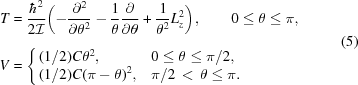
We recognize that this Hamiltonian, in each of the θ-regions above, is exactly that of a two-dimensional harmonic oscillator, provided we identify θ with the polar radius. As shown by the following estimates, the fall-off of the wavefunction is so fast that we can extend without any appreciable error the integral over θ up to infinity.
In the quadratic approximation, in the region  the eigenfunctions are

where

 are Laguerre polynomials and

The eigenvalues are

where

The first excited states have n = 0, lz = ±1, and, as we will see, they are the only states strongly coupled to the ground state by electromagnetic radiation. As shown in Fig. 2, they describe the precession of the atom at an angle  ≃
≃  around the axis of the unit cell.
If the ion is spinless its wavefunction is invariant under the inversion of the orientation of its symmetry axis, that is, not observable. A discussion of the consequences of this symmetry can be found by Palumbo, (2014) but will be ignored here because most RE ions do have a non-vanishing spin.
The dynamics are determined by the magnitude of the zero-point fluctuations . When  the axis of the rotor can be assumed to lie along the z-axis, the direction of easy magnetization, and its zero-point fluctuations can be ignored. For ≃ 1, the zero-point fluctuations cannot be neglected, but the rotor is still polarized within an angle of order . For
  1, there is no polarization at all.
We quote the values of in various systems: in the atomic nuclei (Iudice & Palumbo, 1978) of the REs, 
 10-2; in the crystal LaMnO3,
  , depending on how the moment of inertia and restoring force constant are evaluated. Note that in the mentioned compound the deformed ion is Mn.
3. Estimates of the parameters
For numerical evaluations we need estimates of the and of the restoring force constant C of the RE ions.
For the we should assume, consistently with our ORM, the expression appropriate to a rigid body,

where me is the electron mass,  is the mean square radius of the electrons that contribute to the and Z is their number. We must then establish which are the electrons that effectively take part in the rotation. Indeed one might include or exclude in the evaluation of those electrons whose distribution has a spherical shape (Hatada et al., 2012). For a RE this means including or excluding all the electrons of the inner shells and the 4f-electrons that have a spherical density. In the presence of locking, however, the 4f-electrons that have a spherical distribution have a non-vanishing spin and therefore rotate with the electrons which determine the charge deformation, so that the ambiguity is restricted to the inner shells. If we assume that only the 4f-electrons participate in the rotation, we can set
  =
=  a02 (a0 0.5 Å) and Z = Z4f 10 if we consider, for instance, Dy, Ho and Er, thus obtaining

The main contribution to the restoring force comes from the interaction between the electric quadrupole moment of the RE ion and the electric quadrupole moment of the ligands. So the expression of C depends on the specific structure. One example of its calculation is given by Hatada et al. (2005), but here we do not want to restrict ourselves to particular cases. Therefore we will avoid the evaluation of C and parametrize the energy of the scissors modes according to

We will assume that must be smaller than 1 if the RE ion must be polarized, and in specific cases we indeed found 0.5.
It is also interesting to estimate the resolution power for our experiment. The expression of the width of the scissors mode was determined by Hatada et al. (2010, 2012),

Notice the strong dependence on . With our parametrization of the energy we obtain

We must note that the above expression is not entirely consistent, because, while the expression of the scissors mode energy has a general validity, the width was evaluated for a specific structure of the crystal cell. Nevertheless, we think it should be sufficient to give an order of magnitude of the resolving power.
4. Estimate of the magnetic field generated by photon absorption
We assume that all the crystal unit cells have their easy axis parallel to the z-axis of the laboratory frame. This situation is realised in single crystals and can be easily achieved by applying a convenient magnetic field. Otherwise an average over the cell axes should be performed, as given by Hatada et al. (2014). We also assume that the photons are circularly polarized (left or right is not relevant). The change of the magnetic moment of the target is given by the probability to excite a scissors mode multiplied by the scissors mode magnetic moment minus the ground-state magnetic moment. It can be seen that the spin contribution is  times smaller than the orbital one and therefore will be neglected. The orbital in the ground state vanishes and then

where tflux is the duration of the Na is the effective number of atoms in the sample,  is the and w is the photon absorption probability per unit time per unit frequency, that is given by

In the above equation, me is the electron mass, α the fine-structure constant, c the velocity of light,  the number of photons of energy ω per unit volume and
  the magnetic matrix element,

where

and  = ±1 is the photon polarization.
Using the expression of the wavefunctions, for the quantum numbers f = (0,m), i = (00),


so that

where  is the Compton wavelength of the electron, ω the photon frequency,
  the frequency spread, Nphot the number of incoming photons per unit time and Ssource the of the photon beam.
The effective number of atoms is given by

where ρ is the number of atoms per unit volume, Ssamp is the sample surface and  is the photon r.m.s. path. The above formula holds provided is smaller than the sample thickness.
We assume the bandwidth to be proportional to the photon frequency according to

so that finally

A reasonable assumption is that

so that

The strength of the magnetic field along the z-axis generated by this variation of the magnetic moment at a distance r is

where  is the vacuum magnetic permeability.
Next we assume


To proceed further with numerical estimates we must distinguish the case of a dense RE compound sample as a crystal from the case of gels containing highly diluted RE atoms.
All the following numerical estimates will be carried out in SI units. Then

and

4.1. Dense matter
We assume one RE atom per and a cell volume of (3.5 A)3 = 4.3 × 10⁻²⁹ m3, so that  = 2.3 × 1028 m−3.
We then have

and

Setting

we obtain

where tflux is in seconds. Assuming an acquisition of 1 h, we should measure a of the order of 10−7 T, which is lower than the Earth's magnetic field on the surface, whose magnitude ranges from 20 to 100 µT. However, we can increase the signal by reducing the distance r of the detector and increasing the acquisition time and the intensity.
Examples of suitable compounds for the proposed experiments are R2Fe14B and R2Fe17N3 in which the RE ions can be Dy, Ho and Er. We remind that the spin contribution to the variation of the is times smaller than the orbital contribution. Since all the quoted REs have Z4f ≃ 10 and gJ ≃ 10, if is not sufficiently small the spin contribution cannot be neglected.
Finally, we remark that the ions Gd3+ and La3+, being spherical, do not have an orbital response. They can then be used to exclude, by comparison, spurious effects.
4.2. Soft matter
The difference with respect to a crystal is due to the difference of RE density and photon r.m.s. path,

If x is the percentage in weight of RE atoms in a gel made of Ngel atoms of mass mgel,

Assuming mgel/mRE ≃ 0.1,  ≃ 0.5 × 10²¹ m−3,

With a percentage in weight of x = 0.05 we will have a B 10-21 tflux T. Considering that 10−15 T is the minimum value of the magnetic field actually detectable by existing SQUID devices, we should imagine an acquisition of tens or even hundreds of hours or reduce significantly the distance and increase the flux intensity to be able to detect a signal from such a diluted RE system.
5. Conclusion
The previous experiments designed to observe scissors modes in dense matter are affected by two orders of difficulty. The first one is the detection of photons in a wide energy spectrum, due to the uncertainty in the theoretical value of the energy of these excitations, that ranges between ten and a few tens of eV. The second one is the need of a of the order of 107, much larger than that routinely used, that is of the order of 102 to 104. These difficulties might also explain why, if scissors modes exist, they have not been noticed until now.
We propose here an original approach based on a new experimental layout in which, instead of detecting the decay photons, one has to measure with a sensitive SQUID detector the magnetic field associated with the excitation of scissors modes induced by photon absorption. For such an experiment we only need a sufficient flux of photons and a spectrum of the source sufficiently wide to cover the theoretical range of the scissors modes energy.
The experimental method we propose here should help to eliminate spurious signals and will offer several advantages over routinely used techniques:
(i) There should be no magnetic response with a source of linearly polarized photons.
(ii) The intensity of the variation of the magnetic field should decrease as the inverse of the cubic distance between the SQUID sensor and the sample.
(iii) There should be no magnetic response from spherical RE ions.
(iv) Because our calculations are performed assuming that the unit cells axes are aligned, the induced variation of magnetic field should be proportional to the square of the cosine of the angle between the direction of the photons and the easy axes of the cells.
In single crystals, ion axes are naturally aligned while in other systems a suitable alignment can be achieved by applying an external magnetic field. As far as RE dispersed in gels matrices are concerned, it appears possible to synthesize samples with a significant alignment. However, if the direction of the unit cells axes are disordered, we must perform an average, as performed by Hatada et al. (2014) for nanoparticles. Obviously such an average does not change the order of magnitude of the results.
In this work we separately considered both dense compounds and light systems such as RE ions dispersed in a gel matrix. In the first case with the available photon fluxes in a synchrotron radiation facility in the ultraviolet energy range, we estimated the variation of the magnetic field to be of the order of 10−7 T. This value has to be compared with the typical precision of measurement of the terrestrial magnetic field that is of the order of nanoTeslas.
In the second case, with a small amount of RE ions dispersed in a gel matrix, our estimate yields a magnetic field whose magnitude is well beyond the sensitivity of these superconducting devices. Our approach in this case, although unfeasible at present, is much more interesting from a theoretical point of view. Indeed, for such dilute systems our basic assumption that the RE ions are independent of one another is completely justified and therefore the theoretical interpretation of the results is much cleaner. Experiments on gels, however, could soon become feasible by improving the experimental layout, e.g. with a smaller device–sample distance, improving the SQUID with a dedicated design or, in the future, using a free-electron laser source in order to have a in the ultraviolet energy range three to four orders of magnitude higher then that available with a storage ring.
This original approach can be easily tested and become a powerful technique that we think might be used for the investigation and search of similar behaviours, which may occur in many other systems, in particular in actinides samples in which paramagnetic and deformed atoms can be present in different concentrations.
References
 Abramowitz, M. & Stegun, I. A. (1972). Handbook of Mathematical Functions, p. 753. New York: Dover. Google Scholar
Bohle, D., Richter, A., Steffen, W., Dieperink, A. E. L., Lo Iudice, N., Palumbo, F. & Scholten, O. (1984). Phys. Lett. B, 137, 27–31. CrossRef Google Scholar
Chudnovskii, E. M. (1979). J. Exp. Theor. Phys. 50, 1035. Google Scholar
Chudnovsky, E. M. (1992). Phys. Rev. A, 46, 8011–8014. CrossRef PubMed Google Scholar
Chudnovsky, E. M. (1994). Phys. Rev. Lett. 72, 3433–3436. CrossRef PubMed CAS Google Scholar
Chudnovsky, E. M. & Garanin, D. A. (1997). Phys. Rev. Lett. 79, 4469–4472. CrossRef Google Scholar
Chudnovsky, E. M. & Gunther, L. (1988). Phys. Rev. Lett. 60, 661–664. CrossRef PubMed CAS Google Scholar
Enders, J., Kaiser, H., von Neumann-Cosel, P., Rangacharyulu, C. & Richter, A. (1999). Phys. Rev. C. 59, R1851–R1854. CrossRef CAS Google Scholar
Friedman, J. R. (2003). Resonant Magnetization Tunneling in Molecular Magnets, in Exploring the Quantum/Classical Frontier: Recent Advances in Macroscopic and Mesoscopic Quantum Phenomena, edited by J. R. Friedman and S. Han. Huntington: Nova Science. Google Scholar
Garanin, D. A. & Chudnovsky, E. M. (1997). Phys. Rev. B, 56, 11102. CrossRef Google Scholar
Grabert, H. & Weiss, U. (1984). Phys. Rev. Lett. 53, 1787–1790. CrossRef Google Scholar
Guéry-Odelin, D. & Stringari, S. (1999). Phys. Rev. Lett. 83, 4452–4455. Google Scholar
Hatada, K., Hayakawa, K., Marcelli, A. & Palumbo, F. (2014). Phys. Chem. Chem. Phys. 16, 24055–24062. CrossRef CAS PubMed Google Scholar
Hatada, K., Hayakawa, K. & Palumbo, F. (2005). Phys. Rev. B, 71, 092402. CrossRef Google Scholar
Hatada, K., Hayakawa, K. & Palumbo, F. (2010). Eur. Phys. J. B, 77, 41–45. CrossRef CAS Google Scholar
Hatada, K., Hayakawa, K. & Palumbo, F. (2012). Eur. Phys. J. B, 85, 183. CrossRef Google Scholar
Iudice, N. L. (2000). Riv. Nuov. Cim. 23, 1. Google Scholar
Iudice, N. L. & Palumbo, F. (1978). Phys. Rev. Lett. 41, 1532–1534. CrossRef Google Scholar
Lipparini, E. & Stringari, S. (1989). Phys. Rev. Lett. 63, 570–572. CrossRef PubMed CAS Google Scholar
Maragò, O. M., Hopkins, S. A., Arlt, J., Hodby, E., Hechenblaikner, G. & Foot, C. J. (2000). Phys. Rev. Lett. 84, 2056–2059. PubMed Google Scholar
Minguzzi, A. & Tosi, M. P. (2001). Phys. Rev. A, 63, 023609. CrossRef Google Scholar
Palumbo, F. (2014). arXiv:1409.7298. Google Scholar
Portales, H., Duval, E., Saviot, L., Fujii, M., Sumitomo, M. & Hayashi, S. (2001). Phys. Rev. B, 63, 233402. CrossRef Google Scholar
Serra, Ll., Puente, A. & Lipparini, E. (1999). Phys. Rev. B, 60, R13966–R13969. CrossRef CAS Google Scholar
Smentek, L. & Wybourne, B. G. (2007). Optical Spectroscopy of Lanthanides: Magnetic and Hyperfine Interactions. Boca Raton: CRC Press. Google Scholar
© International Union of Crystallography. Prior permission is not required to reproduce short quotations, tables and figures from this article, provided the original authors and source are cited. For more information, click here.
| JOURNAL OF SYNCHROTRON RADIATION |


