journal menu


issue contents
 | STRUCTURAL SCIENCE CRYSTAL ENGINEERING MATERIALS |
ISSN: 2052-5206
Editors' selection of articles from Acta Cryst. B, Structural Science, Crystal Engineering and Materials
This virtual collection from Acta Crystallographica Section B, Structural Science, Crystal Engineering and Materials showcases a selection of articles from the journal.


Download citation


Download citation
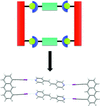
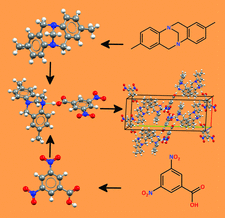
A new tecton, 1,8-diiodoethynylanthracene, with two halogen-bond donor sites was synthesized and characterized. This tecton is capable of forming two parallel halogen bonds at once, which makes it a useful building block for the construction of a variety of supramolecular squares and rectangles.
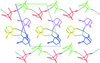
An in-depth investigation of the Z′ > 4 structures of organic molecules archived in the Cambridge Structural Database has shown that the group is very diverse but that most structures are the result of a simple modulation and/or of a hydrogen-bonded aggregate that has at most approximate symmetry.
Download citation
Download citation
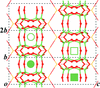
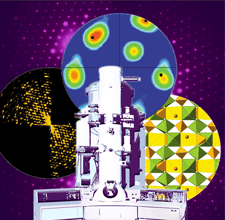
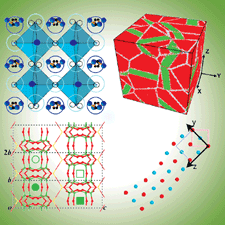
The microstructure of zeolite IM-18 with correlated disorder was elucidated by simulating the diffuse scattering of powder and single-crystal diffraction patterns. The method could be applied to other multidimensional disordered structures.
CCDC reference: 1857218
Download citation
Download citation
Open  access
access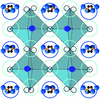
Pressure-induced transformation of CH3NH3PbI3: the role of the noble-gas pressure transmitting media
A structural study of methylammonium lead triiodide [CH3NH3PbI3 (MAPbI3)], at high pressures up to 20 GPa using noble gases Ne and Ar as pressure-transmitting media is reported. It is found that both noble gases are chemically active at high pressures. In particular, Ne stabilizes the high-pressure structure of NexMAPbI3 and prevents amorphization up to 20 GPa. In contrast, Ar acts as a stabilizer only up to 2.4 GPa and accelerates irreversible amorphization upon further compression.
Download citation
Download citation

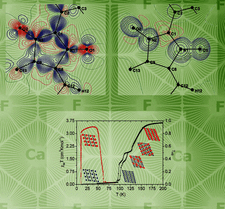
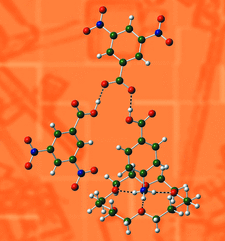
We report the experimental observation of a `unique' and `rare' F⋯O interaction, involving two electronegative atoms, having the characteristics of `short interatomic distance' and `high directionality' that provide robustness to the crystal packing. The characterization of these F⋯O contacts via different computational procedures establish the interaction to be dispersive in nature and the mutual polarization of an O atom by F and vice versa provides real physical insights into the role of atomic polarizability in interacting atoms in molecules in crystals.
CCDC reference: 1477385
Download citation
Download citation
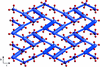
The high-pressure behaviour of monoclinic phosphoric acid is presented and a new high-pressure orthorhombic phase is reported. The molecule–molecule interaction energies of the orthorhombic phase are shown to be more attractive than those of the low-pressure monoclinic phase.
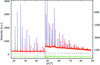
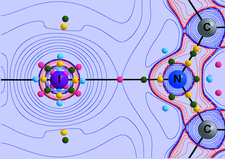
The structure factors of diamond at 800 K at sin θ/λ ≤ 2.2 Å−1 were determined from multiple overlaid powder profiles. Data correction was essential to extract the Bragg intensities of the weak reflections. The quality of the final charge density determined at 800 K was nearly comparable with that of room-temperature data.
Download citation
Download citation
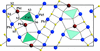
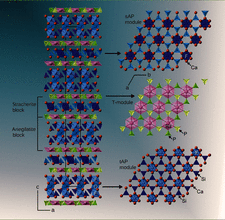
The crystal structure of the mineral meneghinite, CuPb13Sb7S24, has been solved and refined as an incommensurate structure from X-ray single-crystal diffraction data in four-dimensional superspace. The very small departure from the commensurate value of the modulation raises the question of whether incommensurability in sulfosalts could be much more frequent than previously thought.
B-IncStrDB reference: 13202EGzpbI
CCDC reference: 1533002
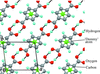
A model for the X-ray diffuse scattering from terephthalic acid (C8H6O4) is presented, and used to explore the sensitivity of diffuse scattering to polymorphic interconversion, and to demonstrate the relative ease with which the harmonic (`thermal') component of the diffuse scattering can be modelled.
Open access
access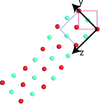
The combinations of phase transitions which occur in Heusler alloys in terms of order parameters and symmetry have been analysed using a group theoretical approach. It is shown how this approach can be applied to relevant examples.
Download citation
Download citation
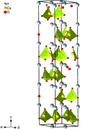
The complex oxide YCuO2.66 is shown to be twinned at the nanoscale. Its structure was solved using precession electron diffraction.
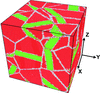
Evolutions of microstructure and crystal defects in the nanocrystalline WC–Co composite during room- and high-temperature deformations were studied using molecular dynamics simulations.