

 journal menu


issue contents
 | STRUCTURAL BIOLOGY |
ISSN: 2059-7983
CCP4 Study Weekend 2024
Decision making in MX – how to be a productive structural biologist
Edited by Helen Ginn, Nicholas Pearce and Clemens Vonrhein
This virtual issue collects together articles from the 2024 CCP4 Study Weekend.


Free 
The Guest Editors introduce the special issue based on talks at the CCP4 Study Weekend 2024. The virtual issue is available at https://journals.iucr.org/special_issues/2026/CCP42024/.

Open access
access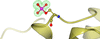
This review explores the importance of post-translational modifications (PTMs) in the Protein Data Bank and identifies examples of well modelled PTMs.
Open access
access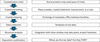
It is discussed how the metadata for the workflow from protein crystallization to the deposition of crystal structures can best be captured by using a dedicated but flexible laboratory information management system that can be either a standalone installation or a hosted service to mitigate the IT risks.
Open access
access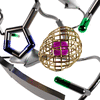
This article examines the application of anomalous scattering for the identification of elements within crystal structures of macromolecules.
Open access
access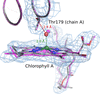
The Crystallography Open Database was mined to extract and organize metal environments. An algorithm and software were designed to apply the derived data to metal-containing components.
Open access
access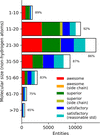
A database of validated ligand restraints computed using various levels of quantum mechanics is generated and distributed with Phenix to streamline and improve macromolecular refinement results.
Open access
access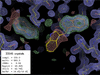
We describe a simple test to determine whether sufficient data have been collected during a serial crystallographic experiment, and its incorporation into the autoprocessing pipeline at the T-REXX endstation on beamline P14 at the PETRA III synchrotron.
Open access
access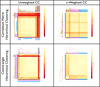
Bovine, porcine and human insulin data sets are isomorphous in terms of unit cell and symmetry. Through enhancements to the multi-crystal clustering methods in DIALS, species-pure data sets are automatically separated by new uncertainty-weighted calculations of pairwise correlation coefficients, algorithm improvements and integration of the OPTICS spatial density clustering method.
Open access
access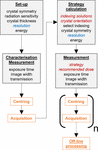
This paper presents and explains a workflow program for automatically deriving, optimizing and executing complex multi-sweep diffraction experiments for macromolecular crystallography at synchrotron beamlines.
Open access
access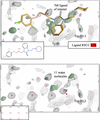
Flawed protein–ligand X-ray structures can misdirect drug discovery based on PDB-deposited models. This review uses publicly available PDB examples to highlight potential pitfalls, from absent ligands to incorrect chemistry, and presents a practical validation approach to improve model reliability.


