journal menu


issue contents
 | STRUCTURAL BIOLOGY |
ISSN: 2059-7983
Image-processing methods for electron microscopy of biological specimens
Edited by Carlos Oscar Sorzano , Alberto Bartesaghi and Amit Singer
This virtual issue collects together articles from the 2025 call for papers on image-processing methods for electron microscopy of biological specimens.
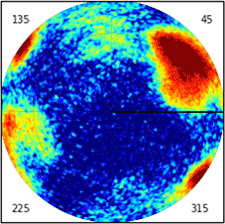
Cover illustration: Distribution of views for the 40S human ribosomal particle experimental data set used in the explicit correction of severely non-uniform distributions of cryo-EM views.


Open  access
access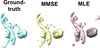
A Bayesian perspective on orientation estimation in cryo-EM is presented, with the minimum mean-square error estimator outperforming standard cross-correlation-based approaches, particularly under challenging low signal-to-noise conditions. We demonstrate that improved orientation estimation has a decisive impact on 3D reconstruction quality and structural heterogeneity recovery.
Open access
access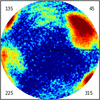
An explicit numerical leveling of non-uniformly distributed sets of 2D projections with the program VUE improves the 3D reconstructions and illustrates sources of image distortion.

Open access
access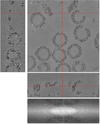
Cryo-ET is a rapidly emerging technique that enables 3D visualization of complex biological structures, but present limits on signal-to-noise ratio and reconstruction quality pose challenges for downstream analysis. Here, we present a systematic analysis of state-of-the-art deep-learning methods for contrast enhancement and propose improvements in neural network architectures and training objectives to preserve more high-resolution information.
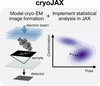
The authors have developed cryoJAX, a cryo-EM image-simulation library for developing data-analysis techniques across cryo-EM modalities. CryoJAX is built on JAX, an emerging scientific computing framework in Python well suited for cryo-EM data analysis.
Open access
access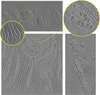
We present ICECREAM, a self-supervised approach that achieves substantially better denoising and more reliable missing-wedge recovery in cryo-ET, while reducing training and inference time relative to comparable baselines.

Open access
access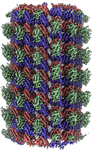
Cryo-EM reconstructions of microtubules are currently technically challenging and time-consuming for average users. A cryo-EM processing pipeline for microtubules using CryoSPARC has been developed that overcomes many of these current issues.
Open access
access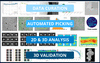
We present a fully automated, unattended cryo-EM pipeline that serves as an on-the-fly diagnostic tool, enabling rapid data-quality assessment and informed decision-making to maximize data-collection efficiency.