 | Acta Crystallographica Section E Acta Crystallographica Section E CRYSTALLOGRAPHIC COMMUNICATIONS |


 journal menu


organic compounds
| CRYSTALLOGRAPHIC COMMUNICATIONS |
 access
Biguanidinium dichloride

aChemistry Department, `Sapienza' University of Rome, P. le A. Moro, 5, I-00185 Rome, Italy
*Correspondence e-mail: [email protected]
The of the title compound, C2H9N52+·2Cl−, is composed of one diprotonated biguanidinium cation and two chloride anions. The diprotonated cation consists of two planar halves twisted by 36.42 (6)°. The ions are associated in the crystal structure by extensive hydrogen bonding into a three-dimensional network; the diprotonated biguanidinium cation is hydrogen bonded to the chloride anions.
Related literature
For a general approach to the use of multiple-hydrogen-bonding DNA/RNA nucleobases as potential supramolecular reagents, see: Portalone & Colapietro (2004![[Portalone, G. & Colapietro, M. (2004). Acta Cryst. E60, o1165-o1166.]](../../../../../../logos/arrows/e_arr.gif "Portalone, G. & Colapietro, M. (2004). Acta Cryst. E60, o1165-o1166.") , 2007 and references therein). For related crystal structures, see: Ernst (1977); Pinkerton & Schwarzenbach (1978); Martin & Pinkerton (1996); Martin et al. (1996, 1997); Kurzer & Pitchfork (1968).
, 2007 and references therein). For related crystal structures, see: Ernst (1977); Pinkerton & Schwarzenbach (1978); Martin & Pinkerton (1996); Martin et al. (1996, 1997); Kurzer & Pitchfork (1968).
![[Scheme 1]](kp2161scheme1.gif)
Experimental
Crystal data
|
Refinement
|
|
 ; (iii)
  ; (iv)
  .
. Data collection: CrysAlis CCD (Oxford Diffraction, 2006; cell refinement: CrysAlis RED (Oxford Diffraction, 2006; data reduction: CrysAlis RED; program(s) used to solve structure: SIR97 (Altomare et al., 1999); program(s) used to refine structure: SHELXL97 (Sheldrick, 2008); molecular graphics: ORTEP-3 (Farrugia, 1997); software used to prepare material for publication: WinGX (Farrugia, 1999).
Supporting information
contains datablocks global, I. DOI: 10.1107/S1600536808006144/kp2161sup1.cif
Structure factors: contains datablock I. DOI: 10.1107/S1600536808006144/kp2161Isup2.hkl
Biguanide (0.1 mmol, Sigma Aldrich at 98% purity) was dissolved in water (9 ml) and heated under reflux for 2 h. After cooling a solution to an ambient temperature, while stirring, HCl (6 mol L-1) was added dropwise until the pH = 2. Crystals suitable for single-crystal X-ray diffraction were obtained by slow evaporation of the solvent after a few days.
Data collection: CrysAlis CCD (Oxford Diffraction, 2006); cell CrysAlis RED (Oxford Diffraction, 2006); data reduction: CrysAlis RED (Oxford Diffraction, 2006); program(s) used to solve structure: SIR97 (Altomare et al., 1999); program(s) used to refine structure: SHELXL97 (Sheldrick, 2008); molecular graphics: ORTEP-3 (Farrugia, 1997); software used to prepare material for publication: WinGX (Farrugia, 1999).
![[Figure 1]](./kp2161fig1thm.gif) | Fig. 1. The molecular structure of (I) showing the atom-labelling scheme. Displacements ellipsoids are at the 50% probability level. |
![[Figure 2]](./kp2161fig2thm.gif) | Fig. 2. Crystal packing diagram for (I) viewed approximately down a. All atoms are shown as small spheres of arbitrary radii. Hydrogen bonding is indicated by dashed lines. |
| C2H9N52+·2Cl− | F(000) = 360 |
| Mr = 174.04 | Dx = 1.613 Mg m−3 |
| Monoclinic, P21/c | Mo Kα radiation, λ = 0.71073 Å |
| Hall symbol: -P 2ybc | Cell parameters from 80724 reflections |
| a = 6.43693 (9) Å | θ = 3.2–32.0° |
| b = 16.93420 (18) Å | µ = 0.83 mm−1 |
| c = 6.65260 (8) Å | T = 298 K |
| β = 98.6878 (12)° | Plate, colourless |
| V = 716.84 (2) Å3 | 0.20 × 0.20 × 0.15 mm |
| Z = 4 |
| Oxford Diffraction Xcalibur S CCD diffractometer | 2456 independent reflections |
| Radiation source: Enhance (Mo) X-ray source | 2349 reflections with I > 2σ(I) |
| Graphite monochromator | Rint = 0.020 |
| Detector resolution: 16.0696 pixels mm-1 | θmax = 32.0°, θmin = 3.2° |
| ω and ϕ scans | h = −9→9 |
| Absorption correction: multi-scan (CrysAlis RED; Oxford Diffraction, 2006) | k = −25→25 |
| Tmin = 0.852, Tmax = 0.886 | l = −9→9 |
| 80724 measured reflections |
| Refinement on F2 | Secondary atom site location: difference Fourier map |
| Least-squares matrix: full | Hydrogen site location: inferred from neighbouring sites |
| R[F2 > 2σ(F2)] = 0.027 | All H-atom parameters refined |
| wR(F2) = 0.071 | w = 1/[σ2(Fo2) + (0.0293P)2 + 0.2376P] where P = (Fo2 + 2Fc2)/3 |
| S = 1.14 | (Δ/σ)max < 0.001 |
| 2456 reflections | Δρmax = 0.14 e Å−3 |
| 119 parameters | Δρmin = −0.14 e Å−3 |
| 0 restraints | Extinction correction: SHELXL97 (Sheldrick, 2008), Fc*=kFc[1+0.001xFc2λ3/sin(2θ)]-1/4 |
| Primary atom site location: structure-invariant direct methods | Extinction coefficient: 0.110 (6) |
| C2H9N52+·2Cl− | V = 716.84 (2) Å3 |
| Mr = 174.04 | Z = 4 |
| Monoclinic, P21/c | Mo Kα radiation |
| a = 6.43693 (9) Å | µ = 0.83 mm−1 |
| b = 16.93420 (18) Å | T = 298 K |
| c = 6.65260 (8) Å | 0.20 × 0.20 × 0.15 mm |
| β = 98.6878 (12)° |
| Oxford Diffraction Xcalibur S CCD diffractometer | 2456 independent reflections |
| Absorption correction: multi-scan (CrysAlis RED; Oxford Diffraction, 2006) | 2349 reflections with I > 2σ(I) |
| Tmin = 0.852, Tmax = 0.886 | Rint = 0.020 |
| 80724 measured reflections |
| R[F2 > 2σ(F2)] = 0.027 | 0 restraints |
| wR(F2) = 0.071 | All H-atom parameters refined |
| S = 1.14 | Δρmax = 0.14 e Å−3 |
| 2456 reflections | Δρmin = −0.14 e Å−3 |
| 119 parameters |
Geometry. All e.s.d.'s (except the e.s.d. in the dihedral angle between two l.s. planes) are estimated using the full covariance matrix. The cell e.s.d.'s are taken into account individually in the estimation of e.s.d.'s in distances, angles and torsion angles; correlations between e.s.d.'s in cell parameters are only used when they are defined by crystal symmetry. An approximate (isotropic) treatment of cell e.s.d.'s is used for estimating e.s.d.'s involving l.s. planes. |
Refinement. Refinement of F2 against ALL reflections. The weighted R-factor wR and goodness of fit S are based on F2, conventional R-factors R are based on F, with F set to zero for negative F2. The threshold expression of F2 > σ(F2) is used only for calculating R-factors(gt) etc. and is not relevant to the choice of reflections for refinement. R-factors based on F2 are statistically about twice as large as those based on F, and R- factors based on ALL data will be even larger. |
| x | y | z | Uiso*/Ueq | ||
| Cl1 | 0.86502 (5) | −0.053995 (15) | 0.27026 (4) | 0.03288 (9) | |
| Cl2 | 0.62775 (5) | 0.315420 (18) | 0.37349 (5) | 0.03605 (9) | |
| N1 | 0.35152 (13) | 0.16618 (5) | 0.32041 (15) | 0.02556 (17) | |
| H1 | 0.430 (3) | 0.2034 (10) | 0.356 (3) | 0.039 (4)* | |
| N2 | 0.00539 (15) | 0.12772 (6) | 0.20409 (16) | 0.02955 (19) | |
| H21 | 0.025 (3) | 0.0812 (11) | 0.243 (3) | 0.038 (4)* | |
| H22 | −0.109 (3) | 0.1408 (11) | 0.130 (3) | 0.048 (5)* | |
| N3 | 0.09938 (18) | 0.25798 (6) | 0.21118 (17) | 0.0335 (2) | |
| H31 | −0.025 (3) | 0.2708 (11) | 0.195 (3) | 0.046 (5)* | |
| H32 | 0.193 (3) | 0.2941 (11) | 0.232 (3) | 0.044 (5)* | |
| N4 | 0.38953 (17) | 0.03968 (6) | 0.18533 (15) | 0.0304 (2) | |
| H41 | 0.461 (3) | −0.0045 (12) | 0.196 (3) | 0.050 (5)* | |
| H42 | 0.308 (3) | 0.0513 (11) | 0.078 (3) | 0.047 (5)* | |
| N5 | 0.62338 (15) | 0.08686 (7) | 0.45410 (16) | 0.0324 (2) | |
| H51 | 0.646 (3) | 0.1178 (11) | 0.556 (3) | 0.044 (5)* | |
| H52 | 0.711 (3) | 0.0485 (11) | 0.440 (3) | 0.051 (5)* | |
| C1 | 0.14797 (15) | 0.18273 (5) | 0.24248 (14) | 0.02118 (17) | |
| C2 | 0.45468 (15) | 0.09538 (6) | 0.31785 (15) | 0.02354 (18) |
| U11 | U22 | U33 | U12 | U13 | U23 | |
| Cl1 | 0.04007 (15) | 0.02213 (13) | 0.03406 (15) | 0.00402 (9) | −0.00208 (10) | −0.00296 (9) |
| Cl2 | 0.03243 (14) | 0.03940 (16) | 0.03375 (15) | −0.01269 (10) | −0.00333 (10) | 0.00083 (10) |
| N1 | 0.0205 (4) | 0.0213 (4) | 0.0344 (4) | −0.0012 (3) | 0.0024 (3) | −0.0021 (3) |
| N2 | 0.0220 (4) | 0.0256 (4) | 0.0390 (5) | −0.0017 (3) | −0.0020 (3) | 0.0058 (4) |
| N3 | 0.0368 (5) | 0.0215 (4) | 0.0420 (6) | 0.0052 (4) | 0.0055 (4) | 0.0047 (4) |
| N4 | 0.0379 (5) | 0.0269 (4) | 0.0257 (4) | 0.0089 (4) | 0.0022 (4) | −0.0017 (3) |
| N5 | 0.0253 (4) | 0.0399 (5) | 0.0312 (5) | 0.0067 (4) | 0.0010 (3) | 0.0010 (4) |
| C1 | 0.0229 (4) | 0.0203 (4) | 0.0208 (4) | 0.0012 (3) | 0.0047 (3) | 0.0022 (3) |
| C2 | 0.0218 (4) | 0.0261 (4) | 0.0238 (4) | 0.0022 (3) | 0.0068 (3) | 0.0031 (3) |
| N1—C1 | 1.3634 (13) | N3—H32 | 0.857 (19) |
| N1—C2 | 1.3719 (13) | N4—C2 | 1.3156 (14) |
| N1—H1 | 0.819 (18) | N4—H41 | 0.88 (2) |
| N2—C1 | 1.3056 (13) | N4—H42 | 0.846 (19) |
| N2—H21 | 0.833 (18) | N5—C2 | 1.3131 (14) |
| N2—H22 | 0.852 (19) | N5—H51 | 0.853 (19) |
| N3—C1 | 1.3211 (13) | N5—H52 | 0.874 (19) |
| N3—H31 | 0.823 (19) | ||
| C1—N1—C2 | 127.89 (9) | H41—N4—H42 | 121.2 (17) |
| C1—N1—H1 | 117.6 (12) | C2—N5—H51 | 120.4 (12) |
| C2—N1—H1 | 113.6 (12) | C2—N5—H52 | 119.2 (13) |
| C1—N2—H21 | 122.9 (12) | H51—N5—H52 | 120.4 (17) |
| C1—N2—H22 | 116.6 (13) | N2—C1—N3 | 120.97 (10) |
| H21—N2—H22 | 120.4 (17) | N2—C1—N1 | 122.31 (9) |
| C1—N3—H31 | 118.5 (13) | N3—C1—N1 | 116.70 (9) |
| C1—N3—H32 | 121.3 (12) | N5—C2—N4 | 122.04 (10) |
| H31—N3—H32 | 119.0 (17) | N5—C2—N1 | 116.03 (10) |
| C2—N4—H41 | 116.7 (12) | N4—C2—N1 | 121.93 (9) |
| C2—N4—H42 | 119.7 (12) | ||
| C2—N1—C1—N2 | 19.96 (17) | C1—N1—C2—N5 | −159.12 (10) |
| C2—N1—C1—N3 | −161.49 (10) | C1—N1—C2—N4 | 21.55 (17) |
| D—H···A | D—H | H···A | D···A | D—H···A |
| N1—H1···Cl2 | 0.819 (18) | 2.279 (18) | 3.0796 (9) | 166.0 (16) |
| N2—H21···Cl1i | 0.833 (18) | 2.530 (18) | 3.2557 (10) | 146.4 (15) |
| N2—H22···Cl2ii | 0.852 (19) | 2.34 (2) | 3.1714 (10) | 167.1 (17) |
| N3—H31···Cl2i | 0.823 (19) | 2.787 (19) | 3.5098 (12) | 147.8 (16) |
| N3—H32···Cl1iii | 0.857 (19) | 2.599 (19) | 3.1933 (10) | 127.4 (15) |
| N3—H32···Cl2 | 0.857 (19) | 2.835 (19) | 3.5454 (12) | 141.3 (15) |
| N4—H41···Cl1 | 0.88 (2) | 2.703 (19) | 3.4178 (11) | 139.4 (16) |
| N4—H42···Cl1iv | 0.846 (19) | 2.412 (19) | 3.2295 (10) | 162.8 (17) |
| N5—H51···Cl2v | 0.853 (19) | 2.413 (19) | 3.2404 (12) | 163.7 (16) |
| N5—H52···Cl1 | 0.874 (19) | 2.369 (19) | 3.1905 (11) | 156.7 (17) |
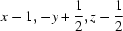
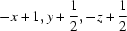
| Symmetry codes: (i) x−1, y, z; (ii) x−1, −y+1/2, z−1/2; (iii) −x+1, y+1/2, −z+1/2; (iv) −x+1, −y, −z; (v) x, −y+1/2, z+1/2. |
Experimental details
| Crystal data | |
| Chemical formula | C2H9N52+·2Cl− |
| Mr | 174.04 |
| Crystal system, space group | Monoclinic, P21/c |
| Temperature (K) | 298 |
| a, b, c (Å) | 6.43693 (9), 16.93420 (18), 6.65260 (8) |
| β (°) | 98.6878 (12) |
| V (Å3) | 716.84 (2) |
| Z | 4 |
| Radiation type | Mo Kα |
| µ (mm−1) | 0.83 |
| Crystal size (mm) | 0.20 × 0.20 × 0.15 |
| Data collection | |
| Diffractometer | Oxford Diffraction Xcalibur S CCD diffractometer |
| Absorption correction | Multi-scan (CrysAlis RED; Oxford Diffraction, 2006) |
| Tmin, Tmax | 0.852, 0.886 |
| No. of measured, independent and observed [I > 2σ(I)] reflections | 80724, 2456, 2349 |
| Rint | 0.020 |
| (sin θ/λ)max (Å−1) | 0.745 |
| Refinement | |
| R[F2 > 2σ(F2)], wR(F2), S | 0.027, 0.071, 1.14 |
| No. of reflections | 2456 |
| No. of parameters | 119 |
| H-atom treatment | All H-atom parameters refined |
| Δρmax, Δρmin (e Å−3) | 0.14, −0.14 |
Computer programs: CrysAlis CCD (Oxford Diffraction, 2006), CrysAlis RED (Oxford Diffraction, 2006), SIR97 (Altomare et al., 1999), SHELXL97 (Sheldrick, 2008), ORTEP-3 (Farrugia, 1997), WinGX (Farrugia, 1999).
| D—H···A | D—H | H···A | D···A | D—H···A |
| N1—H1···Cl2 | 0.819 (18) | 2.279 (18) | 3.0796 (9) | 166.0 (16) |
| N2—H21···Cl1i | 0.833 (18) | 2.530 (18) | 3.2557 (10) | 146.4 (15) |
| N2—H22···Cl2ii | 0.852 (19) | 2.34 (2) | 3.1714 (10) | 167.1 (17) |
| N3—H31···Cl2i | 0.823 (19) | 2.787 (19) | 3.5098 (12) | 147.8 (16) |
| N3—H32···Cl1iii | 0.857 (19) | 2.599 (19) | 3.1933 (10) | 127.4 (15) |
| N3—H32···Cl2 | 0.857 (19) | 2.835 (19) | 3.5454 (12) | 141.3 (15) |
| N4—H41···Cl1 | 0.88 (2) | 2.703 (19) | 3.4178 (11) | 139.4 (16) |
| N4—H42···Cl1iv | 0.846 (19) | 2.412 (19) | 3.2295 (10) | 162.8 (17) |
| N5—H51···Cl2v | 0.853 (19) | 2.413 (19) | 3.2404 (12) | 163.7 (16) |
| N5—H52···Cl1 | 0.874 (19) | 2.369 (19) | 3.1905 (11) | 156.7 (17) |
| Symmetry codes: (i) x−1, y, z; (ii) x−1, −y+1/2, z−1/2; (iii) −x+1, y+1/2, −z+1/2; (iv) −x+1, −y, −z; (v) x, −y+1/2, z+1/2. |
Acknowledgements
We thank MIUR (Rome) for 2006 financial support of the project `X-ray diffractometry and spectrometry'.
References
 Altomare, A., Burla, M. C., Camalli, M., Cascarano, G. L., Giacovazzo, C., Guagliardi, A., Moliterni, A. G. G., Polidori, G. & Spagna, R. (1999). J. Appl. Cryst. 32, 115–119. Web of Science CrossRef CAS IUCr Journals Google Scholar
Ernst, S. R. (1977). Acta Cryst. B33, 237–240. CSD CrossRef CAS IUCr Journals Web of Science Google Scholar
Farrugia, L. J. (1997). J. Appl. Cryst. 30, 565. CrossRef IUCr Journals Google Scholar
Farrugia, L. J. (1999). J. Appl. Cryst. 32, 837–838. CrossRef CAS IUCr Journals Google Scholar
Kurzer, F. & Pitchfork, E. D. (1968). Fortschr. Chem. Forsch. 10, 375–472. CrossRef CAS Google Scholar
Martin, A. & Pinkerton, A. A. (1996). Acta Cryst. C52, 1048–1052. CSD CrossRef CAS Web of Science IUCr Journals Google Scholar
Martin, A., Pinkerton, A. A., Gilardi, R. D. & Bottaro, J. C. (1997). Acta Cryst. B53, 504–512. CSD CrossRef CAS Web of Science IUCr Journals Google Scholar
Martin, A., Pinkerton, A. A. & Schiemann, A. (1996). Acta Cryst. C52, 966–970. CSD CrossRef CAS Web of Science IUCr Journals Google Scholar
Oxford Diffraction (2006). CrysAlis CCD and CrysAlis RED. Oxford Diffraction Ltd, Abingdon, England. Google Scholar
Pinkerton, A. A. & Schwarzenbach, D. (1978). J. Chem. Soc. Dalton Trans. pp. 989–996. CSD CrossRef Web of Science Google Scholar
Portalone, G. & Colapietro, M. (2004). Acta Cryst. E60, o1165–o1166. Web of Science CSD CrossRef IUCr Journals Google Scholar
Portalone, G. & Colapietro, M. (2007). Acta Cryst. C63, o181–o184. Web of Science CSD CrossRef IUCr Journals Google Scholar
Sheldrick, G. M. (2008). Acta Cryst. A64, 112–122. Web of Science CrossRef CAS IUCr Journals Google Scholar
This is an open-access article distributed under the terms of the Creative Commons Attribution (CC-BY) Licence, which permits unrestricted use, distribution, and reproduction in any medium, provided the original authors and source are cited.
| CRYSTALLOGRAPHIC COMMUNICATIONS |


Biguanidine derivatives, characterized by multiple hydrogen-bond donor sites, are good candidates to be coupled in the crystal with carefully selected molecules having multiple hydrogen-bond acceptor sites (Portalone & Colapietro, 2004, 2007). As a part of a more general study of multiple-hydrogen-bonding DNA/RNA nucleobases as potential supramolecular reagents, this paper reports the crystal structure of the title compound, (I), BIGH22+2Cl-. The asymmetric unit of (I) (Fig. 1) consists of a diprotonated biguanidinium cation (BIGH22+) and two chloride anions; protonation occurs at the bridge N atom and the imino N atom of the biguanidine molecule. The structure of the delocalized cation is very similar to those previously reported for the carbonate (BIGH2)CO3 and the sulfates (BIGH2)SO4.2H2O and (BIGH2)SO4.H2O (Pinkerton & Schwarzenbach, 1978), the dinitrate (BIGH2)NO3 (Martin et al., 1996), the diperchlorate (BIGH2)2ClO4 (Martin & Pinkerton, 1996), the bis-dinitramide (BIGH2)(DN)2 and (BIGH2)(DN)2.H2O (Martin et al., 1997). BIGH22+ is composed of two planar halves sharing the atom N(1). These two planar parts are twisted with respect to each other by 36.42 (6)°. The C—N terminal bond lengths are shorter due to delocalization of π-electron density through the planar fragments. The lack of complete planarity of the cation is due to steric interaction between the hydrogen atoms. This interaction induces a strain in the molecule which is manifested by the opening of the angle at the bridging N atom [C1—N1—C2, 127.9 (1)°]. The weakening of the bridges bonds is due to the lowered basicity of the bridge N atom on protonation [pkaI = 11.5; pkaII = 2.9 (Kurzer & Pitchfork, 1968)] and is manifested by the longer C—N1 bridging bonds [1.363 (1) - 1.372 (1) Å] and the shorter terminal C—N bonds [1.306 (1) - 1.321 (1) Å], comparing with the corresponding ones reported for BIGH+Cl- (Ernst, 1977). Analysis of the crystal packing of (I) (Fig. 2) shows that the structure is stabilized by ten hydrogen bonds N—H···Cl- involving all protons (Table 1) which account for the relatively high density (Dx = 1.61 Mg m-3).