 | Acta Crystallographica Section E Acta Crystallographica Section E CRYSTALLOGRAPHIC COMMUNICATIONS |


 journal menu


organic compounds
| CRYSTALLOGRAPHIC COMMUNICATIONS |
 access
Pyromellitic acid–sarcosine (1/2)

aCEMDRX, Physics Department, University of Coimbra, P-3004-516 Coimbra, Portugal
*Correspondence e-mail: [email protected]
The title compound, C10H6O8·2C3H7NO2, crystallizes as an adduct with the acid and amino acid molecules in their neutral forms. The asymmetric unit contains one half of a centrosymmetric pyromellitic acid molecule and one sarcosine molecule. The sarcosine has the amine group protonated and the carboxyl group deprotonated, as is usual for amino acids (zwitterionic form). The pyromellitic acid molecules retain the four carboxyl H atoms with the carboxyl groups rotated out of the ring plane [O—C—C—C torsion angles = 24.1 (3) and 61.6 (2)°]. There is a three-dimensional hydrogen-bond network linking the molecules.
Related literature
For related compounds, see: Yaghi et al. (1997![[Yaghi, O. M., Davis, C. E., Li, G. M. & Li, H. L. (1997). J. Am. Chem. Soc. 119, 2861-2868.]](../../../../../../logos/arrows/e_arr.gif "Yaghi, O. M., Davis, C. E., Li, G. M. & Li, H. L. (1997). J. Am. Chem. Soc. 119, 2861-2868.") ); Arora & Pedireddi (2003); Rochon & Massarweh (2001); Kumagai et al. (2003).
); Arora & Pedireddi (2003); Rochon & Massarweh (2001); Kumagai et al. (2003).
![[Scheme 1]](dn2326scheme1.gif)
Experimental
Crystal data
|
Refinement
|
|
 ; (iii)
  ; (iv)
  .
. Data collection: SMART (Bruker, 2003); cell refinement: SAINT-Plus (Bruker, 2003); data reduction: SAINT-Plus (Bruker, 2003); program(s) used to solve structure: SHELXS97 (Sheldrick, 2008); program(s) used to refine structure: SHELXL97 (Sheldrick, 2008); molecular graphics: ORTEPIII (Burnett & Johnson, 1996), ORTEP-3 for Windows (Farrugia, 1997) and PLATON (Spek, 2003); software used to prepare material for publication: SHELXL97.
Supporting information
contains datablocks global, I. DOI: 10.1107/S1600536808009045/dn2326sup1.cif
Structure factors: contains datablock I. DOI: 10.1107/S1600536808009045/dn2326Isup2.hkl
0. 5 mmol of copper hydroxyfluoride were added to a 20 ml warmed ethanolic solution containing 1.5 mmol of 1,2,4,5-benzenetetracarboxylic acid and 1.5 mmol of sarcosine. After a few weeks, transparent, colourless crystals could be isolated from the solution.
H atoms coordinates were located from a difference Fourier map and refined freely. The Uiso(H) were restrained to be 1.2Ueq(parent atom).
Data collection: SMART (Bruker, 2003); cell SAINT-Plus (Bruker, 2003); data reduction: SAINT-Plus (Bruker, 2003); program(s) used to solve structure: SHELXS97 (Sheldrick, 2008); program(s) used to refine structure: SHELXL97 (Sheldrick, 2008); molecular graphics: ORTEPIII (Burnett & Johnson, 1996), ORTEP-3 for Windows (Farrugia, 1997) and PLATON (Spek, 2003); software used to prepare material for publication: SHELXL97 (Sheldrick, 2008).
![[Figure 1]](./dn2326fig1thm.gif) | Fig. 1. View of the title compound (I). Displacement ellipsoids are drawn at the 50% level. H atoms are represented as small spheres of arbitrary radii. H bond is represented as dashed line. [Symmetry code: (i) 1-x, 1-y, 2-z]. |
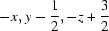
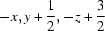
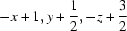
![[Figure 2]](./dn2326fig2thm.gif) | Fig. 2. Packing view of the title compound down the b axis. Hydrogen bonds are depicted as dashed lines. H atoms not involved in hydrogen bondings have been omitted for clarity. [Symmetry codes: (ii) -x, y-1/2, -z+3/2; (iii) -x, y+1/2, -z+3/2; (iv) -x+1, y+1/2, -z+3/2] |
| C10H6O8·2C3H7NO2 | F(000) = 452 |
| Mr = 432.34 | Dx = 1.524 Mg m−3 |
| Monoclinic, P21/c | Mo Kα radiation, λ = 0.71073 Å |
| Hall symbol: -P 2ybc | Cell parameters from 2870 reflections |
| a = 8.8894 (3) Å | θ = 2.4–23.7° |
| b = 5.4118 (2) Å | µ = 0.13 mm−1 |
| c = 20.2205 (7) Å | T = 293 K |
| β = 104.388 (2)° | Prism, colourless |
| V = 942.25 (6) Å3 | 0.47 × 0.10 × 0.07 mm |
| Z = 2 |
| Bruker APEX CCD area-detector diffractometer | 2351 independent reflections |
| Radiation source: fine-focus sealed tube | 1643 reflections with I > 2σ(I) |
| Graphite monochromator | Rint = 0.047 |
| ϕ and ω scans | θmax = 28.4°, θmin = 2.1° |
| Absorption correction: multi-scan (SADABS; Sheldrick, 2000) | h = −11→11 |
| Tmin = 0.915, Tmax = 0.998 | k = −7→7 |
| 16656 measured reflections | l = −27→27 |
| Refinement on F2 | Primary atom site location: structure-invariant direct methods |
| Least-squares matrix: full | Secondary atom site location: difference Fourier map |
| R[F2 > 2σ(F2)] = 0.041 | Hydrogen site location: inferred from neighbouring sites |
| wR(F2) = 0.115 | Only H-atom coordinates refined |
| S = 1.01 | w = 1/[σ2(Fo2) + (0.056P)2 + 0.2509P] where P = (Fo2 + 2Fc2)/3 |
| 2351 reflections | (Δ/σ)max < 0.001 |
| 166 parameters | Δρmax = 0.25 e Å−3 |
| 0 restraints | Δρmin = −0.21 e Å−3 |
| C10H6O8·2C3H7NO2 | V = 942.25 (6) Å3 |
| Mr = 432.34 | Z = 2 |
| Monoclinic, P21/c | Mo Kα radiation |
| a = 8.8894 (3) Å | µ = 0.13 mm−1 |
| b = 5.4118 (2) Å | T = 293 K |
| c = 20.2205 (7) Å | 0.47 × 0.10 × 0.07 mm |
| β = 104.388 (2)° |
| Bruker APEX CCD area-detector diffractometer | 2351 independent reflections |
| Absorption correction: multi-scan (SADABS; Sheldrick, 2000) | 1643 reflections with I > 2σ(I) |
| Tmin = 0.915, Tmax = 0.998 | Rint = 0.047 |
| 16656 measured reflections |
| R[F2 > 2σ(F2)] = 0.041 | 0 restraints |
| wR(F2) = 0.115 | Only H-atom coordinates refined |
| S = 1.01 | Δρmax = 0.25 e Å−3 |
| 2351 reflections | Δρmin = −0.21 e Å−3 |
| 166 parameters |
Geometry. All e.s.d.'s (except the e.s.d. in the dihedral angle between two l.s. planes) are estimated using the full covariance matrix. The cell e.s.d.'s are taken into account individually in the estimation of e.s.d.'s in distances, angles and torsion angles; correlations between e.s.d.'s in cell parameters are only used when they are defined by crystal symmetry. An approximate (isotropic) treatment of cell e.s.d.'s is used for estimating e.s.d.'s involving l.s. planes. |
Refinement. Refinement of F2 against ALL reflections. The weighted R-factor wR and goodness of fit S are based on F2, conventional R-factors R are based on F, with F set to zero for negative F2. The threshold expression of F2 > σ(F2) is used only for calculating R-factors(gt) etc. and is not relevant to the choice of reflections for refinement. R-factors based on F2 are statistically about twice as large as those based on F, and R- factors based on ALL data will be even larger. |
| x | y | z | Uiso*/Ueq | ||
| O1 | 0.19992 (15) | 0.1100 (3) | 0.89313 (8) | 0.0531 (4) | |
| O2 | 0.43230 (15) | −0.0346 (2) | 0.88997 (7) | 0.0415 (4) | |
| H2 | 0.389 (3) | −0.163 (4) | 0.8612 (11) | 0.050* | |
| C1 | 0.33933 (19) | 0.1205 (3) | 0.90904 (8) | 0.0291 (4) | |
| C2 | 0.42466 (17) | 0.3192 (3) | 0.95451 (8) | 0.0236 (3) | |
| C3 | 0.57683 (17) | 0.3865 (3) | 0.95565 (8) | 0.0239 (3) | |
| C4 | 0.65079 (18) | 0.5655 (3) | 1.00139 (8) | 0.0256 (3) | |
| H1 | 0.758 (2) | 0.621 (3) | 1.0018 (9) | 0.031* | |
| C5 | 0.66506 (19) | 0.2833 (3) | 0.90749 (8) | 0.0284 (4) | |
| O4 | 0.78636 (14) | 0.1742 (3) | 0.92796 (7) | 0.0418 (4) | |
| O3 | 0.61224 (16) | 0.3342 (3) | 0.84210 (6) | 0.0382 (3) | |
| H3 | 0.515 (2) | 0.430 (4) | 0.8318 (11) | 0.046* | |
| O5 | 0.35723 (14) | 0.5924 (2) | 0.81422 (6) | 0.0377 (3) | |
| O6 | 0.12981 (14) | 0.7404 (2) | 0.75521 (6) | 0.0365 (3) | |
| C6 | 0.23381 (18) | 0.5845 (3) | 0.76612 (8) | 0.0261 (4) | |
| C7 | 0.21727 (19) | 0.3602 (3) | 0.71983 (9) | 0.0284 (4) | |
| H7A | 0.205 (2) | 0.202 (4) | 0.7448 (9) | 0.034* | |
| H7B | 0.310 (2) | 0.343 (3) | 0.7009 (9) | 0.034* | |
| N1 | 0.07624 (17) | 0.3848 (3) | 0.66375 (8) | 0.0283 (3) | |
| H1A | −0.004 (2) | 0.404 (4) | 0.6805 (10) | 0.034* | |
| H1B | 0.087 (2) | 0.516 (4) | 0.6393 (10) | 0.034* | |
| C8 | 0.0406 (3) | 0.1733 (4) | 0.61676 (12) | 0.0437 (5) | |
| H8A | −0.047 (3) | 0.212 (4) | 0.5816 (12) | 0.052* | |
| H8B | 0.123 (3) | 0.159 (4) | 0.5931 (11) | 0.052* | |
| H8C | 0.033 (3) | 0.037 (5) | 0.6395 (12) | 0.052* |
| U11 | U22 | U33 | U12 | U13 | U23 | |
| O1 | 0.0296 (7) | 0.0604 (10) | 0.0672 (10) | −0.0132 (6) | 0.0080 (6) | −0.0350 (8) |
| O2 | 0.0364 (7) | 0.0329 (7) | 0.0517 (8) | −0.0029 (6) | 0.0042 (6) | −0.0215 (6) |
| C1 | 0.0313 (9) | 0.0282 (9) | 0.0271 (8) | −0.0057 (7) | 0.0061 (7) | −0.0040 (7) |
| C2 | 0.0250 (8) | 0.0231 (8) | 0.0213 (8) | −0.0009 (6) | 0.0030 (6) | −0.0020 (6) |
| C3 | 0.0240 (7) | 0.0247 (8) | 0.0227 (8) | 0.0016 (6) | 0.0054 (6) | −0.0013 (6) |
| C4 | 0.0227 (7) | 0.0282 (9) | 0.0255 (8) | −0.0026 (6) | 0.0052 (6) | −0.0021 (7) |
| C5 | 0.0275 (8) | 0.0283 (9) | 0.0298 (9) | −0.0015 (7) | 0.0079 (7) | −0.0059 (7) |
| O4 | 0.0333 (7) | 0.0487 (8) | 0.0437 (8) | 0.0126 (6) | 0.0105 (6) | −0.0056 (6) |
| O3 | 0.0410 (7) | 0.0487 (8) | 0.0271 (7) | 0.0070 (6) | 0.0128 (5) | −0.0032 (6) |
| O5 | 0.0416 (7) | 0.0326 (7) | 0.0321 (7) | 0.0032 (6) | −0.0034 (5) | −0.0080 (5) |
| O6 | 0.0374 (7) | 0.0330 (7) | 0.0393 (7) | 0.0073 (6) | 0.0098 (6) | −0.0068 (6) |
| C6 | 0.0295 (8) | 0.0253 (8) | 0.0242 (8) | −0.0017 (7) | 0.0079 (6) | −0.0009 (7) |
| C7 | 0.0292 (9) | 0.0258 (9) | 0.0274 (9) | 0.0031 (7) | 0.0019 (7) | −0.0028 (7) |
| N1 | 0.0255 (7) | 0.0285 (8) | 0.0292 (8) | 0.0006 (6) | 0.0036 (6) | −0.0038 (6) |
| C8 | 0.0486 (12) | 0.0370 (11) | 0.0390 (11) | 0.0027 (10) | −0.0015 (10) | −0.0142 (9) |
| O1—C1 | 1.202 (2) | O5—C6 | 1.273 (2) |
| O2—C1 | 1.302 (2) | O6—C6 | 1.230 (2) |
| O2—H2 | 0.93 (2) | C6—C7 | 1.518 (2) |
| C1—C2 | 1.493 (2) | C7—N1 | 1.473 (2) |
| C2—C4i | 1.390 (2) | C7—H7A | 1.02 (2) |
| C2—C3 | 1.396 (2) | C7—H7B | 0.995 (19) |
| C3—C4 | 1.387 (2) | N1—C8 | 1.471 (2) |
| C3—C5 | 1.502 (2) | N1—H1A | 0.87 (2) |
| C4—C2i | 1.390 (2) | N1—H1B | 0.88 (2) |
| C4—H1 | 0.997 (18) | C8—H8A | 0.94 (2) |
| C5—O4 | 1.209 (2) | C8—H8B | 0.97 (2) |
| C5—O3 | 1.318 (2) | C8—H8C | 0.88 (2) |
| O3—H3 | 0.98 (2) | ||
| C1—O2—H2 | 118.4 (14) | O5—C6—C7 | 115.53 (14) |
| O1—C1—O2 | 125.37 (16) | N1—C7—C6 | 109.64 (13) |
| O1—C1—C2 | 122.06 (16) | N1—C7—H7A | 106.5 (11) |
| O2—C1—C2 | 112.57 (14) | C6—C7—H7A | 112.0 (10) |
| C4i—C2—C3 | 119.49 (14) | N1—C7—H7B | 109.9 (11) |
| C4i—C2—C1 | 117.78 (14) | C6—C7—H7B | 110.5 (11) |
| C3—C2—C1 | 122.70 (14) | H7A—C7—H7B | 108.2 (15) |
| C4—C3—C2 | 119.36 (14) | C8—N1—C7 | 115.63 (15) |
| C4—C3—C5 | 117.05 (14) | C8—N1—H1A | 106.3 (13) |
| C2—C3—C5 | 123.53 (14) | C7—N1—H1A | 109.5 (13) |
| C3—C4—C2i | 121.14 (14) | C8—N1—H1B | 107.4 (13) |
| C3—C4—H1 | 120.5 (10) | C7—N1—H1B | 108.1 (13) |
| C2i—C4—H1 | 118.3 (11) | H1A—N1—H1B | 109.8 (18) |
| O4—C5—O3 | 120.72 (15) | N1—C8—H8A | 108.6 (14) |
| O4—C5—C3 | 121.66 (15) | N1—C8—H8B | 108.0 (14) |
| O3—C5—C3 | 117.36 (14) | H8A—C8—H8B | 103.5 (18) |
| C5—O3—H3 | 113.4 (12) | N1—C8—H8C | 110.2 (16) |
| O6—C6—O5 | 125.48 (16) | H8A—C8—H8C | 115 (2) |
| O6—C6—C7 | 118.98 (15) | H8B—C8—H8C | 111 (2) |
| O1—C1—C2—C4i | 24.1 (3) | C5—C3—C4—C2i | 176.64 (15) |
| O2—C1—C2—C4i | −155.56 (15) | C4—C3—C5—O4 | 61.6 (2) |
| O1—C1—C2—C3 | −157.90 (18) | C2—C3—C5—O4 | −121.1 (2) |
| O2—C1—C2—C3 | 22.4 (2) | C4—C3—C5—O3 | −112.73 (18) |
| C4i—C2—C3—C4 | 0.7 (3) | C2—C3—C5—O3 | 64.5 (2) |
| C1—C2—C3—C4 | −177.23 (15) | O6—C6—C7—N1 | 4.9 (2) |
| C4i—C2—C3—C5 | −176.47 (15) | O5—C6—C7—N1 | −175.62 (15) |
| C1—C2—C3—C5 | 5.5 (3) | C6—C7—N1—C8 | −176.75 (17) |
| C2—C3—C4—C2i | −0.8 (3) |
| Symmetry code: (i) −x+1, −y+1, −z+2. |
| D—H···A | D—H | H···A | D···A | D—H···A |
| O2—H2···O5ii | 0.93 (2) | 1.61 (2) | 2.5216 (18) | 166 (2) |
| O3—H3···O5 | 0.98 (2) | 1.62 (2) | 2.6026 (18) | 179 (2) |
| N1—H1A···O6iii | 0.87 (2) | 2.11 (2) | 2.854 (2) | 143.4 (17) |
| N1—H1A···O1iv | 0.87 (2) | 2.28 (2) | 2.7262 (19) | 111.8 (15) |
| N1—H1B···O4v | 0.88 (2) | 2.15 (2) | 2.917 (2) | 145.5 (16) |
| Symmetry codes: (ii) x, y−1, z; (iii) −x, y−1/2, −z+3/2; (iv) −x, y+1/2, −z+3/2; (v) −x+1, y+1/2, −z+3/2. |
Experimental details
| Crystal data | |
| Chemical formula | C10H6O8·2C3H7NO2 |
| Mr | 432.34 |
| Crystal system, space group | Monoclinic, P21/c |
| Temperature (K) | 293 |
| a, b, c (Å) | 8.8894 (3), 5.4118 (2), 20.2205 (7) |
| β (°) | 104.388 (2) |
| V (Å3) | 942.25 (6) |
| Z | 2 |
| Radiation type | Mo Kα |
| µ (mm−1) | 0.13 |
| Crystal size (mm) | 0.47 × 0.10 × 0.07 |
| Data collection | |
| Diffractometer | Bruker APEX CCD area-detector diffractometer |
| Absorption correction | Multi-scan (SADABS; Sheldrick, 2000) |
| Tmin, Tmax | 0.915, 0.998 |
| No. of measured, independent and observed [I > 2σ(I)] reflections | 16656, 2351, 1643 |
| Rint | 0.047 |
| (sin θ/λ)max (Å−1) | 0.669 |
| Refinement | |
| R[F2 > 2σ(F2)], wR(F2), S | 0.041, 0.115, 1.01 |
| No. of reflections | 2351 |
| No. of parameters | 166 |
| H-atom treatment | Only H-atom coordinates refined |
| Δρmax, Δρmin (e Å−3) | 0.25, −0.21 |
Computer programs: SMART (Bruker, 2003), SAINT-Plus (Bruker, 2003), SHELXS97 (Sheldrick, 2008), SHELXL97 (Sheldrick, 2008), ORTEPIII (Burnett & Johnson, 1996), ORTEP-3 for Windows (Farrugia, 1997) and PLATON (Spek, 2003).
| D—H···A | D—H | H···A | D···A | D—H···A |
| O2—H2···O5i | 0.93 (2) | 1.61 (2) | 2.5216 (18) | 166 (2) |
| O3—H3···O5 | 0.98 (2) | 1.62 (2) | 2.6026 (18) | 179 (2) |
| N1—H1A···O6ii | 0.87 (2) | 2.11 (2) | 2.854 (2) | 143.4 (17) |
| N1—H1A···O1iii | 0.87 (2) | 2.28 (2) | 2.7262 (19) | 111.8 (15) |
| N1—H1B···O4iv | 0.88 (2) | 2.15 (2) | 2.917 (2) | 145.5 (16) |
| Symmetry codes: (i) x, y−1, z; (ii) −x, y−1/2, −z+3/2; (iii) −x, y+1/2, −z+3/2; (iv) −x+1, y+1/2, −z+3/2. |
Acknowledgements
This work was supported by Fundação para a Ciência e a Tecnologia (FCT) under project POCI/FIS/57876/2004.
References
 Arora, K. K. & Pedireddi, V. R. (2003). J. Org. Chem. 68, 9177–9185. Web of Science CSD CrossRef PubMed CAS Google Scholar
Bruker (2003). SMART and SAINT-Plus. Bruker AXS Inc., Madison, Wisconsin, USA. Google Scholar
Burnett, M. N. & Johnson, C. K. (1996). ORTEPIII. Report ORNL-6895. Oak Ridge National Laboratory, Tennessee, USA. Google Scholar
Farrugia, L. J. (1997). J. Appl. Cryst. 30, 565. CrossRef IUCr Journals Google Scholar
Kumagai, H., Chapman, K. W., Kepert, C. J. & Kurmoo, M. (2003). Polyhedron, 22, 1921–1927. Web of Science CSD CrossRef CAS Google Scholar
Rochon, F. D. & Massarweh, G. (2001). Inorg. Chim. Acta, 314, 163–171. Web of Science CSD CrossRef CAS Google Scholar
Sheldrick, G. M. (2000). SADABS. University of Göttingen, Germany. Google Scholar
Sheldrick, G. M. (2008). Acta Cryst. A64, 112–122. Web of Science CrossRef CAS IUCr Journals Google Scholar
Spek, A. L. (2003). J. Appl. Cryst. 36, 7–13. Web of Science CrossRef CAS IUCr Journals Google Scholar
Yaghi, O. M., Davis, C. E., Li, G. M. & Li, H. L. (1997). J. Am. Chem. Soc. 119, 2861–2868. CSD CrossRef CAS Web of Science Google Scholar
This is an open-access article distributed under the terms of the Creative Commons Attribution (CC-BY) Licence, which permits unrestricted use, distribution, and reproduction in any medium, provided the original authors and source are cited.
| CRYSTALLOGRAPHIC COMMUNICATIONS |


1,2,4,5-benzenetetracarboxylic acid (pyromellitic) is frequently chosen as a building block for crystal engineering due to its predictable properties and interesting supramolecular properties: It has provided three-dimensional porous networks (Yaghi et al., 1997), host–guest systems (Arora & Pedireddi, 2003), mixed metallic systems (Rochon & Massarweh, 2001) and complex magnetic behaviours (Kumagai et al., 2003). In an attempt to synthesize a low dimensional compound with copper, 1,2,4,5-benzenetetracarboxylic acid and sarcosine (as an auxiliary ligand), we have obtained the title compound, (I).
The midpoint of the acidic molecule lies on an inversion centre thus these molecules exhibit a Ci symmetry (Fig. 1). All four carboxylic groups retain the hydrogen atom and rotate around the C—C bond. Torsion angles O1—C1—C2—C4 24.1 (3)° and C4—C3—C5—O4 61.6 (2)° show different degrees of rotation. Sarcosine (N-methyl-glycine) crystallizes in the zwitterionic form with the amine group protonated and the carboxylic group deprotonated. The molecule when viewed along the C6—C7 bond shows the oxygen atoms anti to each other and the nitrogen atom synperiplanar to O6 [O6—C6—C7—N1 4.9 (2)°]. There is an extensive three-dimensional newtork of hydrogen bonds linking the molecules. Sarcosine molecules are assembled in chains via the N1—H1A···O6 bond (Table 1), running along the b axis. The chains are all interconnected through the remaining H bonds, since each sarcosine molecule is H-bonded to four benzenetetracarboxylic neighbours, (Fig. 2).