 | Acta Crystallographica Section E Acta Crystallographica Section E CRYSTALLOGRAPHIC COMMUNICATIONS |


 journal menu


organic compounds
| CRYSTALLOGRAPHIC COMMUNICATIONS |
 access
1,4-Dimethyl-3-phenyl-3H-pyrazolo[3,4-c]isoquinolin-5(4H)-one

aInstitute of Pharmaceutical and Toxicological Chemistry `P. Pratesi', University of Milan, via L. Mangiagalli 25, 20133 Milan, Italy, and bDepartment of Pharmaceutical and Technological Chemistry, University of Palermo, via Archirafi 32, 90123 Palermo, Italy
*Correspondence e-mail: [email protected]
The title compound, C18H15N3O, is the product of the thermal decomposition of the diazonium salt derived from 2-amino-N-methyl-N-(3-methyl-1-phenyl-1H-pyrazol-5-yl)benzamide. It is characterized by a trans orientation of the methyl groups with respect to the tricyclic ring system. The molecule has a nearly planar phenylpyrazolo[3,4-c]isoquinolin-5-one system, the largest deviation from the mean plane being 0.066 (2) Å for the O atom. The dihedral angle between the phenyl substituent and the heterotricycle is 67 (1)°. The packing is stabilized by C—H⋯N hydrogen-bond interactions, with the formation of molecular chains along the c axis.
Related literature
Pyrazole rings are useful templates to investigate the role of the aryldiazonium group in the Pschorr reaction pathway (Maggio et al., 2005![[Maggio, B., Daidone, G., Raffa, D., Plescia, S., Bombieri, G. & Meneghetti, F. (2005). Helv. Chim. Acta, 88, 2272-2281.]](../../../../../../logos/arrows/e_arr.gif "Maggio, B., Daidone, G., Raffa, D., Plescia, S., Bombieri, G. & Meneghetti, F. (2005). Helv. Chim. Acta, 88, 2272-2281.") ). For related literature, see: Daidone et al. (1980, 1993, 1998).
). For related literature, see: Daidone et al. (1980, 1993, 1998).
![[Scheme 1]](fj2107scheme1.gif)
Experimental
Crystal data
|
Data collection
|
Refinement
|
| |||||||||||||||||
 .
. Data collection: CAD-4 EXPRESS (Enraf–Nonius, 1994); cell refinement: CAD-4 EXPRESS; data reduction: XCAD4 (Harms & Wocadlo, 1995); program(s) used to solve structure: SIR92 (Altomare et al., 1994); program(s) used to refine structure: SHELXL97 (Sheldrick, 2008); molecular graphics: ORTEP-3 for Windows (Farrugia, 1997); software used to prepare material for publication: WinGX (Farrugia, 1999).
Supporting information
contains datablocks I, global. DOI: 10.1107/S1600536808010180/fj2107sup1.cif
Structure factors: contains datablock I. DOI: 10.1107/S1600536808010180/fj2107Isup2.hkl
The title compound was obtained as the product of the thermal decomposition of the diazonium salt derived from 2-amino-N-methyl-N-(3-methyl-1-phenyl-1H-pyrazol-5-yl)benzamide.
All non-H-atoms were refined anisotropically. Hydrogen atoms were introduced at calculated positions, in their described geometries and allowed to ride on the attached carbon atom with fixed isotropic thermal parameters (1.2Ueq and 1.5Ueq of the parent carbon atom for aromatic H-atoms and methyls H-atoms, respectively).
Data collection: CAD-4 EXPRESS (Enraf–Nonius, 1994); cell CAD-4 EXPRESS (Enraf–Nonius, 1994); data reduction: XCAD4 (Harms & Wocadlo, 1995); program(s) used to solve structure: SIR92 (Altomare et al., 1994); program(s) used to refine structure: SHELXL97 (Sheldrick, 2008); molecular graphics: ORTEP-3 for Windows (Farrugia, 1997); software used to prepare material for publication: WinGX (Farrugia, 1999).
![[Figure 1]](./fj2107fig1thm.gif) | Fig. 1. The chemical reaction scheme. |
![[Figure 2]](./fj2107fig2thm.gif) | Fig. 2. The molecular structure of the title compound, showing atom-labelling scheme. Displacement ellipsoids are drawn at the 50% probability level. |
![[Figure 3]](./fj2107fig3thm.gif) | Fig. 3. Intermolecular interactions of the title compound, showing the molecular chains along the c axis. Hydrogen bonds are shown as dashed lines. |
| C18H15N3O | F(000) = 608 |
| Mr = 289.33 | Dx = 1.339 Mg m−3 |
| Monoclinic, P21/n | Mo Kα radiation, λ = 0.71073 Å |
| Hall symbol: -P 2yn | Cell parameters from 25 reflections |
| a = 8.066 (2) Å | θ = 9–10° |
| b = 19.256 (3) Å | µ = 0.09 mm−1 |
| c = 9.270 (3) Å | T = 293 K |
| β = 94.66 (3)° | Prism, colorless |
| V = 1435.0 (6) Å3 | 0.6 × 0.5 × 0.4 mm |
| Z = 4 |
| Enraf–Nonius TurboCAD-4 diffractometer | Rint = 0.031 |
| Radiation source: fine-focus sealed tube | θmax = 26.0°, θmin = 3.1° |
| Graphite monochromator | h = −9→9 |
| Non–profiled ω/2θ scans | k = 0→23 |
| 2984 measured reflections | l = 0→11 |
| 2815 independent reflections | 3 standard reflections every 120 min |
| 1751 reflections with I > 2σ(I) | intensity decay: 3% |
| Refinement on F2 | Secondary atom site location: difference Fourier map |
| Least-squares matrix: full | Hydrogen site location: inferred from neighbouring sites |
| R[F2 > 2σ(F2)] = 0.048 | H-atom parameters constrained |
| wR(F2) = 0.113 | w = 1/[σ2(Fo2) + 1.3459P] where P = (Fo2 + 2Fc2)/3 |
| S = 1.01 | (Δ/σ)max = 0.006 |
| 2815 reflections | Δρmax = 0.16 e Å−3 |
| 202 parameters | Δρmin = −0.15 e Å−3 |
| 0 restraints | Extinction correction: SHELXL97 (Sheldrick, 2008), Fc*=kFc[1+0.001xFc2λ3/sin(2θ)]-1/4 |
| Primary atom site location: structure-invariant direct methods | Extinction coefficient: 0.043 (3) |
| C18H15N3O | V = 1435.0 (6) Å3 |
| Mr = 289.33 | Z = 4 |
| Monoclinic, P21/n | Mo Kα radiation |
| a = 8.066 (2) Å | µ = 0.09 mm−1 |
| b = 19.256 (3) Å | T = 293 K |
| c = 9.270 (3) Å | 0.6 × 0.5 × 0.4 mm |
| β = 94.66 (3)° |
| Enraf–Nonius TurboCAD-4 diffractometer | Rint = 0.031 |
| 2984 measured reflections | 3 standard reflections every 120 min |
| 2815 independent reflections | intensity decay: 3% |
| 1751 reflections with I > 2σ(I) |
| R[F2 > 2σ(F2)] = 0.048 | 0 restraints |
| wR(F2) = 0.113 | H-atom parameters constrained |
| S = 1.01 | Δρmax = 0.16 e Å−3 |
| 2815 reflections | Δρmin = −0.15 e Å−3 |
| 202 parameters |
Geometry. All e.s.d.'s (except the e.s.d. in the dihedral angle between two l.s. planes) are estimated using the full covariance matrix. The cell e.s.d.'s are taken into account individually in the estimation of e.s.d.'s in distances, angles and torsion angles; correlations between e.s.d.'s in cell parameters are only used when they are defined by crystal symmetry. An approximate (isotropic) treatment of cell e.s.d.'s is used for estimating e.s.d.'s involving l.s. planes. |
Refinement. Refinement of F2 against ALL reflections. The weighted R-factor wR and goodness of fit S are based on F2, conventional R-factors R are based on F, with F set to zero for negative F2. The threshold expression of F2 > σ(F2) is used only for calculating R-factors(gt) etc. and is not relevant to the choice of reflections for refinement. R-factors based on F2 are statistically about twice as large as those based on F, and R- factors based on ALL data will be even larger. |
| x | y | z | Uiso*/Ueq | ||
| O1 | 0.62196 (18) | 0.08361 (7) | 0.50784 (16) | 0.0628 (4) | |
| N1 | 0.93284 (19) | −0.15752 (8) | 0.28089 (16) | 0.0508 (4) | |
| N2 | 0.89261 (18) | −0.12641 (8) | 0.40852 (16) | 0.0447 (4) | |
| C1 | 0.8813 (2) | −0.11483 (10) | 0.1753 (2) | 0.0470 (5) | |
| C2 | 0.8049 (2) | −0.05543 (9) | 0.22995 (19) | 0.0415 (4) | |
| C3 | 0.8148 (2) | −0.06473 (9) | 0.37789 (19) | 0.0395 (4) | |
| C4 | 0.9007 (2) | −0.17029 (9) | 0.53322 (19) | 0.0417 (4) | |
| C5 | 0.7563 (2) | −0.19339 (10) | 0.5872 (2) | 0.0504 (5) | |
| H5 | 0.6535 | −0.1779 | 0.5469 | 0.060* | |
| C6 | 0.7650 (3) | −0.23975 (11) | 0.7016 (2) | 0.0571 (6) | |
| H6 | 0.6680 | −0.2551 | 0.7391 | 0.068* | |
| C7 | 0.9167 (3) | −0.26301 (10) | 0.7598 (2) | 0.0586 (6) | |
| H7 | 0.9222 | −0.2948 | 0.8355 | 0.070* | |
| C8 | 1.0615 (3) | −0.23927 (10) | 0.7063 (2) | 0.0592 (6) | |
| H8 | 1.1642 | −0.2545 | 0.7471 | 0.071* | |
| C9 | 1.0537 (2) | −0.19281 (10) | 0.5918 (2) | 0.0496 (5) | |
| H9 | 1.1506 | −0.1770 | 0.5549 | 0.060* | |
| N3 | 0.76230 (18) | −0.01656 (8) | 0.47488 (16) | 0.0427 (4) | |
| C10 | 0.6777 (2) | 0.04286 (10) | 0.4218 (2) | 0.0460 (5) | |
| C11 | 0.6673 (2) | 0.05442 (9) | 0.2651 (2) | 0.0458 (5) | |
| C12 | 0.7305 (2) | 0.00692 (10) | 0.1681 (2) | 0.0446 (5) | |
| C13 | 0.7159 (3) | 0.02280 (11) | 0.0198 (2) | 0.0581 (6) | |
| H13 | 0.7562 | −0.0083 | −0.0457 | 0.070* | |
| C14 | 0.6434 (3) | 0.08330 (12) | −0.0299 (3) | 0.0681 (6) | |
| H14 | 0.6348 | 0.0929 | −0.1286 | 0.082* | |
| C15 | 0.5829 (3) | 0.13036 (12) | 0.0653 (3) | 0.0665 (6) | |
| H15 | 0.5345 | 0.1716 | 0.0309 | 0.080* | |
| C16 | 0.5943 (2) | 0.11612 (11) | 0.2113 (2) | 0.0586 (6) | |
| H16 | 0.5530 | 0.1479 | 0.2749 | 0.070* | |
| C18 | 0.7939 (3) | −0.02364 (10) | 0.63194 (19) | 0.0529 (5) | |
| H18A | 0.7052 | −0.0496 | 0.6694 | 0.079* | |
| H18B | 0.8000 | 0.0216 | 0.6756 | 0.079* | |
| H18C | 0.8972 | −0.0476 | 0.6539 | 0.079* | |
| C17 | 0.9067 (3) | −0.13436 (12) | 0.0218 (2) | 0.0668 (6) | |
| H17A | 0.9664 | −0.1775 | 0.0208 | 0.100* | |
| H17B | 0.9694 | −0.0987 | −0.0214 | 0.100* | |
| H17C | 0.8006 | −0.1394 | −0.0320 | 0.100* |
| U11 | U22 | U33 | U12 | U13 | U23 | |
| O1 | 0.0762 (10) | 0.0510 (9) | 0.0636 (10) | 0.0104 (7) | 0.0201 (8) | −0.0068 (7) |
| N1 | 0.0585 (10) | 0.0518 (10) | 0.0430 (10) | 0.0078 (8) | 0.0096 (8) | −0.0067 (8) |
| N2 | 0.0528 (10) | 0.0429 (9) | 0.0388 (9) | 0.0041 (7) | 0.0070 (7) | −0.0005 (7) |
| C1 | 0.0490 (11) | 0.0520 (11) | 0.0405 (11) | −0.0016 (9) | 0.0060 (8) | −0.0056 (10) |
| C2 | 0.0444 (10) | 0.0429 (11) | 0.0374 (10) | −0.0027 (8) | 0.0055 (8) | −0.0014 (9) |
| C3 | 0.0380 (10) | 0.0400 (10) | 0.0409 (11) | −0.0038 (8) | 0.0046 (8) | −0.0025 (9) |
| C4 | 0.0468 (11) | 0.0382 (10) | 0.0402 (11) | −0.0012 (8) | 0.0030 (8) | −0.0032 (8) |
| C5 | 0.0464 (11) | 0.0561 (12) | 0.0484 (12) | −0.0026 (10) | 0.0030 (9) | −0.0014 (10) |
| C6 | 0.0665 (14) | 0.0578 (13) | 0.0481 (12) | −0.0148 (11) | 0.0118 (11) | −0.0022 (11) |
| C7 | 0.0893 (17) | 0.0431 (12) | 0.0426 (12) | −0.0036 (11) | 0.0014 (11) | 0.0009 (9) |
| C8 | 0.0641 (14) | 0.0507 (13) | 0.0600 (14) | 0.0091 (10) | −0.0116 (11) | −0.0007 (11) |
| C9 | 0.0482 (11) | 0.0452 (11) | 0.0549 (12) | −0.0022 (9) | 0.0007 (9) | −0.0025 (10) |
| N3 | 0.0488 (9) | 0.0420 (9) | 0.0380 (9) | −0.0013 (7) | 0.0075 (7) | −0.0034 (7) |
| C10 | 0.0455 (11) | 0.0400 (11) | 0.0534 (12) | −0.0023 (9) | 0.0094 (9) | −0.0030 (9) |
| C11 | 0.0437 (10) | 0.0436 (11) | 0.0501 (12) | −0.0026 (9) | 0.0048 (9) | 0.0044 (10) |
| C12 | 0.0438 (11) | 0.0467 (11) | 0.0433 (11) | −0.0080 (9) | 0.0024 (9) | 0.0015 (9) |
| C13 | 0.0686 (14) | 0.0578 (14) | 0.0480 (13) | −0.0017 (11) | 0.0056 (10) | 0.0050 (11) |
| C14 | 0.0792 (16) | 0.0678 (15) | 0.0565 (15) | −0.0022 (13) | 0.0006 (12) | 0.0168 (12) |
| C15 | 0.0652 (14) | 0.0598 (14) | 0.0735 (16) | 0.0044 (11) | 0.0000 (12) | 0.0256 (13) |
| C16 | 0.0551 (13) | 0.0503 (12) | 0.0713 (15) | 0.0030 (10) | 0.0098 (11) | 0.0067 (11) |
| C18 | 0.0676 (13) | 0.0530 (12) | 0.0386 (11) | −0.0022 (10) | 0.0076 (9) | −0.0058 (9) |
| C17 | 0.0786 (15) | 0.0777 (16) | 0.0449 (13) | 0.0079 (12) | 0.0099 (11) | −0.0136 (11) |
| O1—C10 | 1.230 (2) | C9—H9 | 0.9300 |
| N1—C1 | 1.319 (2) | N3—C10 | 1.401 (2) |
| N1—N2 | 1.3879 (19) | N3—C18 | 1.464 (2) |
| N2—C3 | 1.362 (2) | C10—C11 | 1.466 (3) |
| N2—C4 | 1.429 (2) | C11—C16 | 1.400 (3) |
| C1—C2 | 1.412 (2) | C11—C12 | 1.407 (2) |
| C1—C17 | 1.502 (2) | C12—C13 | 1.404 (3) |
| C2—C3 | 1.379 (2) | C13—C14 | 1.366 (3) |
| C2—C12 | 1.440 (3) | C13—H13 | 0.9300 |
| C3—N3 | 1.382 (2) | C14—C15 | 1.382 (3) |
| C4—C9 | 1.377 (2) | C14—H14 | 0.9300 |
| C4—C5 | 1.378 (2) | C15—C16 | 1.376 (3) |
| C5—C6 | 1.384 (3) | C15—H15 | 0.9300 |
| C5—H5 | 0.9300 | C16—H16 | 0.9300 |
| C6—C7 | 1.371 (3) | C18—H18A | 0.9600 |
| C6—H6 | 0.9300 | C18—H18B | 0.9600 |
| C7—C8 | 1.383 (3) | C18—H18C | 0.9600 |
| C7—H7 | 0.9300 | C17—H17A | 0.9600 |
| C8—C9 | 1.385 (3) | C17—H17B | 0.9600 |
| C8—H8 | 0.9300 | C17—H17C | 0.9600 |
| C1—N1—N2 | 106.38 (15) | O1—C10—N3 | 119.15 (18) |
| C3—N2—N1 | 109.53 (14) | O1—C10—C11 | 123.45 (18) |
| C3—N2—C4 | 132.37 (15) | N3—C10—C11 | 117.34 (17) |
| N1—N2—C4 | 115.84 (14) | C16—C11—C12 | 119.19 (18) |
| N1—C1—C2 | 111.02 (16) | C16—C11—C10 | 118.10 (18) |
| N1—C1—C17 | 119.19 (17) | C12—C11—C10 | 122.70 (17) |
| C2—C1—C17 | 129.78 (18) | C13—C12—C11 | 118.58 (18) |
| C3—C2—C1 | 105.07 (16) | C13—C12—C2 | 124.78 (18) |
| C3—C2—C12 | 119.52 (17) | C11—C12—C2 | 116.64 (17) |
| C1—C2—C12 | 135.39 (17) | C14—C13—C12 | 121.0 (2) |
| N2—C3—C2 | 107.99 (16) | C14—C13—H13 | 119.5 |
| N2—C3—N3 | 127.58 (16) | C12—C13—H13 | 119.5 |
| C2—C3—N3 | 124.33 (17) | C13—C14—C15 | 120.5 (2) |
| C9—C4—C5 | 120.77 (17) | C13—C14—H14 | 119.8 |
| C9—C4—N2 | 119.08 (16) | C15—C14—H14 | 119.8 |
| C5—C4—N2 | 119.99 (16) | C16—C15—C14 | 119.9 (2) |
| C4—C5—C6 | 119.64 (19) | C16—C15—H15 | 120.0 |
| C4—C5—H5 | 120.2 | C14—C15—H15 | 120.0 |
| C6—C5—H5 | 120.2 | C15—C16—C11 | 120.8 (2) |
| C7—C6—C5 | 120.03 (19) | C15—C16—H16 | 119.6 |
| C7—C6—H6 | 120.0 | C11—C16—H16 | 119.6 |
| C5—C6—H6 | 120.0 | N3—C18—H18A | 109.5 |
| C6—C7—C8 | 120.2 (2) | N3—C18—H18B | 109.5 |
| C6—C7—H7 | 119.9 | H18A—C18—H18B | 109.5 |
| C8—C7—H7 | 119.9 | N3—C18—H18C | 109.5 |
| C7—C8—C9 | 120.1 (2) | H18A—C18—H18C | 109.5 |
| C7—C8—H8 | 120.0 | H18B—C18—H18C | 109.5 |
| C9—C8—H8 | 120.0 | C1—C17—H17A | 109.5 |
| C4—C9—C8 | 119.28 (19) | C1—C17—H17B | 109.5 |
| C4—C9—H9 | 120.4 | H17A—C17—H17B | 109.5 |
| C8—C9—H9 | 120.4 | C1—C17—H17C | 109.5 |
| C3—N3—C10 | 119.09 (16) | H17A—C17—H17C | 109.5 |
| C3—N3—C18 | 123.15 (16) | H17B—C17—H17C | 109.5 |
| C10—N3—C18 | 117.75 (15) |
| D—H···A | D—H | H···A | D···A | D—H···A |
| C6—H6···N1i | 0.93 | 2.59 | 3.457 (3) | 156 |
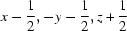
| Symmetry code: (i) x−1/2, −y−1/2, z+1/2. |
Experimental details
| Crystal data | |
| Chemical formula | C18H15N3O |
| Mr | 289.33 |
| Crystal system, space group | Monoclinic, P21/n |
| Temperature (K) | 293 |
| a, b, c (Å) | 8.066 (2), 19.256 (3), 9.270 (3) |
| β (°) | 94.66 (3) |
| V (Å3) | 1435.0 (6) |
| Z | 4 |
| Radiation type | Mo Kα |
| µ (mm−1) | 0.09 |
| Crystal size (mm) | 0.6 × 0.5 × 0.4 |
| Data collection | |
| Diffractometer | Enraf–Nonius TurboCAD-4 diffractometer |
| Absorption correction | – |
| No. of measured, independent and observed [I > 2σ(I)] reflections | 2984, 2815, 1751 |
| Rint | 0.031 |
| (sin θ/λ)max (Å−1) | 0.617 |
| Refinement | |
| R[F2 > 2σ(F2)], wR(F2), S | 0.048, 0.113, 1.01 |
| No. of reflections | 2815 |
| No. of parameters | 202 |
| H-atom treatment | H-atom parameters constrained |
| Δρmax, Δρmin (e Å−3) | 0.16, −0.15 |
Computer programs: CAD-4 EXPRESS (Enraf–Nonius, 1994), XCAD4 (Harms & Wocadlo, 1995), SIR92 (Altomare et al., 1994), SHELXL97 (Sheldrick, 2008), ORTEP-3 for Windows (Farrugia, 1997), WinGX (Farrugia, 1999).
| D—H···A | D—H | H···A | D···A | D—H···A |
| C6—H6···N1i | 0.93 | 2.59 | 3.457 (3) | 155.8 |
| Symmetry code: (i) x−1/2, −y−1/2, z+1/2. |
References
 Altomare, A., Cascarano, G., Giacovazzo, C., Guagliardi, A., Burla, M. C., Polidori, G. & Camalli, M. (1994). J. Appl. Cryst. 27, 435. CrossRef Web of Science IUCr Journals Google Scholar
Daidone, G., Maggio, B., Raffa, D., Plescia, S., Benetollo, F. & Bombieri, G. (1998). J. Chem. Soc. Perkin Trans. 1, pp. 2891–2898. Web of Science CSD CrossRef Google Scholar
Daidone, G., Plescia, S. & Fabra, J. (1980). J. Heterocycl. Chem. 17, 1409–1411. CrossRef CAS Google Scholar
Daidone, G., Plescia, S., Maggio, B., Spirio, V., Benetollo, F. & Bombieri, G. (1993). J. Chem. Soc. Perkin Trans. 1, pp. 285–291. CSD CrossRef Web of Science Google Scholar
Enraf–Nonius (1994). CAD-4 EXPRESS. Enraf–Nonius, Delft, The Netherlands. Google Scholar
Farrugia, L. J. (1997). J. Appl. Cryst. 30, 565. CrossRef IUCr Journals Google Scholar
Farrugia, L. J. (1999). J. Appl. Cryst. 32, 837–838. CrossRef CAS IUCr Journals Google Scholar
Harms, K. & Wocadlo, S. (1995). XCAD4. University of Marburg, Germany. Google Scholar
Maggio, B., Daidone, G., Raffa, D., Plescia, S., Bombieri, G. & Meneghetti, F. (2005). Helv. Chim. Acta, 88, 2272–2281. Web of Science CSD CrossRef CAS Google Scholar
Sheldrick, G. M. (2008). Acta Cryst. A64, 112–122. Web of Science CrossRef CAS IUCr Journals Google Scholar
This is an open-access article distributed under the terms of the Creative Commons Attribution (CC-BY) Licence, which permits unrestricted use, distribution, and reproduction in any medium, provided the original authors and source are cited.
| CRYSTALLOGRAPHIC COMMUNICATIONS |


On the basis of our studies on the non classical Pschorr reaction (Maggio et al., 2005), we have hypothesized that the product of thermal decomposition of the diazonium hydrogen sulfate (1) (Daidone et al., 1980) could be one of the two possible isomers 2 and 3 (Fig. 1). Single-crystal X-ray analysis on the reaction product (Fig. 2) allows to assign the formation of isomer 2, having the two methyl groups trans oriented with respect to the tricyclic ring. The molecule is characterized by a quite planar phenylpyrazolo[3,4-c]isoquinolin-5-one moiety, having as highest deviation from planarity O1 atom (out of plane of 0.066 (2) Å). The non aromatic ring of the tricyclic framework has puckering parameter of ϕ2=-69.4 (2)° and QT=0.059 (3) Å. The phenyl substituent is inclined with respect to the heterotricycle of 67 (1)°, with a torsion angle N1—N2—C4—C5 of -106.1 (3)°. The molecular packing is determined by intermolecular C6—H6···N1i interactions of 2.56 (2)Å and 158 (1)° [symmetry code: (i) x - 1/2, -y - 1/2, z + 1/2], with the formation of chains developing along the c axis (Fig. 3).