 | Acta Crystallographica Section E Acta Crystallographica Section E CRYSTALLOGRAPHIC COMMUNICATIONS |


 journal menu


metal-organic compounds
| CRYSTALLOGRAPHIC COMMUNICATIONS |
 access
(3,5-Dichlorosalicylaldehyde thiosemicarbazonato-κ3S,N1,O)(N,N′-dimethylformamide-κO)copper(II) dimethylformamide solvate

aKey Laboratory of Non-ferrous Metal Materials and New Processing Technology, Department of Materials and Chemical Engineering, Guilin University of Technology, Ministry of Education, Guilin 541004, People's Republic of China
*Correspondence e-mail: [email protected]
In the title compound, [Cu(C8H5Cl2N3OS)(C3H7NO)]·C3H7NO, the CuII atom is coordinated in a slightly distorted square-planar geometry by an O, an S and an N atom from the tridentate ligand 3,5-dichlorosalicylaldehyde thiosemicarbazonate ligand and one O atom from dimethylformamide. At the same time, the Cu atom is in contact with S and Cl atoms from another two complexes [Cu⋯S and Cu⋯Cl = 2.9791 (2) and 3.3800 (3) Å, respectively], thereby forming a [4 + 2] coordination geometry. The exhibits N—H⋯O and N—H⋯N hydrogen bonds.
Related literature
For studies of thiosemicarbazone complexes containing amino acids, see: Garcia-Orozco et al. (2002![[Garcia-Orozco, I., Tapia-Benavides, A. R., Alvarez-Toledano, C., Toscano, R. A., Ramirez-Rosales, D. & Zamorano-Ulloa, R. (2002). J. Mol. Struct. 604, 57-64.]](../../../../../../logos/arrows/e_arr.gif "Garcia-Orozco, I., Tapia-Benavides, A. R., Alvarez-Toledano, C., Toscano, R. A., Ramirez-Rosales, D. & Zamorano-Ulloa, R. (2002). J. Mol. Struct. 604, 57-64.") ); Seena et al. (2007); Valdes-Martinez et al. (1995); Singh et al. (1997); Shen et al. (1997); Zimmer et al. (1991).
); Seena et al. (2007); Valdes-Martinez et al. (1995); Singh et al. (1997); Shen et al. (1997); Zimmer et al. (1991).
![[Scheme 1]](om2219scheme1.gif)
Experimental
Crystal data
|
Refinement
|
| |||||||||||||||||||||||||||||||||
| ||||||||||||||||||||||
 .
. Data collection: SMART (Bruker, 2007); cell refinement: SAINT (Bruker, 2007); data reduction: SAINT; program(s) used to solve structure: SHELXS97 (Sheldrick, 2008); program(s) used to refine structure: SHELXL97 (Sheldrick, 2008); molecular graphics: SHELXTL (Sheldrick, 2008); software used to prepare material for publication: SHELXTL.
Supporting information
contains datablocks global, I. DOI: 10.1107/S1600536808008982/om2219sup1.cif
Structure factors: contains datablock I. DOI: 10.1107/S1600536808008982/om2219Isup2.hkl
An EtOH solution (15 ml) of 3,5-dichlorosalicylaldehyde (5 mmol) was added dropwise to the solution (15 ml) of thiosemicarbazide (5 mmol) and 0.75 ml acetic anhydride with stirring at ca 70°C for 4.5 h. The light brown precipitate was removed by filtration and recrystallized from 1:1 (v/v) MeOH/EtOH solution. Then a mixture of the ligand (0.5 mmol) and copper nitrate (0.5 mmol) in EtOH (35 ml) was stirred at ca 65° C for 2 h to give the desired complex. The Cu complex was dissolved in DMF, and ether slowly diffused into the DMF solution to afford almost quantitatively green crystals of the mononuclear complex at ambient temperature after several days.
Data collection: SMART (Bruker, 2007); cell SMART (Bruker, 2007); data reduction: SAINT (Bruker, 2007); program(s) used to solve structure: SHELXS97 (Sheldrick, 2008); program(s) used to refine structure: SHELXL97 (Sheldrick, 2008); molecular graphics: SHELXTL (Sheldrick, 2008); software used to prepare material for publication: SHELXTL (Sheldrick, 2008).
![[Figure 1]](./om2219fig1thm.gif) | Fig. 1. The asymmetric unit showing 30% probability displacement ellipsoids. Carbon-bound H atoms have been omitted for clarity. |
![[Figure 2]](./om2219fig2thm.gif) | Fig. 2. The interactions of Cl···Cu and S···Cu in the asymmetric unit one-dimensional chains. |
![[Figure 3]](./om2219fig3thm.gif) | Fig. 3. A view down the b axis, broken line showing short Cl–Cu and S···Cu contacts and hydrogen bonds. |
| [Cu(C8H5Cl2N3OS)(C3H7NO)]·C3H7NO | F(000) = 964 |
| Mr = 471.84 | Dx = 1.552 Mg m−3 |
| Monoclinic, P21/n | Mo Kα radiation, λ = 0.71073 Å |
| a = 9.4979 (10) Å | Cell parameters from 3442 reflections |
| b = 9.8057 (12) Å | θ = 2.3–26.8° |
| c = 21.744 (2) Å | µ = 1.47 mm−1 |
| β = 94.263 (2)° | T = 298 K |
| V = 2019.5 (4) Å3 | Block, green |
| Z = 4 | 0.49 × 0.47 × 0.24 mm |
| Bruker SMART 1000 diffractometer | 3558 independent reflections |
| Radiation source: fine-focus sealed tube | 2587 reflections with I > 2σ(I) |
| Graphite monochromator | Rint = 0.034 |
| ϕ and ω scans | θmax = 25.0°, θmin = 1.9° |
| Absorption correction: multi-scan (SADABS; Sheldrick, 1996) | h = −11→10 |
| Tmin = 0.532, Tmax = 0.719 | k = −9→11 |
| 9869 measured reflections | l = −23→25 |
| Refinement on F2 | Primary atom site location: structure-invariant direct methods |
| Least-squares matrix: full | Secondary atom site location: difference Fourier map |
| R[F2 > 2σ(F2)] = 0.036 | Hydrogen site location: inferred from neighbouring sites |
| wR(F2) = 0.098 | H-atom parameters constrained |
| S = 1.06 | w = 1/[σ2(Fo2) + (0.0377P)2 + 1.6178P] where P = (Fo2 + 2Fc2)/3 |
| 3558 reflections | (Δ/σ)max = 0.001 |
| 235 parameters | Δρmax = 0.31 e Å−3 |
| 0 restraints | Δρmin = −0.50 e Å−3 |
| [Cu(C8H5Cl2N3OS)(C3H7NO)]·C3H7NO | V = 2019.5 (4) Å3 |
| Mr = 471.84 | Z = 4 |
| Monoclinic, P21/n | Mo Kα radiation |
| a = 9.4979 (10) Å | µ = 1.47 mm−1 |
| b = 9.8057 (12) Å | T = 298 K |
| c = 21.744 (2) Å | 0.49 × 0.47 × 0.24 mm |
| β = 94.263 (2)° |
| Bruker SMART 1000 diffractometer | 3558 independent reflections |
| Absorption correction: multi-scan (SADABS; Sheldrick, 1996) | 2587 reflections with I > 2σ(I) |
| Tmin = 0.532, Tmax = 0.719 | Rint = 0.034 |
| 9869 measured reflections |
| R[F2 > 2σ(F2)] = 0.036 | 0 restraints |
| wR(F2) = 0.098 | H-atom parameters constrained |
| S = 1.06 | Δρmax = 0.31 e Å−3 |
| 3558 reflections | Δρmin = −0.50 e Å−3 |
| 235 parameters |
Geometry. All e.s.d.'s (except the e.s.d. in the dihedral angle between two l.s. planes) are estimated using the full covariance matrix. The cell e.s.d.'s are taken into account individually in the estimation of e.s.d.'s in distances, angles and torsion angles; correlations between e.s.d.'s in cell parameters are only used when they are defined by crystal symmetry. An approximate (isotropic) treatment of cell e.s.d.'s is used for estimating e.s.d.'s involving l.s. planes. |
Refinement. Refinement of F2 against ALL reflections. The weighted R-factor wR and goodness of fit S are based on F2, conventional R-factors R are based on F, with F set to zero for negative F2. The threshold expression of F2 > σ(F2) is used only for calculating R-factors(gt) etc. and is not relevant to the choice of reflections for refinement. R-factors based on F2 are statistically about twice as large as those based on F, and R- factors based on ALL data will be even larger. |
| x | y | z | Uiso*/Ueq | ||
| Cu1 | 0.54152 (4) | 0.31930 (4) | 0.51062 (2) | 0.04237 (15) | |
| Cl1 | 0.29920 (11) | −0.05605 (11) | 0.41172 (6) | 0.0706 (3) | |
| Cl2 | 0.69572 (16) | −0.09500 (13) | 0.24825 (6) | 0.0928 (4) | |
| N1 | 0.7172 (3) | 0.3290 (3) | 0.46944 (12) | 0.0353 (6) | |
| N2 | 0.8232 (3) | 0.4197 (3) | 0.48940 (14) | 0.0433 (7) | |
| N3 | 0.8875 (3) | 0.5886 (3) | 0.55631 (15) | 0.0592 (9) | |
| H3A | 0.9666 | 0.5938 | 0.5396 | 0.071* | |
| H3B | 0.8710 | 0.6418 | 0.5864 | 0.071* | |
| N4 | 0.1645 (3) | 0.2314 (4) | 0.58339 (19) | 0.0736 (11) | |
| N5 | 0.3114 (4) | 0.6470 (4) | 0.24057 (17) | 0.0673 (10) | |
| O1 | 0.4724 (2) | 0.1664 (2) | 0.46316 (13) | 0.0515 (6) | |
| O2 | 0.3799 (2) | 0.3059 (3) | 0.56320 (12) | 0.0536 (7) | |
| O3 | 0.4168 (4) | 0.7162 (4) | 0.15577 (16) | 0.0890 (10) | |
| S1 | 0.63125 (9) | 0.49051 (9) | 0.57083 (4) | 0.0431 (2) | |
| C1 | 0.7899 (3) | 0.4974 (3) | 0.53551 (15) | 0.0386 (8) | |
| C2 | 0.7456 (3) | 0.2575 (3) | 0.42245 (17) | 0.0427 (8) | |
| H2 | 0.8309 | 0.2751 | 0.4055 | 0.051* | |
| C3 | 0.6572 (3) | 0.1521 (3) | 0.39345 (17) | 0.0430 (8) | |
| C4 | 0.5275 (4) | 0.1113 (3) | 0.41651 (18) | 0.0440 (9) | |
| C5 | 0.4564 (4) | 0.0012 (3) | 0.38446 (19) | 0.0496 (10) | |
| C6 | 0.5066 (5) | −0.0603 (4) | 0.3345 (2) | 0.0604 (11) | |
| H6 | 0.4566 | −0.1317 | 0.3150 | 0.072* | |
| C7 | 0.6330 (5) | −0.0162 (4) | 0.31267 (18) | 0.0579 (10) | |
| C8 | 0.7069 (4) | 0.0878 (4) | 0.34189 (18) | 0.0517 (10) | |
| H8 | 0.7916 | 0.1163 | 0.3272 | 0.062* | |
| C9 | 0.2784 (4) | 0.2276 (4) | 0.55256 (19) | 0.0568 (10) | |
| H9 | 0.2831 | 0.1632 | 0.5214 | 0.068* | |
| C10 | 0.1465 (5) | 0.3332 (6) | 0.6303 (3) | 0.1007 (19) | |
| H10A | 0.2270 | 0.3927 | 0.6334 | 0.151* | |
| H10B | 0.1377 | 0.2890 | 0.6692 | 0.151* | |
| H10C | 0.0629 | 0.3854 | 0.6195 | 0.151* | |
| C11 | 0.0480 (5) | 0.1379 (6) | 0.5678 (3) | 0.118 (2) | |
| H11A | −0.0330 | 0.1885 | 0.5517 | 0.178* | |
| H11B | 0.0252 | 0.0896 | 0.6042 | 0.178* | |
| H11C | 0.0750 | 0.0740 | 0.5374 | 0.178* | |
| C12 | 0.3156 (6) | 0.7130 (5) | 0.1874 (2) | 0.0765 (14) | |
| H12 | 0.2351 | 0.7607 | 0.1731 | 0.092* | |
| C13 | 0.4330 (6) | 0.5683 (5) | 0.2633 (3) | 0.1003 (18) | |
| H13A | 0.4152 | 0.4732 | 0.2556 | 0.151* | |
| H13B | 0.4508 | 0.5831 | 0.3068 | 0.151* | |
| H13C | 0.5139 | 0.5963 | 0.2425 | 0.151* | |
| C14 | 0.1882 (5) | 0.6465 (6) | 0.2757 (2) | 0.0926 (16) | |
| H14A | 0.1149 | 0.7001 | 0.2547 | 0.139* | |
| H14B | 0.2121 | 0.6847 | 0.3158 | 0.139* | |
| H14C | 0.1557 | 0.5546 | 0.2800 | 0.139* |
| U11 | U22 | U33 | U12 | U13 | U23 | |
| Cu1 | 0.0313 (2) | 0.0425 (3) | 0.0537 (3) | −0.00725 (18) | 0.00661 (18) | 0.0006 (2) |
| Cl1 | 0.0498 (6) | 0.0584 (6) | 0.1019 (9) | −0.0229 (5) | −0.0066 (6) | 0.0054 (6) |
| Cl2 | 0.1295 (12) | 0.0781 (8) | 0.0717 (8) | −0.0265 (8) | 0.0131 (8) | −0.0339 (7) |
| N1 | 0.0274 (14) | 0.0357 (15) | 0.0427 (16) | −0.0085 (11) | 0.0012 (12) | −0.0040 (13) |
| N2 | 0.0286 (14) | 0.0462 (17) | 0.0556 (19) | −0.0114 (12) | 0.0064 (13) | −0.0158 (15) |
| N3 | 0.0365 (17) | 0.072 (2) | 0.071 (2) | −0.0200 (16) | 0.0127 (15) | −0.0359 (18) |
| N4 | 0.039 (2) | 0.089 (3) | 0.094 (3) | −0.0100 (18) | 0.0143 (19) | 0.029 (2) |
| N5 | 0.077 (3) | 0.068 (2) | 0.057 (2) | −0.009 (2) | 0.0072 (19) | 0.0059 (19) |
| O1 | 0.0362 (13) | 0.0408 (14) | 0.0782 (19) | −0.0120 (11) | 0.0087 (12) | −0.0043 (13) |
| O2 | 0.0386 (14) | 0.0559 (16) | 0.0681 (18) | −0.0111 (12) | 0.0152 (12) | 0.0063 (13) |
| O3 | 0.098 (3) | 0.101 (3) | 0.067 (2) | −0.024 (2) | −0.0003 (19) | 0.0309 (19) |
| S1 | 0.0349 (5) | 0.0519 (5) | 0.0431 (5) | −0.0045 (4) | 0.0068 (4) | −0.0034 (4) |
| C1 | 0.0312 (17) | 0.044 (2) | 0.0401 (19) | −0.0040 (15) | −0.0008 (15) | −0.0022 (16) |
| C2 | 0.0309 (18) | 0.044 (2) | 0.054 (2) | −0.0099 (15) | 0.0033 (16) | −0.0054 (18) |
| C3 | 0.0384 (19) | 0.0362 (19) | 0.054 (2) | −0.0046 (15) | −0.0019 (16) | −0.0013 (17) |
| C4 | 0.0380 (19) | 0.0337 (19) | 0.059 (2) | −0.0007 (15) | −0.0046 (17) | 0.0041 (17) |
| C5 | 0.044 (2) | 0.037 (2) | 0.066 (3) | −0.0097 (16) | −0.0119 (19) | 0.0091 (19) |
| C6 | 0.070 (3) | 0.039 (2) | 0.068 (3) | −0.011 (2) | −0.021 (2) | −0.004 (2) |
| C7 | 0.074 (3) | 0.047 (2) | 0.051 (2) | −0.008 (2) | −0.007 (2) | −0.0089 (19) |
| C8 | 0.053 (2) | 0.047 (2) | 0.055 (2) | −0.0087 (18) | 0.0024 (19) | −0.0049 (19) |
| C9 | 0.045 (2) | 0.063 (3) | 0.063 (3) | −0.004 (2) | 0.008 (2) | 0.013 (2) |
| C10 | 0.072 (3) | 0.134 (5) | 0.102 (4) | 0.014 (3) | 0.045 (3) | 0.024 (4) |
| C11 | 0.048 (3) | 0.141 (5) | 0.167 (6) | −0.033 (3) | 0.011 (3) | 0.042 (5) |
| C12 | 0.089 (4) | 0.066 (3) | 0.072 (3) | −0.015 (3) | −0.010 (3) | 0.013 (3) |
| C13 | 0.118 (5) | 0.099 (4) | 0.087 (4) | 0.023 (3) | 0.029 (3) | 0.041 (3) |
| C14 | 0.083 (4) | 0.119 (4) | 0.077 (3) | −0.017 (3) | 0.012 (3) | −0.007 (3) |
| Cu1—O1 | 1.909 (2) | C2—H2 | 0.9300 |
| Cu1—N1 | 1.954 (3) | C3—C8 | 1.398 (5) |
| Cu1—O2 | 1.985 (2) | C3—C4 | 1.421 (5) |
| Cu1—S1 | 2.2567 (10) | C4—C5 | 1.427 (5) |
| Cl1—C5 | 1.740 (4) | C5—C6 | 1.359 (6) |
| Cl2—C7 | 1.743 (4) | C6—C7 | 1.393 (6) |
| N1—C2 | 1.284 (4) | C6—H6 | 0.9300 |
| N1—N2 | 1.388 (3) | C7—C8 | 1.367 (5) |
| N2—C1 | 1.316 (4) | C8—H8 | 0.9300 |
| N3—C1 | 1.342 (4) | C9—H9 | 0.9300 |
| N3—H3A | 0.8600 | C10—H10A | 0.9600 |
| N3—H3B | 0.8600 | C10—H10B | 0.9600 |
| N4—C9 | 1.315 (5) | C10—H10C | 0.9600 |
| N4—C10 | 1.446 (6) | C11—H11A | 0.9600 |
| N4—C11 | 1.458 (6) | C11—H11B | 0.9600 |
| N5—C12 | 1.328 (6) | C11—H11C | 0.9600 |
| N5—C14 | 1.444 (6) | C12—H12 | 0.9300 |
| N5—C13 | 1.446 (6) | C13—H13A | 0.9600 |
| O1—C4 | 1.294 (4) | C13—H13B | 0.9600 |
| O2—C9 | 1.241 (4) | C13—H13C | 0.9600 |
| O3—C12 | 1.223 (6) | C14—H14A | 0.9600 |
| S1—C1 | 1.743 (3) | C14—H14B | 0.9600 |
| C2—C3 | 1.447 (4) | C14—H14C | 0.9600 |
| O1—Cu1—N1 | 93.55 (11) | C5—C6—H6 | 120.1 |
| O1—Cu1—O2 | 90.55 (11) | C7—C6—H6 | 120.1 |
| N1—Cu1—O2 | 172.04 (11) | C8—C7—C6 | 119.9 (4) |
| O1—Cu1—S1 | 176.26 (8) | C8—C7—Cl2 | 120.7 (3) |
| N1—Cu1—S1 | 86.04 (8) | C6—C7—Cl2 | 119.4 (3) |
| O2—Cu1—S1 | 89.43 (8) | C7—C8—C3 | 121.1 (4) |
| C2—N1—N2 | 114.1 (3) | C7—C8—H8 | 119.4 |
| C2—N1—Cu1 | 125.1 (2) | C3—C8—H8 | 119.4 |
| N2—N1—Cu1 | 120.8 (2) | O2—C9—N4 | 123.0 (4) |
| C1—N2—N1 | 113.5 (3) | O2—C9—H9 | 118.5 |
| C1—N3—H3A | 120.0 | N4—C9—H9 | 118.5 |
| C1—N3—H3B | 120.0 | N4—C10—H10A | 109.5 |
| H3A—N3—H3B | 120.0 | N4—C10—H10B | 109.5 |
| C9—N4—C10 | 121.6 (4) | H10A—C10—H10B | 109.5 |
| C9—N4—C11 | 120.2 (5) | N4—C10—H10C | 109.5 |
| C10—N4—C11 | 118.0 (4) | H10A—C10—H10C | 109.5 |
| C12—N5—C14 | 122.7 (4) | H10B—C10—H10C | 109.5 |
| C12—N5—C13 | 118.8 (4) | N4—C11—H11A | 109.5 |
| C14—N5—C13 | 118.4 (4) | N4—C11—H11B | 109.5 |
| C4—O1—Cu1 | 127.5 (2) | H11A—C11—H11B | 109.5 |
| C9—O2—Cu1 | 123.8 (3) | N4—C11—H11C | 109.5 |
| C1—S1—Cu1 | 94.29 (11) | H11A—C11—H11C | 109.5 |
| N2—C1—N3 | 116.3 (3) | H11B—C11—H11C | 109.5 |
| N2—C1—S1 | 125.3 (2) | O3—C12—N5 | 125.3 (5) |
| N3—C1—S1 | 118.4 (3) | O3—C12—H12 | 117.3 |
| N1—C2—C3 | 126.0 (3) | N5—C12—H12 | 117.3 |
| N1—C2—H2 | 117.0 | N5—C13—H13A | 109.5 |
| C3—C2—H2 | 117.0 | N5—C13—H13B | 109.5 |
| C8—C3—C4 | 120.6 (3) | H13A—C13—H13B | 109.5 |
| C8—C3—C2 | 116.9 (3) | N5—C13—H13C | 109.5 |
| C4—C3—C2 | 122.5 (3) | H13A—C13—H13C | 109.5 |
| O1—C4—C3 | 124.8 (3) | H13B—C13—H13C | 109.5 |
| O1—C4—C5 | 119.6 (3) | N5—C14—H14A | 109.5 |
| C3—C4—C5 | 115.6 (3) | N5—C14—H14B | 109.5 |
| C6—C5—C4 | 123.0 (4) | H14A—C14—H14B | 109.5 |
| C6—C5—Cl1 | 119.3 (3) | N5—C14—H14C | 109.5 |
| C4—C5—Cl1 | 117.7 (3) | H14A—C14—H14C | 109.5 |
| C5—C6—C7 | 119.8 (3) | H14B—C14—H14C | 109.5 |
| O1—Cu1—N1—C2 | 7.1 (3) | N1—C2—C3—C4 | −2.9 (6) |
| O2—Cu1—N1—C2 | 127.9 (7) | Cu1—O1—C4—C3 | 3.3 (5) |
| S1—Cu1—N1—C2 | −176.6 (3) | Cu1—O1—C4—C5 | −176.6 (2) |
| O1—Cu1—N1—N2 | −174.1 (2) | C8—C3—C4—O1 | −178.8 (3) |
| O2—Cu1—N1—N2 | −53.3 (9) | C2—C3—C4—O1 | 3.1 (5) |
| S1—Cu1—N1—N2 | 2.2 (2) | C8—C3—C4—C5 | 1.2 (5) |
| C2—N1—N2—C1 | 176.6 (3) | C2—C3—C4—C5 | −176.9 (3) |
| Cu1—N1—N2—C1 | −2.3 (4) | O1—C4—C5—C6 | 179.0 (3) |
| N1—Cu1—O1—C4 | −7.1 (3) | C3—C4—C5—C6 | −1.0 (5) |
| O2—Cu1—O1—C4 | 179.7 (3) | O1—C4—C5—Cl1 | −1.6 (4) |
| S1—Cu1—O1—C4 | −90.6 (13) | C3—C4—C5—Cl1 | 178.5 (3) |
| O1—Cu1—O2—C9 | −7.4 (3) | C4—C5—C6—C7 | 0.1 (6) |
| N1—Cu1—O2—C9 | −128.4 (7) | Cl1—C5—C6—C7 | −179.4 (3) |
| S1—Cu1—O2—C9 | 176.3 (3) | C5—C6—C7—C8 | 0.7 (6) |
| O1—Cu1—S1—C1 | 82.5 (12) | C5—C6—C7—Cl2 | −179.5 (3) |
| N1—Cu1—S1—C1 | −1.24 (14) | C6—C7—C8—C3 | −0.5 (6) |
| O2—Cu1—S1—C1 | 172.22 (14) | Cl2—C7—C8—C3 | 179.7 (3) |
| N1—N2—C1—N3 | −179.1 (3) | C4—C3—C8—C7 | −0.5 (6) |
| N1—N2—C1—S1 | 0.9 (4) | C2—C3—C8—C7 | 177.7 (3) |
| Cu1—S1—C1—N2 | 0.6 (3) | Cu1—O2—C9—N4 | −171.5 (3) |
| Cu1—S1—C1—N3 | −179.4 (3) | C10—N4—C9—O2 | 3.2 (7) |
| N2—N1—C2—C3 | 177.6 (3) | C11—N4—C9—O2 | 179.0 (4) |
| Cu1—N1—C2—C3 | −3.5 (5) | C14—N5—C12—O3 | −179.7 (5) |
| N1—C2—C3—C8 | 178.9 (3) | C13—N5—C12—O3 | −1.9 (8) |
| D—H···A | D—H | H···A | D···A | D—H···A |
| N3—H3A···N2i | 0.86 | 2.14 | 2.992 (4) | 170 |
| N3—H3B···O3ii | 0.86 | 2.08 | 2.886 (4) | 157 |
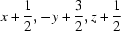
| Symmetry codes: (i) −x+2, −y+1, −z+1; (ii) x+1/2, −y+3/2, z+1/2. |
Experimental details
| Crystal data | |
| Chemical formula | [Cu(C8H5Cl2N3OS)(C3H7NO)]·C3H7NO |
| Mr | 471.84 |
| Crystal system, space group | Monoclinic, P21/n |
| Temperature (K) | 298 |
| a, b, c (Å) | 9.4979 (10), 9.8057 (12), 21.744 (2) |
| β (°) | 94.263 (2) |
| V (Å3) | 2019.5 (4) |
| Z | 4 |
| Radiation type | Mo Kα |
| µ (mm−1) | 1.47 |
| Crystal size (mm) | 0.49 × 0.47 × 0.24 |
| Data collection | |
| Diffractometer | Bruker SMART 1000 diffractometer |
| Absorption correction | Multi-scan (SADABS; Sheldrick, 1996) |
| Tmin, Tmax | 0.532, 0.719 |
| No. of measured, independent and observed [I > 2σ(I)] reflections | 9869, 3558, 2587 |
| Rint | 0.034 |
| (sin θ/λ)max (Å−1) | 0.595 |
| Refinement | |
| R[F2 > 2σ(F2)], wR(F2), S | 0.036, 0.098, 1.06 |
| No. of reflections | 3558 |
| No. of parameters | 235 |
| H-atom treatment | H-atom parameters constrained |
| Δρmax, Δρmin (e Å−3) | 0.31, −0.50 |
Computer programs: SMART (Bruker, 2007), SAINT (Bruker, 2007), SHELXS97 (Sheldrick, 2008), SHELXL97 (Sheldrick, 2008), SHELXTL (Sheldrick, 2008).
| Cu1—O1 | 1.909 (2) | Cu1—O2 | 1.985 (2) |
| Cu1—N1 | 1.954 (3) | Cu1—S1 | 2.2567 (10) |
| O1—Cu1—N1 | 93.55 (11) | O2—Cu1—S1 | 89.43 (8) |
| O1—Cu1—O2 | 90.55 (11) | C4—O1—Cu1 | 127.5 (2) |
| N1—Cu1—O2 | 172.04 (11) | C9—O2—Cu1 | 123.8 (3) |
| O1—Cu1—S1 | 176.26 (8) | C1—S1—Cu1 | 94.29 (11) |
| N1—Cu1—S1 | 86.04 (8) |
| D—H···A | D—H | H···A | D···A | D—H···A |
| N3—H3A···N2i | 0.86 | 2.14 | 2.992 (4) | 170 |
| N3—H3B···O3ii | 0.86 | 2.08 | 2.886 (4) | 157 |
| Symmetry codes: (i) −x+2, −y+1, −z+1; (ii) x+1/2, −y+3/2, z+1/2. |
Acknowledgements
We acknowledge financial support by the Key Laboratory of Non-ferrous Metal Materials and New Processing Technology, Ministry of Education, China.
References
 Bruker (2007). SAINT and SMART. Bruker AXS Inc., Madison, Wisconsin, USA. Google Scholar
Garcia-Orozco, I., Tapia-Benavides, A. R., Alvarez-Toledano, C., Toscano, R. A., Ramirez-Rosales, D. & Zamorano-Ulloa, R. (2002). J. Mol. Struct. 604, 57–64. Web of Science CSD CrossRef CAS Google Scholar
Seena, E. B., Maliyeckal, R. & Kurup, P. (2007). Polyhedron, 26, 829–, 36. Google Scholar
Sheldrick, G. M. (1996). SADABS. University of Göttingen, Germany. Google Scholar
Sheldrick, G. M. (2008). Acta Cryst. A64, 112–122. Web of Science CrossRef CAS IUCr Journals Google Scholar
Shen, X., Wu, D., Huang, X., Liu, Q., Huang, Z. & Kang, B. (1997). Polyhedron, 16, 1477–1482. CSD CrossRef CAS Web of Science Google Scholar
Singh, K., Long, J. R. & Stavropoulos, P. (1997). J. Am. Chem. Soc. 119, 2942–2943. CSD CrossRef CAS Web of Science Google Scholar
Valdes-Martinez, J., Toscano, R. A. & Ramirez-Ortiz, J. (1995). Polyhedron, 14, 579–583. CSD CrossRef CAS Web of Science Google Scholar
Zimmer, M., Schulte, G., Luo, X.-L. & Crabtree, R. H. (1991). Angew. Chem. Int. Ed. Engl. 30, 193–194. Google Scholar
This is an open-access article distributed under the terms of the Creative Commons Attribution (CC-BY) Licence, which permits unrestricted use, distribution, and reproduction in any medium, provided the original authors and source are cited.
| CRYSTALLOGRAPHIC COMMUNICATIONS |


As a special kind of Schiff base, thiosemicarbazones and their metal complexes have become the subjects of intensive study because of their wide ranging biological activities, analytical applications and interesting chemical and structural properties (Zimmer, et al., 1991). In addition, salicylaldehyde thiosemicarbazone and its substituent analogs as well as their copper complexes has been synthesized. The N—S donor also have theoretical interest, as they are capable of furnishing an environment of controlled geometry and ligand field strength.
In the title compound there is a DMF molecule coordinated through O, in addition to one N, one O and one S atom from the tridentate ligand 3,5-dichlorosalicylaldehyde thiosemicarbazone forming a slightly distorted planar square geometry (Fig. 1). In the unit cell, above and below the distorted square plane are Cl and S atoms at a long distance forming a "4 + 2" geometry. The weak interaction length of S–Cu is 2.9791 (2) Å. This bond distance are in the range of upper values for a long coordination distance (2.5–3.0 Å) in Cu(II) compounds. The length of Cl–Cu is 3.3800 (3) Å (Fig. 2). All of these facts can be seen as the result of the Jahn-Teller effect (Garcia-Orozco et al., 2002). A three-dimensional network is formed through these Cl–Cu, S–Cu contacts, N–H···N and N–H···O hydrogen bonds (Fig.3).