 | Acta Crystallographica Section E Acta Crystallographica Section E CRYSTALLOGRAPHIC COMMUNICATIONS |


 journal menu


metal-organic compounds
| CRYSTALLOGRAPHIC COMMUNICATIONS |
 access
Poly[diaqua-μ2-oxalato-di-μ2-pyrimidine-2-carboxylato-dimanganese(II)]

aDepartamento de Química Inorgánica, Facultad de Ciencias, Universidad de Granada, c/ Severo Ochoa s/n, 18071 Granada, Spain, and bDepartement de Chimie, Université Abdelmalek Essaadi, Faculté de Sciences, PO 2121, Tétouan, Morocco
*Correspondence e-mail: [email protected]
In the title compound, [Mn2(C2O4)(C5H3N2O2)2(H2O)2]n, the MnII atom exhibits a distorted octahedral coordination geometry, with the centrosymmetric oxalate anion and the monoanionic pyrimidine-2-carboxylate ligands generating a two-dimensional honeycomb network with a (6,3)-topology.
Related literature
For the preparation of 2-cyanopyrimidine, see: Rodríguez-Diéguez, Salinas-Castillo et al. (2007![[Rodríguez-Diéguez, A., Salinas-Castillo, A., Galli, S., Masciocchi, N., Gutiérrez-Zorrilla, J. M., Vitoria, P. & Colacio, E. (2007). Dalton Trans. pp. 1821-1828.]](../../../../../../logos/arrows/e_arr.gif "Rodríguez-Diéguez, A., Salinas-Castillo, A., Galli, S., Masciocchi, N., Gutiérrez-Zorrilla, J. M., Vitoria, P. & Colacio, E. (2007). Dalton Trans. pp. 1821-1828.") ). For related literature, see: Rodríguez-Diéguez, Cano et al. (2007).
). For related literature, see: Rodríguez-Diéguez, Cano et al. (2007).
![[Scheme 1]](su2042scheme1.gif)
Experimental
Crystal data
|
Refinement
|
| ||||||||||||||||||||||
 .
. Data collection: SMART (Bruker, 2001); cell refinement: SAINT (Bruker, 2001); data reduction: SAINT; program(s) used to solve structure: SHELXTL (Sheldrick, 2008); program(s) used to refine structure: SHELXTL; molecular graphics: SHELXTL; software used to prepare material for publication: publCIF (Westrip, 2008).
Supporting information
contains datablocks global, I. DOI: 10.1107/S1600536808002687/su2042sup1.cif
Structure factors: contains datablock I. DOI: 10.1107/S1600536808002687/su2042Isup2.hkl
The multitopic bridging ligand 2-carboxy-pyrimidine (H-pymca) was prepared by basic hydrolysis of 2-cyanopyrimidine with KOH and further neutralization with 2 N HCl. The title compound was obtained by the reaction of a mixture of two solutions. The first contained pyrimidine-2-carboxylato (17.1 mg) and MnCl2.4(H2O) (8.67 mg) in water/MeOH (10 ml). The second was formed by addition of MnCl2.4(H2O) (8.67 mg) to a solution of sodium oxalate (9.23 mg) in water (10 ml). These two solutions were then mixed and stirred for 2 h to give a pale-yellow solution. After standing at room temperature for several days prismatic yellow crystals appeared.
The water H atoms were located in a difference Fourier map and refined as riding atoms with O—H = 0.77 and 0.80 Å and Uiso(H) = 1.2Ueq(O). The pyrimidine H atoms were positioned geometrically and treated as riding atoms with C—H = 0.93 Å, and Uiso(H) = 1.2Ueq(C).
Data collection: SMART (Bruker, 2001); cell SAINT (Bruker, 2001); data reduction: SAINT (Bruker, 2001); program(s) used to solve structure: SHELXTL (Sheldrick, 2008); program(s) used to refine structure: SHELXTL (Sheldrick, 2008); molecular graphics: SHELXTL (Sheldrick, 2008); software used to prepare material for publication: publCIF (Westrip, 2008).
![[Figure 1]](./su2042fig1thm.gif) | Fig. 1. The molecular structure of the asymmetric unit of [Mn2(pymca)2(ox)(H2O)2]n, showing the atom labels. Thermal ellipsoids are drawn at the 50% probability level. H atoms are represented as spheres of arbitrary radii. |
![[Figure 2]](./su2042fig2thm.gif) | Fig. 2. A view down the a axis of the of [Mn2(pymca)2(ox)(H2O)2]n, showing the environment of the manganese atoms and the bidimensional (6,3) net topology. The H atoms have been omitted for clarity. |
| [Mn2(C2O4)(C5H3N2O2)2(H2O)2] | F(000) = 480 |
| Mr = 480.12 | Dx = 1.988 Mg m−3 |
| Monoclinic, P21/n | Mo Kα radiation, λ = 0.71073 Å |
| Hall symbol: -P 2yn | Cell parameters from 3384 reflections |
| a = 7.5447 (7) Å | θ = 2.8–28.9° |
| b = 11.1944 (11) Å | µ = 1.64 mm−1 |
| c = 9.7259 (10) Å | T = 150 K |
| β = 102.422 (1)° | Prismatic, yellow |
| V = 802.20 (14) Å3 | 0.22 × 0.21 × 0.20 mm |
| Z = 2 |
| Bruker SMART APEX CCD area-detector diffractometer | 1495 independent reflections |
| Radiation source: fine-focus sealed tube | 1389 reflections with I > 2σ(I) |
| Graphite monochromator | Rint = 0.019 |
| ϕ and ω scans | θmax = 25.5°, θmin = 2.8° |
| Absorption correction: multi-scan (SADABS; Sheldrick, 2004) | h = −9→9 |
| Tmin = 0.714, Tmax = 0.774 | k = −13→13 |
| 5847 measured reflections | l = −11→11 |
| Refinement on F2 | Primary atom site location: structure-invariant direct methods |
| Least-squares matrix: full | Secondary atom site location: difference Fourier map |
| R[F2 > 2σ(F2)] = 0.025 | Hydrogen site location: inferred from neighbouring sites |
| wR(F2) = 0.062 | H-atom parameters constrained |
| S = 1.11 | w = 1/[σ2(Fo2) + (0.0274P)2 + 0.6516P] where P = (Fo2 + 2Fc2)/3 |
| 1495 reflections | (Δ/σ)max < 0.001 |
| 127 parameters | Δρmax = 0.41 e Å−3 |
| 0 restraints | Δρmin = −0.21 e Å−3 |
| [Mn2(C2O4)(C5H3N2O2)2(H2O)2] | V = 802.20 (14) Å3 |
| Mr = 480.12 | Z = 2 |
| Monoclinic, P21/n | Mo Kα radiation |
| a = 7.5447 (7) Å | µ = 1.64 mm−1 |
| b = 11.1944 (11) Å | T = 150 K |
| c = 9.7259 (10) Å | 0.22 × 0.21 × 0.20 mm |
| β = 102.422 (1)° |
| Bruker SMART APEX CCD area-detector diffractometer | 1495 independent reflections |
| Absorption correction: multi-scan (SADABS; Sheldrick, 2004) | 1389 reflections with I > 2σ(I) |
| Tmin = 0.714, Tmax = 0.774 | Rint = 0.019 |
| 5847 measured reflections |
| R[F2 > 2σ(F2)] = 0.025 | 0 restraints |
| wR(F2) = 0.062 | H-atom parameters constrained |
| S = 1.11 | Δρmax = 0.41 e Å−3 |
| 1495 reflections | Δρmin = −0.21 e Å−3 |
| 127 parameters |
Geometry. All e.s.d.'s (except the e.s.d. in the dihedral angle between two l.s. planes) are estimated using the full covariance matrix. The cell e.s.d.'s are taken into account individually in the estimation of e.s.d.'s in distances, angles and torsion angles; correlations between e.s.d.'s in cell parameters are only used when they are defined by crystal symmetry. An approximate (isotropic) treatment of cell e.s.d.'s is used for estimating e.s.d.'s involving l.s. planes. |
Refinement. Refinement of F2 against ALL reflections. The weighted R-factor wR and goodness of fit S are based on F2, conventional R-factors R are based on F, with F set to zero for negative F2. The threshold expression of F2 > σ(F2) is used only for calculating R-factors(gt) etc. and is not relevant to the choice of reflections for refinement. R-factors based on F2 are statistically about twice as large as those based on F, and R- factors based on ALL data will be even larger. |
| x | y | z | Uiso*/Ueq | ||
| Mn1 | 0.22294 (4) | 0.67224 (3) | 0.51301 (3) | 0.01810 (12) | |
| N1 | 0.2376 (2) | 0.87496 (16) | 0.49706 (17) | 0.0170 (4) | |
| C2 | 0.1555 (3) | 0.94939 (19) | 0.3937 (2) | 0.0224 (5) | |
| H2 | 0.0850 | 0.9174 | 0.3117 | 0.027* | |
| C3 | 0.1735 (3) | 1.07187 (19) | 0.4065 (2) | 0.0230 (5) | |
| H3 | 0.1164 | 1.1230 | 0.3353 | 0.028* | |
| C4 | 0.2805 (3) | 1.1150 (2) | 0.5301 (2) | 0.0229 (5) | |
| H4 | 0.2929 | 1.1972 | 0.5428 | 0.027* | |
| N5 | 0.3670 (2) | 1.04205 (16) | 0.63259 (18) | 0.0196 (4) | |
| C6 | 0.3405 (3) | 0.92559 (18) | 0.6111 (2) | 0.0166 (4) | |
| C7 | 0.4354 (3) | 0.83993 (18) | 0.7255 (2) | 0.0182 (4) | |
| O8 | 0.3827 (2) | 0.73395 (13) | 0.71406 (16) | 0.0251 (4) | |
| O9 | 0.5576 (2) | 0.88282 (13) | 0.81900 (15) | 0.0224 (3) | |
| O1B | 0.4755 (2) | 0.64691 (13) | 0.43885 (16) | 0.0230 (3) | |
| O2B | 0.30121 (19) | 0.48353 (13) | 0.56335 (16) | 0.0217 (3) | |
| C3B | 0.5504 (3) | 0.54766 (18) | 0.4641 (2) | 0.0185 (4) | |
| O1W | −0.0119 (2) | 0.64879 (13) | 0.60530 (15) | 0.0219 (3) | |
| H2WB | −0.0848 | 0.6091 | 0.5523 | 0.026* | |
| H1WA | 0.0167 | 0.6192 | 0.6778 | 0.026* |
| U11 | U22 | U33 | U12 | U13 | U23 | |
| Mn1 | 0.01820 (19) | 0.01263 (18) | 0.01991 (19) | 0.00050 (12) | −0.00384 (13) | −0.00014 (12) |
| N1 | 0.0170 (9) | 0.0150 (9) | 0.0171 (9) | 0.0001 (7) | −0.0008 (7) | −0.0001 (6) |
| C2 | 0.0235 (11) | 0.0219 (11) | 0.0194 (10) | −0.0003 (9) | −0.0009 (9) | 0.0000 (9) |
| C3 | 0.0250 (11) | 0.0198 (11) | 0.0229 (11) | 0.0005 (9) | 0.0024 (9) | 0.0033 (9) |
| C4 | 0.0259 (11) | 0.0165 (11) | 0.0257 (11) | −0.0010 (9) | 0.0044 (9) | 0.0013 (9) |
| N5 | 0.0219 (9) | 0.0166 (9) | 0.0187 (9) | −0.0014 (7) | 0.0007 (7) | −0.0005 (7) |
| C6 | 0.0162 (10) | 0.0162 (10) | 0.0170 (10) | 0.0002 (8) | 0.0026 (8) | −0.0002 (8) |
| C7 | 0.0185 (10) | 0.0184 (11) | 0.0167 (10) | 0.0026 (8) | 0.0016 (8) | −0.0003 (8) |
| O8 | 0.0297 (9) | 0.0157 (8) | 0.0241 (8) | −0.0014 (6) | −0.0074 (7) | 0.0027 (6) |
| O9 | 0.0222 (8) | 0.0211 (8) | 0.0195 (8) | −0.0023 (6) | −0.0054 (6) | 0.0001 (6) |
| O1B | 0.0223 (8) | 0.0136 (7) | 0.0316 (8) | 0.0020 (6) | 0.0028 (7) | 0.0050 (6) |
| O2B | 0.0188 (7) | 0.0163 (7) | 0.0282 (8) | 0.0010 (6) | 0.0009 (6) | 0.0016 (6) |
| C3B | 0.0172 (10) | 0.0151 (10) | 0.0191 (10) | −0.0009 (8) | −0.0055 (8) | −0.0017 (8) |
| O1W | 0.0235 (8) | 0.0196 (8) | 0.0193 (7) | −0.0002 (6) | −0.0028 (6) | 0.0028 (6) |
| Mn1—O9i | 2.1175 (14) | C4—H4 | 0.9300 |
| Mn1—O1W | 2.1677 (15) | N5—C6 | 1.329 (3) |
| Mn1—O8 | 2.1771 (15) | C6—C7 | 1.526 (3) |
| Mn1—O1B | 2.1958 (16) | C7—O9 | 1.244 (3) |
| Mn1—O2B | 2.2196 (15) | C7—O8 | 1.248 (3) |
| Mn1—N1 | 2.2790 (18) | O9—Mn1ii | 2.1175 (14) |
| N1—C6 | 1.336 (3) | O1B—C3B | 1.247 (2) |
| N1—C2 | 1.349 (3) | O2B—C3Biii | 1.255 (3) |
| C2—C3 | 1.381 (3) | C3B—O2Biii | 1.255 (3) |
| C2—H2 | 0.9300 | C3B—C3Biii | 1.560 (4) |
| C3—C4 | 1.383 (3) | O1W—H2WB | 0.8027 |
| C3—H3 | 0.9300 | O1W—H1WA | 0.7669 |
| C4—N5 | 1.344 (3) | ||
| O9i—Mn1—O1W | 87.50 (6) | C2—C3—H3 | 121.5 |
| O9i—Mn1—O8 | 177.38 (6) | C4—C3—H3 | 121.5 |
| O1W—Mn1—O8 | 90.61 (6) | N5—C4—C3 | 122.1 (2) |
| O9i—Mn1—O1B | 93.21 (6) | N5—C4—H4 | 118.9 |
| O1W—Mn1—O1B | 164.73 (6) | C3—C4—H4 | 118.9 |
| O8—Mn1—O1B | 89.08 (6) | C6—N5—C4 | 116.55 (18) |
| O9i—Mn1—O2B | 89.85 (6) | N5—C6—N1 | 126.02 (19) |
| O1W—Mn1—O2B | 89.76 (6) | N5—C6—C7 | 118.09 (18) |
| O8—Mn1—O2B | 91.96 (5) | N1—C6—C7 | 115.90 (18) |
| O1B—Mn1—O2B | 74.99 (5) | O9—C7—O8 | 127.13 (19) |
| O9i—Mn1—N1 | 104.89 (6) | O9—C7—C6 | 116.64 (18) |
| O1W—Mn1—N1 | 101.81 (6) | O8—C7—C6 | 116.22 (18) |
| O8—Mn1—N1 | 73.72 (6) | C7—O8—Mn1 | 119.06 (13) |
| O1B—Mn1—N1 | 92.76 (6) | C7—O9—Mn1ii | 137.83 (14) |
| O2B—Mn1—N1 | 161.49 (6) | C3B—O1B—Mn1 | 116.05 (14) |
| C6—N1—C2 | 116.64 (18) | C3Biii—O2B—Mn1 | 115.15 (13) |
| C6—N1—Mn1 | 113.21 (13) | O1B—C3B—O2Biii | 126.4 (2) |
| C2—N1—Mn1 | 130.12 (14) | O1B—C3B—C3Biii | 117.0 (2) |
| N1—C2—C3 | 121.7 (2) | O2Biii—C3B—C3Biii | 116.6 (2) |
| N1—C2—H2 | 119.2 | Mn1—O1W—H2WB | 108.0 |
| C3—C2—H2 | 119.2 | Mn1—O1W—H1WA | 109.9 |
| C2—C3—C4 | 117.0 (2) | H2WB—O1W—H1WA | 111.7 |
| Symmetry codes: (i) x−1/2, −y+3/2, z−1/2; (ii) x+1/2, −y+3/2, z+1/2; (iii) −x+1, −y+1, −z+1. |
| D—H···A | D—H | H···A | D···A | D—H···A |
| O1W—H2WB···O2Biv | 0.80 | 2.05 | 2.847 (2) | 170 |
| O1W—H1WA···N5v | 0.77 | 2.05 | 2.815 (2) | 171 |
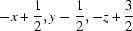
| Symmetry codes: (iv) −x, −y+1, −z+1; (v) −x+1/2, y−1/2, −z+3/2. |
Experimental details
| Crystal data | |
| Chemical formula | [Mn2(C2O4)(C5H3N2O2)2(H2O)2] |
| Mr | 480.12 |
| Crystal system, space group | Monoclinic, P21/n |
| Temperature (K) | 150 |
| a, b, c (Å) | 7.5447 (7), 11.1944 (11), 9.7259 (10) |
| β (°) | 102.422 (1) |
| V (Å3) | 802.20 (14) |
| Z | 2 |
| Radiation type | Mo Kα |
| µ (mm−1) | 1.64 |
| Crystal size (mm) | 0.22 × 0.21 × 0.20 |
| Data collection | |
| Diffractometer | Bruker SMART APEX CCD area-detector diffractometer |
| Absorption correction | Multi-scan (SADABS; Sheldrick, 2004) |
| Tmin, Tmax | 0.714, 0.774 |
| No. of measured, independent and observed [I > 2σ(I)] reflections | 5847, 1495, 1389 |
| Rint | 0.019 |
| (sin θ/λ)max (Å−1) | 0.607 |
| Refinement | |
| R[F2 > 2σ(F2)], wR(F2), S | 0.025, 0.062, 1.11 |
| No. of reflections | 1495 |
| No. of parameters | 127 |
| H-atom treatment | H-atom parameters constrained |
| Δρmax, Δρmin (e Å−3) | 0.41, −0.21 |
Computer programs: SMART (Bruker, 2001), SAINT (Bruker, 2001), SHELXTL (Sheldrick, 2008), publCIF (Westrip, 2008).
| D—H···A | D—H | H···A | D···A | D—H···A |
| O1W—H2WB···O2Bi | 0.80 | 2.05 | 2.847 (2) | 170 |
| O1W—H1WA···N5ii | 0.77 | 2.05 | 2.815 (2) | 171 |
| Symmetry codes: (i) −x, −y+1, −z+1; (ii) −x+1/2, y−1/2, −z+3/2. |
Acknowledgements
Financial support from MEC Spain (project No. CTQ2005/0935) is gratefully acknowledged.
References
 Bruker (2001). SMART and SAINT. Bruker AXS Inc., Madison, Wisconsin, USA. Google Scholar
Rodríguez-Diéguez, A., Cano, J., Kivekäs, R., Debdoubi, A. & Colacio, E. (2007). Inorg. Chem. pp. 2503–2510. Google Scholar
Rodríguez-Diéguez, A., Salinas-Castillo, A., Galli, S., Masciocchi, N., Gutiérrez-Zorrilla, J. M., Vitoria, P. & Colacio, E. (2007). Dalton Trans. pp. 1821–1828. Google Scholar
Sheldrick, G. M. (2004). SADABS. University of Göttingen, Germany. Google Scholar
Sheldrick, G. M. (2008). Acta Cryst. A64, 112–122. Web of Science CrossRef CAS IUCr Journals Google Scholar
Westrip, S. P. (2008). publCIF. In preparation. Google Scholar
This is an open-access article distributed under the terms of the Creative Commons Attribution (CC-BY) Licence, which permits unrestricted use, distribution, and reproduction in any medium, provided the original authors and source are cited.
| CRYSTALLOGRAPHIC COMMUNICATIONS |


The title compound constitutes a new member of a series of honeycomb type compounds previously reported by us (Rodríguez-Diéguez, Cano et al., 2007).
The asymmetric unit of the title compound is illustrated in Fig. 1. The Mn(II) atom exhibits a distorted octahedral coordination geometry built by one pyrimidine-2-carboxylato ligand, half of an oxalic acid ligand and one water molecule. The compound can be described by Mn(pyrimidine-2-carboxylato) chains linked by oxalate ligands to obtain a bidimensional coordination polymer. Each Mn(II) is connected to three Mn atoms through two pyrimidine-2-carboxylato ligands and one oxalate ligand, generating a two-dimensional honeycomb network with a (6,3) topology (Fig. 2). The shortest perpendicular distance between symmetry related pyrimidine rings is ca 3.41 Å.