 | Acta Crystallographica Section E Acta Crystallographica Section E CRYSTALLOGRAPHIC COMMUNICATIONS |


 journal menu


metal-organic compounds
| CRYSTALLOGRAPHIC COMMUNICATIONS |
 access
Tetraaquabis(biuret-κ2O,O′)yttrium(III) trichloride

aDepartment of Chemistry, University of Aberdeen, Meston Walk, Aberdeen AB24 3UE, Scotland
*Correspondence e-mail: [email protected]
In the title compound, [Y(C2H5N3O2)2(H2O)4]Cl3, the Y3+ ion (site symmetry 2) is bonded to eight O atoms (arising from two O,O′-bidentate biuret molecules and four water molecules) in a distorted square-antiprismatic arrangement. A network of N—H⋯O, N—H⋯Cl and O—H⋯Cl hydrogen bonds help to establish the packing, leading to a three-dimensional network. One of the chloride ions has site symmetry 2.
Related literature
For related structures, see: Carugo et al. (1992![[Carugo, O., Poli, G. & Manzoni, L. (1992). Acta Cryst. C48, 2013-2016.]](../../../../../../logos/arrows/e_arr.gif "Carugo, O., Poli, G. & Manzoni, L. (1992). Acta Cryst. C48, 2013-2016.") ); Haddad (1987, 1988). For related literature, see: Bernstein et al. (1995). For valence-sum calculations, see: Brese & O'Keeffe (1991).
); Haddad (1987, 1988). For related literature, see: Bernstein et al. (1995). For valence-sum calculations, see: Brese & O'Keeffe (1991).
![[Scheme 1]](tk2260scheme1.gif)
Experimental
Crystal data
|
Refinement
|
| ||||||||||||
|
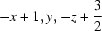 ; (ii)
  ; (iii)
  ; (iv)
 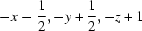 ; (vi)
 Data collection: SMART (Bruker, 1999); cell refinement: SAINT (Bruker, 1999); data reduction: SAINT; program(s) used to solve structure: SHELXS97 (Sheldrick, 2008); program(s) used to refine structure: SHELXL97 (Sheldrick, 2008); molecular graphics: ORTEP-3 (Farrugia, 1997); software used to prepare material for publication: SHELXL97.
Supporting information
contains datablocks I, global. DOI: 10.1107/S1600536808008659/tk2260sup1.cif
Structure factors: contains datablock I. DOI: 10.1107/S1600536808008659/tk2260Isup2.hkl
0.1 M Aqueous solutions of YCl3 (10 ml) and biuret (10 ml) were mixed and a small quantity of dilute hydrochloric acid was added, to result in a colourless solution. Colourless blocks of (I) grew over several days as the water slowly evaporated.
The N-bound hydrogen atoms were geometrically placed (N—H = 0.88 Å) and refined as riding with Uiso(H) = 1.2Ueq(N). The water H atoms were located in difference maps and refined as riding in their as-found relative positions with Uiso(H) = 1.2Ueq(O); see Table 2 for O-H distances.
Data collection: SMART (Bruker, 1999); cell SAINT (Bruker, 1999); data reduction: SAINT (Bruker, 1999); program(s) used to solve structure: SHELXS97 (Sheldrick, 2008); program(s) used to refine structure: SHELXL97 (Sheldrick, 2008); molecular graphics: ORTEP-3 (Farrugia, 1997); software used to prepare material for publication: SHELXL97 (Sheldrick, 2008).
![[Figure 1]](./tk2260fig1thm.gif) | Fig. 1. View of the molecular structure of (I) showing 50% displacement ellipsoids (arbitrary spheres for the H atoms). Symmetry code: (i) -x, y, 3/2 - z. |
![[Figure 2]](./tk2260fig2thm.gif) | Fig. 2. Detail of (I) showing the distorted square antiprismatic coordination of the Y atom. Symmetry code: (i) -x, y, 3/2 - z. |
![[Figure 3]](./tk2260fig3thm.gif) | Fig. 3. Fragment of a [100] chain of cations in (I) with the hydrogen bonds indicated by double-dashed lines. Symmetry codes: (i) 1 - x, y, 3/2 - z; (ii) x + 1, y, z. |
| [Y(C2H5N3O2)2(H2O)4]Cl3 | F(000) = 952 |
| Mr = 473.50 | Dx = 1.830 Mg m−3 |
| Monoclinic, C2/c | Mo Kα radiation, λ = 0.71073 Å |
| Hall symbol: -C 2yc | Cell parameters from 3637 reflections |
| a = 7.6510 (4) Å | θ = 3.1–32.4° |
| b = 13.2534 (7) Å | µ = 3.90 mm−1 |
| c = 17.2547 (9) Å | T = 293 K |
| β = 100.817 (1)° | Block, colourless |
| V = 1718.57 (16) Å3 | 0.36 × 0.24 × 0.14 mm |
| Z = 4 |
| Bruker SMART1000 CCD diffractometer | 3105 independent reflections |
| Radiation source: fine-focus sealed tube | 2464 reflections with I > 2σ(I) |
| Graphite monochromator | Rint = 0.019 |
| ω scans | θmax = 32.6°, θmin = 2.4° |
| Absorption correction: multi-scan (SADABS; Bruker, 1999) | h = −11→11 |
| Tmin = 0.340, Tmax = 0.611 | k = −20→19 |
| 8075 measured reflections | l = −16→26 |
| Refinement on F2 | Primary atom site location: structure-invariant direct methods |
| Least-squares matrix: full | Secondary atom site location: difference Fourier map |
| R[F2 > 2σ(F2)] = 0.025 | Hydrogen site location: difmap (O-H) and geom (N-H) |
| wR(F2) = 0.059 | H-atom parameters constrained |
| S = 0.98 | w = 1/[σ2(Fo2) + (0.0303P)2] where P = (Fo2 + 2Fc2)/3 |
| 3105 reflections | (Δ/σ)max < 0.001 |
| 101 parameters | Δρmax = 0.37 e Å−3 |
| 0 restraints | Δρmin = −0.34 e Å−3 |
| [Y(C2H5N3O2)2(H2O)4]Cl3 | V = 1718.57 (16) Å3 |
| Mr = 473.50 | Z = 4 |
| Monoclinic, C2/c | Mo Kα radiation |
| a = 7.6510 (4) Å | µ = 3.90 mm−1 |
| b = 13.2534 (7) Å | T = 293 K |
| c = 17.2547 (9) Å | 0.36 × 0.24 × 0.14 mm |
| β = 100.817 (1)° |
| Bruker SMART1000 CCD diffractometer | 3105 independent reflections |
| Absorption correction: multi-scan (SADABS; Bruker, 1999) | 2464 reflections with I > 2σ(I) |
| Tmin = 0.340, Tmax = 0.611 | Rint = 0.019 |
| 8075 measured reflections |
| R[F2 > 2σ(F2)] = 0.025 | 0 restraints |
| wR(F2) = 0.059 | H-atom parameters constrained |
| S = 0.98 | Δρmax = 0.37 e Å−3 |
| 3105 reflections | Δρmin = −0.34 e Å−3 |
| 101 parameters |
Geometry. All e.s.d.'s (except the e.s.d. in the dihedral angle between two l.s. planes) are estimated using the full covariance matrix. The cell e.s.d.'s are taken into account individually in the estimation of e.s.d.'s in distances, angles and torsion angles; correlations between e.s.d.'s in cell parameters are only used when they are defined by crystal symmetry. An approximate (isotropic) treatment of cell e.s.d.'s is used for estimating e.s.d.'s involving l.s. planes. |
Refinement. Refinement of F2 against ALL reflections. The weighted R-factor wR and goodness of fit S are based on F2, conventional R-factors R are based on F, with F set to zero for negative F2. The threshold expression of F2 > σ(F2) is used only for calculating R-factors(gt) etc. and is not relevant to the choice of reflections for refinement. R-factors based on F2 are statistically about twice as large as those based on F, and R- factors based on ALL data will be even larger. |
| x | y | z | Uiso*/Ueq | ||
| Y1 | 0.0000 | 0.107273 (15) | 0.7500 | 0.02386 (6) | |
| Cl1 | −0.04205 (5) | 0.33346 (3) | 0.50811 (2) | 0.03905 (10) | |
| Cl2 | 0.5000 | 0.29705 (5) | 0.7500 | 0.03992 (14) | |
| O1 | 0.25038 (14) | 0.02884 (9) | 0.72093 (7) | 0.0348 (3) | |
| O2 | −0.08317 (13) | 0.01042 (8) | 0.63600 (7) | 0.0329 (2) | |
| N1 | 0.45654 (18) | −0.01014 (13) | 0.64850 (10) | 0.0476 (4) | |
| H1 | 0.5399 | 0.0182 | 0.6817 | 0.057* | |
| H2 | 0.4804 | −0.0382 | 0.6068 | 0.057* | |
| N2 | 0.17105 (17) | −0.05973 (11) | 0.60525 (8) | 0.0332 (3) | |
| H3 | 0.2113 | −0.0980 | 0.5724 | 0.040* | |
| N3 | −0.10477 (19) | −0.11253 (11) | 0.54451 (9) | 0.0410 (3) | |
| H4 | −0.2191 | −0.1099 | 0.5351 | 0.049* | |
| H5 | −0.0506 | −0.1546 | 0.5193 | 0.049* | |
| C1 | 0.2922 (2) | −0.01064 (12) | 0.66153 (10) | 0.0308 (3) | |
| C2 | −0.0118 (2) | −0.05156 (11) | 0.59806 (9) | 0.0295 (3) | |
| O3 | −0.23875 (15) | 0.18780 (9) | 0.66560 (7) | 0.0377 (3) | |
| H6 | −0.2731 | 0.1747 | 0.6201 | 0.045* | |
| H7 | −0.3170 | 0.2159 | 0.6812 | 0.045* | |
| O4 | 0.11867 (16) | 0.22520 (10) | 0.67195 (8) | 0.0519 (4) | |
| H8 | 0.0828 | 0.2492 | 0.6326 | 0.062* | |
| H9 | 0.2176 | 0.2465 | 0.6742 | 0.062* |
| U11 | U22 | U33 | U12 | U13 | U23 | |
| Y1 | 0.02161 (9) | 0.02849 (10) | 0.02041 (9) | 0.000 | 0.00117 (7) | 0.000 |
| Cl1 | 0.0364 (2) | 0.0491 (2) | 0.0297 (2) | 0.00110 (17) | 0.00118 (17) | −0.00610 (18) |
| Cl2 | 0.0316 (3) | 0.0479 (3) | 0.0418 (3) | 0.000 | 0.0107 (2) | 0.000 |
| O1 | 0.0255 (5) | 0.0467 (6) | 0.0309 (6) | 0.0049 (5) | 0.0014 (5) | −0.0080 (5) |
| O2 | 0.0282 (5) | 0.0358 (6) | 0.0327 (6) | 0.0034 (5) | 0.0004 (5) | −0.0092 (5) |
| N1 | 0.0266 (7) | 0.0778 (11) | 0.0394 (8) | −0.0078 (7) | 0.0089 (6) | −0.0204 (8) |
| N2 | 0.0266 (6) | 0.0415 (7) | 0.0315 (7) | 0.0016 (6) | 0.0053 (5) | −0.0088 (6) |
| N3 | 0.0321 (7) | 0.0459 (8) | 0.0426 (8) | −0.0014 (6) | 0.0012 (6) | −0.0179 (7) |
| C1 | 0.0271 (7) | 0.0350 (8) | 0.0293 (8) | 0.0013 (6) | 0.0025 (6) | 0.0004 (7) |
| C2 | 0.0290 (7) | 0.0320 (7) | 0.0261 (7) | −0.0009 (6) | 0.0021 (6) | 0.0012 (6) |
| O3 | 0.0353 (6) | 0.0498 (7) | 0.0253 (6) | 0.0145 (5) | −0.0011 (5) | −0.0026 (5) |
| O4 | 0.0390 (7) | 0.0677 (9) | 0.0436 (7) | −0.0157 (6) | −0.0061 (6) | 0.0281 (7) |
| Y1—O1i | 2.3157 (11) | N1—H2 | 0.8600 |
| Y1—O1 | 2.3157 (11) | N2—C1 | 1.374 (2) |
| Y1—O2 | 2.3349 (11) | N2—C2 | 1.385 (2) |
| Y1—O2i | 2.3349 (11) | N2—H3 | 0.8600 |
| Y1—O4i | 2.3536 (12) | N3—C2 | 1.329 (2) |
| Y1—O4 | 2.3536 (12) | N3—H4 | 0.8600 |
| Y1—O3i | 2.3660 (10) | N3—H5 | 0.8600 |
| Y1—O3 | 2.3660 (10) | O3—H6 | 0.7990 |
| O1—C1 | 1.2450 (19) | O3—H7 | 0.7934 |
| O2—C2 | 1.2392 (18) | O4—H8 | 0.7541 |
| N1—C1 | 1.318 (2) | O4—H9 | 0.8023 |
| N1—H1 | 0.8600 | ||
| O1i—Y1—O1 | 126.66 (6) | O4—Y1—O3 | 71.61 (4) |
| O1i—Y1—O2 | 80.21 (4) | O3i—Y1—O3 | 126.37 (6) |
| O1—Y1—O2 | 71.12 (4) | C1—O1—Y1 | 135.89 (10) |
| O1i—Y1—O2i | 71.12 (4) | C2—O2—Y1 | 137.05 (10) |
| O1—Y1—O2i | 80.21 (4) | C1—N1—H1 | 120.0 |
| O2—Y1—O2i | 113.30 (6) | C1—N1—H2 | 120.0 |
| O1i—Y1—O4i | 75.55 (5) | H1—N1—H2 | 120.0 |
| O1—Y1—O4i | 147.74 (4) | C1—N2—C2 | 124.22 (14) |
| O2—Y1—O4i | 140.68 (4) | C1—N2—H3 | 117.9 |
| O2i—Y1—O4i | 87.51 (4) | C2—N2—H3 | 117.9 |
| O1i—Y1—O4 | 147.74 (4) | C2—N3—H4 | 120.0 |
| O1—Y1—O4 | 75.55 (5) | C2—N3—H5 | 120.0 |
| O2—Y1—O4 | 87.51 (4) | H4—N3—H5 | 120.0 |
| O2i—Y1—O4 | 140.68 (4) | O1—C1—N1 | 122.63 (15) |
| O4i—Y1—O4 | 96.78 (8) | O1—C1—N2 | 122.49 (14) |
| O1i—Y1—O3i | 130.07 (4) | N1—C1—N2 | 114.87 (15) |
| O1—Y1—O3i | 76.19 (4) | O2—C2—N3 | 122.60 (14) |
| O2—Y1—O3i | 145.42 (4) | O2—C2—N2 | 122.84 (14) |
| O2i—Y1—O3i | 70.89 (4) | N3—C2—N2 | 114.49 (15) |
| O4i—Y1—O3i | 71.61 (4) | Y1—O3—H6 | 125.5 |
| O4—Y1—O3i | 73.53 (4) | Y1—O3—H7 | 123.2 |
| O1i—Y1—O3 | 76.19 (4) | H6—O3—H7 | 107.8 |
| O1—Y1—O3 | 130.07 (4) | Y1—O4—H8 | 133.0 |
| O2—Y1—O3 | 70.89 (4) | Y1—O4—H9 | 132.0 |
| O2i—Y1—O3 | 145.42 (4) | H8—O4—H9 | 94.3 |
| O4i—Y1—O3 | 73.53 (4) |
| Symmetry code: (i) −x, y, −z+3/2. |
| D—H···A | D—H | H···A | D···A | D—H···A |
| N1—H1···O1ii | 0.86 | 2.10 | 2.9111 (18) | 157 |
| N1—H2···Cl1iii | 0.86 | 2.39 | 3.1897 (17) | 155 |
| N2—H3···Cl1iii | 0.86 | 2.53 | 3.3184 (14) | 153 |
| N3—H4···Cl1iv | 0.86 | 2.54 | 3.3633 (15) | 161 |
| N3—H5···Cl1v | 0.86 | 2.54 | 3.3232 (15) | 151 |
| O3—H6···Cl1vi | 0.80 | 2.39 | 3.1607 (12) | 161 |
| O3—H7···Cl2vii | 0.79 | 2.27 | 3.0504 (12) | 168 |
| O4—H8···Cl1 | 0.75 | 2.45 | 3.2028 (13) | 177 |
| O4—H9···Cl2 | 0.80 | 2.40 | 3.1238 (12) | 150 |
| Symmetry codes: (ii) −x+1, y, −z+3/2; (iii) x+1/2, y−1/2, z; (iv) x−1/2, y−1/2, z; (v) −x, −y, −z+1; (vi) −x−1/2, −y+1/2, −z+1; (vii) x−1, y, z. |
Experimental details
| Crystal data | |
| Chemical formula | [Y(C2H5N3O2)2(H2O)4]Cl3 |
| Mr | 473.50 |
| Crystal system, space group | Monoclinic, C2/c |
| Temperature (K) | 293 |
| a, b, c (Å) | 7.6510 (4), 13.2534 (7), 17.2547 (9) |
| β (°) | 100.817 (1) |
| V (Å3) | 1718.57 (16) |
| Z | 4 |
| Radiation type | Mo Kα |
| µ (mm−1) | 3.90 |
| Crystal size (mm) | 0.36 × 0.24 × 0.14 |
| Data collection | |
| Diffractometer | Bruker SMART1000 CCD diffractometer |
| Absorption correction | Multi-scan (SADABS; Bruker, 1999) |
| Tmin, Tmax | 0.340, 0.611 |
| No. of measured, independent and observed [I > 2σ(I)] reflections | 8075, 3105, 2464 |
| Rint | 0.019 |
| (sin θ/λ)max (Å−1) | 0.758 |
| Refinement | |
| R[F2 > 2σ(F2)], wR(F2), S | 0.025, 0.059, 0.98 |
| No. of reflections | 3105 |
| No. of parameters | 101 |
| H-atom treatment | H-atom parameters constrained |
| Δρmax, Δρmin (e Å−3) | 0.37, −0.34 |
Computer programs: SMART (Bruker, 1999), SAINT (Bruker, 1999), SHELXS97 (Sheldrick, 2008), SHELXL97 (Sheldrick, 2008), ORTEP-3 (Farrugia, 1997).
| D—H···A | D—H | H···A | D···A | D—H···A |
| N1—H1···O1i | 0.86 | 2.10 | 2.9111 (18) | 157 |
| N1—H2···Cl1ii | 0.86 | 2.39 | 3.1897 (17) | 155 |
| N2—H3···Cl1ii | 0.86 | 2.53 | 3.3184 (14) | 153 |
| N3—H4···Cl1iii | 0.86 | 2.54 | 3.3633 (15) | 161 |
| N3—H5···Cl1iv | 0.86 | 2.54 | 3.3232 (15) | 151 |
| O3—H6···Cl1v | 0.80 | 2.39 | 3.1607 (12) | 161 |
| O3—H7···Cl2vi | 0.79 | 2.27 | 3.0504 (12) | 168 |
| O4—H8···Cl1 | 0.75 | 2.45 | 3.2028 (13) | 177 |
| O4—H9···Cl2 | 0.80 | 2.40 | 3.1238 (12) | 150 |
| Symmetry codes: (i) −x+1, y, −z+3/2; (ii) x+1/2, y−1/2, z; (iii) x−1/2, y−1/2, z; (iv) −x, −y, −z+1; (v) −x−1/2, −y+1/2, −z+1; (vi) x−1, y, z. |
References
 Bernstein, J., Davis, R. E., Shimoni, L. & Chang, N.-L. (1995). Angew. Chem. Int. Ed. Engl. 34, 1555–1573. CrossRef CAS Web of Science Google Scholar
Brese, N. E. & O'Keeffe, M. (1991). Acta Cryst. B47, 192–197. CrossRef CAS Web of Science IUCr Journals Google Scholar
Bruker (1999). SMART, SAINT and SADABS. Bruker AXS Inc., Madison, Wisconsin, USA. Google Scholar
Carugo, O., Poli, G. & Manzoni, L. (1992). Acta Cryst. C48, 2013–2016. CSD CrossRef CAS Web of Science IUCr Journals Google Scholar
Farrugia, L. J. (1997). J. Appl. Cryst. 30, 565. CrossRef IUCr Journals Google Scholar
Haddad, S. F. (1987). Acta Cryst. C43, 1882–1885. CSD CrossRef CAS IUCr Journals Google Scholar
Haddad, S. F. (1988). Acta Cryst. C44, 815–818. CSD CrossRef CAS Web of Science IUCr Journals Google Scholar
Sheldrick, G. M. (2008). Acta Cryst. A64, 112–122. Web of Science CrossRef CAS IUCr Journals Google Scholar
This is an open-access article distributed under the terms of the Creative Commons Attribution (CC-BY) Licence, which permits unrestricted use, distribution, and reproduction in any medium, provided the original authors and source are cited.
| CRYSTALLOGRAPHIC COMMUNICATIONS |


No complexes of yttrium(III) with biuret (biur), H2N—CO—NH—CO—NH2 (or C2H5N3O2) have been structurally characterized. The structures of two samarium-biuret complexes, Sm(biur)4.(NO3)3 (Haddad, 1987) and Sm(biur)4.(ClO4)3 (Haddad, 1988) have been described. In both cases, an SmO8 square antiprismatic coordination arises for the metal ion. Based on X-ray photographs, it was suggested that all the Ln(biur)4.(NO3)3 and Ln(biur)4.(ClO4)3 compounds are isostructural with their samarium prototypes. In this paper, we describe the synthesis and structure of the title compound, (I).
Compound (I) is an ionic salt containing a new [Y(biur)2(H2O)4]3+ complex ion. The complete complex ion is generated by crystallographic 2-fold symmetry, with the Y atom lying on the rotation axis. Two uncoordinated chloride ions, one of which has crystallographic site symmetry 2, complete the structure of (I), Fig. 1.
The resulting YO8 polyhedral geometry in (I) (Table 1) is a distorted square antiprism (Fig. 2). The nominal square face formed by atoms O1, O2, O1i and O2i (i = -x, y, 3/2 - z) is reasonably regular, but the second face formed by the four water molecules (O3, O4, O3i and O4i) is much more distorted, and the diagonal O3···O3i and O4···O4i distances of 4.223 (2)Å and 3.5197 (19) Å, respectively, are very different. The Y1 atom deviates from the mean planes of O1/O2/O1i/O2i and O3/O4/O3i/O4i by 1.1616 (8) Å and 1.3151 (9) Å, respectively. The two O atom mean planes are constrained to be parallel by symmetry. The bond valence sum (Brese & O'Keeffe, 1991) for Y1 of 3.34 in (I) indicates that its valence requirement is easily satisfied by this geometry.
The O,O-bidenate coordination of the biuret molecule to the yttrium ion in (I) results in a six-membered chelate ring that is non-planar. As noted previously (Carugo et al., 1992), the biuret molecule can be regarded as two planar amide fragments linked by the NH bridge. Here, the dihedral angle betwen the N1/C1/O1/N2 and N2/C2/O2/N3 units is 5.06 (10)°. The yttrium cation deviates from the N1/C1/O1/N2 and N2/C2/O2/N3 mean planes by 0.894 (4) Å and 0.606 (4) Å, respectively.
The component species in (I) are linked by a dense array of N—H···O, N—H···Cl and O—H···Cl hydrogen bonds (Table 2) resulting in a three-dimensional network. Of note is the N—H···O hydrogen bond, which results in [100] chains (Fig. 3) of cations, in which R22(8) loops (Bernstein et al., 1995) linking the molecules are apparent.