 | Acta Crystallographica Section E Acta Crystallographica Section E CRYSTALLOGRAPHIC COMMUNICATIONS |


 journal menu


organic compounds
| CRYSTALLOGRAPHIC COMMUNICATIONS |
 access
N-(2,6-Dimethylphenyl)benzenesulfonamide

aDepartment of Chemistry, Mangalore University, Mangalagangotri 574 199, Mangalore, India, and bInstitute of Materials Science, Darmstadt University of Technology, Petersenstrasse 23, D-64287 Darmstadt, Germany
*Correspondence e-mail: [email protected]
In the of the title compound, C14H15NO2S, the N—H bond is trans to one of the S=O double bonds, similar to what is observed in N-(2-methylphenyl)benzenesulfonamide and other aryl sulfonamides. The two aromatic rings enclose a dihedral angle of 44.9 (1)°. The molecules are connected by intermolecular N—H⋯O hydrogen bonds into chains running along the a axis. An intermolecular C—H⋯O hydrogen bond is also present.
Related literature
For related literature, see: Gelbrich et al. (2007![[Gelbrich, T., Hursthouse, M. B. & Threlfall, T. L. (2007). Acta Cryst. B63, 621-632.]](../../../../../../logos/arrows/e_arr.gif "Gelbrich, T., Hursthouse, M. B. & Threlfall, T. L. (2007). Acta Cryst. B63, 621-632.") ); Gowda et al. (2005, 2008); Gowda, Babitha et al. (2007); Gowda, Foro et al. (2007); Perlovich et al. (2006).
); Gowda et al. (2005, 2008); Gowda, Babitha et al. (2007); Gowda, Foro et al. (2007); Perlovich et al. (2006).
![[Scheme 1]](bt2760scheme1.gif)
Experimental
Crystal data
|
Data collection
|
Refinement
|
| ||||||||||||||||||||||
 .
. Data collection: CAD-4-PC (Enraf–Nonius, 1996); cell refinement: CAD-4-PC; data reduction: REDU4 (Stoe & Cie, 1987); program(s) used to solve structure: SHELXS97 (Sheldrick, 2008); program(s) used to refine structure: SHELXL97 (Sheldrick, 2008); molecular graphics: PLATON (Spek, 2003); software used to prepare material for publication: SHELXL97.
Supporting information
contains datablocks I, global. DOI: 10.1107/S1600536808024653/bt2760sup1.cif
Structure factors: contains datablock I. DOI: 10.1107/S1600536808024653/bt2760Isup2.hkl
The solution of benzene (10 cc) in chloroform (40 cc) was treated dropwise with chlorosulfonic acid (25 cc) at 0 ° C. After the initial evolution of hydrogen chloride subsided, the reaction mixture was brought to room temperature and poured into crushed ice in a beaker. The chloroform layer was separated, washed with cold water and allowed to evaporate slowly. The residual benzenesulfonylchloride was treated with 2,6-dimethylaniline in the stoichiometric ratio and boiled for ten minutes. The reaction mixture was then cooled to room temperature and added to ice cold water (100 cc). The resultant solid N-(2,6-dimethylphenyl)-benzenesulfonamide was filtered under suction and washed thoroughly with cold water. It was then recrystallized to constant melting point from dilute ethanol. The purity of the compound was checked and characterized by recording its infrared and NMR spectra (Gowda et al., 2005). The single crystals used in X-ray diffraction studies were grown in ethanolic solution by slow evaporation at room temperature.
The H atoms were positioned with idealized geometry using a riding model with C—H = 0.93–0.96 Å, N—H = 0.86 Å, and were refined with isotropic displacement parameters (set to 1.2 times of the Ueq of the parent atom).
Data collection: CAD-4-PC (Enraf–Nonius, 1996); cell CAD-4-PC (Enraf–Nonius, 1996); data reduction: REDU4 (Stoe & Cie, 1987); program(s) used to solve structure: SHELXS97 (Sheldrick, 2008); program(s) used to refine structure: SHELXL97 (Sheldrick, 2008); molecular graphics: PLATON (Spek, 2003); software used to prepare material for publication: SHELXL97 (Sheldrick, 2008).
![[Figure 1]](./bt2760fig1thm.gif) | Fig. 1. Molecular structure of the title compound, showing the atom labeling scheme. The displacement ellipsoids are drawn at the 50% probability level. The H atoms are represented as small spheres of arbitrary radii. |
![[Figure 2]](./bt2760fig2thm.gif) | Fig. 2. Molecular packing of the title compound with hydrogen bonding shown as dashed lines. |
| C14H15NO2S | F(000) = 552 |
| Mr = 261.33 | Dx = 1.320 Mg m−3 |
| Monoclinic, P21/n | Cu Kα radiation, λ = 1.54180 Å |
| Hall symbol: -P 2yn | Cell parameters from 25 reflections |
| a = 5.2133 (7) Å | θ = 4.0–19.2° |
| b = 17.971 (2) Å | µ = 2.14 mm−1 |
| c = 14.040 (1) Å | T = 299 K |
| β = 91.681 (9)° | Prism, colourless |
| V = 1314.8 (2) Å3 | 0.55 × 0.35 × 0.33 mm |
| Z = 4 |
| Enraf–Nonius CAD-4 diffractometer | Rint = 0.071 |
| Radiation source: fine-focus sealed tube | θmax = 66.9°, θmin = 4.0° |
| Graphite monochromator | h = −6→1 |
| ω/2θ scans | k = −21→0 |
| 2622 measured reflections | l = −16→16 |
| 2340 independent reflections | 3 standard reflections every 120 min |
| 2197 reflections with I > 2σ(I) | intensity decay: 1.0% |
| Refinement on F2 | Secondary atom site location: difference Fourier map |
| Least-squares matrix: full | Hydrogen site location: inferred from neighbouring sites |
| R[F2 > 2σ(F2)] = 0.047 | H-atom parameters constrained |
| wR(F2) = 0.134 | w = 1/[σ2(Fo2) + (0.0807P)2 + 0.6081P] where P = (Fo2 + 2Fc2)/3 |
| S = 1.08 | (Δ/σ)max = 0.001 |
| 2340 reflections | Δρmax = 0.35 e Å−3 |
| 164 parameters | Δρmin = −0.42 e Å−3 |
| 0 restraints | Extinction correction: SHELXL97 (Sheldrick, 2008), Fc*=kFc[1+0.001xFc2λ3/sin(2θ)]-1/4 |
| Primary atom site location: structure-invariant direct methods | Extinction coefficient: 0.0060 (9) |
| C14H15NO2S | V = 1314.8 (2) Å3 |
| Mr = 261.33 | Z = 4 |
| Monoclinic, P21/n | Cu Kα radiation |
| a = 5.2133 (7) Å | µ = 2.14 mm−1 |
| b = 17.971 (2) Å | T = 299 K |
| c = 14.040 (1) Å | 0.55 × 0.35 × 0.33 mm |
| β = 91.681 (9)° |
| Enraf–Nonius CAD-4 diffractometer | Rint = 0.071 |
| 2622 measured reflections | 3 standard reflections every 120 min |
| 2340 independent reflections | intensity decay: 1.0% |
| 2197 reflections with I > 2σ(I) |
| R[F2 > 2σ(F2)] = 0.047 | 0 restraints |
| wR(F2) = 0.134 | H-atom parameters constrained |
| S = 1.08 | Δρmax = 0.35 e Å−3 |
| 2340 reflections | Δρmin = −0.42 e Å−3 |
| 164 parameters |
Geometry. All e.s.d.'s (except the e.s.d. in the dihedral angle between two l.s. planes) are estimated using the full covariance matrix. The cell e.s.d.'s are taken into account individually in the estimation of e.s.d.'s in distances, angles and torsion angles; correlations between e.s.d.'s in cell parameters are only used when they are defined by crystal symmetry. An approximate (isotropic) treatment of cell e.s.d.'s is used for estimating e.s.d.'s involving l.s. planes. |
Refinement. Refinement of F2 against ALL reflections. The weighted R-factor wR and goodness of fit S are based on F2, conventional R-factors R are based on F, with F set to zero for negative F2. The threshold expression of F2 > σ(F2) is used only for calculating R-factors(gt) etc. and is not relevant to the choice of reflections for refinement. R-factors based on F2 are statistically about twice as large as those based on F, and R- factors based on ALL data will be even larger. |
| x | y | z | Uiso*/Ueq | ||
| C1 | −0.0070 (4) | 0.19125 (11) | 0.78195 (15) | 0.0359 (5) | |
| C2 | −0.2175 (4) | 0.23812 (13) | 0.7860 (2) | 0.0518 (6) | |
| H2 | −0.3303 | 0.2434 | 0.7339 | 0.062* | |
| C3 | −0.2557 (5) | 0.27695 (15) | 0.8699 (3) | 0.0677 (8) | |
| H3 | −0.3972 | 0.3081 | 0.8744 | 0.081* | |
| C4 | −0.0875 (6) | 0.26990 (16) | 0.9461 (2) | 0.0666 (8) | |
| H4 | −0.1141 | 0.2969 | 1.0014 | 0.080* | |
| C5 | 0.1186 (6) | 0.22354 (15) | 0.94146 (19) | 0.0590 (7) | |
| H5 | 0.2309 | 0.2186 | 0.9938 | 0.071* | |
| C6 | 0.1608 (4) | 0.18376 (13) | 0.85885 (17) | 0.0453 (5) | |
| H6 | 0.3017 | 0.1522 | 0.8554 | 0.054* | |
| C7 | −0.0178 (4) | 0.00007 (11) | 0.74093 (15) | 0.0373 (5) | |
| C8 | −0.1139 (4) | −0.01229 (12) | 0.83144 (16) | 0.0437 (5) | |
| C9 | −0.0176 (6) | −0.07186 (15) | 0.8839 (2) | 0.0609 (7) | |
| H9 | −0.0788 | −0.0809 | 0.9444 | 0.073* | |
| C10 | 0.1675 (7) | −0.11784 (16) | 0.8480 (3) | 0.0730 (9) | |
| H10 | 0.2336 | −0.1568 | 0.8848 | 0.088* | |
| C11 | 0.2541 (6) | −0.10620 (14) | 0.7582 (2) | 0.0680 (8) | |
| H11 | 0.3769 | −0.1382 | 0.7343 | 0.082* | |
| C12 | 0.1628 (5) | −0.04751 (13) | 0.70148 (18) | 0.0498 (6) | |
| C13 | −0.3213 (5) | 0.03545 (14) | 0.87194 (18) | 0.0521 (6) | |
| H13A | −0.4740 | 0.0316 | 0.8323 | 0.063* | |
| H13B | −0.2651 | 0.0863 | 0.8741 | 0.063* | |
| H13C | −0.3570 | 0.0189 | 0.9352 | 0.063* | |
| C14 | 0.2511 (6) | −0.03980 (16) | 0.6006 (2) | 0.0683 (8) | |
| H14A | 0.2690 | 0.0120 | 0.5853 | 0.082* | |
| H14B | 0.1270 | −0.0622 | 0.5576 | 0.082* | |
| H14C | 0.4135 | −0.0643 | 0.5947 | 0.082* | |
| N1 | −0.1132 (3) | 0.06164 (9) | 0.68444 (12) | 0.0371 (4) | |
| H1N | −0.2573 | 0.0571 | 0.6536 | 0.044* | |
| O1 | 0.3127 (3) | 0.12146 (10) | 0.67758 (12) | 0.0478 (4) | |
| O2 | −0.0692 (4) | 0.17882 (10) | 0.59926 (12) | 0.0576 (5) | |
| S1 | 0.04474 (9) | 0.13941 (3) | 0.67748 (3) | 0.0358 (2) |
| U11 | U22 | U33 | U12 | U13 | U23 | |
| C1 | 0.0330 (10) | 0.0277 (9) | 0.0476 (11) | −0.0044 (7) | 0.0082 (8) | 0.0010 (8) |
| C2 | 0.0383 (11) | 0.0382 (12) | 0.0794 (17) | 0.0005 (9) | 0.0079 (11) | −0.0024 (11) |
| C3 | 0.0519 (14) | 0.0440 (14) | 0.109 (2) | 0.0011 (11) | 0.0324 (16) | −0.0178 (14) |
| C4 | 0.0731 (18) | 0.0538 (15) | 0.0749 (19) | −0.0173 (14) | 0.0336 (15) | −0.0237 (14) |
| C5 | 0.0697 (16) | 0.0576 (15) | 0.0500 (14) | −0.0172 (13) | 0.0086 (12) | −0.0106 (12) |
| C6 | 0.0437 (11) | 0.0425 (12) | 0.0500 (12) | −0.0010 (9) | 0.0044 (9) | −0.0046 (9) |
| C7 | 0.0377 (10) | 0.0300 (10) | 0.0437 (11) | −0.0023 (8) | −0.0068 (8) | −0.0014 (8) |
| C8 | 0.0421 (11) | 0.0398 (11) | 0.0490 (12) | −0.0076 (9) | −0.0027 (9) | 0.0031 (9) |
| C9 | 0.0698 (17) | 0.0511 (14) | 0.0614 (16) | −0.0060 (12) | −0.0037 (12) | 0.0180 (12) |
| C10 | 0.088 (2) | 0.0455 (14) | 0.085 (2) | 0.0092 (14) | −0.0165 (17) | 0.0183 (14) |
| C11 | 0.0701 (18) | 0.0419 (14) | 0.091 (2) | 0.0179 (13) | −0.0075 (15) | −0.0061 (14) |
| C12 | 0.0523 (13) | 0.0388 (12) | 0.0579 (14) | 0.0040 (10) | −0.0045 (10) | −0.0108 (10) |
| C13 | 0.0489 (13) | 0.0557 (14) | 0.0523 (13) | −0.0057 (11) | 0.0106 (10) | 0.0054 (11) |
| C14 | 0.0828 (19) | 0.0587 (16) | 0.0638 (17) | 0.0143 (14) | 0.0110 (14) | −0.0211 (13) |
| N1 | 0.0333 (8) | 0.0372 (9) | 0.0402 (9) | −0.0016 (7) | −0.0069 (7) | 0.0004 (7) |
| O1 | 0.0331 (8) | 0.0539 (9) | 0.0569 (10) | −0.0006 (7) | 0.0104 (7) | −0.0048 (7) |
| O2 | 0.0690 (11) | 0.0563 (10) | 0.0473 (9) | 0.0011 (8) | −0.0016 (8) | 0.0193 (8) |
| S1 | 0.0351 (3) | 0.0364 (3) | 0.0361 (3) | −0.00027 (18) | 0.0040 (2) | 0.00487 (18) |
| C1—C6 | 1.376 (3) | C9—C10 | 1.377 (5) |
| C1—C2 | 1.386 (3) | C9—H9 | 0.9300 |
| C1—S1 | 1.765 (2) | C10—C11 | 1.368 (5) |
| C2—C3 | 1.388 (4) | C10—H10 | 0.9300 |
| C2—H2 | 0.9300 | C11—C12 | 1.397 (4) |
| C3—C4 | 1.369 (5) | C11—H11 | 0.9300 |
| C3—H3 | 0.9300 | C12—C14 | 1.508 (4) |
| C4—C5 | 1.363 (4) | C13—H13A | 0.9600 |
| C4—H4 | 0.9300 | C13—H13B | 0.9600 |
| C5—C6 | 1.386 (3) | C13—H13C | 0.9600 |
| C5—H5 | 0.9300 | C14—H14A | 0.9600 |
| C6—H6 | 0.9300 | C14—H14B | 0.9600 |
| C7—C8 | 1.397 (3) | C14—H14C | 0.9600 |
| C7—C12 | 1.398 (3) | N1—S1 | 1.6263 (17) |
| C7—N1 | 1.441 (3) | N1—H1N | 0.8600 |
| C8—C9 | 1.386 (3) | O1—S1 | 1.4334 (16) |
| C8—C13 | 1.505 (3) | O2—S1 | 1.4221 (17) |
| C6—C1—C2 | 120.9 (2) | C9—C10—H10 | 120.0 |
| C6—C1—S1 | 119.41 (16) | C10—C11—C12 | 121.7 (3) |
| C2—C1—S1 | 119.71 (18) | C10—C11—H11 | 119.2 |
| C1—C2—C3 | 118.3 (3) | C12—C11—H11 | 119.2 |
| C1—C2—H2 | 120.8 | C11—C12—C7 | 117.3 (3) |
| C3—C2—H2 | 120.8 | C11—C12—C14 | 119.8 (2) |
| C4—C3—C2 | 120.8 (2) | C7—C12—C14 | 122.9 (2) |
| C4—C3—H3 | 119.6 | C8—C13—H13A | 109.5 |
| C2—C3—H3 | 119.6 | C8—C13—H13B | 109.5 |
| C5—C4—C3 | 120.5 (3) | H13A—C13—H13B | 109.5 |
| C5—C4—H4 | 119.8 | C8—C13—H13C | 109.5 |
| C3—C4—H4 | 119.8 | H13A—C13—H13C | 109.5 |
| C4—C5—C6 | 120.0 (3) | H13B—C13—H13C | 109.5 |
| C4—C5—H5 | 120.0 | C12—C14—H14A | 109.5 |
| C6—C5—H5 | 120.0 | C12—C14—H14B | 109.5 |
| C1—C6—C5 | 119.5 (2) | H14A—C14—H14B | 109.5 |
| C1—C6—H6 | 120.2 | C12—C14—H14C | 109.5 |
| C5—C6—H6 | 120.2 | H14A—C14—H14C | 109.5 |
| C8—C7—C12 | 121.8 (2) | H14B—C14—H14C | 109.5 |
| C8—C7—N1 | 119.69 (19) | C7—N1—S1 | 121.72 (13) |
| C12—C7—N1 | 118.5 (2) | C7—N1—H1N | 119.1 |
| C9—C8—C7 | 118.2 (2) | S1—N1—H1N | 119.1 |
| C9—C8—C13 | 119.5 (2) | O2—S1—O1 | 119.85 (11) |
| C7—C8—C13 | 122.3 (2) | O2—S1—N1 | 105.89 (10) |
| C10—C9—C8 | 121.0 (3) | O1—S1—N1 | 107.55 (10) |
| C10—C9—H9 | 119.5 | O2—S1—C1 | 107.95 (11) |
| C8—C9—H9 | 119.5 | O1—S1—C1 | 106.89 (10) |
| C11—C10—C9 | 120.0 (3) | N1—S1—C1 | 108.28 (9) |
| C11—C10—H10 | 120.0 | ||
| C6—C1—C2—C3 | −0.4 (3) | C10—C11—C12—C14 | −176.0 (3) |
| S1—C1—C2—C3 | 178.70 (18) | C8—C7—C12—C11 | −3.2 (3) |
| C1—C2—C3—C4 | 0.9 (4) | N1—C7—C12—C11 | 179.3 (2) |
| C2—C3—C4—C5 | −1.1 (4) | C8—C7—C12—C14 | 174.0 (2) |
| C3—C4—C5—C6 | 0.7 (4) | N1—C7—C12—C14 | −3.5 (3) |
| C2—C1—C6—C5 | 0.1 (3) | C8—C7—N1—S1 | 99.9 (2) |
| S1—C1—C6—C5 | −179.04 (18) | C12—C7—N1—S1 | −82.5 (2) |
| C4—C5—C6—C1 | −0.2 (4) | C7—N1—S1—O2 | 165.74 (17) |
| C12—C7—C8—C9 | 2.6 (3) | C7—N1—S1—O1 | 36.48 (19) |
| N1—C7—C8—C9 | −179.8 (2) | C7—N1—S1—C1 | −78.70 (18) |
| C12—C7—C8—C13 | −175.8 (2) | C6—C1—S1—O2 | −153.98 (17) |
| N1—C7—C8—C13 | 1.8 (3) | C2—C1—S1—O2 | 26.9 (2) |
| C7—C8—C9—C10 | −0.1 (4) | C6—C1—S1—O1 | −23.8 (2) |
| C13—C8—C9—C10 | 178.3 (3) | C2—C1—S1—O1 | 157.06 (17) |
| C8—C9—C10—C11 | −1.7 (5) | C6—C1—S1—N1 | 91.81 (18) |
| C9—C10—C11—C12 | 1.2 (5) | C2—C1—S1—N1 | −87.33 (18) |
| C10—C11—C12—C7 | 1.2 (4) |
| D—H···A | D—H | H···A | D···A | D—H···A |
| N1—H1N···O1i | 0.86 | 2.55 | 3.179 (2) | 131 |
| C5—H5···O2ii | 0.93 | 2.57 | 3.229 (3) | 129 |
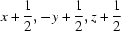
| Symmetry codes: (i) x−1, y, z; (ii) x+1/2, −y+1/2, z+1/2. |
Experimental details
| Crystal data | |
| Chemical formula | C14H15NO2S |
| Mr | 261.33 |
| Crystal system, space group | Monoclinic, P21/n |
| Temperature (K) | 299 |
| a, b, c (Å) | 5.2133 (7), 17.971 (2), 14.040 (1) |
| β (°) | 91.681 (9) |
| V (Å3) | 1314.8 (2) |
| Z | 4 |
| Radiation type | Cu Kα |
| µ (mm−1) | 2.14 |
| Crystal size (mm) | 0.55 × 0.35 × 0.33 |
| Data collection | |
| Diffractometer | Enraf–Nonius CAD-4 diffractometer |
| Absorption correction | – |
| No. of measured, independent and observed [I > 2σ(I)] reflections | 2622, 2340, 2197 |
| Rint | 0.071 |
| (sin θ/λ)max (Å−1) | 0.597 |
| Refinement | |
| R[F2 > 2σ(F2)], wR(F2), S | 0.047, 0.134, 1.08 |
| No. of reflections | 2340 |
| No. of parameters | 164 |
| H-atom treatment | H-atom parameters constrained |
| Δρmax, Δρmin (e Å−3) | 0.35, −0.42 |
Computer programs: CAD-4-PC (Enraf–Nonius, 1996), REDU4 (Stoe & Cie, 1987), SHELXS97 (Sheldrick, 2008), SHELXL97 (Sheldrick, 2008), PLATON (Spek, 2003).
| D—H···A | D—H | H···A | D···A | D—H···A |
| N1—H1N···O1i | 0.86 | 2.55 | 3.179 (2) | 130.5 |
| C5—H5···O2ii | 0.93 | 2.57 | 3.229 (3) | 128.5 |
| Symmetry codes: (i) x−1, y, z; (ii) x+1/2, −y+1/2, z+1/2. |
Acknowledgements
BTG thanks the Alexander von Humboldt Foundation, Bonn, Germany, for extensions of his research fellowship.
References
 Enraf–Nonius (1996). CAD-4-PC. Enraf–Nonius, Delft, The Netherlands. Google Scholar
Gelbrich, T., Hursthouse, M. B. & Threlfall, T. L. (2007). Acta Cryst. B63, 621–632. Web of Science CSD CrossRef IUCr Journals Google Scholar
Gowda, B. T., Babitha, K. S., Tokarčík, M., Kožíšek, J. & Fuess, H. (2007). Acta Cryst. E63, o3361. Web of Science CSD CrossRef IUCr Journals Google Scholar
Gowda, B. T., Foro, S., Babitha, K. S. & Fuess, H. (2008). Acta Cryst. E64, o1692. Web of Science CSD CrossRef IUCr Journals Google Scholar
Gowda, B. T., Foro, S. & Fuess, H. (2007). Acta Cryst. E63, o3325. Web of Science CSD CrossRef IUCr Journals Google Scholar
Gowda, B. T., Shetty, M. & Jayalakshmi, K. L. (2005). Z. Naturforsch. Teil A, 60, 106–112. CAS Google Scholar
Perlovich, G. L., Tkachev, V. V., Schaper, K.-J. & Raevsky, O. A. (2006). Acta Cryst. E62, o780–o782. Web of Science CSD CrossRef IUCr Journals Google Scholar
Sheldrick, G. M. (2008). Acta Cryst. A64, 112–122. Web of Science CrossRef CAS IUCr Journals Google Scholar
Spek, A. L. (2003). J. Appl. Cryst. 36, 7–13. Web of Science CrossRef CAS IUCr Journals Google Scholar
Stoe & Cie (1987). REDU4. Stoe & Cie GmbH, Darmstadt, Germany. Google Scholar
This is an open-access article distributed under the terms of the Creative Commons Attribution (CC-BY) Licence, which permits unrestricted use, distribution, and reproduction in any medium, provided the original authors and source are cited.
| CRYSTALLOGRAPHIC COMMUNICATIONS |


As part of a study of the substituent effects on the crystal structures of N-(aryl)-sulfonamides, in the present work, the structure of N-(2,6-dimethylphenyl)-benzenesulfonamide (N26DMPBSA) has been determined (Gowda et al., 2005, 2008; Gowda, Babitha et al. 2007; Gowda, Foro et al. 2007). The the N—H bond is trans to one of the S—O double bonds (Fig. 1), similar to what is observed in N-(2-methylphenyl)-benzenesulfonamide (N2MPBSA)(Gowda et al., 2008) and other aryl sulfonamides (Perlovich et al., 2006; Gelbrich et al., 2007;). The two aromatic rings are rotated relative to each other by 44.9 (1)°, compared with the value of 61.5 (1)° in N2MPBSA. The other bond parameters in N26DMPBSA are similar to those observed in N2MPBSA and other N-(aryl)-sulfonamides (Gowda, Babitha et al., 2007; Gowda, Foro et al. 2007; Gowda et al. 2008; Perlovich et al., 2006; Gelbrich et al., 2007). The packing diagram of N26DMPBSA via intermolecular N—H···O and C—H···O hydrogen bonds (Table 1) is shown in Fig. 2.