 | Acta Crystallographica Section E Acta Crystallographica Section E CRYSTALLOGRAPHIC COMMUNICATIONS |


 journal menu


organic compounds
| CRYSTALLOGRAPHIC COMMUNICATIONS |
 access
2,2′-Dimethoxybiphenyl

aDepartment of Organic and Polymer Materials Chemistry, Tokyo University of Agriculture & Technology, Koganei, Tokyo 184-8588, Japan, bTDK Corporation, 2-15-7, Hiagashi Owada, Ichikawa, Chiba 272-8558, Japan, and cInstrumentaion Analysis Center, Tokyo University of Agriculture & Technology, Koganei, Tokyo 184-8588, Japan
*Correspondence e-mail: [email protected]
The molecule of the title compound, C14H14O2, lies on a crystallographic twofold axis perpendicular to the central C—C bond; there is one half-molecule in the asymmetric unit. The angle between the least-squares planes of the two aromatic rings is 66.94 (7)°. The methoxy group, with a twist angle of 10.69 (8)°, is slightly out of the plane of the benzene ring. In the crystal structure, C—H⋯π interactions are observed between adjacent molecules along the c-axis direction.
Related literature
For related literature, see: Hargreaves et al. (1961![[Hargreaves, A., Rizvi, S. H. & Trotter, J. (1961). Proc. Chem. Soc. 122-3.]](../../../../../../logos/arrows/e_arr.gif "Hargreaves, A., Rizvi, S. H. & Trotter, J. (1961). Proc. Chem. Soc. 122-3.") ); Yonezawa et al. (1993, 2000, 2003); Iyoda et al. (1990).
); Yonezawa et al. (1993, 2000, 2003); Iyoda et al. (1990).
![[Scheme 1]](fl2209scheme1.gif)
Experimental
Crystal data
|
Refinement
|
| |||||||||||||||||
 .
. Data collection: PROCESS-AUTO (Rigaku, 1998); cell refinement: PROCESS-AUTO; data reduction: CrystalStructure (Rigaku/MSC, 2004); program(s) used to solve structure: SIR2004 (Burla et al., 2005); program(s) used to refine structure: SHELXL97 (Sheldrick, 2008); molecular graphics: ORTEPIII (Burnett & Johnson, 1996); software used to prepare material for publication: SHELXL97.
Supporting information
contains datablocks global, I. DOI: 10.1107/S1600536808025178/fl2209sup1.cif
Structure factors: contains datablock I. DOI: 10.1107/S1600536808025178/fl2209Isup2.hkl
To the solution of 2,2'-dihydroxybiphenyl (5.5 g, 26 mmol) in an aqueous NaOH solution (3.2 wt-%, 220 ml), dimethyl sulfate (16 g, 127 mmol) was added dropwise over a period of 10 min with ice-cooling and vigorous stirring. After stirring for 3 h, the resulting precipitate was collected by filtration and dissolved in chloroform (ca 100 ml). The solution was washed with aqueous 1 M NaOH solution (ca 100 ml) and dried over granular magnesium sulfate. The crude product obtained by evaporation of the above solution was recrystallized from acetone. Yield 72%. M.p. 154–154.5°C. Lit. 154–155°C(Iyoda et al., 1990). Colorless single crystals suitable for X-ray diffraction were obtained by simple standing of the hot acetone solution of the crude crystals at room temperature in an Erlenmeyer flask with a cork-stopper.
All the H atoms were found in difference maps and were subsequently refined as riding atoms, with C—H = 0.95 (aromatic) and 0.98 (methyl) Å, and Uĩso~(H) = 1.2U~eq~(C). The signal of (I) is too weak to predict the accurate Therefore, the merging of Friedel-pair data was performed before final refinement.
Data collection: PROCESS-AUTO (Rigaku, 1998); cell PROCESS-AUTO (Rigaku, 1998); data reduction: CrystalStructure (Rigaku/MSC, 2004); program(s) used to solve structure: SIR2004 (Burla et al., 2005); program(s) used to refine structure: SHELXL97 (Sheldrick, 2008); molecular graphics: ORTEPIII (Burnett & Johnson, 1996); software used to prepare material for publication: SHELXL97 (Sheldrick, 2008).
![[Figure 1]](./fl2209fig1thm.gif) | Fig. 1. Molecular structure of (I), with the atom-labeling scheme and displacement ellipsoids drawn at the 50% probability level. Unlabeled atoms are related to labeled atoms by x, y, -z. |
![[Figure 2]](./fl2209fig2thm.gif) | Fig. 2. A partial packing diagram of (I), viewed down the b-axis. Green broken and full lines indicate the C—H···π and short C···H interactions, respectively. |
| C14H14O2 | Dx = 1.291 Mg m−3 |
| Mr = 214.25 | Melting point = 427.0–427.5 K |
| Tetragonal, P41212 | Cu Kα radiation, λ = 1.54187 Å |
| Hall symbol: P 4abw 2nw | Cell parameters from 19640 reflections |
| a = 7.39307 (13) Å | θ = 4.4–68.2° |
| c = 20.1623 (4) Å | µ = 0.68 mm−1 |
| V = 1102.02 (4) Å3 | T = 193 K |
| Z = 4 | Block, colorless |
| F(000) = 456 | 0.40 × 0.20 × 0.10 mm |
| Rigaku R-AXIS RAPID diffractometer | 651 independent reflections |
| Radiation source: rotating anode | 640 reflections with I > 2σ(I) |
| Graphite monochromator | Rint = 0.024 |
| Detector resolution: 10.00 pixels mm-1 | θmax = 68.2°, θmin = 6.4° |
| ω scans | h = −8→8 |
| Absorption correction: numerical (NUMABS; Higashi, 1999) | k = −8→8 |
| Tmin = 0.813, Tmax = 0.934 | l = −24→24 |
| 20356 measured reflections |
| Refinement on F2 | Secondary atom site location: difference Fourier map |
| Least-squares matrix: full | Hydrogen site location: difference Fourier map |
| R[F2 > 2σ(F2)] = 0.024 | H-atom parameters constrained |
| wR(F2) = 0.071 | w = 1/[σ2(Fo2) + (0.0428P)2 + 0.1367P] where P = (Fo2 + 2Fc2)/3 |
| S = 1.14 | (Δ/σ)max < 0.001 |
| 651 reflections | Δρmax = 0.15 e Å−3 |
| 75 parameters | Δρmin = −0.11 e Å−3 |
| 0 restraints | Extinction correction: SHELXL97 (Sheldrick, 2008), Fc*=kFc[1+0.001xFc2λ3/sin(2θ)]-1/4 |
| Primary atom site location: structure-invariant direct methods | Extinction coefficient: 0.0079 (11) |
| C14H14O2 | Z = 4 |
| Mr = 214.25 | Cu Kα radiation |
| Tetragonal, P41212 | µ = 0.68 mm−1 |
| a = 7.39307 (13) Å | T = 193 K |
| c = 20.1623 (4) Å | 0.40 × 0.20 × 0.10 mm |
| V = 1102.02 (4) Å3 |
| Rigaku R-AXIS RAPID diffractometer | 651 independent reflections |
| Absorption correction: numerical (NUMABS; Higashi, 1999) | 640 reflections with I > 2σ(I) |
| Tmin = 0.813, Tmax = 0.934 | Rint = 0.024 |
| 20356 measured reflections |
| R[F2 > 2σ(F2)] = 0.024 | 0 restraints |
| wR(F2) = 0.071 | H-atom parameters constrained |
| S = 1.14 | Δρmax = 0.15 e Å−3 |
| 651 reflections | Δρmin = −0.11 e Å−3 |
| 75 parameters |
Geometry. All e.s.d.'s (except the e.s.d. in the dihedral angle between two l.s. planes) are estimated using the full covariance matrix. The cell e.s.d.'s are taken into account individually in the estimation of e.s.d.'s in distances, angles and torsion angles; correlations between e.s.d.'s in cell parameters are only used when they are defined by crystal symmetry. An approximate (isotropic) treatment of cell e.s.d.'s is used for estimating e.s.d.'s involving l.s. planes. |
Refinement. Refinement of F2 against ALL reflections. The weighted R-factor wR and goodness of fit S are based on F2, conventional R-factors R are based on F, with F set to zero for negative F2. The threshold expression of F2 > σ(F2) is used only for calculating R-factors(gt) etc. and is not relevant to the choice of reflections for refinement. R-factors based on F2 are statistically about twice as large as those based on F, and R- factors based on ALL data will be even larger. |
| x | y | z | Uiso*/Ueq | ||
| O1 | 0.41372 (12) | 0.38528 (13) | 0.07663 (4) | 0.0307 (3) | |
| C1 | 0.64788 (17) | 0.51523 (17) | 0.01376 (5) | 0.0237 (3) | |
| C2 | 0.59201 (17) | 0.38066 (18) | 0.05852 (6) | 0.0249 (3) | |
| C3 | 0.71465 (19) | 0.25505 (19) | 0.08287 (6) | 0.0297 (3) | |
| H3 | 0.6753 | 0.1627 | 0.1123 | 0.036* | |
| C4 | 0.89583 (18) | 0.2648 (2) | 0.06399 (7) | 0.0332 (4) | |
| H4 | 0.9793 | 0.1774 | 0.0800 | 0.040* | |
| C5 | 0.95499 (19) | 0.4005 (2) | 0.02208 (6) | 0.0338 (4) | |
| H5 | 1.0792 | 0.4093 | 0.0105 | 0.041* | |
| C6 | 0.83034 (18) | 0.52435 (19) | −0.00291 (6) | 0.0290 (3) | |
| H6 | 0.8708 | 0.6171 | −0.0320 | 0.035* | |
| C7 | 0.3605 (2) | 0.2711 (2) | 0.13032 (7) | 0.0364 (4) | |
| H7A | 0.2347 | 0.2969 | 0.1423 | 0.044* | |
| H7B | 0.4388 | 0.2939 | 0.1686 | 0.044* | |
| H7C | 0.3715 | 0.1442 | 0.1169 | 0.044* |
| U11 | U22 | U33 | U12 | U13 | U23 | |
| O1 | 0.0242 (5) | 0.0351 (6) | 0.0327 (5) | 0.0000 (4) | 0.0018 (4) | 0.0101 (4) |
| C1 | 0.0259 (7) | 0.0252 (7) | 0.0201 (6) | −0.0028 (5) | −0.0028 (5) | −0.0028 (5) |
| C2 | 0.0244 (6) | 0.0274 (7) | 0.0229 (6) | −0.0016 (5) | −0.0030 (5) | −0.0025 (5) |
| C3 | 0.0327 (7) | 0.0281 (7) | 0.0282 (6) | −0.0012 (6) | −0.0051 (5) | 0.0031 (6) |
| C4 | 0.0299 (7) | 0.0359 (8) | 0.0339 (7) | 0.0067 (6) | −0.0073 (6) | −0.0019 (6) |
| C5 | 0.0238 (7) | 0.0462 (9) | 0.0313 (7) | 0.0004 (6) | −0.0014 (5) | −0.0038 (6) |
| C6 | 0.0284 (7) | 0.0350 (8) | 0.0237 (6) | −0.0048 (6) | −0.0004 (6) | −0.0009 (6) |
| C7 | 0.0351 (8) | 0.0410 (9) | 0.0331 (6) | −0.0020 (6) | 0.0055 (6) | 0.0094 (6) |
| O1—C2 | 1.3682 (16) | C4—C5 | 1.383 (2) |
| O1—C7 | 1.4279 (16) | C4—H4 | 0.9500 |
| C1—C6 | 1.3918 (18) | C5—C6 | 1.393 (2) |
| C1—C2 | 1.4053 (18) | C5—H5 | 0.9500 |
| C1—C1i | 1.494 (3) | C6—H6 | 0.9500 |
| C2—C3 | 1.3876 (18) | C7—H7A | 0.9800 |
| C3—C4 | 1.3944 (19) | C7—H7B | 0.9800 |
| C3—H3 | 0.9500 | C7—H7C | 0.9800 |
| C2—O1—C7 | 116.93 (11) | C4—C5—C6 | 119.25 (14) |
| C6—C1—C2 | 118.31 (12) | C4—C5—H5 | 120.4 |
| C6—C1—C1i | 120.99 (10) | C6—C5—H5 | 120.4 |
| C2—C1—C1i | 120.69 (10) | C1—C6—C5 | 121.46 (13) |
| O1—C2—C3 | 123.49 (12) | C1—C6—H6 | 119.3 |
| O1—C2—C1 | 115.90 (11) | C5—C6—H6 | 119.3 |
| C3—C2—C1 | 120.60 (12) | O1—C7—H7A | 109.5 |
| C2—C3—C4 | 119.78 (13) | O1—C7—H7B | 109.5 |
| C2—C3—H3 | 120.1 | H7A—C7—H7B | 109.5 |
| C4—C3—H3 | 120.1 | O1—C7—H7C | 109.5 |
| C5—C4—C3 | 120.53 (13) | H7A—C7—H7C | 109.5 |
| C5—C4—H4 | 119.7 | H7B—C7—H7C | 109.5 |
| C3—C4—H4 | 119.7 | ||
| C7—O1—C2—C3 | 9.30 (18) | C1—C2—C3—C4 | 1.5 (2) |
| C7—O1—C2—C1 | −169.45 (11) | C2—C3—C4—C5 | 1.1 (2) |
| C6—C1—C2—O1 | 175.77 (11) | C3—C4—C5—C6 | −2.1 (2) |
| C1i—C1—C2—O1 | −2.66 (18) | C2—C1—C6—C5 | 2.0 (2) |
| C6—C1—C2—C3 | −3.02 (18) | C1i—C1—C6—C5 | −179.53 (12) |
| C1i—C1—C2—C3 | 178.54 (12) | C4—C5—C6—C1 | 0.5 (2) |
| O1—C2—C3—C4 | −177.22 (12) |
| Symmetry code: (i) y, x, −z. |
| D—H···A | D—H | H···A | D···A | D—H···A |
| C3—H3···Cg1ii | 0.95 | 2.85 | 3.7266 (14) | 154 |
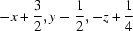
| Symmetry code: (ii) −x+3/2, y−1/2, −z+1/4. |
Experimental details
| Crystal data | |
| Chemical formula | C14H14O2 |
| Mr | 214.25 |
| Crystal system, space group | Tetragonal, P41212 |
| Temperature (K) | 193 |
| a, c (Å) | 7.39307 (13), 20.1623 (4) |
| V (Å3) | 1102.02 (4) |
| Z | 4 |
| Radiation type | Cu Kα |
| µ (mm−1) | 0.68 |
| Crystal size (mm) | 0.40 × 0.20 × 0.10 |
| Data collection | |
| Diffractometer | Rigaku R-AXIS RAPID diffractometer |
| Absorption correction | Numerical (NUMABS; Higashi, 1999) |
| Tmin, Tmax | 0.813, 0.934 |
| No. of measured, independent and observed [I > 2σ(I)] reflections | 20356, 651, 640 |
| Rint | 0.024 |
| (sin θ/λ)max (Å−1) | 0.602 |
| Refinement | |
| R[F2 > 2σ(F2)], wR(F2), S | 0.024, 0.071, 1.14 |
| No. of reflections | 651 |
| No. of parameters | 75 |
| H-atom treatment | H-atom parameters constrained |
| Δρmax, Δρmin (e Å−3) | 0.15, −0.11 |
Computer programs: PROCESS-AUTO (Rigaku, 1998), CrystalStructure (Rigaku/MSC, 2004), SIR2004 (Burla et al., 2005), SHELXL97 (Sheldrick, 2008), ORTEPIII (Burnett & Johnson, 1996).
| D—H···A | D—H | H···A | D···A | D—H···A |
| C3—H3···Cg1i | 0.95 | 2.85 | 3.7266 (14) | 154 |
| Symmetry code: (i) −x+3/2, y−1/2, −z+1/4. |
Acknowledgements
This work was partially supported by The Shorai Foundation for Science and Technology, Tokyo, Japan.
References
 Burla, M. C., Caliandro, R., Camalli, M., Carrozzini, B., Cascarano, G. L., De Caro, L., Giacovazzo, C., Polidori, G. & Spagna, R. (2005). J. Appl. Cryst. 38, 381–388. Web of Science CrossRef CAS IUCr Journals Google Scholar
Burnett, M. N. & Johnson, C. K. (1996). ORTEPIII. Report ORNL-6895. Oak Ridge National Laboratory, Tennessee, USA. Google Scholar
Hargreaves, A., Rizvi, S. H. & Trotter, J. (1961). Proc. Chem. Soc. 122–3. Google Scholar
Higashi, T. (1999). NUMABS. Rigaku Corporation, Tokyo, Japan. Google Scholar
Iyoda, M., Otsuka, H., Sato, K., Nisato, N. & Oda, M. (1990). Bull. Chem. Soc. Jpn, 63, 80–87. CrossRef CAS Web of Science Google Scholar
Rigaku (1998). PROCESS-AUTO. Rigaku Corporation, Tokyo, Japan. Google Scholar
Rigaku/MSC (2004). CrystalStructure. Rigaku/MSC, The Woodlands, Texas, USA. Google Scholar
Sheldrick, G. M. (2008). Acta Cryst. A64, 112–122. Web of Science CrossRef CAS IUCr Journals Google Scholar
Yonezawa, N., Ikezaki, T., Nakamura, H. & Maeyama, K. (2000). Macromolecules, 33, 8125–8129. Web of Science CrossRef CAS Google Scholar
Yonezawa, N., Miyata, S., Nakamura, T., Mori, S., Ueha, Y. & Katakai, R. (1993). Macromolecules, 26, 5262–5263. CrossRef CAS Web of Science Google Scholar
Yonezawa, N., Mori, S., Miyata, S., Ueha, A. Y., Wu, S. M. & Maeyama, K. (2003). Polym. J. 35, 998–1002. Web of Science CrossRef CAS Google Scholar
This is an open-access article distributed under the terms of the Creative Commons Attribution (CC-BY) Licence, which permits unrestricted use, distribution, and reproduction in any medium, provided the original authors and source are cited.
| CRYSTALLOGRAPHIC COMMUNICATIONS |


Biphenyl is the simplest example of aromatic ring assemblies in which aromatic rings are connected by a single bond. The apparent single bond lies behind the characteristic diversity in the molecular structure and chemical properties of these assemblies. As with the formal single bonding of alternative polyenes, the single bond between the aromatic rings has the nature of double bonding. However, the steric hindrance of substituents, especially at the o-positions, collapses coplanarity lowering the stabilizing conjugative effects on the structure. The non-substituted biphenyl is planar in the solid state in spite of the o-protons' repulsion (Hargreaves et al., 1961) but it has a twisted conformation in solution. In the past decade and a half, the authors have demonstrated the excellent acyl-accepting ability of (I), an o,o'-disubstituted biphenyl, in consecutive dual electrophilic aromatic aroylation reactions, especially in condensation polymerization or monomer preparation for wholly aromatic polyketones (Yonezawa et al., 1993, 2000, 2003). The strong electron donating ability of the o-methoxy group should make (I) highly reactive against electrophiles not only for a first acylation but also for a second one, even though the introduced ketonic carbonyl group has a strong electron-withdrawing nature. The maintenance of high reactivity after the first acylation is thought to be brought about by the suitable conformation of the mono-acylated intermediate preventing the transmission of the electron-withdrawing effect of the acyl group to the other aromatic ring.
The molecule of (I) lies across a crystallographic 2-fold axis so that the asymmetric unit contains one-half molecule (Fig. 1). The 2-fold axis is perpendicular to the central C—C bond of (I). The angle between the least-squares planes of the two phenyl rings is 66.94 (7)°. The methoxy group is slightly out of the plane of the phenyl ring with the angle between the O1—C7 bond and least-squares plane of the phenyl ring at 10.69 (8)°. The molecular packing of (I) is mainly stabilized by van der Waals interactions. In addition, C—H···π interactions are observed between adjacent molecules along the c-direction (Fig. 2). The distance between H3 and Cg (the ring center of gravity) at (3/2 - x, y - 1/2, 1/4 - z) is 2.85 Å. The slightly short intermolecular C6···H7A at (y + 1/2, 1/2 - x, z - 1/4) contact of 2.86 Å is also found.