 | Acta Crystallographica Section E Acta Crystallographica Section E CRYSTALLOGRAPHIC COMMUNICATIONS |


 journal menu


metal-organic compounds
| CRYSTALLOGRAPHIC COMMUNICATIONS |
 access
trans-Bis(perchlorato-κO)tetrakis(1H-pyrazole-κN2)copper(II)

aChemisches Institut, Otto-von-Guericke-Universität Magdeburg, Universitätsplatz 2, D-39106 Magdeburg, Germany, and bInstitut für Organische Chemie, Technische Universität Clausthal, Leibnizstrasse 6, D-38678 Clausthal-Zellerfeld, Germany
*Correspondence e-mail: [email protected]
The title compound, [Cu(ClO4)2(C3H4N2)4], was obtained unexpectedly by the reaction of copper(II) perchlorate hexahydrate with equimolar amounts of 1-chloro-1-nitro-2,2,2-tripyrazolylethane in methanol solution. The crystal structure comprises octahedrally coordinated Cu2+ ions, located on an inversion centre, with four pyrazole ligands in the equatorial plane. The average Cu—N distance is 2.000 (1) Å. Two perchlorate ions are coordinated to copper in trans positions [Cu—O = 2.4163 (11) Å].
Related literature
For general background on weakly coordinating anions, see: Gowda et al. (1984![[Gowda, N. M. N., Naikar, S. B. & Reddy, G. K. N. (1984). Adv. Inorg. Chem. Radiochem. 28, 255-299.]](../../../../../../logos/arrows/e_arr.gif "Gowda, N. M. N., Naikar, S. B. & Reddy, G. K. N. (1984). Adv. Inorg. Chem. Radiochem. 28, 255-299.") ); Rosenthal (1973); Strauss (1993). For previous literature on the title compound, see: Misra et al. (1998); Reedijk (1969); Sastry et al. (1986). For 1-chloro-1-nitro-2,2,2-tripyrazolylethane, see: Zapol'skii & Kaufmann (2008).
); Rosenthal (1973); Strauss (1993). For previous literature on the title compound, see: Misra et al. (1998); Reedijk (1969); Sastry et al. (1986). For 1-chloro-1-nitro-2,2,2-tripyrazolylethane, see: Zapol'skii & Kaufmann (2008).
![[Scheme 1]](bt2785scheme1.gif)
Experimental
Crystal data
|
Refinement
|
|
 ; (ii)
  .
. Data collection: X-AREA (Stoe & Cie, 2001); cell refinement: X-AREA; data reduction: X-RED (Stoe & Cie, 2001); program(s) used to solve structure: SHELXS97 (Sheldrick, 2008); program(s) used to refine structure: SHELXL97 (Sheldrick, 2008); molecular graphics: SHELXTL-Plus (Sheldrick, 2008); software used to prepare material for publication: SHELXTL-Plus.
Supporting information
contains datablocks I, global. DOI: 10.1107/S1600536808030080/bt2785sup1.cif
Structure factors: contains datablock I. DOI: 10.1107/S1600536808030080/bt2785Isup2.hkl
The title compound was obtained as an unexpected product from a reaction of copper(II) perchlorate hexahydrate with equimolar amounts of 1-chloro-1-nitro-2,2,2-tris(pyrazolyl)ethane, Cl(NO2)CH—C(C3H3N2)3, in methanol solution. Solid 1-chloro-1-nitro-2,2,2-tris(pyrazolyl)ethane (0.56 g) was added to a solution of Cu(ClO4)2 x 6H2O in methanol (50 ml) and the mixture was stirred at ambient temperature for 2 h. The solution was concentrated under vacuum to a total volume of ca 15 ml and allowed to stand undisturbed at room temperature. After several days, dark blue single-crystals of the title compound were obtained in 64% yield (0.45 g, based on Cu(ClO4)2 x 6H2O). Anal. calcd for C12H16Cl2CuN8O8 (534.75 g mol-1): C 26.85, H 3.04; found: C 26.11, H 3.18%.
Data collection: X-AREA (Stoe & Cie, 2001); cell X-AREA (Stoe & Cie, 2001); data reduction: X-RED (Stoe & Cie, 2001); program(s) used to solve structure: SHELXS97 (Sheldrick, 2008); program(s) used to refine structure: SHELXL97 (Sheldrick, 2008); molecular graphics: SHELXTL-Plus (Sheldrick, 2008); software used to prepare material for publication: SHELXTL-Plus (Sheldrick, 2008).
![[Figure 1]](./bt2785fig1thm.gif) | Fig. 1. The molecule of the title compound in the crystal. Thermal ellipsoids represent 50% probability levels. H-Atom radii are arbitrary. |
| [Cu(ClO4)2(C3H4N2)4] | F(000) = 1084 |
| Mr = 534.77 | Dx = 1.767 Mg m−3 |
| Monoclinic, C2/c | Mo Kα radiation, λ = 0.71073 Å |
| Hall symbol: -C2yc | Cell parameters from 16684 reflections |
| a = 14.1537 (11) Å | θ = 2.6–29.5° |
| b = 9.9483 (5) Å | µ = 1.41 mm−1 |
| c = 15.7414 (12) Å | T = 173 K |
| β = 114.946 (6)° | Prism, green |
| V = 2009.7 (3) Å3 | 0.40 × 0.30 × 0.20 mm |
| Z = 4 |
| Stoe IPDS 2T diffractometer | 2687 independent reflections |
| Radiation source: sealed X-ray tube, 12 x 0.4 mm long-fine focus | 2518 reflections with I > 2σ(I) |
| Plane graphite monochromator | Rint = 0.017 |
| Detector resolution: 6.67 pixels mm-1 | θmax = 29.2°, θmin = 2.6° |
| rotation method scans | h = −19→19 |
| Absorption correction: integration (X-RED; Stoe & Cie, 2001) | k = −13→13 |
| Tmin = 0.606, Tmax = 0.881 | l = −21→21 |
| 9046 measured reflections |
| Refinement on F2 | Primary atom site location: structure-invariant direct methods |
| Least-squares matrix: full | Secondary atom site location: difference Fourier map |
| R[F2 > 2σ(F2)] = 0.025 | Hydrogen site location: inferred from neighbouring sites |
| wR(F2) = 0.068 | All H-atom parameters refined |
| S = 0.99 | w = 1/[σ2(Fo2) + (0.0449P)2 + 1.7635P] where P = (Fo2 + 2Fc2)/3 |
| 2687 reflections | (Δ/σ)max = 0.001 |
| 174 parameters | Δρmax = 0.37 e Å−3 |
| 0 restraints | Δρmin = −0.34 e Å−3 |
| [Cu(ClO4)2(C3H4N2)4] | V = 2009.7 (3) Å3 |
| Mr = 534.77 | Z = 4 |
| Monoclinic, C2/c | Mo Kα radiation |
| a = 14.1537 (11) Å | µ = 1.41 mm−1 |
| b = 9.9483 (5) Å | T = 173 K |
| c = 15.7414 (12) Å | 0.40 × 0.30 × 0.20 mm |
| β = 114.946 (6)° |
| Stoe IPDS 2T diffractometer | 2687 independent reflections |
| Absorption correction: integration (X-RED; Stoe & Cie, 2001) | 2518 reflections with I > 2σ(I) |
| Tmin = 0.606, Tmax = 0.881 | Rint = 0.017 |
| 9046 measured reflections |
| R[F2 > 2σ(F2)] = 0.025 | 0 restraints |
| wR(F2) = 0.068 | All H-atom parameters refined |
| S = 0.99 | Δρmax = 0.37 e Å−3 |
| 2687 reflections | Δρmin = −0.34 e Å−3 |
| 174 parameters |
Geometry. All e.s.d.'s (except the e.s.d. in the dihedral angle between two l.s. planes) are estimated using the full covariance matrix. The cell e.s.d.'s are taken into account individually in the estimation of e.s.d.'s in distances, angles and torsion angles; correlations between e.s.d.'s in cell parameters are only used when they are defined by crystal symmetry. An approximate (isotropic) treatment of cell e.s.d.'s is used for estimating e.s.d.'s involving l.s. planes. |
Refinement. Refinement of F2 against ALL reflections. The weighted R-factor wR and goodness of fit S are based on F2, conventional R-factors R are based on F, with F set to zero for negative F2. The threshold expression of F2 > σ(F2) is used only for calculating R-factors(gt) etc. and is not relevant to the choice of reflections for refinement. R-factors based on F2 are statistically about twice as large as those based on F, and R- factors based on ALL data will be even larger. |
| x | y | z | Uiso*/Ueq | ||
| Cu1 | 0.7500 | 0.7500 | 0.5000 | 0.01532 (8) | |
| Cl2 | 0.90323 (2) | 1.06663 (3) | 0.56166 (2) | 0.01900 (9) | |
| O1 | 0.98696 (11) | 1.03113 (16) | 0.64859 (9) | 0.0454 (3) | |
| O2 | 0.94232 (9) | 1.14470 (12) | 0.50756 (8) | 0.0312 (2) | |
| O3 | 0.82438 (10) | 1.13865 (14) | 0.57726 (10) | 0.0412 (3) | |
| O4 | 0.85586 (8) | 0.94534 (11) | 0.51056 (8) | 0.0283 (2) | |
| N1 | 0.87702 (9) | 0.63692 (11) | 0.55955 (8) | 0.0191 (2) | |
| N2 | 0.87750 (10) | 0.50290 (13) | 0.54924 (11) | 0.0299 (3) | |
| N3 | 0.74610 (9) | 0.77577 (12) | 0.62524 (8) | 0.0186 (2) | |
| N4 | 0.67422 (9) | 0.71389 (13) | 0.64642 (9) | 0.0218 (2) | |
| C1 | 0.97459 (11) | 0.66995 (15) | 0.61591 (11) | 0.0254 (3) | |
| C2 | 1.03738 (12) | 0.55634 (17) | 0.64268 (14) | 0.0364 (4) | |
| C3 | 0.97222 (14) | 0.45238 (18) | 0.59796 (17) | 0.0435 (5) | |
| C4 | 0.80535 (11) | 0.84451 (16) | 0.70182 (10) | 0.0241 (3) | |
| C5 | 0.77179 (12) | 0.82591 (17) | 0.77210 (10) | 0.0274 (3) | |
| C6 | 0.68758 (13) | 0.74111 (16) | 0.73397 (11) | 0.0262 (3) | |
| H2N | 0.825 (2) | 0.460 (3) | 0.5206 (17) | 0.045 (6)* | |
| H4N | 0.6330 (15) | 0.666 (2) | 0.6088 (14) | 0.023 (4)* | |
| H1 | 0.9926 (19) | 0.764 (2) | 0.6332 (17) | 0.033 (5)* | |
| H2 | 1.107 (2) | 0.554 (2) | 0.6810 (17) | 0.047 (6)* | |
| H3 | 0.984 (2) | 0.356 (3) | 0.599 (2) | 0.063 (8)* | |
| H4 | 0.8596 (16) | 0.894 (2) | 0.7022 (15) | 0.032 (5)* | |
| H5 | 0.7974 (19) | 0.866 (3) | 0.8298 (18) | 0.048 (6)* | |
| H6 | 0.6457 (18) | 0.705 (2) | 0.7603 (17) | 0.042 (6)* |
| U11 | U22 | U33 | U12 | U13 | U23 | |
| Cu1 | 0.01307 (11) | 0.01805 (12) | 0.01317 (11) | −0.00047 (7) | 0.00391 (8) | −0.00027 (7) |
| Cl2 | 0.02026 (15) | 0.01988 (15) | 0.01697 (14) | −0.00576 (10) | 0.00797 (11) | −0.00313 (10) |
| O1 | 0.0377 (7) | 0.0568 (8) | 0.0245 (6) | −0.0117 (6) | −0.0037 (5) | 0.0078 (6) |
| O2 | 0.0409 (6) | 0.0281 (5) | 0.0297 (6) | −0.0113 (5) | 0.0197 (5) | 0.0010 (4) |
| O3 | 0.0382 (6) | 0.0409 (7) | 0.0548 (8) | −0.0038 (5) | 0.0296 (6) | −0.0205 (6) |
| O4 | 0.0268 (5) | 0.0224 (5) | 0.0380 (6) | −0.0107 (4) | 0.0158 (5) | −0.0110 (4) |
| N1 | 0.0174 (5) | 0.0182 (5) | 0.0195 (5) | 0.0002 (4) | 0.0057 (4) | −0.0006 (4) |
| N2 | 0.0197 (6) | 0.0200 (6) | 0.0445 (8) | −0.0023 (5) | 0.0080 (5) | −0.0083 (5) |
| N3 | 0.0173 (5) | 0.0216 (5) | 0.0167 (5) | −0.0016 (4) | 0.0070 (4) | −0.0004 (4) |
| N4 | 0.0205 (5) | 0.0250 (5) | 0.0215 (6) | −0.0042 (4) | 0.0104 (5) | −0.0016 (5) |
| C1 | 0.0183 (6) | 0.0208 (6) | 0.0296 (7) | −0.0009 (5) | 0.0028 (5) | 0.0002 (5) |
| C2 | 0.0189 (7) | 0.0262 (7) | 0.0507 (10) | 0.0035 (6) | 0.0015 (6) | 0.0011 (7) |
| C3 | 0.0273 (8) | 0.0215 (7) | 0.0708 (13) | 0.0049 (6) | 0.0098 (8) | −0.0038 (8) |
| C4 | 0.0218 (6) | 0.0291 (7) | 0.0180 (6) | −0.0042 (5) | 0.0051 (5) | −0.0017 (5) |
| C5 | 0.0278 (7) | 0.0359 (8) | 0.0156 (6) | 0.0015 (6) | 0.0063 (5) | −0.0018 (5) |
| C6 | 0.0272 (7) | 0.0327 (8) | 0.0216 (6) | 0.0031 (5) | 0.0131 (6) | 0.0044 (5) |
| Cu1—N1i | 1.9887 (11) | N3—C4 | 1.3310 (18) |
| Cu1—N1 | 1.9887 (11) | N3—N4 | 1.3460 (16) |
| Cu1—N3i | 2.0117 (12) | N4—C6 | 1.3373 (19) |
| Cu1—N3 | 2.0117 (12) | N4—H4N | 0.79 (2) |
| Cu1—O4i | 2.4164 (10) | C1—C2 | 1.389 (2) |
| Cu1—O4 | 2.4164 (10) | C1—H1 | 0.98 (2) |
| Cl2—O1 | 1.4261 (12) | C2—C3 | 1.367 (2) |
| Cl2—O2 | 1.4255 (11) | C2—H2 | 0.91 (3) |
| Cl2—O3 | 1.4318 (12) | C3—H3 | 0.97 (3) |
| Cl2—O4 | 1.4483 (10) | C4—C5 | 1.388 (2) |
| N1—C1 | 1.3299 (17) | C4—H4 | 0.91 (2) |
| N1—N2 | 1.3435 (17) | C5—C6 | 1.375 (2) |
| N2—C3 | 1.331 (2) | C5—H5 | 0.91 (3) |
| N2—H2N | 0.81 (3) | C6—H6 | 0.93 (2) |
| N1i—Cu1—N1 | 180.000 (1) | C3—N2—H2N | 125.5 (18) |
| N1i—Cu1—N3i | 90.18 (5) | N1—N2—H2N | 123.2 (18) |
| N1—Cu1—N3i | 89.82 (5) | C4—N3—N4 | 105.30 (11) |
| N1i—Cu1—N3 | 89.82 (5) | C4—N3—Cu1 | 133.31 (10) |
| N1—Cu1—N3 | 90.18 (5) | N4—N3—Cu1 | 121.37 (9) |
| N3i—Cu1—N3 | 180.0 | C6—N4—N3 | 111.69 (12) |
| N1i—Cu1—O4i | 90.65 (4) | C6—N4—H4N | 129.1 (14) |
| N1—Cu1—O4i | 89.35 (4) | N3—N4—H4N | 119.1 (14) |
| N3i—Cu1—O4i | 95.89 (4) | N1—C1—C2 | 110.67 (13) |
| N3—Cu1—O4i | 84.11 (4) | N1—C1—H1 | 119.8 (14) |
| N1i—Cu1—O4 | 89.35 (4) | C2—C1—H1 | 129.5 (14) |
| N1—Cu1—O4 | 90.65 (4) | C3—C2—C1 | 104.66 (14) |
| N3i—Cu1—O4 | 84.11 (4) | C3—C2—H2 | 128.5 (16) |
| N3—Cu1—O4 | 95.89 (4) | C1—C2—H2 | 126.8 (16) |
| O4i—Cu1—O4 | 180.00 (6) | N2—C3—C2 | 107.94 (15) |
| O1—Cl2—O2 | 109.46 (8) | N2—C3—H3 | 120.5 (16) |
| O1—Cl2—O3 | 110.60 (9) | C2—C3—H3 | 131.5 (16) |
| O2—Cl2—O3 | 110.90 (8) | N3—C4—C5 | 110.90 (13) |
| O1—Cl2—O4 | 109.23 (8) | N3—C4—H4 | 119.4 (13) |
| O2—Cl2—O4 | 109.12 (7) | C5—C4—H4 | 129.6 (13) |
| O3—Cl2—O4 | 107.49 (7) | C6—C5—C4 | 105.01 (13) |
| Cl2—O4—Cu1 | 146.78 (7) | C6—C5—H5 | 127.3 (15) |
| C1—N1—N2 | 105.61 (11) | C4—C5—H5 | 127.6 (15) |
| C1—N1—Cu1 | 130.74 (10) | N4—C6—C5 | 107.09 (13) |
| N2—N1—Cu1 | 123.64 (9) | N4—C6—H6 | 122.9 (15) |
| C3—N2—N1 | 111.12 (13) | C5—C6—H6 | 130.0 (15) |
| O1—Cl2—O4—Cu1 | 71.01 (15) | N1—Cu1—N3—C4 | 70.96 (14) |
| O2—Cl2—O4—Cu1 | −169.36 (12) | N3i—Cu1—N3—C4 | 0 (100) |
| O3—Cl2—O4—Cu1 | −49.03 (15) | O4i—Cu1—N3—C4 | 160.28 (14) |
| N1i—Cu1—O4—Cl2 | 81.05 (13) | O4—Cu1—N3—C4 | −19.72 (14) |
| N1—Cu1—O4—Cl2 | −98.95 (13) | N1i—Cu1—N3—N4 | 72.95 (11) |
| N3i—Cu1—O4—Cl2 | 171.30 (14) | N1—Cu1—N3—N4 | −107.05 (11) |
| N3—Cu1—O4—Cl2 | −8.70 (14) | N3i—Cu1—N3—N4 | 0 (100) |
| O4i—Cu1—O4—Cl2 | 111 (100) | O4i—Cu1—N3—N4 | −17.73 (10) |
| N1i—Cu1—N1—C1 | −140 (100) | O4—Cu1—N3—N4 | 162.27 (10) |
| N3i—Cu1—N1—C1 | 108.25 (14) | C4—N3—N4—C6 | −0.55 (16) |
| N3—Cu1—N1—C1 | −71.75 (14) | Cu1—N3—N4—C6 | 177.94 (10) |
| O4i—Cu1—N1—C1 | −155.85 (14) | N2—N1—C1—C2 | −0.78 (19) |
| O4—Cu1—N1—C1 | 24.15 (14) | Cu1—N1—C1—C2 | 178.35 (12) |
| N1i—Cu1—N1—N2 | 39 (100) | N1—C1—C2—C3 | 0.9 (2) |
| N3i—Cu1—N1—N2 | −72.76 (12) | N1—N2—C3—C2 | 0.2 (2) |
| N3—Cu1—N1—N2 | 107.24 (12) | C1—C2—C3—N2 | −0.6 (2) |
| O4i—Cu1—N1—N2 | 23.13 (12) | N4—N3—C4—C5 | 0.38 (17) |
| O4—Cu1—N1—N2 | −156.87 (12) | Cu1—N3—C4—C5 | −177.85 (11) |
| C1—N1—N2—C3 | 0.4 (2) | N3—C4—C5—C6 | −0.09 (18) |
| Cu1—N1—N2—C3 | −178.83 (14) | N3—N4—C6—C5 | 0.51 (17) |
| N1i—Cu1—N3—C4 | −109.04 (14) | C4—C5—C6—N4 | −0.24 (17) |
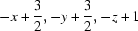
| Symmetry code: (i) −x+3/2, −y+3/2, −z+1. |
| D—H···A | D—H | H···A | D···A | D—H···A |
| N2—H2N···O3i | 0.81 (3) | 2.25 (3) | 3.0517 (19) | 171 (2) |
| N2—H2N···O4i | 0.81 (3) | 2.58 (2) | 3.0722 (17) | 121 (2) |
| N4—H4N···O4i | 0.79 (2) | 2.24 (2) | 2.8124 (17) | 129.3 (17) |
| N4—H4N···O2ii | 0.79 (2) | 2.50 (2) | 3.1580 (17) | 141.5 (17) |
| Symmetry codes: (i) −x+3/2, −y+3/2, −z+1; (ii) x−1/2, y−1/2, z. |
Experimental details
| Crystal data | |
| Chemical formula | [Cu(ClO4)2(C3H4N2)4] |
| Mr | 534.77 |
| Crystal system, space group | Monoclinic, C2/c |
| Temperature (K) | 173 |
| a, b, c (Å) | 14.1537 (11), 9.9483 (5), 15.7414 (12) |
| β (°) | 114.946 (6) |
| V (Å3) | 2009.7 (3) |
| Z | 4 |
| Radiation type | Mo Kα |
| µ (mm−1) | 1.41 |
| Crystal size (mm) | 0.40 × 0.30 × 0.20 |
| Data collection | |
| Diffractometer | Stoe IPDS 2T diffractometer |
| Absorption correction | Integration (X-RED; Stoe & Cie, 2001) |
| Tmin, Tmax | 0.606, 0.881 |
| No. of measured, independent and observed [I > 2σ(I)] reflections | 9046, 2687, 2518 |
| Rint | 0.017 |
| (sin θ/λ)max (Å−1) | 0.686 |
| Refinement | |
| R[F2 > 2σ(F2)], wR(F2), S | 0.025, 0.068, 0.99 |
| No. of reflections | 2687 |
| No. of parameters | 174 |
| H-atom treatment | All H-atom parameters refined |
| Δρmax, Δρmin (e Å−3) | 0.37, −0.34 |
Computer programs: X-AREA (Stoe & Cie, 2001), X-RED (Stoe & Cie, 2001), SHELXS97 (Sheldrick, 2008), SHELXL97 (Sheldrick, 2008), SHELXTL-Plus (Sheldrick, 2008).
| D—H···A | D—H | H···A | D···A | D—H···A |
| N2—H2N···O3i | 0.81 (3) | 2.25 (3) | 3.0517 (19) | 171 (2) |
| N2—H2N···O4i | 0.81 (3) | 2.58 (2) | 3.0722 (17) | 121 (2) |
| N4—H4N···O4i | 0.79 (2) | 2.24 (2) | 2.8124 (17) | 129.3 (17) |
| N4—H4N···O2ii | 0.79 (2) | 2.50 (2) | 3.1580 (17) | 141.5 (17) |
| Symmetry codes: (i) −x+3/2, −y+3/2, −z+1; (ii) x−1/2, y−1/2, z. |
Acknowledgements
Financial support of this work by the Otto-von-Guericke-Universität Magdeburg and the Technische Universität Clausthal is gratefully acknowledged. Special thanks are due to Christian Meyer, TU Clausthal, for providing a sample of 1-chloro-1-nitro-2,2,2-tris(pyrazolyl)ethane.
References
 Gowda, N. M. N., Naikar, S. B. & Reddy, G. K. N. (1984). Adv. Inorg. Chem. Radiochem. 28, 255–299. CrossRef CAS Web of Science Google Scholar
Misra, B. N., Kripal, R. & Narayan, A. (1998). Indian J. Pure Appl. Phys. 36, 412–414. CAS Google Scholar
Reedijk, J. (1969). Rec. Trav. Chim. Pays-Bas, 88, 1451–1470. CrossRef CAS Google Scholar
Rosenthal, M. R. (1973). J. Chem. Educ. 50, 331–334. CrossRef CAS Google Scholar
Sastry, B. A., Balaiah, B., Reddy, K. V. G., Madhu, B., Ponticelli, G., Massacssi, M. & Puggioni, G. (1986). Indian J. Pure Appl. Phys. 24, 460–462. CAS Google Scholar
Sheldrick, G. M. (2008). Acta Cryst. A64, 112–122. Web of Science CrossRef CAS IUCr Journals Google Scholar
Stoe & Cie (2001). X-AREA and X-RED. Stoe & Cie, Darmstadt, Germany. Google Scholar
Strauss, S. H. (1993). Chem. Rev. 93, 927–942. CrossRef CAS Web of Science Google Scholar
Zapol'skii, V. & Kaufmann, D. (2008). Unpublished work. Google Scholar
This is an open-access article distributed under the terms of the Creative Commons Attribution (CC-BY) Licence, which permits unrestricted use, distribution, and reproduction in any medium, provided the original authors and source are cited.
| CRYSTALLOGRAPHIC COMMUNICATIONS |


Today it is generally recognized that the classical "noncoordinating" anions such as ClO4-, BF4- or PF6- can coordinate to metal ions from all regions of the periodic table (Strauss, 1993; Rosenthal, 1973; Gowda et al. , 1984). In the course of an investigation on the coordination chemistry of various azolyl-nitrochloroalkanes (Zapol'skii & Kaufmann, 2008), we studied the reaction of copper(II) perchlorate hexahydrate with equimolar amounts of 1-chloro-1-nitro-2,2,2-tris(pyrazolyl)ethane, Cl(NO2)CH—C(C3H3N2)3, in methanol solution. Quite unexpectedly, complete degradation of the starting material took place during the course of this reaction. Direct crystallization from the concentrated reaction mixture afforded dark blue single-crystals. An X-ray structure determination revealed the presence of the title compound, trans-bis(perchlorato)-tetrakis(pyrazole)copper(II). The formation of free pyrazol can only be explained by a solvolytic degradation of the starting material. This degradation must take place on a large extent as the isolated yield of the title compound was 64%. The complex trans-bis(perchlorato)-tetrakis(pyrazole)copper(II) has been mentioned three times before in the earlier literature, but structural characterization was lacking until now. Reedijk (1969) first decribed the preparation of the title compound by direct treatment of copper perchlorate with pyrazole. The compound was characterized and identified by elemental analysis and physical measurements. Infrared spectroscopy evidently showed coordination of the perchlorate anions to the central copper(2+) ion. This was now confirmed by the present X-ray diffraction study. The structure of the title compound is shown below. Dimensions are available in the archived CIF. In the solid state, the title compound comprises octahedral molecules in which the central Cu2+ ion is surrounded by four neutral pyrazole ligand in the equatorial plane. The average Cu—N distance is 2.000 (1) Å. Two perchlorate ions are coordinated to copper in the trans positions (Cu—O 2.4163 (11) Å).