 | Acta Crystallographica Section E Acta Crystallographica Section E CRYSTALLOGRAPHIC COMMUNICATIONS |


 journal menu


organic compounds
| CRYSTALLOGRAPHIC COMMUNICATIONS |
 access
2,3,4,5,6-Pentabromophenol

aDepartment Chemie und Biochemie, Ludwig-Maximilians-Universität, Butenandtstrasse 5–13 (Haus D), 81377 München, Germany
*Correspondence e-mail: [email protected]
The title compound, C6HBr5O, is the perbrominated derivative of phenol. The molecule shows non-crystallographic mirror symmetry. Bond lengths between the C and Br atoms are normal. In the crystal structure, O—H⋯O hydrogen bonds connect the molecules into infinite strands. Dispersive Br⋯Br contacts are observed. No significant π–π stacking is obvious.
Related literature
For the structure of the perfluorinated derivative of phenol, see: Das et al. (2006![[Das, D., Banerjee, R., Mondal, R., Howard, J. A. K., Boese, R. & Desiraju, G. R. (2006). Chem. Commun. pp. 555-557.]](../../../../../../logos/arrows/e_arr.gif "Das, D., Banerjee, R., Mondal, R., Howard, J. A. K., Boese, R. & Desiraju, G. R. (2006). Chem. Commun. pp. 555-557.") ); Gdaniec (2007). For the structure of 2,3,4,5,6-pentachlorophenol, see: Sakurai (1962).
); Gdaniec (2007). For the structure of 2,3,4,5,6-pentachlorophenol, see: Sakurai (1962).
![[Scheme 1]](rk2109scheme1.gif)
Experimental
Crystal data
|
Refinement
|
| |||||||||||||||||
 .
. Data collection: COLLECT (Nonius, 2004); cell refinement: SCALEPACK (Otwinowski & Minor 1997); data reduction: DENZO (Otwinowski & Minor 1997) and SCALEPACK; program(s) used to solve structure: SHELXS97 (Sheldrick, 2008); program(s) used to refine structure: SHELXL97 (Sheldrick, 2008); molecular graphics: ORTEP-3 (Farrugia, 1997) and Mercury (Macrae et al., 2006); software used to prepare material for publication: SHELXL97.
Supporting information
contains datablocks I, global. DOI: 10.1107/S1600536808028602/rk2109sup1.cif
Structure factors: contains datablock I. DOI: 10.1107/S1600536808028602/rk2109Isup2.hkl
The compound was obtained commercially from Aldrich. Crystals suitable for X-ray diffraction were obtained upon recrystallization of the compound from boiling toluene.
The H atom was located in a difference map and refined as riding on its parent O atom with an Uiso(H) = 1.5Ueq(O).
Data collection: COLLECT (Nonius, 2004); cell SCALEPACK (Otwinowski & Minor 1997); data reduction: DENZO and SCALEPACK (Otwinowski & Minor 1997); program(s) used to solve structure: SHELXS97 (Sheldrick, 2008); program(s) used to refine structure: SHELXL97 (Sheldrick, 2008); molecular graphics: ORTEP-3 (Farrugia, 1997) and Mercury (Macrae et al., 2006); software used to prepare material for publication: SHELXL97 (Sheldrick, 2008).
![[Figure 1]](./rk2109fig1thm.gif) | Fig. 1. The molecular structure of the title compound, with atom labels. The displacement ellipsoids are drawn at 50% probability level. H atom is presented as a small sphere of arbitrary radius. |
![[Figure 2]](./rk2109fig2thm.gif) | Fig. 2. The crystal packing diagram, viewed along [010]. |
| C6HBr5O | F(000) = 1760 |
| Mr = 488.57 | Dx = 3.353 Mg m−3 |
| Monoclinic, C2/c | Mo Kα radiation, λ = 0.71073 Å |
| Hall symbol: -C 2yc | Cell parameters from 8265 reflections |
| a = 32.3058 (15) Å | θ = 3.1–27.5° |
| b = 3.9957 (2) Å | µ = 20.70 mm−1 |
| c = 16.1887 (8) Å | T = 200 K |
| β = 112.118 (3)° | Rod, colourless |
| V = 1935.93 (17) Å3 | 0.28 × 0.08 × 0.05 mm |
| Z = 8 |
| Nonius Kappa CCD diffractometer | 2219 independent reflections |
| Radiation source: Rotating anode | 1930 reflections with I > 2σ(I) |
| MONTEL, graded multilayered X-ray optics monochromator | Rint = 0.054 |
| Rotation images; thick slices scans | θmax = 27.6°, θmin = 3.5° |
| Absorption correction: multi-scan (SADABS; Sheldrick, 2001) | h = −41→41 |
| Tmin = 0.062, Tmax = 0.355 | k = −4→5 |
| 13465 measured reflections | l = −21→21 |
| Refinement on F2 | Secondary atom site location: difference Fourier map |
| Least-squares matrix: Full | Hydrogen site location: inferred from neighbouring sites |
| R[F2 > 2σ(F2)] = 0.030 | H-atom parameters constrained |
| wR(F2) = 0.075 | w = 1/[σ2(Fo2) + (0.0374P)2 + 5.8817P] where P = (Fo2 + 2Fc2)/3 |
| S = 1.03 | (Δ/σ)max = 0.001 |
| 2219 reflections | Δρmax = 0.88 e Å−3 |
| 111 parameters | Δρmin = −1.02 e Å−3 |
| 0 restraints | Extinction correction: SHELXL97 (Sheldrick, 2008) |
| Primary atom site location: structure-invariant direct methods | Extinction coefficient: 0.00087 (8) |
| C6HBr5O | V = 1935.93 (17) Å3 |
| Mr = 488.57 | Z = 8 |
| Monoclinic, C2/c | Mo Kα radiation |
| a = 32.3058 (15) Å | µ = 20.70 mm−1 |
| b = 3.9957 (2) Å | T = 200 K |
| c = 16.1887 (8) Å | 0.28 × 0.08 × 0.05 mm |
| β = 112.118 (3)° |
| Nonius Kappa CCD diffractometer | 2219 independent reflections |
| Absorption correction: multi-scan (SADABS; Sheldrick, 2001) | 1930 reflections with I > 2σ(I) |
| Tmin = 0.062, Tmax = 0.355 | Rint = 0.054 |
| 13465 measured reflections |
| R[F2 > 2σ(F2)] = 0.030 | 0 restraints |
| wR(F2) = 0.075 | H-atom parameters constrained |
| S = 1.03 | Δρmax = 0.88 e Å−3 |
| 2219 reflections | Δρmin = −1.02 e Å−3 |
| 111 parameters |
Geometry. All s.u.'s (except the s.u. in the dihedral angle between two l.s. planes) are estimated using the full covariance matrix. The cell s.u.'s are taken into account individually in the estimation of s.u.'s in distances, angles and torsion angles; correlations between s.u.'s in cell parameters are only used when they are defined by crystal symmetry. An approximate (isotropic) treatment of cell s.u.'s is used for estimating s.u.'s involving l.s. planes. |
Refinement. Refinement of F2 against ALL reflections. The weighted R-factor wR and goodness of fit S are based on F2, conventional R-factors R are based on F, with F set to zero for negative F2. The threshold expression of F2 > 2σ(F2) is used only for calculating R-factors(gt) etc. and is not relevant to the choice of reflections for refinement. R-factors based on F2 are statistically about twice as large as those based on F, and R-factors based on ALL data will be even larger. |
| x | y | z | Uiso*/Ueq | ||
| Br1 | 0.204848 (13) | 0.51248 (10) | 0.41077 (2) | 0.03029 (14) | |
| Br2 | 0.096769 (13) | 0.38703 (10) | 0.36125 (2) | 0.02821 (13) | |
| Br3 | 0.024427 (13) | 0.61492 (11) | 0.16493 (3) | 0.03106 (14) | |
| Br4 | 0.060474 (12) | 0.97946 (11) | 0.02144 (2) | 0.02709 (13) | |
| Br5 | 0.169251 (13) | 1.09979 (10) | 0.07733 (2) | 0.02651 (13) | |
| O1 | 0.22213 (8) | 0.8423 (7) | 0.26447 (18) | 0.0289 (6) | |
| H1 | 0.2271 | 0.9643 | 0.2270 | 0.043* | |
| C1 | 0.17732 (11) | 0.7978 (9) | 0.2394 (2) | 0.0213 (7) | |
| C2 | 0.16196 (12) | 0.6421 (9) | 0.2996 (2) | 0.0216 (7) | |
| C3 | 0.11662 (12) | 0.5889 (9) | 0.2773 (2) | 0.0211 (7) | |
| C4 | 0.08601 (11) | 0.6883 (9) | 0.1945 (2) | 0.0213 (7) | |
| C5 | 0.10107 (12) | 0.8416 (8) | 0.1339 (2) | 0.0209 (7) | |
| C6 | 0.14663 (12) | 0.8957 (8) | 0.1567 (2) | 0.0197 (7) |
| U11 | U22 | U33 | U12 | U13 | U23 | |
| Br1 | 0.0248 (2) | 0.0387 (3) | 0.0229 (2) | 0.00504 (16) | 0.00385 (16) | 0.00541 (16) |
| Br2 | 0.0300 (2) | 0.0331 (2) | 0.0244 (2) | −0.00243 (15) | 0.01352 (16) | 0.00349 (14) |
| Br3 | 0.0171 (2) | 0.0443 (3) | 0.0318 (2) | −0.00324 (15) | 0.00924 (16) | 0.00412 (16) |
| Br4 | 0.0201 (2) | 0.0377 (2) | 0.0212 (2) | 0.00309 (15) | 0.00524 (15) | 0.00423 (14) |
| Br5 | 0.0238 (2) | 0.0331 (2) | 0.0255 (2) | −0.00301 (14) | 0.01252 (16) | 0.00230 (14) |
| O1 | 0.0160 (12) | 0.0393 (16) | 0.0315 (14) | 0.0005 (11) | 0.0091 (11) | 0.0025 (12) |
| C1 | 0.0146 (16) | 0.0222 (16) | 0.0260 (17) | −0.0013 (14) | 0.0066 (13) | −0.0031 (14) |
| C2 | 0.0188 (18) | 0.0236 (18) | 0.0201 (16) | 0.0003 (14) | 0.0048 (13) | −0.0015 (13) |
| C3 | 0.0237 (19) | 0.0211 (16) | 0.0208 (17) | −0.0001 (13) | 0.0110 (14) | −0.0028 (13) |
| C4 | 0.0146 (16) | 0.0261 (17) | 0.0244 (17) | −0.0029 (14) | 0.0087 (13) | −0.0038 (14) |
| C5 | 0.0196 (17) | 0.0237 (17) | 0.0184 (15) | −0.0001 (14) | 0.0061 (13) | −0.0027 (13) |
| C6 | 0.0213 (17) | 0.0215 (17) | 0.0207 (16) | −0.0026 (14) | 0.0129 (13) | −0.0009 (13) |
| Br1—C2 | 1.884 (3) | C1—C6 | 1.389 (5) |
| Br2—C3 | 1.888 (4) | C1—C2 | 1.395 (5) |
| Br3—C4 | 1.886 (3) | C2—C3 | 1.387 (5) |
| Br4—C5 | 1.882 (3) | C3—C4 | 1.391 (5) |
| Br5—C6 | 1.886 (4) | C4—C5 | 1.390 (5) |
| O1—C1 | 1.360 (4) | C5—C6 | 1.393 (5) |
| O1—H1 | 0.8400 | ||
| C1—O1—H1 | 109.5 | C5—C4—C3 | 119.7 (3) |
| O1—C1—C6 | 122.9 (3) | C5—C4—Br3 | 120.4 (2) |
| O1—C1—C2 | 117.9 (3) | C3—C4—Br3 | 120.0 (3) |
| C6—C1—C2 | 119.1 (3) | C4—C5—C6 | 119.8 (3) |
| C3—C2—C1 | 120.3 (3) | C4—C5—Br4 | 120.7 (3) |
| C3—C2—Br1 | 122.1 (3) | C6—C5—Br4 | 119.5 (3) |
| C1—C2—Br1 | 117.6 (3) | C1—C6—C5 | 120.7 (3) |
| C2—C3—C4 | 120.4 (3) | C1—C6—Br5 | 117.4 (3) |
| C2—C3—Br2 | 119.3 (3) | C5—C6—Br5 | 121.9 (3) |
| C4—C3—Br2 | 120.3 (3) | ||
| O1—C1—C2—C3 | −179.7 (3) | C3—C4—C5—C6 | −0.2 (5) |
| C6—C1—C2—C3 | −0.6 (5) | Br3—C4—C5—C6 | 179.7 (3) |
| O1—C1—C2—Br1 | 0.7 (4) | C3—C4—C5—Br4 | −179.9 (3) |
| C6—C1—C2—Br1 | 179.8 (3) | Br3—C4—C5—Br4 | 0.1 (4) |
| C1—C2—C3—C4 | 0.4 (5) | O1—C1—C6—C5 | 179.4 (3) |
| Br1—C2—C3—C4 | 180.0 (3) | C2—C1—C6—C5 | 0.4 (5) |
| C1—C2—C3—Br2 | −178.5 (3) | O1—C1—C6—Br5 | −0.2 (5) |
| Br1—C2—C3—Br2 | 1.1 (4) | C2—C1—C6—Br5 | −179.2 (3) |
| C2—C3—C4—C5 | 0.0 (5) | C4—C5—C6—C1 | 0.0 (5) |
| Br2—C3—C4—C5 | 178.9 (3) | Br4—C5—C6—C1 | 179.7 (3) |
| C2—C3—C4—Br3 | −179.9 (3) | C4—C5—C6—Br5 | 179.6 (3) |
| Br2—C3—C4—Br3 | −1.1 (4) | Br4—C5—C6—Br5 | −0.7 (4) |
| D—H···A | D—H | H···A | D···A | D—H···A |
| O1—H1···O1i | 0.84 | 2.19 | 2.844 (4) | 134 |
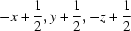
| Symmetry code: (i) −x+1/2, y+1/2, −z+1/2. |
Experimental details
| Crystal data | |
| Chemical formula | C6HBr5O |
| Mr | 488.57 |
| Crystal system, space group | Monoclinic, C2/c |
| Temperature (K) | 200 |
| a, b, c (Å) | 32.3058 (15), 3.9957 (2), 16.1887 (8) |
| β (°) | 112.118 (3) |
| V (Å3) | 1935.93 (17) |
| Z | 8 |
| Radiation type | Mo Kα |
| µ (mm−1) | 20.70 |
| Crystal size (mm) | 0.28 × 0.08 × 0.05 |
| Data collection | |
| Diffractometer | Nonius Kappa CCD diffractometer |
| Absorption correction | Multi-scan (SADABS; Sheldrick, 2001) |
| Tmin, Tmax | 0.062, 0.355 |
| No. of measured, independent and observed [I > 2σ(I)] reflections | 13465, 2219, 1930 |
| Rint | 0.054 |
| (sin θ/λ)max (Å−1) | 0.651 |
| Refinement | |
| R[F2 > 2σ(F2)], wR(F2), S | 0.030, 0.075, 1.03 |
| No. of reflections | 2219 |
| No. of parameters | 111 |
| H-atom treatment | H-atom parameters constrained |
| Δρmax, Δρmin (e Å−3) | 0.88, −1.02 |
Computer programs: COLLECT (Nonius, 2004), DENZO and SCALEPACK (Otwinowski & Minor 1997), SHELXS97 (Sheldrick, 2008), SHELXL97 (Sheldrick, 2008), ORTEP-3 (Farrugia, 1997) and Mercury (Macrae et al., 2006).
| D—H···A | D—H | H···A | D···A | D—H···A |
| O1—H1···O1i | 0.84 | 2.19 | 2.844 (4) | 134.1 |
| Symmetry code: (i) −x+1/2, y+1/2, −z+1/2. |
Acknowledgements
The authors thank Dr Peter Mayer for professional support.
References
 Das, D., Banerjee, R., Mondal, R., Howard, J. A. K., Boese, R. & Desiraju, G. R. (2006). Chem. Commun. pp. 555–557. Web of Science CSD CrossRef Google Scholar
Farrugia, L. J. (1997). J. Appl. Cryst. 30, 565. CrossRef IUCr Journals Google Scholar
Gdaniec, M. (2007). CrystEngComm, 9, 286–288. Web of Science CSD CrossRef CAS Google Scholar
Macrae, C. F., Edgington, P. R., McCabe, P., Pidcock, E., Shields, G. P., Taylor, R., Towler, M. & van de Streek, J. (2006). J. Appl. Cryst. 39, 453–457. Web of Science CrossRef CAS IUCr Journals Google Scholar
Nonius (2004). COLLECT. Nonius BV, Delft, The Netherlands. Google Scholar
Otwinowski, Z. & Minor, W. (1997). Methods in Enzymology, Vol. 276, Macromolecular Crystallography, Part A, edited by C. W. Carter Jr & R. M. Sweet, pp. 307–326. New York: Academic Press. Google Scholar
Sakurai, T. (1962). Acta Cryst. 15, 1164–1173. CSD CrossRef IUCr Journals Web of Science Google Scholar
Sheldrick, G. M. (2001). SADABS. University of Göttingen, Germany. Google Scholar
Sheldrick, G. M. (2008). Acta Cryst. A64, 112–122. Web of Science CrossRef CAS IUCr Journals Google Scholar
This is an open-access article distributed under the terms of the Creative Commons Attribution (CC-BY) Licence, which permits unrestricted use, distribution, and reproduction in any medium, provided the original authors and source are cited.
| CRYSTALLOGRAPHIC COMMUNICATIONS |


During efforts to obtain tetraaryloxy derivatives of orthocarbonic acid it was interesting to determine the influence of bonding to one central carbon atom on geometric parameters of the ligands. Thus the crystal structure of 2,3,4,5,6-pentabromophenol was determined.
In the molecule (Fig. 1), C—C—C angles adopt values covering a range from 119.1 (3)° on the C atom bonded to the hydroxy group to 120.7 (3)° on one of the C atoms in ortho-position to the hydroxy group. The alterations between the C—C—C angles thus are less pronounced than in the perfluorinated derivative of phenol, where the angle on the C atom bearing the hydroxy group was found at a value slightly above 116° (Gdaniec, 2007). The values more closely resemble the ones apparent in the molecular structure of the perchlorinated derivative, yet the smallest C—C—C angle is not present on the C atom bearing the hydroxy group in that compound (Sakurai, 1962).
In the crystal structure H-bonds connect the molecules to infinite strands along [010] (Fig. 2). A bifurcation of the hydrogen bond between oxygen and one of the halogen atoms in ortho-position was not observed. This is in contrast to 2,3,4,5,6–pentachlorophenol, where the presence of such a bifurcated hydrogen bond was substantiated upon nuclear quadrupole resonance spectra for the Cl atoms (Sakurai, 1962). Additionally, dispersive Br···Br interactions between the Br atoms in both meta-positions to the hydroxy group are observed. The range of these interactions falls by about 0.1 Å below the sum of van der Waals radii of the respective atoms. These connect the molecules to chains along [001]. No significant π-stacking is apparent in the crystal structure. The molecular packing is shown in Fig. 3.