Related literature
For the structure of aminopyrazine, see: Chao et al. (1976![[Chao, M., Schempp, E. & Rosenstein, R. D. (1976). Acta Cryst. B32, 288-290.]](../../../../../../logos/arrows/e_arr.gif "Chao, M., Schempp, E. & Rosenstein, R. D. (1976). Acta Cryst. B32, 288-290.") ). For the structure of 2-pyrazinyl-N-2-nitrophenylaniline; see: Parsons et al. (2006).
). For the structure of 2-pyrazinyl-N-2-nitrophenylaniline; see: Parsons et al. (2006).
Experimental
Crystal data
C10H9N3 Mr = 171.20 Monoclinic, P 21 /c a = 11.0644 (3) Å b = 7.8423 (3) Å c = 10.8907 (3) Å β = 116.439 (2)° V = 846.15 (5) Å3 Z = 4 Mo Kα radiation μ = 0.09 mm−1 T = 100 (2) K 0.20 × 0.10 × 0.05 mm
|
Data collection
Bruker SMART APEX diffractometer Absorption correction: none 5664 measured reflections 1934 independent reflections 1463 reflections with I > 2σ(I) Rint = 0.033
|
| D—H⋯A | D—H | H⋯A | D⋯A | D—H⋯A | | N1—H1⋯N2i | 0.89 (1) | 2.12 (1) | 2.977 (2) | 162 (1) | Symmetry code: (i) 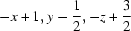 . .
| |
Data collection: APEX2 (Bruker, 2007); cell refinement: SAINT (Bruker, 2007); data reduction: SAINT; program(s) used to solve structure: SHELXS97 (Sheldrick, 2008); program(s) used to refine structure: SHELXL97 (Sheldrick, 2008); molecular graphics: X-SEED (Barbour, 2001); software used to prepare material for publication: publCIF (Westrip, 2008).
Supporting information
Chloropyrazine (1 ml, 1.1 mmol) and aniline (1 ml, 1.1 mmol) were heated at 423–433 K for 3 h. The solid was dissolved in water. The compound was extracted with ether. The ether extract was dried over sodium sulfate; evaporation of the solvent gave a colorless crystals among some unidentified dark brown materials.
Carbon-bound H-atoms were placed in calculated positions (C—H 0.95 Å) and were included in the refinement in the riding model approximation, with U(H) fixed at 1.2U(C). The amino H-atom was located in a difference Fourier map, and was refined with a distance restraint of N—H 0.88 (1) Å.
Data collection: APEX2 (Bruker, 2007); cell refinement: SAINT (Bruker, 2007); data reduction: SAINT (Bruker, 2007); program(s) used to solve structure: SHELXS97 (Sheldrick, 2008); program(s) used to refine structure: SHELXL97 (Sheldrick, 2008); molecular graphics: X-SEED (Barbour, 2001); software used to prepare material for publication: publCIF (Westrip, 2008).
N-(pyrazin-2-yl)aniline
top Crystal data top | C10H9N3 | F(000) = 360 |
| Mr = 171.20 | Dx = 1.344 Mg m−3 |
| Monoclinic, P21/c | Mo Kα radiation, λ = 0.71073 Å |
| Hall symbol: -P 2ybc | Cell parameters from 3723 reflections |
| a = 11.0644 (3) Å | θ = 3.3–26.4° |
| b = 7.8423 (3) Å | µ = 0.09 mm−1 |
| c = 10.8907 (3) Å | T = 100 K |
| β = 116.439 (2)° | Prism, colourless |
| V = 846.15 (5) Å3 | 0.20 × 0.10 × 0.05 mm |
| Z = 4 | |
Data collection top Bruker SMART APEX
diffractometer | 1463 reflections with I > 2σ(I) |
| Radiation source: fine-focus sealed tube | Rint = 0.033 |
| Graphite monochromator | θmax = 27.5°, θmin = 3.3° |
| ω scans | h = −14→14 |
| 5664 measured reflections | k = −10→10 |
| 1934 independent reflections | l = −14→14 |
Refinement top | Refinement on F2 | Primary atom site location: structure-invariant direct methods |
| Least-squares matrix: full | Secondary atom site location: difference Fourier map |
| R[F2 > 2σ(F2)] = 0.041 | Hydrogen site location: inferred from neighbouring sites |
| wR(F2) = 0.101 | H atoms treated by a mixture of independent and constrained refinement |
| S = 1.03 | w = 1/[σ2(Fo2) + (0.0421P)2 + 0.247P]
where P = (Fo2 + 2Fc2)/3 |
| 1934 reflections | (Δ/σ)max = 0.001 |
| 122 parameters | Δρmax = 0.23 e Å−3 |
| 1 restraint | Δρmin = −0.23 e Å−3 |
Crystal data top | C10H9N3 | V = 846.15 (5) Å3 |
| Mr = 171.20 | Z = 4 |
| Monoclinic, P21/c | Mo Kα radiation |
| a = 11.0644 (3) Å | µ = 0.09 mm−1 |
| b = 7.8423 (3) Å | T = 100 K |
| c = 10.8907 (3) Å | 0.20 × 0.10 × 0.05 mm |
| β = 116.439 (2)° | |
Data collection top Bruker SMART APEX
diffractometer | 1463 reflections with I > 2σ(I) |
| 5664 measured reflections | Rint = 0.033 |
| 1934 independent reflections | |
Refinement top | R[F2 > 2σ(F2)] = 0.041 | 1 restraint |
| wR(F2) = 0.101 | H atoms treated by a mixture of independent and constrained refinement |
| S = 1.03 | Δρmax = 0.23 e Å−3 |
| 1934 reflections | Δρmin = −0.23 e Å−3 |
| 122 parameters | |
Fractional atomic coordinates and isotropic or equivalent isotropic displacement parameters (Å2) top| | x | y | z | Uiso*/Ueq | |
| N1 | 0.36080 (11) | 0.49391 (15) | 0.56127 (12) | 0.0188 (3) | |
| H1 | 0.4485 (9) | 0.479 (2) | 0.6153 (13) | 0.024 (4)* | |
| N2 | 0.36741 (11) | 0.89784 (15) | 0.72193 (11) | 0.0205 (3) | |
| N3 | 0.18404 (11) | 0.69151 (16) | 0.51024 (12) | 0.0221 (3) | |
| C1 | 0.29407 (14) | 0.36077 (18) | 0.46992 (13) | 0.0181 (3) | |
| C2 | 0.37632 (14) | 0.23785 (18) | 0.45198 (14) | 0.0201 (3) | |
| H2 | 0.4717 | 0.2479 | 0.5007 | 0.024* | |
| C3 | 0.32046 (15) | 0.1019 (2) | 0.36410 (15) | 0.0246 (3) | |
| H3 | 0.3775 | 0.0188 | 0.3534 | 0.029* | |
| C4 | 0.18124 (15) | 0.0862 (2) | 0.29138 (15) | 0.0255 (3) | |
| H4 | 0.1427 | −0.0058 | 0.2293 | 0.031* | |
| C5 | 0.09930 (14) | 0.20604 (19) | 0.31037 (14) | 0.0235 (3) | |
| H5 | 0.0040 | 0.1948 | 0.2617 | 0.028* | |
| C6 | 0.15425 (14) | 0.34292 (18) | 0.39962 (14) | 0.0204 (3) | |
| H6 | 0.0969 | 0.4236 | 0.4125 | 0.025* | |
| C7 | 0.31216 (13) | 0.64466 (17) | 0.58462 (13) | 0.0174 (3) | |
| C8 | 0.40342 (13) | 0.74982 (17) | 0.69058 (14) | 0.0184 (3) | |
| H8 | 0.4941 | 0.7127 | 0.7412 | 0.022* | |
| C9 | 0.23812 (14) | 0.94629 (19) | 0.64641 (14) | 0.0232 (3) | |
| H9 | 0.2078 | 1.0522 | 0.6649 | 0.028* | |
| C10 | 0.14961 (14) | 0.84350 (19) | 0.54274 (15) | 0.0245 (3) | |
| H10 | 0.0594 | 0.8820 | 0.4914 | 0.029* | |
Atomic displacement parameters (Å2) top| | U11 | U22 | U33 | U12 | U13 | U23 |
| N1 | 0.0140 (6) | 0.0182 (6) | 0.0186 (6) | 0.0013 (5) | 0.0023 (5) | −0.0019 (5) |
| N2 | 0.0201 (6) | 0.0197 (6) | 0.0210 (6) | −0.0006 (5) | 0.0085 (5) | −0.0008 (5) |
| N3 | 0.0182 (6) | 0.0214 (7) | 0.0220 (6) | 0.0020 (5) | 0.0048 (5) | −0.0008 (5) |
| C1 | 0.0201 (7) | 0.0171 (7) | 0.0147 (6) | −0.0012 (5) | 0.0057 (5) | 0.0009 (5) |
| C2 | 0.0176 (7) | 0.0223 (8) | 0.0194 (7) | −0.0005 (6) | 0.0074 (6) | 0.0000 (6) |
| C3 | 0.0285 (8) | 0.0227 (8) | 0.0257 (8) | −0.0008 (6) | 0.0150 (6) | −0.0045 (6) |
| C4 | 0.0286 (8) | 0.0236 (8) | 0.0233 (7) | −0.0072 (6) | 0.0108 (6) | −0.0075 (6) |
| C5 | 0.0197 (7) | 0.0251 (8) | 0.0214 (7) | −0.0047 (6) | 0.0051 (6) | −0.0003 (6) |
| C6 | 0.0189 (7) | 0.0197 (7) | 0.0194 (7) | −0.0005 (6) | 0.0056 (6) | 0.0008 (6) |
| C7 | 0.0180 (7) | 0.0175 (7) | 0.0164 (7) | −0.0003 (5) | 0.0073 (5) | 0.0019 (5) |
| C8 | 0.0155 (6) | 0.0193 (7) | 0.0187 (7) | 0.0006 (5) | 0.0060 (5) | 0.0019 (5) |
| C9 | 0.0215 (7) | 0.0211 (7) | 0.0250 (7) | 0.0039 (6) | 0.0087 (6) | −0.0015 (6) |
| C10 | 0.0191 (7) | 0.0237 (8) | 0.0266 (8) | 0.0058 (6) | 0.0065 (6) | −0.0001 (6) |
Geometric parameters (Å, º) top | N1—C7 | 1.3689 (17) | C3—H3 | 0.9500 |
| N1—C1 | 1.4039 (17) | C4—C5 | 1.384 (2) |
| N1—H1 | 0.891 (9) | C4—H4 | 0.9500 |
| N2—C8 | 1.3207 (18) | C5—C6 | 1.393 (2) |
| N2—C9 | 1.3488 (17) | C5—H5 | 0.9500 |
| N3—C7 | 1.3335 (17) | C6—H6 | 0.9500 |
| N3—C10 | 1.3458 (19) | C7—C8 | 1.4120 (19) |
| C1—C6 | 1.3944 (18) | C8—H8 | 0.9500 |
| C1—C2 | 1.3978 (19) | C9—C10 | 1.378 (2) |
| C2—C3 | 1.381 (2) | C9—H9 | 0.9500 |
| C2—H2 | 0.9500 | C10—H10 | 0.9500 |
| C3—C4 | 1.389 (2) | | |
| | | |
| C7—N1—C1 | 130.38 (12) | C4—C5—H5 | 119.5 |
| C7—N1—H1 | 113.3 (10) | C6—C5—H5 | 119.5 |
| C1—N1—H1 | 116.3 (10) | C5—C6—C1 | 119.56 (13) |
| C8—N2—C9 | 116.75 (12) | C5—C6—H6 | 120.2 |
| C7—N3—C10 | 115.67 (12) | C1—C6—H6 | 120.2 |
| C6—C1—C2 | 119.09 (13) | N3—C7—N1 | 121.64 (12) |
| C6—C1—N1 | 124.65 (13) | N3—C7—C8 | 121.03 (12) |
| C2—C1—N1 | 116.25 (12) | N1—C7—C8 | 117.32 (12) |
| C3—C2—C1 | 120.72 (13) | N2—C8—C7 | 122.44 (12) |
| C3—C2—H2 | 119.6 | N2—C8—H8 | 118.8 |
| C1—C2—H2 | 119.6 | C7—C8—H8 | 118.8 |
| C2—C3—C4 | 120.26 (14) | N2—C9—C10 | 120.58 (13) |
| C2—C3—H3 | 119.9 | N2—C9—H9 | 119.7 |
| C4—C3—H3 | 119.9 | C10—C9—H9 | 119.7 |
| C5—C4—C3 | 119.26 (14) | N3—C10—C9 | 123.53 (13) |
| C5—C4—H4 | 120.4 | N3—C10—H10 | 118.2 |
| C3—C4—H4 | 120.4 | C9—C10—H10 | 118.2 |
| C4—C5—C6 | 121.08 (13) | | |
| | | |
| C7—N1—C1—C6 | −12.7 (2) | C10—N3—C7—N1 | −179.30 (12) |
| C7—N1—C1—C2 | 168.41 (13) | C10—N3—C7—C8 | 0.36 (19) |
| C6—C1—C2—C3 | 1.1 (2) | C1—N1—C7—N3 | −4.2 (2) |
| N1—C1—C2—C3 | −179.89 (12) | C1—N1—C7—C8 | 176.09 (13) |
| C1—C2—C3—C4 | 0.5 (2) | C9—N2—C8—C7 | −0.73 (19) |
| C2—C3—C4—C5 | −1.5 (2) | N3—C7—C8—N2 | 0.3 (2) |
| C3—C4—C5—C6 | 0.9 (2) | N1—C7—C8—N2 | −179.99 (12) |
| C4—C5—C6—C1 | 0.7 (2) | C8—N2—C9—C10 | 0.4 (2) |
| C2—C1—C6—C5 | −1.7 (2) | C7—N3—C10—C9 | −0.7 (2) |
| N1—C1—C6—C5 | 179.40 (13) | N2—C9—C10—N3 | 0.3 (2) |
Hydrogen-bond geometry (Å, º) top | D—H···A | D—H | H···A | D···A | D—H···A |
| N1—H1···N2i | 0.89 (1) | 2.12 (1) | 2.977 (2) | 162 (1) |
| Symmetry code: (i) −x+1, y−1/2, −z+3/2. |
Experimental details
| Crystal data |
| Chemical formula | C10H9N3 |
| Mr | 171.20 |
| Crystal system, space group | Monoclinic, P21/c |
| Temperature (K) | 100 |
| a, b, c (Å) | 11.0644 (3), 7.8423 (3), 10.8907 (3) |
| β (°) | 116.439 (2) |
| V (Å3) | 846.15 (5) |
| Z | 4 |
| Radiation type | Mo Kα |
| µ (mm−1) | 0.09 |
| Crystal size (mm) | 0.20 × 0.10 × 0.05 |
| |
| Data collection |
| Diffractometer | Bruker SMART APEX
diffractometer |
| Absorption correction | – |
No. of measured, independent and
observed [I > 2σ(I)] reflections | 5664, 1934, 1463 |
| Rint | 0.033 |
| (sin θ/λ)max (Å−1) | 0.650 |
| |
| Refinement |
| R[F2 > 2σ(F2)], wR(F2), S | 0.041, 0.101, 1.03 |
| No. of reflections | 1934 |
| No. of parameters | 122 |
| No. of restraints | 1 |
| H-atom treatment | H atoms treated by a mixture of independent and constrained refinement |
| Δρmax, Δρmin (e Å−3) | 0.23, −0.23 |
Hydrogen-bond geometry (Å, º) top | D—H···A | D—H | H···A | D···A | D—H···A |
| N1—H1···N2i | 0.89 (1) | 2.12 (1) | 2.977 (2) | 162 (1) |
| Symmetry code: (i) −x+1, y−1/2, −z+3/2. |
Acknowledgements
The authors thank the University of Malaya for supporting this study (grant Nos. FS 358/2008A and FA 067/2006A).
References
 Barbour, L. J. (2001). J. Supramol. Chem. 1, 189–191. CrossRef CAS Google Scholar
Bruker (2007). APEX2 and SAINT. Bruker AXS Inc., Madison, Wisconsin, USA. Google Scholar
Chao, M., Schempp, E. & Rosenstein, R. D. (1976). Acta Cryst. B32, 288–290. CSD CrossRef CAS IUCr Journals Web of Science Google Scholar
Parsons, S., Wharton, S., McNab, H., Parkin, A. & Johnstone, R. (2006). Private communication (Deposition No. 610410). CCDC, Union Road, Cambridge, England. Google Scholar
Sheldrick, G. M. (2008). Acta Cryst. A64, 112–122. Web of Science CrossRef CAS IUCr Journals Google Scholar
Westrip, S. P. (2008). publCIF. In preparation. Google Scholar
This is an open-access article distributed under the terms of the Creative Commons Attribution (CC-BY) Licence, which permits unrestricted use, distribution, and reproduction in any medium, provided the original authors and source are cited.
 | CRYSTALLOGRAPHIC
COMMUNICATIONS |
ISSN: 2056-9890
Open

access


 journal menu



![[Scheme 1]](pk2121scheme1.gif)
![[Figure 1]](./pk2121fig1thm.gif)


There are few structural examples of pyrazine compounds having an amino substituent; these are limited to, for example, aminopyrazine (Chao et al., 1976) and pyrazinyl-N-2-nitrophenylaniline (Parsons et al., 2006). In the title compound (Scheme I, Fig. 1), the two aromatic rings are aligned at 15.2 (1)°; these open up the angle at the amino nitrogen to 130.4 (1) °. The amino nitrogen forms a hydrogen bond to the 4-nitrogen atom of an adjacent molecule to furnish a chain motif.