 | Acta Crystallographica Section E Acta Crystallographica Section E CRYSTALLOGRAPHIC COMMUNICATIONS |


 journal menu


organic compounds
| CRYSTALLOGRAPHIC COMMUNICATIONS |
 access
2-(2-Fluorobenzoylmethyl)benzoic acid

aDepartment of Applied Sciences, National Textile University, Faisalabad, Pakistan, bDepartment of Chemistry, Quaid-i-Azam University, Islamabad 45320, Pakistan, and cDepartment of General and Inorganic Chemistry, Faculty of Chemical Technology, University of Pardubice, Nam. Cs. Legii' 565, 53210 Pardubice, Czech Republic
*Correspondence e-mail: [email protected]
In the title compound, C15H11FO3, the aromatic rings are oriented at a dihedral angle of 69.26 (3)°. In the crystal structure, inversion dimers arise from pairs of intermolecular O—H⋯O hydrogen bonds, and C—H⋯O hydrogen bonds further consolidate the packing. There are also C—H⋯π contacts between the benzoic acid and 2-fluorobenzene rings.
Related literature
For the biological activity of isocoumarin and 3,4-dihydroisocoumarin derivatives, see: Hill (1986![[Hill, R. A. (1986). Fortschr. Chem. Org. Naturst. 49, 1-78.]](../../../../../../logos/arrows/e_arr.gif "Hill, R. A. (1986). Fortschr. Chem. Org. Naturst. 49, 1-78.") ); Napolitano (1997); Oikawa et al. (1997); Kongsaeree et al. (2003). For bond-length data, see: Allen et al. (1987).
); Napolitano (1997); Oikawa et al. (1997); Kongsaeree et al. (2003). For bond-length data, see: Allen et al. (1987).
![[Scheme 1]](hk2566scheme1.gif)
Experimental
Crystal data
|
Refinement
|
|
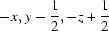 ; (iii)
 Data collection: COLLECT (Hooft, 1998); cell refinement: COLLECT and DENZO (Otwinowski & Minor, 1997); data reduction: COLLECT and DENZO; program(s) used to solve structure: SIR92 (Altomare et al., 1994); program(s) used to refine structure: SHELXL97 (Sheldrick, 2008); molecular graphics: PLATON (Spek, 2003); software used to prepare material for publication: SHELXL97.
Supporting information
contains datablocks I, global. DOI: 10.1107/S160053680803540X/hk2566sup1.cif
Structure factors: contains datablock I. DOI: 10.1107/S160053680803540X/hk2566Isup2.hkl
3-(2-Fluorophenyl)isocoumarin (6.4 mmol) was dissolved in ethanol (25 ml) and potassium hydroxide (30 ml 5%) was added. The mixture refluxed for about 5 h. After cooling the solvent was evaporated under reduced pressure. Cold water (20 ml) was added and the reaction mixture acidified with hydrochloric acid (5%). The precipitated keto acid was filtered, washed, dried and recrystalized from hot ethanol (yield; 87%, m.p. 404-405 K).
H atoms were positioned geometrically, with O-H = 0.82 Å (for OH) and C-H = 0.93 and 0.97 Å for aromatic and methylene H, respectively, and constrained to ride on their parent atoms with Uiso(H) = 1.2Ueq(C,O).
Data collection: COLLECT (Hooft, 1998); cell COLLECT (Hooft, 1998) and DENZO (Otwinowski & Minor, 1997); data reduction: COLLECT (Hooft, 1998) and DENZO (Otwinowski & Minor, 1997); program(s) used to solve structure: SIR92 (Altomare et al., 1994); program(s) used to refine structure: SHELXL97 (Sheldrick, 2008); molecular graphics: PLATON (Spek, 2003); software used to prepare material for publication: SHELXL97 (Sheldrick, 2008).
![[Figure 1]](./hk2566fig1thm.gif) | Fig. 1. The molecular structure of the title molecule, with the atom-numbering scheme. Displacement ellipsoids are drawn at the 30% probability level. |
![[Figure 2]](./hk2566fig2thm.gif) | Fig. 2. A partial packing diagram. Hydrogen bonds are shown as dashed lines. |
![[Figure 3]](./hk2566fig3thm.gif) | Fig. 3. The formation of the title compound. |
| C15H11FO3 | F(000) = 536 |
| Mr = 258.24 | Dx = 1.371 Mg m−3 |
| Monoclinic, P21/c | Melting point: 404(1) K |
| Hall symbol: -P 2ybc | Mo Kα radiation, λ = 0.71073 Å |
| a = 8.3011 (6) Å | Cell parameters from 8503 reflections |
| b = 15.3232 (8) Å | θ = 1–27.5° |
| c = 9.9078 (10) Å | µ = 0.11 mm−1 |
| β = 96.942 (8)° | T = 150 K |
| V = 1251.02 (17) Å3 | Block, colorless |
| Z = 4 | 0.52 × 0.38 × 0.31 mm |
| Bruker–Nonius Kappa CCD area-detector diffractometer | 2782 independent reflections |
| Radiation source: fine-focus sealed tube | 2117 reflections with I > 2σ(I) |
| Graphite monochromator | Rint = 0.040 |
| Detector resolution: 9.091 pixels mm-1 | θmax = 27.5°, θmin = 2.5° |
| ϕ and ω scans | h = −9→10 |
| Absorption correction: gaussian (Coppens, 1970) | k = −18→19 |
| Tmin = 0.962, Tmax = 0.975 | l = −12→12 |
| 8420 measured reflections |
| Refinement on F2 | Primary atom site location: structure-invariant direct methods |
| Least-squares matrix: full | Secondary atom site location: difference Fourier map |
| R[F2 > 2σ(F2)] = 0.053 | Hydrogen site location: inferred from neighbouring sites |
| wR(F2) = 0.136 | H-atom parameters constrained |
| S = 1.12 | w = 1/[σ2(Fo2) + (0.0382P)2 + 0.8217P] where P = (Fo2 + 2Fc2)/3 |
| 2782 reflections | (Δ/σ)max < 0.001 |
| 172 parameters | Δρmax = 0.23 e Å−3 |
| 0 restraints | Δρmin = −0.30 e Å−3 |
| C15H11FO3 | V = 1251.02 (17) Å3 |
| Mr = 258.24 | Z = 4 |
| Monoclinic, P21/c | Mo Kα radiation |
| a = 8.3011 (6) Å | µ = 0.11 mm−1 |
| b = 15.3232 (8) Å | T = 150 K |
| c = 9.9078 (10) Å | 0.52 × 0.38 × 0.31 mm |
| β = 96.942 (8)° |
| Bruker–Nonius Kappa CCD area-detector diffractometer | 2782 independent reflections |
| Absorption correction: gaussian (Coppens, 1970) | 2117 reflections with I > 2σ(I) |
| Tmin = 0.962, Tmax = 0.975 | Rint = 0.040 |
| 8420 measured reflections |
| R[F2 > 2σ(F2)] = 0.053 | 0 restraints |
| wR(F2) = 0.136 | H-atom parameters constrained |
| S = 1.12 | Δρmax = 0.23 e Å−3 |
| 2782 reflections | Δρmin = −0.30 e Å−3 |
| 172 parameters |
Geometry. All e.s.d.'s (except the e.s.d. in the dihedral angle between two l.s. planes) are estimated using the full covariance matrix. The cell e.s.d.'s are taken into account individually in the estimation of e.s.d.'s in distances, angles and torsion angles; correlations between e.s.d.'s in cell parameters are only used when they are defined by crystal symmetry. An approximate (isotropic) treatment of cell e.s.d.'s is used for estimating e.s.d.'s involving l.s. planes. |
Refinement. Refinement of F2 against ALL reflections. The weighted R-factor wR and goodness of fit S are based on F2, conventional R-factors R are based on F, with F set to zero for negative F2. The threshold expression of F2 > σ(F2) is used only for calculating R-factors(gt) etc. and is not relevant to the choice of reflections for refinement. R-factors based on F2 are statistically about twice as large as those based on F, and R- factors based on ALL data will be even larger. |
| x | y | z | Uiso*/Ueq | ||
| F1 | 0.15542 (18) | −0.18437 (8) | 0.10130 (16) | 0.0594 (4) | |
| O1 | 0.3928 (2) | −0.00007 (12) | 0.35571 (16) | 0.0573 (5) | |
| O2 | 0.61607 (19) | 0.07728 (11) | 0.40921 (15) | 0.0504 (4) | |
| H2 | 0.6161 | 0.0506 | 0.4809 | 0.061* | |
| O3 | 0.0632 (2) | 0.07181 (10) | 0.1708 (2) | 0.0626 (5) | |
| C1 | 0.4909 (2) | 0.05329 (13) | 0.3244 (2) | 0.0361 (4) | |
| C2 | 0.4762 (2) | 0.09750 (12) | 0.1908 (2) | 0.0326 (4) | |
| C3 | 0.3662 (2) | 0.06805 (12) | 0.08185 (19) | 0.0316 (4) | |
| C4 | 0.3530 (3) | 0.11624 (15) | −0.0370 (2) | 0.0410 (5) | |
| H4 | 0.2814 | 0.0979 | −0.1111 | 0.049* | |
| C5 | 0.4429 (3) | 0.19136 (15) | −0.0483 (2) | 0.0477 (6) | |
| H5 | 0.4292 | 0.2236 | −0.1284 | 0.057* | |
| C6 | 0.5523 (3) | 0.21865 (14) | 0.0580 (2) | 0.0468 (5) | |
| H6 | 0.6140 | 0.2686 | 0.0499 | 0.056* | |
| C7 | 0.5704 (3) | 0.17144 (13) | 0.1770 (2) | 0.0397 (5) | |
| H7 | 0.6464 | 0.1889 | 0.2485 | 0.048* | |
| C8 | 0.2660 (2) | −0.01340 (13) | 0.0886 (2) | 0.0335 (4) | |
| H8A | 0.3338 | −0.0593 | 0.1325 | 0.040* | |
| H8B | 0.2282 | −0.0325 | −0.0032 | 0.040* | |
| C9 | 0.1223 (2) | 0.00021 (12) | 0.1651 (2) | 0.0344 (4) | |
| C10 | 0.0483 (2) | −0.07466 (12) | 0.2322 (2) | 0.0330 (4) | |
| C11 | 0.0665 (2) | −0.16193 (13) | 0.2005 (2) | 0.0395 (5) | |
| C12 | −0.0064 (3) | −0.22847 (15) | 0.2627 (3) | 0.0520 (6) | |
| H12 | 0.0071 | −0.2862 | 0.2371 | 0.062* | |
| C13 | −0.1001 (3) | −0.20839 (18) | 0.3633 (3) | 0.0599 (7) | |
| H13 | −0.1490 | −0.2527 | 0.4079 | 0.072* | |
| C14 | −0.1213 (3) | −0.12269 (19) | 0.3988 (3) | 0.0603 (7) | |
| H14 | −0.1854 | −0.1092 | 0.4667 | 0.072* | |
| C15 | −0.0491 (3) | −0.05654 (16) | 0.3331 (2) | 0.0469 (5) | |
| H15 | −0.0654 | 0.0011 | 0.3573 | 0.056* |
| U11 | U22 | U33 | U12 | U13 | U23 | |
| F1 | 0.0607 (9) | 0.0356 (7) | 0.0886 (11) | −0.0018 (6) | 0.0356 (8) | −0.0117 (7) |
| O1 | 0.0577 (10) | 0.0698 (12) | 0.0414 (9) | −0.0320 (9) | −0.0064 (7) | 0.0151 (8) |
| O2 | 0.0525 (9) | 0.0544 (10) | 0.0422 (8) | −0.0221 (8) | −0.0034 (7) | 0.0060 (7) |
| O3 | 0.0532 (10) | 0.0293 (8) | 0.1121 (15) | 0.0072 (7) | 0.0381 (10) | 0.0056 (9) |
| C1 | 0.0367 (10) | 0.0344 (10) | 0.0375 (10) | −0.0062 (8) | 0.0057 (8) | −0.0028 (8) |
| C2 | 0.0350 (10) | 0.0281 (9) | 0.0369 (10) | 0.0002 (7) | 0.0126 (8) | −0.0010 (7) |
| C3 | 0.0277 (9) | 0.0324 (10) | 0.0365 (10) | 0.0044 (7) | 0.0108 (8) | 0.0008 (8) |
| C4 | 0.0351 (10) | 0.0487 (12) | 0.0402 (11) | 0.0050 (9) | 0.0086 (8) | 0.0075 (9) |
| C5 | 0.0467 (12) | 0.0463 (12) | 0.0538 (13) | 0.0066 (10) | 0.0210 (11) | 0.0179 (10) |
| C6 | 0.0495 (13) | 0.0339 (11) | 0.0614 (14) | −0.0047 (9) | 0.0245 (11) | 0.0058 (10) |
| C7 | 0.0410 (11) | 0.0350 (11) | 0.0455 (12) | −0.0050 (8) | 0.0146 (9) | −0.0054 (9) |
| C8 | 0.0329 (10) | 0.0320 (10) | 0.0360 (10) | −0.0013 (8) | 0.0050 (8) | −0.0019 (8) |
| C9 | 0.0309 (9) | 0.0291 (10) | 0.0432 (11) | 0.0000 (8) | 0.0046 (8) | −0.0005 (8) |
| C10 | 0.0293 (9) | 0.0331 (10) | 0.0363 (10) | −0.0006 (7) | 0.0023 (7) | 0.0001 (8) |
| C11 | 0.0325 (10) | 0.0343 (10) | 0.0522 (13) | 0.0020 (8) | 0.0068 (9) | 0.0013 (9) |
| C12 | 0.0460 (12) | 0.0328 (11) | 0.0772 (17) | −0.0012 (9) | 0.0074 (12) | 0.0106 (11) |
| C13 | 0.0589 (15) | 0.0561 (15) | 0.0653 (16) | −0.0107 (12) | 0.0103 (13) | 0.0231 (13) |
| C14 | 0.0649 (17) | 0.0703 (18) | 0.0504 (14) | −0.0106 (13) | 0.0257 (12) | 0.0032 (12) |
| C15 | 0.0514 (13) | 0.0455 (12) | 0.0459 (12) | −0.0052 (10) | 0.0142 (10) | −0.0059 (10) |
| F1—C11 | 1.343 (2) | C8—H8A | 0.9700 |
| O1—C1 | 1.220 (2) | C8—H8B | 0.9700 |
| O2—C1 | 1.308 (2) | C9—O3 | 1.206 (2) |
| O2—H2 | 0.8199 | C9—C8 | 1.503 (3) |
| C2—C1 | 1.479 (3) | C9—C10 | 1.495 (3) |
| C2—C3 | 1.402 (3) | C10—C11 | 1.386 (3) |
| C2—C7 | 1.393 (3) | C10—C15 | 1.388 (3) |
| C3—C4 | 1.383 (3) | C11—C12 | 1.370 (3) |
| C3—C8 | 1.506 (3) | C12—C13 | 1.371 (4) |
| C4—C5 | 1.384 (3) | C12—H12 | 0.9299 |
| C4—H4 | 0.9300 | C13—H13 | 0.9300 |
| C5—C6 | 1.370 (3) | C14—C13 | 1.376 (4) |
| C5—H5 | 0.9300 | C14—H14 | 0.9300 |
| C6—H6 | 0.9299 | C15—C14 | 1.380 (3) |
| C7—C6 | 1.376 (3) | C15—H15 | 0.9300 |
| C7—H7 | 0.9300 | ||
| C1—O2—H2 | 109.5 | C9—C8—H8B | 109.1 |
| O1—C1—O2 | 121.87 (19) | C3—C8—H8B | 109.1 |
| O1—C1—C2 | 123.30 (18) | H8A—C8—H8B | 107.8 |
| O2—C1—C2 | 114.80 (17) | O3—C9—C10 | 119.08 (18) |
| C7—C2—C3 | 120.47 (18) | O3—C9—C8 | 120.14 (18) |
| C7—C2—C1 | 118.31 (18) | C10—C9—C8 | 120.77 (16) |
| C3—C2—C1 | 121.18 (17) | C11—C10—C15 | 116.41 (19) |
| C4—C3—C2 | 117.49 (18) | C11—C10—C9 | 125.32 (18) |
| C4—C3—C8 | 119.50 (18) | C15—C10—C9 | 118.26 (18) |
| C2—C3—C8 | 123.00 (17) | F1—C11—C12 | 116.77 (19) |
| C3—C4—C5 | 121.6 (2) | F1—C11—C10 | 119.81 (18) |
| C3—C4—H4 | 119.2 | C12—C11—C10 | 123.4 (2) |
| C5—C4—H4 | 119.2 | C11—C12—C13 | 118.7 (2) |
| C6—C5—C4 | 120.4 (2) | C11—C12—H12 | 120.7 |
| C6—C5—H5 | 119.7 | C13—C12—H12 | 120.6 |
| C4—C5—H5 | 119.9 | C12—C13—C14 | 120.1 (2) |
| C5—C6—C7 | 119.4 (2) | C12—C13—H13 | 120.0 |
| C5—C6—H6 | 120.4 | C14—C13—H13 | 119.9 |
| C7—C6—H6 | 120.2 | C13—C14—C15 | 120.2 (2) |
| C6—C7—C2 | 120.5 (2) | C13—C14—H14 | 120.0 |
| C6—C7—H7 | 119.7 | C15—C14—H14 | 119.8 |
| C2—C7—H7 | 119.8 | C14—C15—C10 | 121.1 (2) |
| C9—C8—C3 | 112.56 (16) | C14—C15—H15 | 119.5 |
| C9—C8—H8A | 109.1 | C10—C15—H15 | 119.4 |
| C3—C8—H8A | 109.1 |
| D—H···A | D—H | H···A | D···A | D—H···A |
| O2—H2···O1i | 0.82 | 1.80 | 2.621 (3) | 175 |
| C12—H12···O3ii | 0.93 | 2.46 | 3.178 (3) | 134 |
| C4—H4···Cg2iii | 0.93 | 2.72 | 3.535 (3) | 146 |
| C13—H13···Cg1ii | 0.93 | 3.06 | 3.868 (3) | 146 |
| Symmetry codes: (i) −x+1, −y, −z+1; (ii) −x, y−1/2, −z+1/2; (iii) −x, −y, −z. |
Experimental details
| Crystal data | |
| Chemical formula | C15H11FO3 |
| Mr | 258.24 |
| Crystal system, space group | Monoclinic, P21/c |
| Temperature (K) | 150 |
| a, b, c (Å) | 8.3011 (6), 15.3232 (8), 9.9078 (10) |
| β (°) | 96.942 (8) |
| V (Å3) | 1251.02 (17) |
| Z | 4 |
| Radiation type | Mo Kα |
| µ (mm−1) | 0.11 |
| Crystal size (mm) | 0.52 × 0.38 × 0.31 |
| Data collection | |
| Diffractometer | Bruker–Nonius Kappa CCD area-detector diffractometer |
| Absorption correction | Gaussian (Coppens, 1970) |
| Tmin, Tmax | 0.962, 0.975 |
| No. of measured, independent and observed [I > 2σ(I)] reflections | 8420, 2782, 2117 |
| Rint | 0.040 |
| (sin θ/λ)max (Å−1) | 0.649 |
| Refinement | |
| R[F2 > 2σ(F2)], wR(F2), S | 0.053, 0.136, 1.12 |
| No. of reflections | 2782 |
| No. of parameters | 172 |
| H-atom treatment | H-atom parameters constrained |
| Δρmax, Δρmin (e Å−3) | 0.23, −0.30 |
Computer programs: , COLLECT (Hooft, 1998) and DENZO (Otwinowski & Minor, 1997), SIR92 (Altomare et al., 1994), SHELXL97 (Sheldrick, 2008), PLATON (Spek, 2003).
| D—H···A | D—H | H···A | D···A | D—H···A |
| O2—H2···O1i | 0.82 | 1.80 | 2.621 (3) | 175 |
| C12—H12···O3ii | 0.93 | 2.46 | 3.178 (3) | 134 |
| C4—H4···Cg2iii | 0.93 | 2.72 | 3.535 (3) | 146 |
| C13—H13···Cg1ii | 0.93 | 3.06 | 3.868 (3) | 146 |
| Symmetry codes: (i) −x+1, −y, −z+1; (ii) −x, y−1/2, −z+1/2; (iii) −x, −y, −z. |
Acknowledgements
M. Tariq Mahmood Babar is grateful to the Higher Education Commission of Pakistan for financial support under the National Support Initiative Program for Pre-doctoral Fellowships at Quaid-i-Azam University.
References
 Allen, F. H., Kennard, O., Watson, D. G., Brammer, L., Orpen, A. G. & Taylor, R. (1987). J. Chem. Soc. Perkin Trans. 2, pp. S1–19. CrossRef Web of Science Google Scholar
Altomare, A., Cascarano, G., Giacovazzo, C., Guagliardi, A., Burla, M. C., Polidori, G. & Camalli, M. (1994). J. Appl. Cryst. 27, 435. CrossRef Web of Science IUCr Journals Google Scholar
Coppens, P. (1970). Crystallographic Computing, edited by F. R. Ahmed, S. R. Hall & C. P. Huber, pp. 255–270. Copenhagen: Munksgaard. Google Scholar
Hill, R. A. (1986). Fortschr. Chem. Org. Naturst. 49, 1–78. CAS Google Scholar
Hooft, R. W. W. (1998). COLLECT. Nonius BV, Delft, The Netherlands. Google Scholar
Kongsaeree, P., Prabpai, S., Sriubolmas, N., Vongvein, C. & Wiyakrutta, S. (2003). J. Nat. Prod. 66, 709–711. Web of Science CrossRef PubMed CAS Google Scholar
Napolitano, E. (1997). Org. Prep. Proced. Int. 29, 631–665. CrossRef CAS Google Scholar
Oikawa, T., Sasaki, M., Inose, M., Shimamura, M., Kuboki, H., Hirano, S. I., Kumagai, H., Ishizuka, M. & Takeuchi, T. (1997). Anticancer Res. 17, 1881–1886. CAS PubMed Web of Science Google Scholar
Otwinowski, Z. & Minor, W. (1997). Methods in Enzimology, Vol. 276, Macromolecular Crystallography, Part A, edited by C. W. Carter Jr & R. M. Sweet, pp. 307–326. New York: Academic Press. Google Scholar
Sheldrick, G. M. (2008). Acta Cryst. A64, 112–122. Web of Science CrossRef CAS IUCr Journals Google Scholar
Spek, A. L. (2003). J. Appl. Cryst. 36, 7–13. Web of Science CrossRef CAS IUCr Journals Google Scholar
This is an open-access article distributed under the terms of the Creative Commons Attribution (CC-BY) Licence, which permits unrestricted use, distribution, and reproduction in any medium, provided the original authors and source are cited.
| CRYSTALLOGRAPHIC COMMUNICATIONS |


The title compound is an important intermediate in the conversion of isocoumarin to 3,4-dihydroisocoumarin. Derivatives of isocoumarin and 3,4-dihydroisocoumarin display a broad range of biological activity (Hill, 1986; Napolitano, 1997). 3,4-Dihydroisocoumarins are an important class of naturally occurring, biologically active gamma-lactones. Numbers of such dihydroisocoumarins have various uses, ranging from sweetening agents to bactericides, antimalarial, antituberclous, antifungal, antiulcergenic and antitumour (Oikawa et al., 1997; Kongsaeree et al., 2003).
In the title compound (Fig. 1), the bond lengths (Allen et al., 1987) and angles are within normal ranges. Rings A (C2-C7) and B (C10-C15) are, of course, planar and they are oriented at a dihedral angle of 69.26 (3)°. The (O1/O2/C1) moiety is oriented with respect to rings A and B at dihedral angles of 14.54 (4)° and 76.12 (3)°, respectively.
In the crystal structure, intermolecular O-H···O and C-H···O hydrogen bonds (Table 1) link the molecules (Fig. 2), in which they may be effective in the stabilization of the structure. There also exist C—H···π contacts (Table 1) between the benzoic acid and 2-fluorobenzene rings.