 | Acta Crystallographica Section E Acta Crystallographica Section E CRYSTALLOGRAPHIC COMMUNICATIONS |


 journal menu


organic compounds
| CRYSTALLOGRAPHIC COMMUNICATIONS |
 access
rac-(S)-2-(1H-Imidazol-1-yl)-3-methylbutan-1-ol

aTechnical Research Center, China Tabacco Chuanyu Industrial Corporation, Chengdu 610066, People's Republic of China
*Correspondence e-mail: [email protected]
In the of the title compound, C8H14N2O, intermolecular O—H⋯N hydrogen bonds link molecules related by translation along the a axis into chains. Weak intermolecular C—H⋯O hydrogen bonds and C—H⋯π interactions enhance the crystal packing stability.
Related literature
For useful applications of imidazole derivatives, see Lu et al. (2006![[Lu, W. G., Su, C. Y., Lu, T. B., Jiang, L. & Chen, J. M. (2006). J. Am. Chem. Soc. 128, 34-35.]](../../../../../../logos/arrows/e_arr.gif "Lu, W. G., Su, C. Y., Lu, T. B., Jiang, L. & Chen, J. M. (2006). J. Am. Chem. Soc. 128, 34-35.") ); Zou et al. (2006). For details of the synthesis, see Bao et al. (2003); Guo et al. (2006).
); Zou et al. (2006). For details of the synthesis, see Bao et al. (2003); Guo et al. (2006).
![[Scheme 1]](cv2517scheme1.gif)
Experimental
Crystal data
|
Data collection
|
Refinement
|
|
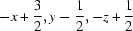 .
. Data collection: DIFRAC (Gabe & White, 1993); cell refinement: DIFRAC; data reduction: NRCVAX (Gabe et al., 1989); program(s) used to solve structure: SHELXS97 (Sheldrick, 2008); program(s) used to refine structure: SHELXL97 (Sheldrick, 2008); molecular graphics: ORTEPIII (Burnett & Johnson, 1996); software used to prepare material for publication: SHELXL97 and PLATON (Spek, 2009).
Supporting information
contains datablocks global, I. DOI: 10.1107/S1600536809004565/cv2517sup1.cif
Structure factors: contains datablock I. DOI: 10.1107/S1600536809004565/cv2517Isup2.hkl
The title compound was prepared according to the literature (Guo et al. 2006). Starting from L-valine, methyl 2-(1H-imidazol-1-yl)-3-methylbutanoate was easily prepared according to literature procedure (Bao et al. 2003). Following, NaBH4 (1.52 g, 40 mmol) was added to methyl 2-(1H-imidazol-1-yl)-3-methylbutanoate (1.82 g, 10.0 mmol) in ethanol (50 ml) at 273 K during 30 min. The mixture was stirred at 333 K for another 20 h and then evaporated under vacuum. The residue was diluted with 50 ml saturated K2CO3 and extracted with 30 ml ethyl acetate. The organic layer was dried over anhydrous Na2SO4 and concentrated under reduced pressure. The resulting residue was purified by on silica gel eluting with CH2Cl2/CH3OH (20/1, v/v). Then, colourless crystals suitable for X-ray analysis can be obtained by recrystallization of the compound from ethyl acetate.
All H atoms were positioned geometrically and refined in the riding model approximation, with C—H = 0.93–0.98 Å and O—H = 0.82 Å, and Uiso(H) = 1.2–1.5 Ueq of the parent atom.
Data collection: DIFRAC (Gabe & White, 1993); cell DIFRAC (Gabe & White, 1993); data reduction: NRCVAX (Gabe et al., 1989); program(s) used to solve structure: SHELXS97 (Sheldrick, 2008); program(s) used to refine structure: SHELXL97 (Sheldrick, 2008); molecular graphics: ORTEPIII (Burnett & Johnson, 1996); software used to prepare material for publication: SHELXL97 (Sheldrick, 2008) and PLATON (Spek, 2009).
![[Figure 1]](./cv2517fig1thm.gif) | Fig. 1. The molecular structure of (I), showing 30% probability displacement ellipsoids and the atomic numbering. |
| C8H14N2O | F(000) = 336 |
| Mr = 154.21 | Dx = 1.167 Mg m−3 |
| Monoclinic, P21/n | Mo Kα radiation, λ = 0.71073 Å |
| Hall symbol: -P 2yn | Cell parameters from 21 reflections |
| a = 7.356 (4) Å | θ = 4.6–7.4° |
| b = 7.212 (3) Å | µ = 0.08 mm−1 |
| c = 16.549 (5) Å | T = 292 K |
| β = 90.54 (3)° | Block, colourless |
| V = 877.9 (7) Å3 | 0.58 × 0.54 × 0.42 mm |
| Z = 4 |
| Enraf–Nonius CAD-4 diffractometer | Rint = 0.004 |
| Radiation source: fine-focus sealed tube | θmax = 25.5°, θmin = 2.5° |
| Graphite monochromator | h = −8→8 |
| ω/2θ scans | k = 0→8 |
| 1931 measured reflections | l = −7→20 |
| 1630 independent reflections | 3 standard reflections every 120 reflections |
| 965 reflections with I > 2σ(I) | intensity decay: 0.3% |
| Refinement on F2 | Secondary atom site location: difference Fourier map |
| Least-squares matrix: full | Hydrogen site location: inferred from neighbouring sites |
| R[F2 > 2σ(F2)] = 0.067 | H-atom parameters constrained |
| wR(F2) = 0.197 | w = 1/[σ2(Fo2) + (0.0941P)2] where P = (Fo2 + 2Fc2)/3 |
| S = 1.18 | (Δ/σ)max < 0.001 |
| 1630 reflections | Δρmax = 0.31 e Å−3 |
| 104 parameters | Δρmin = −0.24 e Å−3 |
| 0 restraints | Extinction correction: SHELXS97 (Sheldrick, 2008), Fc*=kFc[1+0.001xFc2λ3/sin(2θ)]-1/4 |
| Primary atom site location: structure-invariant direct methods | Extinction coefficient: 0.046 (11) |
| C8H14N2O | V = 877.9 (7) Å3 |
| Mr = 154.21 | Z = 4 |
| Monoclinic, P21/n | Mo Kα radiation |
| a = 7.356 (4) Å | µ = 0.08 mm−1 |
| b = 7.212 (3) Å | T = 292 K |
| c = 16.549 (5) Å | 0.58 × 0.54 × 0.42 mm |
| β = 90.54 (3)° |
| Enraf–Nonius CAD-4 diffractometer | Rint = 0.004 |
| 1931 measured reflections | 3 standard reflections every 120 reflections |
| 1630 independent reflections | intensity decay: 0.3% |
| 965 reflections with I > 2σ(I) |
| R[F2 > 2σ(F2)] = 0.067 | 0 restraints |
| wR(F2) = 0.197 | H-atom parameters constrained |
| S = 1.18 | Δρmax = 0.31 e Å−3 |
| 1630 reflections | Δρmin = −0.24 e Å−3 |
| 104 parameters |
Geometry. All e.s.d.'s (except the e.s.d. in the dihedral angle between two l.s. planes) are estimated using the full covariance matrix. The cell e.s.d.'s are taken into account individually in the estimation of e.s.d.'s in distances, angles and torsion angles; correlations between e.s.d.'s in cell parameters are only used when they are defined by crystal symmetry. An approximate (isotropic) treatment of cell e.s.d.'s is used for estimating e.s.d.'s involving l.s. planes. |
Refinement. Refinement of F2 against ALL reflections. The weighted R-factor wR and goodness of fit S are based on F2, conventional R-factors R are based on F, with F set to zero for negative F2. The threshold expression of F2 > σ(F2) is used only for calculating R-factors(gt) etc. and is not relevant to the choice of reflections for refinement. R-factors based on F2 are statistically about twice as large as those based on F, and R- factors based on ALL data will be even larger. |
| x | y | z | Uiso*/Ueq | ||
| O1 | 0.4065 (2) | 0.1870 (3) | 0.31165 (14) | 0.0557 (7) | |
| H1 | 0.3011 | 0.1697 | 0.3255 | 0.084* | |
| N1 | 0.7629 (3) | 0.0340 (3) | 0.34211 (14) | 0.0459 (7) | |
| N2 | 1.0479 (3) | 0.1263 (4) | 0.34916 (16) | 0.0598 (8) | |
| C4 | 0.6043 (3) | −0.0816 (4) | 0.32307 (17) | 0.0456 (8) | |
| H4 | 0.6473 | −0.1848 | 0.2898 | 0.055* | |
| C5 | 0.4713 (4) | 0.0284 (4) | 0.27157 (18) | 0.0480 (8) | |
| H5A | 0.5306 | 0.0660 | 0.2221 | 0.058* | |
| H5B | 0.3692 | −0.0503 | 0.2570 | 0.058* | |
| C1 | 0.9353 (4) | 0.0047 (4) | 0.31778 (19) | 0.0514 (8) | |
| H1A | 0.9698 | −0.0901 | 0.2830 | 0.062* | |
| C3 | 0.7676 (4) | 0.1855 (4) | 0.39170 (18) | 0.0559 (8) | |
| H3 | 0.6696 | 0.2406 | 0.4174 | 0.067* | |
| C6 | 0.5261 (4) | −0.1657 (4) | 0.39954 (16) | 0.0487 (8) | |
| H6 | 0.4769 | −0.0643 | 0.4322 | 0.058* | |
| C2 | 0.9438 (4) | 0.2392 (4) | 0.3958 (2) | 0.0597 (9) | |
| H2 | 0.9875 | 0.3387 | 0.4260 | 0.072* | |
| C7 | 0.3712 (5) | −0.2990 (5) | 0.3805 (2) | 0.0693 (10) | |
| H7A | 0.4164 | −0.4013 | 0.3495 | 0.104* | |
| H7B | 0.2786 | −0.2355 | 0.3500 | 0.104* | |
| H7C | 0.3208 | −0.3444 | 0.4300 | 0.104* | |
| C8 | 0.6711 (5) | −0.2629 (5) | 0.4495 (2) | 0.0761 (11) | |
| H8A | 0.6199 | −0.3035 | 0.4996 | 0.114* | |
| H8B | 0.7693 | −0.1786 | 0.4602 | 0.114* | |
| H8C | 0.7157 | −0.3681 | 0.4202 | 0.114* |
| U11 | U22 | U33 | U12 | U13 | U23 | |
| O1 | 0.0302 (11) | 0.0505 (12) | 0.0864 (15) | 0.0012 (9) | −0.0025 (10) | −0.0011 (11) |
| N1 | 0.0288 (13) | 0.0493 (13) | 0.0595 (15) | 0.0029 (11) | −0.0026 (10) | −0.0055 (11) |
| N2 | 0.0307 (14) | 0.0628 (16) | 0.086 (2) | −0.0005 (12) | −0.0039 (13) | −0.0031 (14) |
| C4 | 0.0325 (15) | 0.0424 (15) | 0.0617 (18) | −0.0002 (12) | −0.0060 (13) | −0.0027 (14) |
| C5 | 0.0355 (16) | 0.0499 (16) | 0.0586 (17) | −0.0024 (13) | −0.0038 (13) | −0.0008 (14) |
| C1 | 0.0334 (16) | 0.0518 (17) | 0.069 (2) | 0.0086 (14) | 0.0035 (14) | −0.0014 (14) |
| C3 | 0.0353 (16) | 0.0655 (19) | 0.0669 (19) | 0.0006 (15) | −0.0020 (14) | −0.0129 (16) |
| C6 | 0.0407 (16) | 0.0520 (17) | 0.0532 (17) | 0.0002 (14) | −0.0043 (13) | 0.0040 (14) |
| C2 | 0.0405 (17) | 0.0628 (19) | 0.075 (2) | −0.0027 (15) | −0.0125 (15) | −0.0133 (16) |
| C7 | 0.066 (2) | 0.071 (2) | 0.071 (2) | −0.0228 (19) | 0.0010 (17) | 0.0087 (18) |
| C8 | 0.063 (2) | 0.085 (2) | 0.081 (2) | 0.0034 (19) | −0.0120 (19) | 0.025 (2) |
| O1—C5 | 1.408 (3) | C3—C2 | 1.354 (4) |
| O1—H1 | 0.8200 | C3—H3 | 0.9300 |
| N1—C1 | 1.351 (4) | C6—C8 | 1.515 (4) |
| N1—C3 | 1.367 (3) | C6—C7 | 1.522 (4) |
| N1—C4 | 1.466 (3) | C6—H6 | 0.9800 |
| N2—C1 | 1.310 (3) | C2—H2 | 0.9300 |
| N2—C2 | 1.362 (4) | C7—H7A | 0.9600 |
| C4—C5 | 1.516 (3) | C7—H7B | 0.9600 |
| C4—C6 | 1.521 (4) | C7—H7C | 0.9600 |
| C4—H4 | 0.9800 | C8—H8A | 0.9600 |
| C5—H5A | 0.9700 | C8—H8B | 0.9600 |
| C5—H5B | 0.9700 | C8—H8C | 0.9600 |
| C1—H1A | 0.9300 | ||
| C5—O1—H1 | 109.5 | N1—C3—H3 | 126.9 |
| C1—N1—C3 | 106.6 (2) | C8—C6—C4 | 111.6 (2) |
| C1—N1—C4 | 126.5 (2) | C8—C6—C7 | 110.0 (3) |
| C3—N1—C4 | 126.8 (2) | C4—C6—C7 | 111.6 (2) |
| C1—N2—C2 | 105.6 (2) | C8—C6—H6 | 107.8 |
| N1—C4—C5 | 109.4 (2) | C4—C6—H6 | 107.8 |
| N1—C4—C6 | 110.8 (2) | C7—C6—H6 | 107.8 |
| C5—C4—C6 | 115.4 (2) | C3—C2—N2 | 110.1 (3) |
| N1—C4—H4 | 107.0 | C3—C2—H2 | 125.0 |
| C5—C4—H4 | 107.0 | N2—C2—H2 | 125.0 |
| C6—C4—H4 | 107.0 | C6—C7—H7A | 109.5 |
| O1—C5—C4 | 112.3 (2) | C6—C7—H7B | 109.5 |
| O1—C5—H5A | 109.1 | H7A—C7—H7B | 109.5 |
| C4—C5—H5A | 109.1 | C6—C7—H7C | 109.5 |
| O1—C5—H5B | 109.1 | H7A—C7—H7C | 109.5 |
| C4—C5—H5B | 109.1 | H7B—C7—H7C | 109.5 |
| H5A—C5—H5B | 107.9 | C6—C8—H8A | 109.5 |
| N2—C1—N1 | 111.6 (3) | C6—C8—H8B | 109.5 |
| N2—C1—H1A | 124.2 | H8A—C8—H8B | 109.5 |
| N1—C1—H1A | 124.2 | C6—C8—H8C | 109.5 |
| C2—C3—N1 | 106.1 (3) | H8A—C8—H8C | 109.5 |
| C2—C3—H3 | 126.9 | H8B—C8—H8C | 109.5 |
| C1—N1—C4—C5 | −115.0 (3) | C1—N1—C3—C2 | −0.8 (3) |
| C3—N1—C4—C5 | 69.3 (3) | C4—N1—C3—C2 | 175.7 (2) |
| C1—N1—C4—C6 | 116.8 (3) | N1—C4—C6—C8 | −51.7 (3) |
| C3—N1—C4—C6 | −59.0 (3) | C5—C4—C6—C8 | −176.6 (2) |
| N1—C4—C5—O1 | −61.5 (3) | N1—C4—C6—C7 | −175.2 (2) |
| C6—C4—C5—O1 | 64.2 (3) | C5—C4—C6—C7 | 59.9 (3) |
| C2—N2—C1—N1 | 0.0 (3) | N1—C3—C2—N2 | 0.8 (4) |
| C3—N1—C1—N2 | 0.5 (3) | C1—N2—C2—C3 | −0.5 (4) |
| C4—N1—C1—N2 | −175.9 (2) |
| D—H···A | D—H | H···A | D···A | D—H···A |
| O1—H1···N2i | 0.82 | 1.93 | 2.751 (3) | 176 |
| C1—H1A···O1ii | 0.93 | 2.43 | 3.353 (4) | 173 |
| C4—H4···Cgii | 0.98 | 2.86 | 3.716 (4) | 146 |
| Symmetry codes: (i) x−1, y, z; (ii) −x+3/2, y−1/2, −z+1/2. |
Experimental details
| Crystal data | |
| Chemical formula | C8H14N2O |
| Mr | 154.21 |
| Crystal system, space group | Monoclinic, P21/n |
| Temperature (K) | 292 |
| a, b, c (Å) | 7.356 (4), 7.212 (3), 16.549 (5) |
| β (°) | 90.54 (3) |
| V (Å3) | 877.9 (7) |
| Z | 4 |
| Radiation type | Mo Kα |
| µ (mm−1) | 0.08 |
| Crystal size (mm) | 0.58 × 0.54 × 0.42 |
| Data collection | |
| Diffractometer | Enraf–Nonius CAD-4 diffractometer |
| Absorption correction | – |
| No. of measured, independent and observed [I > 2σ(I)] reflections | 1931, 1630, 965 |
| Rint | 0.004 |
| (sin θ/λ)max (Å−1) | 0.606 |
| Refinement | |
| R[F2 > 2σ(F2)], wR(F2), S | 0.067, 0.197, 1.18 |
| No. of reflections | 1630 |
| No. of parameters | 104 |
| H-atom treatment | H-atom parameters constrained |
| Δρmax, Δρmin (e Å−3) | 0.31, −0.24 |
Computer programs: DIFRAC (Gabe & White, 1993), NRCVAX (Gabe et al., 1989), SHELXS97 (Sheldrick, 2008), ORTEPIII (Burnett & Johnson, 1996), SHELXL97 (Sheldrick, 2008) and PLATON (Spek, 2009).
| D—H···A | D—H | H···A | D···A | D—H···A |
| O1—H1···N2i | 0.82 | 1.93 | 2.751 (3) | 176 |
| C1—H1A···O1ii | 0.93 | 2.43 | 3.353 (4) | 173 |
| C4—H4···Cgii | 0.98 | 2.86 | 3.716 (4) | 146 |
| Symmetry codes: (i) x−1, y, z; (ii) −x+3/2, y−1/2, −z+1/2. |
Acknowledgements
The authors are grateful to the Science and Technology Bureau of Sichuan Province of China (grant No. 2008JY0142 and 2008JY0143) for financial support.
References
 Bao, W. L., Wang, Z. M. & Li, Y. X. (2003). J. Org. Chem. 68, 591–593. Web of Science CrossRef PubMed CAS Google Scholar
Burnett, M. N. & Johnson, C. K. (1996). ORTEPIII. Report ORNL-6895. Oak Ridge National Laboratory, Tennessee, USA. Google Scholar
Gabe, E. J., Le Page, Y., Charland, J.-P., Lee, F. L. & White, P. S. (1989). J. Appl. Cryst. 22, 384–387. CrossRef CAS Web of Science IUCr Journals Google Scholar
Gabe, E. J. & White, P. S. (1993). DIFRAC. American Crystallographic Association, Pittsburgh Meeting. Abstract PA104. Google Scholar
Guo, S. J., Luo, K., Wang, W. H., Zhang, S. Y., Jiang, H. Y., Lan, J. B. & Xie, R. G. (2006). Gaodeng Xuexiao Huaxue Xuebao, 27, 1664–1668. CAS Google Scholar
Lu, W. G., Su, C. Y., Lu, T. B., Jiang, L. & Chen, J. M. (2006). J. Am. Chem. Soc. 128, 34–35. Web of Science CSD CrossRef PubMed CAS Google Scholar
Sheldrick, G. M. (2008). Acta Cryst. A64, 112–122. Web of Science CrossRef CAS IUCr Journals Google Scholar
Spek, A. L. (2009). Acta Cryst. D65, 148–155. Web of Science CrossRef CAS IUCr Journals Google Scholar
Zou, R., Sakurai, H. & Xu, Q. (2006). Angew. Chem. Int. Ed. 45, 2542–2546. Web of Science CSD CrossRef CAS Google Scholar
This is an open-access article distributed under the terms of the Creative Commons Attribution (CC-BY) Licence, which permits unrestricted use, distribution, and reproduction in any medium, provided the original authors and source are cited.
| CRYSTALLOGRAPHIC COMMUNICATIONS |


Imidazole is important for biological systems, and its derivatives have attracted widespread interest due to their further expanded application in perfume chemistry and in the construction of some interesting metal–organic frameworks (Lu et al. 2006; Zou et al. 2006). Here, we report the crystal structure of the title compound, (I), which is a basic unit of constructing chiral receptors and could be applied for the preparation of perfume.
As shown in Fig. 1, there is a chiral center at C4 derived from the source L-valine. In the crystal, intermolecular O—H···N hydrogen bonds (Table 1) link the molecules related by translation along axis a into chains. Weak intermolecular C—H···O hydrogen bonds and C—H···π interactions (Table 1) enhance the crystal packing stability.