 | Acta Crystallographica Section E Acta Crystallographica Section E CRYSTALLOGRAPHIC COMMUNICATIONS |


 journal menu


organic compounds
| CRYSTALLOGRAPHIC COMMUNICATIONS |
 access
1-(2,6-Dichlorophenyl)indolin-2-one

aDepartment of Chemistry, Quaid-i-Azam Univeristy, Islamabad 45320, Pakistan, bDepartment of Chemistry, University of Sargodah, Sargodah, Pakistan, and cDepartment of Chemistry, Hong Kong Baptist University, Waterloo Road, Kowloon Tong, Hong Kong, People's Republic of China
*Correspondence e-mail: [email protected]
In the molecule of the title compound, C14H9Cl2NO, the planar indole ring system [with a maximum deviation of 0.020 (2) Å for the N atom] is oriented at a dihedral angle of 72.17 (3)° with respect to the phenyl ring. In the crystal structure, weak intermolecular C—H⋯O hydrogen bonds link the molecules. A weak C—H⋯π interaction may further stabilize the structure.
Related literature
For general background, see: Hibino & Choshi (2002![[Hibino, S. & Choshi, T. (2002). Nat. Prod. Rep. 19, 148-180.]](../../../../../../logos/arrows/e_arr.gif "Hibino, S. & Choshi, T. (2002). Nat. Prod. Rep. 19, 148-180.") ); Somei & Yamada (2003); Popp (1977, 1984). For related structures, see: Chakraborty & Talapatra (1985); Chakraborty et al. (1985); De (1992); De & Kitagawa (1991a,b); Itai et al. (1978). For bond-length data, see: Allen et al. (1987).
); Somei & Yamada (2003); Popp (1977, 1984). For related structures, see: Chakraborty & Talapatra (1985); Chakraborty et al. (1985); De (1992); De & Kitagawa (1991a,b); Itai et al. (1978). For bond-length data, see: Allen et al. (1987).
![[Scheme 1]](hk2625scheme1.gif)
Experimental
Crystal data
|
| ||||||||||||||||||||||
 ; (ii)
 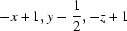 .
. Data collection: SMART (Bruker, 2001); cell refinement: SAINT (Bruker, 2002); data reduction: SAINT; program(s) used to solve structure: SHELXS97 (Sheldrick, 2008); program(s) used to refine structure: SHELXL97 (Sheldrick, 2008); molecular graphics: ORTEP-3 for Windows (Farrugia, 1997) and PLATON (Spek, 2009); software used to prepare material for publication: SHELXTL (Sheldrick, 2008) and PLATON.
Supporting information
contains datablocks I, global. DOI: 10.1107/S1600536809005807/hk2625sup1.cif
Structure factors: contains datablock I. DOI: 10.1107/S1600536809005807/hk2625Isup2.hkl
For the preparation of the title compound, sodium salt of 2-(2-(2,6-dichloro- phenylamino)phenyl)acetate (3.18 g, 10 mmol) was dissolved in distilled water (50 ml) and heated on a hot plate, until a homogeneous solution obtained, and then filtered to remove the undissolved product. It was poured into concentrated hydrochloric acid (5 ml) diluted with ice water (25 ml) in an Erlenmeyer flask to obtain 2-(2-(2,6-dichlorophenylamino)phenyl)acetic acid. Then, it was stand for 15 min in an ice bath. The crude product was separated and recrystallized in ethanol. 2-(2-(2,6-dichlorophenylamino)phenyl)acetic acid (2.96 g, 10 mmol) was refluxed in methanol (50 ml) in catalytic amount of sulfuric acid. As soon as a methyl ester is formed, it is cyclized to form the title compound, which was recrystallized in ethanol (yield; 79%; m.p. 420-421 K).
H atoms were positioned geometrically, with C-H = 0.95 and 0.99 Å for aromatic, and methylene H, respectively, and constrained to ride on their parent atoms, with Uiso(H) = 1.2Ueq(C).
Data collection: SMART (Bruker, 2001); cell SAINT (Bruker, 2002); data reduction: SAINT (Bruker, 2002); program(s) used to solve structure: SHELXS97 (Sheldrick, 2008); program(s) used to refine structure: SHELXL97 (Sheldrick, 2008); molecular graphics: ORTEP-3 for Windows (Farrugia, 1997) and PLATON (Spek, 2009); software used to prepare material for publication: SHELXTL (Sheldrick, 2008) and PLATON (Spek, 2009).
![[Figure 1]](./hk2625fig1thm.gif) | Fig. 1. The molecular structure of the title molecule, with the atom-numbering scheme. |
![[Figure 2]](./hk2625fig2thm.gif) | Fig. 2. A partial packing diagram of the title compound. Hydrogen bonds are shown as dashed lines. |
![[Figure 3]](./hk2625fig3thm.gif) | Fig. 3. The formation of the title compound. |
| C14H9Cl2NO | F(000) = 284 |
| Mr = 278.12 | Dx = 1.516 Mg m−3 |
| Monoclinic, P21 | Mo Kα radiation, λ = 0.71073 Å |
| Hall symbol: P 2yb | Cell parameters from 2148 reflections |
| a = 7.1412 (8) Å | θ = 5.2–24.3° |
| b = 8.0241 (9) Å | µ = 0.52 mm−1 |
| c = 11.0510 (13) Å | T = 173 K |
| β = 105.789 (2)° | Block, yellow |
| V = 609.35 (12) Å3 | 0.30 × 0.24 × 0.20 mm |
| Z = 2 |
| Bruker SMART CCD area-detector diffractometer | 2328 independent reflections |
| Radiation source: fine-focus sealed tube | 2295 reflections with I > 2σ(I) |
| Graphite monochromator | Rint = 0.014 |
| ω and ϕ scans | θmax = 28.3°, θmin = 3.1° |
| Absorption correction: multi-scan (SADABS; Bruker, 2001) | h = −9→9 |
| Tmin = 0.755, Tmax = 0.902 | k = −9→10 |
| 3710 measured reflections | l = −14→11 |
| Refinement on F2 | Secondary atom site location: difference Fourier map |
| Least-squares matrix: full | Hydrogen site location: inferred from neighbouring sites |
| R[F2 > 2σ(F2)] = 0.021 | H-atom parameters constrained |
| wR(F2) = 0.060 | w = 1/[σ2(Fo2) + (0.0379P)2 + 0.0681P] where P = (Fo2 + 2Fc2)/3 |
| S = 1.06 | (Δ/σ)max < 0.001 |
| 2328 reflections | Δρmax = 0.19 e Å−3 |
| 163 parameters | Δρmin = −0.16 e Å−3 |
| 1 restraint | Absolute structure: Flack (1983), 705 Friedel pairs |
| Primary atom site location: structure-invariant direct methods | Absolute structure parameter: −0.02 (4) |
| C14H9Cl2NO | V = 609.35 (12) Å3 |
| Mr = 278.12 | Z = 2 |
| Monoclinic, P21 | Mo Kα radiation |
| a = 7.1412 (8) Å | µ = 0.52 mm−1 |
| b = 8.0241 (9) Å | T = 173 K |
| c = 11.0510 (13) Å | 0.30 × 0.24 × 0.20 mm |
| β = 105.789 (2)° |
| Bruker SMART CCD area-detector diffractometer | 2328 independent reflections |
| Absorption correction: multi-scan (SADABS; Bruker, 2001) | 2295 reflections with I > 2σ(I) |
| Tmin = 0.755, Tmax = 0.902 | Rint = 0.014 |
| 3710 measured reflections |
| R[F2 > 2σ(F2)] = 0.021 | H-atom parameters constrained |
| wR(F2) = 0.060 | Δρmax = 0.19 e Å−3 |
| S = 1.06 | Δρmin = −0.16 e Å−3 |
| 2328 reflections | Absolute structure: Flack (1983), 705 Friedel pairs |
| 163 parameters | Absolute structure parameter: −0.02 (4) |
| 1 restraint |
Geometry. All e.s.d.'s (except the e.s.d. in the dihedral angle between two l.s. planes) are estimated using the full covariance matrix. The cell e.s.d.'s are taken into account individually in the estimation of e.s.d.'s in distances, angles and torsion angles; correlations between e.s.d.'s in cell parameters are only used when they are defined by crystal symmetry. An approximate (isotropic) treatment of cell e.s.d.'s is used for estimating e.s.d.'s involving l.s. planes. |
Refinement. Refinement of F2 against ALL reflections. The weighted R-factor wR and goodness of fit S are based on F2, conventional R-factors R are based on F, with F set to zero for negative F2. The threshold expression of F2 > σ(F2) is used only for calculating R-factors(gt) etc. and is not relevant to the choice of reflections for refinement. R-factors based on F2 are statistically about twice as large as those based on F, and R- factors based on ALL data will be even larger. |
| x | y | z | Uiso*/Ueq | ||
| Cl1 | 0.57381 (5) | 0.76042 (5) | 0.02255 (3) | 0.03458 (10) | |
| Cl2 | 0.05095 (6) | 0.97960 (6) | 0.25885 (3) | 0.03843 (11) | |
| O1 | 0.41005 (16) | 0.54202 (14) | 0.22865 (9) | 0.0304 (2) | |
| N1 | 0.43177 (17) | 0.82839 (15) | 0.24614 (10) | 0.0230 (2) | |
| C1 | 0.2984 (2) | 0.86900 (18) | 0.12903 (12) | 0.0224 (2) | |
| C2 | 0.3471 (2) | 0.83882 (17) | 0.01693 (12) | 0.0243 (3) | |
| C3 | 0.2172 (2) | 0.8739 (2) | −0.09901 (13) | 0.0302 (3) | |
| H3A | 0.2512 | 0.8509 | −0.1747 | 0.036* | |
| C4 | 0.0386 (2) | 0.9425 (2) | −0.10285 (13) | 0.0330 (3) | |
| H4A | −0.0507 | 0.9663 | −0.1819 | 0.040* | |
| C5 | −0.0126 (2) | 0.9774 (2) | 0.00703 (14) | 0.0304 (3) | |
| H5A | −0.1350 | 1.0266 | 0.0036 | 0.036* | |
| C6 | 0.1176 (2) | 0.93932 (19) | 0.12198 (12) | 0.0266 (3) | |
| C7 | 0.48390 (19) | 0.66561 (18) | 0.28346 (12) | 0.0233 (3) | |
| C8 | 0.6499 (2) | 0.67599 (18) | 0.40391 (12) | 0.0249 (3) | |
| H8A | 0.6135 | 0.6223 | 0.4749 | 0.030* | |
| H8B | 0.7688 | 0.6219 | 0.3929 | 0.030* | |
| C9 | 0.6805 (2) | 0.85913 (18) | 0.42570 (12) | 0.0234 (3) | |
| C10 | 0.54970 (19) | 0.94523 (17) | 0.32861 (11) | 0.0219 (2) | |
| C11 | 0.5448 (2) | 1.11669 (19) | 0.32044 (13) | 0.0286 (3) | |
| H11A | 0.4558 | 1.1731 | 0.2533 | 0.034* | |
| C12 | 0.6774 (2) | 1.2032 (2) | 0.41607 (14) | 0.0335 (3) | |
| H12A | 0.6783 | 1.3216 | 0.4138 | 0.040* | |
| C13 | 0.8073 (2) | 1.1219 (2) | 0.51397 (15) | 0.0357 (3) | |
| H13A | 0.8950 | 1.1846 | 0.5778 | 0.043* | |
| C14 | 0.8101 (2) | 0.9477 (2) | 0.51951 (13) | 0.0310 (3) | |
| H14A | 0.8994 | 0.8912 | 0.5865 | 0.037* |
| U11 | U22 | U33 | U12 | U13 | U23 | |
| Cl1 | 0.03021 (17) | 0.0422 (2) | 0.03333 (16) | 0.00882 (15) | 0.01213 (12) | −0.00025 (14) |
| Cl2 | 0.04088 (19) | 0.0480 (2) | 0.03094 (16) | 0.01679 (17) | 0.01741 (14) | 0.00795 (15) |
| O1 | 0.0330 (5) | 0.0230 (5) | 0.0309 (5) | −0.0025 (4) | 0.0011 (4) | −0.0026 (4) |
| N1 | 0.0249 (5) | 0.0208 (5) | 0.0204 (5) | 0.0012 (4) | 0.0010 (4) | −0.0009 (4) |
| C1 | 0.0235 (6) | 0.0220 (6) | 0.0197 (5) | 0.0010 (5) | 0.0025 (5) | 0.0010 (4) |
| C2 | 0.0245 (6) | 0.0223 (6) | 0.0256 (6) | 0.0011 (5) | 0.0063 (5) | −0.0021 (5) |
| C3 | 0.0358 (8) | 0.0322 (8) | 0.0206 (6) | 0.0009 (6) | 0.0043 (5) | −0.0003 (5) |
| C4 | 0.0320 (7) | 0.0379 (8) | 0.0240 (6) | 0.0021 (6) | −0.0012 (5) | 0.0041 (6) |
| C5 | 0.0242 (6) | 0.0343 (8) | 0.0303 (6) | 0.0058 (6) | 0.0035 (5) | 0.0062 (6) |
| C6 | 0.0274 (7) | 0.0276 (7) | 0.0251 (6) | 0.0031 (6) | 0.0077 (5) | 0.0034 (5) |
| C7 | 0.0216 (6) | 0.0239 (6) | 0.0229 (5) | 0.0004 (5) | 0.0037 (5) | 0.0007 (4) |
| C8 | 0.0235 (6) | 0.0236 (6) | 0.0241 (6) | 0.0037 (5) | 0.0006 (5) | 0.0007 (5) |
| C9 | 0.0224 (6) | 0.0244 (7) | 0.0226 (5) | 0.0010 (5) | 0.0049 (5) | −0.0020 (5) |
| C10 | 0.0236 (6) | 0.0225 (6) | 0.0194 (5) | −0.0006 (5) | 0.0055 (4) | −0.0032 (4) |
| C11 | 0.0352 (8) | 0.0236 (7) | 0.0290 (6) | 0.0008 (6) | 0.0122 (6) | 0.0003 (5) |
| C12 | 0.0397 (8) | 0.0230 (7) | 0.0414 (7) | −0.0057 (6) | 0.0173 (7) | −0.0081 (6) |
| C13 | 0.0303 (8) | 0.0373 (8) | 0.0389 (8) | −0.0068 (7) | 0.0085 (6) | −0.0162 (6) |
| C14 | 0.0259 (7) | 0.0371 (8) | 0.0272 (6) | −0.0002 (6) | 0.0023 (5) | −0.0080 (5) |
| C1—C6 | 1.392 (2) | C8—C9 | 1.4955 (19) |
| C1—C2 | 1.3958 (18) | C8—H8A | 0.9900 |
| C1—N1 | 1.4203 (15) | C8—H8B | 0.9900 |
| C2—C3 | 1.3908 (19) | C9—C14 | 1.3834 (19) |
| C2—Cl1 | 1.7223 (14) | C9—C10 | 1.3984 (18) |
| C3—C4 | 1.379 (2) | C10—C11 | 1.379 (2) |
| C3—H3A | 0.9500 | C10—N1 | 1.4146 (16) |
| C4—C5 | 1.389 (2) | C11—C12 | 1.397 (2) |
| C4—H4A | 0.9500 | C11—H11A | 0.9500 |
| C5—C6 | 1.3890 (19) | C12—C13 | 1.382 (2) |
| C5—H5A | 0.9500 | C12—H12A | 0.9500 |
| C6—Cl2 | 1.7353 (14) | C13—C14 | 1.399 (2) |
| C7—O1 | 1.2061 (17) | C13—H13A | 0.9500 |
| C7—N1 | 1.3896 (18) | C14—H14A | 0.9500 |
| C7—C8 | 1.5250 (17) | ||
| C6—C1—C2 | 118.16 (12) | C9—C8—H8B | 111.0 |
| C6—C1—N1 | 121.73 (12) | C7—C8—H8B | 111.0 |
| C2—C1—N1 | 120.12 (12) | H8A—C8—H8B | 109.0 |
| C3—C2—C1 | 121.19 (13) | C14—C9—C10 | 119.49 (14) |
| C3—C2—Cl1 | 119.46 (11) | C14—C9—C8 | 131.59 (14) |
| C1—C2—Cl1 | 119.34 (10) | C10—C9—C8 | 108.91 (12) |
| C4—C3—C2 | 119.23 (13) | C11—C10—C9 | 122.89 (13) |
| C4—C3—H3A | 120.4 | C11—C10—N1 | 128.25 (13) |
| C2—C3—H3A | 120.4 | C9—C10—N1 | 108.86 (12) |
| C3—C4—C5 | 121.01 (13) | C10—C11—C12 | 116.53 (14) |
| C3—C4—H4A | 119.5 | C10—C11—H11A | 121.7 |
| C5—C4—H4A | 119.5 | C12—C11—H11A | 121.7 |
| C4—C5—C6 | 119.01 (14) | C13—C12—C11 | 121.99 (15) |
| C4—C5—H5A | 120.5 | C13—C12—H12A | 119.0 |
| C6—C5—H5A | 120.5 | C11—C12—H12A | 119.0 |
| C5—C6—C1 | 121.38 (12) | C12—C13—C14 | 120.31 (14) |
| C5—C6—Cl2 | 118.81 (11) | C12—C13—H13A | 119.8 |
| C1—C6—Cl2 | 119.81 (10) | C14—C13—H13A | 119.8 |
| O1—C7—N1 | 125.35 (11) | C9—C14—C13 | 118.77 (14) |
| O1—C7—C8 | 127.81 (13) | C9—C14—H14A | 120.6 |
| N1—C7—C8 | 106.83 (11) | C13—C14—H14A | 120.6 |
| C9—C8—C7 | 103.83 (11) | C7—N1—C10 | 111.54 (10) |
| C9—C8—H8A | 111.0 | C7—N1—C1 | 123.04 (11) |
| C7—C8—H8A | 111.0 | C10—N1—C1 | 124.68 (11) |
| D—H···A | D—H | H···A | D···A | D—H···A |
| C4—H4A···O1i | 0.95 | 2.55 | 3.2267 (19) | 128 |
| C8—H8A···Cg1ii | 0.99 | 2.74 | 3.613 (2) | 147 |
| Symmetry codes: (i) −x, y+1/2, −z; (ii) −x+1, y−1/2, −z+1. |
Experimental details
| Crystal data | |
| Chemical formula | C14H9Cl2NO |
| Mr | 278.12 |
| Crystal system, space group | Monoclinic, P21 |
| Temperature (K) | 173 |
| a, b, c (Å) | 7.1412 (8), 8.0241 (9), 11.0510 (13) |
| β (°) | 105.789 (2) |
| V (Å3) | 609.35 (12) |
| Z | 2 |
| Radiation type | Mo Kα |
| µ (mm−1) | 0.52 |
| Crystal size (mm) | 0.30 × 0.24 × 0.20 |
| Data collection | |
| Diffractometer | Bruker SMART CCD area-detector diffractometer |
| Absorption correction | Multi-scan (SADABS; Bruker, 2001) |
| Tmin, Tmax | 0.755, 0.902 |
| No. of measured, independent and observed [I > 2σ(I)] reflections | 3710, 2328, 2295 |
| Rint | 0.014 |
| (sin θ/λ)max (Å−1) | 0.666 |
| Refinement | |
| R[F2 > 2σ(F2)], wR(F2), S | 0.021, 0.060, 1.06 |
| No. of reflections | 2328 |
| No. of parameters | 163 |
| No. of restraints | 1 |
| H-atom treatment | H-atom parameters constrained |
| Δρmax, Δρmin (e Å−3) | 0.19, −0.16 |
| Absolute structure | Flack (1983), 705 Friedel pairs |
| Absolute structure parameter | −0.02 (4) |
Computer programs: SMART (Bruker, 2001), SAINT (Bruker, 2002), SHELXS97 (Sheldrick, 2008), SHELXL97 (Sheldrick, 2008), ORTEP-3 for Windows (Farrugia, 1997) and PLATON (Spek, 2009), SHELXTL (Sheldrick, 2008) and PLATON (Spek, 2009).
| D—H···A | D—H | H···A | D···A | D—H···A |
| C4—H4A···O1i | 0.95 | 2.55 | 3.2267 (19) | 128 |
| C8—H8A···Cg1ii | 0.99 | 2.74 | 3.6125 (23) | 147 |
| Symmetry codes: (i) −x, y+1/2, −z; (ii) −x+1, y−1/2, −z+1. |
Footnotes
‡Additonal contact author, e-mail: [email protected].
Acknowledgements
The authors gratefully acknowledge the financial support of the Higher Education Commission, Islamabad, Pakistan.
References
 Allen, F. H., Kennard, O., Watson, D. G., Brammer, L., Orpen, A. G. & Taylor, R. (1987). J. Chem. Soc. Perkin Trans. 2, pp. S1–19. CrossRef Web of Science Google Scholar
Bruker (2001). SMART and SADABS. Bruker AXS Inc., Madison, Wisconsin, USA. Google Scholar
Bruker (2002). SAINT. Bruker AXS Inc., Madison, Wisconsin, USA. Google Scholar
Chakraborty, D. K. & Talapatra, S. K. (1985). Acta Cryst. C41, 1365–1366. CSD CrossRef CAS Web of Science IUCr Journals Google Scholar
Chakraborty, D. K., Talapatra, S. K. & Chatterjee, A. (1985). Acta Cryst. C41, 1363–1364. CSD CrossRef CAS Web of Science IUCr Journals Google Scholar
De, A. (1992). Acta Cryst. C48, 660–662. CSD CrossRef CAS Web of Science IUCr Journals Google Scholar
De, A. & Kitagawa, Y. (1991a). Acta Cryst. C47, 2179–2181. CSD CrossRef CAS Web of Science IUCr Journals Google Scholar
De, A. & Kitagawa, Y. (1991b). Acta Cryst. C47, 2384–2386. CSD CrossRef CAS Web of Science IUCr Journals Google Scholar
Farrugia, L. J. (1997). J. Appl. Cryst. 30, 565. CrossRef IUCr Journals Google Scholar
Flack, H. D. (1983). Acta Cryst. A39, 876–881. CrossRef CAS Web of Science IUCr Journals Google Scholar
Hibino, S. & Choshi, T. (2002). Nat. Prod. Rep. 19, 148–180. Web of Science CrossRef PubMed CAS Google Scholar
Itai, A., Iitaka, Y. & Kubo, A. (1978). Acta Cryst. B34, 3775–3777. CSD CrossRef CAS IUCr Journals Web of Science Google Scholar
Popp, F. D. (1977). In Anticonvulsants, edited by J. A. Vida. New York: Academic Press. Google Scholar
Popp, F. D. (1984). J. Heterocycl. Chem. 21, 1641–1643. CrossRef CAS Google Scholar
Sheldrick, G. M. (2008). Acta Cryst. A64, 112–122. Web of Science CrossRef CAS IUCr Journals Google Scholar
Somei, M. & Yamada, F. (2003). Nat. Prod. Rep. 20, 216–242. Web of Science CrossRef PubMed CAS Google Scholar
Spek, A. L. (2009). Acta Cryst. D65, 148–155. Web of Science CrossRef CAS IUCr Journals Google Scholar
This is an open-access article distributed under the terms of the Creative Commons Attribution (CC-BY) Licence, which permits unrestricted use, distribution, and reproduction in any medium, provided the original authors and source are cited.
| CRYSTALLOGRAPHIC COMMUNICATIONS |


Indolinones are a class of heterocyclic compounds found in many natural products and in a number of marketed drugs (Hibino & Choshi, 2002; Somei & Yamada, 2003). They have diverse chemical structures and complex physiological and pharmacological actions. The search for potential drugs and their mechanism of action has been difficult because of their complexity. These compounds contain both oxoindole and dioxolane moieties which have independently been seen in other anticonvulsants (Popp, 1977, 1984). The title compound, a chloro analogue, was found to be most potent in the MES test. Since no common target site has yet been established, X-ray analysis was undertaken to search its crystal structure, which may help to understand the mechanism of action at the molecular level.
In the title compound (Fig. 1), the bond lengths (Allen et al., 1987) and angles are within normal ranges. Rings A (C1-C6), B (N1/C7-C10) and C (C9-C14) are, of course, planar and the dihedral angles between them are A/B = 71.73 (3)°, A/C = 72.43 (3)° and B/C = 1.07 (3)°. So, rings B and C are nearly coplanar. Ring A is oriented with respect to the planar indole ring system at a dihedral angle of 72.17 (3)°. The C8-C9 [1.4955 (19) Å] bond length may be compared with the corresponding values in other indoline nuclei (Itai et al., 1978; Chakraborty & Talapatra, 1985; Chakraborty et al., 1985; De & Kitagawa, 1991a,b; De, 1992).
In the crystal structure, weak intermolecular C-H···O hydrogen bonds (Table 1) link the molecules (Fig. 2), in which they may be effective in the stabilization of the structure. The weak C—H···π interaction (Table 1) may further stabilize the structure.