 | Acta Crystallographica Section E Acta Crystallographica Section E CRYSTALLOGRAPHIC COMMUNICATIONS |


 journal menu


organic compounds
| CRYSTALLOGRAPHIC COMMUNICATIONS |
 access
2,4-Diamino-6-methyl-1,3,5-triazin-1-ium nitrate

aCollege of Sciences, Nanjing University of Technology, Nanjing 210009, People's Republic of China, and bState Key Laboratory of Coordination Chemistry, Nanjing National Laboratory of Microstructures, School of Chemistry and Chemical Engineering, Nanjing University, Nanjing, 210093, People's Republic of China
*Correspondence e-mail: [email protected],
In the title salt, C4H8N5+·NO3−, a ring N atom of 2,6-diamino-4-methyltriazine is protonated. Each anion is connected to three neighbouring cations by multiple N—H⋯O hydrogen bonds which, together with N—H⋯N contacts, generate a layer structure.
Related literature
For 2,6-diamino-4-methyltriazine compounds, see: Kaczmarek et al. (2008![[Kaczmarek, M., Radecka-Paryzek, W. & Kubicki, M. (2008). Acta Cryst. E64, o269.]](../../../../../../logos/arrows/e_arr.gif "Kaczmarek, M., Radecka-Paryzek, W. & Kubicki, M. (2008). Acta Cryst. E64, o269.") ); Perpétuo & Janczak (2007); Portalone & Colapietro (2007); Wijaya et al. (2004); Xiao (2008).
); Perpétuo & Janczak (2007); Portalone & Colapietro (2007); Wijaya et al. (2004); Xiao (2008).
![[Scheme 1]](ng2537scheme1.gif)
Experimental
Crystal data
|
Data collection
|
Refinement
|
|
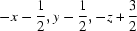 .
. Data collection: SMART (Bruker, 2000); cell refinement: SAINT (Bruker, 2000); data reduction: SAINT; program(s) used to solve structure: SHELXTL (Sheldrick, 2008); program(s) used to refine structure: SHELXTL; molecular graphics: SHELXTL; software used to prepare material for publication: SHELXTL.
Supporting information
contains datablocks global, I. DOI: 10.1107/S1600536809003900/ng2537sup1.cif
Structure factors: contains datablock I. DOI: 10.1107/S1600536809003900/ng2537Isup2.hkl
Experimental The title compound was obtained as a by-product from the reaction between CuNO3.3H2O (180 mg, 1.0 mmol) and 2,6-diamino-4-methayltriazine (935 mg, 5.0 mmol) in methanol (30 ml). Colourless crystals of (I) were obtained by slow evaporation of the mother liquid at room temperature in air after one week. Anal.Calcd. for C4H8N6O3: C: 25.55; H: 4.29; N: 44.67%. Found: C: 25.45; H: 4.34; N: 44.56%. Main FT—IR absorptions (KBr, cm-1): 3384 (b, s), 2396 (m), 1763 (m), 1624 (s), 1384 (s), 825 (m), and 456 (m).
The methyl H atoms were placed in geometrically idealized positions and refined as riding, with C—H = 0.96 Å and Uiso(H) = 1.5Ueq(C). The H atoms bonded to the N atoms were located in the difference synthesis. Four restraints are used to restrain the bond lengths of N2—H2, N4—H4D, N5—H5A and N5—H5B in order to give similar N—H distances. In addition, one restraint is used to restrain the distance of atoms N1 and H5A so that it is simiar to that between atoms N1 and H4D.
Data collection: SMART (Bruker, 2000); cell SAINT (Bruker, 2000); data reduction: SAINT (Bruker, 2000); program(s) used to solve structure: SHELXTL (Sheldrick, 2008); program(s) used to refine structure: SHELXTL (Sheldrick, 2008); molecular graphics: SHELXTL (Sheldrick, 2008); software used to prepare material for publication: SHELXTL (Sheldrick, 2008).
![[Figure 1]](./ng2537fig1thm.gif) | Fig. 1. The molecular structure of the title compound with the atom-numbering scheme. Displacement ellipsoids are drawn at the 30% probability level. |
![[Figure 2]](./ng2537fig2thm.gif) | Fig. 2. Perspective view of the hydrogen bonding interactions related to every nitrate anion where the hydrogen bonds are shown as dashed lines. [Symmetry codes: (i) x, y-1, z; (ii) -x-1/2, y-1/2, -z+3/2.] |
| C4H8N5+·NO3− | F(000) = 392 |
| Mr = 188.16 | Dx = 1.583 Mg m−3 |
| Monoclinic, P21/n | Mo Kα radiation, λ = 0.71073 Å |
| Hall symbol: -P 2yn | Cell parameters from 1324 reflections |
| a = 7.667 (1) Å | θ = 2.8–26.0° |
| b = 10.338 (2) Å | µ = 0.14 mm−1 |
| c = 9.977 (1) Å | T = 291 K |
| β = 93.384 (2)° | Block, colourless |
| V = 789.4 (2) Å3 | 0.13 × 0.12 × 0.10 mm |
| Z = 4 |
| Bruker SMART CCD area-detector diffractometer | 1202 reflections with I > 2σ(I) |
| Radiation source: fine-focus sealed tube | Rint = 0.070 |
| Graphite monochromator | θmax = 28.0°, θmin = 2.8° |
| ϕ and ω scans | h = −8→10 |
| 4763 measured reflections | k = −12→13 |
| 1867 independent reflections | l = −12→13 |
| Refinement on F2 | Primary atom site location: structure-invariant direct methods |
| Least-squares matrix: full | Secondary atom site location: difference Fourier map |
| R[F2 > 2σ(F2)] = 0.046 | Hydrogen site location: inferred from neighbouring sites |
| wR(F2) = 0.178 | H atoms treated by a mixture of independent and constrained refinement |
| S = 1.00 | w = 1/[σ2(Fo2) + (0.106P)2] where P = (Fo2 + 2Fc2)/3 |
| 1867 reflections | (Δ/σ)max = 0.001 |
| 138 parameters | Δρmax = 0.30 e Å−3 |
| 5 restraints | Δρmin = −0.38 e Å−3 |
| C4H8N5+·NO3− | V = 789.4 (2) Å3 |
| Mr = 188.16 | Z = 4 |
| Monoclinic, P21/n | Mo Kα radiation |
| a = 7.667 (1) Å | µ = 0.14 mm−1 |
| b = 10.338 (2) Å | T = 291 K |
| c = 9.977 (1) Å | 0.13 × 0.12 × 0.10 mm |
| β = 93.384 (2)° |
| Bruker SMART CCD area-detector diffractometer | 1202 reflections with I > 2σ(I) |
| 4763 measured reflections | Rint = 0.070 |
| 1867 independent reflections |
| R[F2 > 2σ(F2)] = 0.046 | 5 restraints |
| wR(F2) = 0.178 | H atoms treated by a mixture of independent and constrained refinement |
| S = 1.00 | Δρmax = 0.30 e Å−3 |
| 1867 reflections | Δρmin = −0.38 e Å−3 |
| 138 parameters |
Experimental. The structure was solved by direct methods (Bruker, 2000) and successive difference Fourier syntheses. |
Geometry. All e.s.d.'s (except the e.s.d. in the dihedral angle between two l.s. planes) are estimated using the full covariance matrix. The cell e.s.d.'s are taken into account individually in the estimation of e.s.d.'s in distances, angles and torsion angles; correlations between e.s.d.'s in cell parameters are only used when they are defined by crystal symmetry. An approximate (isotropic) treatment of cell e.s.d.'s is used for estimating e.s.d.'s involving l.s. planes. |
Refinement. Refinement of F2 against ALL reflections. The weighted R-factor wR and goodness of fit S are based on F2, conventional R-factors R are based on F, with F set to zero for negative F2. The threshold expression of F2 > σ(F2) is used only for calculating R-factors(gt) etc. and is not relevant to the choice of reflections for refinement. R-factors based on F2 are statistically about twice as large as those based on F, and R- factors based on ALL data will be even larger. |
| x | y | z | Uiso*/Ueq | ||
| C1 | 0.0367 (3) | 0.2000 (2) | 0.8411 (2) | 0.0350 (5) | |
| C2 | 0.3207 (3) | 0.2520 (2) | 0.9243 (2) | 0.0368 (5) | |
| C3 | 0.2268 (3) | 0.0451 (2) | 0.9114 (2) | 0.0340 (5) | |
| C4 | 0.4496 (3) | 0.3560 (2) | 0.9556 (3) | 0.0488 (6) | |
| H4A | 0.5589 | 0.3183 | 0.9872 | 0.073* | |
| H4B | 0.4074 | 0.4113 | 1.0239 | 0.073* | |
| H4C | 0.4661 | 0.4057 | 0.8761 | 0.073* | |
| H2 | 0.129 (4) | 0.372 (2) | 0.858 (3) | 0.067 (9)* | |
| H4D | 0.189 (3) | −0.137 (2) | 0.909 (2) | 0.034 (6)* | |
| H4E | 0.371 (4) | −0.096 (2) | 0.965 (3) | 0.044 (7)* | |
| N1 | 0.0678 (2) | 0.07622 (17) | 0.85890 (19) | 0.0366 (5) | |
| N2 | 0.1626 (2) | 0.29135 (19) | 0.87137 (19) | 0.0373 (5) | |
| N3 | 0.3580 (2) | 0.13121 (17) | 0.94713 (19) | 0.0358 (5) | |
| N4 | 0.2668 (3) | −0.07814 (18) | 0.9311 (2) | 0.0415 (5) | |
| N5 | −0.1161 (3) | 0.2428 (2) | 0.7917 (2) | 0.0484 (6) | |
| H5A | −0.193 (3) | 0.1810 (18) | 0.771 (3) | 0.082 (9)* | |
| H5B | −0.131 (4) | 0.3288 (11) | 0.783 (3) | 0.066 (9)* | |
| N6 | 0.0038 (2) | 0.61218 (18) | 0.84158 (19) | 0.0391 (5) | |
| O1 | −0.0186 (2) | 0.73101 (16) | 0.84536 (19) | 0.0515 (5) | |
| O2 | 0.1471 (2) | 0.56484 (18) | 0.8772 (2) | 0.0582 (6) | |
| O3 | −0.1190 (3) | 0.54094 (17) | 0.7991 (2) | 0.0596 (6) |
| U11 | U22 | U33 | U12 | U13 | U23 | |
| C1 | 0.0308 (11) | 0.0347 (12) | 0.0391 (11) | 0.0002 (8) | −0.0019 (8) | 0.0011 (9) |
| C2 | 0.0326 (12) | 0.0345 (12) | 0.0426 (12) | −0.0011 (9) | −0.0030 (9) | −0.0022 (9) |
| C3 | 0.0316 (11) | 0.0309 (11) | 0.0394 (11) | −0.0013 (8) | 0.0010 (9) | −0.0007 (8) |
| C4 | 0.0425 (14) | 0.0299 (12) | 0.0722 (16) | −0.0060 (9) | −0.0120 (12) | −0.0034 (11) |
| N1 | 0.0307 (10) | 0.0306 (10) | 0.0478 (11) | −0.0016 (7) | −0.0035 (8) | 0.0007 (8) |
| N2 | 0.0337 (10) | 0.0280 (10) | 0.0493 (11) | 0.0009 (7) | −0.0056 (8) | 0.0022 (8) |
| N3 | 0.0315 (10) | 0.0263 (9) | 0.0488 (11) | −0.0008 (7) | −0.0054 (8) | −0.0018 (7) |
| N4 | 0.0322 (11) | 0.0284 (11) | 0.0629 (13) | −0.0031 (8) | −0.0070 (9) | 0.0015 (8) |
| N5 | 0.0351 (11) | 0.0422 (13) | 0.0661 (13) | 0.0015 (9) | −0.0122 (9) | 0.0049 (10) |
| N6 | 0.0357 (11) | 0.0339 (10) | 0.0474 (11) | 0.0038 (8) | −0.0007 (8) | 0.0017 (8) |
| O1 | 0.0459 (10) | 0.0359 (10) | 0.0719 (12) | 0.0047 (7) | −0.0045 (8) | −0.0026 (8) |
| O2 | 0.0414 (11) | 0.0514 (12) | 0.0796 (14) | 0.0133 (8) | −0.0134 (9) | 0.0030 (9) |
| O3 | 0.0468 (11) | 0.0408 (10) | 0.0896 (14) | −0.0073 (8) | −0.0107 (10) | −0.0001 (9) |
| C1—N1 | 1.311 (3) | C4—H4B | 0.9600 |
| C1—N5 | 1.321 (3) | C4—H4C | 0.9600 |
| C1—N2 | 1.371 (3) | N2—H2 | 0.88 (2) |
| C2—N3 | 1.298 (3) | N4—H4D | 0.87 (2) |
| C2—N2 | 1.356 (3) | N4—H4E | 0.87 (3) |
| C2—C4 | 1.481 (3) | N5—H5A | 0.888 (10) |
| C3—N4 | 1.322 (3) | N5—H5B | 0.900 (10) |
| C3—N1 | 1.337 (3) | N6—O2 | 1.236 (2) |
| C3—N3 | 1.375 (3) | N6—O1 | 1.241 (2) |
| C4—H4A | 0.9600 | N6—O3 | 1.249 (3) |
| N1—C1—N5 | 121.8 (2) | C1—N1—C3 | 116.22 (18) |
| N1—C1—N2 | 121.5 (2) | C2—N2—C1 | 118.7 (2) |
| N5—C1—N2 | 116.6 (2) | C2—N2—H2 | 126 (2) |
| N3—C2—N2 | 122.7 (2) | C1—N2—H2 | 115 (2) |
| N3—C2—C4 | 121.6 (2) | C2—N3—C3 | 115.26 (18) |
| N2—C2—C4 | 115.7 (2) | C3—N4—H4D | 119.0 (17) |
| N4—C3—N1 | 119.2 (2) | C3—N4—H4E | 117.7 (17) |
| N4—C3—N3 | 115.2 (2) | H4D—N4—H4E | 123 (2) |
| N1—C3—N3 | 125.6 (2) | C1—N5—H5A | 114.3 (16) |
| C2—C4—H4A | 109.5 | C1—N5—H5B | 118 (2) |
| C2—C4—H4B | 109.5 | H5A—N5—H5B | 128 (3) |
| H4A—C4—H4B | 109.5 | O2—N6—O1 | 120.34 (19) |
| C2—C4—H4C | 109.5 | O2—N6—O3 | 120.2 (2) |
| H4A—C4—H4C | 109.5 | O1—N6—O3 | 119.42 (18) |
| H4B—C4—H4C | 109.5 |
| D—H···A | D—H | H···A | D···A | D—H···A |
| N2—H2···O3 | 0.88 (2) | 2.62 (2) | 3.414 (3) | 150 (3) |
| N2—H2···O2 | 0.88 (2) | 2.00 (3) | 2.831 (3) | 156 (3) |
| N4—H4D···O1i | 0.87 (2) | 2.17 (2) | 3.031 (3) | 175 (2) |
| N4—H4E···N3ii | 0.87 (3) | 2.24 (3) | 3.105 (3) | 177 (2) |
| N5—H5B···O3 | 0.90 (1) | 2.20 (1) | 3.083 (3) | 167 (3) |
| N5—H5A···O3iii | 0.89 (1) | 2.13 (1) | 3.014 (3) | 174 (3) |
| N5—H5A···O1iii | 0.89 (1) | 2.49 (2) | 3.046 (3) | 121 (2) |
| Symmetry codes: (i) x, y−1, z; (ii) −x+1, −y, −z+2; (iii) −x−1/2, y−1/2, −z+3/2. |
Experimental details
| Crystal data | |
| Chemical formula | C4H8N5+·NO3− |
| Mr | 188.16 |
| Crystal system, space group | Monoclinic, P21/n |
| Temperature (K) | 291 |
| a, b, c (Å) | 7.667 (1), 10.338 (2), 9.977 (1) |
| β (°) | 93.384 (2) |
| V (Å3) | 789.4 (2) |
| Z | 4 |
| Radiation type | Mo Kα |
| µ (mm−1) | 0.14 |
| Crystal size (mm) | 0.13 × 0.12 × 0.10 |
| Data collection | |
| Diffractometer | Bruker SMART CCD area-detector diffractometer |
| Absorption correction | – |
| No. of measured, independent and observed [I > 2σ(I)] reflections | 4763, 1867, 1202 |
| Rint | 0.070 |
| (sin θ/λ)max (Å−1) | 0.661 |
| Refinement | |
| R[F2 > 2σ(F2)], wR(F2), S | 0.046, 0.178, 1.00 |
| No. of reflections | 1867 |
| No. of parameters | 138 |
| No. of restraints | 5 |
| H-atom treatment | H atoms treated by a mixture of independent and constrained refinement |
| Δρmax, Δρmin (e Å−3) | 0.30, −0.38 |
Computer programs: SMART (Bruker, 2000), SAINT (Bruker, 2000), SHELXTL (Sheldrick, 2008).
| D—H···A | D—H | H···A | D···A | D—H···A |
| N2—H2···O3 | 0.88 (2) | 2.62 (2) | 3.414 (3) | 150 (3) |
| N2—H2···O2 | 0.88 (2) | 2.00 (3) | 2.831 (3) | 156 (3) |
| N4—H4D···O1i | 0.87 (2) | 2.17 (2) | 3.031 (3) | 175 (2) |
| N4—H4E···N3ii | 0.87 (3) | 2.24 (3) | 3.105 (3) | 177 (2) |
| N5—H5B···O3 | 0.90 (1) | 2.20 (1) | 3.083 (3) | 167 (3) |
| N5—H5A···O3iii | 0.89 (1) | 2.13 (1) | 3.014 (3) | 174 (3) |
| N5—H5A···O1iii | 0.89 (1) | 2.49 (2) | 3.046 (3) | 121 (2) |
| Symmetry codes: (i) x, y−1, z; (ii) −x+1, −y, −z+2; (iii) −x−1/2, y−1/2, −z+3/2. |
Acknowledgements
WH acknowledges the National Natural Science Foundation of China (No. 20871065) and the Scientific Research Foundation for the Returned Overseas Chinese Scholars, State Education Ministry, for financial aid.
References
 Bruker (2000). SMART and SAINT. Bruker AXS Inc., Madison, Wisconsin, USA. Google Scholar
Kaczmarek, M., Radecka-Paryzek, W. & Kubicki, M. (2008). Acta Cryst. E64, o269. Web of Science CSD CrossRef IUCr Journals Google Scholar
Perpétuo, G. J. & Janczak, J. (2007). Acta Cryst. C63, o271–o273. Web of Science CSD CrossRef IUCr Journals Google Scholar
Portalone, G. & Colapietro, M. (2007). Acta Cryst. C63, o655–o658. Web of Science CSD CrossRef IUCr Journals Google Scholar
Sheldrick, G. M. (2008). Acta Cryst. A64, 112–122. Web of Science CrossRef CAS IUCr Journals Google Scholar
Wijaya, K., Moers, O., Henschel, D., Blaschette, A. & Jones, P. G. (2004). Z. Naturforsch. Teil B, 59, 747–756. CAS Google Scholar
Xiao, Z.-H. (2008). Acta Cryst. E64, o411. Web of Science CSD CrossRef IUCr Journals Google Scholar
This is an open-access article distributed under the terms of the Creative Commons Attribution (CC-BY) Licence, which permits unrestricted use, distribution, and reproduction in any medium, provided the original authors and source are cited.
| CRYSTALLOGRAPHIC COMMUNICATIONS |


The crystal structures of 2,6-diamino-4-methayltriazine with methanol and ethanol solvates (Kaczmarek et al., 2008; Xiao, 2008) and its trifluoroacetate, dimesylamide and hydrogenchlorate (Perpétuo & Janczak 2007; Wijaya et al., 2004; Portalone et al., 2007) have been reported in literature. In this paper, we report the X-ray single-crystal structure of 2,4-diamino-6-methyl-1,3,5-triazin-1-ium nitrate (I).
The molecular structure of (I) is illustrated in Fig. 1. The bond distances and bond angles are similar to those reported structures. All the non-hydrogen atoms of cations and nitrate anions are coplanar with the mean deviation from least-squares plane is 0.0745 (3) Å. The proton is suggested to be delocalized within the aromatic ring although it is added to one of the nitrogen atoms. The molecules of (I) form a layer structure where intermolecular N—H···O, N—H···N hydrogen bonds are found between adjacent molecules (Table 1). Every nitrate is connected with three neighboring cations by multiple N—H···O hydrogen contacts (Fig. 2).