 | Acta Crystallographica Section E Acta Crystallographica Section E CRYSTALLOGRAPHIC COMMUNICATIONS |


 journal menu


organic compounds
| CRYSTALLOGRAPHIC COMMUNICATIONS |
 access
(Z)-(1,3-Thiazinan-2-ylideneamino)formonitrile

aJiang Nan University, Wu-Xi 214112, People's Republic of China, and, Finance Department of Business School, Hunan Normal University, Changsha 412006, People's Republic of China, and bJiang Nan University, Wu-Xi 214112, People's Republic of China;
*Correspondence e-mail: [email protected]
In the title molecule, C5H7N3S, the thiazine ring shows a conformation close to a half-boat. The Cremer & Pople puckering parameters of the thiazine ring are q2 = 0.4645 (2) Å, θ = 132.4 (3) and φ = 285.52 (2)°. The packing is stabilized by intermolecular N—H⋯N and C—H⋯S interactions.
Related literature
For the crystal structures of thiazine compounds, see: Kálmán, et al. (1977![[Kálmán, A., Argay, G., Riba'r, B. & Toldy, L. (1977). Tetrahedron Lett. 48, 4241-4244.]](../../../../../../logos/arrows/e_arr.gif "Kálmán, A., Argay, G., Riba'r, B. & Toldy, L. (1977). Tetrahedron Lett. 48, 4241-4244.") ). For the biological activities of thiazine-containing compounds, see: Soloway et al. (1978); Tomizawa et al. (1995). For bond-length data, see: Allen et al. (1987). For puckering parameters, see: Cremer & Pople (1975).
). For the biological activities of thiazine-containing compounds, see: Soloway et al. (1978); Tomizawa et al. (1995). For bond-length data, see: Allen et al. (1987). For puckering parameters, see: Cremer & Pople (1975).
![[Scheme 1]](hg2486scheme1.gif)
Experimental
Crystal data
|
Refinement
|
| ||||||||||||||||||||||
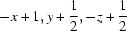 ; (ii)
 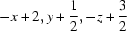 .
. Data collection: RAPID-AUTO (Rigaku, 2004); cell refinement: RAPID-AUTO; data reduction: RAPID-AUTO; program(s) used to solve structure: SHELXTL (Sheldrick, 2008); program(s) used to refine structure: SHELXTL; molecular graphics: SHELXTL; software used to prepare material for publication: SHELXTL.
Supporting information
contains datablocks I, global. DOI: 10.1107/S1600536809008940/hg2486sup1.cif
Structure factors: contains datablock I. DOI: 10.1107/S1600536809008940/hg2486Isup2.hkl
A mixture of dimethyl cyanocarbonimidodithioate 10 mmol (1.46 g) and 3-aminopropane-1-thiol (1.00 g, 11 mmol) was refluxed in absolute EtOH (20 ml) for 3 h. On cooling, the product crystallizes and was filtered and then recrystallized from absolute ethanol. Yield 1.20 g (85%). Single crystals suitable for X-ray measurements were obtained by recrystallization from ethanol at room temperature.
H atoms were positioned geometrically and refined using a riding model, with C—H = 0.99 Å, N—H = 0.86 Å with Uiso(H) = 1.2 times Ueq(C, N).
Data collection: RAPID-AUTO (Rigaku, 2004); cell RAPID-AUTO (Rigaku, 2004); data reduction: RAPID-AUTO (Rigaku, 2004); program(s) used to solve structure: SHELXTL (Sheldrick, 2008); program(s) used to refine structure: SHELXTL (Sheldrick, 2008); molecular graphics: SHELXTL (Sheldrick, 2008); software used to prepare material for publication: SHELXTL (Sheldrick, 2008).
![[Figure 1]](./hg2486fig1thm.gif) | Fig. 1. The molecular structure of (I), with atom labels and 40% probability displacement ellipsoids for non-H atoms. |
| C5H7N3S | F(000) = 296 |
| Mr = 141.21 | Dx = 1.445 Mg m−3 |
| Monoclinic, P21/c | Mo Kα radiation, λ = 0.71073 Å |
| Hall symbol: -P 2ybc | Cell parameters from 2501 reflections |
| a = 7.0931 (14) Å | θ = 2.3–25.1° |
| b = 12.689 (3) Å | µ = 0.40 mm−1 |
| c = 9.232 (3) Å | T = 153 K |
| β = 128.617 (19)° | Needle, colorless |
| V = 649.2 (3) Å3 | 0.42 × 0.11 × 0.06 mm |
| Z = 4 |
| Rigaku R-AXIS RAPID IP area-detector diffractometer | 1101 independent reflections |
| Radiation source: Rotating Anode | 970 reflections with I > 2σ(I) |
| Graphite monochromator | Rint = 0.032 |
| ω Oscillation scans | θmax = 25.0°, θmin = 3.2° |
| Absorption correction: multi-scan (ABSCOR; Higashi 1995) | h = −8→8 |
| Tmin = 0.849, Tmax = 0.976 | k = −14→15 |
| 4731 measured reflections | l = −10→10 |
| Refinement on F2 | Secondary atom site location: difference Fourier map |
| Least-squares matrix: full | Hydrogen site location: inferred from neighbouring sites |
| R[F2 > 2σ(F2)] = 0.066 | H-atom parameters constrained |
| wR(F2) = 0.192 | w = 1/[σ2(Fo2) + (0.1515P)2 + 0.068P] where P = (Fo2 + 2Fc2)/3 |
| S = 1.09 | (Δ/σ)max < 0.001 |
| 1101 reflections | Δρmax = 1.14 e Å−3 |
| 83 parameters | Δρmin = −0.32 e Å−3 |
| 0 restraints | Extinction correction: SHELXTL (Sheldrick, 2008), Fc*=kFc[1+0.001xFc2λ3/sin(2θ)]-1/4 |
| Primary atom site location: structure-invariant direct methods | Extinction coefficient: 0.040 (14) |
| C5H7N3S | V = 649.2 (3) Å3 |
| Mr = 141.21 | Z = 4 |
| Monoclinic, P21/c | Mo Kα radiation |
| a = 7.0931 (14) Å | µ = 0.40 mm−1 |
| b = 12.689 (3) Å | T = 153 K |
| c = 9.232 (3) Å | 0.42 × 0.11 × 0.06 mm |
| β = 128.617 (19)° |
| Rigaku R-AXIS RAPID IP area-detector diffractometer | 1101 independent reflections |
| Absorption correction: multi-scan (ABSCOR; Higashi 1995) | 970 reflections with I > 2σ(I) |
| Tmin = 0.849, Tmax = 0.976 | Rint = 0.032 |
| 4731 measured reflections |
| R[F2 > 2σ(F2)] = 0.066 | 0 restraints |
| wR(F2) = 0.192 | H-atom parameters constrained |
| S = 1.09 | Δρmax = 1.14 e Å−3 |
| 1101 reflections | Δρmin = −0.32 e Å−3 |
| 83 parameters |
Geometry. All e.s.d.'s (except the e.s.d. in the dihedral angle between two l.s. planes) are estimated using the full covariance matrix. The cell e.s.d.'s are taken into account individually in the estimation of e.s.d.'s in distances, angles and torsion angles; correlations between e.s.d.'s in cell parameters are only used when they are defined by crystal symmetry. An approximate (isotropic) treatment of cell e.s.d.'s is used for estimating e.s.d.'s involving l.s. planes. |
Refinement. Refinement of F2 against ALL reflections. The weighted R-factor wR and goodness of fit S are based on F2, conventional R-factors R are based on F, with F set to zero for negative F2. The threshold expression of F2 > σ(F2) is used only for calculating R-factors(gt) etc. and is not relevant to the choice of reflections for refinement. R-factors based on F2 are statistically about twice as large as those based on F, and R- factors based on ALL data will be even larger. |
| x | y | z | Uiso*/Ueq | ||
| S1 | 0.97192 (13) | 0.28689 (6) | 0.64894 (10) | 0.0263 (5) | |
| N1 | 0.7395 (4) | 0.47140 (17) | 0.5152 (3) | 0.0213 (6) | |
| H1A | 0.6246 | 0.5077 | 0.4223 | 0.026* | |
| N2 | 0.5695 (4) | 0.33420 (19) | 0.3151 (3) | 0.0231 (7) | |
| N3 | 0.5490 (5) | 0.1469 (2) | 0.2340 (4) | 0.0324 (8) | |
| C1 | 1.1467 (7) | 0.3667 (3) | 0.8561 (5) | 0.0406 (10) | |
| H1B | 1.0764 | 0.3613 | 0.9206 | 0.049* | |
| H1C | 1.3136 | 0.3390 | 0.9404 | 0.049* | |
| C2 | 1.1539 (7) | 0.4785 (3) | 0.8161 (5) | 0.0403 (9) | |
| H2B | 1.2330 | 0.4840 | 0.7582 | 0.048* | |
| H2C | 1.2538 | 0.5179 | 0.9345 | 0.048* | |
| C3 | 0.9066 (6) | 0.5297 (3) | 0.6889 (5) | 0.0316 (8) | |
| H3A | 0.8374 | 0.5342 | 0.7544 | 0.038* | |
| H3B | 0.9245 | 0.6023 | 0.6600 | 0.038* | |
| C4 | 0.7430 (5) | 0.3711 (2) | 0.4833 (4) | 0.0189 (7) | |
| C5 | 0.5676 (5) | 0.2335 (2) | 0.2802 (4) | 0.0228 (7) |
| U11 | U22 | U33 | U12 | U13 | U23 | |
| S1 | 0.0269 (6) | 0.0189 (6) | 0.0199 (6) | 0.0071 (3) | 0.0081 (5) | 0.0043 (2) |
| N1 | 0.0262 (13) | 0.0119 (11) | 0.0189 (13) | 0.0008 (10) | 0.0108 (12) | −0.0002 (9) |
| N2 | 0.0243 (13) | 0.0159 (13) | 0.0174 (13) | 0.0017 (10) | 0.0073 (11) | −0.0020 (9) |
| N3 | 0.0362 (17) | 0.0226 (15) | 0.0376 (18) | −0.0079 (12) | 0.0226 (15) | −0.0118 (12) |
| C1 | 0.0317 (19) | 0.052 (2) | 0.0163 (17) | 0.0024 (15) | 0.0041 (15) | −0.0040 (14) |
| C2 | 0.040 (2) | 0.044 (2) | 0.032 (2) | −0.0136 (16) | 0.0198 (18) | −0.0108 (15) |
| C3 | 0.0365 (19) | 0.0224 (16) | 0.0284 (18) | −0.0043 (14) | 0.0165 (16) | −0.0111 (13) |
| C4 | 0.0206 (14) | 0.0179 (14) | 0.0165 (15) | 0.0000 (11) | 0.0107 (13) | 0.0014 (11) |
| C5 | 0.0180 (14) | 0.0265 (16) | 0.0181 (15) | −0.0046 (12) | 0.0085 (13) | −0.0056 (12) |
| S1—C4 | 1.737 (3) | C1—C2 | 1.474 (6) |
| S1—C1 | 1.806 (4) | C1—H1B | 0.9900 |
| N1—C4 | 1.310 (4) | C1—H1C | 0.9900 |
| N1—C3 | 1.467 (4) | C2—C3 | 1.519 (5) |
| N1—H1A | 0.8600 | C2—H2B | 0.9900 |
| N2—C5 | 1.315 (4) | C2—H2C | 0.9900 |
| N2—C4 | 1.327 (4) | C3—H3A | 0.9900 |
| N3—C5 | 1.156 (4) | C3—H3B | 0.9900 |
| C4—S1—C1 | 103.52 (16) | C1—C2—H2C | 108.8 |
| C4—N1—C3 | 128.3 (3) | C3—C2—H2C | 108.8 |
| C4—N1—H1A | 115.8 | H2B—C2—H2C | 107.7 |
| C3—N1—H1A | 115.9 | N1—C3—C2 | 112.6 (3) |
| C5—N2—C4 | 119.3 (2) | N1—C3—H3A | 109.1 |
| C2—C1—S1 | 112.5 (3) | C2—C3—H3A | 109.1 |
| C2—C1—H1B | 109.1 | N1—C3—H3B | 109.1 |
| S1—C1—H1B | 109.1 | C2—C3—H3B | 109.1 |
| C2—C1—H1C | 109.1 | H3A—C3—H3B | 107.8 |
| S1—C1—H1C | 109.1 | N1—C4—N2 | 118.2 (3) |
| H1B—C1—H1C | 107.8 | N1—C4—S1 | 122.6 (2) |
| C1—C2—C3 | 113.7 (3) | N2—C4—S1 | 119.2 (2) |
| C1—C2—H2B | 108.8 | N3—C5—N2 | 174.2 (3) |
| C3—C2—H2B | 108.8 | ||
| C4—S1—C1—C2 | −34.3 (3) | C5—N2—C4—N1 | −179.3 (3) |
| S1—C1—C2—C3 | 59.4 (4) | C5—N2—C4—S1 | 3.5 (4) |
| C4—N1—C3—C2 | 25.2 (4) | C1—S1—C4—N1 | 7.7 (3) |
| C1—C2—C3—N1 | −54.0 (4) | C1—S1—C4—N2 | −175.3 (2) |
| C3—N1—C4—N2 | 178.6 (3) | C4—N2—C5—N3 | −177 (3) |
| C3—N1—C4—S1 | −4.3 (4) |
| D—H···A | D—H | H···A | D···A | D—H···A |
| N1—H1A···N3i | 0.86 | 2.12 | 2.926 (4) | 156 |
| C3—H3B···S1ii | 0.99 | 2.74 | 3.468 (3) | 131 |
| Symmetry codes: (i) −x+1, y+1/2, −z+1/2; (ii) −x+2, y+1/2, −z+3/2. |
Experimental details
| Crystal data | |
| Chemical formula | C5H7N3S |
| Mr | 141.21 |
| Crystal system, space group | Monoclinic, P21/c |
| Temperature (K) | 153 |
| a, b, c (Å) | 7.0931 (14), 12.689 (3), 9.232 (3) |
| β (°) | 128.617 (19) |
| V (Å3) | 649.2 (3) |
| Z | 4 |
| Radiation type | Mo Kα |
| µ (mm−1) | 0.40 |
| Crystal size (mm) | 0.42 × 0.11 × 0.06 |
| Data collection | |
| Diffractometer | Rigaku R-AXIS RAPID IP area-detector diffractometer |
| Absorption correction | Multi-scan (ABSCOR; Higashi 1995) |
| Tmin, Tmax | 0.849, 0.976 |
| No. of measured, independent and observed [I > 2σ(I)] reflections | 4731, 1101, 970 |
| Rint | 0.032 |
| (sin θ/λ)max (Å−1) | 0.595 |
| Refinement | |
| R[F2 > 2σ(F2)], wR(F2), S | 0.066, 0.192, 1.09 |
| No. of reflections | 1101 |
| No. of parameters | 83 |
| H-atom treatment | H-atom parameters constrained |
| Δρmax, Δρmin (e Å−3) | 1.14, −0.32 |
Computer programs: RAPID-AUTO (Rigaku, 2004), SHELXTL (Sheldrick, 2008).
| D—H···A | D—H | H···A | D···A | D—H···A |
| N1—H1A···N3i | 0.86 | 2.12 | 2.926 (4) | 155.6 |
| C3—H3B···S1ii | 0.99 | 2.74 | 3.468 (3) | 130.5 |
| Symmetry codes: (i) −x+1, y+1/2, −z+1/2; (ii) −x+2, y+1/2, −z+3/2. |
Acknowledgements
We gratefully acknowledge Dr Jing-Kun Xu for valuable advice given by him in the preparation of the reported compound.
References
 Allen, F. H., Kennard, O., Watson, D. G., Brammer, L., Orpen, A. G. & Taylor, R. (1987). J. Chem. Soc. Perkin Trans. 2, pp. S1–19. CrossRef Web of Science Google Scholar
Cremer, D. & Pople, J. A. (1975). J. Am. Chem. Soc. 97, 1354–1358. CrossRef CAS Web of Science Google Scholar
Higashi, T. (1995). ABSCOR. Rigaku Corporation, Tokyo, Japan. Google Scholar
Kálmán, A., Argay, G., Riba'r, B. & Toldy, L. (1977). Tetrahedron Lett. 48, 4241–4244. Google Scholar
Rigaku (2004). RAPID-AUTO. Rigaku Corporation, Tokyo, Japan. Google Scholar
Sheldrick, G. M. (2008). Acta Cryst. A64, 112–122. Web of Science CrossRef CAS IUCr Journals Google Scholar
Soloway, S. B., Henry, A. C., Kollmeyer, W. D., Padgett, W. M., Powell, J. E., Roman, S. A., Tiemann, C. H., Corey, R. A. & Horne, C. A. (1978). Nitromethylene Heterocycles as Insecticides. In Pesticide and Venom Neurotoxicology, edited by D. L. Shankland, R. M. Hollingworth and T. Smyth, pp. 153–158. New York: Plenum Press. Google Scholar
Tomizawa, M., Otsuka, H., Miyamoto, T. & Yamamoto, I. (1995). J. Pestic. Sci. 20, 49–56. CrossRef CAS Google Scholar
This is an open-access article distributed under the terms of the Creative Commons Attribution (CC-BY) Licence, which permits unrestricted use, distribution, and reproduction in any medium, provided the original authors and source are cited.
| CRYSTALLOGRAPHIC COMMUNICATIONS |


The frequent occurence of pesticide residues accidents and the introduction of Green Trade Barriers to protect human health threaten export and national agriculture market and highlights the importance of food safely. Therefore, the development of pesticides with new chemical structures and high insecticidal activities with low residues is highly desirable. Consequently, spurred by the need for new pesticidal agents and the fact that many new effective pesticides possess heterocyclic rings in their structure, such as the thiazine ring (Soloway et al., 1978; Tomizawa et al., 1995), over the last few years, we have synthesized some novel thiazine derivatives. Here, we report the crystal structure of (Z)-(1,3-thiazinan-2-ylideneamino)formonitrile.
In (Z)-(1,3-thiazinan-2-ylideneamino)formonitrile (Fig. 1), all bond lengths are normal (Allen et al., 1987) and in a good agreement with those reported previously (Kálmán, et al., 1977). It is known that the imino tautomers can exist as two geometrical isomers, syn (Z) and anti (E), but in this crystal, only Z isomers have been observed. The thiazine ring shows a conformation near to half boat with the C2 atom deviating 0.618 (2) Å above the plane formed by S1, C1, N1, C3 and C4 [maximum least squares plane deviation for S1 0.053 (3) Å]. This geometry is proved by the puckering parameters q2 = 0.4645 (2) Å, θ = 132.4 (3)° and ϕ = 285.52 (2)° (Cremer & Pople, 1975). There are some weak N—H···N and C—H···S intermolecular interactions (see Table 1) which stabilize the title structure.