 | Acta Crystallographica Section E Acta Crystallographica Section E CRYSTALLOGRAPHIC COMMUNICATIONS |


 journal menu


organic compounds
| CRYSTALLOGRAPHIC COMMUNICATIONS |
 access
5-Ethyl-4a-methoxy-1,3-dimethyl-4a,5-dihydrobenzo[g]pteridine-2,4(1H,3H)dione

aDepartment of Organic Chemistry, Institute of Chemical Technology, Prague, Technická 5, 166 28, Prague 6, Czech Republic, bDepartment of Solid State Chemistry, Institute of Chemical Technology, Prague, Technická 5, 166 28, Prague 6, Czech Republic, and cCentral Laboratories, Institute of Chemical Technology, Prague, Technická 5, 166 28, Prague 6, Czech Republic
*Correspondence e-mail: [email protected]
The title compound, C15H18N4O3, was formed by the reaction of methanol with 5-ethyl-1,3-dimethylalloxazinium perchlorate. Its structure mimics those of possible flavin intermediates in flavoenzymes. The heterocyclic rings are substituted with methyl, ethyl and methoxy groups. The central tricyclic skeleton is bent due to the presence of an sp3 C atom. There are weak intermolecular C—H⋯O interactions in the structure, forming a three-dimensional network.
Related literature
in the context of this article, a C4a-adduct is a compound with a covalently bound to atom C4a of the flavin fragment; isoalloxazines are natural flavin derivatives, alloxazines are their isomers. For the biological relevance of C4a-adducts in flavoenzymes, see: Palfey & Massey (1998![[Palfey, B. & Massey, V. (1998). Comprehensive Biological Catalysis, Vol. 3, edited by M. Sinnott, pp. 83-154. London: Academic Press.]](../../../../../../logos/arrows/e_arr.gif "Palfey, B. & Massey, V. (1998). Comprehensive Biological Catalysis, Vol. 3, edited by M. Sinnott, pp. 83-154. London: Academic Press.") ); Massey (2000); Müller (1991). For the preparation of C4a-isoalloxazine adducts, see: Kemal & Bruice (1976); Kemal et al. (1977); Hoegy & Mariano (1997). For the crystal structures of isoalloxazine adducts, see: Bolognesi et al. (1978). For the crystal structures of reduced isoalloxazines, see: Werner & Rönnquist (1970); Norrestam & Von Glehn (1972). For puckering parameters, see: Cremer & Pople (1975). For the extinction correction, see: Larson (1970).
); Massey (2000); Müller (1991). For the preparation of C4a-isoalloxazine adducts, see: Kemal & Bruice (1976); Kemal et al. (1977); Hoegy & Mariano (1997). For the crystal structures of isoalloxazine adducts, see: Bolognesi et al. (1978). For the crystal structures of reduced isoalloxazines, see: Werner & Rönnquist (1970); Norrestam & Von Glehn (1972). For puckering parameters, see: Cremer & Pople (1975). For the extinction correction, see: Larson (1970).
![[Scheme 1]](fb2153scheme1.gif)
Experimental
Crystal data
|
Refinement
|
|
 ; (iii)
 Data collection: CrysAlis CCD (Oxford Diffraction, 2005); cell refinement: CrysAlis RED (Oxford Diffraction, 2005); data reduction: CrysAlis RED; program(s) used to solve structure: Superflip (Palatinus & Chapuis, 2006); program(s) used to refine structure: CRYSTALS (Betteridge et al., 2003); molecular graphics: ORTEP-3 (Farrugia, 1997); software used to prepare material for publication: CRYSTALS and PARST97 (Nardelli, 1997).
Supporting information
contains datablocks global, I. DOI: 10.1107/S1600536809020856/fb2153sup1.cif
Structure factors: contains datablock I. DOI: 10.1107/S1600536809020856/fb2153Isup2.hkl
The crystals of the title compound were obtained from a solution of 1,3-dimethyl-5-ethylalloxazinium perchlorate (20 mg, 0.054 mmol) and dry triethylamine (7.5 µl, 0.054 mmol) in dry methanol (1.8 ml). Single crystals suitable for analysis were grown overnight directly from the reaction mixture. M. p. 384 - 386 K.
The H atoms were found in the Δρ map and initially refined with the restraints on the bond lengths and angles to regularize their geometry (Cmethyl—H = 0.96 (2), Cmethylene—H = 0.97 (2), Caryl = 0.93 (2) Å. Uiso(H) = 1.5 UeqCmethyl or 1.2 UeqCmethylene/aryl. After the convergement the geometrical restraints were substituted by the geometrical constraints.
1H NMR (pyridine-d5; 600 MHz): 1.57 (t, 3H; CH2CH3), 2.82 (s, 3H; OCH3), 3.31 (s, 3H; 3 N–CH3), 3.56 (s, 3H; 1 N–CH3), 3.58–3.62 (m, 1H; 5 N–CH2CH3), 4.17–4.21 (m, 1H; 5 N–CH2CH3), 7.03–7.07 (m, 2H; 6,8–CH), 7.33 (t, 2J = 7.20 Hz, 1H; 7–CH), 7.63 (d, 2J = 7.14 Hz, 1H; 9–CH). 13C NMR (pyridine-d5; 150 MHz): 50.9 (OCH3), 82.2 (4a–C).
Data collection: CrysAlis CCD (Oxford Diffraction, 2005); cell CrysAlis RED (Oxford Diffraction, 2005); data reduction: CrysAlis RED (Oxford Diffraction, 2005); program(s) used to solve structure: Superflip (Palatinus & Chapuis, 2006); program(s) used to refine structure: CRYSTALS (Betteridge et al., 2003); molecular graphics: ORTEP-3 (Farrugia, 1997); software used to prepare material for publication: CRYSTALS (Betteridge et al., 2003) and PARST97 (Nardelli, 1997).
![[Figure 1]](./fb2153fig1thm.gif) | Fig. 1. The title molecule with the displacement ellipsoids drawn at the 50% probability level. The H atoms are shown as spheres of arbitrary radius. |
![[Figure 2]](./fb2153fig2thm.gif) | Fig. 2. Formation of the adduct by the reaction of 5-ethyl-1,3-dimethylalloxazinium perchlorate with methanol. |
| C15H18N4O3 | F(000) = 640 |
| Mr = 302.33 | Dx = 1.412 Mg m−3 |
| Monoclinic, P21/n | Melting point = 384–386 K |
| Hall symbol: -P 2yn | Cu Kα radiation, λ = 1.54184 Å |
| a = 10.3958 (2) Å | Cell parameters from 11727 reflections |
| b = 12.7174 (2) Å | θ = 4–77° |
| c = 10.9421 (2) Å | µ = 0.83 mm−1 |
| β = 100.4727 (16)° | T = 150 K |
| V = 1422.53 (4) Å3 | Prism, colourless |
| Z = 4 | 0.50 × 0.28 × 0.15 mm |
| Oxford Diffraction Xcalibur diffractometer | 2996 independent reflections |
| Graphite monochromator | 2692 reflections with I > 2σ(I) |
| Detector resolution: 8.1917 pixels mm-1 | Rint = 0.025 |
| ϕ and ω scans | θmax = 77.5°, θmin = 5.4° |
| Absorption correction: analytical (de Meulenaer & Tompa, 1965) | h = −13→13 |
| Tmin = 0.76, Tmax = 0.88 | k = −15→15 |
| 18511 measured reflections | l = −12→13 |
| Refinement on F2 | Secondary atom site location: difference Fourier map |
| Least-squares matrix: full | Hydrogen site location: difference Fourier map |
| R[F2 > 2σ(F2)] = 0.041 | H-atom parameters constrained |
| wR(F2) = 0.121 | Modified Sheldrick (2008) w = 1/[σ2(F2) + (0.08P)2 + 0.33P], where P = [max(Fo2,0) + 2Fc2]/3 |
| S = 0.99 | (Δ/σ)max = 0.000301 |
| 2996 reflections | Δρmax = 0.23 e Å−3 |
| 200 parameters | Δρmin = −0.21 e Å−3 |
| 0 restraints | Extinction correction: Larson (1970), Equation 22 |
| Primary atom site location: structure-invariant direct methods | Extinction coefficient: 29 (5) |
| C15H18N4O3 | V = 1422.53 (4) Å3 |
| Mr = 302.33 | Z = 4 |
| Monoclinic, P21/n | Cu Kα radiation |
| a = 10.3958 (2) Å | µ = 0.83 mm−1 |
| b = 12.7174 (2) Å | T = 150 K |
| c = 10.9421 (2) Å | 0.50 × 0.28 × 0.15 mm |
| β = 100.4727 (16)° |
| Oxford Diffraction Xcalibur diffractometer | 2996 independent reflections |
| Absorption correction: analytical (de Meulenaer & Tompa, 1965) | 2692 reflections with I > 2σ(I) |
| Tmin = 0.76, Tmax = 0.88 | Rint = 0.025 |
| 18511 measured reflections |
| R[F2 > 2σ(F2)] = 0.041 | 0 restraints |
| wR(F2) = 0.121 | H-atom parameters constrained |
| S = 0.99 | Δρmax = 0.23 e Å−3 |
| 2996 reflections | Δρmin = −0.21 e Å−3 |
| 200 parameters |
| x | y | z | Uiso*/Ueq | ||
| O1 | 0.43813 (9) | 0.38054 (7) | 0.10771 (8) | 0.0341 | |
| C2 | 0.53277 (11) | 0.36250 (9) | 0.18746 (11) | 0.0269 | |
| N3 | 0.65728 (10) | 0.37227 (8) | 0.16350 (9) | 0.0295 | |
| C4 | 0.67024 (14) | 0.39751 (11) | 0.03524 (12) | 0.0394 | |
| C5 | 0.77221 (12) | 0.37049 (9) | 0.25223 (12) | 0.0308 | |
| O6 | 0.87775 (9) | 0.38486 (8) | 0.22244 (10) | 0.0413 | |
| N7 | 0.75942 (9) | 0.35479 (8) | 0.37412 (10) | 0.0293 | |
| C8 | 0.87888 (12) | 0.36402 (11) | 0.46793 (13) | 0.0388 | |
| C9 | 0.63877 (10) | 0.35461 (8) | 0.41330 (11) | 0.0249 | |
| N10 | 0.63770 (9) | 0.37433 (8) | 0.52755 (9) | 0.0272 | |
| C11 | 0.51698 (11) | 0.37383 (9) | 0.56668 (11) | 0.0260 | |
| C12 | 0.51588 (13) | 0.38898 (10) | 0.69269 (11) | 0.0317 | |
| C13 | 0.39963 (14) | 0.39033 (10) | 0.73696 (11) | 0.0340 | |
| C14 | 0.28241 (13) | 0.37940 (9) | 0.65335 (12) | 0.0333 | |
| C15 | 0.28184 (12) | 0.36561 (9) | 0.52737 (12) | 0.0301 | |
| C16 | 0.39920 (11) | 0.36095 (8) | 0.48170 (10) | 0.0248 | |
| N17 | 0.40282 (9) | 0.34548 (8) | 0.35602 (9) | 0.0257 | |
| C18 | 0.27877 (11) | 0.31653 (11) | 0.27437 (11) | 0.0328 | |
| C19 | 0.19478 (12) | 0.41186 (13) | 0.22860 (13) | 0.0412 | |
| C20 | 0.52333 (10) | 0.31848 (9) | 0.31740 (10) | 0.0249 | |
| O21 | 0.53556 (8) | 0.20753 (6) | 0.29281 (7) | 0.0295 | |
| C22 | 0.54526 (16) | 0.14088 (10) | 0.39936 (13) | 0.0417 | |
| H41 | 0.7567 | 0.3805 | 0.0256 | 0.0569* | |
| H42 | 0.6530 | 0.4708 | 0.0177 | 0.0574* | |
| H43 | 0.6097 | 0.3549 | −0.0197 | 0.0574* | |
| H81 | 0.8696 | 0.3196 | 0.5369 | 0.0560* | |
| H82 | 0.8932 | 0.4348 | 0.4948 | 0.0553* | |
| H83 | 0.9525 | 0.3400 | 0.4345 | 0.0558* | |
| H121 | 0.5991 | 0.3989 | 0.7479 | 0.0377* | |
| H131 | 0.3999 | 0.3991 | 0.8214 | 0.0392* | |
| H141 | 0.2022 | 0.3814 | 0.6805 | 0.0402* | |
| H151 | 0.2003 | 0.3581 | 0.4738 | 0.0353* | |
| H181 | 0.2289 | 0.2703 | 0.3207 | 0.0369* | |
| H182 | 0.2982 | 0.2774 | 0.2036 | 0.0371* | |
| H191 | 0.1071 | 0.3889 | 0.1944 | 0.0565* | |
| H192 | 0.1917 | 0.4597 | 0.2970 | 0.0566* | |
| H193 | 0.2316 | 0.4495 | 0.1641 | 0.0564* | |
| H221 | 0.5453 | 0.0697 | 0.3721 | 0.0593* | |
| H222 | 0.6286 | 0.1545 | 0.4591 | 0.0602* | |
| H223 | 0.4725 | 0.1509 | 0.4432 | 0.0599* |
| U11 | U22 | U33 | U12 | U13 | U23 | |
| O1 | 0.0330 (5) | 0.0392 (5) | 0.0302 (4) | 0.0028 (4) | 0.0063 (3) | 0.0028 (3) |
| C2 | 0.0302 (6) | 0.0222 (5) | 0.0303 (5) | 0.0018 (4) | 0.0110 (4) | −0.0008 (4) |
| N3 | 0.0308 (5) | 0.0291 (5) | 0.0322 (5) | 0.0028 (4) | 0.0156 (4) | 0.0040 (4) |
| C4 | 0.0483 (7) | 0.0396 (7) | 0.0363 (7) | 0.0079 (6) | 0.0236 (6) | 0.0081 (5) |
| C5 | 0.0302 (6) | 0.0237 (6) | 0.0425 (7) | 0.0025 (4) | 0.0174 (5) | 0.0041 (4) |
| O6 | 0.0300 (5) | 0.0432 (5) | 0.0566 (6) | 0.0001 (4) | 0.0231 (4) | 0.0068 (4) |
| N7 | 0.0218 (5) | 0.0302 (5) | 0.0379 (5) | 0.0017 (4) | 0.0107 (4) | 0.0035 (4) |
| C8 | 0.0229 (6) | 0.0440 (7) | 0.0491 (7) | 0.0016 (5) | 0.0056 (5) | 0.0067 (6) |
| C9 | 0.0226 (5) | 0.0207 (5) | 0.0328 (6) | 0.0009 (4) | 0.0085 (4) | 0.0025 (4) |
| N10 | 0.0256 (5) | 0.0260 (5) | 0.0306 (5) | 0.0007 (3) | 0.0068 (4) | 0.0020 (4) |
| C11 | 0.0271 (6) | 0.0218 (5) | 0.0305 (6) | −0.0003 (4) | 0.0093 (4) | 0.0007 (4) |
| C12 | 0.0393 (6) | 0.0270 (6) | 0.0295 (6) | 0.0004 (5) | 0.0082 (5) | −0.0004 (4) |
| C13 | 0.0481 (7) | 0.0271 (6) | 0.0307 (6) | 0.0007 (5) | 0.0179 (5) | 0.0006 (4) |
| C14 | 0.0388 (6) | 0.0261 (6) | 0.0407 (6) | −0.0025 (5) | 0.0227 (5) | −0.0008 (5) |
| C15 | 0.0285 (6) | 0.0265 (6) | 0.0381 (6) | −0.0040 (4) | 0.0137 (5) | −0.0029 (4) |
| C16 | 0.0272 (5) | 0.0202 (5) | 0.0292 (5) | −0.0020 (4) | 0.0111 (4) | −0.0005 (4) |
| N17 | 0.0220 (4) | 0.0279 (5) | 0.0286 (5) | −0.0020 (4) | 0.0082 (3) | −0.0034 (4) |
| C18 | 0.0247 (5) | 0.0412 (7) | 0.0334 (6) | −0.0084 (5) | 0.0074 (4) | −0.0088 (5) |
| C19 | 0.0238 (5) | 0.0612 (9) | 0.0373 (6) | 0.0020 (5) | 0.0020 (5) | −0.0044 (6) |
| C20 | 0.0244 (5) | 0.0228 (5) | 0.0293 (5) | −0.0003 (4) | 0.0097 (4) | −0.0006 (4) |
| O21 | 0.0350 (4) | 0.0223 (4) | 0.0342 (4) | 0.0002 (3) | 0.0141 (3) | −0.0013 (3) |
| C22 | 0.0614 (9) | 0.0254 (6) | 0.0435 (7) | 0.0023 (6) | 0.0231 (6) | 0.0045 (5) |
| O1—C2 | 1.2124 (15) | C12—H121 | 0.969 |
| C2—N3 | 1.3723 (15) | C13—C14 | 1.3914 (19) |
| C2—C20 | 1.5476 (15) | C13—H131 | 0.930 |
| N3—C4 | 1.4696 (15) | C14—C15 | 1.3886 (18) |
| N3—C5 | 1.3961 (17) | C14—H141 | 0.935 |
| C4—H41 | 0.949 | C15—C16 | 1.4012 (16) |
| C4—H42 | 0.962 | C15—H151 | 0.944 |
| C4—H43 | 0.955 | C16—N17 | 1.3965 (14) |
| C5—O6 | 1.2138 (15) | N17—C18 | 1.4758 (14) |
| C5—N7 | 1.3786 (16) | N17—C20 | 1.4347 (14) |
| N7—C8 | 1.4650 (16) | C18—C19 | 1.524 (2) |
| N7—C9 | 1.3973 (14) | C18—H181 | 0.983 |
| C8—H81 | 0.961 | C18—H182 | 0.972 |
| C8—H82 | 0.950 | C19—H191 | 0.966 |
| C8—H83 | 0.956 | C19—H192 | 0.969 |
| C9—N10 | 1.2771 (16) | C19—H193 | 0.985 |
| C9—C20 | 1.5149 (15) | C20—O21 | 1.4464 (13) |
| N10—C11 | 1.3977 (15) | O21—C22 | 1.4300 (15) |
| C11—C12 | 1.3944 (16) | C22—H221 | 0.953 |
| C11—C16 | 1.4060 (16) | C22—H222 | 1.002 |
| C12—C13 | 1.3813 (18) | C22—H223 | 0.975 |
| O1—C2—N3 | 121.04 (11) | C13—C14—C15 | 120.70 (11) |
| O1—C2—C20 | 123.43 (10) | C13—C14—H141 | 120.9 |
| N3—C2—C20 | 115.33 (10) | C15—C14—H141 | 118.4 |
| C2—N3—C4 | 117.11 (11) | C14—C15—C16 | 120.83 (12) |
| C2—N3—C5 | 125.69 (10) | C14—C15—H151 | 118.1 |
| C4—N3—C5 | 116.89 (10) | C16—C15—H151 | 121.1 |
| N3—C4—H41 | 108.0 | C11—C16—C15 | 117.99 (10) |
| N3—C4—H42 | 110.9 | C11—C16—N17 | 119.44 (10) |
| H41—C4—H42 | 110.2 | C15—C16—N17 | 122.56 (10) |
| N3—C4—H43 | 108.2 | C16—N17—C18 | 117.02 (9) |
| H41—C4—H43 | 109.2 | C16—N17—C20 | 120.34 (9) |
| H42—C4—H43 | 110.3 | C18—N17—C20 | 118.40 (9) |
| N3—C5—O6 | 120.78 (12) | N17—C18—C19 | 112.69 (10) |
| N3—C5—N7 | 117.02 (10) | N17—C18—H181 | 108.8 |
| O6—C5—N7 | 122.17 (12) | C19—C18—H181 | 108.7 |
| C5—N7—C8 | 116.60 (10) | N17—C18—H182 | 109.0 |
| C5—N7—C9 | 123.15 (10) | C19—C18—H182 | 109.6 |
| C8—N7—C9 | 118.62 (10) | H181—C18—H182 | 108.1 |
| N7—C8—H81 | 108.0 | C18—C19—H191 | 109.3 |
| N7—C8—H82 | 111.0 | C18—C19—H192 | 110.0 |
| H81—C8—H82 | 110.2 | H191—C19—H192 | 109.2 |
| N7—C8—H83 | 110.0 | C18—C19—H193 | 110.3 |
| H81—C8—H83 | 108.3 | H191—C19—H193 | 109.3 |
| H82—C8—H83 | 109.3 | H192—C19—H193 | 108.6 |
| N7—C9—N10 | 117.91 (10) | C2—C20—C9 | 110.62 (9) |
| N7—C9—C20 | 115.48 (10) | C2—C20—N17 | 112.87 (9) |
| N10—C9—C20 | 126.22 (10) | C9—C20—N17 | 110.34 (9) |
| C9—N10—C11 | 117.84 (10) | C2—C20—O21 | 99.18 (8) |
| N10—C11—C12 | 118.13 (11) | C9—C20—O21 | 109.84 (9) |
| N10—C11—C16 | 121.37 (10) | N17—C20—O21 | 113.53 (9) |
| C12—C11—C16 | 120.49 (11) | C20—O21—C22 | 114.97 (9) |
| C11—C12—C13 | 120.89 (12) | O21—C22—H221 | 108.1 |
| C11—C12—H121 | 117.9 | O21—C22—H222 | 110.8 |
| C13—C12—H121 | 121.2 | H221—C22—H222 | 108.6 |
| C12—C13—C14 | 119.06 (11) | O21—C22—H223 | 112.2 |
| C12—C13—H131 | 120.3 | H221—C22—H223 | 108.8 |
| C14—C13—H131 | 120.6 | H222—C22—H223 | 108.2 |
| D—H···A | D—H | H···A | D···A | D—H···A |
| C4—H42···O1i | 0.96 | 2.43 | 3.3230 (18) | 155 |
| C14—H141···O21ii | 0.94 | 2.56 | 3.3999 (18) | 149 |
| C19—H191···O6iii | 0.97 | 2.46 | 3.3021 (18) | 146 |
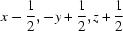
| Symmetry codes: (i) −x+1, −y+1, −z; (ii) x−1/2, −y+1/2, z+1/2; (iii) x−1, y, z. |
Experimental details
| Crystal data | |
| Chemical formula | C15H18N4O3 |
| Mr | 302.33 |
| Crystal system, space group | Monoclinic, P21/n |
| Temperature (K) | 150 |
| a, b, c (Å) | 10.3958 (2), 12.7174 (2), 10.9421 (2) |
| β (°) | 100.4727 (16) |
| V (Å3) | 1422.53 (4) |
| Z | 4 |
| Radiation type | Cu Kα |
| µ (mm−1) | 0.83 |
| Crystal size (mm) | 0.50 × 0.28 × 0.15 |
| Data collection | |
| Diffractometer | Oxford Diffraction Xcalibur diffractometer |
| Absorption correction | Analytical (de Meulenaer & Tompa, 1965) |
| Tmin, Tmax | 0.76, 0.88 |
| No. of measured, independent and observed [I > 2σ(I)] reflections | 18511, 2996, 2692 |
| Rint | 0.025 |
| (sin θ/λ)max (Å−1) | 0.633 |
| Refinement | |
| R[F2 > 2σ(F2)], wR(F2), S | 0.041, 0.121, 0.99 |
| No. of reflections | 2996 |
| No. of parameters | 200 |
| H-atom treatment | H-atom parameters constrained |
| Δρmax, Δρmin (e Å−3) | 0.23, −0.21 |
Computer programs: CrysAlis CCD (Oxford Diffraction, 2005), CrysAlis RED (Oxford Diffraction, 2005), Superflip (Palatinus & Chapuis, 2006), ORTEP-3 (Farrugia, 1997), CRYSTALS (Betteridge et al., 2003) and PARST97 (Nardelli, 1997).
| C2—C20—C9 | 110.62 (9) | C2—C20—O21 | 99.18 (8) |
| C2—C20—N17 | 112.87 (9) | C9—C20—O21 | 109.84 (9) |
| C9—C20—N17 | 110.34 (9) | N17—C20—O21 | 113.53 (9) |
| D—H···A | D—H | H···A | D···A | D—H···A |
| C4—H42···O1i | 0.96 | 2.43 | 3.3230 (18) | 155 |
| C14—H141···O21ii | 0.94 | 2.56 | 3.3999 (18) | 149 |
| C19—H191···O6iii | 0.97 | 2.46 | 3.3021 (18) | 146 |
| Symmetry codes: (i) −x+1, −y+1, −z; (ii) x−1/2, −y+1/2, z+1/2; (iii) x−1, y, z. |
Acknowledgements
Financial support from the Czech Science Foundation (grant No. 203/07/1246) and the Ministry of Education, Youth and Sports of the Czech Republic (grant No. 6046137302) is gratefully acknowledged.
References
 Betteridge, P. W., Carruthers, J. R., Cooper, R. I., Prout, K. & Watkin, D. J. (2003). J. Appl. Cryst. 36, 1487. Web of Science CrossRef IUCr Journals Google Scholar
Bolognesi, M., Ghisla, S. & Incoccia, L. (1978). Acta Cryst. B34, 821–828. CSD CrossRef CAS IUCr Journals Web of Science Google Scholar
Cremer, D. & Pople, J. A. (1975). J. Am. Chem. Soc. 97, 1354–1358. CrossRef CAS Web of Science Google Scholar
Farrugia, L. J. (1997). J. Appl. Cryst. 30, 565. CrossRef IUCr Journals Google Scholar
Hoegy, S. E. & Mariano, P. S. (1997). Tetrahedron, 53, 5027–5046. CrossRef CAS Web of Science Google Scholar
Kemal, C. & Bruice, T. C. (1976). Proc. Natl Acad. Sci. USA, 73, 995–999. CrossRef PubMed CAS Web of Science Google Scholar
Kemal, C., Chan, T. W. & Bruice, T. C. (1977). J. Am. Chem. Soc. 99, 7272–7286. CrossRef CAS PubMed Web of Science Google Scholar
Larson, A. C. (1970). Crystallographic Computing, edited by F. R. Ahmed, S. R. Hall & C. P. Huber, pp. 291–294. Copenhagen: Munksgaard. Google Scholar
Massey, V. (2000). Biochem. Soc. Trans. 28, 283–296. Web of Science CrossRef PubMed CAS Google Scholar
Meulenaer, J. de & Tompa, H. (1965). Acta Cryst. 19, 1014–1018. CrossRef IUCr Journals Web of Science Google Scholar
Müller, F. (1991). In Chemistry and Biochemistry of Flavoenzymes. Boca Raton, Florida: CRC Press. Google Scholar
Nardelli, M. (1999). J. Appl. Cryst. 32, 563–571. Web of Science CrossRef CAS IUCr Journals Google Scholar
Norrestam, R. & Von Glehn, M. (1972). Acta Cryst. B28, 434–440. CSD CrossRef CAS IUCr Journals Web of Science Google Scholar
Oxford Diffraction (2005). CrysAlis CCD and CrysAlis RED. Oxford Diffraction Ltd, Abingdon, England. Google Scholar
Palatinus, L. & Chapuis, G. (2006). Superflip. EPFL Lausanne, Switzerland. http://superspace.epfl.ch/superflip . Google Scholar
Palfey, B. & Massey, V. (1998). Comprehensive Biological Catalysis, Vol. 3, edited by M. Sinnott, pp. 83–154. London: Academic Press. Google Scholar
Sheldrick, G. M. (2008). Acta Cryst. A64, 112–122. Web of Science CrossRef CAS IUCr Journals Google Scholar
Werner, P.-E. & Rönnquist, O. (1970). Acta Chem. Scand. 24, 997–1009. CrossRef CAS Web of Science Google Scholar
This is an open-access article distributed under the terms of the Creative Commons Attribution (CC-BY) Licence, which permits unrestricted use, distribution, and reproduction in any medium, provided the original authors and source are cited.
| CRYSTALLOGRAPHIC COMMUNICATIONS |


Flavinium salts (both, isoalloxazinium and alloxazinium) represent suitable models (Müller, 1991; Kemal & Bruice, 1976; Kemal et al., 1977) of natural flavin derivatives which are important cofactors in many types of oxido-reductases and monooxygenases (Massey, 2000; Palfey & Massey, 1998). Similarly to natural flavins, flavinium salts react easily with various nucleophiles (water, methanol, primary amines etc.) with the formation of the covalent C4a-adducts (C4a-adduct means a compound with the covalently bound nucleophile to the C4a-atom of the flavin fragment; see Kemal & Bruice, 1976; Kemal et al., 1977; Hoegy & Mariano, 1997). The C4a-adducts of flavins are important intermediates of the reactions catalyzed by flavoenzymes.
In this paper, the first crystal structure of the C4a-adduct of alloxazinium salt (Figs. 1 and 2) is reported. The adduct is formed by the reaction of methanol with 5-ethyl-1,3-dimethylalloxazinium perchlorate (Fig. 2). By this reaction, the hybridization of C20 atom (C4a atom in IUPAC numbering of alloxazine moiety) is changed from sp2 to sp3 (Fig. 2). This change of hybridization causes a folding of the tricyclic alloxazine skeleton. The value of the interplanar angle between the plane determined by the C2, N3, C5, and N7 atoms and the plane determined by the C9, N10, C11, C12, C13, C14, C15, C16, and N17 atoms is 15.69 (5)°. This angle is larger in comparison with that found in the case of the similar adducts of C-nucleophiles with isoalloxazine derivatives; e.g. the angle between the analogous planes in 4a,5-dihydro-4a-isopropyl-3,10-dimethylisoalloxazine (Bolognesi et al., 1978) is only 6.85 (9)°. The observed 'butterfly' arrangement of the tricyclic alloxazine subunit in the title compound corresponds to the structure of dihydroflavins already published by Werner & Rönnquist (1970) and Norrestam & Von Glehn (1972).
Due to the sp3 hybridization, C20 atom is shifted out of the alloxazine plane by 0.313 (1)Å. On the other hand, the values of the bond angles around C20 are different from those expected for an sp3 carbon atom, probably due to the rigidity of the dihydroalloxazine system. The conformation of the ring 1 (C2, N3, C5, N7, C9, C20) is between 5H6 and E6. The conformation of the ring 2 (C9, N10, C11, C16, N17, C20) is between 5S6 and E6, rather closer to E6. The distances, angles and puckering parameters (Cremer & Pople, 1975) were calculated using PARST97 (Nardelli, 1999).
Three weak intermolecular C—H···O interactions were found forming a three-dimensional network.