 | Acta Crystallographica Section E Acta Crystallographica Section E CRYSTALLOGRAPHIC COMMUNICATIONS |


 journal menu


organic compounds
| CRYSTALLOGRAPHIC COMMUNICATIONS |
 access
4-(Carboxymethyl)anilinium chloride

aUnité de Recherche de Chimie de l'Environnement et Moléculaire Structurale, CHEMS, Faculté des Sciences Exactes, Département de Chimie, Université Mentouri Constantine, 25000 Algeria, and bFaculté de Chimie, USTHB, BP32 El-Alia, Bab-Ezzouar, Alger, Algeria
*Correspondence e-mail: [email protected]
In the crystal of the title compound, C8H10NO2+·Cl−, alternating layers of hydrophobic and hydrophilic zones stack along the c axis. The chloride anions are sandwiched between the 4-(carboxymethyl)anilinium layers, forming intermolecular O—H⋯Cl and N—H⋯Cl hydrogen bonds with the ammonium and carboxyl groups of the cations. In addition, intermolecular N—H⋯O and weak C—H⋯O and C—H⋯Cl hydrogen bonds help stabilize the crystal structure.
Related literature
For our ongoing studies of hydrogen-bonding interactions in the crystal structures of protonated see: Benslimane et al. (2007![[Benslimane, M., Merazig, H., Bouacida, S., Denbri, S., Beghidja, A. & Ouahab, L. (2007). Acta Cryst. E63, o3682-o3683.]](../../../../../../logos/arrows/e_arr.gif "Benslimane, M., Merazig, H., Bouacida, S., Denbri, S., Beghidja, A. & Ouahab, L. (2007). Acta Cryst. E63, o3682-o3683.") ); Bouacida et al. (2005a,b,c, 2006, 2007, 2008, 2009). For amino acids in which the amino N atom is protonated, see: Bouacida et al. (2006); Rademeyer (2004a,b). For a related structure, see: Benslimane et al. (2007). For bond-length data, see: Allen et al. (1987).
); Bouacida et al. (2005a,b,c, 2006, 2007, 2008, 2009). For amino acids in which the amino N atom is protonated, see: Bouacida et al. (2006); Rademeyer (2004a,b). For a related structure, see: Benslimane et al. (2007). For bond-length data, see: Allen et al. (1987).
![[Scheme 1]](lh2838scheme1.gif)
Experimental
Crystal data
|
Refinement
|
|
 ; (iii)
  ; (iv)
  .
. Data collection: APEX2 (Bruker, 2001); cell refinement: SAINT (Bruker, 2001); data reduction: SAINT; program(s) used to solve structure: SIR2002 (Burla et al., 2005); program(s) used to refine structure: SHELXL97 (Sheldrick, 2008); molecular graphics: ORTEP-3 for Windows (Farrugia, 1997) and DIAMOND (Brandenburg & Berndt, 2001); software used to prepare material for publication: WinGX (Farrugia, 1999).
Supporting information
contains datablocks global, I. DOI: 10.1107/S1600536809021849/lh2838sup1.cif
Structure factors: contains datablock I. DOI: 10.1107/S1600536809021849/lh2838Isup2.hkl
The title compound was crystallized by slow evaporation of an aqueous solution of 4-aminophenyl acetic acid, tin(II) chloride dihydrate and hydrochloric acid in a molar ratio of 5:5:1. White stick-like crystals were obtained after two weeks.
All H atoms were located in Fourier maps but introduced in calculated positions and treated as riding on their parent C, O and N atoms with C—H = 0.93–0.97 Å, O—H = 0.82Å and N—H = 0.89Å and Uiso(H) =1.5–1.2(carrier atom).
Data collection: SMART (Bruker, 2001); cell SAINT (Bruker, 2001); data reduction: SAINT (Bruker, 2001); program(s) used to solve structure: SIR2002 (Burla et al., 2005); program(s) used to refine structure: SHELXL97 (Sheldrick, 2008); molecular graphics: ORTEP-3 for Windows (Farrugia, 1997) and DIAMOND (Brandenburg & Berndt, 2001); software used to prepare material for publication: WinGX (Farrugia, 1999).
![[Figure 1]](./lh2838fig1thm.gif) | Fig. 1. The asymmetric unit of the title compound with the atomic labelling scheme. Displacement are drawn at the 50% probability level. |
![[Figure 2]](./lh2838fig2thm.gif) | Fig. 2. Part of the crystal structure illustrating the molecular layers, viewed along the b axis. |
![[Figure 3]](./lh2838fig3thm.gif) | Fig. 3. Part of the crystal structure with hydrogen bonds shown as dashed lines, viewed along the a axis. |
| C8H10NO2+·Cl− | F(000) = 392 |
| Mr = 187.62 | Dx = 1.418 Mg m−3 |
| Monoclinic, P21/n | Mo Kα radiation, λ = 0.71073 Å |
| Hall symbol: -P 2yn | Cell parameters from 3208 reflections |
| a = 4.4982 (4) Å | θ = 2.3–27.4° |
| b = 11.0790 (11) Å | µ = 0.39 mm−1 |
| c = 17.7120 (17) Å | T = 100 K |
| β = 95.429 (3)° | Stick, white |
| V = 878.73 (14) Å3 | 0.44 × 0.12 × 0.1 mm |
| Z = 4 |
| Bruker APEXII diffractometer | 1785 reflections with I > 2σ(I) |
| Graphite monochromator | Rint = 0.040 |
| CCD rotation images, thin slices scans | θmax = 27.5°, θmin = 3.7° |
| Absorption correction: multi-scan (SADABS; Bruker, 1998) | h = −5→5 |
| Tmin = 0.809, Tmax = 0.962 | k = −14→14 |
| 7536 measured reflections | l = −22→22 |
| 2006 independent reflections |
| Refinement on F2 | Primary atom site location: structure-invariant direct methods |
| Least-squares matrix: full | Secondary atom site location: difference Fourier map |
| R[F2 > 2σ(F2)] = 0.033 | Hydrogen site location: inferred from neighbouring sites |
| wR(F2) = 0.08 | H-atom parameters constrained |
| S = 1.03 | w = 1/[σ2(Fo2) + (0.0283P)2 + 0.5301P] where P = (Fo2 + 2Fc2)/3 |
| 2006 reflections | (Δ/σ)max = 0.001 |
| 113 parameters | Δρmax = 0.30 e Å−3 |
| 0 restraints | Δρmin = −0.22 e Å−3 |
| C8H10NO2+·Cl− | V = 878.73 (14) Å3 |
| Mr = 187.62 | Z = 4 |
| Monoclinic, P21/n | Mo Kα radiation |
| a = 4.4982 (4) Å | µ = 0.39 mm−1 |
| b = 11.0790 (11) Å | T = 100 K |
| c = 17.7120 (17) Å | 0.44 × 0.12 × 0.1 mm |
| β = 95.429 (3)° |
| Bruker APEXII diffractometer | 2006 independent reflections |
| Absorption correction: multi-scan (SADABS; Bruker, 1998) | 1785 reflections with I > 2σ(I) |
| Tmin = 0.809, Tmax = 0.962 | Rint = 0.040 |
| 7536 measured reflections |
| R[F2 > 2σ(F2)] = 0.033 | 0 restraints |
| wR(F2) = 0.08 | H-atom parameters constrained |
| S = 1.03 | Δρmax = 0.30 e Å−3 |
| 2006 reflections | Δρmin = −0.22 e Å−3 |
| 113 parameters |
Geometry. All e.s.d.'s (except the e.s.d. in the dihedral angle between two l.s. planes) are estimated using the full covariance matrix. The cell e.s.d.'s are taken into account individually in the estimation of e.s.d.'s in distances, angles and torsion angles; correlations between e.s.d.'s in cell parameters are only used when they are defined by crystal symmetry. An approximate (isotropic) treatment of cell e.s.d.'s is used for estimating e.s.d.'s involving l.s. planes. |
Refinement. Refinement of F2 against ALL reflections. The weighted R-factor wR and goodness of fit S are based on F2, conventional R-factors R are based on F, with F set to zero for negative F2. The threshold expression of F2 > σ(F2) is used only for calculating R-factors(gt) etc. and is not relevant to the choice of reflections for refinement. R-factors based on F2 are statistically about twice as large as those based on F, and R- factors based on ALL data will be even larger. |
| x | y | z | Uiso*/Ueq | ||
| Cl1 | 0.33999 (7) | 0.14718 (3) | 0.035821 (18) | 0.01567 (11) | |
| O1 | 0.7756 (3) | 0.59938 (11) | 0.02054 (6) | 0.0270 (3) | |
| H1 | 0.7238 | 0.6660 | 0.0040 | 0.040* | |
| O2 | 0.5016 (3) | 0.65210 (10) | 0.11399 (6) | 0.0257 (3) | |
| N1 | 0.3016 (3) | 0.37706 (11) | 0.40929 (7) | 0.0145 (3) | |
| H1A | 0.1824 | 0.3128 | 0.4051 | 0.022* | |
| H1B | 0.1969 | 0.4414 | 0.4212 | 0.022* | |
| H1C | 0.4494 | 0.3642 | 0.4455 | 0.022* | |
| C1 | 0.4271 (3) | 0.39836 (13) | 0.33671 (8) | 0.0126 (3) | |
| C2 | 0.3601 (3) | 0.32006 (13) | 0.27659 (8) | 0.0148 (3) | |
| H2 | 0.2377 | 0.2535 | 0.2817 | 0.018* | |
| C3 | 0.4804 (3) | 0.34312 (13) | 0.20801 (8) | 0.0155 (3) | |
| H3 | 0.4373 | 0.2911 | 0.1672 | 0.019* | |
| C4 | 0.6631 (3) | 0.44257 (13) | 0.19984 (8) | 0.0145 (3) | |
| C5 | 0.7279 (3) | 0.51913 (14) | 0.26215 (8) | 0.0176 (3) | |
| H5 | 0.8524 | 0.5853 | 0.2576 | 0.021* | |
| C6 | 0.6098 (3) | 0.49813 (14) | 0.33049 (8) | 0.0166 (3) | |
| H6 | 0.6522 | 0.5499 | 0.3714 | 0.020* | |
| C7 | 0.7903 (3) | 0.46817 (14) | 0.12557 (8) | 0.0180 (3) | |
| H7A | 0.7456 | 0.4006 | 0.0916 | 0.022* | |
| H7B | 1.0060 | 0.4744 | 0.1347 | 0.022* | |
| C8 | 0.6709 (3) | 0.58249 (14) | 0.08711 (8) | 0.0157 (3) |
| U11 | U22 | U33 | U12 | U13 | U23 | |
| Cl1 | 0.01972 (19) | 0.01379 (19) | 0.01353 (18) | 0.00041 (13) | 0.00178 (13) | 0.00186 (12) |
| O1 | 0.0392 (7) | 0.0206 (6) | 0.0239 (6) | 0.0128 (5) | 0.0181 (5) | 0.0103 (5) |
| O2 | 0.0361 (7) | 0.0226 (6) | 0.0203 (6) | 0.0151 (5) | 0.0123 (5) | 0.0061 (5) |
| N1 | 0.0169 (6) | 0.0146 (6) | 0.0124 (6) | −0.0011 (5) | 0.0034 (5) | −0.0013 (5) |
| C4 | 0.0141 (6) | 0.0146 (7) | 0.0150 (7) | 0.0054 (5) | 0.0026 (5) | 0.0034 (5) |
| C1 | 0.0131 (6) | 0.0142 (7) | 0.0108 (6) | 0.0020 (5) | 0.0025 (5) | 0.0023 (5) |
| C6 | 0.0173 (7) | 0.0163 (7) | 0.0160 (7) | −0.0025 (6) | 0.0003 (5) | −0.0027 (6) |
| C3 | 0.0190 (7) | 0.0138 (7) | 0.0137 (7) | 0.0024 (6) | 0.0011 (5) | −0.0020 (5) |
| C7 | 0.0199 (7) | 0.0173 (7) | 0.0178 (7) | 0.0043 (6) | 0.0071 (6) | 0.0034 (6) |
| C8 | 0.0156 (7) | 0.0161 (7) | 0.0157 (7) | 0.0003 (6) | 0.0034 (5) | 0.0007 (6) |
| C5 | 0.0152 (7) | 0.0173 (7) | 0.0206 (7) | −0.0039 (6) | 0.0032 (5) | 0.0013 (6) |
| C2 | 0.0161 (6) | 0.0123 (7) | 0.0159 (7) | −0.0021 (6) | 0.0014 (5) | 0.0000 (6) |
| O1—C8 | 1.3234 (17) | C1—C6 | 1.388 (2) |
| O1—H1 | 0.8200 | C6—C5 | 1.387 (2) |
| O2—C8 | 1.2121 (18) | C6—H6 | 0.9300 |
| N1—C1 | 1.4709 (17) | C3—C2 | 1.399 (2) |
| N1—H1A | 0.8900 | C3—H3 | 0.9300 |
| N1—H1B | 0.8900 | C7—C8 | 1.512 (2) |
| N1—H1C | 0.8900 | C7—H7A | 0.9700 |
| C4—C3 | 1.390 (2) | C7—H7B | 0.9700 |
| C4—C5 | 1.401 (2) | C5—H5 | 0.9300 |
| C4—C7 | 1.5100 (19) | C2—H2 | 0.9300 |
| C1—C2 | 1.384 (2) | ||
| C8—O1—H1 | 109.5 | C4—C3—H3 | 119.5 |
| C1—N1—H1A | 109.5 | C2—C3—H3 | 119.5 |
| C1—N1—H1B | 109.5 | C4—C7—C8 | 113.72 (12) |
| H1A—N1—H1B | 109.5 | C4—C7—H7A | 108.8 |
| C1—N1—H1C | 109.5 | C8—C7—H7A | 108.8 |
| H1A—N1—H1C | 109.5 | C4—C7—H7B | 108.8 |
| H1B—N1—H1C | 109.5 | C8—C7—H7B | 108.8 |
| C3—C4—C5 | 118.62 (13) | H7A—C7—H7B | 107.7 |
| C3—C4—C7 | 121.06 (13) | O2—C8—O1 | 123.32 (14) |
| C5—C4—C7 | 120.33 (13) | O2—C8—C7 | 124.41 (13) |
| C2—C1—C6 | 121.69 (13) | O1—C8—C7 | 112.27 (12) |
| C2—C1—N1 | 119.89 (12) | C6—C5—C4 | 121.20 (14) |
| C6—C1—N1 | 118.42 (12) | C6—C5—H5 | 119.4 |
| C5—C6—C1 | 118.77 (13) | C4—C5—H5 | 119.4 |
| C5—C6—H6 | 120.6 | C1—C2—C3 | 118.67 (13) |
| C1—C6—H6 | 120.6 | C1—C2—H2 | 120.7 |
| C4—C3—C2 | 121.05 (13) | C3—C2—H2 | 120.7 |
| C2—C1—C6—C5 | −0.1 (2) | C4—C7—C8—O1 | −176.97 (13) |
| N1—C1—C6—C5 | −179.72 (13) | C1—C6—C5—C4 | 0.7 (2) |
| C5—C4—C3—C2 | 0.7 (2) | C3—C4—C5—C6 | −1.0 (2) |
| C7—C4—C3—C2 | −179.38 (13) | C7—C4—C5—C6 | 179.07 (13) |
| C3—C4—C7—C8 | 113.71 (16) | C6—C1—C2—C3 | −0.2 (2) |
| C5—C4—C7—C8 | −66.37 (18) | N1—C1—C2—C3 | 179.42 (12) |
| C4—C7—C8—O2 | 3.9 (2) | C4—C3—C2—C1 | −0.1 (2) |
| D—H···A | D—H | H···A | D···A | D—H···A |
| O1—H1···Cl1i | 0.82 | 2.20 | 3.0087 (13) | 171 |
| N1—H1A···O2ii | 0.89 | 1.98 | 2.8517 (17) | 167 |
| N1—H1B···Cl1iii | 0.89 | 2.41 | 3.2285 (13) | 152 |
| N1—H1C···Cl1iv | 0.89 | 2.26 | 3.1516 (14) | 174 |
| C2—H2···O2ii | 0.93 | 2.49 | 3.2338 (18) | 137 |
| C3—H3···Cl1 | 0.93 | 2.82 | 3.7481 (15) | 175 |
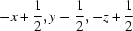
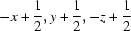
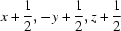
| Symmetry codes: (i) −x+1, −y+1, −z; (ii) −x+1/2, y−1/2, −z+1/2; (iii) −x+1/2, y+1/2, −z+1/2; (iv) x+1/2, −y+1/2, z+1/2. |
Experimental details
| Crystal data | |
| Chemical formula | C8H10NO2+·Cl− |
| Mr | 187.62 |
| Crystal system, space group | Monoclinic, P21/n |
| Temperature (K) | 100 |
| a, b, c (Å) | 4.4982 (4), 11.0790 (11), 17.7120 (17) |
| β (°) | 95.429 (3) |
| V (Å3) | 878.73 (14) |
| Z | 4 |
| Radiation type | Mo Kα |
| µ (mm−1) | 0.39 |
| Crystal size (mm) | 0.44 × 0.12 × 0.1 |
| Data collection | |
| Diffractometer | Bruker APEXII diffractometer |
| Absorption correction | Multi-scan (SADABS; Bruker, 1998) |
| Tmin, Tmax | 0.809, 0.962 |
| No. of measured, independent and observed [I > 2σ(I)] reflections | 7536, 2006, 1785 |
| Rint | 0.040 |
| (sin θ/λ)max (Å−1) | 0.649 |
| Refinement | |
| R[F2 > 2σ(F2)], wR(F2), S | 0.033, 0.08, 1.03 |
| No. of reflections | 2006 |
| No. of parameters | 113 |
| H-atom treatment | H-atom parameters constrained |
| Δρmax, Δρmin (e Å−3) | 0.30, −0.22 |
Computer programs: SMART (Bruker, 2001), SAINT (Bruker, 2001), SIR2002 (Burla et al., 2005), SHELXL97 (Sheldrick, 2008), ORTEP-3 for Windows (Farrugia, 1997) and DIAMOND (Brandenburg & Berndt, 2001), WinGX (Farrugia, 1999).
| D—H···A | D—H | H···A | D···A | D—H···A |
| O1—H1···Cl1i | 0.8200 | 2.2000 | 3.0087 (13) | 171.00 |
| N1—H1A···O2ii | 0.8900 | 1.9800 | 2.8517 (17) | 167.00 |
| N1—H1B···Cl1iii | 0.8900 | 2.4100 | 3.2285 (13) | 152.00 |
| N1—H1C···Cl1iv | 0.8900 | 2.2600 | 3.1516 (14) | 174.00 |
| C2—H2···O2ii | 0.9300 | 2.4900 | 3.2338 (18) | 137.00 |
| C3—H3···Cl1 | 0.9300 | 2.8200 | 3.7481 (15) | 175.00 |
| Symmetry codes: (i) −x+1, −y+1, −z; (ii) −x+1/2, y−1/2, −z+1/2; (iii) −x+1/2, y+1/2, −z+1/2; (iv) x+1/2, −y+1/2, z+1/2. |
Acknowledgements
The authors are grateful to Dr Thierry Roisnel, Centre de Diffractométrie X (CDIFX) de Rennes, Université de Rennes 1, France, for data-collection facilities. SB thanks Université A. Mira de Béjaia, Algeria, for financial support.
References
 Allen, F. H., Kennard, O., Watson, D. G., Brammer, L., Orpen, A. G. & Taylor, R. (1987). J. Chem. Soc. Perkin Trans. 2, pp. S1–19. CrossRef Web of Science Google Scholar
Benslimane, M., Merazig, H., Bouacida, S., Denbri, S., Beghidja, A. & Ouahab, L. (2007). Acta Cryst. E63, o3682–o3683. Web of Science CSD CrossRef IUCr Journals Google Scholar
Bouacida, S. (2008). PhD thesis, Montouri–Constantine University, Algeria. Google Scholar
Bouacida, S., Belhouas, R., Kechout, H., Merazig, H. & Bénard-Rocherullé, P. (2009). Acta Cryst. E65, o628–o629. Web of Science CSD CrossRef CAS IUCr Journals Google Scholar
Bouacida, S., Merazig, H., Beghidja, A. & Beghidja, C. (2005a). Acta Cryst. E61, m1153–m1155. Web of Science CSD CrossRef IUCr Journals Google Scholar
Bouacida, S., Merazig, H., Beghidja, A. & Beghidja, C. (2005b). Acta Cryst. E61, m2072–m2074. Web of Science CSD CrossRef IUCr Journals Google Scholar
Bouacida, S., Merazig, H., Beghidja, A. & Beghidja, C. (2005c). Acta Cryst. E61, m577–m579. Web of Science CSD CrossRef IUCr Journals Google Scholar
Bouacida, S., Merazig, H. & Benard-Rocherulle, P. (2006). Acta Cryst. E62, o838–o840. Web of Science CSD CrossRef IUCr Journals Google Scholar
Bouacida, S., Merazig, H., Benard-Rocherulle, P. & Rizzoli, C. (2007). Acta Cryst. E63, m379–m381. Web of Science CSD CrossRef CAS IUCr Journals Google Scholar
Brandenburg, K. & Berndt, M. (2001). DIAMOND. Version 3.1e. Crystal Impact, Bonn, Germany. Google Scholar
Bruker (1998). SADABS. Bruker AXS Inc., Madison, Wisconsin, USA. Google Scholar
Bruker (2001). APEX2 and SAINT. Bruker AXS Inc., Madison, Wisconsin, USA. Google Scholar
Burla, M. C., Caliandro, R., Camalli, M., Carrozzini, B., Cascarano, G. L., De Caro, L., Giacovazzo, C., Polidori, G. & Spagna, R. (2005). J. Appl. Cryst. 38, 381–388. Web of Science CrossRef CAS IUCr Journals Google Scholar
Farrugia, L. J. (1997). J. Appl. Cryst. 30, 565. CrossRef IUCr Journals Google Scholar
Farrugia, L. J. (1999). J. Appl. Cryst. 32, 837–838. CrossRef CAS IUCr Journals Google Scholar
Rademeyer, M. (2004a). Acta Cryst. C60, m55–m56. Web of Science CSD CrossRef CAS IUCr Journals Google Scholar
Rademeyer, M. (2004b). Acta Cryst. E60, m345–m347. Web of Science CSD CrossRef IUCr Journals Google Scholar
Sheldrick, G. M. (2008). Acta Cryst. A64, 112–122. Web of Science CrossRef CAS IUCr Journals Google Scholar
This is an open-access article distributed under the terms of the Creative Commons Attribution (CC-BY) Licence, which permits unrestricted use, distribution, and reproduction in any medium, provided the original authors and source are cited.
| CRYSTALLOGRAPHIC COMMUNICATIONS |


The title compound, was prepared as part of our ongoing studies of hydrogen-bonding interactions in the crystal structure of protonated amines (Bouacida et al., 2005a,b,c, 2006, 2007, 2008, 2009).
The molecular structure of (I), and the atomic numbering used, is illustrated in Fig. 1. All bond distances (Allen et al., 1987) and angles are within the ranges of accepted values. The amino N atom is protonated as in previously reported amino acids (Bouacida & al., 2006; Rademeyer, 2004a,b). The layered crystal packing of (I) is shown in Fig. 2, in which cations form alterning layers of 4-(carboxymethyl)anilinium of hydrophobic and hydrophilic zones along the c axis, and the chloride ions are located between these layers. In the structure, two types of classical hydrogen bonds are observed, viz. cation–anion and cation–cation (Fig. 3). The 4-(carboxymethyl)anilinium cations and the chloride anions form hydrogen-bonded double layers at z = 0 and z = 1/2, linked by N—H···Cl, C—H···Cl and O—H···Cl hydrogen bonds. Additional hydrogen-bonding parameters are listed in Table 1. These interaction bonds link the cations and the anions together, forming a three-dimensional network and reinforcing the cohesion of the ionic structure.