 | Acta Crystallographica Section E Acta Crystallographica Section E CRYSTALLOGRAPHIC COMMUNICATIONS |


 journal menu


organic compounds
| CRYSTALLOGRAPHIC COMMUNICATIONS |
 access
(R)-2-[(R)-2,2-Dimethyl-1,3-dioxolan-4-yl]-1,3-oxathiolan-5-one

aSchool of Chemical Engineering and Environment, Beijing Institute of Technology, Beijing 100081, People's Republic of China, and bSchool of Life Science, Beijing Institute of Technology, Beijing 100081, People's Republic of China
*Correspondence e-mail: [email protected]
In the title compound, C8H12O4S, the two five-membered rings both adopt envelope conformations. In the crystal, weak C—H⋯O interactions link neighbouring molecules.
Related literature
The title compound is a precursor for the preparation of an important nucleoside drug. For applications of in the fields of biology, drugs and chemistry, see: Goodyear et al. (2005![[Goodyear, M. D., Hill, M. L., West, J. P. & Whitehead, A. J. (2005). Tetrahedron Lett. 46, 8535-8538.]](../../../../../../logos/arrows/e_arr.gif "Goodyear, M. D., Hill, M. L., West, J. P. & Whitehead, A. J. (2005). Tetrahedron Lett. 46, 8535-8538.") ); Simons (2001); Vittori et al. (2006).
); Simons (2001); Vittori et al. (2006).
![[Scheme 1]](wn2324scheme1.gif)
Experimental
Crystal data
|
| |||||||||||||||||||||||||||
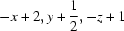 ; (iii)
 Data collection: RAPID-AUTO (Rigaku/MSC, 2005); cell refinement: RAPID-AUTO; data reduction: CrystalStructure (Rigaku/MSC, 2005); program(s) used to solve structure: SHELXS97 (Sheldrick, 2008); program(s) used to refine structure: SHELXL97 (Sheldrick, 2008); molecular graphics: SHELXTL (Sheldrick, 2008); software used to prepare material for publication: SHELXL97.
Supporting information
contains datablocks global, I. DOI: 10.1107/S160053680902039X/wn2324sup1.cif
Structure factors: contains datablock I. DOI: 10.1107/S160053680902039X/wn2324Isup2.hkl
A solution of (R)-(+)-2,2-dimethyl -1,3-dioxolane-4-carboxaldehyde (6.51 g, 50.0 mmol) and 2-mercaptoacetic acid (4.20 ml, 60.0 mmol) in toluene (200 ml) was heated under reflux for 1.5 h. After the reaction mixture was cooled to room temperature, a saturated aqueous solution of NaHCO3 (30 ml) was added and these two layers were separated. The organic layer was washed with brine, dried (MgSO4) and concentrated under reduced pressure. The residue was isolated through short on silica gel, which was eluted with EtOAc-petroleum to give the target compound (4.96 g, 48%). m.p. 75–77°C.
50 mg of the final product was dissolved in petroleum ether (5 ml) and the solution was kept at room temperature for 2 days to give colorless single crystals.
H atoms were included in the riding model approximation, with C—H distances 0.96–0.98 Å, and with Uiso(H) = kUeq(C), where k = 1.5 for methyl H and 1.2 for all other H atoms.
Data collection: RAPID-AUTO (Rigaku/MSC, 2005); cell RAPID-AUTO (Rigaku/MSC, 2005); data reduction: CrystalStructure (Rigaku/MSC, 2005); program(s) used to solve structure: SHELXS97 (Sheldrick, 2008); program(s) used to refine structure: SHELXL97 (Sheldrick, 2008); molecular graphics: SHELXTL (Sheldrick, 2008); software used to prepare material for publication: SHELXL97 (Sheldrick, 2008).
![[Figure 1]](./wn2324fig1thm.gif) | Fig. 1. Molecular structure of the title compound with displacement ellipsoids drawn at the 30% probability level. Hydrogen atoms are drawn as spheres of arbitrary radius. |
![[Figure 2]](./wn2324fig2thm.gif) | Fig. 2. The crystal packing of the title compound, viewed along the a axis. Hydrogen bonds are shown as dashed lines. |
| C8H12O4S | F(000) = 216 |
| Mr = 204.24 | Dx = 1.450 Mg m−3 |
| Monoclinic, P21 | Mo Kα radiation, λ = 0.71073 Å |
| a = 6.5528 (13) Å | Cell parameters from 1941 reflections |
| b = 9.4029 (19) Å | θ = 2.7–27.5° |
| c = 7.9240 (16) Å | µ = 0.33 mm−1 |
| β = 106.60 (3)° | T = 293 K |
| V = 467.89 (16) Å3 | Block, colourless |
| Z = 2 | 0.50 × 0.20 × 0.15 mm |
| Rigaku Saturn CCD area-detector diffractometer | 1705 independent reflections |
| Radiation source: fine-focus sealed tube | 1275 reflections with I > 2σ(I) |
| Graphite monochromator | Rint = 0.056 |
| Detector resolution: 10.00 pixels mm-1 | θmax = 27.5°, θmin = 2.7° |
| Ω scans | h = −8→8 |
| Absorption correction: multi-scan (CrystalClear; Rigaku/MSC, 2005) | k = −12→11 |
| Tmin = 0.859, Tmax = 0.952 | l = −10→10 |
| 1941 measured reflections |
| Refinement on F2 | Hydrogen site location: inferred from neighbouring sites |
| Least-squares matrix: full | H-atom parameters constrained |
| R[F2 > 2σ(F2)] = 0.042 | w = 1/[σ2(Fo2) + (0.088P)2] where P = (Fo2 + 2Fc2)/3 |
| wR(F2) = 0.129 | (Δ/σ)max < 0.001 |
| S = 1.01 | Δρmax = 0.24 e Å−3 |
| 1705 reflections | Δρmin = −0.20 e Å−3 |
| 119 parameters | Extinction correction: SHELXL97 (Sheldrick, 2008), Fc*=kFc[1+0.001xFc2λ3/sin(2θ)]-1/4 |
| 1 restraint | Extinction coefficient: 0.102 (15) |
| Primary atom site location: structure-invariant direct methods | Absolute structure: Flack (1983), 593 Friedel pairs |
| Secondary atom site location: difference Fourier map | Absolute structure parameter: −0.01 (13) |
| C8H12O4S | V = 467.89 (16) Å3 |
| Mr = 204.24 | Z = 2 |
| Monoclinic, P21 | Mo Kα radiation |
| a = 6.5528 (13) Å | µ = 0.33 mm−1 |
| b = 9.4029 (19) Å | T = 293 K |
| c = 7.9240 (16) Å | 0.50 × 0.20 × 0.15 mm |
| β = 106.60 (3)° |
| Rigaku Saturn CCD area-detector diffractometer | 1705 independent reflections |
| Absorption correction: multi-scan (CrystalClear; Rigaku/MSC, 2005) | 1275 reflections with I > 2σ(I) |
| Tmin = 0.859, Tmax = 0.952 | Rint = 0.056 |
| 1941 measured reflections |
| R[F2 > 2σ(F2)] = 0.042 | H-atom parameters constrained |
| wR(F2) = 0.129 | Δρmax = 0.24 e Å−3 |
| S = 1.01 | Δρmin = −0.20 e Å−3 |
| 1705 reflections | Absolute structure: Flack (1983), 593 Friedel pairs |
| 119 parameters | Absolute structure parameter: −0.01 (13) |
| 1 restraint |
Experimental. 1H NMR(CDCl3,P.P.M.): 1.41 (d, 6 H), 3.58(d, 4 H), 3.77 (d, 1 H), 3.92 (dd, 1 H), 4.12 (dd, 1 H), 4.35 (m, 1 H), 5.45(d, 1 H). |
Geometry. All e.s.d.'s (except the e.s.d. in the dihedral angle between two l.s. planes) are estimated using the full covariance matrix. The cell e.s.d.'s are taken into account individually in the estimation of e.s.d.'s in distances, angles and torsion angles; correlations between e.s.d.'s in cell parameters are only used when they are defined by crystal symmetry. An approximate (isotropic) treatment of cell e.s.d.'s is used for estimating e.s.d.'s involving l.s. planes. |
Refinement. Refinement of F2 against ALL reflections. The weighted R-factor wR and goodness of fit S are based on F2, conventional R-factors R are based on F, with F set to zero for negative F2. The threshold expression of F2 > σ(F2) is used only for calculating R-factors(gt) etc. and is not relevant to the choice of reflections for refinement. R-factors based on F2 are statistically about twice as large as those based on F, and R- factors based on ALL data will be even larger. |
| x | y | z | Uiso*/Ueq | ||
| S1 | 0.57296 (17) | 0.19608 (12) | 0.31212 (10) | 0.0733 (4) | |
| O1 | 0.7766 (4) | 0.0255 (3) | 0.5605 (3) | 0.0514 (6) | |
| O2 | 1.1103 (4) | 0.0457 (3) | 0.5630 (4) | 0.0734 (8) | |
| O3 | 0.8026 (4) | 0.1607 (2) | 0.9331 (3) | 0.0560 (6) | |
| O4 | 0.7352 (4) | 0.2936 (2) | 0.6920 (3) | 0.0482 (5) | |
| C1 | 0.8546 (6) | 0.1980 (5) | 0.3737 (4) | 0.0612 (9) | |
| H1A | 0.9049 | 0.1803 | 0.2718 | 0.073* | |
| H1B | 0.9075 | 0.2899 | 0.4225 | 0.073* | |
| C2 | 0.9307 (6) | 0.0859 (4) | 0.5061 (4) | 0.0502 (8) | |
| C3 | 0.5800 (5) | 0.1011 (4) | 0.5101 (4) | 0.0509 (8) | |
| H3 | 0.4622 | 0.0328 | 0.4851 | 0.061* | |
| C4 | 0.5669 (5) | 0.1947 (4) | 0.6584 (4) | 0.0486 (7) | |
| H4 | 0.4302 | 0.2451 | 0.6269 | 0.058* | |
| C5 | 0.5987 (5) | 0.1192 (5) | 0.8312 (4) | 0.0567 (9) | |
| H5A | 0.4914 | 0.1477 | 0.8871 | 0.068* | |
| H5B | 0.5915 | 0.0169 | 0.8144 | 0.068* | |
| C6 | 0.8418 (5) | 0.2954 (4) | 0.8756 (4) | 0.0486 (8) | |
| C7 | 1.0731 (6) | 0.3117 (5) | 0.9004 (6) | 0.0742 (11) | |
| H7A | 1.1010 | 0.4044 | 0.8614 | 0.111* | |
| H7B | 1.1201 | 0.2405 | 0.8330 | 0.111* | |
| H7C | 1.1483 | 0.3006 | 1.0228 | 0.111* | |
| C8 | 0.7487 (7) | 0.4089 (5) | 0.9608 (5) | 0.0743 (12) | |
| H8A | 0.7778 | 0.5000 | 0.9182 | 0.111* | |
| H8B | 0.8106 | 0.4046 | 1.0861 | 0.111* | |
| H8C | 0.5975 | 0.3954 | 0.9332 | 0.111* |
| U11 | U22 | U33 | U12 | U13 | U23 | |
| S1 | 0.0745 (6) | 0.0908 (9) | 0.0459 (4) | −0.0108 (6) | 0.0034 (4) | 0.0026 (5) |
| O1 | 0.0541 (13) | 0.0404 (12) | 0.0659 (14) | −0.0020 (10) | 0.0269 (11) | −0.0011 (11) |
| O2 | 0.0606 (17) | 0.0628 (18) | 0.107 (2) | 0.0052 (14) | 0.0402 (16) | −0.0045 (16) |
| O3 | 0.0649 (15) | 0.0446 (14) | 0.0563 (12) | 0.0047 (11) | 0.0139 (10) | 0.0108 (11) |
| O4 | 0.0566 (12) | 0.0465 (12) | 0.0411 (10) | −0.0113 (11) | 0.0132 (9) | 0.0000 (9) |
| C1 | 0.082 (2) | 0.053 (2) | 0.0589 (18) | −0.012 (2) | 0.0367 (17) | −0.0009 (17) |
| C2 | 0.059 (2) | 0.0397 (17) | 0.0597 (18) | −0.0016 (15) | 0.0293 (16) | −0.0084 (14) |
| C3 | 0.0457 (16) | 0.0508 (19) | 0.0557 (17) | −0.0117 (15) | 0.0134 (14) | −0.0050 (16) |
| C4 | 0.0389 (14) | 0.0522 (19) | 0.0563 (15) | −0.0025 (15) | 0.0163 (12) | 0.0032 (17) |
| C5 | 0.0558 (19) | 0.060 (2) | 0.062 (2) | −0.0076 (17) | 0.0287 (17) | 0.0027 (16) |
| C6 | 0.0548 (19) | 0.0429 (18) | 0.0453 (16) | 0.0041 (15) | 0.0100 (14) | 0.0022 (13) |
| C7 | 0.058 (2) | 0.065 (3) | 0.088 (3) | −0.0082 (19) | 0.004 (2) | −0.004 (2) |
| C8 | 0.106 (3) | 0.057 (2) | 0.063 (2) | 0.015 (2) | 0.027 (2) | −0.0093 (18) |
| S1—C1 | 1.769 (4) | C3—H3 | 0.9800 |
| S1—C3 | 1.795 (4) | C4—C5 | 1.504 (5) |
| O1—C2 | 1.333 (4) | C4—H4 | 0.9800 |
| O1—C3 | 1.425 (4) | C5—H5A | 0.9700 |
| O2—C2 | 1.195 (4) | C5—H5B | 0.9700 |
| O3—C6 | 1.395 (4) | C6—C8 | 1.483 (5) |
| O3—C5 | 1.405 (4) | C6—C7 | 1.480 (5) |
| O4—C4 | 1.408 (4) | C7—H7A | 0.9600 |
| O4—C6 | 1.423 (4) | C7—H7B | 0.9600 |
| C1—C2 | 1.470 (5) | C7—H7C | 0.9600 |
| C1—H1A | 0.9700 | C8—H8A | 0.9600 |
| C1—H1B | 0.9700 | C8—H8B | 0.9600 |
| C3—C4 | 1.490 (5) | C8—H8C | 0.9600 |
| C1—S1—C3 | 89.97 (16) | O3—C5—C4 | 104.7 (3) |
| C2—O1—C3 | 113.9 (3) | O3—C5—H5A | 110.8 |
| C6—O3—C5 | 107.4 (3) | C4—C5—H5A | 110.8 |
| C4—O4—C6 | 109.3 (2) | O3—C5—H5B | 110.8 |
| C2—C1—S1 | 107.7 (3) | C4—C5—H5B | 110.8 |
| C2—C1—H1A | 110.2 | H5A—C5—H5B | 108.9 |
| S1—C1—H1A | 110.2 | O3—C6—O4 | 103.9 (3) |
| C2—C1—H1B | 110.2 | O3—C6—C8 | 111.5 (3) |
| S1—C1—H1B | 110.2 | O4—C6—C8 | 109.2 (3) |
| H1A—C1—H1B | 108.5 | O3—C6—C7 | 109.1 (3) |
| O2—C2—O1 | 119.9 (3) | O4—C6—C7 | 108.8 (3) |
| O2—C2—C1 | 126.4 (3) | C8—C6—C7 | 113.8 (4) |
| O1—C2—C1 | 113.7 (3) | C6—C7—H7A | 109.5 |
| O1—C3—C4 | 109.0 (3) | C6—C7—H7B | 109.5 |
| O1—C3—S1 | 106.8 (2) | H7A—C7—H7B | 109.5 |
| C4—C3—S1 | 113.7 (3) | C6—C7—H7C | 109.5 |
| O1—C3—H3 | 109.1 | H7A—C7—H7C | 109.5 |
| C4—C3—H3 | 109.1 | H7B—C7—H7C | 109.5 |
| S1—C3—H3 | 109.1 | C6—C8—H8A | 109.5 |
| O4—C4—C3 | 108.7 (2) | C6—C8—H8B | 109.5 |
| O4—C4—C5 | 104.0 (3) | H8A—C8—H8B | 109.5 |
| C3—C4—C5 | 114.5 (3) | C6—C8—H8C | 109.5 |
| O4—C4—H4 | 109.8 | H8A—C8—H8C | 109.5 |
| C3—C4—H4 | 109.8 | H8B—C8—H8C | 109.5 |
| C5—C4—H4 | 109.8 | ||
| C3—S1—C1—C2 | 19.2 (3) | S1—C3—C4—O4 | −57.3 (3) |
| C3—O1—C2—O2 | 168.2 (3) | O1—C3—C4—C5 | −54.1 (3) |
| C3—O1—C2—C1 | −13.0 (4) | S1—C3—C4—C5 | −173.1 (2) |
| S1—C1—C2—O2 | 171.1 (3) | C6—O3—C5—C4 | 28.4 (3) |
| S1—C1—C2—O1 | −7.6 (4) | O4—C4—C5—O3 | −11.8 (4) |
| C2—O1—C3—C4 | −96.1 (3) | C3—C4—C5—O3 | 106.7 (3) |
| C2—O1—C3—S1 | 27.2 (3) | C5—O3—C6—O4 | −33.7 (3) |
| C1—S1—C3—O1 | −26.0 (3) | C5—O3—C6—C8 | 83.8 (3) |
| C1—S1—C3—C4 | 94.2 (3) | C5—O3—C6—C7 | −149.6 (3) |
| C6—O4—C4—C3 | −130.9 (3) | C4—O4—C6—O3 | 25.9 (3) |
| C6—O4—C4—C5 | −8.5 (3) | C4—O4—C6—C8 | −93.2 (4) |
| O1—C3—C4—O4 | 61.7 (3) | C4—O4—C6—C7 | 142.0 (3) |
| D—H···A | D—H | H···A | D···A | D—H···A |
| C1—H1A···O3i | 0.97 | 2.58 | 3.428 (4) | 146 |
| C1—H1B···O2ii | 0.97 | 2.41 | 3.306 (6) | 153 |
| C3—H3···O2iii | 0.98 | 2.55 | 3.265 (4) | 129 |
| Symmetry codes: (i) x, y, z−1; (ii) −x+2, y+1/2, −z+1; (iii) x−1, y, z. |
Experimental details
| Crystal data | |
| Chemical formula | C8H12O4S |
| Mr | 204.24 |
| Crystal system, space group | Monoclinic, P21 |
| Temperature (K) | 293 |
| a, b, c (Å) | 6.5528 (13), 9.4029 (19), 7.9240 (16) |
| β (°) | 106.60 (3) |
| V (Å3) | 467.89 (16) |
| Z | 2 |
| Radiation type | Mo Kα |
| µ (mm−1) | 0.33 |
| Crystal size (mm) | 0.50 × 0.20 × 0.15 |
| Data collection | |
| Diffractometer | Rigaku Saturn CCD area-detector diffractometer |
| Absorption correction | Multi-scan (CrystalClear; Rigaku/MSC, 2005) |
| Tmin, Tmax | 0.859, 0.952 |
| No. of measured, independent and observed [I > 2σ(I)] reflections | 1941, 1705, 1275 |
| Rint | 0.056 |
| (sin θ/λ)max (Å−1) | 0.649 |
| Refinement | |
| R[F2 > 2σ(F2)], wR(F2), S | 0.042, 0.129, 1.01 |
| No. of reflections | 1705 |
| No. of parameters | 119 |
| No. of restraints | 1 |
| H-atom treatment | H-atom parameters constrained |
| Δρmax, Δρmin (e Å−3) | 0.24, −0.20 |
| Absolute structure | Flack (1983), 593 Friedel pairs |
| Absolute structure parameter | −0.01 (13) |
Computer programs: RAPID-AUTO (Rigaku/MSC, 2005), CrystalStructure (Rigaku/MSC, 2005), SHELXS97 (Sheldrick, 2008), SHELXL97 (Sheldrick, 2008), SHELXTL (Sheldrick, 2008).
| D—H···A | D—H | H···A | D···A | D—H···A |
| C1—H1A···O3i | 0.97 | 2.58 | 3.428 (4) | 146 |
| C1—H1B···O2ii | 0.97 | 2.41 | 3.306 (6) | 153 |
| C3—H3···O2iii | 0.98 | 2.55 | 3.265 (4) | 129 |
| Symmetry codes: (i) x, y, z−1; (ii) −x+2, y+1/2, −z+1; (iii) x−1, y, z. |
Acknowledgements
The authors thank the National Science Foundation of China (30340070) and the Ministry of Science and Technology of China (2006AA100216) for financial support.
References
 Flack, H. D. (1983). Acta Cryst. A39, 876–881. CrossRef CAS Web of Science IUCr Journals Google Scholar
Goodyear, M. D., Hill, M. L., West, J. P. & Whitehead, A. J. (2005). Tetrahedron Lett. 46, 8535–8538. Web of Science CrossRef CAS Google Scholar
Rigaku/MSC (2005). CrystalClear, CrystalStructure and RAPID-AUTO. Rigaku/MSC Inc., The Woodlands, Texas, USA. Google Scholar
Sheldrick, G. M. (2008). Acta Cryst. A64, 112–122. Web of Science CrossRef CAS IUCr Journals Google Scholar
Simons, C. (2001). Nucleoside Mimetics, Their Chemistry and Biological Properties. Amsterdam: Gordon and Breach Science Publisher. Google Scholar
Vittori, S., Dal Ben, D., Lambertucci, C., Marucci, G., Volpini, R. & Cristalli, G. (2006). Curr. Med. Chem. 13, 3529–3552. Web of Science CrossRef PubMed CAS Google Scholar
This is an open-access article distributed under the terms of the Creative Commons Attribution (CC-BY) Licence, which permits unrestricted use, distribution, and reproduction in any medium, provided the original authors and source are cited.
| CRYSTALLOGRAPHIC COMMUNICATIONS |


Nucleosides are a very important series of compounds in the fields of biology, drugs and chemistry (Simons, 2001); as an example, lamivudine is used as a drug for HIV and HBV diseases (Goodyear et al., 2005; Vittori et al., 2006). Studies of the synthesis of nucleoside mimetics are essential.
The purpose of this structure determination was to establish the molecular conformation of the title compound obtained by coupling (R)-(+)-2,2-dimethyl-1,3-dioxolane-4-carboxaldehyde with 2-mercaptoacetic acid. The chirality at the 2-position (C3) is R; this satisfies our requirements for the preparation of corresponding L-nucleosides. All bond lengths and bond angles have expected values. The two 5-membered rings both adopt envelope conformations with atoms C3 and C6 at the flap. Three intermolecular C—H···O interactions link neighbouring molecules.