 | Acta Crystallographica Section E Acta Crystallographica Section E CRYSTALLOGRAPHIC COMMUNICATIONS |


 journal menu


organic compounds
| CRYSTALLOGRAPHIC COMMUNICATIONS |
 access
Pyridine-4-carboximidamidate chloride

aCollege of Chemistry, Liaoning University, Shenyang 110036, People's Republic of China, and bLiaoning Fixed Star Chemicals (Group) Co. Ltd, Dandong 118000, People's Republic of China
*Correspondence e-mail: [email protected]
In the title salt, C6H8N3+·Cl−, each pyridinecarboximidamidate cation is linked to two symmetry-related cations through N—H⋯N hydrogen bonds, and to two chloride ions by N—H⋯Cl hydrogen bonds. The N—H⋯N hydrogen bonds involve the pyridine N atom and one NH2 group. In the crystal, N—H⋯N and N—H⋯Cl hydrogen bonds extend the structure into two-dimensional layers. Weak C—H⋯Cl interactions further connect these layers into a three-dimensional network.
![[Scheme 1]](bh2242scheme1.gif)
Experimental
Crystal data
|
Refinement
|
|
 ; (ii)
  ; (iii)
  .
. Data collection: SMART (Bruker, 2001![[Bruker (2001). SADABS. Bruker AXS Inc., Madison, Wisconsin, USA.]](../../../../../../logos/arrows/e_arr.gif "Bruker (2001). SADABS. Bruker AXS Inc., Madison, Wisconsin, USA.") ); cell refinement: SAINT (Bruker, 2001); data reduction: SAINT; program(s) used to solve structure: SHELXS97 (Sheldrick, 2008); program(s) used to refine structure: SHELXL97 (Sheldrick, 2008); molecular graphics: SHELXTL (Sheldrick, 2008); software used to prepare material for publication: SHELXL97.
); cell refinement: SAINT (Bruker, 2001); data reduction: SAINT; program(s) used to solve structure: SHELXS97 (Sheldrick, 2008); program(s) used to refine structure: SHELXL97 (Sheldrick, 2008); molecular graphics: SHELXTL (Sheldrick, 2008); software used to prepare material for publication: SHELXL97.
Supporting information
contains datablocks I, global. DOI: 10.1107/S160053680903517X/bh2242sup1.cif
Structure factors: contains datablock I. DOI: 10.1107/S160053680903517X/bh2242Isup2.hkl
The title compound was prepared according to the method of Kamei et al. (2005). Block-shaped crystals suitable for X-ray diffraction were obtained from ethanol/acetone.
Data collection: SMART (Bruker, 2001); cell SAINT (Bruker, 2001); data reduction: SAINT (Bruker, 2001); program(s) used to solve structure: SHELXS97 (Sheldrick, 2008); program(s) used to refine structure: SHELXL97 (Sheldrick, 2008); molecular graphics: SHELXTL (Sheldrick, 2008); software used to prepare material for publication: SHELXL97 (Sheldrick, 2008).
![[Figure 1]](./bh2242fig1thm.gif) | Fig. 1. View of (I), showing atomic labels and displacement ellipsoids drawn at 30% probability level. |
![[Figure 2]](./bh2242fig2thm.gif) | Fig. 2. N—H···N and N—H···Cl hydrogen bonds in the crystal. |
![[Figure 3]](./bh2242fig3thm.gif) | Fig. 3. View of the hydrogen bonded one-dimensional chain along b axis. |
| C6H8N3+·Cl− | F(000) = 656 |
| Mr = 157.60 | Dx = 1.432 Mg m−3 |
| Orthorhombic, Pbca | Mo Kα radiation, λ = 0.71073 Å |
| Hall symbol: -P 2ac 2ab | Cell parameters from 542 reflections |
| a = 7.3928 (13) Å | θ = 2.3–22.8° |
| b = 10.4467 (16) Å | µ = 0.44 mm−1 |
| c = 18.925 (3) Å | T = 293 K |
| V = 1461.6 (4) Å3 | Block, colourless |
| Z = 8 | 0.37 × 0.32 × 0.21 mm |
| Bruker SMART CCD area-detector diffractometer | 1435 independent reflections |
| Radiation source: fine-focus sealed tube | 1215 reflections with I > 2σ(I) |
| Graphite monochromator | Rint = 0.018 |
| ϕ and ω scans | θmax = 26.0°, θmin = 2.2° |
| Absorption correction: multi-scan (SADABS; Bruker, 2001) | h = −9→1 |
| Tmin = 0.853, Tmax = 0.911 | k = −1→12 |
| 1949 measured reflections | l = −23→1 |
| Refinement on F2 | Secondary atom site location: difference Fourier map |
| Least-squares matrix: full | Hydrogen site location: inferred from neighbouring sites |
| R[F2 > 2σ(F2)] = 0.033 | All H-atom parameters refined |
| wR(F2) = 0.092 | w = 1/[σ2(Fo2) + (0.0416P)2 + 0.5489P] where P = (Fo2 + 2Fc2)/3 |
| S = 1.04 | (Δ/σ)max = 0.001 |
| 1435 reflections | Δρmax = 0.23 e Å−3 |
| 124 parameters | Δρmin = −0.18 e Å−3 |
| 0 restraints | Extinction correction: SHELXL97 (Sheldrick, 2008), Fc*=kFc[1+0.001xFc2λ3/sin(2θ)]-1/4 |
| Primary atom site location: structure-invariant direct methods | Extinction coefficient: 0.0056 (15) |
| C6H8N3+·Cl− | V = 1461.6 (4) Å3 |
| Mr = 157.60 | Z = 8 |
| Orthorhombic, Pbca | Mo Kα radiation |
| a = 7.3928 (13) Å | µ = 0.44 mm−1 |
| b = 10.4467 (16) Å | T = 293 K |
| c = 18.925 (3) Å | 0.37 × 0.32 × 0.21 mm |
| Bruker SMART CCD area-detector diffractometer | 1435 independent reflections |
| Absorption correction: multi-scan (SADABS; Bruker, 2001) | 1215 reflections with I > 2σ(I) |
| Tmin = 0.853, Tmax = 0.911 | Rint = 0.018 |
| 1949 measured reflections |
| R[F2 > 2σ(F2)] = 0.033 | 0 restraints |
| wR(F2) = 0.092 | All H-atom parameters refined |
| S = 1.04 | Δρmax = 0.23 e Å−3 |
| 1435 reflections | Δρmin = −0.18 e Å−3 |
| 124 parameters |
| x | y | z | Uiso*/Ueq | ||
| N1 | 0.0852 (2) | 0.38353 (14) | 0.75509 (8) | 0.0367 (4) | |
| C1 | 0.0499 (3) | 0.36114 (17) | 0.82329 (10) | 0.0367 (4) | |
| Cl1 | 0.15740 (8) | 0.91636 (4) | 1.05546 (2) | 0.0432 (2) | |
| N2 | 0.0353 (2) | 0.79417 (15) | 0.89141 (9) | 0.0369 (4) | |
| C2 | 0.0593 (3) | 0.45387 (17) | 0.87518 (9) | 0.0341 (4) | |
| N3 | 0.1766 (3) | 0.66264 (17) | 0.97084 (9) | 0.0428 (4) | |
| C3 | 0.1026 (2) | 0.57807 (15) | 0.85578 (9) | 0.0285 (4) | |
| C4 | 0.1401 (3) | 0.60305 (17) | 0.78520 (9) | 0.0337 (4) | |
| C5 | 0.1315 (3) | 0.50297 (18) | 0.73774 (9) | 0.0376 (4) | |
| C6 | 0.1052 (2) | 0.68338 (16) | 0.90895 (9) | 0.0310 (4) | |
| H4 | 0.171 (3) | 0.6863 (18) | 0.7679 (10) | 0.033 (5)* | |
| H1 | 0.015 (3) | 0.275 (2) | 0.8348 (11) | 0.044 (6)* | |
| H2 | 0.032 (3) | 0.4327 (18) | 0.9204 (11) | 0.041 (5)* | |
| H5 | 0.159 (3) | 0.519 (2) | 0.6925 (12) | 0.048 (6)* | |
| H2B | 0.037 (3) | 0.854 (2) | 0.9202 (13) | 0.060 (7)* | |
| H2A | −0.016 (3) | 0.803 (2) | 0.8500 (12) | 0.050 (6)* | |
| H3B | 0.229 (4) | 0.590 (2) | 0.9833 (12) | 0.056 (7)* | |
| H3A | 0.184 (3) | 0.732 (2) | 1.0012 (14) | 0.061 (7)* |
| U11 | U22 | U33 | U12 | U13 | U23 | |
| N1 | 0.0452 (9) | 0.0312 (8) | 0.0338 (8) | 0.0019 (7) | 0.0001 (7) | −0.0051 (7) |
| C1 | 0.0439 (11) | 0.0261 (9) | 0.0400 (10) | −0.0002 (8) | −0.0007 (9) | 0.0007 (7) |
| Cl1 | 0.0580 (3) | 0.0357 (3) | 0.0359 (3) | 0.0007 (2) | −0.0055 (2) | −0.00566 (18) |
| N2 | 0.0484 (10) | 0.0262 (8) | 0.0360 (9) | 0.0009 (7) | 0.0006 (8) | −0.0043 (7) |
| C2 | 0.0436 (11) | 0.0306 (9) | 0.0280 (9) | 0.0035 (8) | 0.0027 (8) | 0.0019 (7) |
| N3 | 0.0613 (12) | 0.0348 (9) | 0.0323 (8) | 0.0070 (8) | −0.0090 (8) | −0.0067 (7) |
| C3 | 0.0313 (9) | 0.0266 (8) | 0.0277 (8) | 0.0021 (7) | −0.0020 (7) | −0.0021 (7) |
| C4 | 0.0421 (10) | 0.0280 (9) | 0.0310 (9) | −0.0020 (8) | 0.0003 (8) | 0.0024 (7) |
| C5 | 0.0488 (12) | 0.0377 (10) | 0.0264 (9) | −0.0002 (8) | 0.0022 (8) | −0.0012 (8) |
| C6 | 0.0348 (9) | 0.0280 (9) | 0.0300 (9) | −0.0018 (7) | 0.0031 (7) | −0.0020 (7) |
| N1—C5 | 1.335 (2) | N3—C6 | 1.303 (2) |
| N1—C1 | 1.337 (2) | N3—H3B | 0.89 (2) |
| C1—C2 | 1.381 (3) | N3—H3A | 0.93 (3) |
| C1—H1 | 0.96 (2) | C3—C4 | 1.389 (2) |
| N2—C6 | 1.310 (2) | C3—C6 | 1.491 (2) |
| N2—H2B | 0.83 (3) | C4—C5 | 1.380 (3) |
| N2—H2A | 0.88 (2) | C4—H4 | 0.958 (19) |
| C2—C3 | 1.386 (2) | C5—H5 | 0.90 (2) |
| C2—H2 | 0.91 (2) | ||
| C5—N1—C1 | 116.80 (15) | C2—C3—C4 | 118.47 (16) |
| N1—C1—C2 | 123.63 (17) | C2—C3—C6 | 120.99 (15) |
| N1—C1—H1 | 115.7 (12) | C4—C3—C6 | 120.52 (15) |
| C2—C1—H1 | 120.6 (12) | C5—C4—C3 | 118.33 (17) |
| C6—N2—H2B | 119.8 (17) | C5—C4—H4 | 118.5 (11) |
| C6—N2—H2A | 119.2 (15) | C3—C4—H4 | 123.2 (11) |
| H2B—N2—H2A | 121 (2) | N1—C5—C4 | 124.05 (17) |
| C1—C2—C3 | 118.68 (16) | N1—C5—H5 | 118.2 (15) |
| C1—C2—H2 | 119.3 (13) | C4—C5—H5 | 117.7 (15) |
| C3—C2—H2 | 122.0 (13) | N3—C6—N2 | 122.31 (17) |
| C6—N3—H3B | 123.9 (15) | N3—C6—C3 | 119.28 (16) |
| C6—N3—H3A | 116.9 (16) | N2—C6—C3 | 118.41 (16) |
| H3B—N3—H3A | 119 (2) |
| D—H···A | D—H | H···A | D···A | D—H···A |
| N2—H2A···N1i | 0.88 (2) | 2.22 (2) | 3.058 (2) | 160 (2) |
| N3—H3A···Cl1 | 0.93 (2) | 2.19 (2) | 3.100 (2) | 167 (2) |
| N2—H2B···Cl1 | 0.83 (2) | 2.79 (2) | 3.476 (2) | 142 (2) |
| N3—H3B···Cl1ii | 0.89 (2) | 2.41 (2) | 3.270 (2) | 161 (2) |
| C5—H5···Cl1iii | 0.90 (2) | 2.68 (2) | 3.556 (2) | 166 (2) |
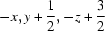
| Symmetry codes: (i) −x, y+1/2, −z+3/2; (ii) −x+1/2, y−1/2, z; (iii) x, −y+3/2, z−1/2. |
Experimental details
| Crystal data | |
| Chemical formula | C6H8N3+·Cl− |
| Mr | 157.60 |
| Crystal system, space group | Orthorhombic, Pbca |
| Temperature (K) | 293 |
| a, b, c (Å) | 7.3928 (13), 10.4467 (16), 18.925 (3) |
| V (Å3) | 1461.6 (4) |
| Z | 8 |
| Radiation type | Mo Kα |
| µ (mm−1) | 0.44 |
| Crystal size (mm) | 0.37 × 0.32 × 0.21 |
| Data collection | |
| Diffractometer | Bruker SMART CCD area-detector diffractometer |
| Absorption correction | Multi-scan (SADABS; Bruker, 2001) |
| Tmin, Tmax | 0.853, 0.911 |
| No. of measured, independent and observed [I > 2σ(I)] reflections | 1949, 1435, 1215 |
| Rint | 0.018 |
| (sin θ/λ)max (Å−1) | 0.617 |
| Refinement | |
| R[F2 > 2σ(F2)], wR(F2), S | 0.033, 0.092, 1.04 |
| No. of reflections | 1435 |
| No. of parameters | 124 |
| H-atom treatment | All H-atom parameters refined |
| Δρmax, Δρmin (e Å−3) | 0.23, −0.18 |
Computer programs: SMART (Bruker, 2001), SAINT (Bruker, 2001), SHELXS97 (Sheldrick, 2008), SHELXL97 (Sheldrick, 2008), SHELXTL (Sheldrick, 2008).
| D—H···A | D—H | H···A | D···A | D—H···A |
| N2—H2A···N1i | 0.88 (2) | 2.22 (2) | 3.058 (2) | 160 (2) |
| N3—H3A···Cl1 | 0.93 (2) | 2.19 (2) | 3.100 (2) | 167 (2) |
| N2—H2B···Cl1 | 0.83 (2) | 2.79 (2) | 3.476 (2) | 142 (2) |
| N3—H3B···Cl1ii | 0.89 (2) | 2.41 (2) | 3.270 (2) | 161 (2) |
| C5—H5···Cl1iii | 0.90 (2) | 2.68 (2) | 3.556 (2) | 166 (2) |
| Symmetry codes: (i) −x, y+1/2, −z+3/2; (ii) −x+1/2, y−1/2, z; (iii) x, −y+3/2, z−1/2. |
References
 Bruker (2001). SADABS. Bruker AXS Inc., Madison, Wisconsin, USA. Google Scholar
Chudinov, M. V., Konstantinova, I. D., Ryzhova, O. I., Esipov, R. S., Yurkevich, A. M., Shvets, V. I. & Miroshnikov, A. I. (2005). Pharm. Chem. J. 39, 212–215. CrossRef CAS Google Scholar
Kamei, K., Maeda, N., Katsuragi-Ogino, R., Koyama, M., Nakajima, M., Tatsuoka, T., Ohno, T. & Inoue, T. (2005). Bioorg. Med. Chem. Lett. 15, 2990–2993. Web of Science CrossRef PubMed CAS Google Scholar
Sheldrick, G. M. (2008). Acta Cryst. A64, 112–122. Web of Science CrossRef CAS IUCr Journals Google Scholar
This is an open-access article distributed under the terms of the Creative Commons Attribution (CC-BY) Licence, which permits unrestricted use, distribution, and reproduction in any medium, provided the original authors and source are cited.
| CRYSTALLOGRAPHIC COMMUNICATIONS |


The title compound, also known as isonicotinamidine hydrochloride, served as a key intermediate in the synthesis of pharmacologically active compounds. It had attracted a great deal of interest during recent years. A series of new piperidinyl- and 1,2,3,6-tetrahydropyridinylpyrimidine derivatives was synthesized by using isonicotinamidine as an important intermediate. Isonicotinamidine has a unique structure and exists in the form of hydrochloride or acetate (Chudinov et al., 2005; Kamei et al., 2005).
The title compound is an organic salt (Fig. 1). In the cation, dihedral angle between the pyridyl ring and the plane confined by N2, N3 and C6 is 42.1°. Each isonicotinamidine cation is connected to two other cations by N—H···N hydrogen bonds, and to two Cl- anions by N—H···Cl hydrogen bonds (Fig. 2), to form two dimensional layers including one-dimensional zigzag chains (Fig. 3). Weak C—H···Cl interactions [C···Cl = 3.556 (2) Å] link these layers to provide a three-dimensional supramolecular network.