 | Acta Crystallographica Section E Acta Crystallographica Section E CRYSTALLOGRAPHIC COMMUNICATIONS |


 journal menu


organic compounds
| CRYSTALLOGRAPHIC COMMUNICATIONS |
 access
2-Ureido-1,3-thiazol-3-ium dihydrogen phosphate

aNational Taras Shevchenko University, Department of Chemistry, Volodymyrska Street 64, 01033 Kyiv, Ukraine
*Correspondence e-mail: [email protected]
The title compound, C4H6N3OS+·H2PO4−, (I), was obtained as a result of hydrolysis of [(1,3-thiazol-2-ylamino)carbonyl]phosphoramidic acid, (II), in water. X-ray analysis has shown that the N—P bond in (II) breaks, leading to the formation of the substituted carbamide (I). This compound exists as an internal salt. The unit cell consists of a urea cation and an anion of H2PO4−. Protonation of the N atom of the heterocyclic ring was confirmed by the location of the H atom in a difference Fourier map. The molecules of substituted urea are connected by O⋯O hydrogen bonds into unlimited planes. In turn, those planes are connected to each other via N—H⋯O hydrogen bonds with molecules of phosphoric acid, forming a three-dimensional polymer.
Related literature
For background to the chemistry of phosphorus–organic compounds, see: Ly & Woollins (1998![[Ly, T. Q. & Woollins, J. D. (1998). Coord. Chem. Rev. 176, 451-481.]](../../../../../../logos/arrows/e_arr.gif "Ly, T. Q. & Woollins, J. D. (1998). Coord. Chem. Rev. 176, 451-481.") ). For details of the synthesis and properties of the [(1,3-thiazol-2-ylamino)carbonyl]phosphoramidic acid, see: Kirsanov & Levchenko (1957); Smaliy et al.(2003). For structural analogues of phosphorylated carbacylamides and their properties, see: Amirkhanov et al. (1997). For a structural investigation of phosphortriamidic compounds, see: Ovchynnikov et al. (1997). For the synthesis of the aminothiazol-containing phosphortriamides, see: Shatrava et al. (2009). For a description of the attractive interaction in thiazole compounds, see: Burling & Goldstein (1992); Angyan et al. (1987).
). For details of the synthesis and properties of the [(1,3-thiazol-2-ylamino)carbonyl]phosphoramidic acid, see: Kirsanov & Levchenko (1957); Smaliy et al.(2003). For structural analogues of phosphorylated carbacylamides and their properties, see: Amirkhanov et al. (1997). For a structural investigation of phosphortriamidic compounds, see: Ovchynnikov et al. (1997). For the synthesis of the aminothiazol-containing phosphortriamides, see: Shatrava et al. (2009). For a description of the attractive interaction in thiazole compounds, see: Burling & Goldstein (1992); Angyan et al. (1987).
![[Scheme 1]](dn2693scheme1.gif)
Experimental
Crystal data
|
Refinement
|
|
 ; (ii)
  ; (iii)
  ; (iv)
  .
. Data collection: SMART-NT (Bruker, 1999); cell refinement: SAINT-NT (Bruker, 1999); data reduction: SAINT-NT; program(s) used to solve structure: SHELXS97 (Sheldrick, 2008); program(s) used to refine structure: SHELXL97 (Sheldrick, 2008); molecular graphics: XP within SHELXTL (Sheldrick, 2008); software used to prepare material for publication: SHELXTL.
Supporting information
contains datablocks I, global. DOI: 10.1107/S1600536811021337/dn2693sup1.cif
Structure factors: contains datablock I. DOI: 10.1107/S1600536811021337/dn2693Isup2.hkl
Supporting information file. DOI: 10.1107/S1600536811021337/dn2693Isup3.cml
The synthesis of [(1,3-thiazol-2-ylamino)carbonyl]phosphoramidic acid (II) was carried out according to the method described by Kirsanov (Kirsanov & Levchenko, 1957). The compound N-1,3-thiazol-2-yl-urea phosphate (I) was obtained due to hydrolyzation of (II) in the water solution (Smaliy et al., 2003). The crystals (I) suitable for X-ray analysis were obtained by heating of [(1,3-thiazol-2-ylamino)carbonyl]phosphoramidic acid in water and evaporating the solvent at room temperature for about 2 days.
H2,H3A and H4A atoms were included in the in the riding motion approximation but with refined isotropic thermal parameter. Other hydrogen atoms were refine isotropically.
Data collection: SMART-NT (Bruker, 1999); cell SAINT-NT (Bruker, 1999); data reduction: SAINT-NT (Bruker, 1999); program(s) used to solve structure: SHELXS97 (Sheldrick, 2008); program(s) used to refine structure: SHELXL97 (Sheldrick, 2008); molecular graphics: XP within SHELXTL (Sheldrick, 2008); software used to prepare material for publication: SHELXTL (Sheldrick, 2008).
![[Figure 1]](./dn2693fig1thm.gif) | Fig. 1. View of N-1,3-thiazol-2-yl-urea phosphate with the atom labeling scheme. Displacement ellipsoids are drawn at the 30% probability level. H atoms are represented as small spheres of arbitrary radii. Hydrogen bonds are shown as dashed lines. |
![[Figure 2]](./dn2693fig2thm.gif) | Fig. 2. three-dimensional-view of the N-1,3-thiazol-2-yl-urea phosphate. |
![[Figure 3]](./dn2693fig3thm.gif) | Fig. 3. The formation of the title compound. |
| C4H6N3OS+·H2PO4− | F(000) = 496 |
| Mr = 241.16 | Dx = 1.691 Mg m−3 |
| Monoclinic, P21/c | Mo Kα radiation, λ = 0.71073 Å |
| Hall symbol: -P 2ybc | Cell parameters from 2646 reflections |
| a = 11.9038 (11) Å | θ = 1.7–28.0° |
| b = 9.7936 (10) Å | µ = 0.51 mm−1 |
| c = 8.1914 (12) Å | T = 293 K |
| β = 97.231 (9)° | Block, colourless |
| V = 947.37 (19) Å3 | 0.30 × 0.20 × 0.20 mm |
| Z = 4 |
| Siemens SMART CCD area-detector diffractometer | 2239 independent reflections |
| Radiation source: fine-focus sealed tube | 1893 reflections with I > 2σ(I) |
| Graphite monochromator | Rint = 0.014 |
| ω scans | θmax = 28.0°, θmin = 1.7° |
| Absorption correction: empirical (using intensity measurements) (SADABS; Bruker, 1999) | h = −14→15 |
| Tmin = 0.861, Tmax = 0.904 | k = −12→10 |
| 2644 measured reflections | l = −10→10 |
| Refinement on F2 | Primary atom site location: structure-invariant direct methods |
| Least-squares matrix: full | Secondary atom site location: difference Fourier map |
| R[F2 > 2σ(F2)] = 0.038 | Hydrogen site location: inferred from neighbouring sites |
| wR(F2) = 0.109 | H atoms treated by a mixture of independent and constrained refinement |
| S = 1.05 | w = 1/[σ2(Fo2) + (0.0666P)2 + 0.4134P] where P = (Fo2 + 2Fc2)/3 |
| 2239 reflections | (Δ/σ)max = 0.001 |
| 150 parameters | Δρmax = 0.58 e Å−3 |
| 0 restraints | Δρmin = −0.43 e Å−3 |
| C4H6N3OS+·H2PO4− | V = 947.37 (19) Å3 |
| Mr = 241.16 | Z = 4 |
| Monoclinic, P21/c | Mo Kα radiation |
| a = 11.9038 (11) Å | µ = 0.51 mm−1 |
| b = 9.7936 (10) Å | T = 293 K |
| c = 8.1914 (12) Å | 0.30 × 0.20 × 0.20 mm |
| β = 97.231 (9)° |
| Siemens SMART CCD area-detector diffractometer | 2239 independent reflections |
| Absorption correction: empirical (using intensity measurements) (SADABS; Bruker, 1999) | 1893 reflections with I > 2σ(I) |
| Tmin = 0.861, Tmax = 0.904 | Rint = 0.014 |
| 2644 measured reflections |
| R[F2 > 2σ(F2)] = 0.038 | 0 restraints |
| wR(F2) = 0.109 | H atoms treated by a mixture of independent and constrained refinement |
| S = 1.05 | Δρmax = 0.58 e Å−3 |
| 2239 reflections | Δρmin = −0.43 e Å−3 |
| 150 parameters |
Geometry. All esds (except the esd in the dihedral angle between two l.s. planes) are estimated using the full covariance matrix. The cell esds are taken into account individually in the estimation of esds in distances, angles and torsion angles; correlations between esds in cell parameters are only used when they are defined by crystal symmetry. An approximate (isotropic) treatment of cell esds is used for estimating esds involving l.s. planes. |
Refinement. Refinement of F2 against ALL reflections. The weighted R-factor wR and goodness of fit S are based on F2, conventional R-factors R are based on F, with F set to zero for negative F2. The threshold expression of F2 > σ(F2) is used only for calculating R-factors(gt) etc. and is not relevant to the choice of reflections for refinement. R-factors based on F2 are statistically about twice as large as those based on F, and R- factors based on ALL data will be even larger. |
| x | y | z | Uiso*/Ueq | ||
| S1 | 0.76064 (4) | 0.11536 (5) | 0.89426 (7) | 0.03929 (16) | |
| O1 | 0.93971 (13) | 0.18350 (15) | 0.7497 (2) | 0.0487 (4) | |
| N1 | 1.00646 (16) | 0.3959 (2) | 0.7104 (3) | 0.0450 (4) | |
| C1 | 0.93508 (16) | 0.30721 (18) | 0.7630 (2) | 0.0343 (4) | |
| P1 | 0.71692 (4) | 0.70375 (4) | 0.89068 (5) | 0.02801 (15) | |
| N2 | 0.84692 (14) | 0.36706 (16) | 0.8367 (2) | 0.0341 (3) | |
| H2 | 0.8438 | 0.4545 | 0.8448 | 0.061 (8)* | |
| C2 | 0.76722 (15) | 0.29001 (18) | 0.8948 (2) | 0.0302 (4) | |
| O2 | 0.77229 (12) | 0.62295 (13) | 0.76649 (16) | 0.0368 (3) | |
| N3 | 0.68142 (13) | 0.34568 (18) | 0.9603 (2) | 0.0341 (3) | |
| C3 | 0.63845 (18) | 0.1230 (2) | 0.9884 (3) | 0.0456 (5) | |
| H3A | 0.5988 | 0.0467 | 1.0173 | 0.076 (9)* | |
| O3 | 0.66290 (12) | 0.61762 (13) | 1.01208 (16) | 0.0357 (3) | |
| C4 | 0.60814 (17) | 0.2511 (2) | 1.0144 (3) | 0.0414 (4) | |
| H4A | 0.5446 | 0.2745 | 1.0636 | 0.062 (8)* | |
| O4 | 0.62286 (13) | 0.79913 (17) | 0.80225 (19) | 0.0460 (4) | |
| O5 | 0.80967 (14) | 0.79873 (16) | 0.98184 (19) | 0.0457 (4) | |
| H1A | 1.001 (2) | 0.483 (3) | 0.731 (3) | 0.042 (6)* | |
| H1B | 1.054 (3) | 0.359 (3) | 0.660 (3) | 0.053 (8)* | |
| H3 | 0.676 (2) | 0.427 (3) | 0.969 (3) | 0.041 (6)* | |
| H4 | 0.633 (3) | 0.815 (4) | 0.710 (5) | 0.080 (11)* | |
| H5 | 0.800 (3) | 0.806 (4) | 1.077 (4) | 0.077 (11)* |
| U11 | U22 | U33 | U12 | U13 | U23 | |
| S1 | 0.0400 (3) | 0.0256 (2) | 0.0531 (3) | 0.00031 (17) | 0.0089 (2) | 0.00314 (18) |
| O1 | 0.0451 (8) | 0.0277 (7) | 0.0769 (11) | 0.0041 (6) | 0.0221 (8) | −0.0017 (7) |
| N1 | 0.0420 (9) | 0.0316 (9) | 0.0659 (12) | 0.0008 (7) | 0.0243 (9) | −0.0012 (8) |
| C1 | 0.0320 (9) | 0.0295 (9) | 0.0424 (10) | 0.0045 (7) | 0.0085 (7) | 0.0015 (7) |
| P1 | 0.0337 (3) | 0.0256 (3) | 0.0268 (2) | 0.00013 (16) | 0.01202 (17) | 0.00036 (15) |
| N2 | 0.0372 (8) | 0.0241 (7) | 0.0433 (8) | 0.0027 (6) | 0.0138 (7) | 0.0017 (6) |
| C2 | 0.0316 (8) | 0.0272 (9) | 0.0320 (8) | 0.0023 (6) | 0.0052 (7) | 0.0016 (6) |
| O2 | 0.0511 (8) | 0.0299 (7) | 0.0328 (7) | 0.0094 (5) | 0.0179 (6) | 0.0025 (5) |
| N3 | 0.0340 (8) | 0.0306 (8) | 0.0390 (8) | 0.0012 (6) | 0.0099 (6) | 0.0002 (6) |
| C3 | 0.0366 (10) | 0.0407 (11) | 0.0605 (13) | −0.0074 (8) | 0.0107 (9) | 0.0076 (9) |
| O3 | 0.0473 (8) | 0.0300 (7) | 0.0328 (6) | −0.0065 (5) | 0.0171 (6) | −0.0001 (5) |
| C4 | 0.0321 (9) | 0.0472 (12) | 0.0461 (11) | −0.0024 (8) | 0.0102 (8) | 0.0043 (9) |
| O4 | 0.0461 (8) | 0.0575 (10) | 0.0377 (8) | 0.0196 (7) | 0.0185 (6) | 0.0120 (6) |
| O5 | 0.0513 (9) | 0.0550 (10) | 0.0337 (7) | −0.0228 (7) | 0.0174 (6) | −0.0071 (6) |
| S1—C2 | 1.7122 (18) | N2—C2 | 1.345 (2) |
| S1—C3 | 1.732 (2) | N2—H2 | 0.8600 |
| O1—C1 | 1.218 (2) | C2—N3 | 1.329 (2) |
| N1—C1 | 1.324 (3) | N3—C4 | 1.383 (3) |
| N1—H1A | 0.87 (3) | N3—H3 | 0.80 (3) |
| N1—H1B | 0.82 (3) | C3—C4 | 1.330 (3) |
| C1—N2 | 1.403 (2) | C3—H3A | 0.9300 |
| P1—O2 | 1.5048 (12) | C4—H4A | 0.9300 |
| P1—O3 | 1.5083 (13) | O4—H4 | 0.80 (4) |
| P1—O5 | 1.5602 (16) | O5—H5 | 0.81 (4) |
| P1—O4 | 1.5642 (15) | ||
| C2—S1—C3 | 89.80 (10) | C1—N2—H2 | 119.4 |
| C1—N1—H1A | 121.0 (16) | N3—C2—N2 | 121.65 (17) |
| C1—N1—H1B | 113 (2) | N3—C2—S1 | 111.93 (14) |
| H1A—N1—H1B | 126 (3) | N2—C2—S1 | 126.41 (14) |
| O1—C1—N1 | 125.79 (19) | C2—N3—C4 | 113.74 (18) |
| O1—C1—N2 | 119.90 (17) | C2—N3—H3 | 120.7 (19) |
| N1—C1—N2 | 114.29 (17) | C4—N3—H3 | 125.5 (18) |
| O2—P1—O3 | 114.27 (8) | C4—C3—S1 | 111.84 (15) |
| O2—P1—O5 | 107.05 (9) | C4—C3—H3A | 124.1 |
| O3—P1—O5 | 110.65 (8) | S1—C3—H3A | 124.1 |
| O2—P1—O4 | 110.48 (8) | C3—C4—N3 | 112.69 (18) |
| O3—P1—O4 | 107.43 (8) | C3—C4—H4A | 123.7 |
| O5—P1—O4 | 106.73 (10) | N3—C4—H4A | 123.7 |
| C2—N2—C1 | 121.12 (16) | P1—O4—H4 | 112 (3) |
| C2—N2—H2 | 119.4 | P1—O5—H5 | 110 (3) |
| O1—C1—N2—C2 | 0.6 (3) | N2—C2—N3—C4 | −179.63 (17) |
| N1—C1—N2—C2 | 179.39 (19) | S1—C2—N3—C4 | 0.8 (2) |
| C1—N2—C2—N3 | −177.96 (17) | C2—S1—C3—C4 | 0.44 (19) |
| C1—N2—C2—S1 | 1.6 (3) | S1—C3—C4—N3 | −0.1 (3) |
| C3—S1—C2—N3 | −0.69 (15) | C2—N3—C4—C3 | −0.4 (3) |
| C3—S1—C2—N2 | 179.74 (18) |
| D—H···A | D—H | H···A | D···A | D—H···A |
| N2—H2···O2 | 0.86 | 1.93 | 2.697 (2) | 148 |
| N3—H3···O3 | 0.80 (3) | 1.91 (3) | 2.710 (2) | 174 (3) |
| N1—H1A···O1i | 0.87 (3) | 2.09 (3) | 2.898 (2) | 155 (2) |
| N1—H1B···O5ii | 0.82 (3) | 2.20 (3) | 3.007 (2) | 170 (3) |
| O5—H5···O2iii | 0.81 (4) | 1.77 (4) | 2.546 (2) | 162 (4) |
| O4—H4···O3iv | 0.80 (4) | 1.82 (4) | 2.613 (2) | 170 (4) |
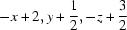
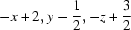
| Symmetry codes: (i) −x+2, y+1/2, −z+3/2; (ii) −x+2, y−1/2, −z+3/2; (iii) x, −y+3/2, z+1/2; (iv) x, −y+3/2, z−1/2. |
Experimental details
| Crystal data | |
| Chemical formula | C4H6N3OS+·H2PO4− |
| Mr | 241.16 |
| Crystal system, space group | Monoclinic, P21/c |
| Temperature (K) | 293 |
| a, b, c (Å) | 11.9038 (11), 9.7936 (10), 8.1914 (12) |
| β (°) | 97.231 (9) |
| V (Å3) | 947.37 (19) |
| Z | 4 |
| Radiation type | Mo Kα |
| µ (mm−1) | 0.51 |
| Crystal size (mm) | 0.30 × 0.20 × 0.20 |
| Data collection | |
| Diffractometer | Siemens SMART CCD area-detector diffractometer |
| Absorption correction | Empirical (using intensity measurements) (SADABS; Bruker, 1999) |
| Tmin, Tmax | 0.861, 0.904 |
| No. of measured, independent and observed [I > 2σ(I)] reflections | 2644, 2239, 1893 |
| Rint | 0.014 |
| (sin θ/λ)max (Å−1) | 0.660 |
| Refinement | |
| R[F2 > 2σ(F2)], wR(F2), S | 0.038, 0.109, 1.05 |
| No. of reflections | 2239 |
| No. of parameters | 150 |
| H-atom treatment | H atoms treated by a mixture of independent and constrained refinement |
| Δρmax, Δρmin (e Å−3) | 0.58, −0.43 |
Computer programs: SMART-NT (Bruker, 1999), SAINT-NT (Bruker, 1999), SHELXS97 (Sheldrick, 2008), SHELXL97 (Sheldrick, 2008), XP within SHELXTL (Sheldrick, 2008), SHELXTL (Sheldrick, 2008).
| D—H···A | D—H | H···A | D···A | D—H···A |
| N2—H2···O2 | 0.86 | 1.93 | 2.697 (2) | 147.9 |
| N3—H3···O3 | 0.80 (3) | 1.91 (3) | 2.710 (2) | 174 (3) |
| N1—H1A···O1i | 0.87 (3) | 2.09 (3) | 2.898 (2) | 155 (2) |
| N1—H1B···O5ii | 0.82 (3) | 2.20 (3) | 3.007 (2) | 170 (3) |
| O5—H5···O2iii | 0.81 (4) | 1.77 (4) | 2.546 (2) | 162 (4) |
| O4—H4···O3iv | 0.80 (4) | 1.82 (4) | 2.613 (2) | 170 (4) |
| Symmetry codes: (i) −x+2, y+1/2, −z+3/2; (ii) −x+2, y−1/2, −z+3/2; (iii) x, −y+3/2, z+1/2; (iv) x, −y+3/2, z−1/2. |
References
 Amirkhanov, V. M., Ovchynnikov, V. A., Glowiak, T. & Kozlowski, H. (1997). Z. Naturforsh. Teil B, 52, 1331–1336. CAS Google Scholar
Angyan, J. G., Poirier, R. A., Kucsman, A. & Csizmadia, I. G. (1987). J. Am. Chem. Soc. 109, 2237–2245. CrossRef CAS Google Scholar
Bruker (1999). SMART-NT, SAINT-Plus-NT and SADABS. Bruker AXS Inc., Madison, Wisconsin, USA. Google Scholar
Burling, F. T. & Goldstein, B. M. (1992). J. Am. Chem. Soc. 114, 2313–2320. CrossRef CAS Web of Science Google Scholar
Kirsanov, A. & Levchenko, V. (1957). Zh. Obshch. Khim. 27, 2313–2320. Google Scholar
Ly, T. Q. & Woollins, J. D. (1998). Coord. Chem. Rev. 176, 451–481. Web of Science CrossRef CAS Google Scholar
Ovchynnikov, V. A., Amirkhanov, V. M., Timoshenko, T. P., Glowiak, T. & Kozlowski, H. (1997). Z. Naturforsh. Teil B, 53, 481–484. Google Scholar
Shatrava, I., Ovchynnikov, O., Sliva, T., Amirkhanov, V. & Skopenko, V. (2009). Zh. Dopov. Nac. Akad. Nauk, 5, 179–185. Google Scholar
Sheldrick, G. M. (2008). Acta Cryst. A64, 112–122. Web of Science CrossRef CAS IUCr Journals Google Scholar
Smaliy, R. V., Chaikovskay, A. A., Pinchyk, A. M. & Tolmachev, A. A. (2003). Synthesis, 16, 2525–2529. CrossRef Google Scholar
This is an open-access article distributed under the terms of the Creative Commons Attribution (CC-BY) Licence, which permits unrestricted use, distribution, and reproduction in any medium, provided the original authors and source are cited.
| CRYSTALLOGRAPHIC COMMUNICATIONS |


The compound N-1,3-thiazol-2-yl-urea phosphate (I) can be synthesized by hydrolyzation of the [(1,3-thiazol-2-ylamino)carbonyl]phosphoramidic acid (II) in the water solution by heating (Scheme 1). The crystal structure investigation shows that the break up of N—P bond in [(1,3-thiazol-2-ylamino)carbonyl]phosphoramidic leads to the forming of substituted carbamide (Fig.1).
The proton of the phosphoric acid locates at the nitrogen atom of the heterocyclic ring from difference-Fourier map. The molecules of substituted urea connected by hydrogen bonds O(4)H(4)O(3) and O(5)H(5)O(2) into unlimited planes (Table 1). In turn those planes are connected to each other forming three-dimensional polymer via hydrogen bonds with molecules of phosphoric acid: N(3)H(3)O(3), N(2)H(2)O(2) and N(1)H(1 A)O(1), N(1)H(1B)O(5) (Table 1, Fig.2). The interaction of nonbonded S and O atoms can be described as attractive (Angyan, et al., 1987). In the molecule the S O nonbonded distances are significantly shorter (2.653 Å) than the sum of the corresponding van der Waals radii (3.25 Å).