 | Acta Crystallographica Section E Acta Crystallographica Section E CRYSTALLOGRAPHIC COMMUNICATIONS |


 journal menu


metal-organic compounds
| CRYSTALLOGRAPHIC COMMUNICATIONS |
 access
Bis(acetato-κ2O,O′)(4,4′-dimethyl-2,2′-bipyridine-κ2N,N′)zinc

aUniversidad Nacional de la Patagonia S.J.B. and Centro Nacional Patagonico, CONICET, Bvd. Alte. Brown 3700, 9120 Puerto Madryn, Chubut, Argentina, bDepartamento de Química Inorgánica, Analítica y Química, Física/INQUIMAE-CONICET, Facultad de Ciencias Exactas y Naturales, Universidad de Buenos Aires, Argentina, cLaboratorio de Cristalografía, Difracción de Rayos-X, Facultad de Ciencias Físicas y Matemáticas, Universidad de Chile. Av. Blanco Encalada 2008, Santiago, Chile, and dGerencia de Investigación y Aplicaciones, Centro Atómico Constituyentes, Comisión Nacional de Energía Atómica, Buenos Aires, Argentina
*Correspondence e-mail: [email protected]
The molecular structure of the title compound, [Zn(CH3COO)2(C12H12N2)], consists of isolated molecules bisected by a twofold rotation axis which goes through the ZnII cation and halves the organic base through the central C—C bond. The ZnII ion is coordinated by two N atoms from one molecule of the aromatic base and four O atoms from two bidentate, symmetry-related acetate anions, which coordinate asymmetrically [Zn—O distances of 2.058 (2) and 2.362 (3) Å], while the two Zn—N bond distances are equal as imposed by symmetry [2.079 (2) Å]. The is supported by a number of weak C—H⋯O interactions and C—H⋯π contacts, with no π–π interactions present, mainly hindered by the substituent methyl groups and the relative molecular orientation. The result is a three-dimensional structure in which each molecule is linked to eight different neighbors.
Related literature
For properties of polypyridyl compounds, see: Steed & Atwood (2009![[Steed, J. W. & Atwood, J. L. (2009). Supramolecular Chemistry, 2nd. ed., pp. 710-718. New York: John Wiley & Sons.]](../../../../../../logos/arrows/e_arr.gif "Steed, J. W. & Atwood, J. L. (2009). Supramolecular Chemistry, 2nd. ed., pp. 710-718. New York: John Wiley & Sons.") ). For related structures, see: Barquín et al. (2010). For details of the vectorial bond–valence model, see Harvey et al. (2006).
). For related structures, see: Barquín et al. (2010). For details of the vectorial bond–valence model, see Harvey et al. (2006).
![[Scheme 1]](br2212scheme1.gif)
Experimental
Crystal data
|
|
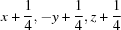 ; (ii)
  .
. Data collection: CrysAlis PRO (Oxford Diffraction, 2009); cell refinement: CrysAlis PRO; data reduction: CrysAlis PRO; program(s) used to solve structure: SHELXS97 (Sheldrick, 2008); program(s) used to refine structure: SHELXL97 (Sheldrick, 2008); molecular graphics: SHELXTL (Sheldrick, 2008); software used to prepare material for publication: SHELXL97 and PLATON (Spek, 2009).
Supporting information
contains datablocks global, I. DOI: 10.1107/S1600536812042699/br2212sup1.cif
Structure factors: contains datablock I. DOI: 10.1107/S1600536812042699/br2212Isup2.hkl
The title compound was obtained as an unexpected byproduct in an attempt to synthesize a Zn tetrathionate complex with the aromatic base. Solid Zn acetate dihydrate, 4,4'-Dimethylbipyridine and potassium tetrathionate, 0.050 mmol of each, were added to 5 ml of dimethylformamide. On standing, colorless blocks of the title compound could be extracted for diffraction experiments.
All H atoms were confirmed in a difference map, further idealized and allowed to ride, with displacement parameters taken as Uiso(H) = X × Ueq(C) [(C—H) methyl = 0.96 A°, X = 1.5; (C—H) arom = 0.93 A°, X = 1.2] (CH3 groups were also free to rotate as well).
Data collection: CrysAlis PRO (Oxford Diffraction, 2009); cell CrysAlis PRO (Oxford Diffraction, 2009); data reduction: CrysAlis PRO (Oxford Diffraction, 2009); program(s) used to solve structure: SHELXS97 (Sheldrick, 2008); program(s) used to refine structure: SHELXL97 (Sheldrick, 2008); molecular graphics: SHELXTL (Sheldrick, 2008); software used to prepare material for publication: SHELXL97 (Sheldrick, 2008) and PLATON (Spek, 2009).
![[Figure 1]](./br2212fig1thm.gif) | Fig. 1. Ellipsoid plot of (I), drawn with displacement factors at a 40% probability level. In full(empty) ellipsods and bonds, the independent(symmetry related) part of the structure. Symmetry code: (v): -x, -y, z |
![[Figure 2]](./br2212fig2thm.gif) | Fig. 2. Packing view projected down c. Only the C—H···O interactions have been drawn (in broken lines). H atoms not invovled in these interactions have been omitted, for clarity. Symmetry codes: (i) x + 1/4, -y + 1/4, z + 1/4; (ii) -x, -y, z + 1. |
| [Zn(C2H3O2)2(C12H12N2)] | F(000) = 1520 |
| Mr = 367.71 | Dx = 1.461 Mg m−3 |
| Orthorhombic, Fdd2 | Mo Kα radiation, λ = 0.71073 Å |
| Hall symbol: F 2 -2d | Cell parameters from 1985 reflections |
| a = 14.4779 (5) Å | θ = 3.6–28.9° |
| b = 28.5700 (15) Å | µ = 1.49 mm−1 |
| c = 8.0854 (3) Å | T = 295 K |
| V = 3344.4 (2) Å3 | Prism, white |
| Z = 8 | 0.3 × 0.3 × 0.2 mm |
| Oxford Diffraction Gemini CCD S Ultra diffractometer | 1481 reflections with I > 2σ(I) |
| Graphite monochromator | Rint = 0.015 |
| ω scans, thick slices | θmax = 29.0°, θmin = 3.6° |
| Absorption correction: multi-scan (CrysAlis PRO; Oxford Diffraction, 2009) | h = −17→18 |
| Tmin = 0.65, Tmax = 0.75 | k = −37→17 |
| 3945 measured reflections | l = −10→5 |
| 1563 independent reflections |
| Refinement on F2 | Secondary atom site location: difference Fourier map |
| Least-squares matrix: full | Hydrogen site location: difference Fourier map |
| R[F2 > 2σ(F2)] = 0.026 | H-atom parameters constrained |
| wR(F2) = 0.068 | w = 1/[σ2(Fo2) + (0.0402P)2 + 1.025P] where P = (Fo2 + 2Fc2)/3 |
| S = 1.09 | (Δ/σ)max < 0.001 |
| 1563 reflections | Δρmax = 0.28 e Å−3 |
| 107 parameters | Δρmin = −0.26 e Å−3 |
| 1 restraint | Absolute structure: Flack (1983), 374 Friedel pairs |
| Primary atom site location: structure-invariant direct methods | Absolute structure parameter: 0.010 (16) |
| [Zn(C2H3O2)2(C12H12N2)] | V = 3344.4 (2) Å3 |
| Mr = 367.71 | Z = 8 |
| Orthorhombic, Fdd2 | Mo Kα radiation |
| a = 14.4779 (5) Å | µ = 1.49 mm−1 |
| b = 28.5700 (15) Å | T = 295 K |
| c = 8.0854 (3) Å | 0.3 × 0.3 × 0.2 mm |
| Oxford Diffraction Gemini CCD S Ultra diffractometer | 1563 independent reflections |
| Absorption correction: multi-scan (CrysAlis PRO; Oxford Diffraction, 2009) | 1481 reflections with I > 2σ(I) |
| Tmin = 0.65, Tmax = 0.75 | Rint = 0.015 |
| 3945 measured reflections |
| R[F2 > 2σ(F2)] = 0.026 | H-atom parameters constrained |
| wR(F2) = 0.068 | Δρmax = 0.28 e Å−3 |
| S = 1.09 | Δρmin = −0.26 e Å−3 |
| 1563 reflections | Absolute structure: Flack (1983), 374 Friedel pairs |
| 107 parameters | Absolute structure parameter: 0.010 (16) |
| 1 restraint |
Geometry. All e.s.d.'s (except the e.s.d. in the dihedral angle between two l.s. planes) are estimated using the full covariance matrix. The cell e.s.d.'s are taken into account individually in the estimation of e.s.d.'s in distances, angles and torsion angles; correlations between e.s.d.'s in cell parameters are only used when they are defined by crystal symmetry. An approximate (isotropic) treatment of cell e.s.d.'s is used for estimating e.s.d.'s involving l.s. planes. |
Refinement. Refinement of F2 against ALL reflections. The weighted R-factor wR and goodness of fit S are based on F2, conventional R-factors R are based on F, with F set to zero for negative F2. The threshold expression of F2 > σ(F2) is used only for calculating R-factors(gt) etc. and is not relevant to the choice of reflections for refinement. R-factors based on F2 are statistically about twice as large as those based on F, and R- factors based on ALL data will be even larger. |
| x | y | z | Uiso*/Ueq | ||
| Zn1 | 0 | 0 | 0.08552 (5) | 0.04845 (13) | |
| O1 | −0.10026 (14) | 0.03972 (8) | −0.0279 (3) | 0.0745 (6) | |
| N1 | 0.02563 (14) | 0.04418 (7) | 0.2846 (2) | 0.0456 (4) | |
| O2 | −0.12535 (18) | −0.03328 (9) | −0.0599 (3) | 0.0843 (7) | |
| C4 | 0.01794 (12) | 0.05180 (7) | 0.5779 (5) | 0.0421 (5) | |
| H4 | 0.0071 | 0.038 | 0.6803 | 0.051* | |
| C7 | −0.14861 (19) | 0.00731 (10) | −0.0837 (4) | 0.0548 (7) | |
| C5 | 0.01168 (12) | 0.02544 (8) | 0.4354 (3) | 0.0361 (4) | |
| C8 | −0.2331 (2) | 0.01806 (14) | −0.1800 (9) | 0.0900 (14) | |
| H8B | −0.2777 | 0.0328 | −0.1093 | 0.135* | |
| H8C | −0.2584 | −0.0104 | −0.2238 | 0.135* | |
| H8A | −0.2178 | 0.0388 | −0.2694 | 0.135* | |
| C3 | 0.04052 (15) | 0.09917 (8) | 0.5683 (4) | 0.0502 (5) | |
| C1 | 0.0483 (2) | 0.08971 (10) | 0.2769 (4) | 0.0604 (7) | |
| H1 | 0.0586 | 0.103 | 0.1735 | 0.073* | |
| C2 | 0.05697 (19) | 0.11722 (9) | 0.4128 (4) | 0.0607 (7) | |
| H2 | 0.0741 | 0.1484 | 0.401 | 0.073* | |
| C6 | 0.0449 (2) | 0.12828 (10) | 0.7225 (4) | 0.0719 (9) | |
| H6A | 0.0721 | 0.1103 | 0.8101 | 0.108* | |
| H6C | −0.0164 | 0.1376 | 0.7538 | 0.108* | |
| H6B | 0.0818 | 0.1556 | 0.7024 | 0.108* |
| U11 | U22 | U33 | U12 | U13 | U23 | |
| Zn1 | 0.04289 (17) | 0.0737 (3) | 0.02871 (17) | 0.01368 (17) | 0 | 0 |
| O1 | 0.0622 (11) | 0.0907 (14) | 0.0706 (15) | −0.0028 (10) | −0.0158 (11) | −0.0093 (12) |
| N1 | 0.0478 (10) | 0.0549 (11) | 0.0342 (11) | 0.0047 (8) | 0.0032 (8) | 0.0080 (8) |
| O2 | 0.0909 (16) | 0.0871 (15) | 0.0749 (17) | 0.0313 (12) | −0.0146 (13) | −0.0022 (13) |
| C4 | 0.0424 (11) | 0.0480 (10) | 0.0361 (11) | 0.0034 (8) | −0.0042 (16) | 0.0013 (12) |
| C7 | 0.0399 (12) | 0.0850 (19) | 0.0393 (14) | 0.0085 (11) | 0.0013 (10) | −0.0056 (13) |
| C5 | 0.0329 (9) | 0.0459 (12) | 0.0296 (11) | 0.0036 (7) | −0.0017 (8) | 0.0031 (9) |
| C8 | 0.061 (2) | 0.109 (3) | 0.100 (4) | 0.0012 (17) | −0.037 (3) | 0.017 (3) |
| C3 | 0.0452 (10) | 0.0462 (11) | 0.0593 (16) | 0.0006 (9) | −0.0095 (12) | −0.0025 (12) |
| C1 | 0.0654 (15) | 0.0602 (15) | 0.0557 (18) | −0.0014 (12) | 0.0060 (12) | 0.0240 (13) |
| C2 | 0.0621 (16) | 0.0440 (12) | 0.076 (2) | −0.0032 (11) | −0.0005 (14) | 0.0087 (14) |
| C6 | 0.080 (2) | 0.0559 (15) | 0.079 (2) | −0.0007 (14) | −0.0190 (17) | −0.0158 (16) |
| Zn1—O1i | 2.058 (2) | C4—H4 | 0.93 |
| Zn1—O1 | 2.058 (2) | C7—C8 | 1.482 (5) |
| Zn1—N1 | 2.079 (2) | C5—C5i | 1.493 (4) |
| Zn1—N1i | 2.079 (2) | C8—H8B | 0.96 |
| Zn1—O2 | 2.362 (3) | C8—H8C | 0.96 |
| Zn1—O2i | 2.362 (3) | C8—H8A | 0.96 |
| Zn1—C7 | 2.558 (3) | C3—C2 | 1.380 (4) |
| Zn1—C7i | 2.558 (3) | C3—C6 | 1.500 (4) |
| O1—C7 | 1.246 (3) | C1—C2 | 1.357 (4) |
| N1—C1 | 1.343 (3) | C1—H1 | 0.93 |
| N1—C5 | 1.347 (3) | C2—H2 | 0.93 |
| O2—C7 | 1.223 (3) | C6—H6A | 0.96 |
| C4—C5 | 1.380 (4) | C6—H6C | 0.96 |
| C4—C3 | 1.394 (3) | C6—H6B | 0.96 |
| O1i—Zn1—O1 | 127.09 (15) | C5—C4—C3 | 119.9 (3) |
| O1i—Zn1—N1 | 123.63 (9) | C5—C4—H4 | 120 |
| O1—Zn1—N1 | 97.82 (8) | C3—C4—H4 | 120 |
| O1i—Zn1—N1i | 97.82 (8) | O2—C7—O1 | 119.6 (3) |
| O1—Zn1—N1i | 123.63 (9) | O2—C7—C8 | 120.4 (3) |
| N1—Zn1—N1i | 78.52 (11) | O1—C7—C8 | 120.0 (3) |
| O1i—Zn1—O2 | 95.63 (10) | O2—C7—Zn1 | 66.85 (17) |
| O1—Zn1—O2 | 57.21 (9) | O1—C7—Zn1 | 52.72 (15) |
| N1—Zn1—O2 | 140.08 (8) | C8—C7—Zn1 | 172.7 (2) |
| N1i—Zn1—O2 | 90.22 (9) | N1—C5—C4 | 122.0 (2) |
| O1i—Zn1—O2i | 57.21 (9) | N1—C5—C5i | 114.92 (13) |
| O1—Zn1—O2i | 95.63 (10) | C4—C5—C5i | 123.13 (15) |
| N1—Zn1—O2i | 90.22 (9) | C7—C8—H8B | 109.5 |
| N1i—Zn1—O2i | 140.08 (8) | C7—C8—H8C | 109.5 |
| O2—Zn1—O2i | 120.30 (15) | H8B—C8—H8C | 109.5 |
| O1i—Zn1—C7 | 113.57 (9) | C7—C8—H8A | 109.5 |
| O1—Zn1—C7 | 28.79 (8) | H8B—C8—H8A | 109.5 |
| N1—Zn1—C7 | 120.97 (8) | H8C—C8—H8A | 109.5 |
| N1i—Zn1—C7 | 108.27 (9) | C2—C3—C4 | 117.0 (3) |
| O2—Zn1—C7 | 28.42 (8) | C2—C3—C6 | 122.9 (2) |
| O2i—Zn1—C7 | 110.31 (10) | C4—C3—C6 | 120.1 (3) |
| O1i—Zn1—C7i | 28.79 (8) | N1—C1—C2 | 123.1 (2) |
| O1—Zn1—C7i | 113.57 (9) | N1—C1—H1 | 118.5 |
| N1—Zn1—C7i | 108.27 (9) | C2—C1—H1 | 118.5 |
| N1i—Zn1—C7i | 120.97 (8) | C1—C2—C3 | 120.4 (2) |
| O2—Zn1—C7i | 110.31 (10) | C1—C2—H2 | 119.8 |
| O2i—Zn1—C7i | 28.42 (8) | C3—C2—H2 | 119.8 |
| C7—Zn1—C7i | 115.34 (13) | C3—C6—H6A | 109.5 |
| C7—O1—Zn1 | 98.50 (18) | C3—C6—H6C | 109.5 |
| C1—N1—C5 | 117.6 (2) | H6A—C6—H6C | 109.5 |
| C1—N1—Zn1 | 126.56 (18) | C3—C6—H6B | 109.5 |
| C5—N1—Zn1 | 115.64 (15) | H6A—C6—H6B | 109.5 |
| C7—O2—Zn1 | 84.73 (19) | H6C—C6—H6B | 109.5 |
| Symmetry code: (i) −x, −y, z. |
| Cg1 and Cg2 are the centroids of the Zn1,O1,C7,O2 and N1,C1–C5 rings, respectively. |
| D—H···A | D—H | H···A | D···A | D—H···A |
| C2—H2···O1ii | 0.93 | 2.53 | 3.354 (4) | 147 |
| C6—H6A···O2iii | 0.96 | 2.56 | 3.438 (4) | 153 |
| C4—H4···Cg1iv | 0.93 | 2.99 | 3.874 (4) | 160 |
| C4—H4···Cg1iii | 0.93 | 2.96 | 3.766 (4) | 145 |
| C8—H8B···Cg2v | 0.96 | 2.96 | 3.804 (4) | 147 |
| Symmetry codes: (ii) x+1/4, −y+1/4, z+1/4; (iii) −x, −y, z+1; (iv) x, y, z+1; (v) x−1/2, y, z−1/2. |
Experimental details
| Crystal data | |
| Chemical formula | [Zn(C2H3O2)2(C12H12N2)] |
| Mr | 367.71 |
| Crystal system, space group | Orthorhombic, Fdd2 |
| Temperature (K) | 295 |
| a, b, c (Å) | 14.4779 (5), 28.5700 (15), 8.0854 (3) |
| V (Å3) | 3344.4 (2) |
| Z | 8 |
| Radiation type | Mo Kα |
| µ (mm−1) | 1.49 |
| Crystal size (mm) | 0.3 × 0.3 × 0.2 |
| Data collection | |
| Diffractometer | Oxford Diffraction Gemini CCD S Ultra diffractometer |
| Absorption correction | Multi-scan (CrysAlis PRO; Oxford Diffraction, 2009) |
| Tmin, Tmax | 0.65, 0.75 |
| No. of measured, independent and observed [I > 2σ(I)] reflections | 3945, 1563, 1481 |
| Rint | 0.015 |
| (sin θ/λ)max (Å−1) | 0.682 |
| Refinement | |
| R[F2 > 2σ(F2)], wR(F2), S | 0.026, 0.068, 1.09 |
| No. of reflections | 1563 |
| No. of parameters | 107 |
| No. of restraints | 1 |
| H-atom treatment | H-atom parameters constrained |
| Δρmax, Δρmin (e Å−3) | 0.28, −0.26 |
| Absolute structure | Flack (1983), 374 Friedel pairs |
| Absolute structure parameter | 0.010 (16) |
Computer programs: CrysAlis PRO (Oxford Diffraction, 2009), SHELXS97 (Sheldrick, 2008), SHELXTL (Sheldrick, 2008), SHELXL97 (Sheldrick, 2008) and PLATON (Spek, 2009).
| Cg1 and Cg2 are the centroids of the Zn1,O1,C7,O2 and N1,C1–C5 rings, respectively. |
| D—H···A | D—H | H···A | D···A | D—H···A |
| C2—H2···O1i | 0.93 | 2.53 | 3.354 (4) | 147 |
| C6—H6A···O2ii | 0.96 | 2.56 | 3.438 (4) | 153 |
| C4—H4···Cg1iii | 0.93 | 2.99 | 3.874 (4) | 160 |
| C4—H4···Cg1ii | 0.93 | 2.96 | 3.766 (4) | 145 |
| C8—H8B···Cg2iv | 0.96 | 2.96 | 3.804 (4) | 147 |
| Symmetry codes: (i) x+1/4, −y+1/4, z+1/4; (ii) −x, −y, z+1; (iii) x, y, z+1; (iv) x−1/2, y, z−1/2. |
Acknowledgements
We would like to thank the Spanish Research Council (CSIC) for providing us with a free-of charge licence to the CSD System (Allen, 2002). FONCyT grant PME-01113 (XRD) is gratefully acknowledged.
References
 Allen, F. H. (2002). Acta Cryst. B58, 380–388. Web of Science CrossRef CAS IUCr Journals Google Scholar
Barquín, M., Cocera, N., González Garmendia, M. J., Larrínaga, L., Pinilla, E., Seco, J. M. & Torres, M. R. (2010). Inorg. Chim. Acta, 363, 127–133. Google Scholar
Flack, H. D. (1983). Acta Cryst. A39, 876–881. CrossRef CAS Web of Science IUCr Journals Google Scholar
Harvey, M. A., Baggio, S. & Baggio, R. (2006). Acta Cryst. B62, 1038–1042. Web of Science CrossRef CAS IUCr Journals Google Scholar
Oxford Diffraction (2009). CrysAlis PRO. Oxford Diffraction Ltd, Yarnton, England. Google Scholar
Sheldrick, G. M. (2008). Acta Cryst. A64, 112–122. Web of Science CrossRef CAS IUCr Journals Google Scholar
Spek, A. L. (2009). Acta Cryst. D65, 148–155. Web of Science CrossRef CAS IUCr Journals Google Scholar
Steed, J. W. & Atwood, J. L. (2009). Supramolecular Chemistry, 2nd. ed., pp. 710–718. New York: John Wiley & Sons. Google Scholar
This is an open-access article distributed under the terms of the Creative Commons Attribution (CC-BY) Licence, which permits unrestricted use, distribution, and reproduction in any medium, provided the original authors and source are cited.
| CRYSTALLOGRAPHIC COMMUNICATIONS |


Polypyridil compounds and some of their derivatives have shown to be fruitful ligands in supramolecular photochemistry, due to the capability of its extended π- systems to absorb light. They can act as light harvesters as much as to relax photoexcited metal centres via MLCT to the ligand-centred π*L orbital; some interesting examples can be found in Steed & Atwood, 2009. In particular, in the case of 4,4'-dimethyl-2,2'-bipyridine (dmbp), the presence of the methyl groups in the aromatic ligand can additionally influence the structural behavior when binding to a metal centre. We present in what follows the crystal and molecular structure of the title compound, C16H18N2O4Zn, consisting of isolated Zn(dmbp)(ac)2, molecules (ac = acetate) bisected by a twofold axis which goes through the Zn(II) cation and halves the organic base through the central C—C bond.
The Zn(II) ion is coordinated by two nitrogen atoms from one molecule of the aromatic base and four oxygen atoms from two bidentate, symmetry related acetate anions (Fig. 1). A very similar compound, with Cu(II) as its central cation has been reported in Barquín et al., 2010. Donor atoms in the title compound can not fit in any regular polyhedron, but the three chelate ligands fulfill the vector bond valence postulate of the Vectorial Bond-Valence Model (for details on the theory see Harvey et al., 2006). The three ligand vectors, as defined therein, lay in a planar trigonal geometry with a sum of angles equal to 359.6 (2)° (ideal: 360°) and a resultant vector modulus of 0.03 v.u. (Ideal: 0.00 v.u.).
Both acetate anions coordinate asymmetrically (Zn—O distances 2.058 (2) and 2.362 (3) Å), while the two Zn—N bond distances are equal (2.079 (2) Å) as imposed by symmetry.
The crystal structure is supported by a number of weak C—H···O interactions (Table 1, entries 1,2) and C—H···π contacts (Table 1, entries 3 to 5). In spite of the presence of aromatic rings there are no π-π interactions in the structure, mainly hindered by the substituent methyl groups and the relative molecular orientation.
The overall effect of these weak interactions, uniformly distributed in space, is the formation of a three-dimensional structure where each molecule is linked to eight different neighbors. Fig. 2 presents a highly simplified packing view projected down c, where only the C—H···O bonds have been drawn, for clarity, and where the complex linkage can be envisaged.