

 journal menu


issue contents
September 2025 issue
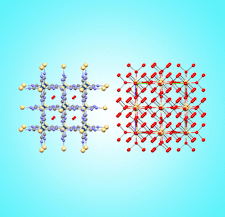
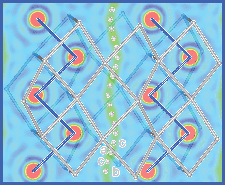
Cover illustration: The cover image shows idealized components of the Fm3m structure of [Cd2+]3[Ir(CN)63−]2·12H2O [Mullica et al. (1996). Acta Cryst. C52, 502–504], which is an example of a rare type of structure that the IUCr Commission on Crystallographic Nomenclature has decided can be reported as having a fractional Z [Brock (2025). Acta Cryst. A81, 405–408]. This Z = 4/3 structure is understood to be a 2:1 stoichiometric ratio of components [Cd2+][Ir(CN)63−]·H2O (charge 1−) and [Cd(OH2)62+]·4H2O (charge 2+) that are spatially disordered. Each metal atom lies on an m3m site, which has multiplicity 4.
advances
research papers


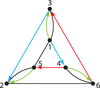
The distribution of aluminium cations in disordered tectosilicates is analysed according to the concepts of maximal independence and maximum symmetry.
foundations
research papers
Open  access
access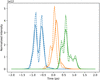
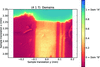
An algorithm is described to recover super-temporal resolution dynamics of X-ray scattering profiles of photo-excited biomolecules in solution from pump–probe X-ray solution scattering data.
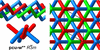
We provide a systematic account using symmetry and coordinates to explore symmetric (vertex- and edge-transitive) 3-periodic weavings of piecewise linear threads and 3-coordinated nets.
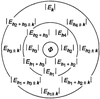
A probabilistic theory of the quartet invariants is presented, which is capable of estimating quartet phases by exploiting the prior information contained in the Patterson map.
short communications
Open access
access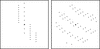
Machine learning based sorting of synthetic serial electron diffraction patterns into 2D zonal patterns and patterns representing intersections of multiple Laue zones is demonstrated. The extracted zonal patterns can be used for the determination of unit-cell parameters.

Open access
access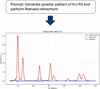
The present work demonstrates the use of large language models for generating computational tools to aid X-ray powder diffraction analysis.
commission reports
Free
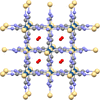
The Commission on Crystallographic Nomenclature has concluded that, in some rare, carefully justified circumstances, Z, the number of formula units in the unit cell, may be a fraction.