

 menu


issue contents
November 2026 issue
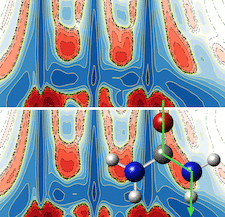
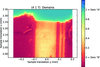
Cover illustration: The cover image shows the first experimentally reconstructed Wigner function of electrons in a molecular crystal (top), compared with a correlated quantum-chemical calculation (bottom), mapping the electrons of urea in a joint position–momentum phase-space picture along the O–C–N–H chain of the molecule [Yu & Gillet (2026). Acta Cryst. A82, 419–427]. Unlike a classical probability distribution, the Wigner function can become negative, and the red regions where it does are a direct signature of the quantum nature of the electrons. Obtained by combining X-ray diffraction with Compton scattering, this result opens a route to experimentally determining electron quantum states in crystalline materials.
advances
research papers


Open  access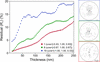
This work establishes the role of absorption in 3D electron diffraction dynamical refinement, where its inclusion is shown to significantly affect refinement outcomes only in high-Z materials at thicknesses approaching ξg.
Open access
access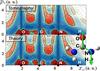
The first reconstruction of an experimental one-particle reduced Wigner function for electrons in molecular crystals is reported. It relies on an ensemble N-representable model jointly refined from the X-ray diffraction and Compton scattering data.
foundations
research papers
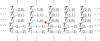
We study the dynamics and entropy of dynamical systems arising from two-dimensional random substitutions, exhibiting both local disorder and global order, as shown by positive topological entropy and the presence of non-trivial pure-point components in the diffraction spectrum.

We investigate the spectral properties of two distinct classes of two-dimensional random substitutions: a family of constant-shape block random substitutions and the random Fibonacci direct product variation, which is a nonconstant-shape but geometrically compatible random inflation rule.

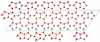
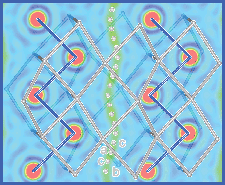
The stability factors of ice bilayers with different arrangements of hydrogen atoms in hydrogen bonds are established. A topological condition for the assembly of bilayers from individual fragments is proposed. Methods for producing bilayers and the main challenges are described.
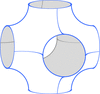
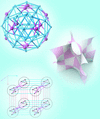
The triply periodic Schwarz minimal P surface is derived from close packing of polyhedra in 3D space, through iterative minimization of the area of the interface that separates the two identical 3D labyrinths that are created in this way.
Open access
access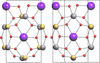
The distribution of aluminium cations in disordered phyllosilicates is analysed according to the concepts of maximal independence and regularity.
book reviews
Free