
Acta Crystallographica
Section A FOUNDATIONS AND ADVANCES


 menu


- 1. Introduction
- 2. Modification of the structure-factor equation
- 3. Model building for structure refinement
- 4. Special cases
- 5. (2 + 1)-Dimensional illustrative example
- 6. Conclusions
- A1. Atomic modulation functions from rigid-body modulation
- A2. Atomic form factors
- A3. Structure-factor calculations
- A4. Electron-density calculations
- Supporting information
- References


- 1. Introduction
- 2. Modification of the structure-factor equation
- 3. Model building for structure refinement
- 4. Special cases
- 5. (2 + 1)-Dimensional illustrative example
- 6. Conclusions
- A1. Atomic modulation functions from rigid-body modulation
- A2. Atomic form factors
- A3. Structure-factor calculations
- A4. Electron-density calculations
- Supporting information
- References
research papers
| FOUNDATIONS ADVANCES |
 access
Towards quantum crystallographic description of incommensurately modulated structures

aInstitute for Inorganic and Analytical Chemistry, Goethe University Frankfurt, Max-von-Laue Straße 7, Frankfurt am Main 60438, Germany
*Correspondence e-mail: [email protected]
In this contribution, a slight modification of the structure-factor equation for incommensurately modulated structures is proposed in order to enable structure description with non-spherical atomic form factors. A hypothetical (2 + 1)-dimensional structure in Flatland is used as an example to demonstrate the need for the modification when switching to a more advanced description of the electron density. The study is primarily concerned with molecular systems.
Keywords: quantum crystallography; aspherical form factors; incommensurately modulated structures; aperiodic structures.
1. Introduction
Charge density in crystal structure modeling is traditionally described assuming isotropic electron distribution around independent atoms. This is a good approximation and leads to reasonably precise structure models when refining from experimental diffraction data. A more advanced charge-density description can be achieved using the Hansen–Coppens formalism in which atoms are still considered as independent, but the charge density is anisotropic – described using spherical harmonics (Hansen & Coppens, 1978 ). Even before the development of the multipole density formalism, wavefunction-based methods were considered and later Massa and Karle coined the term quantum crystallography (Huang et al., 1999; Macchi, 2020). This field has flourished ever since and different methods are at the disposal of researchers (Gatti & Macchi, 2012). One of the approaches that has gained considerable attention for small-molecule systems is Hirshfeld atom refinement (HAR) (Jayatilaka & Dittrich, 2008; Capelli et al., 2014). The structure models can be significantly improved in this way, especially the parameters of the hydrogen atoms (Capelli et al., 2014; Woińska et al., 2014; Woińska et al., 2016).
Despite all the advancements in the vibrant field of quantum crystallography, aperiodic crystal structures have received comparatively little to no attention in this regard. The aim of this contribution is to formalize the use of non-spherical atomic form factors in describing (3+n)-dimensional incommensurately modulated structures. A slight modification of the structure-factor equation is proposed. Finally, an illustrative (2+1)-dimensional case is demonstrated.
2. Modification of the structure-factor equation
The structure factor of (3 + n)-dimensional incommensurately modulated structures described within the superspace formalism can be calculated as follows:
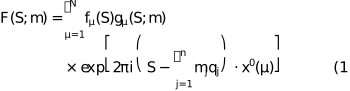
with

Here,  is the form factor of atom μ that for spherical atom electron density is a function of the scattering vector norm
 only,
 is the vector of satellite indices (
 for main reflections),
 is the modulation wavevector of each additional dimension
 ,
 is the basic position of atom μ, N is the number of atoms in the basic-structure unit cell, n is the number of additional superspace dimensions. For simplicity, atomic thermal displacement is omitted. Structure modulation is expressed in the function
 , where the vector
 components are the modulation function values at
 for each spatial coordinate. Integral (2) encompasses one period of modulation (van Smaalen, 2007).
Equation (1) is valid for calculating the structure factor under the spherical approximation of the atomic electron density. To enable a proper structure description with non-spherical atomic electron density, we propose replacing the product  in (1) by the following integral:

The structure-factor formula becomes

The atomic form factor in integral (3) is now a function of which means that the atom electron-density distribution may be modulated along the additional superspace dimension(s).
3. Model building for structure refinement
For an ordinary structure, building a model with non-spherical atom electron density requires appropriate scattering factors for each atom in the asymmetric unit. One class of methods for obtaining such non-spherical atomic scattering factors uses quantum-chemical electron densities partitioned into atomic contributions. In a method known as HAR (Capelli et al., 2014) the standard independent atom model based on spherical atomic form factors is exploited as the starting point. From this, a single-point quantum-chemical calculation is performed and the resulting electron density of the asymmetric unit is partitioned into atomic electron densities. A new refinement of the structural parameters is performed using the form factors obtained from the partitioned electron density. The single-point quantum-chemical calculation step with the subsequent structure refinement is performed until a convergence according to some criteria is reached. Because the single-point calculation is performed for the asymmetric unit, it must define an isolated chemical entity like a molecule, an ion pair, a complex compound or a group of molecules (in case of hydrates/solvates or  structures). Alternatively, the calculation of the full unit cell can be performed using the periodic boundary condition which leads to a better model description since the asymmetric unit is no longer considered in isolation from the rest of the crystal structure. In addition, polymeric and purely ionic structures can be treated in this way. This procedure is called periodic HAR (Chu et al., 2026).
In the case of incommensurately modulated structures described within the superspace framework, atoms are considered as strings in (3 + 1)-dimensional structures and higher-dimensional constructs (sheets or solids) in (3 + 2)- or (3 + 3)-dimensional structures. A quantum-chemical calculation requires a 3D atomistic model. Despite this superspace formalism, the structure exists physically in the 3D space, allowing a 3D atomistic model to be constructed. Specifically, a 3D atomistic model is recovered by intersecting the superspace structure with a 3D physical-space section, whose position in superspace is specified by t. The problem is that such a model, in principle, contains a countably infinite number of unit cells for which no 3D periodic boundary condition applies. In addition, the superspace can be intersected at countably infinite  values. The first issue can be circumvented by focusing on the asymmetric unit only. However, a reliable quantum-chemical calculation must be feasible for such an isolated entity, i.e. it must be, for example, a molecule. The second issue can be circumvented by evaluating integral (3) numerically. Here, Gauss–Legendre integration can be applied (Riley et al., 2006), i.e. the integrand of (3) is evaluated at a number of values,
pn. Consequently, the
 values which are derived from single-point quantum-chemical calculations are only required at these
pn points. For
(3+1)-dimensional cases (
 ), evaluating the integrand at
 Gauss–Legendre nodes might be sufficient.
A prospective refinement based on non-spherical atomic electron density of an incommensurately modulated structure may be performed as follows: (i) a converged refinement based on the spherical model is used as a starting point; (ii) a number of points
pn is chosen at which to evaluate the integrand of (3) based on complexity of the modulation functions; (iii) the geometry of the asymmetric unit at  points is recovered and
pn single-point quantum-chemical calculations are performed; (iv) the resulting electron density is partitioned into atomic contributions and the Fourier transform is applied to derive ; (v) a refinement step is performed using the non-spherical atomic form factors and structure-factor equation (4); (vi) steps (iii), (iv) and (v) are repeated until a convergence is reached. Due to the aperiodicity of incommensurately modulated structures no true periodic HAR is feasible. Nevertheless, instead of considering an isolated asymmetric unit at
pn points, larger structure fragments can be used (i.e. a group of molecules around the asymmetric unit) to ensure that the immediate chemical environment is taken into account.
4. Special cases
The above given general procedure can be further simplified for molecular systems in case some additional conditions regarding the nature of modulation apply. The following cases can be distinguished: (i) the asymmetric unit is rigid and the modulation only involves some translation along the unit-cell axis (retaining the orientation); (ii) the asymmetric unit is rigid but the modulation also involves some rotation. In both cases, only one single-point calculation of the asymmetric unit in each refinement step is necessary ( ). A downside of this simplification is that subtleties in the molecular electron density arising from the modulation are not captured.
For the first case, no modification of the structure-factor equation (1) is in fact necessary. The geometry of the asymmetric unit can be taken at an arbitrary to perform the theoretical calculations. Note that the geometry based on the basic positions is not necessarily meaningful. The derived values are constant along .
For the second case, structure-factor equation (4) is appropriate. The geometry of the asymmetric unit (defined as a rigid body) is taken at  to perform the theoretical calculations. The atomic electron-density distribution is constant along , but its orientation with respect to the unit-cell axis is a function of , i.e. of or
 . To formalize this, the description of a
(3+n)-dimensional incommensurately modulated structure with the rigid-body approach is first summarized.
A rigid body  is defined by a group of atoms and their basic positions . In addition, a reference point (origin)
 is defined (e.g. the geometric center, the center of mass, one of the atoms or an arbitrary point). The positional modulation of a rigid body can then be described with the translational modulation functions
 =
 ,
 ,
 and the rotational modulation functions
 =
 ,
 ,
 . The former functions represent translations in the fractional space. The latter functions represent rotation of rigid body in the Cartesian space along all three axes with as the origin. Unlike translations, the rotation operations are not commutative and the order in which the individual rotations along each axis take place must be given. Then, the individual atomic displacement modulation functions necessary for the structure-factor calculation can be derived as follows:

Here, is the modulation phase vector with components  and , L is the direct-lattice matrix relating the fractional and the Cartesian space, and
Rx,
Ry and
Rz are rotation matrices:



Once atomic modulation functions  are defined, the atomic form factor dependence on remains to be expressed. Rotation of atomic electron-density distribution can be realized directly in the Fourier domain. Furthermore, the rotational modulation functions of the rigid body,
 , can be directly applied to the electron density of the individual atoms:

where
Si are components of the scattering vector  .
5. (2 + 1)-Dimensional illustrative example
To illustrate the implications of the general formalism, we will consider a simplified (2 + 1)-dimensional realization in this section. Although such a reduced-dimensional setting does not correspond to a physically realizable system, it provides a convenient framework for visualizing a structure described with non-spherical electron density as encoded by the derived equations. The hypothetical (2 + 1)-dimensional structure exists in Flatland rather than the physical space. Consequently, the atomic electron density is either circular or non-circular. First, we will consider the structure using a circular atom approximation. Then, a more advanced description of electron density will be considered based on the same example structure. The (2 + 1)-dimensional superplane will be referred to as superspace for convenience.
5.1. Structure model based on circular atomic density
This Flatland structure is described in a (2 + 1)-dimensional superspace group  , which is based on the lowest-symmetry 2D crystallographic plane group p1 (Schattschneider, 1978). There is only the identity symmetry operator
(x1,x2,x3) present. The unit-cell parameters are chosen as
a1 = 4 length units,
a2 = 6 length units, α = 100°. The modulation wavevector
 . The structure model is summarized in Fig. 1. Three different atoms 1, 2 and 3 are chosen to form a molecule and the molecule is a rigid body. For this rigid body, displacive modulation
 ,
 is assigned together with a rotation along the geometric center
 . Based on this assigned modulation, functions
 and
 for individual atoms are derived according to equation (5) (see also Appendix A). Those are shown in Fig. 1 (bottom).
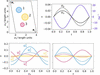
|
Figure 1
Representation of a hypothetical (2 + 1)-dimensional incommensurately modulated structure in Flatland. Top left: basic cell showing a molecule of three atoms in basic positions. Top right: assigned modulation for the molecule as a rigid body; displacement functions ux (solid line) and uy (dotted line) as well as a rotation along the geometric center  . Bottom: derived displacive modulation functions for individual atoms as functions of
x3 and t. |
To reconstruct the hypothetical electron density for this Flatland structure, structure factors of a set of reciprocal-lattice  points need to be calculated. The set of reciprocal-lattice points can be generated to correspond to some chosen resolution, say,
 1.5 reciprocal length units. The maximum order of the satellite reflections will be set to 3. The modulation of the rigid body in this Flatland structure example is composed of simple sinusoidal functions, but the resulting amplitudes for individual atoms become rather large (for display purposes) which means that higher-order satellites are necessary to accurately reconstruct the electron density. Finally, some circular atomic form factors are introduced (see Appendix A for details). With this information at hand, the structure-factor function can be calculated with equation (1).
The inverse Fourier transform of the structure-factor function in the 3D superspace, i.e. with integer
h1,h2,m indices  , leads to the generalized electron density
 (van Smaalen, 2007). This electron-density function can be depicted in 3D space exploiting the direct superspace lattice Σ with basis vectors
 :

where  are the basis vectors of the direct lattice Λ in the Flatland plane and
 is the additional basis vector perpendicular to the Flatland plane. Unlike all other basis vectors that have some units of length, is dimensionless and encompasses one modulation period (van Smaalen, 2007). For display purposes, it is set at
 = 2 length units, but only the fractional range
[0,1) is in fact relevant. Electron density in (2 + 1)-dimensional superspace is periodic in all three dimensions and the space defined by the direct superspace lattice basis vectors and can be considered the unit cell of the generalized electron density . There, the atoms are strings approximately parallel to . In Fig. 2 (top left), is depicted.
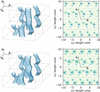
|
Figure 2
Reconstructed electron density of the (2 + 1)-dimensional incommensurately modulated Flatland structure. Top left: isosurface of the generalized electron density in superspace  with circular atoms. Top right: a fragment of the Flatland structure electron density  with circular atoms. Bottom left: isosurface of the generalized electron density in superspace with one non-circular atom. Bottom right: a fragment of the Flatland structure electron density with one non-circular atom. |
The modulated structure in Flatland is retrieved when the generalized electron density is intersected by a plane perpendicular to . This condition is met if the plane goes through points  ,
 and
 . Vectors
 and
 correspond to the Flatland plane direct-lattice Λ basis vectors
 and
 , respectively. Since the generalized electron density is translationally symmetrical, the intersecting plane will feature countably infinite 2D unit cells yielding the incommensurately modulated structure. A plane
 to can intersect at a countably infinite number of points. All resulting 2D structures will be essentially the same structures but with different origins.
A fragment of the electron density of the incommensurately modulated structure in Flatland is depicted in Fig. 2 (top right). It was generated by slant plane Fourier series (see Appendix A) using the superspace structure-factor function. Alternatively, it can be computed using the projected structure factors [equation 8.3 of van Smaalen (2007)].
5.2. Structure model based on non-circular atomic density
Going beyond an isotropic charge-density distribution of atoms requires appropriate atomic form factors. In this Flatland structure example, we will consider only atom 2 to have some non-circular form factor. Now,  is a function of the scattering vector not of its norm. Furthermore, is complex. [The atomic form factor is a complex function if the density distribution function is not even. Spherical (circular) density centered at the origin is an even function and the corresponding form factor is real. Non-spherical electron density may be an even function but in the most general case it does not result in complex form factor functions.] Let us assume that the electron density of the molecule does not vary along the additional superspace dimension. However, according to the structure model, the modulation of the asymmetric unit has some rotational component and therefore equation (4) is applicable. This corresponds to the special case (ii) as described above. In Appendix A all necessary equations to generate the electron density are given. Those are derived from the general
(3+n)-dimensional equations as given above.
The reconstructed electron density of the Flatland structure with atom 2 having a non-circular form factor is depicted in Fig. 2 (bottom). Note how the non-circular atomic electron density of atom 2 in Fig. 2 (bottom right) is always oriented to be consistent in particular with the rotational modulation of the molecule (rigid body). This is not achievable with structure-factor equation (1). It is evident from the electron-density reconstruction that slightly modifying the structure-factor formula (1) allows us to introduce a modulated structure description with non-circular (non-spherical in the general sense) electron density.
6. Conclusions
The proposed modification of the structure-factor equation enables incommensurately modulated structures to be described using non-spherical atomic form factors. This modification treats the form factor as a function of the superspace argument . The illustrative
(2+1)-dimensional case shows why this dependence matters when switching from circular to non-circular form factors. A refinement strategy is outlined for molecular compounds. Applying it to experimental diffraction data will be the next step in assessing its practical benefits. This work extends quantum crystallography methods to incommensurately modulated structures.
APPENDIX A
All crystallographic computations were done and illustrations generated using self-written Python codes (see the supporting information); 3D superspace electron density was displayed using the program VESTA 3.90 (Momma & Izumi, 2011).
A1. Atomic modulation functions from rigid-body modulation
A rigid body was defined using three atoms and the geometric center as the origin. Translational modulations  with
 ,
 and a rotational modulation
 were applied. The 3D rotation matrices given above [equations (6), (7) and (8)] reduce to the following matrix:

where  .
The individual atomic displacive modulation functions for each atom μ can be calculated using equation (5) adapted as follows:

A2. Atomic form factors
Circular atomic form factors for three atoms were introduced using the analytical Fourier transform of an isotropic 2D Gaussian function:

with  and
 . For atom 2, additionally a non-circular electron-density distribution was introduced using a sum of displaced isotropic Gaussian functions. Its Fourier transform, i.e. the atomic form factor, is expressed analytically as follows:
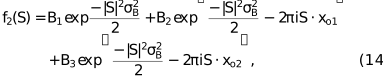
with  and
 . The imaginary phase terms arise from the Fourier shift theorem and offset the two additional Gaussian peaks by
 and
 . All numerical values are chosen arbitrarily.
A3. Structure-factor calculations
To calculate structure factors [equations (1) and (4)] a set of
(h1,h2) was generated so that  1.5 reciprocal length units. In addition to main reflections (
 ), satellite reflections with
 were considered. This formed a set of reflections . The integrals (2) and (3) were evaluated numerically using Gauss–Legendre integration evaluating the integrands at
 nodes.
For the non-circular case, rotation of the atomic electron-density distribution realized in the Fourier domain [as given in equation (9)] becomes

where
Si are components of the scattering vector in Flatland reciprocal space.
A4. Electron-density calculations
Generalized superspace electron density was calculated using Beevers–Lipson factorization (Giacovazzo, 2002). The electron density for the Flatland structure was calculated using the slant plane Fourier series (Rollett, 1965):
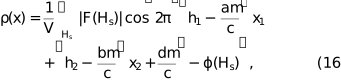
where  is the phase of the structure factor and
a,b,c,d are constants defining the chosen plane
 , with
xsi being the fractional coordinates with respect to the basis vectors as defined by equation (10) and the additional basis vector .
Supporting information
Python code. DOI: https://doi.org/10.1107/S2053273326010909/lu5053sup1.txt
Python code (classes). DOI: https://doi.org/10.1107/S2053273326010909/lu5053sup2.txt
Acknowledgements
Open access funding enabled and organized by Projekt DEAL.
Conflict of interest
There are no conflicts of interest.
References
 Capelli, S. C., Bürgi, H.-B., Dittrich, B., Grabowsky, S. & Jayatilaka, D. (2014). IUCrJ 1, 361–379.
Web of Science
CSD
CrossRef
CAS
PubMed
IUCr Journals
Google Scholar
Chu, K., Jayatilaka, D., Malaspina, L. A., Genoni, A., Cametti, G., Mebs, S., Lentz, D., Bürgi, H.-B., Churakov, S. V. & Grabowsky, S. (2026). J. Phys. Chem. Lett. 17, 3170–3179.
Web of Science
CrossRef
CAS
PubMed
Google Scholar
Gatti, C. & Macchi, P. (2012). Modern Charge-Density Analysis. https://api.semanticscholar.org/CorpusID:117998946.
Google Scholar
Giacovazzo, C. (2002). Fundamentals of Crystallography. IUCr Texts on Crystallography. Oxford University Press.
Google Scholar
Hansen, N. K. & Coppens, P. (1978). Acta Cryst. A34, 909–921.
CrossRef
CAS
IUCr Journals
Web of Science
Google Scholar
Huang, L., Massa, L. & Karle, J. (1999). Int. J. Quant. Chem. 73, 439–450.
CrossRef
CAS
Google Scholar
Jayatilaka, D. & Dittrich, B. (2008). Acta Cryst. A64, 383–393.
Web of Science
CrossRef
CAS
IUCr Journals
Google Scholar
Macchi, P. (2020). Crystallogr. Rev. 26, 209–268.
Web of Science
CrossRef
Google Scholar
Momma, K. & Izumi, F. (2011). J. Appl. Cryst. 44, 1272–1276.
Web of Science
CrossRef
CAS
IUCr Journals
Google Scholar
Riley, K. F., Hobson, M. P. & Bence, S. J. (2006). Mathematical Methods for Physics and Engineering, 3rd ed. Cambridge University Press.
Google Scholar
Rollett, J. (1965). Computing Methods in Crystallography. Pergamon.
Google Scholar
Schattschneider, D. (1978). Am. Math. Mon. 85, 439–450.
CrossRef
Web of Science
Google Scholar
van Smaalen, S. (2007). Incommensurate Crystallography. Oxford University Press.
Google Scholar
Woińska, M., Grabowsky, S., Dominiak, P. M., Woźniak, K. & Jayatilaka, D. (2016). Sci. Adv. 2, e1600192.
Web of Science
PubMed
Google Scholar
Woińska, M., Jayatilaka, D., Spackman, M. A., Edwards, A. J., Dominiak, P. M., Woźniak, K., Nishibori, E., Sugimoto, K. & Grabowsky, S. (2014). Acta Cryst. A70, 483–498.
Web of Science
CSD
CrossRef
IUCr Journals
Google Scholar
This is an open-access article distributed under the terms of the Creative Commons Attribution (CC-BY) Licence, which permits unrestricted use, distribution, and reproduction in any medium, provided the original authors and source are cited.
| FOUNDATIONS ADVANCES |