


 journal menu


issue contents
September 2016 issue
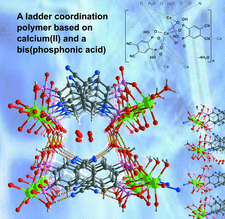
Cover illustration: In a crystal structure based on ![[infinity]](/logos/entities/infin_rmgif.gif) 1[Ca2(H2cpp)2(H2O)2] ladders [H2cpp is (4,5-dicyano-1,2-phenylene)bis(phosphonate)], the ladders close pack in the solid state with water molecules mediated by various hydrogen-bonding interactions. See Venkatramaiah, Mendes, Silva, Tomé & Almeida Paz [Acta Cryst. (2016), C72, 685-691].
1[Ca2(H2cpp)2(H2O)2] ladders [H2cpp is (4,5-dicyano-1,2-phenylene)bis(phosphonate)], the ladders close pack in the solid state with water molecules mediated by various hydrogen-bonding interactions. See Venkatramaiah, Mendes, Silva, Tomé & Almeida Paz [Acta Cryst. (2016), C72, 685-691].
research papers


Download citation


Download citation
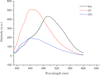
Two d10 coordination polymers of ZnII and CdII based on 2,2-dimethylsuccinate and flexible 1,4-bis(imidazol-1-ylmethyl)benzene as coligands have been synthesized under hydrothermal conditions. Both complexes display a two-dimensional layered architecture and were characterized by elemental analysis, X-ray crystallography, IR spectroscopy and thermogravimetric analysis. They also display a strong blue photoluminescence in the solid state at room temperature.
Download citation
Download citation
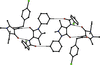
In each of three 2-aryl-N-(1,5-dimethyl-3-oxo-2-phenyl-2,3-dihydro-1H-pyrazol-4-yl)acetamides, two different molecular conformations co-exist in the crystalline state. In each, N—H⋯O hydrogen bonds give rise to cyclic  (10) dimers which are further linked by C—H⋯O hydrogen bonds to give a supramolecular assembly in zero, one or two dimensions.
(10) dimers which are further linked by C—H⋯O hydrogen bonds to give a supramolecular assembly in zero, one or two dimensions.
Download citation
Download citation
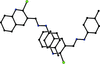
The reactions between arylhydrazinium chlorides and 2-chloroquinoline-3-carbaldehydes under different conditions can give rise to a hydrazone, a 4,9-dihydro-1H-pyrazolo[3,4-b]quinoline or a 1H-pyrazolo[3,4-b]quinoline. Various combinations of N—H⋯N and C—H⋯π(arene) hydrogen bonds lead to supramolecular assemblies in the form of rings, chains or sheets.
Download citation
Download citation
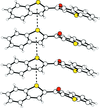
The syntheses of three bis(benzo[b]thiophen-2-yl)methane derivatives are described and their crystal structures discussed comparatively. The conformations of the title compounds are compared with respective bioisoteres and active pharmaceutical ingredients (APIs) containing the dithiophen-2-ylmethane scaffold.
Download citation
Download citation
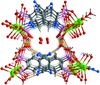
In a crystal structure based on ∞1[Ca2(H2cpp)2(H2O)2] ladders [H2cpp is (4,5-dicyano-1,2-phenylene)bis(phosphonate)], the ladders close pack in the solid state with water molecules mediated by various hydrogen-bonding interactions.
CCDC reference: 1496849
Download citation
Download citation
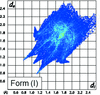
1,3-Bis(3-fluorophenyl)urea crystallizes in two conformational polymorphs. The urea molecules assemble into one-dimensional hydrogen-bonded chains, which adopt antiparallel and parallel alignments in the two forms.
Download citation
Download citation

A linear tetranuclear unit, in which the two CoII ions at the ends are six-coordinated and the two inner CoII ions are five-coordinated in a distorted triangular bipyramidal configuration, is the first example of (E)-2-[(2-hydroxybenzylidene)amino]phenol in coordination chemistry co-operating with 1,10-phenanthroline under solvothermal conditions. Magnetic studies show the presence of ferromagnetic CoII⋯CoII exchange interactions in the tetranuclear unit.
CCDC reference: 1494051
Download citation
Download citation
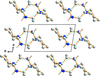
3,14-Dimethyl-2,6,13,17-tetraazapentacyclo[16.4.0.12,17.16,13.07,12]tetracosane was synthesized and characterized by elemental, spectroscopic and single-crystal X-ray diffraction analyses. The crystal structure is stabilized by intramolecular C—H⋯N hydrogen bonds. NMR and IR spectroscopic properties support the methylene-bridged macrocyclic structure.
CCDC reference: 977111
Download citation
Download citation
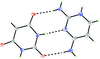
The triply hydrogen-bonded ADA/DAD synthon (D = donor and A = acceptor) was successfully formed in the crystal structure of 2,4-diaminopyrimidinium barbiturate and in two solvates of 2,4-diaminopyrimidinium 2-thiobarbiturate. An additional crystallization study of pure 2,4-diaminopyrimidine revealed  (8) N—H⋯N hydrogen-bond motifs to be the preferred interaction in the structures of one ansolvate and three solvates.
(8) N—H⋯N hydrogen-bond motifs to be the preferred interaction in the structures of one ansolvate and three solvates.